
Learn how esports betting works as a vertical — titles, markets, odds feeds, and the software operators need to add esports to an existing sportsbook.
Ever felt lost watching millions of bets on video games while you’re sitting there with no clue where to begin? Yeah, you’re not the only one. Esports hit 640.8 million viewers in 2025, with 318.1 million die-hard fans and 322.7 million people who watch casually.
Take League of Legends championships; Nearly 7 million people watched at the same time during peak moments. Betting competitive gaming? Growing at the exact same rate.
This esports betting guide walks you through how it actually works in 2026, what kinds of bets exist, and what matters before you drop money on your first wager. It doesn’t matter if you’re brand new, already betting on traditional sports, running a sportsbook platform, or planning to start one. There’s something useful here for you.
Esports Betting Explained
Placing a bet on esports works much the same way as having a flutter on any other sport. You pick your side, you back them with money, and you wait to see how things play out. The difference is that instead of a football pitch or cricket ground, the action takes place inside a game engine, with professional players and their teams competing in high-stakes tournaments that draw millions of viewers.
The range of things you can actually wager on is broader than most newcomers expect. Sure, picking out the outright winner of a match is the obvious starting point, but plenty of bettors dig deeper. How many maps will get played, who grabs the first major objective, and whether a series goes the distance. Each esports game has its own rhythm and its own set of moments worth putting money on.
Timing matters, too. Some people like to have everything settled before a match kicks off. Others prefer to watch a few minutes unfold, get a feel for which way momentum is leaning, and then commit, all while the odds tick up and down in the background, responding to every development.
There are a few things that genuinely separate this world from traditional sports wagering. The entire ecosystem lives online. Matches burn through quickly, often finishing in half an hour or so. And the games themselves are living products, meaning a developer can release an update on any given week that shifts which strategies work, and which teams suddenly find themselves at a disadvantage.
All that feeds into odds that move in ways even experienced bettors sometimes find surprising. With the audience for competitive gaming closing in on 650 million people globally by 2026, the betting side of things has quietly grown into something that is very hard to ignore.
Here’s how Esports is different from sports betting:
| Feature | Esports Betting | Sports Betting |
| Platform Style | Entirely digital and streamed online | Often broadcast via TV and online |
| Pace of Play | Very fast – many games last 20–40 mins | Slower with defined quarters/halves |
| Updates Impact Play | Game patches/meta changes regularly shift competitive balance | Rules rarely change mid-season |
| Audience | Younger, digitally native viewers
|
Broader age range |
| Data & Volatility | Odds can change quickly due to game updates | More stable odds based on physical performance |
When we talk about the popular esports’ titles in betting, these games top the most frequently wagered on worldwide:
- The ecosystem of Counterstrike 2 is one of the oldest and is facilitated by regional leagues and international majors.
- The structured league seasons and world championships have helped Valorant to grow to a premier category in the fastest time possible.
- The International attracts huge numbers of people to Dota 2, which has traditionally been one of the largest prize pools in esports.
- League of Legends completes the top tier by having franchise leagues in key regions and a world championship that attracts tens of millions of viewers annually.
How Does Esports Betting Work? (Step-by-step for beginners)
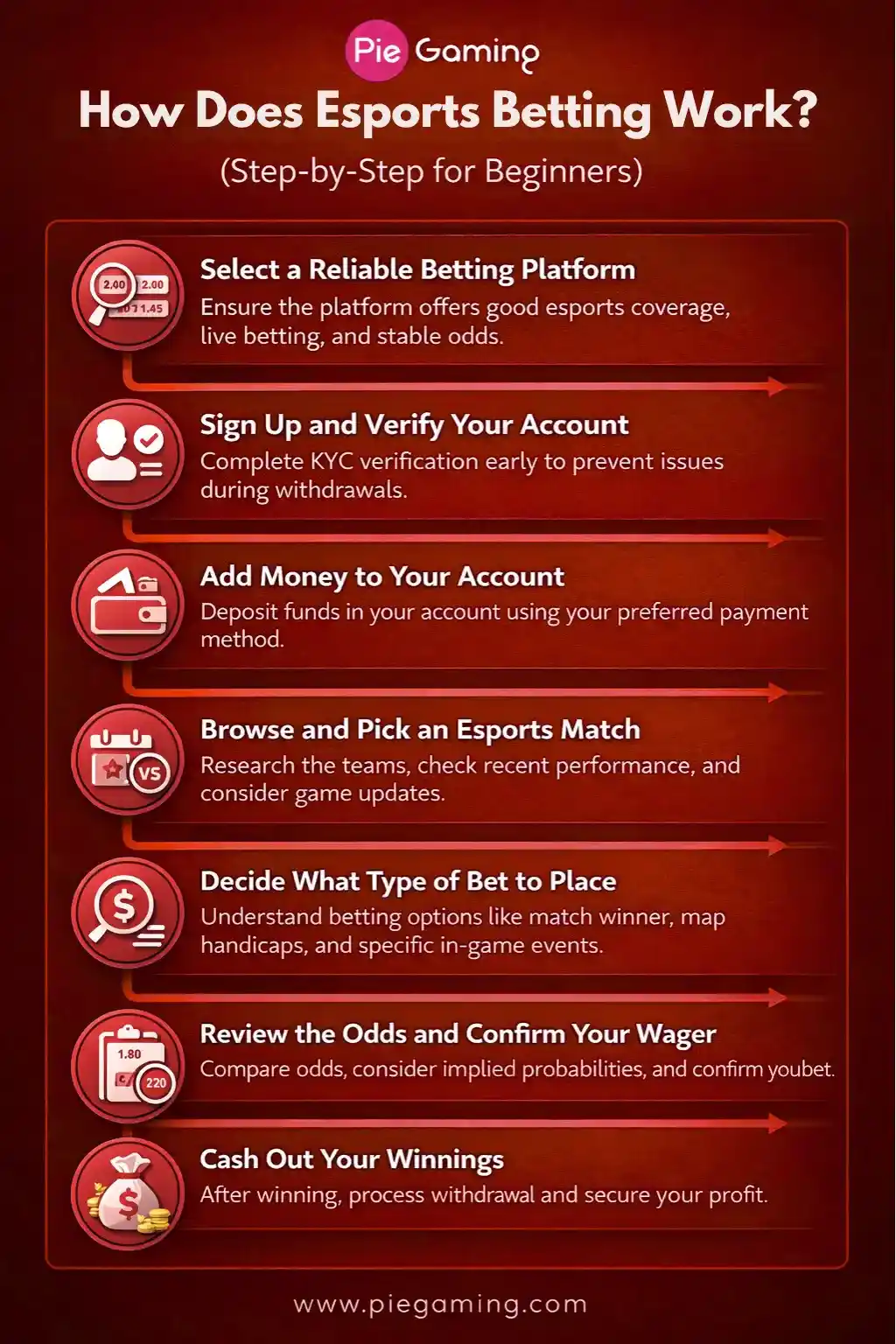
Discover how esports betting works step by step
In case you are new to esports betting, the experience is not as complicated as it appears. Here is an easy step-by-step guide that can help you start off with confidence.
Step 1: Select a Reliable Betting Platform
Not all sportsbooks treat esports the same way. Some mirrors odds from third-party feeds, while others have dedicated trading teams who understand game mechanics, map pools, and patch impacts.
When choosing a platform, look beyond licensing:
- Market depth: Do they offer map handicaps, round spreads, player props?
- Liquidity: Are odds stable, or do they swing aggressively with small bets?
- Live model sophistication: In Esports, odds update every few seconds. Poor live modeling leads to frequent suspensions.
A sportsbook with shallow esports knowledge may misprice niche markets, but major events are usually efficiently priced due to global betting volume.
Step 2: Sign up and Verify Your Account
Account setup is simple, but identity verification is where most beginners lose time. In regulated markets, KYC is mandatory before meaningful withdrawals.
Here’s why it matters:
- Large withdrawals often trigger enhanced verification.
- Delaying KYC can lock your funds during a winning streak.
- Some sportsbooks restrict betting limits until verification is complete.
Handling compliance early prevents friction later.
Step 3: Add Money to Your Account
Funding your account should follow a structured strategy, not impulse. Professional bettors typically risk 1 to 3% of their total bankroll per bet, especially in volatile esports markets.
Competitive balance can shift rapidly because of:
- Patch updates changing game balance
- Sudden roster substitutions
- Momentum shifts in best-of-three or best-of-five series
Also, evaluate deposit methods carefully. Digital wallet payments often provide faster withdrawals. Cryptocurrency may offer flexibility, but price volatility adds indirect exposure risk.
Step 4: Browse and pick an Esports match
In Esports, information asymmetry can be significant. Major tournaments in titles like Counter- Strike 2 or League of Legends attract global liquidity, meaning sharper, more efficient odds. Smaller regional events may offer softer pricing but come with high unpredictability due to:
- Limited statistical transparency.
- Frequent roasters change.
- Lower-tier teams with inconsistent performance.
Before picking a match, ask yourself:
- Has there been a recent patch?
- Does this team have a map pool advantage?
- Are they paying online or via LAN?
Context shapes value.
Step 5: Decide What Type of Bet to Place
Different titles create different betting dynamics. In Dota 2, early objectives like first blood or first tower can reflect drafting strategy but are highly volatile. In Valorant, pistol round shape map economy and early momentum.
Format matters too:
- Best-of-one: Higher variance, potential increases.
- Best-of-three: Favors deeper teams with a stronger map veto strategy.
- Single elimination brackets: Pressure amplifies mistakes.
Markets like match winners are simpler, but map handicaps and totals often carry more pricing inefficiencies, especially when teams specialize in specific maps.
Step 6: Review the Odds and Confirm Your Wager
Odds represent implied probability. Converting pricing into math is where depth begins.
- Decimal 1.80= 55.5% implied probability.
- Decimal 2.20= 45.4% implied probability.
The real question is whether you believe true probability is higher than what the sportsbook suggests. That gap is where value lies. In esports, public bias toward popular organizations can inflate favorites, and casual bettors often overbet brand-name teams, creating inflated lines. Tracking line movement before a match can also signal sharp money entering the market.
Step 7: Cash Out your Winnings
Winning means nothing until the funds are secured.
Before withdrawing:
- Confirm wagering requirements if a bonus is used.
- Ensure that identity verification is complete.
- Understand processing times by payment method.
Common beginner mistakes include trying to withdraw bonus funds too early, using a different withdrawal method than your deposit, and ignoring regional regulatory limits. Many disciplined bettors practice partial withdrawals, pulling out profit while keeping their operational bankroll intact.
Esports betting in 2026 is institutionalized, data-driven, and globally scaled. Competitive balance can flip overnight from a single game patch, which makes preparation more important than prediction. Success comes from understanding game structure, spotting pricing inefficiencies, managing volatility, and protecting your capital. Betting frequently is easy. Betting strategically is what actually works long term.
Read Blog – Virtual sports betting software: a guide
Are Esports Betting Sites Legal?
Esports betting sites are legal in many places in 2026, but it’s not the same everywhere. Most countries regulate it under existing sports wagering or online gambling laws rather than creating separate esports legislation.
That matters because how mature a market’s regulations are directly affecting player protection, how hard enforcements hit, and whether operators are actually held accountable.
Here’s a global legal status overview:
| Region | Country / Market | Regulatory Authority / Law | Legal Status | Minimum Age |
| Europe | United Kingdom | UK Gambling Commission | Fully Regulated | 18+ |
| Malta | Malta Gaming Authority | Fully Regulated | 18+ | |
| Germany | State Treaty on Gambling (GlüStV) | Regulated | 18+ | |
| Netherlands | KOA Act | Regulated | 18+ | |
| France | ANJ | Regulated | 18+ | |
| North America | United States (19+ states incl. New Jersey, Nevada, Pennsylvania, Colorado, Washington, West Virginia) | State gaming commissions | Regulated (State-Level) | 21+ |
| Canada (e.g., Ontario) | Provincial regulators | Regulated (Province-Level) | 18+/19+ | |
| Latin America | Brazil | Federal Betting Framework (2024) | Regulated | 18+ |
| Mexico | Mixed / Offshore | Grey | 18+ | |
| Asia-Pacific | Australia | Interactive Gambling Act | Regulated | 18+ |
| Philippines | PAGCOR | Regulated | 18+ | |
| Singapore | State-approved pools | Restricted | 21+ | |
| India | 2026 enforcement actions | Restricted / Banned | N/A | |
| Japan | National gambling laws | Illegal | N/A | |
| Middle East & Africa | South Africa | Limited provincial oversight | Grey / Limited | 18+ |
| United Arab Emirates | National gambling ban | Illegal | N/A |
The global landscape shows that esports betting isn’t being regulated as its own thing. Rather, it is integrated into the existing online sports betting systems. Established gambling jurisdictions such as the UK sports betting regulations and Malta now treat esports markets in the same way as football or tennis. Same licensing criteria, same AML regulations, same advertising regulations, same responsible gambling regulations.
The emerging economies, such as Brazil, are transitioning to more organized regulation, yet the capacity to regulate and the consistency of enforcement is lagging behind. This brings predictability as well as uncertainty. Operators weighing that market can read our guide to starting an online casino in Brazil.
Some countries have restrictive jurisdictions, such as Japan or the United Arab Emirates, which have a wider gambling ban on esports, despite its digital nature. The trend is obvious: legalization is growing, but consistency is not.
For operators, this means regulatory classification directly shapes your market-entry strategy.
- In completely regulated jurisdictions, you obtain legal predictability, predictable payment processing, and advertising mediums. Yet you also incur more licensing costs, intensive compliance audits, and constant reporting requirements.
- In state or province-level systems, scalability gets messy. Launching across multiple U.S. states requires separate approvals, local partnerships, and jurisdiction-specific technical certifications. Expansion is incremental, not national.
- Grey or partially restricted markets carry different risks. Enforcement may be inconsistent, but you’re exposed to payment disruption, sudden regulatory shifts, and reputational damage. Long-term asset building in these regions is structurally unstable.
- Age thresholds also influence positioning. In Europe, the standard is 18+, and in some jurisdictions in North America, it is 21+. This has an impact on customer acquisition strategy, sponsorship alignment, and your implementation of responsible gambling tools in esports ecosystems.
For 2026, the competitive advantage isn’t just entering “legal” markets. It’s entering markets where enforcement clarity, regulatory stability, and commercial viability actually align.
Tips for Beginners in Esports Betting
Esports betting moves fast. Games are patched, rosters are updated overnight, and momentum can change in-series. When you are new to it, research and discipline are more important than bold predictions. Here’s how to approach it practically.
Start With Major Tournaments
Begin with Tier-1 events rather than small regional leagues. Major tournaments have stronger data availability. You get past match stats, head-to-head records, map performance, and player metrics. Top teams are more consistent, which makes outcomes slightly more predictable. Odds are usually more efficient and transparent because of higher market liquidity.
Games such as League of Legends or Counter-Strike 2 tend to have rich analytics coverage on tournaments. That allows you to make decisions based on performance trends, rather than hunch decisions. Avoid obscure tournaments in the beginning. The competition of lower tier is more unstable and difficult to study.
Understand the Game Meta
Meta stands for “most effective tactics available.” It refers to the dominant strategies, characters, weapons, or playstyles at any given time. In esports, the meta changes through game updates and patches.
A patch can weaken a previously dominant strategy. There are teams that adjust swiftly to meta shifts, and others find it difficult. The performance of a player is largely determined by the level of comfort they have in the existing meta.
Prior to placing a bet, take into account whether a patch was released a few days ago, consider the performance of teams during the last patch, and find out how analysts have dissected strategies. Betting without knowing the meta is as much as betting in football without knowing the formation at the start.
Follow Team Form and Roster Changes
Esports teams can change dramatically with one player substitution. Unlike traditional sports, chemistry and communication are crucial, especially in team-based titles.
Track official roster announcements. Monitor team and player social media accounts. Check whether a substitute is temporary or permanent. See how long the current lineup has been playing together. A last-minute roster change before a tournament can significantly affect performance.
If a key in-game leader or star player is missing, the odds may not immediately reflect that shift.
Recent match form matters too. A team on a five-match winning streak may have strong momentum but look deeper. Were those wins against weaker opponents?
Manage Your Bankroll
Bankroll management separates casual bettors from disciplined ones. Use fixed percentage staking. Risk only 1 to 5% of your total bankroll per bet. This protects you from volatility.
For example, if your bankroll is $1,000, a 2% stake means $20 per bet, regardless of confidence level. Don’t chase losses. Increasing your stake after losing your bet is emotionally driven and statistically dangerous. Esports can be unpredictable, especially in best-of-one formats.
Consistency over time matters more than a single big win.
Avoid Emotional Betting
Esports fans often support specific teams or players. That emotional attachment clouds judgment. Don’t bet on your favorite team just because you support them. Compare odds to actual probability. Ask whether the price reflects real value.
If you can’t separate fandom from analysis, skip betting on that match. Successful esports betting is less about passion and more about probability, discipline, and data-driven decisions.
For beginners, the goal isn’t to win big quickly. It’s to build a repeatable process. Research the meta, track roster stability, manage risk carefully, and remove emotion from decision-making.
Read Blog – How betting odds work
How PieGaming Helps You Start with Esports Betting?
Starting an esports betting platform takes more than just odds feeds. You need solid infrastructure, real-time data, risk tooling, compliance systems, and tech that scales. PieGaming isn’t just a sportsbook provider. It’s a complete iGaming software platform that gives you everything you need to launch, run, and grow an esports betting operation.
Complete Platform Infrastructure
PieGaming gives you an all-in-one iGaming solution. Sportsbook, esports betting, casino games, player account management, payment processing, and back-office controls all work together in one system.
For esports specifically, you get esports markets built right into the sportsbook software, real-time odds updates and live betting, advanced trading and risk tools, and a single wallet system for player accounts.
This all-in-one approach keeps everything stable, gets you launched faster, and scales with you long term. There is no need to patch together a bunch of different systems.
Easy to Launch, Powerful to Run
If you’re new to esports betting, getting started needs to be simple. Our white-label sportsbook solution makes it easier with ready-made esports market setups, customizable front-end designs, live match dashboards and bet slips, and flexible controls for odds and margins.
But the backend is still powerful enough for experienced operators who need deeper customization and precise risk management. This balance works for both brand-new startups and established gaming companies.
Wide Market Coverage
Esports betting works when you cover the games people care about. PieGaming supports major global esports tournaments, pre-match and live betting options, multiple bet types like match winners, map winners, totals, and special markets, and regular updates that follow the global esports calendar.
This lets you serve casual bettors and hardcore esports fans without missing any action.
Built for Security and Compliance
As a complete iGaming platform, PieGaming puts compliance front and center. You get secure encrypted transactions, KYC and AML tools built in, flexibility to operate in multiple jurisdictions, and iGaming risk management wired into the same back office.
This setup cuts down on regulatory headaches and helps you launch in regulated markets with confidence.
What makes PieGaming different isn’t just the features. It has control over the entire system. You launch faster, manage everything from one place, don’t have to rely on a bunch of scattered third-party tools, scale easily into new markets, and give players a smooth experience across sportsbooks, esports, and casino games.
Instead of piecing together disconnected solutions, you get one solid platform built for long-term growth.
Read Blog – top sports betting software providers
Wrapping Up…
Esports betting has grown. It’s no longer a niche market or an experiment. It’s a legitimate industry built on fast-paced competition, real-time data, and millions of engaged viewers worldwide. The opportunities are real, but so are the risks.
Success comes from understanding the games, following the teams, managing your bankroll smartly, and staying disciplined. Whether you’re a beginner testing the waters or an operator looking to enter the space, the key is the same: do your research, stay informed, and approach it strategically. Esports betting isn’t going anywhere. It’s only getting bigger in 2026 and beyond.

FAQ's
-
Is esports betting safe?
It's safe with licensed operators that offer encryption, fair odds, and responsible gambling tools. But risks like match-fixing and addiction still exist. Stick to platforms licensed by authorities like the UKGC or MGA to reduce your exposure.
-
Can beginners make money in esports betting?
Beginners rarely profit long-term because of the house edge and lack of experience. Success demands research, bankroll management, and discipline over luck. It's not a quick money scheme. Treat it as a skill you build over time.
-
What is live esports betting?
Live betting lets you place wagers in real time during matches. You can bet on outcomes like kills, objectives, or map wins while the game is happening. Odds adjust dynamically based on what's unfolding in the match.
-
Which esports game is best for betting?
Counter-Strike 2 leads for liquidity and stats depth, followed by Dota 2, League of Legends, and Valorant. High-volume titles offer the best markets and more predictable outcomes because of better data availability.
-
Why Is Esports Betting Growing in 2026?
Global revenue has hit over $14 billion, driven by younger demographics, mobile apps, crypto payment options, regulatory progress in markets like Brazil, and mainstream titles pulling in 500 million-plus viewers. The audience is massive and still growing.


Palak Madan has been writing about the iGaming industry since 2024. She focuses on helping operators and founders understand their options when launching an online casino, from choosing the right software provider to figuring out costs and compliance requirements across different markets. At PieGaming, she covers topics like white label casino solutions, platform selection, and market entry, turning complex industry information into practical guidance for people building iGaming businesses. She also keeps a close eye on licensing and regulatory changes; particularly how new rules shape the way operators enter and grow in different jurisdictions.

Micro betting is a type of live sports betting that focuses on the small moments within a game. Instead of wagering on the final result, bettors place bets on what happens next, such as the outcome of the next pitch in baseball, point in tennis, possession in basketball, or ball in cricket. Because these events are settled almost instantly, micro betting offers a faster and more dynamic experience than traditional sports wagers.
Esports betting offers a major opportunity to operators, and choosing the right partner can greatly impact profitability, player engagement, and operational efficiency.
Learn what retail sports betting is, how on-premise sportsbooks operate, and what the retail model costs and returns compared with going online only.
Read about what horse racing betting software includes — tote and fixed-odds markets, race feeds, and payments — plus what a build or a full license costs.

Learn how automated sports betting software handles odds, bet acceptance, risk, and payouts – what operators can automate and what still needs a trader.
Learn about how sports betting algorithms price odds and manage risk, plus the leading algorithm software compared on data, models, and integration options.
Learn how AI is used in sports betting for odds pricing, fraud detection, live markets, and player segmentation — and what it changes for operators.








See you in your inbox soon!

Stay ahead of the game. Subscribe for exclusive content, updates, and insiders!