
Learn about What a white-label sportsbook is, how the model works, what it includes, and how it compares with turnkey – a plain guide for new operators.

The world of iGaming is now booming with huge potential for operators in 2026. According to reports, the market is valued at over $130 billion and has a compound annual growth rate (CAGR) of nearly 17.5%. The white-label sportsbook segment alone is anticipated to grow to $210.97 million in 2026. This rapid growth is driving the need for faster launch models and less expensive (e.g., white-label) betting solutions.
Rather than starting from scratch, platforms are more and more relying on commercial sportsbook software to fast-track enter-market play, mitigate development risks, and efficiently scale when betting remains on mobile.
What is a White Label Sportsbook Solution?
A white-label sportsbook solution offers the complete infrastructure – software, licenses, integrations – as the operator remains the sole purveyor of branding, marketing, and user acquisition.
As per Statista the global online gambling market is estimated to top $150 billion by 2030, fueled by mobile gambling and fast-growing digital penetration. This explosive rise has driven the white-label models to an even greater level of popularity because they significantly reduce time-to-market and upfront investment.
Turnkey and white-label platforms are among the fastest-growing verticals in iGaming, and a white-label sportsbook solution is what most new brands start from.
How It Works: Pre-Built Platform + Brand Customization
The white-label model works on a “plug-and-play” mentality. The provider runs a powerful, battle-tested backend that supports thousands of bets per second. The operator then uses a “skin” – a customized UI and brand identity – over this infrastructure. And it means a brand can run from concept to market in 7 to 14 days vs 12 months or longer for a custom development.
Core Components
A modern white-label solution has 4 key components:
Betting Engine: The powerhouse that processes wagers, calculates payouts, and updates balances in real-time.
Odds Management: The kind of AI-driven data feeds that give real-time odds on thousands of global events using automated data feeds – often powered by AI to keep prices competitive.
Payment Systems: Fully integrated gateways for credit cards, e-wallets, and, increasingly, cryptocurrency (which now makes up a growing share of transactions in emerging markets).
Admin Panel: Operator-driven dashboard for user-side administration, revenue tracking, and suspicious betting patterns monitoring.
White-Label vs. Turnkey vs. Custom Solutions
Choosing the right model depends on your budget, technical expertise, and desired time-to-market. If you lean toward the middle option, a turnkey sportsbook hands you the brand and the license while the provider runs the infrastructure.
| Feature | White-Label Sportsbook | Turnkey Sportsbook | Custom-Built Sportsbook |
| Time to Market | Fast (2–6 weeks) | Moderate (2–4 months) | Slow (6–12+ months) |
| Cost | Low to Medium | Medium to High | Very High |
| Customization | Limited to Moderate | Moderate to High | Fully customizable |
| Ownership | Provider-owned infrastructure | Shared/partial ownership | Fully owned |
| Technical Complexity | Minimal | Moderate | High |
| Maintenance & Support | Managed by the provider | Shared | Fully in-house |
| Best For | Startups, quick launches | Growing operators | Large enterprises |
Understanding White Label Sportsbooks
Operators will need to look under the hood to understand how these systems work within the global betting ecosystem in 2026 to thrive.
Backend Infrastructure
The backend is the brain of the operation. Top providers use cloud-native architectures in 2026 in advance for events like the World Cup or Super Bowl. Everything from the “Bet Builder” logic to real-time risk management is handled by it, which keeps the house protected from professional syndicates.
Frontend Interface
The backend is what is shared, but the frontend is where you stand out. The new generation of white-label sportsbook platform designs uses a “mobile-first” approach. Data shows AI-driven personalization on the frontends can boost user conversion rates by up to 15% by exposing users to the sports and bets they are more likely to interact with.
Payment Gateways
The platform comes pre-linked with a payment orchestration layer. This helps automate where transactions are routed through the more successful or affordable local gateway, thus minimizing the friction around failed deposits, a leading cause of player churn.
Licensing and Compliance
The white-label model is among the most powerful because of the sub-licensing benefit. The provider often holds licenses in major jurisdictions (Curaçao iGaming license, Malta, or specific US states), and the operator operates under that umbrella. This saves the operator hundreds of thousands of dollars in legal fees and months of bureaucratic red tape as the provider administers all AML (Anti-Money Laundering) and KYC (Know Your Customer) processes.
Key Benefits of White-Label Sportsbooks
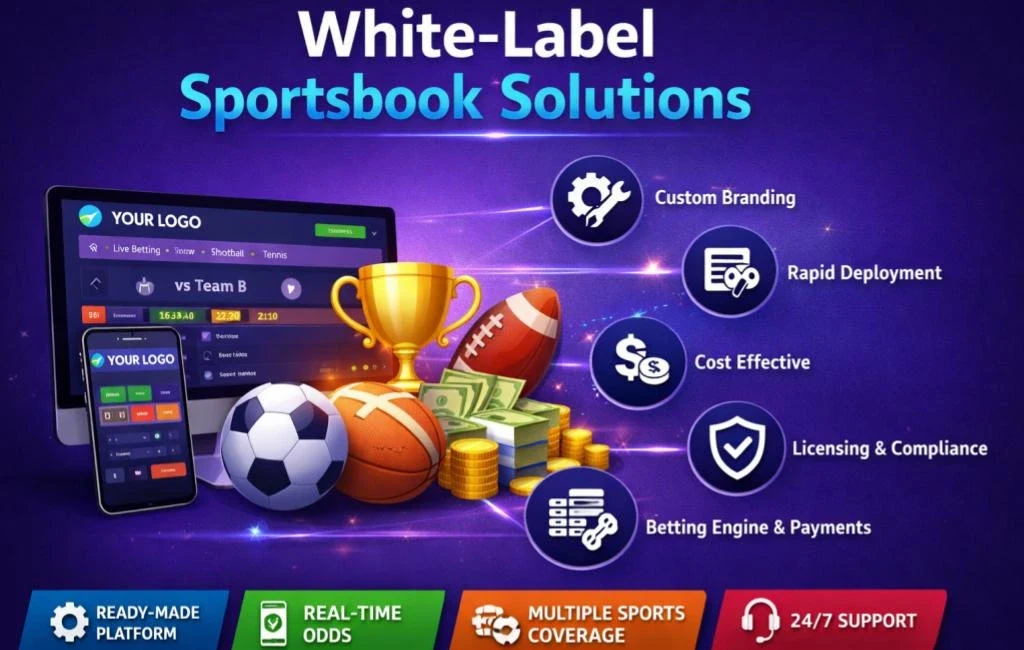
Benefits of White-Label Sportsbooks
The rising penetration of a sports betting white label model is no accident; it has obvious business motives. White-label sportsbook software offers operators entering the competitive arena of iGaming in 2026 speed, efficiency, and access to enterprise-grade technology that avoids the usual complexities of development.
Rapid Market Entry
The quick launch is one of the biggest benefits of a white label sportsbook platform. Traditional sportsbook development takes an average of 6-12 months or so for a business to develop in a short period of time and includes various phases such as UI/UX design, backend development, testing, and compliance approvals.
Comparatively, with a white-label model, operators can go live in 2–6 weeks, as the system is already built and tested. That speed is vital in a rapidly moving market where trends in live betting or esports betting software can turn so quickly. Early entry is what gives operators an advantage and increases their turnover.
Example:
A startup focusing on a small niche market, e.g., local cricket betting, can open its business before a major tournament (e.g., the IPL season) in an effort to fill this gap without the luxury of having a long time to complete a project, since development is long.
Cost Efficiency
Developing a sportsbook from the ground up is capital-intensive. The cost can significantly exceed $150,000–$500,000+, depending on features, integrations, and how much compliance is required. This includes:
- Development teams
- Infrastructure setup
- Licensing and legal fees
- Ongoing maintenance
With a subscription-based or revenue-sharing model, a sportsbetting white label solution helps minimize these expenses. Operators can afford lower upfront expenses and rather have predictable operating fees.
Deloitte states that outsourcing technology infrastructure lowers operational costs by about 30–40%, which reflects why a significant part of iGaming startups opted for white label platforms.
Example:
Instead, an affiliate marketer who steps foot into the betting space can fully open the door to an operations, operation-wide model with a white-label solution (all while minimizing heavy tech investments), boosting margins and monetization.
Advanced Technology
White label providers provide enterprise-class sportsbook technology that would be unaffordable and time-consuming to develop independently. This includes:
- Odds feeds and automated iGaming risk management in real time.
- AI-enabled analytics and player behavior tracking.
- High-performance betting engines to accommodate thousands of simultaneous users.
- In-built security measures (encryption, fraud detection).
- Mobile-centric and cross-network compatibility.
API integrations to live streaming, esports, and next-level betting features are now commonplace on many platforms – keeping operators competitive in a fast-moving world.
What’s more, according to a study from Gartner, more than 70 per cent of digital businesses now also use third-party software to drive the pace of innovation, supporting the move to a set of easily adaptable technology cultures.
Read More – white-label sportsbook trends
Types of Solutions Offered by White-Label Sportsbook Provider
But not all sports betting white-label software is created equal. Operators often switch depending on their business goals, technical expertise, and budget. With varying degrees of custom-tailored features, operators can select between several different types of white label sportsbook. Each presents a different equilibrium in terms of control, customization, and operational responsibility.
Fully-Handled White-Label Sportsbook
A fully-handled white-label sportsbook platform is the most comprehensive and beginner-friendly choice. Here, the provider handles everything – from platform infrastructure to compliance and ongoing operations.
What’s included:
- Platform setup and hosting
- Licensing and regulatory compliance
- Payment gateway integration
- Odds management and risk control
- Technical support and maintenance
This is an excellent model for startups or non-technical operators who want to get to the market as quickly as possible but without the complication of a backend.
Key advantage:
Minimal operational burden-operators can spend very little effort on production and focus entirely on branding, marketing, and user acquisition.
Customizable White-Label Sportsbook Solution
This sports betting white label solution offers more flexibility while still leveraging a ready-made platform. Operators can customize key components of the sportsbook so as to fit their brand name and audience.
The following customization options are usually offered:
- UI/UX design and themes
- Betting markets and sports coverage
- Bonus structures and promotions
- Localization (language, currency, region-specific features)
It is a perfect model for businesses that need to stand out yet don’t want to run the high cost of custom development.
Key advantage:
Balanced approach, faster launch than custom builds, with enough flexibility to differentiate in a competitive market.
API-Based White-Label Sportsbook Solution
An API-based White-Label Sportsbook Solution is designed for operators who already have a platform (casino, fantasy sports app, gaming portal) and want to get sportsbook functionality built into the platform too.
Instead of relying on a full platform, certain services that operators integrate via APIs are:
- Odds feeds
- Betting engine
- Player account management
- Payment systems
Key advantage:
Maximum flexibility and control over the frontend experience, yet benefits from the powerful backend services.
This model is the optimal option for tech-savvy operators or existing businesses who want to add sportsbook offerings without replacing their existing ecosystem.
Read More – How to choose white-label sportsbook software
Cost of White-Label Sportsbook Software in 2026
By shifting from substantial upfront development to an organized service model, operators can enter the sports betting market in 2026 at a low cost and launch modern platforms with a fraction of the traditional capital.
Setup Costs
The initial setup fee for a sports betting white label solution covers branding, platform deployment, and the integration of essential data feeds. In 2026, these costs are tiered based on the complexity and geographic scope of the project.
- Starter/MVP Tiers: $5,000-$20,000. This typically includes a standard UI, 1–2 payment rails, and core sports markets.
- Growth/Premium Tiers: $40,000 to $90,000+, offering deep customization, multi-jurisdiction compliance, and advanced AI features like personalized bet recommendations.
Revenue-Sharing Models
The industry’s standard is the revenue-share model, which aligns the interests of the provider and the operator.
- Zero Rev-Share Options: PieGaming and companies like it offer alternatives with no GGR sharing, meaning operators can keep 100% of earnings and pay a higher fixed monthly fee.
Ongoing Operational Costs
While the white-label provider handles the tech, operators need to budget for monthly overheads:
- Platform Fees: Often ranging from $3,000 to $15,000 per month, depending on traffic and support levels.
- Data Feeds: Licensing premium live-odds feeds and “Bet Builder” tools can cost additional monthly royalties.
- Marketing & Acquisition: This is usually the largest expense, often requiring $50,000+ in the first year to build a player base.
ROI Potential
The rapid time-to-market increases the Return on Investment (ROI) for a What is White-Label Sportsbook Solution. By launching in weeks rather than years, operators can achieve profitability much faster.
- Breakeven Point: Successful operators often reach breakeven within 6 to 12 months.
- Market Growth: The global white-label sportsbook market is estimated at $210.97 million in 2026, presenting a massive revenue opportunity for new entrants who focus on niche markets or superior user engagement.
Comparison of 2026 Investment Tiers
The following table breaks down the expected financial commitment for different launch scales:
| Cost Component | White-Label Sportsbook (2026) | Custom-Built Sportsbook |
| Setup Cost | $5,000 – $50,000+ | $150,000 – $500,000+ |
| Time to Launch | 2–6 weeks | 6–12+ months |
| Revenue Model | Rev share / hybrid / fixed | Fully owned |
| Monthly Operational Cost | $2,000 – $15,000+ | $20,000+ (team + infra) |
| Maintenance | Included with provider | In-house responsibility |
| ROI Timeline | 6–12 months (avg.) | 12–24+ months |
Why White Label Sportsbook Solutions are Seeing Rising 2026
It’s a paradigm shift in the iGaming industry. For a number of important reasons, the White-Label Sportsbook Solution is moving from niche solution to industry norm in 2026.
- Global Growth: The global online sports betting market is projected to achieve an impressive $182 billion by 2030, most of which would be gained in 2026 as recently designated regions in Latin America and Africa enter regulatory conditions.
- Mobile-First Behavior: More than 80% of bets are made for mobile now. Those who offer white-label providers deliver apps that are high-performing and optimized, and that separate operators have found difficulty in creating from scratch.
- Regulatory Clarity: The evolution of clear licensing requirements in more jurisdictions also means that the pre-licensed nature of white-label systems lowers “fear of entry” for a new brand.
- Hyper-Competition: Brands need to be ready to launch fast to be on the cutting edge of the competitive ecosystem. Sports betting white label technology is desired for the simple reason that long development queues can be circumvented, and users are kept purely on the acquisition side.
Benefits of White-Label Sportsbook Software
- Quick to Enter Betting Market: The opening of a sportsbook used to take years; now it takes days. This speed means brands can take advantage of the latest trend, with no window of opportunity missed.
- Cost-effective Measure: By not spending on dev specialists and server maintenance, operators can put away the capital invested in player bonuses and marketing efforts.
- Option to Customize: Next-gen solutions enable deep “skinning,” allowing for ensuring the look and feel of the site, rather than merely a generic template.
- Advanced Technology: Operators can gain AI risk management, 5G optimized live streaming, and blockchain-based transparency at once.
Features of White-Label Sportsbook Software
For a platform to be competitive in 2026, it ought to include these six pillars:
- Scalable and Flexible: The ability to handle large-scale traffic surges when events like the Super Bowl or World Cup arrive
- Robust Back Office and User Interface: A player-friendly UI, and an operator-friendly data-rich admin panel.
- Customization Options: Flexible layouts, widgets to flag specific sports or promotions
- Access to Different Betting Markets: Entry of eSports and other kinds, virtual sports, or niche markets, such as politics or awards shows.
- Secure Payment Gateways: Multi-currency, crypto with SSL-encrypted transaction layers.
- Real-Time Odds and Updates: Fast data feeds for quick score adjustments and odds re-shifts.
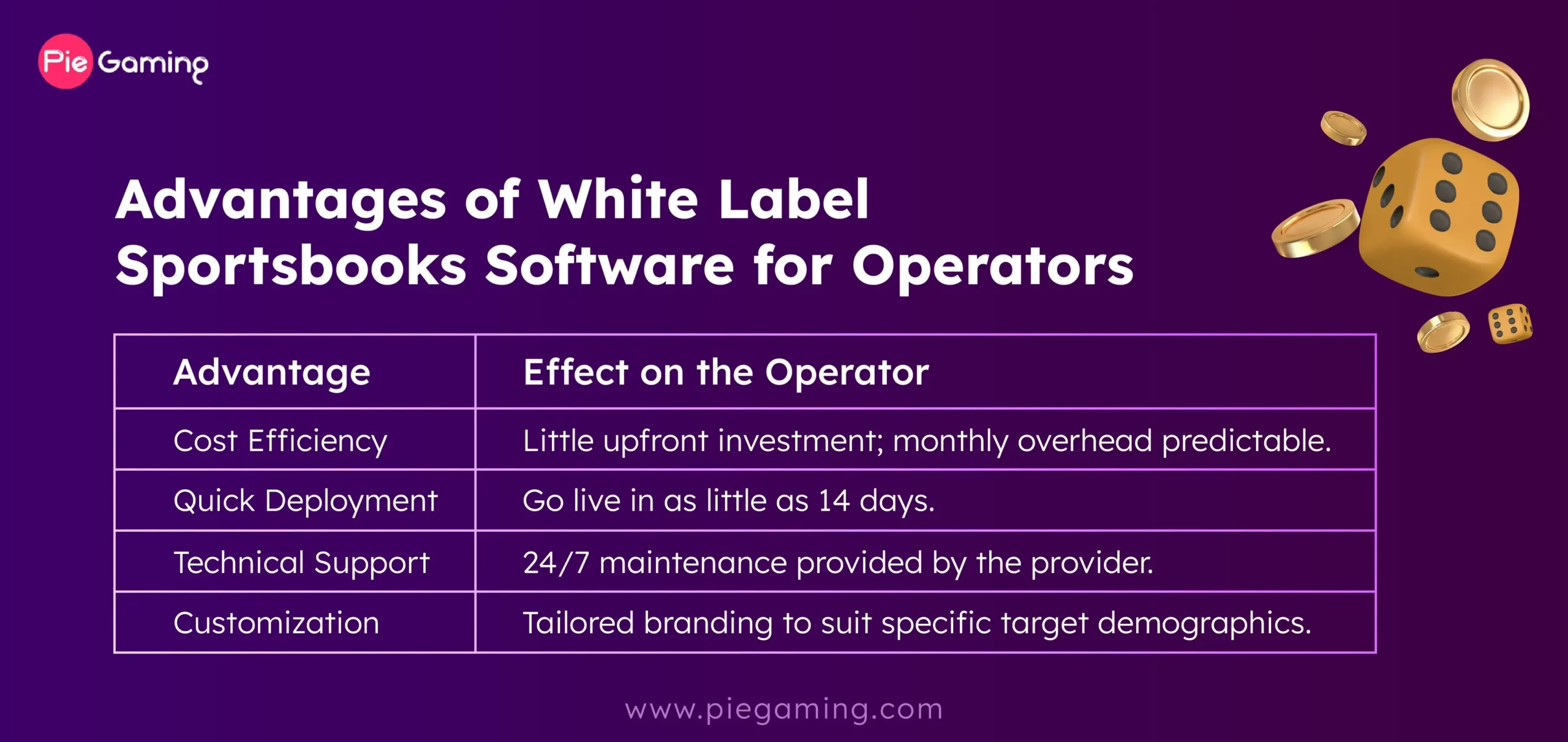
Benefits of White-Label Sportsbooks
Some Challenges to Keep in Mind
Although powerful, white label models have trade-offs:
- Limited Control: You need to rely on the provider’s roadmap for significant feature upgrades.
- Revenue Sharing: Conventional models involve ceding a portion of your monthly GGR.
- Compliance Risks: Any provider losing their license or experiencing regulatory issues hits your brand directly.
- Market Saturation: Due to relatively low barriers, your marketing strategy must be very strong to compete in an easy-to-learn market with many good sportsbooks as well.
Profitability Factors
Success in 2026 is predicated on four critical variables:
- Market Selection: Focusing on a few high-growth, low-competition geography (e.g., Africa or East Asia).
- Marketing Strategy: Using SEO, influencers, and affiliate groups to generate traffic.
- User Experience (UX): The quickest time-to-bet solution with seamless checkout.
- Operational Efficiency: Players retaining via AI-reward loyalty programs.
Strategic Recommendations
The Steps to Maximizing Investment
- Thorough Market Research: Do more than follow the crowd; discover a niche sport or region that has been left underserved.
- Choose the Right Provider: Find providers such as PieGaming that have flexibility in revenue sharing and strong localization capabilities.
- Focus on Differentiation: When you customize something for yourself, create a unique “vibe” or community experience that separates you from the corporate behemoths.
- Invest in Marketing: Since the tech is being managed, you should dedicate at least 70% of your budget to player acquisition and brand building.
Why Choose PieGaming for White-Label Sportsbook Solutions
In light of the current trend towards a more modular and operator-centered iGaming industry in 2026, PieGaming has cemented its place among top-tier players in the field as an industry partner for those looking for a sports betting white label that’s as fast and profitable as it is performance-driven. PieGaming isn’t simply a software provider. They’re a strategic first platform, offering the technical spine that’ll allow you to start your brand-building effort, but more than that.
Overview of PieGaming
PieGaming is an iGaming solution provider with a focus on “operator-first” solutions. With a strong focus on secure, very scalable environments, they offer everything you need to be a gaming pro, from casino aggregators to their flagship. They are designed for high-frequency trading and enormous simultaneous user loads, and are therefore the backbone of today’s betting markets.
Main Strengths of Platform
- White-Label Sportsbook Platform Can Scale: PieGaming’s infrastructure, backed by a cloud-native design, has evolved with your business. No matter if you have 100 or 100,000 active players, the platform keeps latency low and downtime zero.
- Rich Sportsbook Features & Global Coverage: Use a huge library of 50+ sports and more than 50,000 monthly live events. Among other things, this feature deep markets around niche sports, eSports, and virtual gaming, providing sustained engagement throughout the year.
- Crypto-Ready Payment Integrations: In order to remain ahead of 2026 digital trends, PieGaming provides seamless integration with Bitcoin, Ethereum, and other stablecoins (e.g., USDT) and fiat-based localized gateways. Operators running digital assets as the primary rail can also look at our dedicated crypto sportsbook software.
- Compliance Ready Infrastructure: The platform is designed so that it can satisfy regulations from all different countries. PieGaming takes on the “crushing AML, KYC, and technical certifications” that get in the way of legitimate use.
- Quick deployment timelines: Realizing that time to market is everything, PieGaming’s quick onboarding process translates operators quickly from contract to “Go-Live.”
Ideal For
- iGaming Startups: For entrepreneurs who require a professional “one-stop shop” without expensive custom development at over $1M.
- Operators Moving Into Sports Betting: Established online casinos or land operators that are looking to add one vertical area of a sportsbook to the current sports-betting ecosystem without experiencing any friction.
The Competitive Edge
| Feature | PieGaming Advantage |
| High-Performance Platform | AI-based risk management and 5G-driven mobile interfaces. |
| Flexibility Towards Custom Branding | Deep “skinning” capabilities, allowing your brand to shine without giving off a cookie-cutter appearance. |
| End-to-End Support | Beyond the software support, PieGaming provides technical maintenance and dedicated account management necessary for long-term success. |
With the decision of PieGaming, you get a sports betting white label for the future, flexible, technology-enhanced, and engineered to optimize your 2026 in this hyper-competitive industry.
Read More – Sportsbook bonus types: an operator guide
Recent Developments in White-Label Sportsbook Software
Sports betting white label technology 2026 is defined as a rapid digital transformation. Providers are not delivering betting lines anymore, just providing users with some betting tools; they are offering sophisticated ecosystems supported by cutting-edge technologies that keep margins protected and drive better user experience.
Managing Risk And Odds Through The Power Of Artificial Intelligence
Artificial Intelligence is no longer a luxury feature. In 2026, AI algorithms process millions of data points in milliseconds to:
- Predictive Risk Modeling: Find “sharp” bettors and potential arbitrage patterns in real-time, so the operators can adjust limits out of the box before someone gets into trouble.
- Dynamic Odds Optimization: Generates and shifts lines automatically based on real-time movement in the market and volumes, keeping the house advantage under control, from start to finish.
- Personalized Odds: Certain platforms now offer “bespoke odds” for their most faithful players, generating higher engagement and lifetime value through different types of betting markets.
Crypto and Blockchain Technologies Utilization
For instance, blockchain is not just about accepting Bitcoin; it’s about infrastructure integrity and transparency, not just the technology that supports it.
- Instant Settlements: With smart contracts, white-label platforms have allowed almost instantaneous payouts using smart contracts, A top-three demand for bettors in 2026.
- Provably Fair Betting: Blockchain allows players to verify the outcome of virtual sports and RNG-based games, creating a strong brand trust.
- Decentralized Liquidity: By 2026, many providers are using blockchain technology to pool liquidity through various operators, which makes smaller brands able to take larger wagers with relatively little risk.
Conclusion
The rise of white-label sportsbook offerings is a sign of democratization in the iGaming market. The barrier has never been lower in 2026, and the technology offered is nothing short of innovative. By opting for a sports betting white label approach, operators can avoid the technical and regulatory “valley of death” that is currently afflicting the majority of the startups, and steer directly toward the areas of power that are more vital of all: brand building and player acquisition.
Whether you are a fledgling startup seeking a fast start-up or an entrenched operator looking for a tech upgrade, offerings like PieGaming offer the scale, security, and innovation needed to succeed. Now, as we move forward into the rest of 2026 and beyond, the winners will certainly be brands that utilize high-performing software to provide a personalized, secure, and hassle-free betting experience.
FAQs
-
Why are white label sportsbooks growing in 2026?
They cost less, launch quickly, and can grow easily, letting businesses join the sports betting market faster.
-
Which markets are best suited for white-label sportsbooks in 2026?
Growing regions like Africa, Latin America, and parts of Asia are where legal sports betting is becoming more popular.
-
What are the risks of choosing a white label sportsbook?
You have less control over technical parts, might depend on the provider for updates, and may look similar to competitors.
-
Can I integrate custom features into a white label sportsbook?
Yes, you can add your own branding and special features to meet your business needs.

Jaya Swaroop has been covering iGaming and betting technology since 2019, with a specialization in online casino platforms, sportsbook solutions, and licensing frameworks. Her work involves analyzing platform capabilities and evaluating cost structures, compliance requirements, payment integrations, market strategies, and regulatory updates that impact operators entering or scaling in the iGaming space. With a background in B2B marketing and content strategy, she has contributed to SEO-led growth and demand generation initiatives for global businesses. Jaya holds a Bachelor’s degree in Science (Chemistry & Mathematics) and is certified in content writing, email marketing (HubSpot), project management, and Google Analytics.

Micro betting is a type of live sports betting that focuses on the small moments within a game. Instead of wagering on the final result, bettors place bets on what happens next, such as the outcome of the next pitch in baseball, point in tennis, possession in basketball, or ball in cricket. Because these events are settled almost instantly, micro betting offers a faster and more dynamic experience than traditional sports wagers.

Esports betting offers a major opportunity to operators, and choosing the right partner can greatly impact profitability, player engagement, and operational efficiency.
Learn what retail sports betting is, how on-premise sportsbooks operate, and what the retail model costs and returns compared with going online only.

Read about what horse racing betting software includes — tote and fixed-odds markets, race feeds, and payments — plus what a build or a full license costs.

Learn how automated sports betting software handles odds, bet acceptance, risk, and payouts – what operators can automate and what still needs a trader.

Learn about how sports betting algorithms price odds and manage risk, plus the leading algorithm software compared on data, models, and integration options.
Learn how esports betting works as a vertical — titles, markets, odds feeds, and the software operators need to add esports to an existing sportsbook.

See you in your inbox soon!

Stay ahead of the game. Subscribe for exclusive content, updates, and insiders!