
A Kahnawake iGaming license is a credible and cost-effective licensing solution for online casinos and sportsbook operators. The process to obtain this license includes multiple steps, key benefits, and licensing costs.
Starting an online casino or sportsbook isn’t just about choosing the right platform. In today’s highly regulated iGaming industry, getting the right gaming license is among the most important decisions an operator can make.
While jurisdictions like the UK Gaming Commission or Malta dominate the industry, many operators are going with the Kahnawake iGaming license. Why? Because it’s a faster, cost-effective, and highly respected option available. Regulated by the Kahnawake Gaming Commission (KGC), this license has been supporting iGaming businesses since 1996.
Whether you’re starting an online casino or expanding into new markets, understanding the Kahnawake licensing process is crucial. This guide will walk you through the Kahnawake Gaming License process, including types of licenses, compliance, benefits, costs, and challenges.
What Is the Kahnawake Gaming License?
The Kahnawake iGaming License is the official permit or document issued by the Kahnawake Gaming Commission (KGC), known to be the oldest gaming regulator in North America. This license lets online casino and sportsbook operators run platforms (online casino, sportsbook, poker, and bingo) from within Kahnawake’s jurisdiction.
Though the license offers worldwide operational flexibility, operators must comply with the gambling laws and regulations of each targeted market wherever they wish to offer services.
| Key Facts
Today, more than 250 online casinos, operated by 50+ companies, run under the Kahnawake gaming license, serving players globally. |
Further, the Client Provider Authorization (CPA) is the widely known and common Kahnawake permit, that covers casinos, sportsbooks, lotteries, poker, and even cryptocurrency gambling.
Why Is the Kahnawake Gaming License Popular Among iGaming Operators?
Unlike top-tier jurisdictions available in the industry, Kahnawake offers operators something unique, making it the best choice in the market.
This includes the following:
Strong Industry Reputation
The Kahnawake gambling license is known as the oldest in the industry, building confidence among partners and players. Since the license is directly issued by the authority itself, it significantly increases trust from partners and payment providers.
Faster Licensing Process
Unlike European jurisdictions, Kahnawake issues licenses within a few weeks. Once a license is submitted, it will take around 4-8 weeks. After approval, you get a 6-month provisional permit. During this time, the operation is audited.
Cost-Effective Licensing
The Kahnawake online casino license is popular among operators for its low fees and tax advantage. Yes, there is no corporate income tax or gaming tax for licenses. Many operators report that starting an online gambling business with a Kahnawake license typically costs around USD 40,000-70,000.
Flexible Business Environment
The best thing about the Kahnawake gambling license is that it doesn’t require a ‘physical office’ within the region. Only a registered company and a key person are required. That means operators can establish themselves in any jurisdiction, making it an ideal choice for startups.
Support for Multiple Gaming Verticals
Whether it’s a casino, sportsbook, poker, live dealer, or lottery products, the Kahnawake iGaming license covers all types of gambling activities. That means one license can support all iGaming activities under the roof.
| Specialized Permits Issued by KGC
KGC also issues specific licenses; for instance, a Casino Software Provider Authorization (CSPA) for B2B game developers and a Live Dealer Studio Authorization (LDSA) for live gaming studios. |
Robust Regulatory Framework
The jurisdiction also maintains a legal framework while emphasizing player protection, fair play, and anti-crime measures. For instance, KGS has AML regulations and requires independent testing of game RNG for fairness.
Types of Licenses Offered by the Kahnawake Gaming Commission
There are multiple types of licenses issued by the Kahnawake Gaming Commission, which include the following:
Interactive Gaming License (IGL) – B2B
This is the key hosting permit within the region. IGL lets a company operate a colocation center (data center) in Kahnawake, which hosts gaming platforms. IGL is led by Mohawk Internet Technologies (MIT); therefore, operators in Kahnawake use MIT infrastructure.
Best for: B2B hosting/data center providers
Casino Software Provider Authorization (CSPA) – B2B
This is a B2B software supplier license. It lets a company develop and supply casino software to Kahnawake-licensed operators.
Best for: slot or game providers and platform developers.
Client Provider Authorization (CPA) – B2C
CPA is the main gambling license, allowing operators to run online casinos, sportsbooks, poker rooms, and live dealer games. It’s a B2C license, which includes all types of games and bets. The operator who holds a CPA license becomes an Authorized Provider.
Best for: Online casino/sportsbook operators
Inter-Jurisdictional Authorization – Other
This license is for operators who already have an IGL license in another jurisdiction, like Curacao or the UK, but want to have staff in Kahnawake. An IJA license allows a company to use Kahnawake’s infrastructure while remaining licensed elsewhere.
Best for: foreign-licensed gaming companies looking for Kahnawake data center use.
Key Person License – Other
This is a personal license and not a full business license. Every business applying for a CPA license should appoint at least one “Key Person.”
Best for: company directors or managers who will take care of operations.
Essential iGaming License Guides for Online Casino & Sportsbook Operators
Who Can Apply for a Kahnawake Gaming License?
There is a strict eligibility criterion that an applicant must follow, which includes the following:
Eligibility Criteria
-
Registered business entity
An operator should have a legal company established in a recognized jurisdiction. Kahnawake doesn’t require a local office within the jurisdiction.
-
Financial stability
The applicant must showcase solid financial records. This means multiple years of audited financial statements or bank documents covering operations and players’ payouts.
-
Clean criminal background
All owners, stakeholders, directors, shareholders, and key persons must undergo background checks. Therefore, full disclosure of personal history is mandatory.
-
Transparent ownership structure
The company should give complete information on its structure and ultimate beneficial owner. You must explain the source of funds, shareholdings, and the roles of each director.
-
Technical capability
All gaming servers must be physically present in Kahnawake. The operator must outline its IT security measures, hosting arrangements, and approved third-party software.
-
Responsible gaming policies
Operators must fulfill all compliance policies, including AML/CFT measures (transaction monitoring, customer ID checks, etc.) and responsible gaming policies.
In other words, eligible companies must be well-capitalized, well-organized gaming companies with transparent histories, ownership, and robust software.
Step-by-Step Process to Get a Kahnawake Gaming License
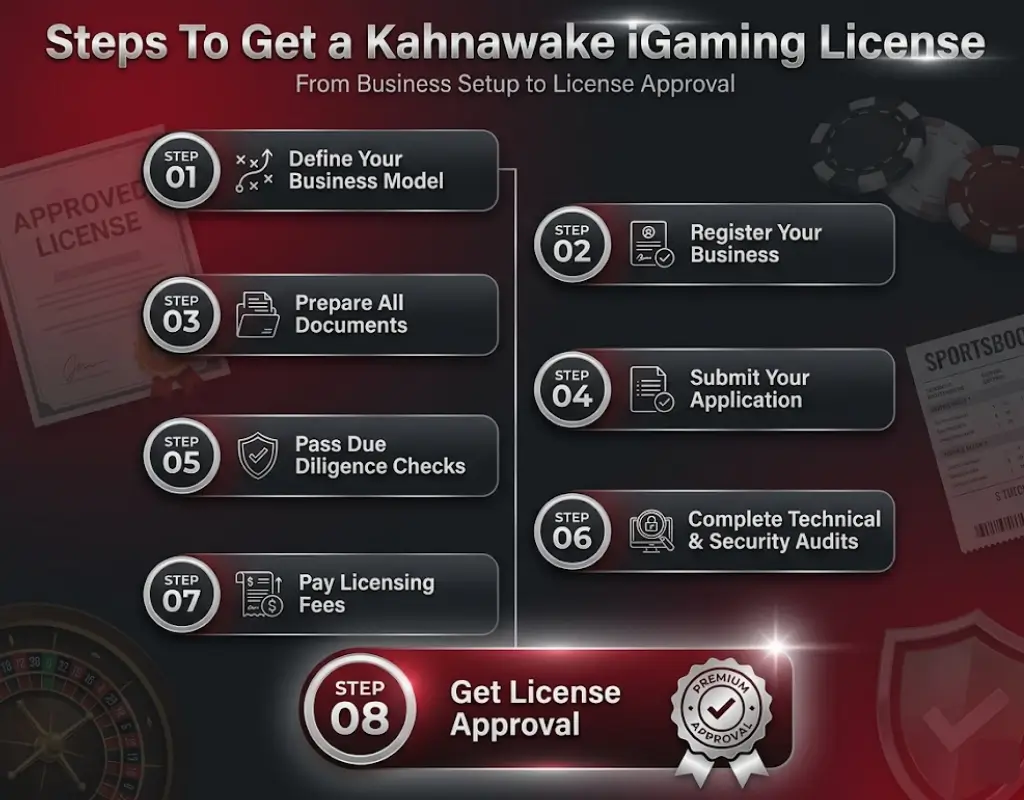
Steps to obtain a Kahnawake iGaming license
Obtaining a Kahnawake gambling license involves multiple steps. Completing each step gets you closer to obtaining a license.
Step 1—Define Your iGaming Business Model
Have you decided what kind of business operations you want to run? If not, this is what the first step is about. Decide whether you wish to start an online casino, a sportsbook, a poker room, a live dealer platform, or a crypto gambling site.
Based on your business model, it will be decided which type of license and document you need.
For instance, if you want to offer both casino and sportsbook activities, one CPA license will be required. Or if you wish to build games for others, a CSPA license will work for you.
Whatever your business model is, you need to submit a detailed business plan. The KGC expects a detailed plan listing your games, software vendors, player demographics, marketing strategy, and risk management approach.
Step 2 — Register Your Business Entity
You must form a legal company or corporate entity (LLC, corporation, etc.) in a jurisdiction recognized by the KGC. Many operators choose to establish in Canada or in renowned offshore centers like Curacao or Malta.
Since the Kahnawake iGaming license doesn’t require the company to be based in Kahnawake, there is no need for a local office or directors.
Note: Always go with the jurisdiction that makes your banking and compliance easy.
Further, the key senior managers you appoint must have a clean background and relevant industry experience.
Step 3—Prepare Documentation
Prepare all the important and legal documents required to proceed with the Kahnawake online casino license. This step is important, as any missing document can lead to a delay in the approval process.
List of legal documents required:
- Corporate registration certificates
- Local business license
- Tax IDs
- Photos
- Shareholder registers
- Business plan
- Financial statements
- Source of funds (bank statements)
- Shareholder details (criminal record check)
- AML/KYC policies
- Technical infrastructure details
- Game fairness certifications
- RNG/fairness certificates
- System architecture diagrams
According to Tradepass International Tax LLC, “the clearer your business plan, the better the KGC can evaluate your intentions.”
Step 4 — Submit Application to KGC
Send your application to the Kahnawake Gaming Commission. Use the official Kahnawake application form and include all supporting documents along with the application fee.
The initial fee will depend on the type of license you prefer.
Once the receipt is with KGC, you will be assigned a Compliance Officer or agent, who will become your agent during the review. The application review process will begin with a form submission review, follow-up questions, and then a commission meeting.
Step 5 — Background & Due Diligence Checks
While your application is under review, the KGC will conduct a thorough background check. The regulators will verify and vet all key persons, stakeholders, shareholders, and company principals.
They will check criminal records, credit checks, and conduct interviews. While verifying these, if anything seems suspicious to them, they will mark it as a red flag.
As per the Global Law Expert, “founders, directors, and shareholders should have a clean legal record and verifiable legal source.”
Subsequently, the KGC will also check your financial documents to ensure everything is fair for the license.
Step 6 — Technical & Security Review
After background verification, the KGC will assess your technical setup. This also includes an Approved Agent, who will check your gaming control systems.
Further, the agent will audit the RNG system, IT security, and anti-fraud measures. Apart from this, they will verify all the critical systems physically located in Kahnawake’s designated data center (MIT).
Operators need to ensure that they are compliant with Kahnawake’s interactive gaming regulations. Your platform must include the following features:
- Encryption
- Secure authentication
- Stable uptime
If any issue is found, make sure to resolve it on time so that the review process can be conducted seamlessly.
Step 7 — Pay Licensing Fees
Operators must pay license fees before the finalization of the application. During submission, you would have already paid an initial application fee. Post-provisional approval ensures that all remaining fees are paid. This includes:
- Application fee
- Annual licensing fee
- Compliance-related costs
Step 8 — Approval & License Issuance
Once all the above steps are completed successfully and the KGC is satisfied with your documents, you will get a 6-month provisional license. With this license, you can start iGaming operations legally.
During this phase, you will have to place the KGC logo on your site or platform and implement essential self-exclusion tools.
Once the probationary period is completed, KGC will review your operations. If you followed all the laws and regulations, complied with all the rules and fee structures, and passed the control audit, KGC will issue the full Kahnawake gaming license, valid for 5 years.
In summary, this entire application process takes around 4-6 months if you prepare everything well.
Read Blog – Explore Top iGaming software provider in 2026
How Much Does a Kahnawake Gaming License Cost?
The table below highlights the Kahnawake gaming license cost (estimated cost), based on the types of licenses you choose.
| License Type | Cost (USD) |
| CPA License —initial application | $40,000 (first-year fee and one key person) |
| CPA License —annual renewal | $20,000/- |
| Key person permit (per person) | $5,000 (initial), $1,000/- yearly |
| IGL License – application | $30,000 (first year) |
| CSPA License application | $40,000 (first year) |
| LDSA (live dealer) – application | $30,000 (first year) |
| Data Center Hosting (MIT) | $3,770/month |
| Initial Technical Audit | $5,000-$10,000 (differs) |
| Legal/Consultant Fees | $5,000-$20,000+ (one time) |
Disclaimer: The above-mentioned cost estimates are taken from industry sources. These cost may vary as per the jurisdiction’s update on the license fees. Also, please note that if a license is not approved, application fees will be refunded.
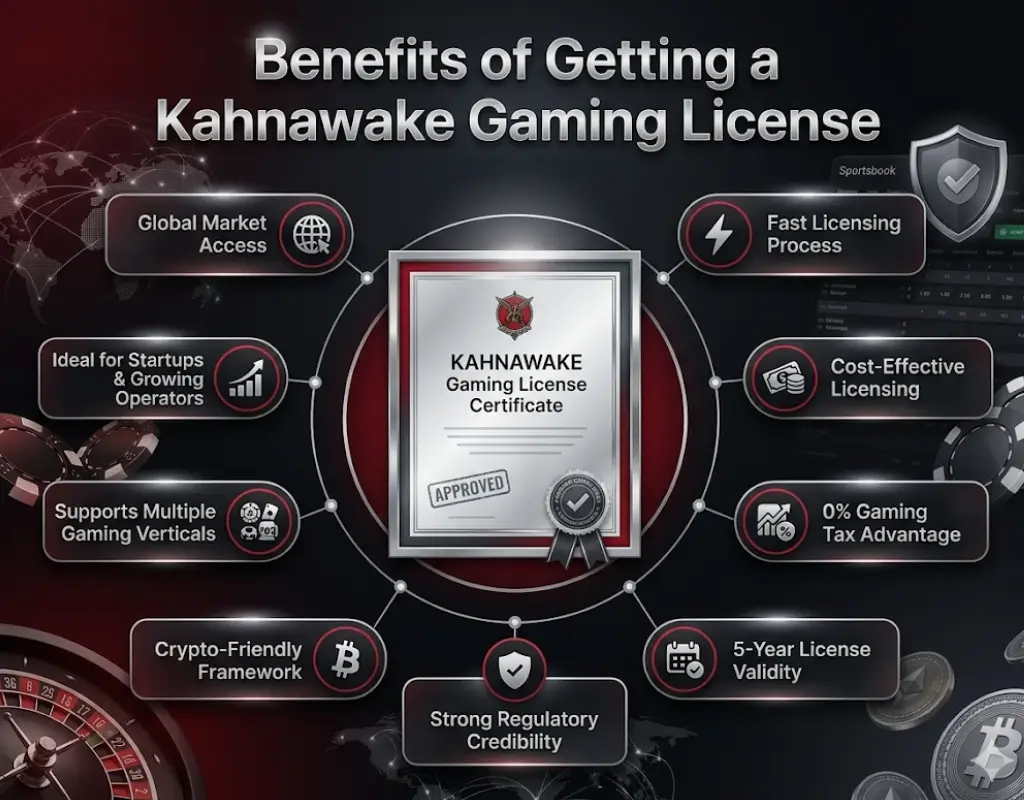
Benefits of Kahnawake online casino license
How Does PieGaming Help Operators Launch Licensed iGaming Platforms?
As a certified iGaming software provider, PieGaming offers white label and turnkey casino and sportsbook platforms with built-in compliance features that keep operations safe and seamless. We help operators launch a scalable and compliant online casino platform in Kahnawake without any operational difficulty.
Our offerings include:
-
White-label casino & sportsbook solutions
Our platform comes with pre-integrated game providers, payment solutions, live dealer studios, and 50+ sports with live odds.
-
Compliance-ready infrastructure
To ensure your operations run legally, we combine all compliance modules in our platform. This includes KYC/AML policies, responsible gaming tools, transaction monitoring, etc.
-
Payment integration support
PieGaming offers support for a variety of payment solutions and crypto wallets. We make sure to simplify the banking and payout process under a Kahnawake license.
-
PAM & CRM systems
Our platform also includes a PAM solution, back office, CRM/CMS, bonus management, affiliate management, and customer support with KGC standards.
-
Scalable platform architecture
We offer technical consultation to operators on regulatory readiness, ensuring that the setup meets Kahnawake’s technical and security requirements.
Conclusion
Kahnawake iGaming license is a credible, flexible, and cost-effective choice for startups and growing operators. With no legal complexities or gaming taxes, operators can seamlessly run their business without facing major challenges.
However, obtaining this license requires careful preparation, from documentation to system audits. Therefore, white label casino software providers like PieGaming can make the journey easy by offering pre-certified and compliant online casino software.
But don’t forget to have a proper team and plan, which will make the license approval process smooth.

FAQs
-
Is the Kahnawake iGaming license legal?
Yes, the Kahnawake Gaming Commission gets its authority from the Kahnawake Gaming Law (1996), a law enacted by the Mohawk Council of Kahnawake. This law is recognized under Canada’s Constitution (Section 35 (1)).
-
What is the cost of a Kahnawake gaming license?
The cost of a Kahnawake gaming license depends upon various factors. However, the CPA license application is USD 40,000, and the annual renewal is about USD 20,000. In total, launching an operation might cost you around USD 40-70K+ in initial fees and setup costs.
-
How long does it take to get a Kahnawake gaming license?
Typically, it takes around 8-16 weeks. This includes the initial KGC review (1-2 months), a 6-month provisional operating period, and the final audit.
-
What types of businesses can apply for a Kahnawake license?
All types of gambling businesses are eligible. Common applicants include online casinos, sportsbooks, lotteries, poker sites, live dealer studios, and skill gaming platforms.
-
Can I run a crypto casino with a Kahnawake license?
Yes. Crypto gambling is allowed under the Kahnawake license. The Client Provider Authorization (CPA) allows "casino, sports betting, poker, and even cryptocurrency gambling” under one license.

Monika Gola is an iGaming content specialist at PieGaming. Since 2020, she has been researching and developing content around software selection, online casino & sports betting regulations, and operator growth strategies. Her research includes analyzing market opportunities in regions like Europe, Africa, and Southeast Asia, as well as evaluating regulatory frameworks and entry barriers. She is actively monitoring industry trends, compliance updates, and evolving player demands across global iGaming markets to help operators navigate this industry seamlessly.

A GCGRA Gaming License is required to operate commercial gaming in the UAE, including online casinos and sportsbooks. Foreign operators can apply, but must meet GCGRA’s suitability, financial, compliance, and operational requirements before they can launch.
Online casino gaming is not allowed in Australia under Interactive Gambling Act 2001. But operators can still apply for an internet gaming license via specific jurisdictions like the Northern Territory, which allows them to offer gambling services legally- generally outside Australia.
Bulgaria’s iGaming license enables operators to legally provide services in the areas of online casino, betting, poker, and bingo in accordance with the regulations of the EU. Typically, a licensing process can take 60 to 90 days, and it will need to be approved by the NRA, technical certification, AML compliance, and data storage in the local area. Minimum capital requirements range from BGN 50,000 for betting operators to BGN 1.5 million for online casino operators.
To obtain the Anjouan Gaming License, applicants must collect and submit all the important documents. Learn the process of obtaining Anjouan iGaming license.
Algeria has no online casino or sports betting regulation to speak of — instead, the country enforces a near-total gambling ban rooted in civil law and Islamic principles. Yet despite the prohibition, offshore platforms continue to pull in millions of users every month, driven by high demand and a near-total absence of legal local alternatives.
Malta pays attention to the credibility of the regulatory framework and to access regulated markets, which is more conducive to long-term growth and industry reputation. However, Curaçao places a strong emphasis on speed and affordability, making it a good choice for startups and businesses focused on cryptocurrencies that are keen to establish a presence rapidly and at a lower cost. If you are constructing a major operation, select Malta. Pick Curaçao when you are just getting started and have to get your product to market quickly.
The best jurisdiction depends on your target market. Malta suits operators who want a credible European base with strong banking. The UKGC is required for Great Britain. The Isle of Man suits B2B and platform-led operators. Curaçao is the usual low-cost route for global launches. Anjouan is typically quoted as the cheapest and fastest, but with limited banking and lower recognition.

See you in your inbox soon!

Stay ahead of the game. Subscribe for exclusive content, updates, and insiders!