
To open an online casino in Mexico, operators must understand the SEGOB/DGJS regulatory framework, localize payments, and KYC, and plan launch budget accordingly.
Mexico is one of the largest iGaming markets in Latin America. With its over 130 million population, high smartphone penetration, and developing regulatory environment, the Mexican market offers great opportunities for casino operators. However, to enter and succeed in the market, one must understand the local regulations, customer preferences, and much more. Operators must also stay on the right side of the Federal Gaming and Raffles Law, enforced by Secretaría de Gobernación (SEGOB, the Interior Ministry).
This guide will help you learn how to launch an online casino in Mexico and explain how an online casino platform provider such as PieGaming can assist you in the process.
Mexico Online Casino Market Overview
Anyone planning to start an online casino should first understand the online gambling market in Mexico. Player preferences, the broader digital infrastructure supporting the industry, and how the market operates.
Mexican online casino market is rapidly growing and giving operators an opportunity to establish a casino business. The Mexican online gambling market size is projected to go from USD 0.79 billion in 2025 and USD 0.97 billion in 2026 to USD 1.09 billion by 2031, registering a CAGR of 8.60% between 2026 and 2031, as per a Mordor Intelligence report.
The surge is because of the rising demand for digital entertainment, which has created a strong presence of casino platorms in the country. And like many markets at this stage, Mexico is predominantly mobile. Smartphones are how most people get online, and they account for more than 60% of online gambling activity. That’s why operators who want to compete here put serious effort into mobile-optimized platforms, instant-play games, and dedicated apps.
Casino Vs. Sports Betting
Sports betting represents an important part of Mexico’s online gambling ecosystem. Mexican players prefer sports betting more, but love for games and growing digital habits has made Mexico an ideal place for online casino operators.
Sports betting is especially popular for football and other big sporting events, but operators looking to make a career in the casino segment should analyze their market opportunities independently; the sportsbook should not be used as a proxy for the casino segment.
Casino products can include:
- Online slots
- Live casino
- Roulette and blackjack
- Other table games
- Bingo and lottery-style products
For an operator, the opportunity is therefore not just about tapping into a big gambling market but about determining what type of player segment they want to appeal to and developing the right mix of games, payments, promotions, content and UX around this.
Step-by-Steps to Start an Online Casino in Mexico
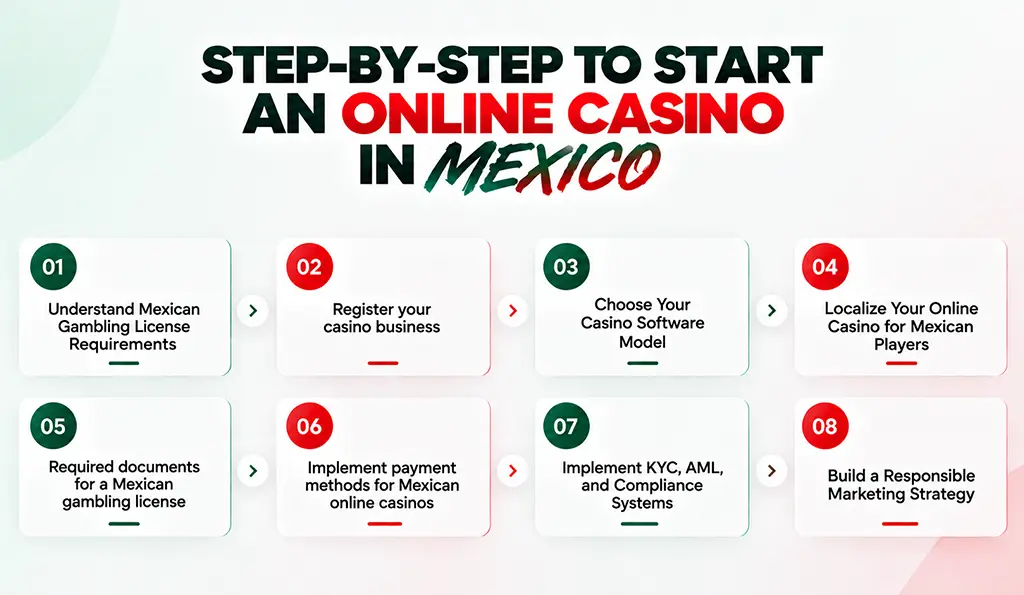
Steps to start an online casino in mexico
Step 1- Understand Mexican Gambling License Requirements
The first is to thoroughly understand the regulatory and licensing requirements of the Mexican gambling industry.
Mexico’s gambling framework is governed by the Federal Gaming and Raffles Law and its implementing regulations. SEGOB is the federal secretariat, while Dirección General de Juegos y Sorteos (DGJS) is the competent authority for issuing gambling-related permits and supervision. The DGJS publishes requirements for permits covering activities such as remote betting centers and number-draw rooms.
For an online casino project, operators should therefore:
- Determine which Mexican authorization structure applies to the planned operation.
- Review the status and scope of any existing permit involved in the business.
- Understand whether online activities can legally be offered under that structure.
- Assess the operator’s corporate, technical, tax, AML, and responsible-gaming obligations.
- Obtain advice from qualified Mexican gambling counsel before committing capital.
Do not treat a foreign gambling license as a substitute for understanding Mexican requirements.
Step 2 – Register your casino business
Once the regulatory route is established, set up the business structure that will operate or participate in the casino venture.
Depending on the chosen structure, this can involve:
- Establishing the appropriate corporate entity
- Defining ownership and management
- Completing tax registration
- Preparing corporate and financial documentation
- Setting up banking and payment arrangements
- Defining relationships with licensed partners and technology providers
The legal structure should be decided alongside the licensing strategy rather than after the technology has already been purchased.
Step 3 – Choose Your Casino Software Model
The platform itself is the key component of the whole operation, and thus this decision has its weight. Three major routes are mostly considered by the operators.
A turnkey casino platform gives you a complete system. Player account management, game integrations, payment gateways, and compliance tools. The whole stack. You can customize features, integrations, and user experience to match your business goals. It is the best option if you want flexibility without building complex infrastructure from scratch.
A white label casino solution is built for speed and simplicity. The provider manages the core software and technical infrastructure. You launch quickly with a ready-made platform. The setup time is significantly reduced, which means you can enter the market faster and invest more effort into branding and marketing the product and acquiring users rather than building the platform.
Larger organizations may choose to develop a platform in order to obtain greater control and customization capabilities over the system, but this requires a significantly higher initial investment and takes more time to develop.
For the Mexican market, turnkey and white label platforms tend to be the most practical choice. They already come up with MXN payment support, local banking integrations, and mobile-optimized experiences built in, which matters in a market where the majority of players are gambling on their phones.
Choosing the right software architecture is critical for operators starting an online casino in Mexico. It directly impacts scalability, customization, and operational control. Pick the wrong setup, and you’re stuck with limitations that slow everything down.
Step 4 – Localise Your Online Casino for Mexican Players
A translated website is not enough. Localisation should span the entire player’s journey.
Spanish-language interface
Use Spanish in every part of the process, from registration and navigation to promotions, payment instructions, customer support, and responsible-gaming information.
MXN currency
Having the option to use Mexican pesos will make the deposit, withdrawal, and balance process easier for locally targeted players.
Mexican payment methods
Assess the available options based on availability, transaction success rates, player preferences, and the provider’s ability to support gambling transactions.
Local customer support
Spanish-language support can reduce friction around registration, payments, withdrawals, and account verification.
Localised promotions
Operators should adapt their promotions for the Mexican audience, as well as ensuring that they meet applicable advertising and responsible-gaming requirements.
Relevant casino games
Build the lobby around the target audience rather than just listing every title. Use player and performance data to identify which categories deserve the most space and visibility.
Step 5 – Required documents for a Mexican gambling license
Documentation will depend on the applicable permit, corporate structure, and regulatory route. Operators should prepare information covering areas such as:
- Corporate incorporation documents
- Ownership and shareholder information
- Directors and key management
- Financial information
- Business and operational plans
- Proposed gambling operation details
- Technology and system information
- Responsible gaming policies
- KYC/AML procedures
- Payment and financial agreements
- Technical certifications or documentation, as required
The important thing is to prepare documentation before the application, or approval process begins. Missing out on corporate, financial or technical information can cause avoidable delays.
Step 6 – Implement payment methods for Mexican online casinos
The right payment methods can directly impact conversion and retention. Operators should assess options by the target audience, transaction requirements, and regulatory structure. The options include the following:
- Bank transfers through systems such as SPEI
- Cash or voucher-based options such as OXXO, where available and appropriate
- Debit and credit cards
- Digital wallets
And other locally supported solutions. Do not assume that a payment method is suitable simply because it is popular in Mexico. The provider must also support the operator’s gambling business, flows, compliance, and settlement structure. The payment architecture should include deposits and withdrawals, with transaction monitoring and fraud controls built in.
Step 7 – Implement KYC, AML and Compliance Systems
Compliance infrastructure is non-negotiable. KYC procedures are used to verify player identities. These checks rely on official documents such as national IDs or passports. This helps prevent underage gambling and fraud.
AML monitoring tools track transaction patterns and flag suspicious activity. Fraud detection systems analyze device fingerprints, IP addresses, and betting behavior. These systems help identify issues such as multi-accounting or bonus abuse
Mexican regulators expect RNG testing and certification from recognized labs like GLI or BMM Testlabs to confirm that games operate fairly. Responsible gambling tools including deposit limits, cooling-off periods, and self-exclusion options are also expected as part of the standard platform setup.
Step 8 – Build a Responsible Marketing Strategy
Once the regulatory and operational foundations are set, operators can design their acquisition strategy. Key channels include:
- SEO and Spanish content
- Affiliate partnerships
- CRM and retention campaigns
- Social media
- Paid acquisition where permitted
- Localised promotional campaigns
Operators should focus on qualified acquisition rather than registrations at any cost. Marketing should clearly communicate applicable terms and restrictions for players. Avoid targeting minors or promoting irresponsible gambling. Responsible gaming controls should also be tied to CRM and promotional activity.
What Games Work Best in Mexico?
Attracting Mexican players means your gaming portfolio should be diversified. Here’s what you need to add to your gaming portfolio.
1. Slots and Mexican-Themed Content
Slots can be the foundation of the online casino lobby as they provide a vast variety of themes, mechanisms, and volatility. Operators can test:
- The most popular international slots
- Local themes
- Mexican content
- Jackpot products
- Mobile-optimized
- New-releases content
2. Lottery and bingo
The lottery and bingo sub-vertical can complement the traditional casino lobby and attract players to simpler and different game categories. Bingo and lottery products can be a great addition for operators focusing on bingo and simple gambling games.
3. Poker and card games with a twist
Poker and card games can be utilized to diversify the casino lobby and draw more traffic. They can offer a variation of traditional product formats such as local promotions, tournaments, and progressive jackpots.
4. Live dealer experiences
Live roulette, blackjack, and other live dealer games can enhance the player experience within the live casino vertical. From an operator’s perspective, the key challenges include the quality of production and streaming, mobile optimization, game variety, table limits, localization, and tournament structures.
Key Taxes for Online Casino Operators in Mexico
Tax planning requires special attention in light of the change to Mexico’s gambling tax regime for 2026.
All operators are required to pay 30% corporate income tax (ISR) on their net annual income, a standard across most Mexican businesses.
Among other things, the 2025 reform of Mexico’s IEPS law raised the rate applicable to games with bets and draws from 30% to 50%. The reform also explicitly applies to certain games with bets and draws conducted over the internet by foreign residents without a Mexican establishment. The changes take effect from 1 January 2026.
Timeline and Costs to Start an Online Casino in Mexico
Having a realistic understanding of the timeline helps in planning budgets, establishing partnerships, plus avoiding unnecessary delays in meeting operational milestones. The following is an estimated timeline for launching an online casino in Mexico.
Phase 1: Licensing and Legal Setup (6 to 12 months)
This is where most of the time goes by. Since standalone online licenses are not available, operators should seek partnerships with land-based license proprietors who have the approval of SEGOB.
This usually requires negotiations on revenue-sharing terms as well as preparation of corporate documents. Operators must also submit compliance policies covering AML and responsible gaming. The timeline depends on the complexity of the partnership as well as the readiness of the documentation.
Phase 2: Platform Development (2 to 4 months)
Once the regulatory structure is in place, the platform can be built and configured. This covers game integrations, MXN payment systems, localized Spanish interfaces, and mobile optimization.
Given that the majority of Mexican players access gambling platforms through their phones, getting the mobile experience right is not optional. Turnkey and white label systems help compress this phase significantly compared to custom builds.
Phase 3: Testing and Certification (4 to 8 weeks)
Before launch, the platform must pass independent testing. This includes RNG certification, payment functionality, KYC verification, and anti-fraud systems.
Audits by organizations such as GLI and BMM Testlabs are usually performed. It is important to note that these are mandatory compliance stages and should be incorporated into the timeline.
Phase 4: Marketing Launch (1 to 2 months)
The operator can begin preparing their marketing apparatus while the final tests are being conducted. This would include SEO content in the Spanish language, establishment of affiliate programs, influencer relations, and promotions in relation to sporting events. Running this in parallel with testing keeps the overall timeline tighter.
In most cases, expect the full process from legal setup to launch to take between 9 and 15 months. Running licensing and platform development in parallel wherever possible is the most effective way to bring that number down.
Cost Required to Start an Online Casino In Mexico
Here’s a breakdown of the average startup costs you can expect when launching an online casino in Mexico.
Disclaimer: The figures provided in this guide are based on publicly available data from industry reports and may change over time.
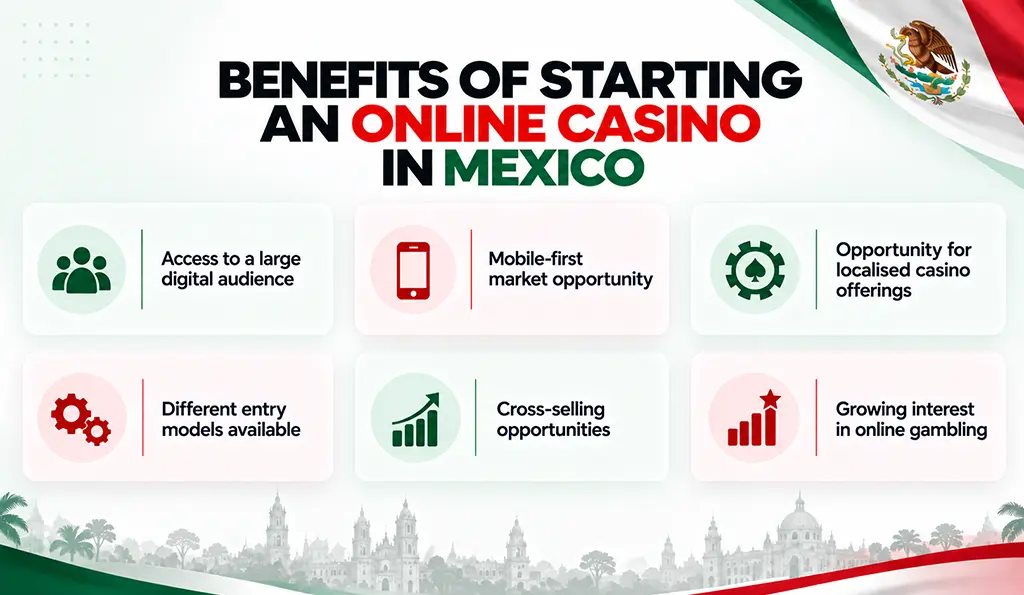
Benefits of starting online casino in mexico
What are the Challenges of the Mexican Online Casino Market?
Mexico’s online casino market comes with real opportunity, but it also comes with real challenges. Operators who go in with a clear-eyed view of the obstacles are far better positioned to build something that lasts.
Regulatory Complexity That Requires Local Navigation
Mexico’s gambling laws were originally designed for land-based casinos. Online-specific regulations have not been fully developed. As a result, most operators must enter the market through partnerships with existing permit holders.
This creates additional complexity. Operators should consider potential risks associated with legal negotiations, revenue distribution agreements, and regulatory dependencies that are not applicable to less regulated jurisdictions offering direct licensing.
Payment Infrastructure Still Catching Up
Digital payments are growing in Mexico, but cash remains a significant part of how many players move money. Operators who only support international card payments will run into conversion problems quickly.
Integrating SPEI bank transfers and retail cash deposit options, such as OXXO, is essential for reaching a broader player base. Operators should also factor in the possible increased costs and compliance requirements associated with international payment processors, who may label gambling as a high-risk category.
Competing Against Established Offshore Operators
A significant portion of Mexico’s online gambling activity is currently handled by offshore platforms. These operators have spent years building brand recognition. They rely heavily on aggressive affiliate marketing and generous promotional offers.
New entrants are not coming into an empty market. To compete effectively, operators must earn player trust. This can be achieved through Spanish-language platforms, strong mobile performance, transparent withdrawal policies, and familiar payment methods. Brand credibility takes time to build here, and shortcuts tend to backfire.
Comparing Mexico to Other Jurisdictions
Mexico is usually a better fit for operators who want to make a stronger presence in the LATAM market. However, other jurisdictions like Curacao and Malta are used as broader international licensing bases.
| Factors | Mexico | Curacao | Malta |
|---|---|---|---|
| Licensing time | 6–9 months | 2–4 weeks | 6–12 months |
| Market access | LATAM-focused | International launch jurisdiction | EU-focused |
| Costs | Medium–High | Low | High |
| Regulatory reputation | Good regional credibility | Lower than Tier-1 jurisdictions | High |
| Typical setup requirements | Corporate regulator, permit route, technology, payment, and compliance | Local business entity, regulatory application requirements | Eligible entity, application, technical documentation, compliance, and regulatory assessment |
| Tax considerations | 2026 IEPS changes are significant; other taxes may apply | Tax depends entirely on the structure | MGA lists 5% gaming tax for relevant remote gaming services, plus applicable fees |
| Best suited for | Operators specifically targeting a Mexico audience | Operators building an international presence where a Curacao license is applicable | Operators seeking a Malta-regulated international framework |
Final Checklist to Launch Your Online Casino in Mexico
- Conduct due diligence on applicable Mexican regulatory and permit structure
- Consult with qualified Mexican legal and tax advisors
- Establish the required corporate structure
- Choose between white label or turnkey casino software
- Secure the required game portfolio
- Configure Spanish language content
- Support MXN wherever applicable
- Review Mexican payment methods
- Implement KYC and AML controls
- Add fraud detection and transaction monitoring
- Configure responsible-gaming tools
- Prepare customer support in Spanish
- Review promotional and advertising content
- Test deposits and withdrawals
- Complete technical and compliance checks
- Develop a Mexico-specific acquisition strategy
- Monitor regulatory and tax changes post-launch
How Can PieGaming Help?
Launching an online casino in Mexico requires several elements at once. These include localized payments, Spanish-language support, mobile-first design, and compliance-ready infrastructure. PieGaming brings all of these together in a single platform.
Speed to Market
PieGaming’s ready-to-launch platform allows operators to go live in as little as two weeks. Casino games, payment systems, and back-office tools are already integrated.
Game Portfolio Built for the Market
With access to 5000+ casino games, PieGaming boasts all these games from leading providers such as Evolution, Pragmatic Play, and PG Soft. The game library includes Online slots, blackjack, roulette, baccarat, poker, live dealer games, and sportsbook integrations.
Localized Payment Support
The platform supports both fiat and cryptocurrency transactions. It integrates with credit cards, bank transfers, e-wallets, and crypto wallets. Operators can also add localized payment methods popular with Mexican players.
Back-Office and Player Management
The platform includes a full Player Account Management system. Key features include:
- Real-time financial reporting
- KYC and AML monitoring
- Bonus and loyalty program management
- Affiliate tracking and commission control
- Player activity and betting history analytics
Marketing, Affiliate, and Loyalty Systems
The operators can utilize PieGaming’s platform to attract new partners, track their performance, and control commissions. Furthermore, they can offer appealing welcome bonuses, deposit bonuses, cashback, and VIP reward systems, thus implementing an efficient player acquisition and retention strategy.
Experience That Backs It Up
With over 10 years in the iGaming industry and more than 150 clients worldwide, PieGaming brings strong experience to the table. The company has served clients across Europe, Africa, and Latin America. Its platform includes 40+ third-party integrations, 24/7 technical support, and ISO-aligned security standards.
Conclusion
Understanding how to open an online casino in Mexico means looking beyond the platform itself. Rather, it is essential to review the context of local regulation and taxation conditions.
Indeed, the 2026 IEPS changes imply a particular importance of tax optimization, whereas the current permit system requires operators to define their strategy in terms of regulatory oversight before considering their launch timelines.
Meanwhile, as far as technology is concerned, the main priority is to select an underlying platform that best fits the operator’s strategic positioning. As defined by the abovementioned factors, the provision of payments, player management, and game catalogue should be localized as per the market.
Contact Us
FAQs
-
What's the very first step to start an online casino in Mexico?
Before choosing software or signing payment and game provider agreements, determine how the proposed operation can legally offer online gambling in Mexico and what SEGOB requirements apply.
-
White label vs. turnkey: which is better to start an online casino in Mexico on a limited budget?
A white label is the ideal option to start an online casino in Mexico. It reduces technical complexity and launch with a ready-made technology stack. A turnkey solution is more suitable when the operator wants more customization and control.
-
What's the minimum budget needed to start an online casino in Mexico as a small operator?
There is no official minimum startup budget that applies to every online casino model. Costs depend on the regulatory structure, games, payments, technology, compliance, staffing, and marketing.
-
How do I choose between software providers when I start an online casino in Mexico?
You have to look beyond the number of games. Try to evaluate: Mexican payment support KYC and AML integrations PAM capabilities Back office Mobile-first platform Game providers list Security Scalability Integration and flexibility Technical and operational support
-
What are the biggest risks for early-stage operators trying to start an online casino in Mexico?
The biggest risks include regulatory uncertainty, payment limitations, high player acquisition costs, incorrect tax assumptions, weak compliance processes, and choosing technology that doesn’t scale with business growth.
-
Where can I get a ready-made platform with Mexican payment integrations already built in?
Operators can check out a white label casino solution supporting the required payments. PieGaming offers white label and turnkey solutions, but operators must confirm the exact Mexican payment integrations.


Monika Gola is an iGaming content specialist at PieGaming. Since 2020, she has been researching and developing content around software selection, online casino & sports betting regulations, and operator growth strategies. Her research includes analyzing market opportunities in regions like Europe, Africa, and Southeast Asia, as well as evaluating regulatory frameworks and entry barriers. She is actively monitoring industry trends, compliance updates, and evolving player demands across global iGaming markets to help operators navigate this industry seamlessly.
Starting a turnkey online casino means getting a ready-made platform with pre-designed software and pre-integrated games but rebranding as per your choice. Important steps are doing research on the market deciding on a budget picking the partners getting a gaming license setting up ways to pay and more.
Online casino problems can affect operators at every stage, from market entry and payment to player retention, technology, and profitability. Learn the key challenges and practical ways to address them.
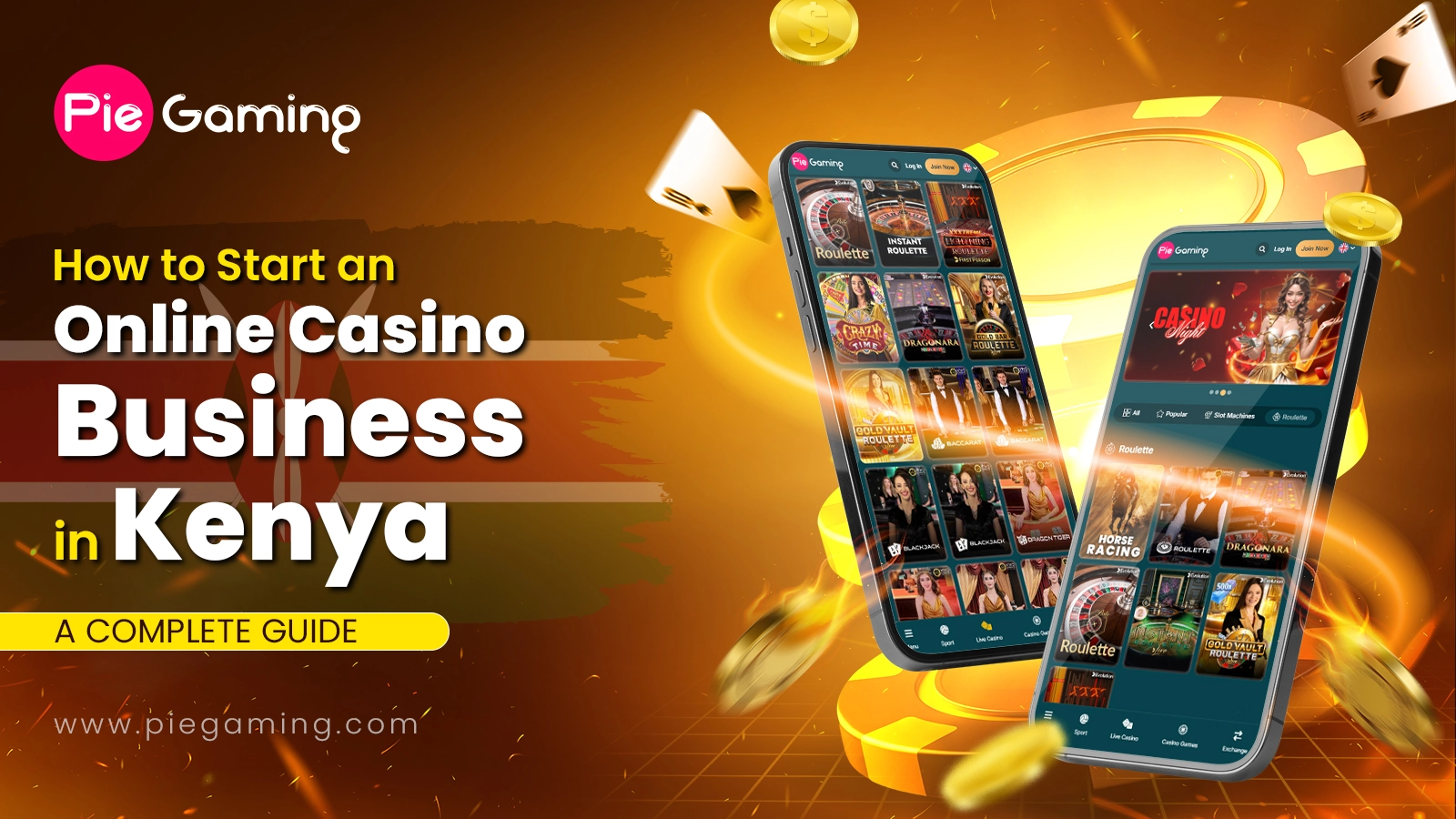
Kenya has a growing online gambling market supported by increasing internet adoption and mobile payment systems. This guide clarifies the steps and protocols you can follow for setting up an online casino business in Kenya, including regulations and licensing requirements.

The key components of scaling online casino users can be summarized in four areas. The right acquisition channels, delivering personalized engagement, developing loyalty programs, and making data-driven decisions. Creating a mobile experience, maintaining player engagement and translating markets that you want to attract are all just as crucial to sustainable growth.

This blog breaks down the key strategies of top iGaming operators in 2026 and how you can grow like them as a market leader. Stay tuned until the end.

Starting an online casino sounds exciting. But many new operators fail within a few months due to evitable mistakes. Here are the top 10 mistakes you must steer clear of.

Learn how to start an online casino in Turkey in 2026. Get easy tips on laws, licenses, payments, and more to run your business smoothly.

See you in your inbox soon!

Stay ahead of the game. Subscribe for exclusive content, updates, and insiders!