
The world’s most regulated online gambling industry exists in the UK. This guide outlines all important regulations in place for online casinos and sports betting within the UK — from licensing requirements to regulatory compliance to responsible gambling principles.
Every day, another operator gets caught in the UK’s regulatory net.
The Gambling Commission’s crackdown has changed the market, leaving even established companies surprised.
The rules have changed dramatically.
Player verification, spending caps, and addiction monitoring are no longer optional– they are mandatory.
Smart operators are turning these challenges into opportunities, using compliance as a marketing tool to attract safety-conscious players.
In Britain’s iGaming industry, which is projected to grow by $11.7 million in 2025, understanding these changes makes all the difference between market leadership and bankruptcy.
(Source: First)
Why 2025 Is A Pivotal Year For iGaming Regulations In The UK?
2025 is bringing major updates to the UK sports betting laws & other forms of betting regulations. Here’s what’s happening and why it matters:
1) New Game Design Rules
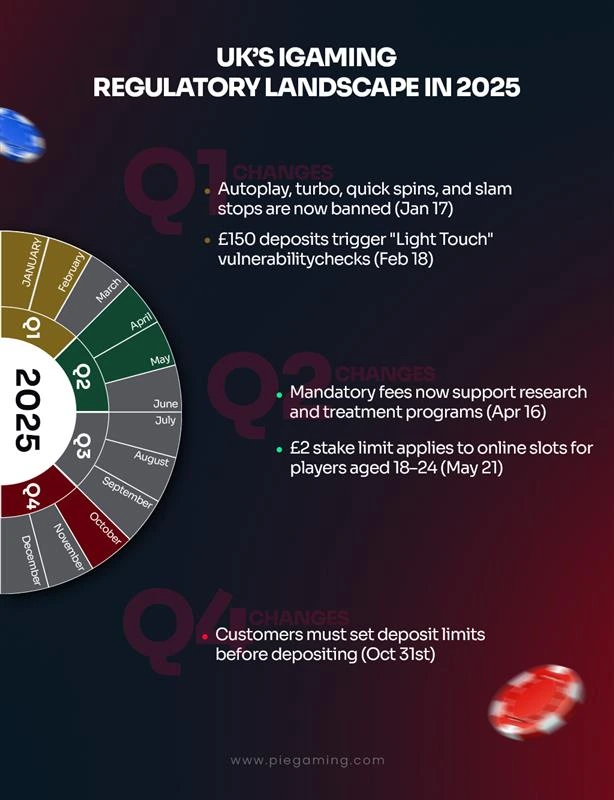
Since January 17, 2025, online games must follow stricter rules.
Features like autoplay, turbo, quick spins, and slam stop are now banned to make games safer and clearer for players.
These changes aim to slow down gameplay and give players more time to think about their betting decisions.
Operators must update all their games to remove these features or face penalties from the Gambling Commission.
(Source: Gambling Commission RTS updates)
2) Money Checks
From February 28, 2025, operators must run money checks when players deposit £150 (net) over 30 days, down from the old £500 limit.
These “Light Touch” vulnerability checks ensure people only bet what they can afford.
These checks use public data to look at a player’s money situation without needing personal details.
Operators would need systems that can track deposits across a rolling 30-day period and trigger checks automatically.
3) Mandatory Fees
By April 6, 2025, a required fee system will replace voluntary payments to fund research, prevention, and treatment programs.
This legal levy ensures all operators contribute fairly based on their size and revenue.
The money will go to approved organizations working on harm reduction.
Operators should consider this additional expense as a part of their 2025 financial planning.
4) Marketing Rules
Starting May 1, 2025, players must actively choose what types of marketing they want to receive and how they want to receive it.
Operators must create opt-in options for different marketing channels (email, SMS, phone calls, etc.
Players can opt out of marketing easily at any time.
All marketing materials must clearly show safer betting messages and tools.
5) Betting Limits
New laws will set maximum stake limits for online slot games.
- £5 per game cycle for adults aged 25 and over
- £2 per game cycle for young adults aged 18 to 24
These limits aim to reduce betting harm while maintaining industry survival.
The government will review these limits within 5 years.
If age verification systems aren’t reliable enough, regulators may apply the £2 limit to everyone.
Operators must update their platforms to enforce these limits automatically.
Here’s how this affects businesses:
- The new framework will make it easier to understand what’s required, reducing uncertainty for operators.
- Compliance costs will increase as new systems and technologies need to be implemented.
- Despite stricter rules, the UK sports betting market is still expected to grow as technology improves and player habits change.
- Innovation in game design will need to focus on entertainment value rather than rapid play or high stakes.
- Operators who leverage the new rules have chances to grow and will likely perform better.
Understanding Licensing Requirements for Running iGaming Businesses in the UK
Running an iGaming business in the UK requires proper licensing. Here’s everything you need to know in simpler terms:
UK Betting Rules Explained
Betting is completely legal in the UK but is carefully regulated.
The casino & sports Betting regulations in the UK are set by the Betting Act 2005, creating the framework for all betting activities.
The Gambling Commission watches over everything to make sure games are fair, honest, and transparent.
The Three Types of Licenses You’ll Need:
1) Operating Licenses
What they are: The main permit that allows your business to offer betting services.
Available Types:
- iGaming Licenses
- Land-based betting licenses (for physical locations)
- Ancillary Licenses
What you need to prove:
- That you are honest and trustworthy
- That your business has enough money to operate.
- That you have experience in betting or related fields.
Application Process:
- Takes about 16 weeks from start to finish.
- Involves deep background checks by the commission.
- Requires detailed paperwork about your business plan.
Costs:
- You pay an application fee upfront.
- You also pay yearly fees to maintain your license.
2) Personal License
What they are: Licenses for individuals working in betting roles.
Two main types:
Personal Functional Licenses (PFLs) for staff like couriers and cashiers.
Personal Management Licenses (PMLs) for people in management positions.
What you need to provide:
- Identity documents (passport, driver’s license)
- History of where you’ve lived.
- Background information about yourself.
Time and Cost:
- Takes about 2 weeks to process.
- Fees vary depending on the type of license.
3) Premises License
What they are:
Licenses for physical betting locations (not needed for online-only).
Who issues time:
Your local town council, not the Gambling Commission.
Following The Rules
1) Money Laundering Prevention
- You must verify who your customers are.
- You need systems to spot suspicious activities.
- You must report suspicious transactions to the National Crime Agency (NCA)
- All these requirements come from the Proceeds of Crime Act 2002.
2) License Conditions And Code Of Practice
- These are specific rules you must follow to keep your license.
- Include requirements for preventing money laundering.
- Include rules about protecting vulnerable bettors.
- Cover how you advertise your services.
3) Technical Standards
Remote betting Software Technical Standards (RTS) set requirements for:
- Ensuring games are fair and random.
- Protecting player funds and personal information.
- Including responsible betting features.
- Ensuring your games work correctly and reliably.
Explore Casino & Sports Betting Regulations in Different Countries
Recent Updates And Enforcement In UK (12th Feb, 2025)
UK’s iGaming Regulations in 2025
(Source: Hansard Gambling Levy Commission 2025)
Deeper Insights on the Statutory Betting Levy
- The levy represents what officials are calling a “watershed moment” in betting regulation.
- It is expected to rise by approximately £90-100 million annually.
- Different rates are applied to different sectors based on their relation to betting harm:
- Online operators will pay comparatively higher rates.
- The Tote and on-course bookmakers will pay lower rates than land-based operators.
- Licensed operators risk losing their licenses if they fail to pay.
Commissioning Structure and Governance
The levy funds will be managed through a sophisticated commissioning structure:
- The Office for Health Improvement and Disparities (OHID) will be the lead commissioning body for prevention in England.
- A dedicated levy board will monitor how much money is spent and if it works.
- An advisory group will give guidance based on evidence.
- 30% of levy funds will go to prevention programs.
The Scale Of Betting Harm: Exclusive Data
Recent parliamentary discussions have highlighted the extent of betting-related harm:
- Betting harm affects 2.5% of the UK adult population (approximately 1.5 million adults)
- Online slot machines are the most dangerous type of betting because:
- They’ve grown by 61% in the last five years.
- People are more likely to play them for too long at once compared to other betting activities.
- 70% of betting sessions that only use slots last more than three hours.
- The monetary cost of betting harm is £1.4 billion each year (some say it could be up to £5 billion.
- People with betting problems are nine times more likely to need hospital care.
Northern Ireland: Interesting Considerations
The parliamentary debate revealed interesting details about Northern Ireland’s position:
- While Northern Ireland can make its own betting rules, iGaming companies serving Northern Ireland customers must have a Great Britain betting license.
- This makes things tricky because iGaming isn’t fully under Ireland’s control.
- The UK government is ready to help Northern Ireland leaders make new rules.
- Northern Ireland seems to have more betting platforms than other parts of the UK.
The Future of iGaming Regulations in the UK
The UK iGaming world is changing fast.
As regulators tighten up their grip, smart companies are finding ways to turn these challenges into advantages.
In this £14 billion industry, how companies handle these changes will make or break their success.
What’s Coming Next In Regulations?
UK gambling companies must now implement improved data analytics to identify at-risk players before they spend too much.
Soon, keeping an eye on player behavior all the time, not just when they hit betting limits, will become normal.
The UK’s tough approach is spreading to other countries, too, so betting companies need systems that can quickly adjust to different rules.
Those who build flexible compliance systems will find it easier to grow into new markets later.
As iGaming reaches across the border, having one system that works everywhere gives companies a real advantage.
How Is The Market Changing?
1) Companies coming together
Small businesses are teaming up or selling to bigger companies because following the rules costs too much.
Many small operators simply can’t afford to hire teams of people to handle all the regulations.
Some are finding smart partners to share these costs with, while others are joining forces in larger groups where they can split the expenses.
This is changing the UK market– We’re seeing fewer companies overall, but those that remain are bigger and stronger.
Additionally, some new specialized compliance service providers are appearing that make it easier for small businesses to follow betting rules.
2) Games are changing
Game makers are now focusing on new kinds of fun now that quick-play features are banned.
Instead of games that focus on fast betting, they are building experiences that keep players interested in different ways.
We are seeing games with stories, skill challenges, and social elements that make playing more about enjoyment than just placing bets.
These games keep people playing without pushing them to bet more.
3) Using Blockchain
This technology creates a secure record system that works across all betting platforms.
It helps track if players can afford to play and respect their self-bans everywhere.
Players can set up one self-exclusion profile that works on all platforms, closing gaps in protection.
The system can check a player’s financial situation across different sources without sharing personal details.
These unchangeable records create perfect tracking for the regulators, which means fewer investigations and checkups.
What Does the Future Hold?
The UK betting world will probably end up with fewer companies, but those that remain will be stronger and offer safe betting experiences.
Rules will get tougher but also clearer, helping businesses know what they need to do.
Companies that see these changes as chances to grow, not just problems to solve, will be the winners.
Those who invest in compliance technology will now gain lasting benefits in the market, where keeping players safe and making money will increasingly work together.
Read More – How to Start An Online Casino In 2025?
Wrapping Up…
The UK’s rules in 2025 show a good mix of fun and safety.
The industry has taken up a “player-first” mindset, with casinos and sports betting in the UK competing on safety features as much as bonuses.
The UK market has found a sweet spot where responsible bettors enjoy their hobbies, vulnerable people receive protection, and businesses grow.
This practical middle ground could become the template for other countries to follow worldwide.

FAQs
-
Is betting legal in the UK?
Yes, betting is legal in the UK. The Betting Act 2005 allows it as long as betting companies have a license from the UK Gambling Commission (UKGC) to ensure everything is fair.
-
How much does it cost to get a gambling license in the UK?
Smaller gambling businesses pay around £4,224, while larger ones can pay up to £91,686. These are just the basic license fees, and companies also need to pay extra yearly fees and costs related to their business locations.


Palak Madan has been writing about the iGaming industry since 2024. She focuses on helping operators and founders understand their options when launching an online casino, from choosing the right software provider to figuring out costs and compliance requirements across different markets. At PieGaming, she covers topics like white label casino solutions, platform selection, and market entry, turning complex industry information into practical guidance for people building iGaming businesses. She also keeps a close eye on licensing and regulatory changes; particularly how new rules shape the way operators enter and grow in different jurisdictions.

A GCGRA Gaming License is required to operate commercial gaming in the UAE, including online casinos and sportsbooks. Foreign operators can apply, but must meet GCGRA’s suitability, financial, compliance, and operational requirements before they can launch.
Online casino gaming is not allowed in Australia under Interactive Gambling Act 2001. But operators can still apply for an internet gaming license via specific jurisdictions like the Northern Territory, which allows them to offer gambling services legally- generally outside Australia.
Bulgaria’s iGaming license enables operators to legally provide services in the areas of online casino, betting, poker, and bingo in accordance with the regulations of the EU. Typically, a licensing process can take 60 to 90 days, and it will need to be approved by the NRA, technical certification, AML compliance, and data storage in the local area. Minimum capital requirements range from BGN 50,000 for betting operators to BGN 1.5 million for online casino operators.
To obtain the Anjouan Gaming License, applicants must collect and submit all the important documents. Learn the process of obtaining Anjouan iGaming license.
Algeria has no online casino or sports betting regulation to speak of — instead, the country enforces a near-total gambling ban rooted in civil law and Islamic principles. Yet despite the prohibition, offshore platforms continue to pull in millions of users every month, driven by high demand and a near-total absence of legal local alternatives.
A Kahnawake iGaming license is a credible and cost-effective licensing solution for online casinos and sportsbook operators. The process to obtain this license includes multiple steps, key benefits, and licensing costs.
Malta pays attention to the credibility of the regulatory framework and to access regulated markets, which is more conducive to long-term growth and industry reputation. However, Curaçao places a strong emphasis on speed and affordability, making it a good choice for startups and businesses focused on cryptocurrencies that are keen to establish a presence rapidly and at a lower cost. If you are constructing a major operation, select Malta. Pick Curaçao when you are just getting started and have to get your product to market quickly.


See you in your inbox soon!

Stay ahead of the game. Subscribe for exclusive content, updates, and insiders!