
The South African online gambling market is tightly regulated, allowing sports betting under licensed operators while prohibiting online casinos. What operators must know to enter this market? Read here.
South Africa has one of the most structured gambling markets in Africa. But when it comes to online gambling or the iGaming industry, the legal landscape is far more complex than it appears.
On one hand, the country has a comprehensive set of regulatory frameworks established by the National Gambling Act 2004, which is supported by both national and provincial authorities. On the flip side, the swift rise of online gambling, particularly mobile betting and offshore casino platforms, has created a substantial gap between what is legal and what activities are happening in the market.
For operators, it raises a question—how they can enter the market and what iGaming activities they can offer to the players. Especially when online sports betting is legal, and online casinos are prohibited.
Explore this guide as we break down everything you should know about online casino & sports betting regulations in South Africa.
Overview of Online Gambling Laws in South Africa
The gambling industry in South Africa is governed by the National Gambling Act 7 of 2004. This regulatory body established the National Gambling Board (NGB) as a legal framework for licensing.
The country’s iGaming regulatory body reigns over land-based casino activities, bingo, sports betting, horse racing, and lottery. The sports betting industry of the country covers popular games like cricket, soccer, and horse racing. However, cricket and rugby are the most popular sports to bet on in the country.
But when it comes to online gambling, the law draws a firm line. Online casino activities are not legal in the country, especially if the operator is locally licensed.
Nevertheless, millions of South African players access both, sometimes through offshore platforms operating in the legal grey areas.
Important points to remember:
- Land-based and online sports betting are legal.
- Online casino games or RNG-based games are largely prohibited.
This difference creates a dual market reality. One is a regulated local betting ecosystem, and the second is a growing offshore casino segment.
Is Online Gambling Legal in South Africa?
The legality of online gambling in South Africa entirely depends on what type of gambling activity you’re referring to. The South African law creates a thin line between what is permitted and what is restricted, and where you fall on that line determines whether you’re operating within the law or not.
Under Section 11 of the National Gambling Act 2004, no individual may participate in or make available interactive games unless specifically authorized by national legislation.
What are interactive games? Interactive games are any gambling games that are accessible through the internet.
This bans online casino platforms from offering poker, roulette, blackjack, and similar games to South African players—whether they’re based locally or internationally.
Legal vs. Illegal Gambling in South Africa At a Glance
The table highlights the legality and non-legality of South African iGaming markets:
| Category | Status | Descriptions |
| Land-based casinos | Legal | Strictly regulated |
| Online sports betting | Legal | Allowed through licensed operators |
| Online casinos | Restricted | No local licensing framework |
| Offshore casinos | Grey area | Accessible but not regulated |
Legal Status of Online Sports Betting in South Africa
Online sports betting is fully legal, with operators who are licensed at the provincial level. Sports betting is fully operated and actively regulated under the existing licensing structure.
Further, licensed bookmakers can offer online betting through their websites and mobile apps. This allows South Africans to participate in and bet on sports betting activities and place bets on cricket, football, rugby, horse racing, and other real-world sports events.
The important requirement here is that the operator must have a valid provincial bookmaker license issued by the province’s gambling board in which they are registered.
Some important points about online sports betting regulations in South Africa:
- Online sports betting is fully legal when conducted via a provincially licensed bookmaker.
- Betting on real sports events, both in the national and international markets, is allowed.
- Each of South Africa’s nine provinces provides its licenses independently.
Significantly, betting regulations in South Africa differ from casino regulations in one important way, which includes
- Sports betting operates primarily at the provincial level.
- A casino requires a national standard license.
- Sports bookmakers are licensed directly through provincial boards. This creates differences in fees, rules, and licensing conditions from province to province.
The 2025 Supreme Court of Appeal (SCA) governing Gauteng made it strictly clear that bookmakers can’t provide casino-style games like roulette, poker, baccarat, etc. A separate casino license is required to offer these games, and not a bookmaker license.
This rule made a clear boundary between sports betting and online casino games.
Also Read – Where are online casinos legal
Who Regulates Gambling in South Africa?
In South Africa, a dual-layer regulatory system works. Responsibilities are shared between a national oversight body and nine provincial licensing authorities.
National Gambling Board (NGB)
The National Gambling Board (NGB) is the country’s main national gambling regulator. The board was established under the National Gambling Act 2004.
Located in Pretoria, the NGB doesn’t give licenses directly for most activities but rather gives national oversight, implements reform standards, and monitors how provincial boards enforce those standards.
The key functions of NGB include:
- Establishing national norms and standards that ensure all provincial legislation is properly aligned.
- Proper verification to ensure consistency across all nine provinces.
- Giving licenses for multiple activities, some of which may require permission from national-level authorization.
- Working with offshore jurisdictions to stop the activities of illegal operators.
- Conducting public education campaigns on how to gamble responsibly.
- Monitoring how well provincial licensing authorities are doing.
Provincial Gambling Boards (PGB)
Provincial Gambling Boards are primarily looking after issuing licenses and governing operators within their jurisdictions. There are a total of nine Provincial Licensing Authorities in South Africa, including
- Gauteng
- Western Cape
- Eastern Cape
- Free State
- KwaZulu-Natal
- Mpumalanga
- North West
- Limpopo
- Northern Cape
Each provincial statutory body has its own set of rules and regulations for iGaming activities.
Each provincial authority is responsible for issuing licenses to bookmakers, casinos, bingo operators, and limited payout machine operators.
All nine provincial bodies have their own gambling legislation, which is compliant with the National Gambling Act.
Apart from these, all nine provincial regulatory bodies do proper investigations regarding licensing and compliance and possess the power to suspend or revoke licenses.
Does South Africa Offer an Online Gambling License?
There is no straightforward answer to this because here things get restrictive for operators, especially when they’re in the online casino business. Let’s understand this.
Licensing availability for sportsbooks
It has been clear since the introduction that mobile- and web-based online sports betting is legal in South Africa. Operators can issue licenses at the provincial level by the gambling board. Operators must comply with the province’s rules in which they wish to offer sports betting activities.
Key requirements asked operators to submit the following:
- Proof of financial fitness and integrity for key personnel.
- Deposit technical competence and system security standards.
- Comply with responsible gambling requirements, including self-exclusion tools.
- Payment of the submitted application and annual license fees, which differ from province to province.
- Operating within the betting types and conditions set by the provincial boards.
Bookmakers are required to pay a provincial gambling tax averaging 6.5% of GGR per province. Moreover, they also need to pay 15% VAT on GGR, bringing effective combined tax rates to between 18% and 19% before any proposed national tax.
Licensing availability for Casino
A license is not available for online casino operators, as casino activities are prohibited in the country. That’s where no legal pathway exists for operators to run online casino businesses in South Africa.
Regardless of operators holding licenses from renowned jurisdictions like Curacao, Malta, or the Isle of Man, any online casino activity targeting South African players is considered illegal.
Impact on operators and players
The casino license gap poses real consequences for both operators and players. For operators, they can’t enter the South African online casino industry regardless of any license they’re holding. While players who use offshore casino platforms are not legally protected by the government, it’s their free will to play at their own risk.
Also Read – White Label Vs Turnkey Casino Solutions
Explore Casino & Sports Betting Regulations in Different Countries
Enforcement of Gambling Laws in South Africa
Operators and players are quite familiar with online casino and sports betting laws in South Africa. But what happens if they don’t follow the rules? How do regulators ensure operators are complying with the laws or not?
That’s where enforcement of gambling laws in South Africa is implemented to check whether the operators or players are following the laws or not.
Here’s how regulators ensure and take action:
Key enforcement actions taken by regulators
Both the National Gambling Board and Provincial Gambling Boards have the authority to conduct proper investigations for unlicensed or illegal gambling operations and issue fines. If any licensed operator is found violating the rules may face the following penalties:
- Suspension of the gambling license
- Penalties or fines charged by the Provincial Gambling Board
- The Provincial Gambling Board will impose criminal prosecution under the National Gambling Act if it finds any serious violations.
The offshore enforcement actions and laws
Online casino activities are not legal in the country, not even for offshore operators. Still, many operators outside the jurisdiction are operating and targeting South African players. The NGB has acknowledged the difficulty and found that it’s virtually impossible to block such operators without cross-border cooperation.
To curb this issue in the country, the NGB has started engaging with the jurisdiction where illegal operators are based and has started issuing formal notices. They are also coordinating with the South African Banking Risk Information Center (SABRIC) regarding restrictions on payment flows to illegal sites.
Legal Risks for Players and Operators
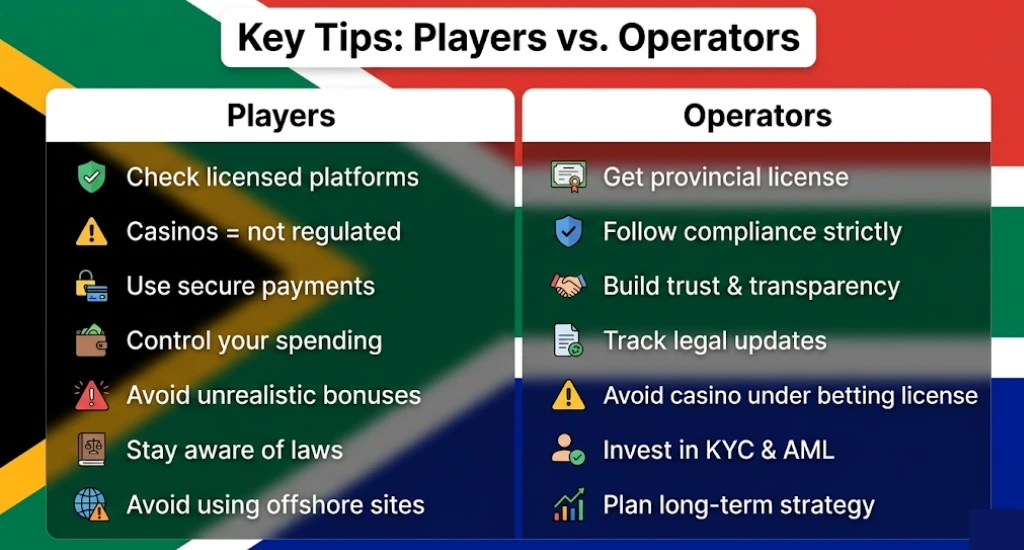
key points, players and operators SA
Player Risks:
Today, the majority of players in South Africa assume that using an offshore casino platform won’t pose any risk. This is a very wrong assumption, legally incorrect, and financially dangerous.
Here are the risks players can carry while playing on offshore casino platforms:
- Players can’t receive any legal aid.
- No regulatory body to complain about winning payouts if players don’t receive them.
- Winnings may be forfeited.
- No exposure to responsible gambling tools
Operator Risks:
Despite knowing that running an online casino business is legal in South Africa, local and international operators run casino businesses. This audacity can bring various risks.
- Operators must have a valid provincial license.
- There is no path to attain a casino license in South Africa; any operator running this business is acting unlawfully under the current law.
- Operators must navigate the nine provinces’ framework to meet compliance requirements.
- Operators also must face strict advertisement challenges imposed by NGB.
Online Gambling Market Reality in South Africa
Judging the online gambling market in South Africa by its law alone might convey that this market rarely exists. However, reality is the opposite. Today, South Africa’s online gambling market is among the fastest-growing on the continent.
Regardless of operators running business outside the regulated system or players using offshore platforms, this market is rapidly growing.
The South African iGaming market generated a revenue of USD 1,440.0 million in 2024 and is projected to reach USD 2,663.1 million by 2030, as per the Grand View Research Report.
Believe it or not, but today, the iGaming market in South Africa is dominated by illegal offshore operators. These platforms are licensed in low-oversight jurisdictions like Malta, Curacao, the Philippines, and Gibraltar. These licenses don’t carry any legal standing within South Africa.
Payment Methods Used by Players:
Whether it’s legal platforms or illegal platforms, South African players typically use EFT bank transfers, debit and credit cards, and cryptocurrency increasingly. However, the use of crypto is a little concerning to operators as it makes transaction monitoring and enforcement difficult.
Taxation on Gambling in South Africa
The taxation system in the South African gambling market varies from province to province. The licensed operators are taxed on their Gross Gambling Revenue. Let’s understand the tax rate for each type of gambling operations in South Africa:
| Type | Provincial GGR | VAT on GGR | Combined Rate | Status |
| Land-based casino
|
10-15% | 15% | -25-30% | Currently applies |
| Online sports bookmakers
|
6.5% avg. | 15% | 18-19% | Currently applies |
| Bingo operators
|
Varies by province | 15% | Province-dependent | Currently applies |
| Online casino operators
|
N/A | N/A | N/A | No license exists |
| Limited payout machines
|
Varies by province | 15% | Province-dependent | Currently applies |
| Offshore/ unlicensed operators | None paid | None paid | R3.5bn+ lost annually | Illegal – no tax |
Future of Online Gambling Regulations in South Africa
The future of online gambling is bright, but it is heavily dependent on regulations. Let’s understand the laws one by one and what would be the future of the South African Gambling market:
The Remote Gambling Bill
The Remote Gambling Bill was first proposed in draft form in 2022 and formally introduced in 2024 in Parliament to regulate online gambling in South Africa, particularly online casinos.
However, the bill wasn’t passed. If it were passed (or may pass in the future), the purpose it will serve includes the following:
- Allow licensed online casino operators in South Africa.
- Require operators to follow strict rules.
- Help the government. control offshore gambling.
- Introduce taxation on online gambling revenue.
Regulatory trends
Multiple trends might change the shape of future gambling, including
- Strict advertisement enforcement to ensure strict market protocols.
- GGR tax implementation will ensure the most significant reshaping of operator economics.
- Provincial coordination between nine provincial states and the NGB to reduce enforcement gaps.
- Payment blocking flows to unlicensed or offshore operators.
Also Read – Get a South African iGaming License
Conclusion
The online gambling market in South Africa offers promising opportunities to operators. But the legal landscape of the country remains restricted under the current laws, especially for casino operators.
It can be said that the legal framework does exist, but enforcement doesn’t.
For players, using legal sports betting platforms (locally-based) is what can save them from any mishap related to money in the future. And operators must obtain a valid provincial license to run a sports betting business in the country. However, casino activities remain in the grey area.
But keeping a close eye on future regulatory shifts might unlock the online casino market.
FAQs
-
Is sports betting legal in South Africa?
Yes, online sports betting is fully legal in South Africa. Operators should be holding a valid provincial bookmaker license. Thus, licensed operators can offer betting activities on various real-world sports events like cricket, hockey, soccer, horse racing, etc.
-
Who regulates casinos in South Africa?
The National Gambling Board and Provincial Gambling Boards regulate online casino activities in South Africa. They offer insights, set standards, and monitor performance.
-
Which legislation covers gambling?
There are multiple legislative bodies that regulate gambling in South Africa. For instance, the National Gambling Act 2004, the National Gambling Amendment Act 2008, the National Gambling Regulations 2004, and the Provincial Gambling Act for each of the nine provinces. By working together, these regulatory bodies ensure what is legal, licensed, and can be operated in the country.
-
What is the 13-gambling act?
The Gambling Act 13 of 1965 was South Africa’s original federal gambling legislation. For four decades, they governed gambling activities in the country during which gambling was tightly restricted. This act was formally replaced by the National Gambling Act of 2004.
-
What is the National Gambling Act in South Africa?
The National Gambling Act 7 of 2004 is the epicenter of iGaming regulations in South Africa. It established the National Gambling Board and carried out all types of regulations for sports betting and casino activities in the country. However, the act was amended in 2008 as the National Gambling Amendment Act, which gave a clear framework for interactive gambling.


Monika Gola is an iGaming content specialist at PieGaming. Since 2020, she has been researching and developing content around software selection, online casino & sports betting regulations, and operator growth strategies. Her research includes analyzing market opportunities in regions like Europe, Africa, and Southeast Asia, as well as evaluating regulatory frameworks and entry barriers. She is actively monitoring industry trends, compliance updates, and evolving player demands across global iGaming markets to help operators navigate this industry seamlessly.
A GCGRA Gaming License is required to operate commercial gaming in the UAE, including online casinos and sportsbooks. Foreign operators can apply, but must meet GCGRA’s suitability, financial, compliance, and operational requirements before they can launch.
Online casino gaming is not allowed in Australia under Interactive Gambling Act 2001. But operators can still apply for an internet gaming license via specific jurisdictions like the Northern Territory, which allows them to offer gambling services legally- generally outside Australia.
Bulgaria’s iGaming license enables operators to legally provide services in the areas of online casino, betting, poker, and bingo in accordance with the regulations of the EU. Typically, a licensing process can take 60 to 90 days, and it will need to be approved by the NRA, technical certification, AML compliance, and data storage in the local area. Minimum capital requirements range from BGN 50,000 for betting operators to BGN 1.5 million for online casino operators.
To obtain the Anjouan Gaming License, applicants must collect and submit all the important documents. Learn the process of obtaining Anjouan iGaming license.
Algeria has no online casino or sports betting regulation to speak of — instead, the country enforces a near-total gambling ban rooted in civil law and Islamic principles. Yet despite the prohibition, offshore platforms continue to pull in millions of users every month, driven by high demand and a near-total absence of legal local alternatives.
A Kahnawake iGaming license is a credible and cost-effective licensing solution for online casinos and sportsbook operators. The process to obtain this license includes multiple steps, key benefits, and licensing costs.
Malta pays attention to the credibility of the regulatory framework and to access regulated markets, which is more conducive to long-term growth and industry reputation. However, Curaçao places a strong emphasis on speed and affordability, making it a good choice for startups and businesses focused on cryptocurrencies that are keen to establish a presence rapidly and at a lower cost. If you are constructing a major operation, select Malta. Pick Curaçao when you are just getting started and have to get your product to market quickly.

See you in your inbox soon!

Stay ahead of the game. Subscribe for exclusive content, updates, and insiders!