
Learn how AI is used in sports betting for odds pricing, fraud detection, live markets, and player segmentation — and what it changes for operators.

Wagering is being reshaped with the help of data, and AI is a big part of it. AI enables sportsbooks to automate a multitude of processes, from real-time odds calculations to personalized betting experiences. These are incredibly important for any sportsbook that relies on its data and is constantly evolving.
For operators, this translates into greater operational efficiency, as well as far better risk control and player retention rates, provided the AI is wired into the sportsbook software solution rather than bolted on afterwards. For bettors, it translates to an active market and tailored experiences.
With AI adoption gaining momentum in sports, the global AI in sports betting market is expected to grow at a CAGR of almost 15% through 2034. The sports betting industry is expected to reach over $187 billion by 2030. With intensified competition in these and similar fields, AI can no longer be regarded as a choice. It is quickly moving toward becoming a strategic advantage.
What is AI in Sports Betting?
AI involves the use of advanced computer systems that, when properly trained, can analyze an entire gamut of data, find trends, and make decisions with almost no human intervention. In sports betting, AI assists sportsbooks in processing tremendous amounts of information. This includes player numbers, match results, betting patterns, live game data, and more.
Traditional betting systems are based on predefined rules developed by people and manual adjustments. By using AI technology, these new platforms continue learning. This enables sportsbooks to react faster to changing events, optimize odds, deal with risk, and make players’ experiences better.
AI is a decision tool for sportsbook operators. It can sift through thousands of data points in seconds and reveal patterns that would be nearly impossible to spot manually. Operators will thus make better-informed decisions, and the gambling platforms will work more efficiently, therefore.
Technologies Behind AI Betting Platforms
These technologies are applied in the development of AI betting platforms of the future:
- Machine Learning (ML): Leverages data insights and training on historical or real-time data for predictions and betting models.
- Predictive Analytics: It uses patterns of data to predict outcomes by applying insights and trends to forecast them, to make odds.
- Big Data Processing: Processes an enormous amount of betting, player, and match data in real time.
- Natural Language Processing (NLP): Gathers and uses sports news, injury reports, and customer interaction to deliver actionable information.
- Automation Tools: Automation for odds updates, fraud, customer service, and personalized offers.
And these technologies enable sportsbooks to increase effectiveness, improve player interaction, and provide a more intelligent betting experience.
How Does AI Work Inside Modern Sportsbooks?
Modern sportsbooks process millions of data points a day. These data include match stats, betting patterns, player activity, market movements, and live event updates. Manually handling this amount of data is challenging. That’s where AI comes in.
AI assists sportsbooks in calculating and adjusting odds in real time based on changing match conditions and betting activity. It examines player activity to figure out preferences, target high-value users, and provide increasingly personalized experiences. AI helps risk monitoring by spotting abnormal betting behavior, in addition to assisting operators in balancing liabilities across markets.
In live betting, AI takes real-time match data and dynamically updates odds as events unfold. Recommendation engines use player data to suggest relevant betting markets, promotions, and sports events.
Simultaneously, AI-driven fraud detection systems track suspicious activity, bonus abuse, and potential account manipulation. AI also enhances CRM performance in addition to betting operations. It can automate the division of players, customize campaigns and strategies, predict churn rates, and initiate retention offers in a timely manner.
Read Blog – How to start a sportsbook
Rule-Based Betting Platforms vs AI-Driven Sportsbooks
The biggest difference between traditional and AI-powered sportsbooks is their ability to adapt. Traditional systems follow fixed rules, while AI continuously learns from new data and adjusts its decisions accordingly.
| Traditional Rule-Based Systems | AI-Driven Adaptive Systems |
| Operate using predefined rules | Learn and improve from data |
| Require frequent manual updates | Adapt automatically to changing conditions |
| Limited personalization | Deliver personalized experiences |
| Slower response to live events | Real-time decision-making |
| Reactive risk management | Predictive risk monitoring |
| Basic player segmentation | Advanced behavioral analysis |
Why AI is Becoming Essential for Sportsbook Operators
Now, the sports betting industry is more competitive than ever. Operators will have to manage expanding betting volumes while offering smooth live betting experiences to keep their players playing in an increasingly crowded space. This kind of high demand is not something that traditional systems can handle on a scale. AI enables sportsbooks to address the following operational challenges:
Key Challenges AI Solves
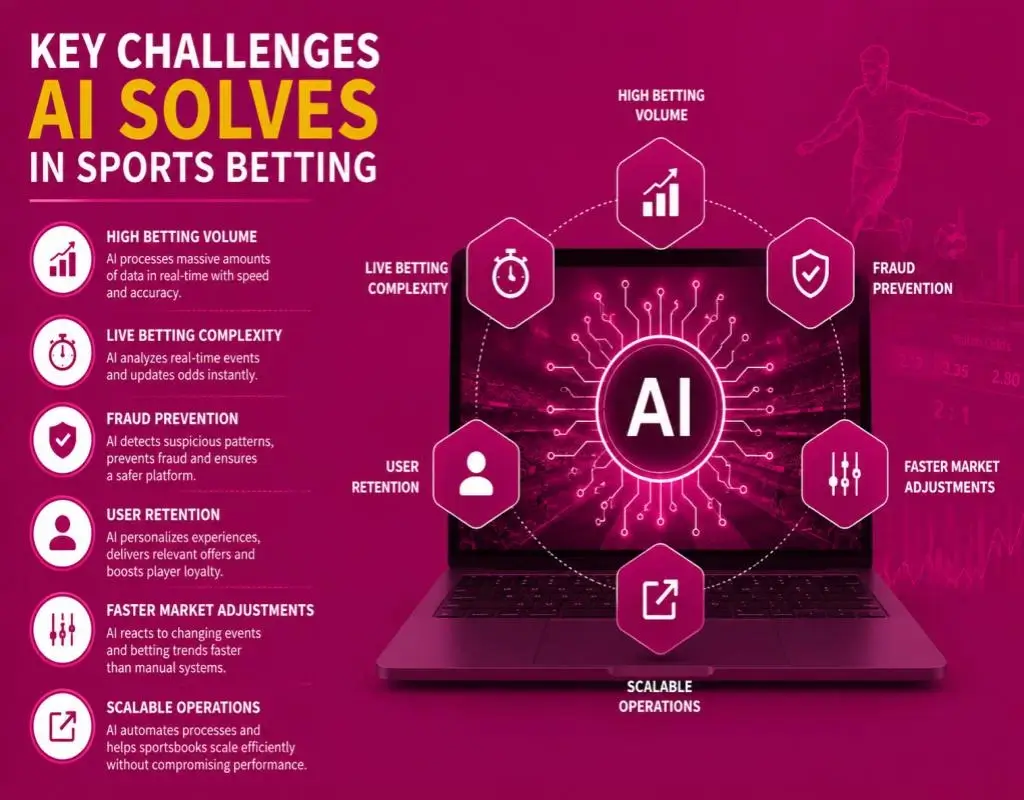
How AI improves sports betting platform
- Operating at High Betting Volumes: AI can handle a large volume of betting data at the same time, ensuring operators can operate with speed and accuracy during peak times.
- Tackling the Complexity of Live Betting: Sportsbooks can update odds and markets on the fly with real-time data as events unfold.
- Building Prevention of Fraud: AI catches uncommon betting trends, bonus abuse, account manipulation, and similar issues before they get out of hand.
- Improving Player Retention: Operators can use AI to deliver personalized offers, suggestions, and engagement methods.
- Facilitate Quicker Market Adjustments: AI-based systems can move far more quickly than any human could to react to injury and match events and betting trends.
- To Scale the Business: Automation cuts down on the operations workload and can grow sportsbooks without spending a lot more resources.
Why is AI adoption in sports betting accelerating?
Several trends shaping AI adoption in industry:
- Growing competition in the iGaming market.
- Increasing demand for real-time decision-making.
- Growing players are seeking personal experiences.
- A sharpened emphasis on operational efficiency and profitability.
- The need for data-driven strategies and risk management.
With the ongoing evolution of sportsbooks, AI is becoming a key component for enhancing efficiency, improving player experience, and keeping pace with the competition.
How to use AI in sports betting?
As the name suggests, there is no longer a single function of AI in a sportsbook. Now it fuels nearly every level of sportsbook operations, from odds management and keeping an eye on risk to keeping players and customers informed. By handling vast volumes of data in real-time, AI enables operators to make quicker decisions, work more efficiently, and provide customers with more satisfying bets.
Dynamic odds calculation
Establishing an accurate odds count is not a cakewalk for any sportsbook. Artificial intelligence aids by continuing to evaluate everything from player performance to group form and injuries to the weather and live match events. This allows sportsbooks to:
- Realtime odds adjustment.
- Be agile to market fluctuation.
- Monitor betting patterns.
- Trade off liabilities in different markets.
AI also lightens the load on trading teams. Rather than tracking multiple factors manually, traders can use the AI-generated insights to make more rapid and informed decisions during live events.
AI-Driven Predictive Analytics
Predictive analytics employs the use of AI to detect patterns in both historical and current information. Sportsbooks use this information to create better odds and better risk assessments. Common applications include:
- Historical data analysis.
- Match simulations.
- Player statistics modeling.
- Betting trend forecasting.
- Probability optimization.
One must understand that AI does not have certainty about its prognostications. Sports remain unpredictable. But by delivering probabilities with more accuracy, AI helps operators make more decisions based on data, in fact.
Fraud Detection & Responsible Gambling Monitoring
Virtually all sports books must deal with fraud, abuse, and compliance issues all the time. AI is key to discovering threats before they turn into massive problems. AI systems can detect:
- Suspicious betting activity.
- Unusual wagering patterns.
- Bot-driven accounts.
- Bonus abuse attempts.
- Possible collusion between players.
AI also supports Anti-Money Laundering (AML) workflows and responsible gambling programs, sitting alongside the wider iGaming risk management stack. It tracks player behavior, detects potential risks, and can flag behavioral signs of risky gambling habits so the operator can investigate further.
Personalized Betting Experiences
The modern-day player expects a personalized experience similar to what streaming and eCommerce platforms offer. AI allows sportsbooks to give relevant content that matches individual tastes and behavior. Use cases include:
- AI-driven recommendation engines
- Personalized promotions and bonuses.
- Player segmentation.
- Custom betting recommendations.
- Retention-focused campaigns.
Such personalization enhances the player’s experience, allowing the operator to increase retention as well as lifetime value.
AI in Live Betting & In-Play Wagering
Live gambling puts out enormous volumes of data every minute. AI can enable sportsbooks to process this information instantly and stay informed about the markets. Key benefits include:
- Real-time data processing.
- Odds recalculated instantly.
- Automated market updates.
- Betting adjustments triggered by in-play events.
Without AI, running thousands of live betting markets at once would be a manual process. AI makes betting in play faster, more accurate, and easier to scale.
AI Chatbots & Automation of Customer Support
AI is also highly useful for customer support. For example, AI-powered chatbots can instantly handle ordinary player queries, making it easier for one to ask questions. The result: shorter waiting times and better user satisfaction. What such tools offer:
- 24/7 customer support.
- Multilingual support.
- New player onboarding.
- Instant query resolution.
- Account and payment support.
Automating repetitive process responses lets support teams focus more on the bigger picture and maintain clean player interactions. This not only speeds up operations but also promotes greater player retention.
Read Blog – Automated sports betting software explained
AI Challenges in Sports Betting
Although AI has many merits, sportsbook operators must overcome several challenges from the outset before applying it at scale.
Data Accuracy Issues
- Data quality, not just data. AI models depend on this very important factor.
- Bad predictions and wrong odds resulting from incorrect, partial, or outdated data.
- If we consider effective AI operations, good-quality data sources are also essential.
Implementation Costs
- Adopting AI depends on investment in technology systems, infrastructure, and talented human capital.
- Operators will need access to premium data feeds and third-party AI tools.
- Ongoing maintenance and training of the model brings a greater cost to the system.
Regulatory Compliance
- Sports betting is a heavily regulated industry.
- AI systems must adhere to responsible gambling, AML, KYC, and data privacy standards.
- Operators must ensure transparency and accountability when making AI-powered decisions.
Over-reliance on Automation
- AI is capable of task automation, but it should never fully supplant human control.
- Unforeseen incidents and market abnormalities can still require manual intervention.
- It is important to strike the right amount of automation and human insight.
Ethical Concerns
- If trained on flawed data, AI systems can create algorithmic bias.
- The privacy of player data is still a big issue.
- Operators should make sure AI is used responsibly and ensure safe gambling practices are achieved.
Future of AI in Sports Betting
As AI has developed, its use in sports betting is likely to grow further in various aspects.
AI-Empowering Virtual Sports Betting
- AI can create genuine virtual sports betting software events and simulations.
- Operators take bets even in the absence of actual live events.
- Realism can also enhance player engagement.
Cutting-Edge Streaming Analytics
- Much faster processing of live matches and betting data.
- Accuracy in odds calculation and risk assessment.
- Enhanced decision-making during in-play betting.
Voice AI for Sportsbooks
- Voice-based assistants might offer gambling a simpler experience.
- Players wager bets, check odds, and get recommendations with their voice commands.
- Better access and ease to use for users.
Hyper-Customized Betting Experience
- AI will provide personalized promotions and betting recommendations.
- Real-time behavioral analysis will enable player journeys tailored to each individual.
- Higher levels of engagement and retention with personalized experiences.
Integration of Blockchain and Automation
- Transparency and transaction security can be achieved through blockchain, which is why AI and crypto sportsbook software increasingly ship together.
- Trade automation, risk management, and player engagement workflows can all be performed by AI.
- These technologies can support a sportsbook ecosystem that runs a more efficient and scalable sportsbook.
How to Choose the Right AI Sports Betting Software Provider
Choosing the right AI provider is crucial for future expansion. The ideal solution should not only fit current business needs but also help operators scale as markets change, and our comparison of the leading sports betting software providers sets out the criteria in detail.
Scalability & Customization
- Pick a platform that will support growing player traffic and betting volume.
- Search for flexible options for customization, catering to varying sports or betting styles, markets, or business models.
- Make sure that the platform is capable of scaling without massive infrastructure changes needed for future growth.
Operators launching a new brand rather than upgrading an existing one should weigh these criteria against a white-label sportsbook software deployment.
Real-Time Data Processing
- AI systems must interpret live match data and betting activity in real time.
- Operators can update odds faster and control risks more efficiently with real-time analytics.
- Live betting operations particularly need low-latency performance.
Security & Compliance
- Ensure that the provider follows all relevant industry security standards and data protection regulations.
- Seek those features that enable AML, KYC, and responsible gambling.
- Strong security features defend all player data and businesses.
API Integration Capabilities
- The platform should integrate easily with data providers, payment gateways, CRM systems, and third-party tools.
- Robust APIs support operators extending capability without shutting down the current flow of business.
AI & Analytics Features
- Assess the firm’s AI capabilities, including predictive analytics, risk assessment, fraud detection, player segmentation, personalization tools, and much more.
- Sophisticated reporting and analytics can support operators’ decision-making by enabling them to make intelligent, data-driven decisions.
A provider that fuses scalability, security, real-time intelligence, and powerful AI capabilities should be well-suited to support long-term success in sportsbook sales and delivery.
Read Blog – Turnkey sportsbook guide
Conclusion
Artificial intelligence is reshaping the sports betting business by enabling sports betting operators to create efficiencies, create a better experience, and make quicker decisions. With dynamic odds generation, predictive analytics, fraud detection, personalized engagement, and more, AI is powering many of the aspects of a sportsbook that businesses once depended on.
Though challenges such as compliance, implementation costs, and data quality persist, rewards usually outweigh pitfalls. And as technologies such as real-time analytics, automation, and machine learning continue to develop, AI will play a very important role in the future of sports betting. For operators, AI is no longer an optional asset but something that has to work in today’s fast-paced markets.
If you would rather not build these models yourself, our sportsbook software ships with AI-driven odds, risk, and segmentation already integrated.

FAQs
-
Is AI legal in sports betting?
Yes, AI is legal in sports betting in most regulated markets. Sportsbooks use AI for tasks such as odds of calculation, risk management, fraud detection, customer support, and player personalization. However, operators must ensure that their AI systems comply with local gambling regulations, data privacy laws, and are responsible for gambling requirements.
-
Is AI better than human analysis?
AI and human expertise serve different purposes. AI can process large volumes of data, identify patterns, and analyze information much faster than humans. However, human analysts bring contextual understanding, experience, and judgment that AI cannot fully replicate. The most effective sportsbooks often combine AI-driven insights with human oversight.
-
How accurate are AI betting predictions?
AI can improve prediction accuracy by analyzing historical data, player statistics, team performance, betting trends, and real-time information. However, sports outcomes are influenced by many unpredictable factors, such as injuries, weather conditions, and unexpected events. As a result, AI can enhance decision-making but cannot predict outcomes with complete accuracy.
-
Can AI guarantee wins in sports betting?
No, AI cannot guarantee wins in sports betting. While AI can help identify trends and estimate probabilities, sports remain unpredictable. Even the most advanced AI models cannot account for every variable that may affect a game's outcome. AI should be viewed as a decision-support tool rather than a guaranteed winning strategy.
-
Are there any AI tools for gambling?
Yes, many AI-powered tools are used across the gambling industry. Sportsbooks use AI for predictive analytics, odds of optimization, player segmentation, fraud detection, risk management, and customer support automation. Some platforms also offer AI-driven betting recommendations and personalized player experiences.
-
Can sportsbooks detect AI-based betting strategies?
In many cases, yes. Modern sportsbooks use advanced monitoring systems and AI-driven fraud detection tools to identify unusual betting patterns, automated wagering behavior, and potential attempts to exploit market inefficiencies. If a betting strategy consistently triggers risk indicators, sportsbooks may investigate the activity further.
-
Is AI used for fraud detection in betting?
Yes, fraud detection is one of the most common applications of AI in sports betting. AI systems can analyze betting activity in real time to identify suspicious patterns, bonus abuse, account manipulation, collusion, and potential money laundering risks. This helps sportsbooks protect their platforms, maintain compliance, and support safer betting environments.


Jaya Swaroop has been covering iGaming and betting technology since 2019, with a specialization in online casino platforms, sportsbook solutions, and licensing frameworks. Her work involves analyzing platform capabilities and evaluating cost structures, compliance requirements, payment integrations, market strategies, and regulatory updates that impact operators entering or scaling in the iGaming space. With a background in B2B marketing and content strategy, she has contributed to SEO-led growth and demand generation initiatives for global businesses. Jaya holds a Bachelor’s degree in Science (Chemistry & Mathematics) and is certified in content writing, email marketing (HubSpot), project management, and Google Analytics.

Micro betting is a type of live sports betting that focuses on the small moments within a game. Instead of wagering on the final result, bettors place bets on what happens next, such as the outcome of the next pitch in baseball, point in tennis, possession in basketball, or ball in cricket. Because these events are settled almost instantly, micro betting offers a faster and more dynamic experience than traditional sports wagers.
Esports betting offers a major opportunity to operators, and choosing the right partner can greatly impact profitability, player engagement, and operational efficiency.
Learn what retail sports betting is, how on-premise sportsbooks operate, and what the retail model costs and returns compared with going online only.
Read about what horse racing betting software includes — tote and fixed-odds markets, race feeds, and payments — plus what a build or a full license costs.

Learn how automated sports betting software handles odds, bet acceptance, risk, and payouts – what operators can automate and what still needs a trader.
Learn about how sports betting algorithms price odds and manage risk, plus the leading algorithm software compared on data, models, and integration options.
Learn how esports betting works as a vertical — titles, markets, odds feeds, and the software operators need to add esports to an existing sportsbook.








See you in your inbox soon!

Stay ahead of the game. Subscribe for exclusive content, updates, and insiders!