
Malta is one of the best places for online casinos and sports betting. It is overseen by the Malta Gaming Authority (MGA), which makes sure operators follow the law, protect players, and run fair games. This makes Malta a trusted and popular choice for gambling companies and players worldwide.
Not every online casino plays by the rules. Unlicensed operators still exist, and when things go wrong, players rarely have anywhere to turn. Malta was built to fix exactly that.
The Malta Gaming Authority, established in 2001, created a framework that holds operators accountable and gives players real protection. Today, it oversees 500+ active licenses and billions in annual revenue, making Malta one of the most respected names in gambling regulation.
Understanding how that regulatory system actually works helps explain why Malta sits at the center of the online casino and sports betting industry today, and why that position is unlikely to change anytime soon.
Overview of Gambling Laws in Malta
Malta runs one of the most structured gambling frameworks in the world, and it all sits under one roof. The Gaming Act (Cap. 583), which came into force in August 2018, consolidated all gambling legislation into a single new law covering both land-based and online operations. Before that, rules were scattered across multiple outdated acts. The 2018 overhaul changed that entirely.
The Malta Gaming Authority sits at the centre of it all. As the sole regulator, it handles licensing, monitors compliance, and enforces the rules. Operators cannot simply set up and run. They go through fit-and-proper checks, meet capital requirements, implement anti-money laundering controls, and maintain responsible gambling tools for their players.
Two main license types exist. A B2C Gaming License covers operators selling directly to players. A B2B Critical Gaming Supply License covers software and game providers working behind the scenes. Both come with real obligations and regular scrutiny.
The scope is broad by design. Fixed-odds betting, casino games, poker, lotteries, bingo, virtual sports, and fantasy sports all fall under the same framework. Online and land-based operations are treated equally, with land-based venues carrying additional requirements for physical premises and devices.
For players, the protections are genuine. Licensed sites must offer self-exclusion tools, deposit limits, and clear complaint procedures. Independent dispute resolution is mandatory. The MGA also maintains a public register of licensed operators and a list of prohibited sites, so players always know where they stand.
Understanding Malta Gaming Authority (MGA)
The Malta Gaming Authority is the sole authority in all aspects related to gambling in Malta. Established under the Gaming Act 2018, it has a simple task: to ensure that gaming remains fair, transparent, and free of criminal influence, and to ensure that vulnerable players and minors are safeguarded.
Its authority is wide. The MGA issues and revokes licenses, establishes technical and compliance standards, and oversees operators continually. It also collaborates with the Financial Intelligence Analysis Unit in Malta to verify that no licensee is being used to conduct money laundering, and all licensees are expected to have AML policies and submit suspicious transaction reports when necessary.
Obtaining a license is not an easy task. Applications can only be made by EEA-founded companies; all applicants undergo comprehensive fit-and-proper investigations, which include financial, ownership, governance, and technology-related aspects. There are high standards, and they are not accidental.
Operators have continuing obligations after being licensed. They will have to be linked to a national self-exclusion register, which will provide players with a real means of withdrawing themselves in gambling through more than one platform.
They must also possess an approved Alternative Dispute Resolution process so that players always have an avenue to complain. In case of failure, the MGA directly intervenes through the Player Support Office.
It is that approach to accountability at multiple layers that makes a Malta license truly count.
Player Protection and Compliance Enforcement
Malta’s regulatory framework is not built on good intentions alone. The rules exist, the tools are mandatory, and operators are monitored to make sure both are actually working.
Under the Player Protection Directive, every licensed operator must display their licensing details, responsible gambling messages, and links to support organisations directly on their platform. Players must also be informed about available safety tools before they make their first deposit. That is not optional, and the MGA checks.
The protections built into every licensed platform cover the full range of player safety:
- Players can set their own deposit, wagering, and loss limits
- Self-exclusion is available for anywhere between 24 hours and an indefinite period
- Reality checks show time spent and amounts wagered during a session
- Age verification is enforced at registration, with underage gambling strictly prohibited
Once a player self-excludes, operators must block access instantly while still allowing any pending withdrawals to go through. Reversing that exclusion requires a formal request and a cooling-off period, specifically to prevent impulsive decisions. Persuasion attempts are not permitted under any circumstances.
On complaint handling, every licensed operator must:
- Maintain an internal complaint procedure with defined response timelines
- Partner with an approved Alternative Dispute Resolution body
- Escalate unresolved complaints to that ADR provider, whose decisions are binding
That structure gives players a clear and enforceable path beyond customer support, which matters when things go wrong.
The MGA does not sit back and wait for operators to self-report problems. Compliance is monitored actively through system audits, thematic inspections, and mystery shopping exercises that test how platforms perform in real conditions. A recent regulatory review specifically tested self-exclusion systems across multiple operators, identifying gaps and requiring improvements where standards fell short.
When operators fall short, the consequences are real. Fines, licence suspension, and full revocation are all on the table. In serious cases, operators can be required to cease operations entirely and return player funds. Malta’s enforcement record shows these are not empty threats.
Read More – How to Start An Online Casino
Types of Gambling Licenses in Malta
Types of Gambling Licenses
The MGA issues two main license types. Everything in Malta’s gambling framework sits under one of these two categories, and understanding the difference matters whether you are an operator, a software provider, or a player trying to make sense of who is regulated and how.
Gambling Service License (B2C)
This is the license for operators who offer games directly to players. Online casinos, sportsbooks, poker rooms, bingo, and lotteries all fall here. Under one B2C license, an operator can cover multiple game types without applying separately for each. They simply notify the MGA when adding a new vertical.
Critical Gaming Supply License (B2B)
This covers companies working behind the scenes. Game studios, platform providers, RNG software suppliers, and hardware manufacturers all need a B2B license if they are supplying MGA-regulated operators. They do not take bets from players, but they are held to the same standards of integrity as anyone who does.
Game Types Under Each License
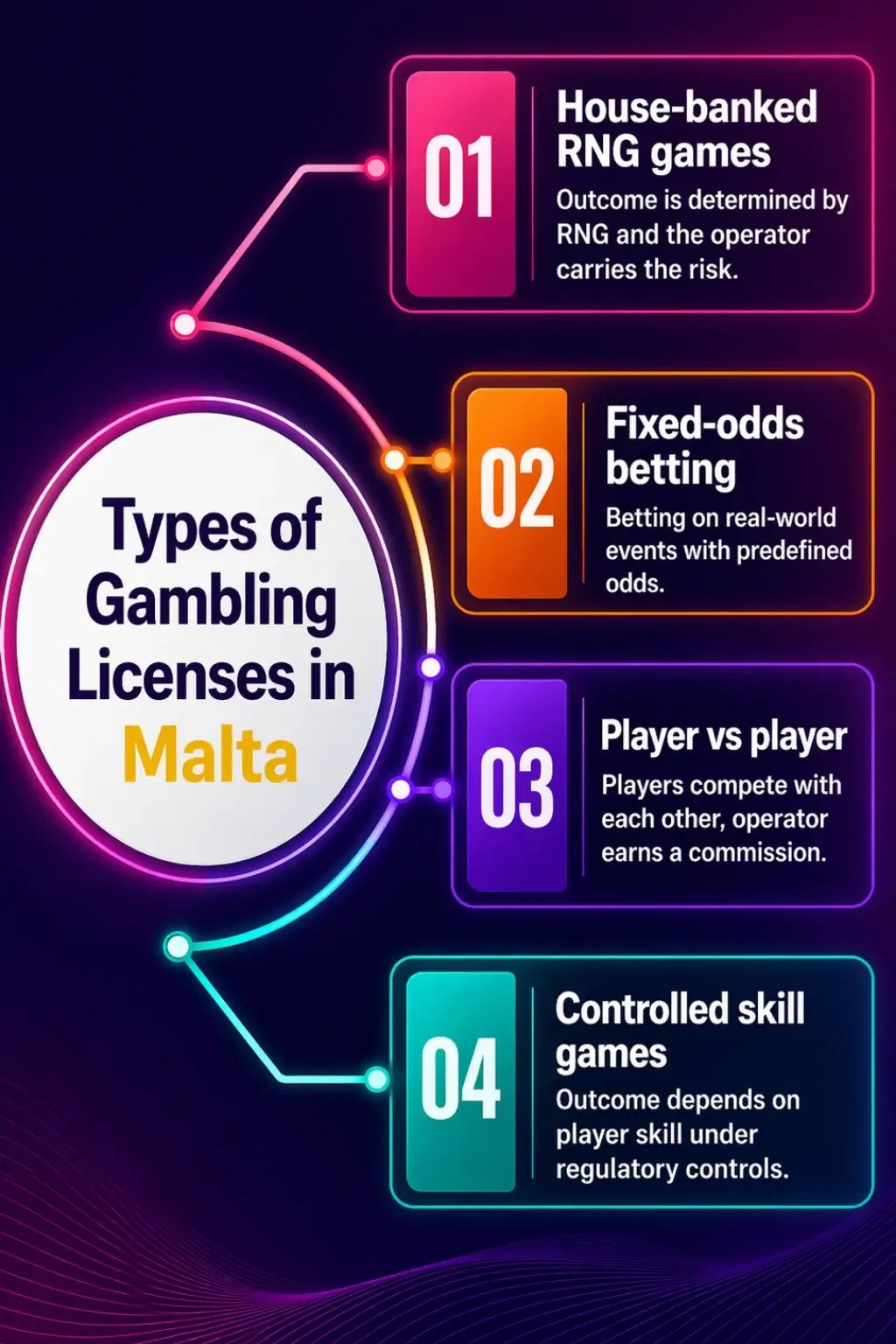
All MGA licenses, both B2C and B2B, are classified by game type. There are four categories:
| Type | Description | Examples |
| Type 1 | House-banked RNG games | Slots, roulette, blackjack, virtual sports |
| Type 2 | Fixed-odds betting on external events | Sportsbook, live betting |
| Type 3 | Player vs player, operator takes commission | Poker, bingo, betting exchanges |
| Type 4 | Controlled skill games | Fantasy sports, trivia games |
B2C License: Key Facts
To qualify, applicants must be a company registered in Malta or another EU/EEA state. Individual applicants are not eligible. Minimum share capital requirements apply depending on the game types covered, typically €100,000 for Types 1 to 3 and €40,000 for Type 4.
The application process runs through the MGA’s online portal and covers corporate documents, a business plan, financial forecasts, AML policies, and a full technical audit of the gaming platform. It is thorough by design, and approval typically takes between six and twelve months for well-prepared applicants.
| Feature | Details |
| Application Fee | €5,000 (non-refundable) |
| Annual Fee | €25,000 standard / €10,000 for Type 4 only |
| Gaming Tax | 5% of gross gaming revenue |
| Licence Term | 10 years, renewable |
| Minimum Capital | €100,000 (Types 1–3) / €40,000 (Type 4) |
Once licensed, operators must maintain player fund segregation, implement self-exclusion and deposit limit tools, display MGA licence details on all platforms, and submit to regular audits. There are no shortcuts after approval, either.
B2B Licence: Key Facts
B2B licence holders supply the infrastructure that makes online gambling work. They do not interact with players directly, but the MGA holds them to the same fit-and-proper and AML standards as operators. Their software must be certified by MGA-approved testing labs, and any changes to key systems or management must be reported.
The fee structure differs from B2C because B2B companies pay no gaming tax. Instead, annual fees are tiered by revenue:
| Annual Revenue | Annual Fee |
| Up to €5 million | €25,000 |
| €5 million to €10 million | €30,000 |
| Above €10 million | €35,000 |
| Type 4 supply only | €10,000 |
B2C vs B2B at a Glance
| Feature | B2C | B2B |
| Licence Purpose | Offer games to players | Supply software or systems to operators |
| Customers | End players | Licensed operators |
| Gaming Tax | 5% of GGR | None |
| Annual Fee | From €25,000 | From €25,000 (revenue-based) |
| Minimum Capital | €100,000 (Types 1–3) | €40,000 |
| Licence Term | 10 years | 10 years |
Both licence types carry real weight. A Malta licence, whether B2C or B2B, signals to the wider industry that an operator or supplier has met one of the most demanding regulatory standards in the world.
Read More – How to Secure a Gaming License
Gambling Licence in Malta: Requirements and Application Process
A Malta gambling licence carries real weight in the industry. Here is what operators need to meet before they can get one.
1) Company Incorporation in Malta
Operators cannot simply apply for a licence and start trading. They need a properly established Maltese entity first.
That means incorporating a private limited company under local corporate law, appointing directors, defining shareholders and beneficial owners, securing a registered address, and opening a corporate bank account dedicated to gaming operations.
2) Fit and Proper Test (Background Checks)
Every key individual connected to the application goes through a background check. Directors, shareholders, and anyone in a position of influence are assessed on their criminal record, financial history, and past business conduct.
Links to fraud, money laundering, or previous regulatory violations are grounds for disqualification. The MGA is not looking for perfect people, but it is looking for clean ones.
3) Business Plan and Financial Projections
Applicants must submit a structured business plan that covers operational strategy, target markets, and revenue streams.
Financial projections spanning three years are required, including cash flow forecasts, cost breakdowns, and evidence of enough capital to sustain operations from day one.
4) Technical Infrastructure Approval
The MGA wants to see exactly how the platform is built. Applicants must present detailed system architecture covering hosting, servers, and security protocols.
The infrastructure needs to support secure transactions, data protection, and regulatory reporting. Scalability and reliability are not optional extras here; they are part of the checklist.
5) Compliance with AML and KYC Laws
Anti-money laundering and know-your-customer measures must be fully operational before a licence is granted. That includes identity verification at onboarding, ongoing customer risk profiling, and real-time transaction monitoring.
Operators are required to detect and report suspicious activity, maintain detailed records, and align fully with EU AML directives.
6) Responsible Gambling Policies
Every operator must have responsible gambling tools built into the platform before going live. Deposit limits, self-exclusion options, and session reminders are all mandatory.
Beyond the tools themselves, operators are expected to monitor player behavior actively and intervene when patterns suggest harm.
7) Player Fund Protection
Player funds must be held separately from operational accounts at all times. This segregation exists to protect user balances if an operator becomes insolvent.
The MGA categorises fund protection into different levels depending on how securely those balances are held, and operators must meet the standard relevant to their licence type.
8) Fair Gaming and RNG Certification
All gaming software must be independently tested before it goes live. Random Number Generators are evaluated for accuracy and unpredictability, and return-to-player rates must be transparent and consistent with certified standards. No game reaches players without passing that process.
9) Pre-Application and Documentation
Before submitting anything, operators need to get their paperwork in order. Corporate records, technical documentation, and compliance policies all need to be compiled and consistent. Incomplete or mismatched submissions do not just slow things down; they can result in rejection.
10) Due Diligence Checks
The MGA verifies the source of funds, ownership structures, and regulatory history for every applicant.
This is not a box-ticking exercise. It is a detailed review designed to confirm that everyone involved in the business meets the integrity standards required to hold a Malta licence.
11) Business and Financial Review
Beyond the business plan, regulators look closely at whether the proposed model is actually viable.
Revenue projections, cost structures, and liquidity are all assessed to confirm that the operator can sustain operations and meet its financial obligations without putting player funds at risk.
12) System Audit and Certification
An independent audit of the gaming system is required before approval is granted. Transaction handling, player account management, and reporting systems are all tested for accuracy, security, and compliance. The system has to work correctly before the licence does.
13) License Approval
Once every requirement has been met and every check has been cleared, the licence is issued. In some cases, operators receive conditional approval, allowing them to launch under supervision while final verifications are completed. Either way, nothing goes live until the MGA is satisfied.
14) Ongoing Compliance and Monitoring
Getting licensed is not the finish line. Operators must continue meeting regulatory standards through regular audits, financial reporting, and system updates.
The MGA monitors activity on an ongoing basis, and falling short of those standards after approval carries the same consequences as failing to meet them before it.
Explore Casino & Sports Betting Regulations in Different Countries
Taxation and Costs
Malta’s tax framework is one of the main reasons iGaming operators keep choosing it over other jurisdictions. The system is built around gross gaming revenue, meaning operators are taxed on what they actually earn rather than total betting volume. That distinction matters, and it keeps the structure predictable.
The standard gaming tax rate sits at 5% of GGR generated from Malta-based players. However, from 2026 onwards, that is changing. The MGA is moving toward differentiated rates based on game type, making the framework more structured and aligned with the nature of each product. Type 1 games will be taxed at 15%, while Types 2 to 4 will attract a 10% rate.
Corporate tax in Malta sits at 35%, though refund mechanisms under the full imputation system mean the effective rate for most operators ends up significantly lower in practice.
Beyond the gaming tax, operators need to budget for the following:
| Tax / Cost Type | Details | Rate / Amount |
| Gaming Tax (Standard) | Applied on GGR from Malta-based players | ~5% of GGR |
| Updated Gaming Tax (from 2026) | Differentiated by game type | 15% (Type 1) / 10% (Types 2–4) |
| Corporate Tax | Standard Malta corporate tax on profits | 35% (refund mechanisms apply) |
| B2C Licence Fee | Annual fee for operators offering games to players | ~€25,000/year |
| B2B Licence Fee | Annual fee for software and platform providers | €25,000–€35,000 (revenue-based) |
| Application Fee | One-time fee at submission | €5,000 (non-refundable) |
| Compliance Contributions | Ongoing regulatory fees based on activity | Variable, tier-based |
| Tax Payment Frequency | Gaming tax reporting and payment schedule | Monthly filings required |
The overall structure keeps costs proportional to actual activity. Operators are not penalised for betting volume they do not profit from, and the move toward differentiated rates from 2026 adds another layer of fairness to how different game types are treated.
Future Trends in Malta iGaming Regulations
Regulation in Malta does not react to trends. It anticipates them. Here is where the MGA is heading and what operators should be paying attention to.
Stronger Compliance and Risk-Based Supervision
Oversight in Malta is no longer uniform. Operators with higher AML exposure, complex ownership structures, or payment vulnerabilities face deeper scrutiny. In 2026, the MGA introduced targeted thematic reviews covering cash controls and internal governance, raising the bar for higher-risk operators specifically.
Increased Focus on Player Protection Standards
The focus has shifted from whether protection tools exist to whether they actually work. Operators are now assessed on ADR reporting quality and real-time player monitoring. Self-exclusion systems and intervention triggers are evaluated on their effectiveness at preventing harm, not just their presence.
Regulation of Crypto and Digital Payments
Crypto is no longer a grey area. The MGA has initiated reviews covering wallet usage, transaction traceability, and internal controls around digital payments. Operators accepting crypto must now demonstrate that those flows are properly monitored, audited, and aligned with AML obligations.
Sports Betting Integrity and Match-Fixing Controls
Integrity monitoring has become more granular. Regulators are focusing on athletes betting on their own sports and risks within esports markets. Operators must have systems that flag suspicious patterns and report integrity concerns proactively, before issues escalate, rather than after.
Evolving Tax and Regulatory Frameworks
Malta’s flat 5% GGR tax is being replaced with differentiated rates, 15% for Type 1 and 10% for Types 2 to 4. VAT rules are also being refined to align with licensing definitions, creating a more structured and predictable fiscal framework for operators.
Wrapping Up…
The rules governing online gambling in Malta exist for a reason, and the MGA makes sure they are followed. Operators are held to real standards; players have real protections, and the system is built to evolve as the industry changes.
Whether you are an operator evaluating where to licence or a player choosing where to play, Malta’s regulatory framework gives you something most jurisdictions cannot: genuine confidence in how the game is run.
FAQ
-
Is online gambling legal in Malta?
Yes, fully. Online gambling is legal and tightly regulated in Malta under the Malta Gaming Authority. Every licensed operator goes through a strict approval process, and the framework is built around fairness and player protection.
-
How much does an MGA license cost?
The application fee is €5,000 and is non-refundable. After that, annual fees run at around €25,000 for a standard B2C licence, reduced to €10,000 if the operator covers Type 4 games only. B2B licences sit between €25,000 and €35,000 depending on revenue. Ongoing compliance contributions are also payable and calculated on a tier basis.
-
How long does it take to get a Malta license?
Realistically, between three and six months from start to finish. Preparation and submission typically takes five to eight weeks, followed by twelve to sixteen weeks of MGA review and system audits. How well the application is prepared makes a significant difference to that timeline.
-
What is the difference between B2C and B2B Malta igaming license?
A B2C Gaming Service Licence covers operators offering games directly to players, think online casinos and sportsbooks. A B2B Critical Gaming Supply Licence covers companies providing the software, platforms, or systems that those operators run on. B2B holders do not interact with players directly and are not subject to the same player fund segregation requirements.
-
Can foreigners start an online casino in Malta?
Yes. There are no nationality restrictions on directors or shareholders. What matters is passing the MGA's fit and proper checks and having a registered company in Malta or another EU/EEA state. If those conditions are met, the door is open regardless of where the applicant is from.

Palak Madan has been writing about the iGaming industry since 2024. She focuses on helping operators and founders understand their options when launching an online casino, from choosing the right software provider to figuring out costs and compliance requirements across different markets. At PieGaming, she covers topics like white label casino solutions, platform selection, and market entry, turning complex industry information into practical guidance for people building iGaming businesses. She also keeps a close eye on licensing and regulatory changes; particularly how new rules shape the way operators enter and grow in different jurisdictions.

A GCGRA Gaming License is required to operate commercial gaming in the UAE, including online casinos and sportsbooks. Foreign operators can apply, but must meet GCGRA’s suitability, financial, compliance, and operational requirements before they can launch.
Online casino gaming is not allowed in Australia under Interactive Gambling Act 2001. But operators can still apply for an internet gaming license via specific jurisdictions like the Northern Territory, which allows them to offer gambling services legally- generally outside Australia.
Bulgaria’s iGaming license enables operators to legally provide services in the areas of online casino, betting, poker, and bingo in accordance with the regulations of the EU. Typically, a licensing process can take 60 to 90 days, and it will need to be approved by the NRA, technical certification, AML compliance, and data storage in the local area. Minimum capital requirements range from BGN 50,000 for betting operators to BGN 1.5 million for online casino operators.
To obtain the Anjouan Gaming License, applicants must collect and submit all the important documents. Learn the process of obtaining Anjouan iGaming license.
Algeria has no online casino or sports betting regulation to speak of — instead, the country enforces a near-total gambling ban rooted in civil law and Islamic principles. Yet despite the prohibition, offshore platforms continue to pull in millions of users every month, driven by high demand and a near-total absence of legal local alternatives.
A Kahnawake iGaming license is a credible and cost-effective licensing solution for online casinos and sportsbook operators. The process to obtain this license includes multiple steps, key benefits, and licensing costs.
Malta pays attention to the credibility of the regulatory framework and to access regulated markets, which is more conducive to long-term growth and industry reputation. However, Curaçao places a strong emphasis on speed and affordability, making it a good choice for startups and businesses focused on cryptocurrencies that are keen to establish a presence rapidly and at a lower cost. If you are constructing a major operation, select Malta. Pick Curaçao when you are just getting started and have to get your product to market quickly.

See you in your inbox soon!

Stay ahead of the game. Subscribe for exclusive content, updates, and insiders!