
Isle of Man iGaming License is a gambling license granted by the Gambling Supervision Commission (GSC) of the Isle of Man. Allows operators and B2B providers to legally provide gambling services. You must fulfill certain requirements in ownership, finances, compliance, and technology before the GSC approves you.
Securing an iGaming license isn’t just a legal checkbox. It’s proof that you’re legitimate, compliant, and trustworthy. That’s why plenty of online casinos, sportsbooks, and gaming software providers go for an Isle of Man license.
It’s one of the world’s most respected iGaming jurisdictions. If you’re thinking about getting an Isle of Man iGaming license, this guide walks you through everything. What you need to apply, what it costs, the regulatory side of things, and how long it’ll actually take to get approved.
Let’s get right into it.
What is the Isle of Man iGaming License?
The Isle of Man iGaming License lets you legally run online gambling services from the Isle of Man. The Isle of Man Gambling Supervision Commission issues it, and it’s respected globally for strong compliance, player protection, and regulatory credibility. Operators love it because they can reach international markets while operating from a stable, business-friendly jurisdiction.
The GSC handles the heavy lifting. They do due diligence on applicants, review ownership structures, monitor AML and KYC compliance, and make sure you’re running fair, secure gaming environments.
Now, the licensing framework covers basically every type of online gambling you can think of:
- Online Casino: Slots, table games, live dealer games, instant-win products.
- Sports Betting: Pre-match betting, in-play wagering, betting exchanges, fixed-odds markets.
- Poker: Cash games, tournaments, poker networks, peer-to-peer platforms.
- Bingo: Online bingo rooms and networked bingo operations.
- Lottery: Online lottery sales, draw-based games, instant lottery products.
- Esports Betting: Betting on pro tournaments, leagues, and competitive gaming events.
The Isle of Man also sets up its licensing structure well. You can get different license types depending on what your operation does.
- Full Online Gambling Regulation Act (OGRA) License if you’re offering gambling services directly to players.
- A Sub-License if you’re working under an existing Full OGRA licensee.
- A Network Services License if you’re providing gaming platforms or shared infrastructure.
- Software Supplier Registration if you’re a tech provider for building software for licensed operators.
This flexibility is exactly why casinos, sportsbooks, poker operators, bingo platforms, lottery businesses, esports betting companies, and B2B iGaming software providers choose the Isle of Man. You get a globally respected regulatory base that actually works for your business model.
Types of Isle of Man Gambling Licenses
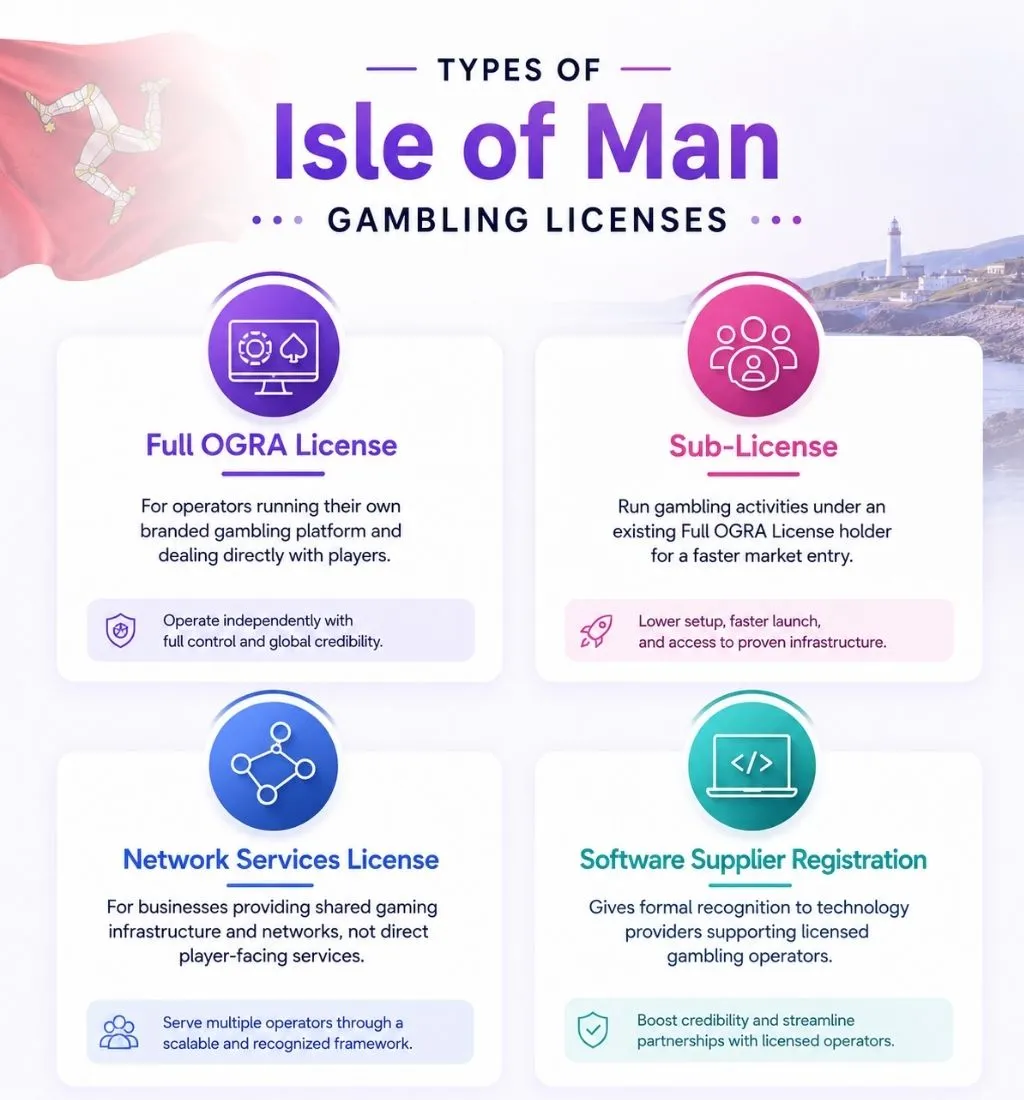
Types of Isle of Man iGaming licenses
The Isle of Man license offers multiple licensing options to fit different business models across iGaming. Which one you choose depends on whether you want to operate directly with players, provide gaming infrastructure, or deliver tech solutions to licensed operators.
1. Full OGRA License
The Full Online Gambling Regulation Act (OGRA) License is what you need if you want to run your own gambling platform under your own brand and have a direct relationship with players.
Who it is for
- Online casino operators
- Sportsbook brands
- Poker networks
- Bingo operators
- Multi-vertical gambling platforms
Key benefits
- You operate independently under a fully recognized Isle of Man license
- You control player accounts, payments, and compliance directly
- You get greater flexibility when entering regulated international markets
- You gain serious credibility with payment processors, banks, and business partners
Limitations
- The regulatory scrutiny is highest in this category
- You’ll need comprehensive compliance, AML, and responsible gambling frameworks
- It requires more capital and operational commitment
Suitable business models
- Established gambling operators
- Large-scale gaming groups
- Companies launching standalone casino or sportsbook brands
- Businesses targeting multiple jurisdictions
2. Sub-License
The Sub-License lets you run gambling activities under an existing Full OGRA License holder instead of getting your own standalone license.
Who it is for
- Startups entering the iGaming industry
- White-label casino operators
- Emerging sportsbook brands
- Businesses wanting a faster market launch
Key benefits
- Lower setup and compliance burden
- Faster route to market compared to a Full OGRA License
- Access to established operational infrastructure
- Fewer administrative requirements
Limitations
- You depend on the primary license holder
- You’ll have less operational autonomy
- Certain activities might need approval from the master licensee
Suitable business models
- White-label casinos
- Affiliate-driven gaming brands
- New market entrants testing business viability
- Operators expanding into new regions with minimal infrastructure investment
3. Network Services License
This license is for businesses providing shared gaming infrastructure rather than offering gambling services directly to players.
Who it is for
- Poker network operators
- Bingo network providers
- Gaming platform aggregators
- Shared liquidity providers
Key benefits
- You can serve multiple licensed operators through a single network
- You get a scalable framework for expanding across multiple brands
- You gain regulatory recognition as an infrastructure-focused business
Limitations
- You can’t run direct B2C gambling operations
- Your revenue depends on operator partnerships rather than player acquisition
- You’re subject to technical and operational oversight requirements
Suitable business models
- Shared poker ecosystems
- Multi-operator bingo networks
- Gaming platform providers
- Infrastructure and liquidity-sharing businesses
4. Software Supplier Registration
Software supplier registration isn’t a player-facing gambling license, but it gives formal recognition to tech companies supporting licensed operators.
Who it is for
- Casino game developers
- RNG software providers
- Platform developers
- Sports betting technology companies
- Back-office and compliance software vendors
Key benefits
- Increased credibility when working with regulated operators
- Easier onboarding with licensed gambling businesses
- Shows your commitment to regulatory standards and system integrity
Limitations
- You can’t authorize gambling operations
- You can’t accept wagers or manage player accounts
- You’re limited to technology and service provision activities
Suitable business models
- Slot game studios
- Live casino technology providers
- Sportsbook platform suppliers
- SaaS providers serving the gambling industry
B2B vs B2C Licensing Structure
B2C licenses are for operators offering gambling services directly to players, like online casinos and sportsbooks. B2B licenses are for businesses supporting those operators through software, platforms, payment solutions, gaming networks, or other backend services without dealing with players directly.
Read Blog – Where Are Online Casinos Legal?
Why Choose the Isle of Man for Your iGaming License?
There’s a reason why top iGaming operators trust the Isle of Man. Let’s understand what sets it apart as a licensing destination.
1. Strong Player Protection
The Isle of Man has regulated gambling since 1962, making it one of the world’s longest-established regulators. Since the OGRA in 2001, they’ve maintained a strong focus on player protection and operational integrity.
Key safeguards include:
- Segregation of player funds from business accounts
- Ongoing financial monitoring of operators
- Independent testing of gaming systems
- Strict AML and counter-terrorist financing controls
- Robust responsible gambling requirements
The regulatory framework keeps evolving—2026 brings updated AML guidance and proposed Civil Penalty Regulations to strengthen compliance.
2. Stable Government and Economy
As a self-governing British Crown Dependency with over 1,000 years of history, the Isle of Man offers political and economic stability that operators trust. As of February 2024, the jurisdiction had granted 75 gambling licenses, showing a 15% year-on-year increase and 79% growth over five years.
3. Great Tax Deals
The Isle of Man is one of the most tax-efficient jurisdictions for online gambling:
- 0% corporate income tax
- 0% capital gains tax
- 0% inheritance tax
Gaming duty is tiered: 1.5% on gross gaming yield up to £20 million, 0.5% between £20-40 million, and 0.1% above that. This structure works great for high-volume operators scaling globally.
4. Easy Banking and Payments
Licensed operators easily access international banks and payment processors. The Isle of Man has 32 OECD-compliant agreements: 9 Double Taxation Agreements and 27 Tax Information Exchange Agreements. These support cross-border operations and financial transactions.
5. Crypto-Friendly Regulatory Environment
The Isle of Man is progressive when it comes to digital assets. While crypto gambling needs regulatory approval, the GSC has built specific frameworks for blockchain technology, crypto payments, and digital asset gaming.
You get clear AML rules for crypto transactions, support for blockchain innovations, and regulatory certainty. That’s attractive for crypto casinos, blockchain gaming platforms, and operators integrating digital assets into payments.
6. Global Market Recognition
An Isle of Man license carries real weight globally. Payment providers, software suppliers, investors, and industry stakeholders recognize it.
You get increased trust from players and partners, better credibility with banks and payment processors, easier B2B partnerships, and stronger appeal to investors. For operators targeting international markets, this reputation gives you a real competitive edge.
7. Strong Banking Relationships
Banking access is tough for gambling businesses worldwide. The Isle of Man’s financial services sector and regulatory framework help you build relationships with reputable banks and payment providers.
You get access to a mature financial ecosystem, better acceptance from international processors, compliance standards that reduce banking risk, and easier multi-currency management. Combined with tax cooperation agreements and regulatory credibility, the Isle of Man keeps your banking and payments stable long-term.
Isle of Man iGaming License Requirements
Getting an Isle of Man license takes serious work. The GSC doesn’t just want an application and fees. They dig deep into your ownership, finances, operations, tech setup, and compliance framework before approving you.
Company Formation and Ownership
You must establish a legal entity in the Isle of Man and register it with the Companies Registry. The GSC requires full transparency regarding your corporate structure, subsidiaries, shareholders, and ultimate beneficial owners. Complex ownership arrangements often receive additional scrutiny.
Local Presence and Key Personnel
You must maintain a genuine operational presence in the Isle of Man. A registered office alone is not enough. Regulators expect operational staff and local management functions to be available for inspections.
The GSC expects resident directors and experienced key personnel. You must also appoint a Designated Official as the main regulatory contact. An operations manager should oversee daily business activities.
All key personnel undergo detailed due diligence. This includes identity verification, employment checks, regulatory background reviews, financial probity assessments, and criminal record screening.
Financial and Compliance Requirements
You must prove that your business has adequate financial resources. This includes audited statements, capital projections, business plans, and cash flow forecasts. The GSC must be confident that you can meet player obligations, operating expenses, and compliance costs.
You must implement robust AML and KYC programs. These should include identity verification, risk-based due diligence, PEP checks, sanctions screening, and suspicious activity reporting.
Responsible Gambling and Technology
Your platform must include responsible gambling controls. These should cover self-exclusion tools, deposit limits, age verification, problem gambling measures, and staff training.
Your technical infrastructure must meet regulatory standards. The GSC reviews platform architecture, cybersecurity controls, data protection measures, business continuity plans, and game fairness certifications.
Server hosting is flexible. However, regulators must be able to access the systems when required. Independent testing and certification may also be needed before launch.
Step-by-Step Application Process
Obtaining an Isle of Man GSC license involves a detailed review of your ownership, funding, operations, and compliance framework. Timelines vary by business complexity. Most delays occur during due diligence and document reviews rather than the initial application stage.
Step 1: Define the Licensing Structure
Start by figuring out which license type you actually need: Full OGRA, Sub-License, or Network Services License.
The GSC wants to understand:
- Whether you’re operating directly with players (B2C) or supporting other operators (B2B)
- Which gambling verticals are you offering (casino, sportsbook, poker, bingo, esports, etc.)
- Which markets and jurisdictions are you targeting
- Whether you’re using third-party platforms, white-label arrangements, or network services
Your business model directly shapes how much regulatory review you’ll face.
Step 2: Incorporate the Isle of Man Operating Entity
Set up the legal entity that’ll actually hold the license before you file anything.
The GSC reviews:
- Company incorporation records
- Shareholder structure
- Constitutional documents
- Intercompany agreements
- Group ownership charts
If you’re part of a larger gaming group, they’ll check how operational control flows across the structure.
Step 3: Identify Beneficial Owners and Funding Sources
This is one of the most scrutinized parts. You need to verify who actually owns or controls your business.
You’ll disclose:
- Ultimate beneficial owners
- Direct and indirect shareholdings
- Voting rights arrangements
- Investment sources
- Historical business interests
The GSC wants evidence supporting your source of wealth and source of funds. Unsupported funding is a common reason for extra regulatory questions.
Step 4: Appoint Key Persons Required by the GSC
Your application needs to identify who’s managing the licensed activities.
This typically includes:
- Directors
- Designated Official
- Operations Manager
- AML Compliance Officer
- Money Laundering Reporting Officer (MLRO)
The regulator checks each person’s experience in gambling, financial services, compliance, technology, or risk management. Background investigations cover regulatory history, finances, employment verification, and criminal records.
Step 5: Prepare the Operational and Compliance Framework
Show the GSC how you’ll actually run gambling activities day-to-day.
Key documents normally include:
- AML and CFT policies
- Customer due diligence procedures
- Responsible gambling policies
- Risk assessment reports
- Player fund protection arrangements
- Complaint handling procedures
- Fraud prevention controls
The regulator checks whether these procedures fit your risk profile and target markets.
Step 6: Submit Technical and Hosting Information
Give a detailed overview of your technology stack.
The submission covers:
- Gaming platform providers
- RNG suppliers
- Payment processing systems
- Data storage arrangements
- Hosting infrastructure
- Cybersecurity controls
- Business continuity measures
If you’re using third-party suppliers, the GSC may review their agreements and credentials.
Step 7: File the Application with the Gambling Supervision Commission
Once you’ve compiled everything, submit the formal application.
A typical package includes:
- License application forms
- Personal declaration forms
- Corporate documentation
- Ownership disclosures
- Financial forecasts
- Compliance manuals
- Technical architecture documentation
- Due diligence materials
They review it for completeness before moving to investigation.
Step 8: Regulatory Investigation and Due Diligence Review
The GSC digs into you and everyone connected to the business.
The review usually focuses on:
- Ownership transparency
- Financial standing
- Source of wealth verification
- Competency of key personnel
- Business model sustainability
- AML risk exposure
- Technical integrity of gaming systems
Higher-risk structures may trigger additional information requests and interviews.
Step 9: Pre-Launch Compliance Verification
Before the license goes live, the regulator may verify your systems and controls match what you described in the application.
This can include reviewing:
- Player onboarding workflows
- KYC verification processes
- Responsible gambling tools
- Transaction monitoring controls
- Reporting systems
- Data security measures
You need to prove you’re operationally ready before you accept customers.
Step 10: License Issuance and Ongoing Regulatory Oversight
Once everything checks out, the GSC grants the license with applicable conditions.
After approval, you stay under ongoing supervision:
- AML audits and inspections
- Regulatory reporting obligations
- Material change notifications
- Ongoing fitness and propriety assessments
- Reviews of key personnel and ownership structures
The Isle of Man takes continuous compliance seriously—regulatory oversight doesn’t stop after you get the license.
Costs and Timeframe of Getting an Isle of Man License
Getting an Isle of Man license costs way more than just the application fee. You’re budgeting for company formation, legal support, compliance setup, technology certification, local presence, and ongoing regulatory costs. For most operators, first-year investment is significantly higher than the licensing fees alone.
Isle of Man Licensing Costs Overview
| Cost Component | Typical Cost / Consideration |
| GSC Application Fee | Approximately £5,250 per application |
| Annual License Fee | Typically £36,750–£52,500, depending on license type and structure |
| Company Incorporation & Corporate Services | Varies based on corporate complexity and ownership structure |
| Legal & Regulatory Advisory | One of the largest pre-application expenses for most operators |
| AML & Compliance Framework Development | Includes AML policies, KYC procedures, risk assessments, and responsible gambling controls |
| Key Personnel Appointments | Designated Official, MLRO, AML Compliance Officer, and operational management roles |
| Platform Certification & Testing | RNG certification, security testing, platform audits, and technical reviews |
| Hosting & Infrastructure | Cloud hosting, cybersecurity controls, disaster recovery systems, and monitoring solutions |
| Post-Licensing Compliance | Ongoing audits, reporting obligations, compliance reviews, and regulatory filings |
Most operators should budget a minimum of £56,000–£72,000+ before you even factor in technology development, staffing, or marketing. Larger casino or sportsbook projects can easily exceed six figures in the first year.
Tax Considerations
One of the big reasons operators choose the Isle of Man is the tax environment. Here’s what you’re actually paying:
| Tax Category | Rate |
| Corporate Income Tax | Generally, 0% for most Isle of Man companies conducting qualifying activities |
| Gaming Duty / GGR Tax | Typically ranges from 0.1% to 1.5% of gross gaming revenue depending on revenue levels |
| Capital Gains Tax | 0% |
| Withholding Tax on Dividends | Generally, 0% |
This tax framework is one of the jurisdiction’s biggest competitive advantages compared to European licensing jurisdictions.
Typical Isle of Man Licensing Timeline
| Stage | Typical Duration |
| Licensing strategy and corporate setup | 2–4 weeks |
| Documentation and compliance preparation | 2–6 weeks |
| Technical documentation and certification | 2–8 weeks |
| GSC review and due diligence | 4–12 weeks |
| Additional information requests (if required) | Variable |
| Final approval and launch readiness review | 1–3 weeks |
Well-prepared applications with transparent ownership and complete documentation usually take 8–12 weeks. More complex structures may take 3–6 months or longer. This includes international holdings, multiple beneficial owners, complex funding arrangements, or high-risk target markets.
Read Blog – Explore Casino Software Development Cost
Isle of Man Vs Other iGaming Licenses
Choosing the right gambling license depends on your target markets, tax strategy, compliance resources, and growth plans. The Isle of Man offers a strong reputation and tax advantages. However, other jurisdictions may provide faster approvals or better access to certain regulated markets.
| Factor | Isle of Man | Malta (MGA) | Gibraltar | Curaçao |
| Regulatory Reputation | Tier-1 jurisdiction with strong international recognition | Tier-1 EU regulator with broad industry acceptance | Highly respected but selective licensing regime | Mid-tier reputation undergoing regulatory reforms |
| Primary Target Operators | B2C operators, sportsbooks, casinos, B2B suppliers, network providers | European-facing operators and B2B providers | Large international gaming groups | Startups and emerging operators |
| Corporate Tax Environment | Generally, 0% corporate tax for qualifying activities | Effective tax benefits available but more complex structure | Competitive tax framework | Favorable tax environment |
| Gaming Duty / GGR Tax | Typically, 0.1%–1.5% depending on revenue levels | Higher effective gaming tax obligations | Varies by business structure | Lower regulatory tax burden |
| Average Licensing Timeline | Approximately 8–12 weeks for straightforward applications | Often 3–6 months depending on workload and complexity | Can exceed 6 months for some applicants | Generally faster than Tier-1 jurisdictions |
| Ownership Due Diligence | Extensive source-of-funds and beneficial ownership reviews | Extensive due diligence and financial investigations | Very rigorous ownership assessments | Increasingly strict under new framework |
| AML & Compliance Expectations | High | High | Very High | Moderate to High |
| B2B Licensing Framework | Strong B2B and software supplier recognition | One of the industry’s most established B2B frameworks | Primarily suited for larger operators | Available but less prestigious |
| Market Credibility with Banks & PSPs | Excellent | Excellent | Excellent | Moderate |
| Economic Substance Requirements | Meaningful local presence expected | Local substance requirements apply | Significant local presence expected | Less demanding than Tier-1 jurisdictions |
| Ideal For | Operators seeking a respected license with favorable taxation and strong international credibility | Businesses targeting European regulated markets | Large enterprise operators with substantial compliance resources | Startups prioritizing speed and lower entry costs |
Is the Isle of Man License Right for Your Business Model?
Isle of Man isn’t the cheapest jurisdiction to enter, and it’s not the fastest either. But it’s one of the most respected gambling licensing jurisdictions globally. This license suits operators and suppliers focused on credibility, banking stability, tax efficiency, and long-term growth. It is less suitable for businesses seeking the lowest-cost market entry.
This jurisdiction is designed for businesses that can meet strict compliance requirements and undergo thorough due diligence.
| Business Model | Is the Isle of Man a Good Fit? | Why |
| Online Casino Operators | Excellent Fit | Strong international reputation, competitive gaming duty rates, credibility with payment providers and banks |
| Sportsbook Operators | Excellent Fit | Suitable for operators targeting multiple international markets with highly respected regulatory status |
| Poker Networks | Excellent Fit | The Network Services License is designed specifically for shared liquidity and multi-operator network models |
| Bingo Networks | Excellent Fit | Supports centralized network structures serving multiple licensed operators |
| Multi-Brand Gaming Groups | Excellent Fit | Lets larger operators manage multiple gambling brands under a well-established regulatory framework |
| B2B Platform Providers | Excellent Fit | Strong recognition among operators seeking licensed platform, PAM, and infrastructure suppliers |
| Casino Game Developers | Excellent Fit | Software Supplier Registration boosts credibility when partnering with regulated operators globally |
| Sports Betting Technology Providers | Excellent Fit | Well-suited for odds providers, trading platforms, risk management solutions, and sportsbook tech vendors |
| White-Label Casino Operators | Potential Fit | Often more cost-effective to operate through a Sub-License rather than getting a Full OGRA License |
| Startup Operators with Limited Capital | Depends | Licensing costs, compliance obligations, and operational substance requirements can create significant entry barriers |
| Affiliate Businesses | Usually Not Required | Affiliates generally don’t need a gambling license unless they participate directly in gambling operations |
| Crypto-Only Gambling Startups | Case-Specific | Regulatory scrutiny may increase based on your payment flows, AML controls, and business structure. |
The Isle of Man is ideal for established operators, growing gaming groups, and B2B tech providers. It offers strong regulatory credibility and commercial prestige. The application process is more demanding than some alternatives. However, the license helps build trust with payment providers, investors, software suppliers, and business partners.
Wrapping Up…
Getting an Isle of Man iGaming license takes time, money, and serious preparation. You’ll face extensive due diligence, hefty compliance requirements, and meaningful upfront costs. But you get something valuable in return: a globally respected license that opens doors with banks, payment processors, and B2B partners. For operators prioritizing credibility and long-term stability over cheap market entry, it’s worth the effort.
FAQ's
-
Can you gamble in the isle of man?
Yes. You can gamble on the island through casinos, slot machines, betting offices, lotteries, and online gambling. The Isle of Man Gambling Supervision Commission (GSC) regulates all gambling activities with strong player protection standards and compliance oversight.
-
What is the Isle of Man Gambling Act?
There's no single "Isle of Man Gambling Act." Instead, gambling operates under a framework of multiple laws, with the Gambling Supervision Act 2010 taking the lead. This act created the Gambling Supervision Commission and set out how licensing, oversight, and enforcement work for both land-based and online gambling.
-
How to get an Isle of Man Gambling license from India?
Follow the standard five-step process: initial consultation (1-2 weeks), company incorporation (2-3 weeks), GSC submission (1 week), audit and review (4-6 weeks), and license issuance (1-2 weeks). The total timeline is typically 8-12 weeks. Costs start around £5,250 for the application plus £36,750 in annual fees.
-
How to get an Isle of Man Gambling license from South Africa?
The process is identical for applicants worldwide. Incorporate an Isle of Man company, appoint directors, engage a local agent, submit your business plan and compliance policies, and undergo GSC due diligence. The timeline is 8-12 weeks typically. Expect £150k+ total Year 1 costs, fully loaded.
-
Who is the main supervisory authority for gambling operators in the isle of man?
The Isle of Man Gambling Supervision Commission (GSC) regulates all gambling on the island. Established in 1962, it oversees casinos, betting offices, lotteries, and online gambling. They ensure fair operations, player protection, and anti-money laundering compliance throughout the sector.

Palak Madan has been writing about the iGaming industry since 2024. She focuses on helping operators and founders understand their options when launching an online casino, from choosing the right software provider to figuring out costs and compliance requirements across different markets. At PieGaming, she covers topics like white label casino solutions, platform selection, and market entry, turning complex industry information into practical guidance for people building iGaming businesses. She also keeps a close eye on licensing and regulatory changes; particularly how new rules shape the way operators enter and grow in different jurisdictions.

A GCGRA Gaming License is required to operate commercial gaming in the UAE, including online casinos and sportsbooks. Foreign operators can apply, but must meet GCGRA’s suitability, financial, compliance, and operational requirements before they can launch.
Online casino gaming is not allowed in Australia under Interactive Gambling Act 2001. But operators can still apply for an internet gaming license via specific jurisdictions like the Northern Territory, which allows them to offer gambling services legally- generally outside Australia.
Bulgaria’s iGaming license enables operators to legally provide services in the areas of online casino, betting, poker, and bingo in accordance with the regulations of the EU. Typically, a licensing process can take 60 to 90 days, and it will need to be approved by the NRA, technical certification, AML compliance, and data storage in the local area. Minimum capital requirements range from BGN 50,000 for betting operators to BGN 1.5 million for online casino operators.
To obtain the Anjouan Gaming License, applicants must collect and submit all the important documents. Learn the process of obtaining Anjouan iGaming license.
Algeria has no online casino or sports betting regulation to speak of — instead, the country enforces a near-total gambling ban rooted in civil law and Islamic principles. Yet despite the prohibition, offshore platforms continue to pull in millions of users every month, driven by high demand and a near-total absence of legal local alternatives.
A Kahnawake iGaming license is a credible and cost-effective licensing solution for online casinos and sportsbook operators. The process to obtain this license includes multiple steps, key benefits, and licensing costs.
Malta pays attention to the credibility of the regulatory framework and to access regulated markets, which is more conducive to long-term growth and industry reputation. However, Curaçao places a strong emphasis on speed and affordability, making it a good choice for startups and businesses focused on cryptocurrencies that are keen to establish a presence rapidly and at a lower cost. If you are constructing a major operation, select Malta. Pick Curaçao when you are just getting started and have to get your product to market quickly.

See you in your inbox soon!

Stay ahead of the game. Subscribe for exclusive content, updates, and insiders!