
Compare white-label betting exchange providers on liquidity, commission model, APIs, and compliance – and how an exchange differs from a sportsbook.

The global online sports betting market is expanding, resulting in a massive operator shift from fixed-odds sportsbooks to peer-to-peer (P2P) betting exchanges.
Unlike traditional models where operators take on financial liability, exchanges eliminate house risk by matching users against each other and charging a standard 2% to 5% commission on winnings.
With this structural advantage, platforms can also attract high-volume traders rather than capping them. Launch speed is vital to riding the wave. But building an exchange from scratch is complex, which is why most operators start from betting exchange software that is already built.
Operators now rely on top-tier white-label providers who have immediate global liquidity pools, ultra-low-latency matching engines, advanced algorithmic trading APIs, and automated compliance frameworks right out of the box.
What is a White Label Betting Exchange Platform?
A white-label betting exchange is a premade betting platform that enables customers to launch their own betting services under their own brand. Not to develop the whole thing from scratch, companies have access to the bet exchange software that already comes pre-built. They provide functions such as market creation, odds management, payment integration, player management, risk controls, and compliance tools.
These apps allow users to gain faster entry into a market as well as lower development expenses and technical complexity. Additionally, most white label betting exchange providers also offer ongoing maintenance, API integrations, licensing support, and scalability features as an advantage to both fledgling and established operators alike.
Sportsbook vs Betting Exchange: What’s the Difference?
Despite both having their own platforms for betting on sports and events, both allow users to bet, but they are quite different in operation.
In a traditional sportsbook, the operator acts as the bookmaker. The platform sets the odds, accepts bets, and pays winnings directly to players. This means the operator carries the financial risk if large numbers of users win. That liability model is what sportsbook software is built around.
A betting exchange platform works differently. Instead of betting against the bookmaker, users bet against each other. One player backs an outcome to happen, while another player lays the same outcome, meaning they bet against it happening.
| Feature | Traditional Sportsbook | Betting Exchange |
| Betting Model | Player vs bookmaker | Player vs player |
| Odds Control | Set by operator | Set by market demand |
| Operator Risk | High | Low |
| Revenue Model | House margin | Commission on winning bets |
| Transparency | Moderate | High |
Understanding the Peer-to-Peer Betting Model
We all talk a lot about the peer-to-peer Betting Model. At the heart of every betting exchange platform is a peer-to-peer betting system. In this model:
- One player places a “back” bet, wagering that something will happen.
- Another player places a “lay” bet, wagering that the outcome will not occur.
- Both bets are automatically matched on the betting exchange platform.
For example:
- Player A backs Team X to win.
- Player B lays Team X, betting that Team X will not win.
- Both bets are matched and the platform locks the wager.
The construction of this setup generates a changing market where betting odds shift constantly in response to supply and demand.
Simple Betting Exchange Workflow
Player A backs Team X → Player B lays Team X → Platform matches the bets → Winning player gets paid → Platform takes a small commission
How Betting Exchange Operators Earn Money
Unlike traditional sportsbooks, betting exchange operators who run such systems do not make money by extracting betting losses from players. Rather, they earn money by charging a commission for winning bets. The fact that the platform isn’t directly exposed to outcomes of betting means that this significantly lowers operational risk.
Read More – How to start a sportsbook
Why Businesses Choose White Label Betting Exchange Providers
Online betting is one of the fastest-growing sectors of the economy, and operators are seeking faster, more scalable ways to launch their platform. The global online gambling market is expected to reach USD 153.57 billion by 2030, growing at a CAGR of 11.9%. This demand is escalating to provide white label betting exchange services.
Reduced Development Cost
Developing a betting exchange platform from scratch is expensive due to engineering, infrastructure upgrades, and maintenance (including security). Such costs can be lowered by white label betting exchange providers, which offer prebuilt solutions with features built in.
Faster Deployment
Custom betting platforms take over one year to start selling. Under their banner, businesses can go live within weeks with white label betting exchange software.
Licensing Assistance
Regulatory compliance is a huge challenge for the betting industry. Licensing guidance, KYC, AML, and responsible gambling tools are also offered by many betting exchange providers to ensure ease of launch.
Ready-Made Payment Integrations
Today’s betting sites demand secure and flexible payment methods. A white-label sportsbook solution often includes in-built payment gateways for card, wallet, bank transfer, cryptocurrencies, and multi-currency transactions.
Scalability Benefits
With the demand for betting and user volume, platforms need to manage higher volumes as efficiently as possible. Most current betting exchange sites use cloud-based platforms to facilitate seamless expansion across sports, markets, and geographic locations.
Cloud infrastructure provides a strong foundation when dealing with huge betting platforms that facilitate cross-platform scaling for seamless integration and development. It allows for multiple betting providers to manage a continuous exchange of gamblers, such as gaming operators, mobile devices, and various financial institutions.
Lower Operational Risk
In traditional sportsbooks, operators assume more straightforward betting risks. Betting exchanges mitigate this liability because people on betting exchanges risk betting against each other; the platform takes commissions on winning bets.
Higher User Engagement
Players benefit more from betting platforms that offer dynamic odds, real-time trading features, live trading, and lay betting; this is because they make it easier to participate. Such features generally drive player engagement and retention.
Better Odds for Players
Betting exchanges usually price more competitively for all the odds because chances are based mainly on market-driven demand rather than bookmaker margins. This could help them expand into the broader global, regulated betting marketplace.
Scalability Across Multiple Regions
White label betting exchange platforms support multi-language, multi-currency, and regional compliance features. This makes it easier for operators to expand into global and regulated betting markets.
Read More – White-label betting exchange solutions explained
Key Features to Look for in a White Label Betting Exchange Provider
The right provider will depend on their fundamental technical infrastructure. Make sure your white label betting exchange provider has the following ten pillars:
Liquidity Management System
A successful platform requires immediate liquidity. Top providers have shared global liquidity pools, meaning your new exchange has access to an active network of traders on day one.
Real-Time Odds Engine
The matching engine is required to be ultra-low latency and must process thousands of price changes per second for processing large in-play trading bursts without delay.
Broad-Based Sports Coverage across Multiple Markets
Broad market penetration across global sports, from soccer, tennis, cricket, and esports. To respond to an array of preferences among the players.
API and Third-Party Integration
Robust REST and WebSocket APIs are important. They help algorithmic traders, syndicates, betting bots, and anyone to communicate to create a continuous ecosystem of volume.
Risk Management Tools
Even without any house betting risk, operators require real-time dashboards to monitor market manipulation, questionable trading patterns, and exposure limits.
KYC & AML Compliance
An integrated KYC & AML Compliance solution can also be integrated into the operating model. Automatic identity verification (KYC) and Anti-Money Laundering (AML) pipelines help users be seamlessly onboarded while dealing with stringent international regulators.
Multi-Currency & Crypto Support
The platform must accept traditional fiat trading systems, local payment networks, and secure crypto. It should also handle transactions such as Bitcoin or stablecoins safely for smooth deposits. Operators running digital assets as the primary rail should compare this against dedicated crypto sportsbook software.
Custom Branding & UI Flexibility
You can have a customer-facing front end that is fully customizable, enabling you to customize UI, layout, and navigation for differentiation in your market.
Mobile Betting Experience
With mobile playing a leading role in online betting, the platform needs a responsive web front-end or a native iOS/Android app ready for live trade.
Back Office & Player Management
Operators need robust backend analytics, player segmentation capabilities, custom commission tiering, and integrated report generation to effectively scale.
Top White Label Betting Exchange Software Providers
The choice of a betting exchange software provider, however, can play a key role in an operator’s growth and expansion as well as, subsequently, in its market coverage potential. For comparison, we will be analyzing the top white label betting exchange providers in 2026 based on platform features, customization, integrations, compliance support, and operator-oriented functionalities.
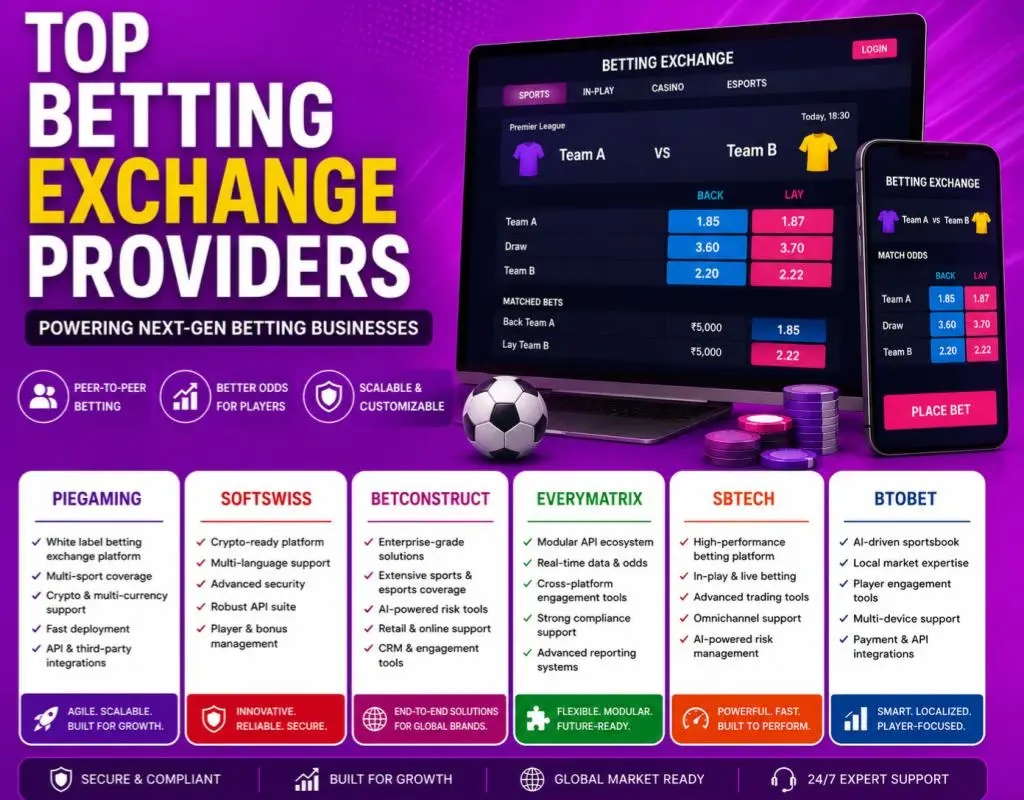
Betting exchange provider
PieGaming
PieGaming is a growing iGaming technology provider offering white label sportsbook, casino, and betting exchange solutions for startups and enterprise operators. The platform focuses on scalable infrastructure, customization, and faster market entry.
Best For
Mid-size and startups seeking a customizable and economical betting exchange.
Key Features
- White label betting exchange platform
- Multi-currency and crypto support
- API and third-party integrations
- Risk management and back-office tools
- Real-time odds and market management
- Mobile-optimized betting experience
Strengths
PieGaming has flexible customizability, rapid deployment, and scalable infrastructure for operators operating in multiple regions. Its operator-oriented design for support and integration makes it the perfect fit for businesses interested in moving rapidly.
SOFTSWISS
SOFTSWISS is a globally recognized iGaming technology provider offering sportsbook, casino, and crypto-ready betting solutions. This is due to the company’s reputation for innovation, security, and cryptocurrency integration.
Best For
Crypto-focused operators & businesses focused on regulated global markets.
Key Features
- Crypto betting support
- Multi-language and multi-currency functionality
- API-driven architecture
- Anti-fraud and security systems
- Player and bonus management tools
- Scalable cloud infrastructure
Strengths
SOFTSWISS is well known for its crypto expertise as well as good compliance practices. The platform also offers reliable scalability and advanced automation capabilities for scaling betting ventures.
BetConstruct
BetConstruct is one of the largest iGaming & sportsbook technology providers worldwide. The company provides full white label betting exchange, sportsbook, and gaming solutions in a number of regulated territories.
Best For
Enterprise operators who need large-scale betting infrastructure.
Key Features
- Advanced betting exchange software
- Extensive sports and esports coverage
- AI-powered risk management tools
- Multiple API integrations
- Retail and online betting support
- CRM and player engagement tools
Strengths
BetConstruct allows for both scale and broad market coverage with enterprise-grade technology. Its broad product ecosystem will work for operators contemplating international expansion.
EveryMatrix
EveryMatrix is a leading iGaming technology provider known for modular sportsbook and betting solutions. The company powers several large-scale operators throughout Europe and other regulated markets.
Best For
Operators needing a modular and API-first betting exchange solution.
Key Features
- API-based sportsbook ecosystem
- Real-time odds management
- Cross-platform player engagement tools
- Multi-jurisdiction compliance support
- Scalable cloud-native infrastructure
- Advanced reporting systems
Strengths
EveryMatrix offers unique features in its API and technology stack. The provider is strong in compliance, scalability, and operational efficiency.
SBTech
SBTech, which is now a part of DraftKings, is an international sportsbook and betting technology provider. It operates online and retail lines of high-volume gaming.
Best For
Large operators with enterprise-level sportsbook and betting exchange technology needs.
Key Features
- Real-time betting engine
- Live betting and in-play features
- AI-powered risk and trading management systems
- Omnichannel betting support
- Advanced analytics and reporting
- Flexible front-end customization
Strengths
SBTech is famous for its robust live betting capability and high-performance infrastructure. Its complex trading systems and scalability make it well-suited for operators managing large betting volumes.
BtoBet
BtoBet is a sportsbook and betting platform provider specializing in flexible data-driven betting solutions. The company is focused on emerging and regulated betting markets.
Best For
Operators targeting localized and emerging betting markets.
Key Features
- AI-driven sportsbook platform
- Regional market customization
- Multi-device betting support
- CRM and player retention tools
- API and payment integrations
- Responsible gambling features
Strengths
BtoBet is recognized for its platform customization and localization opportunities. Its emphasis on regional betting habits and consumer behavior enables operators to design custom betting experiences.
White Label Betting Exchange vs Traditional Sportsbook
The primary difference lies in financial risks and oddsmaking. A traditional sportsbook entails that players make bets against the house.
At that stage, it puts up fixed odds and bears full financial liability for payouts. This forces operators to operate extremely large risk departments and restrict the number of winning participants to preserve margins. Operators who want that model instead should look at a white-label sportsbook platform.
In contrast, a white label betting exchange operates based on a peer-to-peer (P2P) model in which players swap odds directly with each other. All the platform does is enable a match. Since users back and lay positions against other bettors, the operator carries zero outcome risk and thus earns steady, predictable revenue only from a 2% to 5% commission on winning trades.
| Feature | Betting Exchange | Traditional Sportsbook |
| Betting Model | Peer-to-peer | House-based |
| Revenue Model | Commission | Margin |
| Risk Exposure | Lower | Higher |
| Odds | Usually better | Controlled by bookmakers |
| Liquidity Requirement | High | Medium |
Read More – How to secure a gaming license
Cost of Launching a White Label Betting Exchange Platform
While adopting a white label infrastructure minimizes the financial commitment compared to building in-house, starting iGaming requires capital allocation in the right amounts. An industry-standard introductory white label platform can start from around $8,000 up front, while advanced, heavily customized enterprise systems cost considerably more.
To construct a business plan that is truly accurate around 2026, operators need to decompose the upfront capital requirements into five distinct financial pillars:
1) Upfront Setup Costs
The Upfront Setup costs comprise the sum that you pay to the software seller to get a personalized platform. This includes custom UI/UX design, front-end branding, server environment setups, and deploying your localized web and mobile skins. This usually falls between $5,000 and $20,000 for an entry-level framework based on how many regional configurations you will need.
2) Licensing and Sub-Licensing Costs
Officially, a gambling license is needed to run a betting exchange in the legal sense. Getting an independent license under the Malta Gaming Authority (MGA) or the UK Gambling Commission can mean a year and tens of thousands in application fees.
White label providers do this by providing sub-licensing models (often in Curaçao or Anjouan systems). That means you can operate legally under the vendor’s own corporate regulatory umbrella at once. Annual prices for these sub-licensing fees range from $10,000 to $25,000, preventing protracted bureaucratic red tape.
3) API Integrations & Sports Data Feeds
Betting exchanges operate with the same degree of realism as a financial trading floor, in that they require enormous volumes of external data. Commercial agreements connect your platform to premium, live data streams. Choosing between them is covered in our guide to sports betting odds providers.
Data Feed Costs: Advanced WebSocket and REST APIs for automated odds feeds, real-time match settlements, and streaming capabilities cost your initial technical integration budget between $3,000 and $15,000.
4) Recurring Maintenance & Infrastructure Fees
To keep the platform responsive through peak sporting events such as the World Cup, providers run continuously and incur operational costs each month.
These costs run from $1,500 to $5,000 a month and are the direct equivalent of:
- Hosting & SaaS server for private cloud.
- Ongoing security patching and anti-fraud checking.
- Continuous updates of software and 24/7 Tech B2B Customer support.
5) Revenue-Sharing Models (GGR Share)
White label providers’ core monetization plan is based on a GGR (Gross Gaming Revenue) share model. Instead of setting high upfront software acquisition costs, vendors charge a monthly royalty charge according to the number and volume of software use on your platform. At the peer-to-peer level, this royalty is normally 10% to 20% of the aggregate commission fees received from the operator.
Conclusion
The evolution of online gambling and its accompanying model of peer-to-peer betting exchange platform has made this potential among the most lucrative, risk-free ways for iGaming entrepreneurs. Exchanges don’t just eliminate the burden of the financial risk associated with traditional oddsmaking but create a predictable, high-volume commission structure, delivering a level of business stability never seen.
Strategic partnerships with established white label providers are the most likely route to success in this rapidly growing market. A white-label solution not only saves hundreds of thousands of dollars to start your website, but it also allows your brand to go live in under one month, rather than long enough to build a proprietary product from scratch. So you can work on the same level of detail and scale. It provides instant worldwide liquidity, automated regulatory compliance frameworks, multi-currency crypto processing, and premium matching engines directly from start to end.
If you want to build a competitive base in the world of global sports betting, choosing a vendor that aligns with your regional target, cost, and customization is your quickest way to grow and start turning a profit on your market entry.

FAQs
-
What is a white label betting exchange platform?
A white label betting exchange platform is a ready-made betting solution that allows operators to launch their own branded betting exchange business without developing the software from scratch.
-
How does betting exchange software work?
Betting exchange software works on a peer-to-peer model where players bet against each other instead of the bookmaker. The platform matches back and lay bets and earns revenue through commissions on winning bets.
-
Can I integrate crypto payments into a betting exchange?
Yes, most modern white label betting exchange providers support crypto payment integrations, allowing operators to accept cryptocurrencies alongside traditional payment methods.
-
Which is the best betting exchange provider?
PieGaming is one of the leading betting exchange providers in 2026, offering scalable infrastructure, customization, API integrations, crypto support, and faster deployment for operators.
-
What is the cost of launching a betting exchange platform?
The cost of launching a betting exchange platform depends on features, licensing, integrations, and customization requirements. White label solutions typically cost significantly less than custom-built platforms.


Jaya Swaroop has been covering iGaming and betting technology since 2019, with a specialization in online casino platforms, sportsbook solutions, and licensing frameworks. Her work involves analyzing platform capabilities and evaluating cost structures, compliance requirements, payment integrations, market strategies, and regulatory updates that impact operators entering or scaling in the iGaming space. With a background in B2B marketing and content strategy, she has contributed to SEO-led growth and demand generation initiatives for global businesses. Jaya holds a Bachelor’s degree in Science (Chemistry & Mathematics) and is certified in content writing, email marketing (HubSpot), project management, and Google Analytics.

Micro betting is a type of live sports betting that focuses on the small moments within a game. Instead of wagering on the final result, bettors place bets on what happens next, such as the outcome of the next pitch in baseball, point in tennis, possession in basketball, or ball in cricket. Because these events are settled almost instantly, micro betting offers a faster and more dynamic experience than traditional sports wagers.

Esports betting offers a major opportunity to operators, and choosing the right partner can greatly impact profitability, player engagement, and operational efficiency.

Learn what retail sports betting is, how on-premise sportsbooks operate, and what the retail model costs and returns compared with going online only.

Read about what horse racing betting software includes — tote and fixed-odds markets, race feeds, and payments — plus what a build or a full license costs.

Learn how automated sports betting software handles odds, bet acceptance, risk, and payouts – what operators can automate and what still needs a trader.

Learn about how sports betting algorithms price odds and manage risk, plus the leading algorithm software compared on data, models, and integration options.
Learn how esports betting works as a vertical — titles, markets, odds feeds, and the software operators need to add esports to an existing sportsbook.

See you in your inbox soon!

Stay ahead of the game. Subscribe for exclusive content, updates, and insiders!