
Tunisia’s gambling market is highly restricted, yet online casino and sports betting demands among players continue to rise. What future opportunities does this market offer to operators? Let’s decode.
Tunisia is North America’s most contradictory iGaming landscape. Though the country maintains tight control over gambling activities, particularly due to Islamic principles. However, the demand for online casino and sports betting activities is growing quietly. This creates a shadow market, which generates no tax revenue and offers players zero legal protection.
The disconnect between strict regulations and rising digital demand is what’s attracting local and international operators to evaluate Tunisia as a potential future iGaming market.
This write-up contains everything operators and players need to know about online casino and sports betting regulations in Tunisia, legal status, licensing, risk, and opportunities.
Is Online Gambling Legal in Tunisia?
The short answer: No.
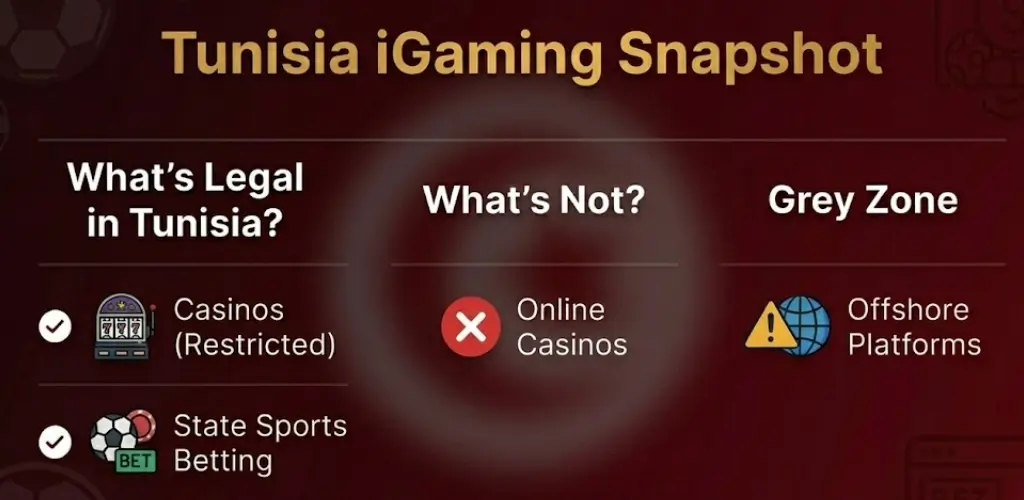
Land-based casino gaming is legal but highly prohibited. Sports betting is legal only through state-owned operators.
When it comes to online casinos, it is prohibited, and there is no domestic license for operators. If operators run an online casino business targeting Tunisian players, then it leads to a violation of rules. While online sports betting operates in the grey area.
For players, using offshore platforms isn’t considered a criminal offense, but it carries risks. Since there is no regulatory legal framework, financial transactions exist in gray areas. For operators, targeting Tunisian players without a license means putting business at risk, which can lead to license cancellation.
What does this really mean for operators?
- No legal pathway exists for casino and sportsbook operators
- No consumer protection exists for players
- Offshore platforms allow access
Key iGaming Regulatory Authorities in Tunisia
Tunisia Gambling laws
In Tunisia, multiple government bodies oversee different aspects of gambling. The table below highlights the different government bodies regulating different iGaming sectors.
| Authority | Primary Role | Jurisdiction |
| Ministry of Interior | Casino licensing and security oversight | Land-based casino approvals, operational monitoring |
| Ministry of National Economy | Economic licensing and fiscal oversight | Commercial licensing, taxation coordination |
| Ministry of Youth, Sports, and Physical Education | Sports betting regulations | Oversight of Promosport, sports integrity |
| Promosport | State-owned betting monopoly | Sole legal operator for sports betting and lotteries |
Current Legal Status of Gambling in Tunisia
A quick snapshot of Tunisia’s gambling landscape is highlighted in the table below: Strictly regulated legal activities vs. unregulated online space.
| Gambling Type | Status | Key Conditions | Implications for Operators |
| Land-based casinos | Legal | Limited to designated tourist zones. Requires government authorization from the Ministry of Interior. | Highly restricted. No domestic player accesses |
| Sports betting (land-based) | Legal
|
Exclusively through Promosport (state monopoly); limited formats —football pools, lotteries only | No private operator participation allowed |
| Online Casinos | Illegal | No domestic license framework, no regulated platform, and prohibited for domestic operators. | Can’t legally launch and no compliance pathway exists. |
| Online Sports Betting (Offshore) | Grey market | No domestic license is issued. Offshore platforms are not accessible but widely used through VPN. | Operate without legal recognition and players don’t have legal protection. |
| Online Lottery | Limited legal | State-run only | State monopoly |
What is a Grey Market?
In the iGaming industry, the grey market refers to the market where online gambling is not properly banned but lacks clear regulations. In Tunisia, players can access offshore sports betting and casino platforms.
Licensing Framework in Tunisia
Let’s decode the legal licensing framework of the gambling industry in Tunisia.
Land-Based Licensing
To operate a physical casino or sports betting platform in Tunisia, operators must obtain a license from
- Ministry of Interior
- Ministry of National Economy
This process includes strict eligibility requirements, ongoing compliance obligations, and background check verification.
Online Licensing Status
Does Tunisia offer an online gambling license?
No. Tunisia doesn’t offer any kind of online gambling license to operators. Though the government doesn’t reject the applications, there is no established process to receive them. This becomes a hurdle for offshore operators seeking to enter the Tunisian iGaming market.
Thus, international operators with or without holding international licenses like Malta, the UK, or other Tier-1 jurisdictions can’t enter the market.
Enforcement of Online Gambling Laws
In practice, Tunisia’s online gambling laws are non-systematic. Written law is much different from reality. Let’s discuss it here.
Written Law
On paper, unauthorized gambling laws are prohibited. Running unlicensed casino or sportsbook platforms, facilitating gambling transactions, or participating in illegal gambling activities could lead players or operators to legal consequences.
Practical Enforcement
In reality, enforcement is not proactive, particularly in the digital space.
This includes:
- No systematic blocking of offshore gambling platforms.
- Banks and payment processors face regulatory pressure to avoid gambling transactions.
Legal Risks for Players and Operators
Since online gambling in Tunisia is not legal, both operators and players face risks.
Player risks:
- No legal protection
- Payment issues
- Fraud exposure
- No problem gambling support
- Data privacy concerns
- No guaranteed fair gameplay
Operator risks:
- No legal market entry
- Advertisement restrictions
- Payment processing challenges
- Reputation risks in regulated markets
Read Blog – Discover Where are online casinos legal?
Online Gambling Market Reality in Tunisia
It has been clear that online gambling is not legal in Tunisia, and despite restrictions, offshore platforms are widely used by Tunisian players.
Why are offshore platforms widely used?
In Tunisia, there is a gap between Promosport and offshore platforms. Here is a list of reasons why players use offshore platforms more in Tunisia:
- Diverse sports coverage.
- Mobile-optimized interfaces.
- International operators offer better value.
- No legal domestic option exists.
Payment Methods
The widely accepted payment methods used by Tunisian players for online gambling include the following:
- e-wallets (Skrill, Neteller) – Allows deposits and withdrawals with direct bank involvement.
- Cryptocurrency (BTC, USDT) – Attracts privacy-conscious players and avoids bank scrutiny.
- Prepaid cards – Some international prepaid solutions work depending upon the availability.
- Bank transfers – Direct bank transactions might get blocked.
- Credit/Debit Cards – Sometimes declined due to bank restrictions.
Explore Casino & Sports Betting Regulations in Different Countries
Taxation on Online Gambling in Tunisia
In Tunisia, operators have to pay taxes on different types of gambling.
Land-Based Gambling Taxes
Licensed land-based casino operators in Tunisia’s tourist zones are subject to taxation on their gross gaming revenue. The government gets revenue from both licensing fees and profit earned in casinos. The exact tax rate is not publicly disclosed and varies by authorization terms.
Sports Betting Tax
Promosports operators are taxed at standard state enterprise taxation. From the players’ point of view, a withholding tax of approximately 25% is applied to winnings through the state-controlled betting system.
Online Gambling Taxation
Online casino or gambling is the most underdeveloped area of Tunisia’s regulatory framework. At present, there is no structured tax regime for online gambling.
International operators processing bets from Tunisian players are not registered entities in Tunisia and don’t pay local taxes. Similarly, Tunisian players who win from offshore platforms are not subject to formal reporting.
Compliance Challenges for iGaming Businesses
Any iGaming operator running a casino or sportsbook platform must navigate multiple layers of complexity.
Regulatory uncertainty: The lack of a clear legal framework creates regulatory uncertainty. If operators don’t get the license, they will not have clarity on what compliance looks like.
Cultural and religious restrictions: Gambling opinion in Tunisia is shaped by Islamic views. This means any operator entering the market would need to implement localized responsible gambling approaches.
Banking & payment barriers: Operators might face restrictions on gambling-related transactions. If operators want to build a reliable payment structure, they may require significant investment.
Future of Online Casino & Sports Betting Regulations in Tunisia
Till now, Tunisia hasn’t announced any formal plans to legalize online gambling. And the possibility of legalization of online gambling seems to be lower in the future since Tunisia is strict about online gambling. However, the rapid growth in the country is pushing the government to modernize outdated regulations and get emerging revenue streams.
Further, as players in Tunisia engage with international platforms, proper regulations can make this industry more controlled.
Also, the growing competition from regulated African markets is putting pressure on restrictive jurisdictions like Tunisia.
Conclusion
Tunisia seems to be a restricted iGaming industry, as current laws limit the legal participation of operators. A state monopoly controls legal betting while international platforms can still serve Tunisian players. For offshore operators, there is no license or taxation.
Operators who are comfortable with gray markets can reach Tunisian players through offshore platforms. However, it comes with legal, reputational, and operational risks.
It’s important for compliance-focused operators to wait for regulations that may roll out in the future.
FAQs
-
Does Tunisia plan to legalize online gambling?
There is no confirmed news or roadmap announced yet. But growing digital demand and regional trends suggest potential future discussions regarding this.
-
Are offshore casinos safe for Tunisian players?
Offshore casinos are widely used in the country, but they are not regulated legally. So, there is no legal safety for players accessing offshore gambling platforms.
-
Can businesses launch an online casino in Tunisia?
No, there is no legal framework or license availability for operators to launch an online casino in Tunisia.
-
Are there any penalties for online gambling in Tunisia?
Legal penalties exist under Tunisia’s gambling laws, but enforcement or legal actions against players hardly exists.
-
Is online gambling a regulated activity?
No, online gambling is unregulated and not licensed in Tunisia. Since there are no licensing authority and no regulatory framework, every online gambling activity remains in a grey area.

Monika Gola is an iGaming content specialist at PieGaming. Since 2020, she has been researching and developing content around software selection, online casino & sports betting regulations, and operator growth strategies. Her research includes analyzing market opportunities in regions like Europe, Africa, and Southeast Asia, as well as evaluating regulatory frameworks and entry barriers. She is actively monitoring industry trends, compliance updates, and evolving player demands across global iGaming markets to help operators navigate this industry seamlessly.

A GCGRA Gaming License is required to operate commercial gaming in the UAE, including online casinos and sportsbooks. Foreign operators can apply, but must meet GCGRA’s suitability, financial, compliance, and operational requirements before they can launch.
Online casino gaming is not allowed in Australia under Interactive Gambling Act 2001. But operators can still apply for an internet gaming license via specific jurisdictions like the Northern Territory, which allows them to offer gambling services legally- generally outside Australia.
Bulgaria’s iGaming license enables operators to legally provide services in the areas of online casino, betting, poker, and bingo in accordance with the regulations of the EU. Typically, a licensing process can take 60 to 90 days, and it will need to be approved by the NRA, technical certification, AML compliance, and data storage in the local area. Minimum capital requirements range from BGN 50,000 for betting operators to BGN 1.5 million for online casino operators.
To obtain the Anjouan Gaming License, applicants must collect and submit all the important documents. Learn the process of obtaining Anjouan iGaming license.
Algeria has no online casino or sports betting regulation to speak of — instead, the country enforces a near-total gambling ban rooted in civil law and Islamic principles. Yet despite the prohibition, offshore platforms continue to pull in millions of users every month, driven by high demand and a near-total absence of legal local alternatives.
A Kahnawake iGaming license is a credible and cost-effective licensing solution for online casinos and sportsbook operators. The process to obtain this license includes multiple steps, key benefits, and licensing costs.
Malta pays attention to the credibility of the regulatory framework and to access regulated markets, which is more conducive to long-term growth and industry reputation. However, Curaçao places a strong emphasis on speed and affordability, making it a good choice for startups and businesses focused on cryptocurrencies that are keen to establish a presence rapidly and at a lower cost. If you are constructing a major operation, select Malta. Pick Curaçao when you are just getting started and have to get your product to market quickly.

See you in your inbox soon!

Stay ahead of the game. Subscribe for exclusive content, updates, and insiders!