
Learn what retail sports betting is, how on-premise sportsbooks operate, and what the retail model costs and returns compared with going online only.
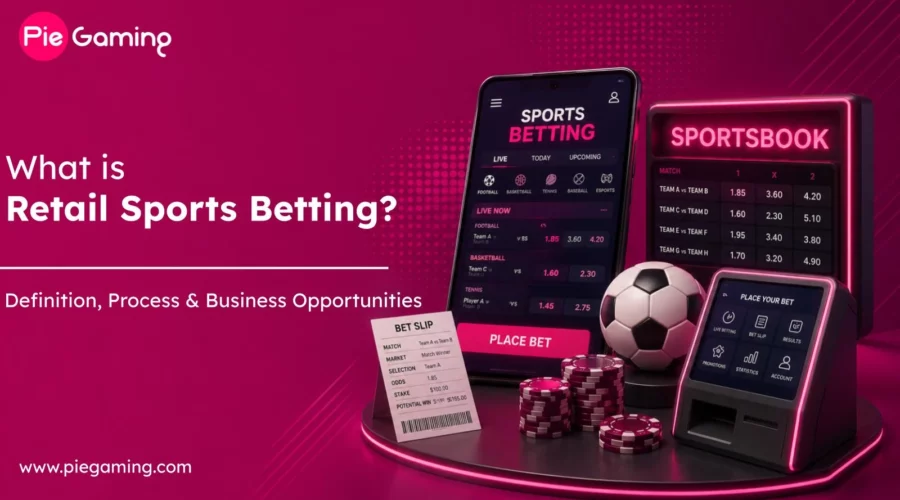
Retail sports betting means wagering placed in person at licensed physical locations, such as sportsbook windows located in casinos, racetracks, or dedicated betting shops. Unlike online betting, where wagers are entered via the app or the web, retail betting places the bettor in physical attendance.
In a digital-first world, retail betting is a viable solution for many reasons: cash transactions, personal touch, and the communal ambiance of a live environment. None of which an app can match. Operators are getting off to a good start by designing omnichannel ecosystems of the consumer, where retail and digital channels are not competitors but part of the same ecosystem, run from a single sportsbook platform.
Demand is scaling with it. The global market for sports betting was worth $100.9 billion in 2024 and is estimated to touch $187.39 billion by 2030, growing at a CAGR of 11%. In the US alone, revenue surged from $400 million in 2018 to over $11 billion in 2023 following the repeal of PASPA.
Since legalization, US sportsbooks have posted over $600 billion in cumulative legal wagers. The next frontier is emerging markets. Cricket betting will be the fastest-growing segment through 2030, powered by an explosive smartphone adoption and progress in regulation in India, Pakistan, Bangladesh, and Africa.
How Retail Sports Betting Works?
Knowing the retail betting journey lets game operators create better venues, and players make better decisions. Here’s how it unfolds:
Step 1: Entering the Venue
The bettor enters a licensed sportsbook, a casino, a racetrack, or a standalone betting shop. Staff verifies age and identity at entry, where required by local regulation.
Step 2: Viewing the Odds
Live odds on large digital display boards, wall-mounted screens, and self-service kiosks show live odds across markets. The odds change in real time, updated on the fly, taken directly from the operator’s trading platform.
Step 3: Placing the Bet
The bettor has two choices: a staffed counter or a self-service kiosk. Counters provide personal assistance. Kiosks enable quicker, independent wagering. Both accept cash, with many now supporting cards and digital wallets.
Step 4: Receiving the Betting Slip
A printed slip is issued immediately at the counter or kiosk. It contains the event, selection, betting odds, stake, and potential payout. This slip is the bettor’s sole evidence of wagering.
Step 5: Watching the Game
Most sportsbooks are equipped with in-venue screens projecting live coverage. This helps to maintain interest among bettors as well as to facilitate in-play bets at the counter.
Step 6: Collecting Winnings
Winning slips are redeemed at the cashier counter. Many venues are now offering kiosk-based payouts for amounts below a set threshold, saving time in queues.
Role of Staff vs. Automation
Modern retail sportsbooks combine human touchpoints with automation. Staff take high-value bets, sort disputes, and answer customer queries. Kiosks and self-service terminals handle high-volume, low-complexity transactions, reducing wait times and operational expenses.
Backend System Integration
Each bet placed at a counter or kiosk is entered into a centralised sportsbook management system in real time, which a turnkey sportsbook solution bundles rather than leaving operators to wire it together. This system manages odds calculation, liability management, risk exposure, and regulatory reporting, giving a single view of exposure across every touchpoint in the estate.
Retail Sports Betting vs Online Betting
| Feature | Retail Sports Betting | Online Sports Betting |
| Betting Method | Bets are placed physically at sportsbooks, casinos, or kiosks | Bets are placed through websites or mobile apps |
| Accessibility | Requires visiting a physical location | Accessible anytime and anywhere |
| User Experience | Social, immersive, and venue-based | Personalized and convenience-driven |
| Interaction | Includes staff assistance and in-person support | Mostly self-service and automated |
| Payment Options | Cash, vouchers, cards, and counters | Digital wallets, cards, crypto, bank transfers |
| Speed of Betting | Slightly slower due to physical processes | Instant bet placement and withdrawals |
| Live Experience | Large screens, live crowd atmosphere, and entertainment | Individual viewing through mobile or desktop |
| Operational Costs | Higher due to venue and staffing expenses | Lower infrastructure and operational costs |
| Customer Engagement | Stronger physical brand engagement | Higher digital engagement and retention tools |
| Scalability | Limited by physical locations | Easily scalable across regions |
| Popularity Driver | Experience and trust | Convenience and accessibility |
| Technology Used | Betting kiosks, POS systems, display boards | Mobile apps, AI algorithms, live-stream integrations |
| Regulation | Depends on local/state venue licenses | Depends on the online gambling regulations by jurisdiction |
| Ideal For | Players seeking immersive betting experiences | Players prefer quick and flexible betting |
Read More – How to start a sportsbook
Key Features of Retail Sports Betting Platforms
Now, modern retail sportsbooks are no longer just rooms with TVs. They are high-tech ecosystems aimed at speed, security, and immersion. Physical venues have specialized hardware and integrated software to compete with mobile apps.
1) Real-Time Odds Display
Static boards are in the past. Today’s venues operate Digital Odds Walls with live data feeds. These setups rely on Managed Trading Services (MTS) for instant pricing updates. If a major player gets injured, the odds onscreen shift in just a matter of milliseconds, meaning the house never sees “stale” lines. Choosing between sports betting odds providers is what makes that possible.
2) SSBTs (Self-Service Betting Terminals)
Kiosks form the backbone of modern retail. These touch-screen units enable users to explore thousands of markets without waiting in line. By 2026, a lot of SSBTs will offer AI personalization. If a user scans a loyalty card, the kiosk recommends bets based on the customer’s history.
3) Live Betting Support in-Play (Live)
More than 70% of sportsbook revenue worldwide flows through live betting. Retail platforms also began offering “micro-betting” on-site. On handheld tablets or kiosks in the area, users can wager out of their seats about what the next play or the next point might be.
4) Omnichannel Payment Systems that are Secure
Highstreet retention calls for flexibility. As of this point, retail platforms are now offering:
Cash and Vouchers: The security of privacy and instant gratification.
Contactless & E-wallets: Quick deposits through Apple Pay or Google Pay, the same digital wallet payments players already expect online.
Single-Wallet Integration: Deposit cash at a store and check the balance instantly through your mobile app.
5) Advanced Ticketing and Payouts
Trust is built on the reliability of payouts. Today’s systems use an encrypted TITO (Ticket-In, Ticket-Out) system. Users are provided a thermal slip that is secured alongside a unique QR code. They can be redeemed for cash at a teller or scanned at a kiosk for instant funds to cover the next bet.
6) Interactive Player Engagement
To keep users on-site longer, platforms have integrated live zones. These areas have 2D/3D match visualizations and real-time statistics. Retailers turn a basic shop into an expert-level “war room” for bettors by offering insight into vast amounts of data on-site.
Pros and Cons of Retail Betting
| Pros of Retail Sports Betting | Cons of Retail Sports Betting |
| Offers a social and immersive betting experience | Requires physical presence at a betting venue |
| Creates stronger player engagement and entertainment value | Limited accessibility compared to online betting |
| Builds trust through face-to-face transactions | Higher operational and infrastructure costs |
| Supports cash-based betting options | Dependent on venue footfall and location |
| Provides live match viewing with sportsbook atmosphere | Slower betting process during peak hours |
| Enhances brand visibility through physical venues | Difficult to scale across multiple regions |
| Allows staff assistance for beginners and support | Limited operating hours in some jurisdictions |
| Generates additional revenue through food, beverages, and events | Competition from fast-growing mobile betting apps |
| Encourages longer player retention within venues | Regulatory compliance costs can be high |
| Combines entertainment, hospitality, and wagering in one place | Requires continuous maintenance of kiosks and hardware |
Benefits of Retail Sports Betting for Operators
Retail is not only a legacy channel. By understanding its strategic role, it offers operators advantages that digital alone cannot replicate.
Customer Acquisition Channel
Physical sportsbooks bring in organic foot traffic that no paid digital ad campaign can completely substitute. A well-placed betting counter inside a casino or stadium exposes the brand to thousands of visitors who may never have downloaded an app before. Often, operators use retail as their point of contact. They bring bettors onto the system physically first and then gradually bring them onto the digital network. This model of omnichannel acquisition lowers CAC – the general customer acquisition cost.
Higher Trust & Brand Visibility
Having a physical presence signals legitimacy. In regulated markets where bettors are wary of online fraud, a licensed retail venue gains credibility more quickly than digital marketing expenses. Brand signage, uniformed staff, and a safe environment convey reliability at scale. This is more crucial in emerging markets, namely across Africa, South Asia, and Latin America, where the first contact of a consumer and a broker is with a retail betting shop.
Cash-Based Betting Markets
Worldwide, a large proportion of sports bettors are unbanked or underbanked. In Sub-Saharan Africa, Southeast Asia, and portions of South Asia, cash remains the primary form of transaction. There’s a sector that retail sportsbooks are directly catering to, no card, no app, no bank account required. Retailers maintain outlets in these markets and capture bettors’ base that online-only platforms structurally cannot serve.
Cross-Selling Opportunities
Convenient retail facilities introduce natural cross-sell situations. A bettor who has redeemed a winning slip is literally on the floor at a remove from slot machines, table games, and casino locations. Many operators are also told they get significantly more customer lifetime value (LTV) from those who bet on sports and play in the casino. This is enhanced through programmes of loyalty. Card-based and app-linked schemes reward bettors at retail and online touchpoints that drive retention and average spend per visit.
Legal and Regulatory Considerations
Running a retail sportsbook has many local and international laws that you must get your head around. Venues built physically are regulated by zoning and property rules, which are distinct from our online counterparts.
1) Licensing Requirements
If your operator wants to open a retail venue, it should have a Business-to-Consumer (B2C) license. Global rules have moved towards this centralization by 2026. For instance, Curaçao’s new LOK framework requires stricter due diligence and transparency of business operations. Our guide to securing a gaming license covers the process end to end. Common requirements include:
- Minimum Share Capital:
- In jurisdictions such as Malta, at least €40,000 to €100,000 in capital would be required, based on the nature of the service.
- Technical Audits:
All SSBTs (as well as backend software) need to be approved by the regulators to ensure fair play and RNG (Random Number Generator) integrity.
2) Regional Legality Differences
- United States:
Regulation happens at the state level. Over 38 states, since the 2018 PASPA overturned, have legalized some sort of sports betting, though some continue to strictly limit wagering to retail kiosks and storefronts located in casinos or stadiums.
- Brazil:
Brazil’s fully regulated market has gone full swing in 2026. The government has cleared more than 15,000 illegal pages to protect licensed operators and make sure physical betting shops are not only safe but also a boon.
- India:
The PROG Rules 2026 are a powerful framework. Online “money games” are largely banned, but skill-based sports betting has found a place under state laws.
3) Compliance and Responsible Gambling (RG)
Retailer operators bear a “face-to-face” responsibility. And compliance teams are required to put in place:
- Age Verification:
Very strict KYC (Know Your Customer) procedures to stop underage betting.
- Self-Exclusion Databases:
Retail kiosks have to correlate with national databases to immediately block the excluded.
- Financial Risk Checks:
Now, in areas such as the UK, operators administer so-called “affordability checks” to make sure players aren’t betting beyond their means.
4) The Role of Regulated Operators
A regulated path is definitely the only option for 2026. Licensed operators gain access to premium odds feeds, banking partners, and trusted marketing affiliates. More importantly, regulation makes consumers trust you. Bettors are 40% more likely to come to a venue if it has a seal from the regulatory authority, and its money and data are safe from any outside influence, too.
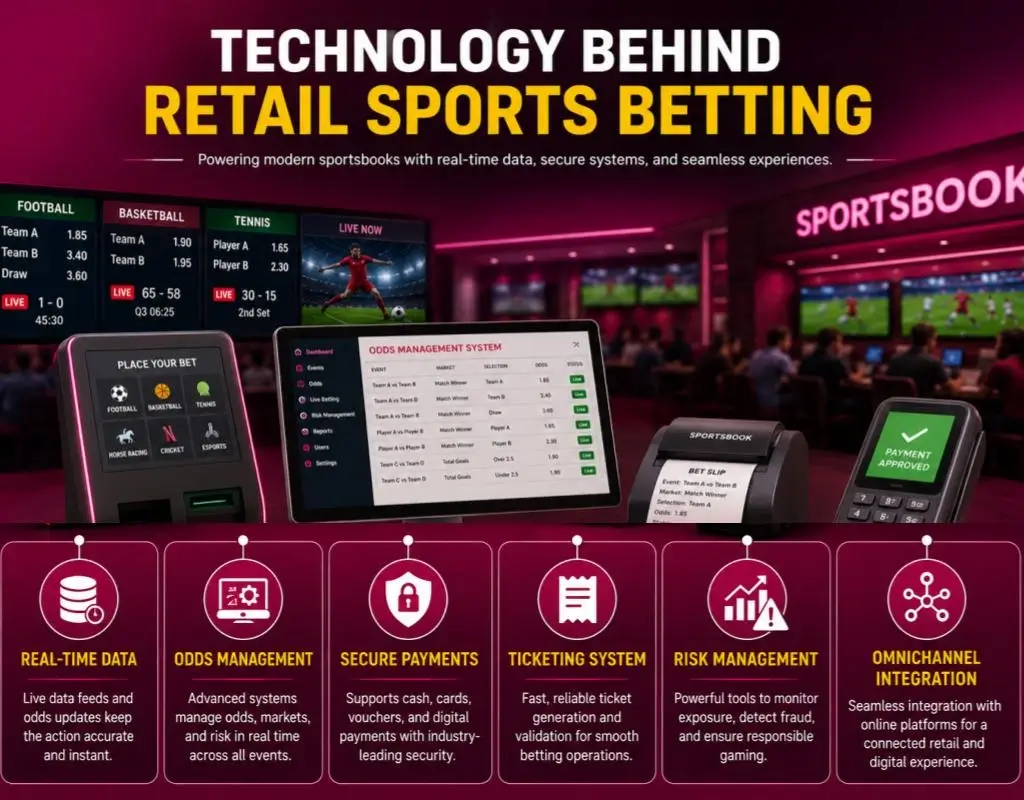
Retail Sports betting Infographics
Technology Behind Retail Sports Betting
The modern retail betting shop has become an enterprise at all levels of integrated technology. To stay competitive in 2026, venues depend on a blend of strong hardware and cloud-native software that mirrors the speed of online platforms.
1) Advanced Retail Betting Platforms
The “brain of the operation” is the Odds Management System (OMS). That software consumes millions of points of information a second from providers like Betradar or Genius Sports. It is able to make prices on shop screens update instantly.
- Risk Management:
- AI-driven iGaming risk management modules monitor betting patterns. Its ability to adapt the lines and/or limit exposure will help to safeguard the operator’s margin if the system identifies a “sharp” bettor or unusual jump on a given match.
- Offline Sync:
High-end retail software now offers smart offline processing. The system handles bets locally if there’s a failure of the internet; reconciliation with the central server takes place when internet connectivity is restored.
2) Betting Interiors, Kiosks
SSBTs in retail have changed the game. They are more than computers – these are high-performance machines that handle:
- Hardware Integration:
Kiosks incorporate thermal printers to securely take bet slips and barcode scanners to automatically validate the ticketing on the fly.
- Biometric Readiness:
By 2026, many terminals will have facial recognition or fingerprint scanners to confirm a player’s age and identity without the need for a human hand holding the line.
3) POS & Payment Systems
It is the Point of Sale (POS) system that performs all the heavy lifting of cash and digital transactions.
- Cash Management:
Modern POS systems employ automated “bill acceptors” to authenticate currency and minimize the risk of manual accounting errors.
- Voucher Systems:
Operators also have TITO (Ticket-In, Ticket-Out) technology. A player who wins a wager receives a voucher and can scan it at any terminal, or at another store belonging to the same brand, to carry the balance straight into the next bet.
4) Backend Infrastructure
All of this is held together by RESTful and GraphQL APIs, which let retail shops talk to the sportsbook’s central engines.
- Data Feeds:
Low-latency feeds offer immediate score and Micro Markets (such, for example, as “who has the next point”?).
- Unified Wallet:
This supports the ability to link a user’s retail use through API integrations to their other accounts. This enables operators to follow a player as they navigate between the high street and their home mobile app.
Challenges in Retail Sports Betting
While retail sports betting has high involvement and engagement, it brings a different set of structural and fiscal problems that online operators do not face. Going beyond the digital-only model and transitioning into a physical one involves huge changes in resource deployment.
1) High Operational Costs (CAPEX and OPEX)
Running a physical sportsbook is a costly experience. In contrast to an app, which can scale at low physical overhead, retail has CAPEX required for high-end displays, SSBTs, and secure furniture. Operating Expenses (OPEX) are continuous as well, including rent for prime locations, electricity for 24/7 video walls, and maintenance of specialized hardware.
2) Staffing and Human Capital
The “human element” drives retail success. Operators must bring on and train tellers, hospitality staff, and security personnel. In 2026, finding employees who are experienced in sports betting markets and adhere to strict Know Your Customer (KYC) requirements is a challenge. High staff turnover may also degrade the consistency of the customer experience.
3) Scalability vs. Online
An online platform can handle 10,000 bets per second from anywhere within a licensed territory. A retail store is confined by its own physical size. Because of mass events such as the World Cup or Super Bowl, shops can be crowded with thousands, and there can be long lines at counters and terminals. Scaling a retail business begins with finding a piece of real estate to occupy, securing relevant local permits, and setting up physical shop spaces.
4) Stricter Regulatory Constraints
Local authorities scrutinize retail shops constantly. Many jurisdictions have strict “Zoning Laws,” preventing shops from existing in proximity to schools or other residential centers. Retail is also subject to local tax differences. New municipal policy has the potential to directly impact the bottom line of a particular location, at a lower risk for centralized online services.
Conclusion
For the gaming industry, retail sports betting is still the lifeblood of the industry. Certainly, the speed and scale of online platforms are unmatched, yet a sportsbook’s physical presence enables social, high-trust settings that digital tools cannot.
By 2026, the best operators are no longer those who see retail and online as rivals. Rather, they adopt an omnichannel approach. Using the fact that retail shops operate as high-profile locations for acquisition and online sources for 24/7 access, brands can have a full profile of the players’ conduct.
As technology such as AI-powered kiosks and unified wallets narrows the divide, the separation between “in-person” and “on-app” betting is about to become blurrier and blurrier. Retail is not dying; it is continuing to evolve into something more secure, social, and tech-savvy than it has ever felt.
If the online half of that omnichannel picture is still missing, our white-label sportsbook solution covers it, with a shared wallet across retail and digital.

FAQs
-
Is retail betting legal everywhere?
No, retail sports betting is only legal in regulated jurisdictions where gambling laws permit licensed sportsbook operations.
-
Do retail sportsbooks accept cash?
Yes, most retail sportsbooks support cash payments along with cards, vouchers, and other approved payment methods.
-
What sports can you bet on in retail sportsbooks?
Retail sportsbooks typically offer betting on football, basketball, cricket, horse racing, tennis, esports, and many other sports.
-
Is retail betting profitable for operators?
Yes, retail betting can be highly profitable through betting margins, customer retention, in-venue spending, and omnichannel engagement.
-
Are retail sportsbooks safe and regulated?
Yes, licensed retail sportsbooks operate under strict regulations related to security, fair play, payments, and responsible gambling.
-
Do retail sportsbooks offer live betting?
Yes, many modern retail sportsbooks provide in-play or live betting with real-time odds updates during matches.

Jaya Swaroop has been covering iGaming and betting technology since 2019, with a specialization in online casino platforms, sportsbook solutions, and licensing frameworks. Her work involves analyzing platform capabilities and evaluating cost structures, compliance requirements, payment integrations, market strategies, and regulatory updates that impact operators entering or scaling in the iGaming space. With a background in B2B marketing and content strategy, she has contributed to SEO-led growth and demand generation initiatives for global businesses. Jaya holds a Bachelor’s degree in Science (Chemistry & Mathematics) and is certified in content writing, email marketing (HubSpot), project management, and Google Analytics.

Micro betting is a type of live sports betting that focuses on the small moments within a game. Instead of wagering on the final result, bettors place bets on what happens next, such as the outcome of the next pitch in baseball, point in tennis, possession in basketball, or ball in cricket. Because these events are settled almost instantly, micro betting offers a faster and more dynamic experience than traditional sports wagers.

Esports betting offers a major opportunity to operators, and choosing the right partner can greatly impact profitability, player engagement, and operational efficiency.

Read about what horse racing betting software includes — tote and fixed-odds markets, race feeds, and payments — plus what a build or a full license costs.
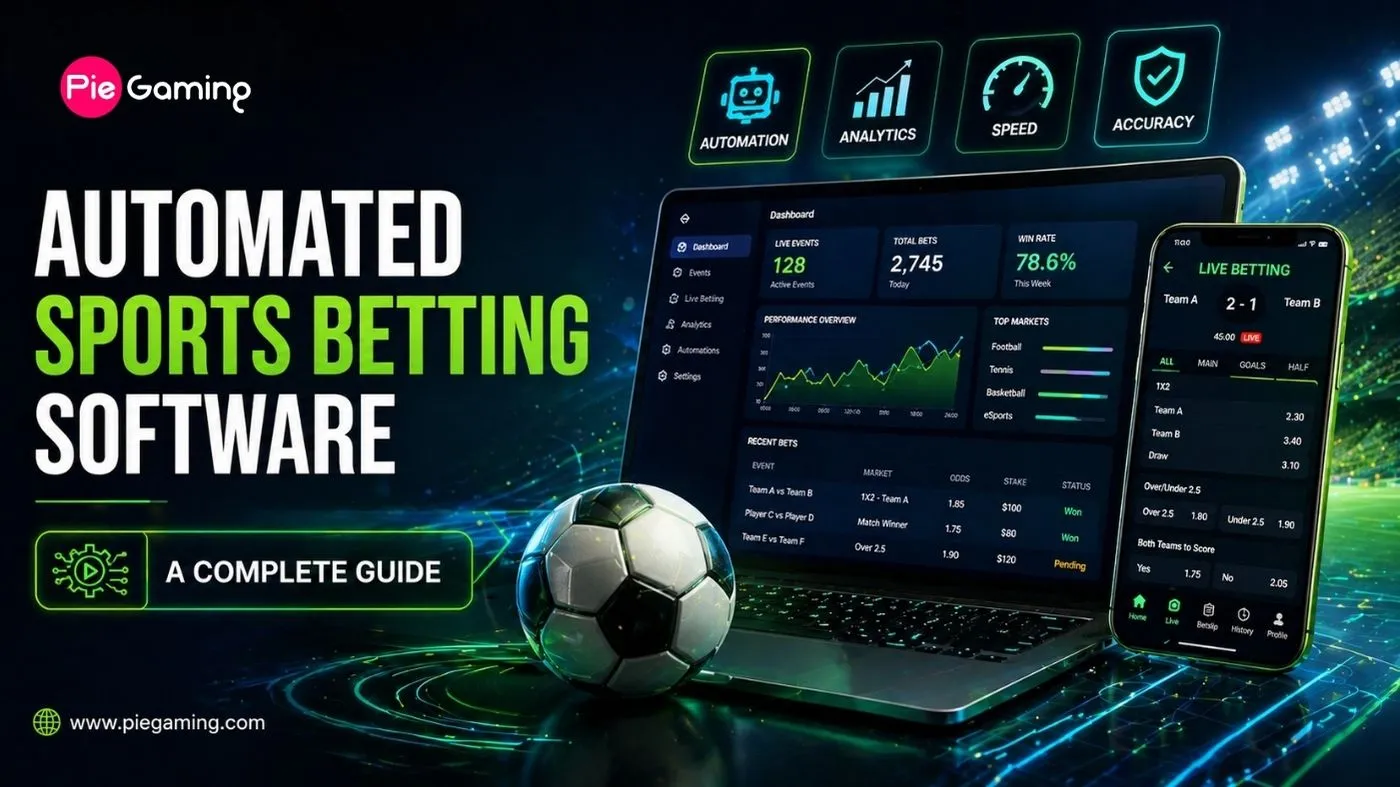
Learn how automated sports betting software handles odds, bet acceptance, risk, and payouts – what operators can automate and what still needs a trader.

Learn about how sports betting algorithms price odds and manage risk, plus the leading algorithm software compared on data, models, and integration options.
Learn how esports betting works as a vertical — titles, markets, odds feeds, and the software operators need to add esports to an existing sportsbook.

Learn how AI is used in sports betting for odds pricing, fraud detection, live markets, and player segmentation — and what it changes for operators.

See you in your inbox soon!

Stay ahead of the game. Subscribe for exclusive content, updates, and insiders!