
Kenya has a growing online gambling market supported by increasing internet adoption and mobile payment systems. This guide clarifies the steps and protocols you can follow for setting up an online casino business in Kenya, including regulations and licensing requirements.

Kenya is betting big, and the numbers prove it. With a mobile-first population and round-the-clock internet access, the country is one of Africa’s most exciting digital gambling markets.
In fact, Kenya’s betting sector generated over KSh 13 billion in excise duty in 2024–2025 financial year, highlighting just how active and monetized the ecosystem has become. This momentum has opened serious opportunities to start a successful online casino business in Kenya, especially for early-stage casino operators. Whether you’re a startup or an established investor, this is your blueprint for navigating Kenya’s 2026 market. We focus on getting you from licensing to launch with a clear, compliant, and scalable strategy.
Is Online Casino Business Legal in Kenya?
Online casinos are permitted in Kenya, provided they operate within the state’s official regulatory bounds. This framework is anchored by the long-standing Betting, Lotteries and Gaming Act (Cap. 131), which has governed the sector since its enactment in 1966.
This legislation forms the legal foundation for all betting and gaming activities in the country, including online and mobile-based gambling.
Gambling Laws in Kenya Explained
At its core, the industry is anchored by the Betting, Lotteries and Gaming Act, which dictates exactly how licensing, taxes, and operations should run. The BCLB holds the reins here, and they don’t take compliance lightly.
To stay legal, you need their stamp of approval and a solid commitment to their reporting and responsible gaming standards. The takeaway for any serious operator is clear: Kenya isn’t a ‘wild west’ or a grey market, it’s a fully transparent, enforcement-driven environment.
What Is Allowed vs Prohibited
Here’s how legality breaks down in practice:
- Online casinos: Allowed only when licensed locally by the BCLB. Unlicensed platforms are illegal.
- Sports betting: Fully legal and deeply rooted in the culture; this is the most mature and widely regulated gambling segment in the country.
- Offshore vs locally licensed casinos: Kenya is a “local-first” market. Offshore operators are strictly barred from targeting local punters unless they’ve gone through the full BCLB licensing process. Regulators actively favor locally licensed operators with compliant infrastructure and tax registration.
Recent Regulatory Updates (2025–2026)
The 2025–2026 period marked the end of the ‘wait and see’ era for Kenyan gambling. Authorities have tightened the screws on everything from advertising standards to payment of transparency.
The big takeaway? The regulator is prioritizing consumer safety and clear financial trails above all else. If you’re planning to launch, you need to be prepared for higher levels of scrutiny. However, those who lean into these changes early will find it much easier to scale without hitting regulatory walls later.
Under the Finance Act 2025, Kenya reduced both excise duty on wagers and withholding tax on winnings to 5%. Despite the lower rate, government betting tax revenue is expected to rise significantly, projected at Sh11.4 billion, compared to Sh5.4 billion previously.
This increase is driven by a broader tax application, where the 5% levy now also applies to transfers between mobile money accounts and betting wallets, even before a wager is placed.
For anyone entering the market now, aligning early with BCLB requirements isn’t just safer; it’s smarter.
Read Blog: Where are online casinos legal
Kenya Online Gambling Market Overview
For operators, Kenya has clearly moved beyond the “emerging market” label. With a population of 55+ million and a median age of around 20, it is one of Africa’s youngest and most digitally active markets. High mobile penetration and affordable data have essentially moved Kenya’s entire gambling ecosystem onto the small screen.
We’re seeing sports betting revenue stay on a solid track with a 6.19% CAGR, but the real momentum is shifting toward online casinos. Because slots and crash games provide high-speed engagement 24/7, they’re quickly becoming the preferred choice for players who want more than just a bet on a match day.
As player activity and revenues grow, Kenya’s regulatory framework is evolving alongside the market. For both local and foreign operators, this combination of scale, mobile behavior, and regulatory momentum makes Kenya one of the most commercially attractive iGaming markets in Africa heading into 2026.
Why 2026 Is a Strategic Entry Year
For operators entering Kenya in 2026, the focus shifts from experimentation to scaling efficiently and profitably.
Kenyan players are young, mobile-native, and value speed. Slots and instant-win games dominate the charts because they’re easy to jump into, though we’re seeing a real surge in live dealer games as players look for a more interactive experience. What’s interesting is the spending pattern: it’s a high-volume market.
Players usually make smaller, more frequent deposits, which means your success doesn’t rely on ‘big spenders’ but on how well you can retain the average user through smart bonuses and frictionless payments.
Step-by-Step Breakdown to Starting an Online Casino in Kenya
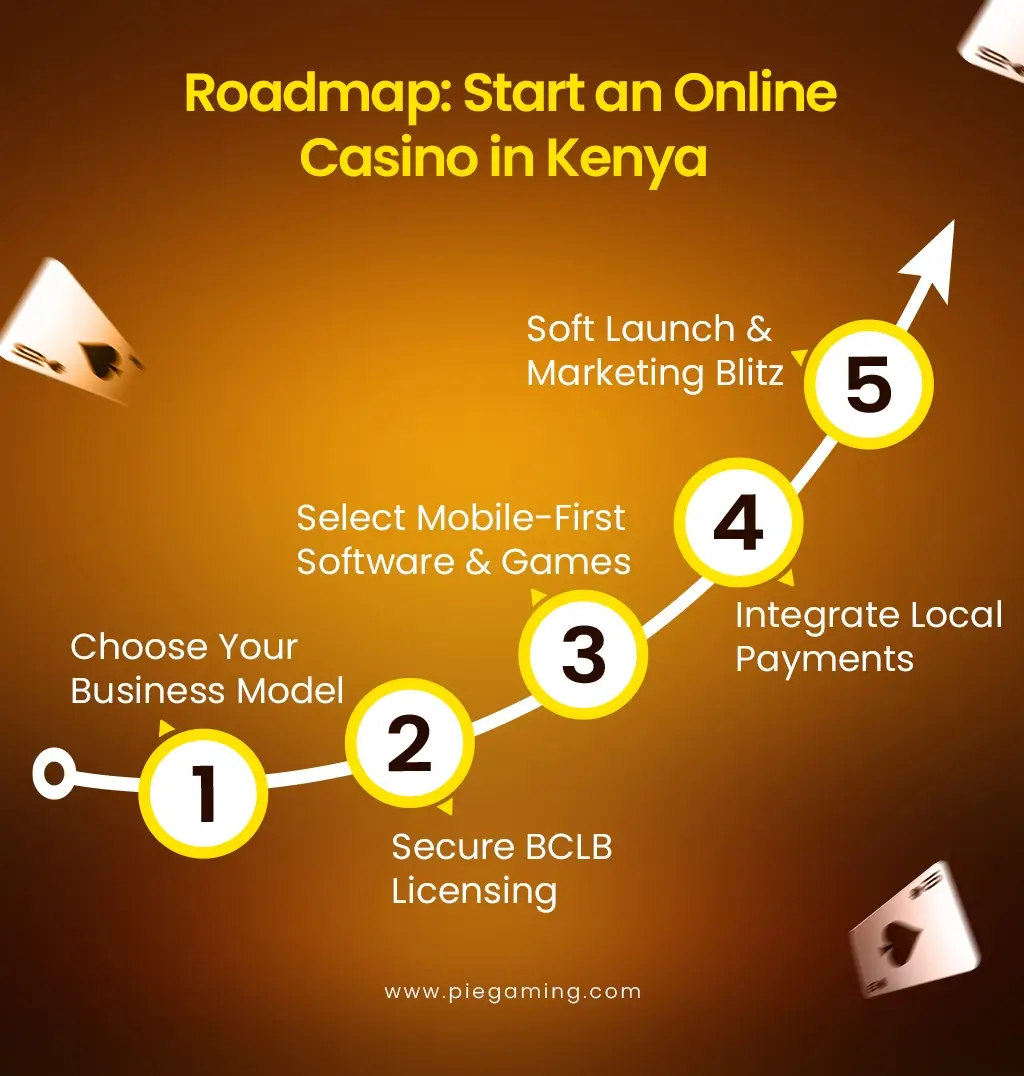
Guide to start an online casino in Kenya
Entering this market is more than just going live; it’s about being compliant and scalable from day one. You need a platform that’s built for the Kenyan mobile user. If you’re looking to launch, here is the realistic, step-by-step path most operators follow to get it right.
Step 1: Decide Your Casino Business Model
First, you need a clear vision of how you’re going to run the business. This isn’t just a detail; it’s a decision that sets the pace for your budget, your speed to market, and your long-term flexibility in the Kenyan landscape.
Most operators entering Kenya choose between two models:
White-label casino
For a rapid entry, this is ideal. The games, wallets, and management tools are already baked in and ready. You simply take the wheel on branding, marketing campaigns, and the daily business operations.
- Faster launch (weeks, not months)
- Lower upfront investment
- Ideal for startups and first-time operators
Turnkey casino platform
A fully custom casino platform offering greater control and flexibility, but requires more capital, time, and technical oversight.
- Higher setup and maintenance costs
- Longer development timelines
- Best suited for experienced or enterprise-level operators
Many operators entering Kenya in 2026 start with a white-label platform and gradually move toward customization as the business scales. Pie Gaming’s online casino software is designed to support this evolution, allowing operators to launch quickly without limiting future growth.
Step 2: Secure Licensing
Securing an iGaming license is a non-negotiable step. Though Kenya is not a grey market, operating without approval carries serious legal and financial risk.
To operate legally, you must secure a green light from the BCLB. They don’t just check your paperwork; the Board looks for real-world proof that your tech is solid, and your ownership is transparent.
Key point for operators:
Licensing is not something you “handle later.” Your platform, payments, and company structure must already align with regulatory expectations before approval is granted.
Step 3: Choose Software & Games
Your casino software is the backbone of the business. It dictates how players feel on the site, how smoothly you run the back-office, and whether your reporting keeps you on the right side of regulators.
Operators entering Kenya should prioritize:
- Mobile-first architecture
- Stable wallet and transaction handling
- Real-time reporting and player monitoring
- A game portfolio suited to short, frequent play sessions
Kenyan players prefer slots, instant-win games, crash games, and live casino formats. A strong platform must support these without performance issues.
PieGaming delivers a ‘ready-to-go’ casino ecosystem. By baking in games, wallets, KYC, and risk tools from the start, we’ve removed the headache of juggling multiple vendors or dealing with glitchy, third-party integrations.
Step 4: Integrate Payments
Payments are one of the most critical success factors in Kenya. Even minor delays in deposits or withdrawals can quickly erode players’ trust and hurt retention. Kenyan players expect transactions to be fast, familiar, and transparent.
Operators should focus on:
- Instant deposits
- Fast withdrawals
- Clear transaction visibility
To meet player expectations, your payment flow has to be local. That means putting M-Pesa front and center for quick transactions, while keeping bank transfers in the mix to manage higher-value player movement.
Step 5: Launch & Market
A successful launch is rarely a “big bang.” Most operators opt for a soft launch, testing payment flows, bonus mechanics, player onboarding, and mobile UX.
Marketing should begin early, with budgets allocated for:
- Player acquisition
- Retention campaigns
- Bonuses and promotions
Online Casino Licensing in Kenya (BCLB)
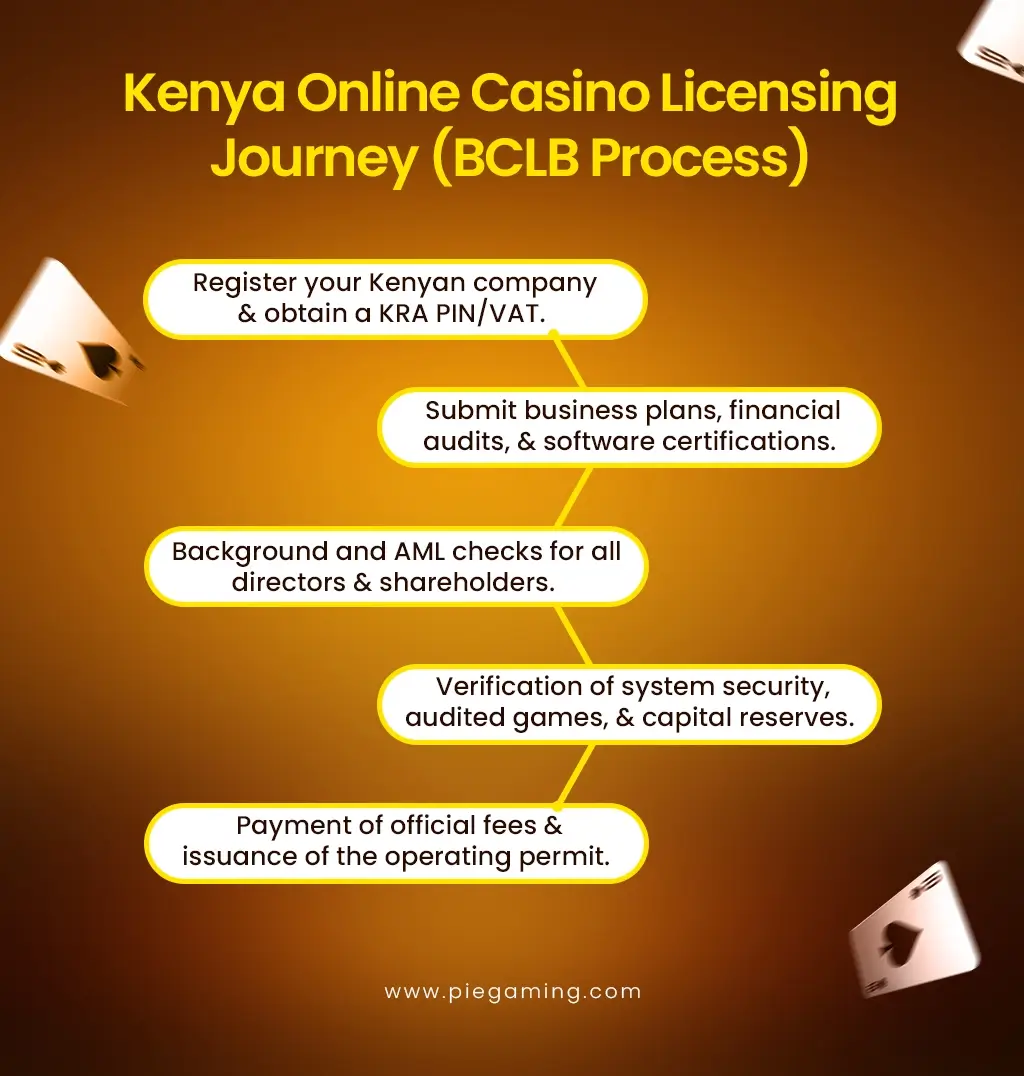
Kenya online casino licensing process
Licensing lies amongst the most critical steps if you plan to open an online casino software in Kenya. Kenyan casino industry operates under a regulated framework, and authorities actively monitor online casino software operators. This makes Kenya a structured but opportunity-rich destination for businesses planning a long-term online casino business Kenya strategy.
Betting Control and Licensing Board (BCLB) oversees all gambling activities in Kenya. Any operator offering online casino games to Kenyan players must hold a local license. Offshore licenses alone are not sufficient to operate legally in the Kenyan market.
License Types & Fees
Online casino license
An online casino license allows operators to run an online casino platform with games such as slots, live dealer games, and instant-play games. This license is mandatory before any real-money operations can begin. Without it, payment providers and marketing channels are unlikely to work with you.
Annual renewal costs
Licensing in Kenya is not a one-time process. The BCLB requires annual renewals, which include compliance reviews and fee payments. These renewal costs should be factored into the overall online casino setup cost Kenya operators plan for, especially when forecasting long-term profitability.
Licensing Requirements and Process
Protecting players and tracking the money are the BCLB’s top priorities, which is why their vetting process is so intense. Most operators follow this step-by-step sequence:
Company registration – Start by registering a Kenyan company and tackling the KRA requirements immediately. You’ll need that Tax PIN and VAT registration before you can move an inch further.
License application – A formal application is then submitted to the BCLB along with supporting documentation, including:
- Certified company incorporation records
- Shareholder and director disclosures
- Audited financial statements
- Detailed business and operational plans
- System certifications confirming the security and reliability of gaming and payment software
Due diligence checks – The BCLB doesn’t take your word for it. They dig deep into the histories of your directors and shareholders, looking for solid financial standing and a clean track record. Their main goal here is to ensure your team meets strict AML (Anti-Money Laundering) benchmarks.
Technical and financial review – Applicants are required to show that they have the liquid capital to stay afloat and a technical stack that is both secure and audited. Expect the regulator to grill you on your data privacy protocols and how you plan to monitor suspicious transactions.
Approval and fees – Once approved, operators can complete the payment process of licensing and annual renewal fees before they go live.
Common rejection reasons
Applications are commonly delayed or rejected due to:
- Incomplete or inconsistent documentation
- Unclear or complex shareholding and ownership structures
- Casino platforms that lack proper reporting, audit trails, or transaction visibility
- Payment or wallet systems that do not meet regulatory transparency standards
Operators planning to start an online casino in Kenya in 2026 should ensure their legal, technical, and operational systems are fully in place before applying.
Cost Breakdown: Starting an Online Casino in Kenya (2026)
Understanding costs early helps avoid cash-flow issues later. The online casino setup cost Kenya varies depending on business model, technology, and scale.
| Item | Estimated Cost (KES) | Estimated Cost (USD) |
| Application Fee | KES 1,000,000 | ~$7,700 |
| Online Casino License (Grant) | KES 5,000,000 | ~$38,500 |
| Annual License Renewal | KES 3,000,000 | ~$23,000 |
| Security Bond (Bank Guarantee) | KES 100,000,000 | ~$770,000 |
| Compliance/Vetting Fee | KES 500,000 | ~$3,800 |
Disclaimer: The above-mentioned prices are indicative. Prices may vary as per the jurisdiction of updates. It’s advisable to contact the regulator directly to get up-to-date information.
Read Blog – How to Get an Anjouan iGaming License?
Choosing the Right Online Casino Software Provider in Kenya
Success starts with your tech stack. The wrong casino software will paralyze your operations and trigger compliance with red flags. Choosing the right Online casino software provider in Kenya is the difference between a scalable business and one that’s constantly fighting its own tech.
White Label vs Custom Casino Software
White label casino software platforms allow faster launches and lower upfront costs, making them ideal for new operators entering the casino business in Kenya 2026 market. Custom platforms offer greater control but require higher investment and longer timelines.
Many operators start with white-label and gradually customize as revenue grows. Pie Gaming supports this flexible growth approach.
Key Features to Look For
Mobile optimization
Mobile-first design is non-negotiable in Kenya.
Back-office & reporting
Operators need real-time visibility into players, payments, bonuses, and risks.
Player account management
KYC, segmentation, responsible gaming tools, and fraud monitoring should be built in.
Payment Solutions & Mobile Wallet Integration
Payments directly affect conversion and retention. Kenyan players expect fast, familiar payment methods.
M-Pesa Integration (Must-Have)
M-Pesa online casino integration is essential. It is the most widely used payment method in Kenya. Casinos without M-Pesa support struggle to acquire and retain players.
Local Bank Payments
Bank transfers are still used for higher-value deposits and withdrawals and add credibility to the platform.
E-Wallets & Crypto Options
While secondary, these options add flexibility and future-proofing, especially cross-border operations.
Payment Compliance & Fraud Prevention
Payment systems must support KYC verification, transaction monitoring, and fraud detection. Weak controls increase regulatory risk and operational losses.
Read Blog – Top 10 iGaming Payment Solutions Providers
Common Mistakes to Avoid
Operating without a license: This leads to shutdowns, penalties, and blocked payments.
Poor payment integration: Slow or unreliable payments destroy player trust.
Ignoring mobile users: Desktop-focused platforms underperform in Kenya.
Underestimating marketing costs: Acquisition and retention require sustained investment, not one-time campaigns.
Wrapping Up
Launching an online casino in Kenya in 2026 is a high-reward venture that requires a sophisticated balance of regulatory compliance and local market insight.
While the Gambling Control Act 2025 has raised the bar for entry with stricter licensing and higher security bonds, it has also fostered a more stable and transparent ecosystem for long-term investment.
Now is the strategic moment to capitalize on Kenya’s maturing digital economy and establish a dominant presence in Africa’s most vibrant gaming hub.

FAQ's
-
What is the actual cost of the new mandatory Security Bond in 2026?
To protect players and ensure tax compliance, the Kenyan government now requires a security bond of KES 100 million for online gambling licenses. This is a significant jump from previous years and serves as a financial guarantee that your business can cover major winning payouts and monthly tax obligations to the KRA.
-
How important is M-Pesa for player conversion and retention?
It is extremely important. M-Pesa is the dominant payment method in Kenya, and casinos without seamless M-Pesa online casino integration typically struggle with both onboarding and repeat play. Players expect instant deposits, fast withdrawals, and familiar payment flows; anything less impacts trust and retention.
-
How does the KRA’s "Real-Time Monitoring" affect my software choice?
Since early 2026, the Kenya Revenue Authority (KRA) and the Gambling Regulatory Authority (GRAK) have required all casino platforms to have an active API link for real-time transaction monitoring. Your software must be capable of reporting every bet, win, and tax remittance (including the 15% GGR tax) instantly to avoid heavy fines or license suspension.
-
What are the basic requirements to get a Kenyan Gaming license?
To obtain a Kenyan gaming license in 2026, you must meet these five core pillars: Must be registered in Kenya with a physical office. Minimum 30% of shares must be held by Kenyan citizens. A security guarantee of KES 100 million (for online operators). Mandatory API link to GRA/KRA for automated tax reporting. All directors must pass background checks and hold valid tax compliance certificates.
-
Is a Kenyan iGaming license valid nationwide?
Yes. Online gambling licenses are issued at the national level by the Gambling Regulatory Authority (GRA), allowing you to acquire players from all 47 counties. However, if your business includes a physical retail presence (like branded betting shops), you must additionally secure trade permits from each individual county government where you operate.

Jaya Swaroop has been covering iGaming and betting technology since 2019, with a specialization in online casino platforms, sportsbook solutions, and licensing frameworks. Her work involves analyzing platform capabilities and evaluating cost structures, compliance requirements, payment integrations, market strategies, and regulatory updates that impact operators entering or scaling in the iGaming space. With a background in B2B marketing and content strategy, she has contributed to SEO-led growth and demand generation initiatives for global businesses. Jaya holds a Bachelor’s degree in Science (Chemistry & Mathematics) and is certified in content writing, email marketing (HubSpot), project management, and Google Analytics.
Starting a turnkey online casino means getting a ready-made platform with pre-designed software and pre-integrated games but rebranding as per your choice. Important steps are doing research on the market deciding on a budget picking the partners getting a gaming license setting up ways to pay and more.
Online casino problems can affect operators at every stage, from market entry and payment to player retention, technology, and profitability. Learn the key challenges and practical ways to address them.

The key components of scaling online casino users can be summarized in four areas. The right acquisition channels, delivering personalized engagement, developing loyalty programs, and making data-driven decisions. Creating a mobile experience, maintaining player engagement and translating markets that you want to attract are all just as crucial to sustainable growth.

This blog breaks down the key strategies of top iGaming operators in 2026 and how you can grow like them as a market leader. Stay tuned until the end.

Starting an online casino sounds exciting. But many new operators fail within a few months due to evitable mistakes. Here are the top 10 mistakes you must steer clear of.

Learn how to start an online casino in Turkey in 2026. Get easy tips on laws, licenses, payments, and more to run your business smoothly.
GGR vs NGR are the two-revenue metrics every casino operator needs to track. GGR is total wager minus player payouts, reflecting gaming performance before any deductions. NGR is GGR after bonuses, taxes, payment fees, provider royalties, and chargebacks are deducted. The gap between the two reveals where margin pressure is building.

See you in your inbox soon!

Stay ahead of the game. Subscribe for exclusive content, updates, and insiders!