
To start an online casino in Brazil, operators need a local licence, a compliant casino platform, local payment methods, suitable games, strong security, and Portuguese localisation to meet market requirements.
Millions of Brazilians were already gambling online before a single license was officially issued. In fact, Brazil’s Central Bank estimated that players were transferring between R$18 billion and R$21 billion per month through Pix to betting operators in the first eight months of 2024, before the regulated market even launched.
That’s the kind of market you’re walking into, one where demand didn’t wait for regulation to catch up. Now that Brazil has formally opened its doors to licensed operators in 2025, the opportunity is real, but so is the complexity.
If you’re researching how to start an online casino in Brazil, the answer involves more than ambition. From securing the right license to navigating local payment systems, launching compliant online casino software requires more than ambition.
Is Online Gambling Legal in Brazil?
Yes, regulated online gambling is legal in Brazil. The country formally legalized and regulated fixed-odds sports betting and online casino-style games under Law No. 14,790/2023, with the federal licensing framework taking effect on January 1, 2025.
The body responsible for overseeing the market is the Secretariat of Prizes and Bets (SPA/MF), which operates under the Ministry of Finance. The SPA handles licensing, compliance enforcement, and ongoing regulatory oversight across the sector.
That said, legal doesn’t mean unrestricted. To operate lawfully in Brazil, there are clear conditions operators must meet:
- Authorization from the SPA/MF is required before offering any gambling services in the country.
- Licensed operators must generally be established and managed within Brazil.
- Platforms must comply with tax, responsible gambling, AML, KYC, advertising, and consumer protection requirements.
- Players must be at least 18 years old to participate.
- Unauthorized operators’ risk being blocked and penalized.
Under the current framework, licensed operators can offer a broad range of products, including slots, table games, and live dealer titles, as well as fixed-odds sports betting, poker, fantasy sports, and bingo. Land-based casino gambling, however, remains largely prohibited outside specific exceptions such as state lotteries and horse-race betting.
One area where the rules tightened significantly is crypto. Under Normative Ordinance No. 615/2024, licensed operators are prohibited from accepting cryptocurrency payments, a ban that came into effect in October 2025. For operators building their payment stack for the Brazilian market, crypto is off the table.
The Brazilian Gambling Market Opportunity
Brazil isn’t just a large market. It’s a highly connected one.
With a population of over 212 million and approximately 183 million internet users at the start of 2025, the addressable audience is massive. Internet penetration sits at 86.2%, and nearly all internet users connect through mobile devices, making smartphones a central channel for betting and gaming operators rather than a secondary one.
Google’s policy changes in June 2025 improved the distribution environment further, allowing licensed gambling apps across permitted categories to be listed on Google Play, provided operators hold authorization from Brazil’s Secretariat of Prizes and Betting and meet local compliance requirements. Note that the permitted categories should be verified against your specific product offering before citing this as a blanket to win casino apps.
Market opportunities are substantial. Statista forecasts strong growth for Brazil’s gambling sector, with figures pointing toward significant expansion through 2027.
Cultural familiarity also works in operators’ favor. Football has a major commercial and cultural presence in Brazil, lotteries have been a household staple for decades, and informal games like Jogo do Bicho predate the modern regulated framework entirely. That baseline awareness isn’t something operators need to manufacture. It’s already there.
The 2025 Pesquisa Game Brasil adds further weight to the demand signal. The survey found that 38.2% of respondents said they played recreational games of chance, the first time the category was included in the study. Sports betting is widely regarded as the leading regulated category, while online casino products, particularly slots and live dealers, are seen as a strong growth area for operators building toward long-term revenue.
| Date | Update | What It Means for Operators |
| Jan 2025 | Law 14,790 takes effect | Licensed operators can legally offer real-money gambling products in Brazil. |
| Mar 2025 | SPA Ordinance 566 passed | Banks must block payments to unlicensed operators. Compliance is now enforced at the payment level. |
| Apr 2025 | Esports betting added to permitted categories | Esports betting is now a licensable product offering. |
| Jun 2025 | GGR tax raised from 12% to 18% (effective Oct 2025) | Revisit your financial model. The higher tax rate directly impacts margins. |
| Oct 2025 | Crypto payments banned under Ordinance No. 615/2024 | Cryptocurrency is no longer permitted. Fiat payment alternatives are required. |
| Dec 2025 | Bill 4044/2025 passed | Enforcement against illegal operators is tightening. Licensing is non-negotiable. |
Brazil Online Gambling License — Types, Requirements, and Costs
Before you can take a single bet in Brazil, you need the right license. Here’s what the framework looks like, what it costs, and what you need to qualify.
B2C Operator Authorization
The SPA/MF grants a federal authorization to operate fixed-odds betting and online casino games in Brazil. Each authorization is valid for five years, covers up to three commercial brands, and costs BRL 30 million per authorization (approximately EUR 5–6 million depending on the exchange rate). Operators running more than three brands require additional authorization, and a separate BRL 30 million payment, for each further set of up to three brands.
System and Game Certification
Brazil does not issue a standalone B2B license for RGS providers, aggregators, or platform suppliers. Instead, the operator’s betting system, technical components, and each individual game must be certified by an SPA/MF-recognized certification entity. A foreign certificate alone does not establish Brazilian compliance.
Before committing to any platform or content partner, verify their certification status with an SPA/MF-recognized entity and request certificates for the exact system version and game titles you plan to offer.
Key Applicant Requirements
| Requirement | Detail |
| Local incorporation | Legal entity incorporated under Brazilian law, headquartered and administered in Brazil. |
| Brazilian ownership | At least 20% of capital held by a Brazilian natural person or legal entity. |
| Financial capacity | Demonstrated solvency and lawful origin of funds, separate from the authorization grant. |
| Certified technology | All systems and games certified by an SPA/MF-recognized entity. |
| Responsible gambling | Self-exclusion, safer play tools, and at-risk customer intervention measures. |
| AML/KYC | Full compliance controls operational before launch. |
Choosing the Right Casino Software Platform for Brazil
Choosing the right platform for Brazil is a compliance, payments, and operational-readiness decision as much as it is a technology one. Law No. 14,790/2023 and the SPA/MF framework require operators to run a certified betting system, meet technical obligations, implement player protection controls, and use permitted payment and verification processes. Your platform needs to be structurally capable of meeting all of this before you go live.
Here is what to prioritize:
Certified Game and System Capability
Every online game must be certified by an SPA/MF-recognized certification entity. The wider betting system, including platform, PAM, wallet, and content integrations, must also meet applicable technical requirements. Request certificates covering the exact system version and game titles before committing to any provider.
Brazil-Compliant Payments
Pix should be treated as a commercial priority. The legal requirement is broader: operators must support compliant electronic transfers between a bettor’s registered account and the operator’s transaction account, through Central Bank-authorized institutions. Cash, boleto, credit-funded betting, and crypto are not permitted.
PT-BR Localization and Customer Support
Full Brazilian Portuguese localization across the player journey is the minimum standard. The SPA/MF requires Portuguese-language customer support through free electronic and telephone channels, available 24/7, with the service structure based in Brazil.
.bet.br Domain Readiness
Authorized operators must use the .bet.br domain for approved commercial brands. Confirm your provider can deploy and manage this without relying on redirects or non-compliant legacy infrastructure.
KYC, AML, SIGAP, and Security
The platform must support facial recognition with liveness detection, account verification, transaction monitoring, and a minimum five-year data retention period for Sistema de Gestão de Apostas (SIGAP) reporting. Login authentication, re-authentication after 30 minutes of inactivity, and geolocation checks every 30 minutes are also required.
Mobile-First Architecture and Responsible Gambling
Smartphones accounted for 98.64% of Brazilian betting platform visits in Q1 2026, making mobile performance non-negotiable. The platform must also support self-exclusion, player-risk monitoring, and intervention workflows in line with SPA/MF responsible gambling requirements.

Online Casino Software Provider
Payment Methods for Online Casinos in Brazil
Payment Methods for Online Casinos in Brazil
Brazil’s payment landscape for licensed operators is tightly defined by regulation and getting it wrong is not a recoverable mistake post-launch.
The Regulatory Baseline
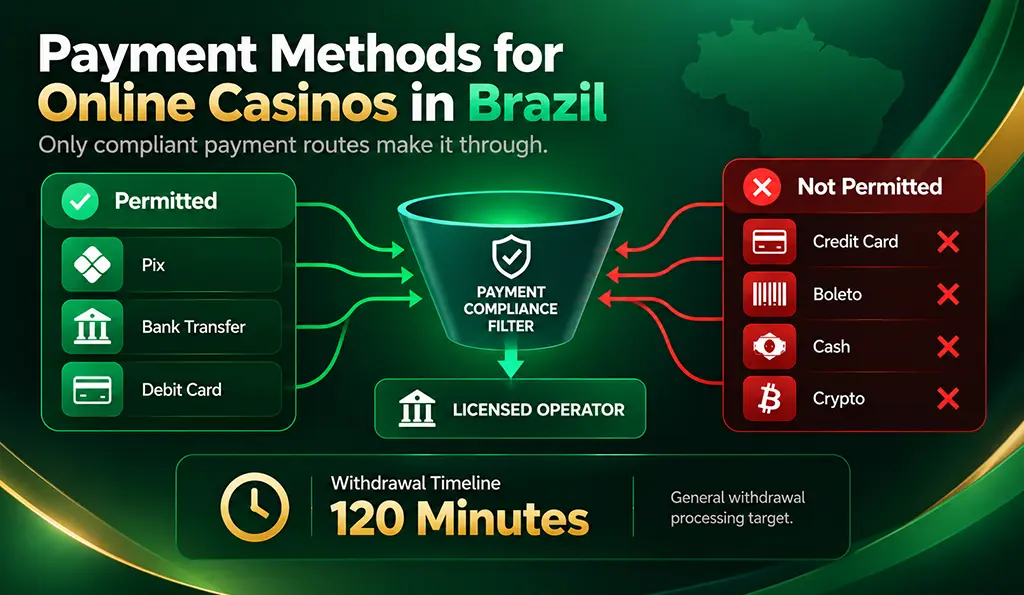
Licensed operators must process all transactions through compliant electronic transfers between a bettor’s pre-registered financial or payment account and the operator’s designated transaction account. All institutions involved must be authorized by Brazil’s Central Bank. The following are not permitted:
- Cash payments
- Boleto bancário
- Credit-funded betting
- Cryptocurrency
Pix is the Practical Standard
No single Payment Method is legally mandated, but Pix is the de facto standard for Brazilian betting operators. It is deeply embedded across all demographics, supports near-instant transaction speeds, and aligns with the player behavior operators will encounter at scale. Entering Brazil without Pix integration is a significant commercial disadvantage regardless of what else your payment stack offers.
Withdrawal Timeline
The SPA/MF framework sets a general 120-minute deadline for processing withdrawals and prize payments. Documented exceptions apply for fraud investigations or AML concerns, but this should be treated as the default operational target when scoping up your payments infrastructure.
Permitted vs. Prohibited Methods at a Glance
| Method | Status |
| Pix | Permitted — commercially essential |
| Bank transfer (TED/DOC) | Permitted where compliant with account-linking rules |
| Debit card | Permitted where linked to bettor’s registered account |
| Credit card | Not permitted |
| Boleto bancário | Not permitted |
| Cash | Not permitted |
| Cryptocurrency | Not permitted for licensed operators |
Player Preferences and Game Portfolio for the Brazilian Market
Brazil Casino Portfolio Checklist
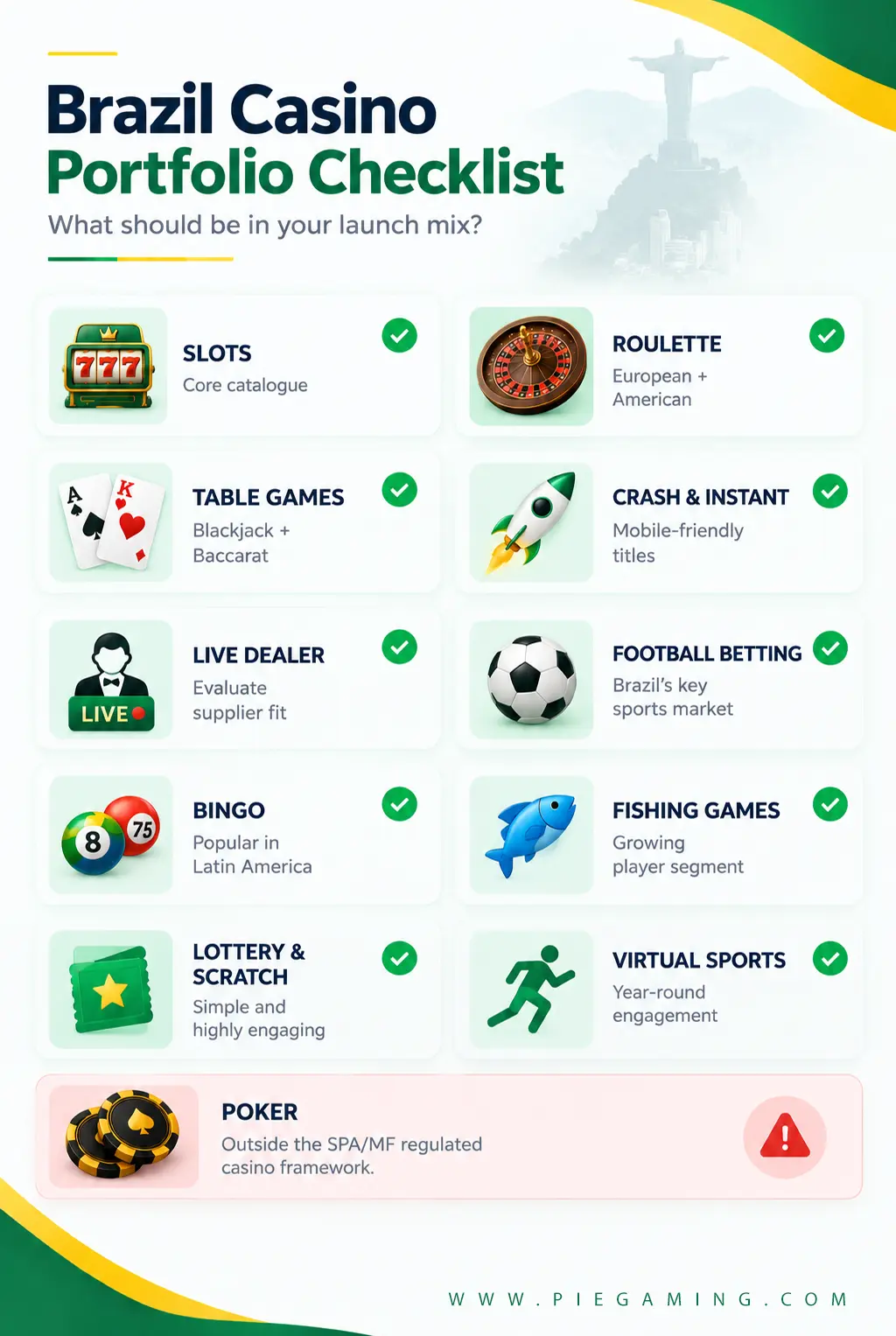
Brazilian players are not a uniform audience, and an effective portfolio should not simply replicate a European casino lobby. Operators need certified casino content, football-led sports betting, mobile-first delivery, and Brazilian Portuguese localization working together from day one.
Roulette and Table Games
Roulette is an important casino category in Brazil and should be part of any launch portfolio. European roulette, American roulette, blackjack, and baccarat together provide a well-rounded certified table games offering that covers the core player preference range for this market.
Slots, Crash, and Instant-Play
Slots remain in a core catalogue category given their mobile compatibility and ease of discovery. Crash games have become particularly significant in the Brazilian market and should not be overlooked when building a launch portfolio. A competitive offering should combine certified video slots with compliant crash-style and instant-play titles, supported by a mobile-optimized lobby and localized game discovery.
Live Dealer
Live dealer is a valuable complement to RNG casino content, particularly for roulette, blackjack, and baccarat. Evaluate it against your acquisition mix, supplier costs, and certification requirements rather than treating it as either a guaranteed revenue driver or a secondary add-on.
Poker and Skill-Based Games
Poker is popular in Brazil but sits outside the SPA/MF regulated online casino framework. It is generally treated as a skill-based game, which excludes it from regulated virtual online game events under the fixed-odds betting regime. Operators considering poker should obtain specific Brazilian legal advice before including it in their product offering.
Sports Betting and Esports
Sports betting should be a core vertical, with football as the principal acquisition driver. Brasileirão, Copa do Brasil, Copa Libertadores, and Brazil national team fixtures are the most commercially relevant markets to prioritize. TGM research found that 31.06% of Brazilian sports bettors reported betting multiple times per week, indicating strong habitual behavior among the active bettor base.
Esports is a worthwhile area to build toward where the relevant competitions qualify under federal sports betting rules and integrity requirements can be met.
Marketing Your Online Casino in Brazil
Licensed operators in Brazil can advertise legally, but permission comes with strict obligations. Every commercial communication must include a clear 18+ restriction and a responsible gambling warning.
Operators cannot portray betting as a source of income, an investment, a solution to financial problems, or an easy route to wealth. These rules extend to affiliate, and influencer content produced in the operator’s commercial interest.
Search and Paid Media
SPA/MF authorization alone is not enough to run Google Ads in Brazil. Operators must also obtain Google’s gambling certification for Brazil separately. Paid search copy must include age and responsible gambling safeguards, and only approved .bet.br destinations should be used.
SEO and Content Marketing
Brazilian Portuguese SEO is a strong long-term acquisition channel, but SEO content is regulated marketing and must meet the same standards as paid advertising.
Localization must go beyond translation. Vocabulary, payment terminology, and responsible gambling information all need to reflect Brazilian Portuguese, not European Portuguese.
Technical SEO should be built around the .bet.br domain from day one. Migrating from a .com or .com.br domain after launch creates ranking, tracking, and compliance risk.
Social Media and Influencer Marketing
Instagram, Facebook, and YouTube are the dominant platforms for Brazilian audiences, but each platform’s own gambling advertising policies apply alongside Brazilian law. Adult targeting controls and 18+ creative standards must be applied across all placements.
Influencer marketing has driven significant brand awareness in this market, but operators remain responsible for all influencer communications made in their commercial interest. Every arrangement requires pre-approved creative, visible responsible gambling messaging, and immediate takedown rights.
Affiliates
CPA and RevShare models are standard, but operators are responsible for casino affiliate marketing conduct. Affiliate agreements must prohibit misleading bonus or odds claims, targeting of minors, and any suggestion that betting provides financial relief or investment returns.
Domain Infrastructure
The .bet.br domain requirement affects paid media approval, SEO, attribution, and brand trust. Build around it before launch, not after.
Questions to Ask Any Platform Provider Before Signing
Most online casino software providers will tell you they are Brazil-ready. These questions will tell you whether they actually are.
- Does your betting system, including all relevant components, fall within the scope of certification by an SPA/MF-recognized entity?
- Can you provide certification documentation for the exact game titles and system version we intend to launch in Brazil?
- Do you support Pix as a native payment method, and can your payment infrastructure meet the SPA/MF’s 120-minute withdrawal processing requirement?
- Is your platform architected to operate under a.bet.br domain without requiring redirects or workarounds?
- Does your platform support SIGAP reporting, five-year data retention, re-authentication after inactivity, and geolocation checks as required under Brazilian technical standards?
- Do you have existing authorized Brazilian operator clients we can speak with as references?
Wrapping Up…
Getting licensed, certified, and operational in Brazil takes planning, capital, and the right partners. The regulatory framework is detailed by design, and shortcuts tend to surface as problems after starting an online casino in Brazil, rather than before. For operators willing to invest in the structure the market demands, Brazil represents a generational opportunity in regulated iGaming. The window is open, but the competition is already moving.

Contact Us
FAQ's
-
Do I need a Brazilian gaming license to operate an online casino legally?
Yes. Legally offering regulated online casino games in Brazil requires SPA/MF authorization for fixed-odds betting, a Brazilian legal entity, and operation under approved .bet.br domains.
-
How much does a Brazilian online casino license cost in 2026?
A five-year SPA/MF authorization costs BRL 30 million per authorization, covering up to three brands. Each additional group of brands requires a separate authorization and another BRL 30 million payment.
-
How much capital is needed to launch an online casino platform in Brazil?
Beyond the BRL 30 million authorization grant, operators must also meet a BRL 30 million paid-in share capital requirement, BRL 30 million minimum net equity, and a mandatory financial reserve.
-
How do I renew or maintain compliance after receiving authorization?
Ongoing compliance requires certified systems, eligible Brazilian corporate structure and ownership, financial reserves, AML/KYC controls, responsible gambling measures, SIGAP reporting, .bet.br domain operation, regulatory access, and continuous tax and consumer protection obligations throughout the authorization period.

Palak Madan has been writing about the iGaming industry since 2024. She focuses on helping operators and founders understand their options when launching an online casino, from choosing the right software provider to figuring out costs and compliance requirements across different markets. At PieGaming, she covers topics like white label casino solutions, platform selection, and market entry, turning complex industry information into practical guidance for people building iGaming businesses. She also keeps a close eye on licensing and regulatory changes; particularly how new rules shape the way operators enter and grow in different jurisdictions.
Online casino problems can affect operators at every stage, from market entry and payment to player retention, technology, and profitability. Learn the key challenges and practical ways to address them.
Kenya has a growing online gambling market supported by increasing internet adoption and mobile payment systems. This guide clarifies the steps and protocols you can follow for setting up an online casino business in Kenya, including regulations and licensing requirements.
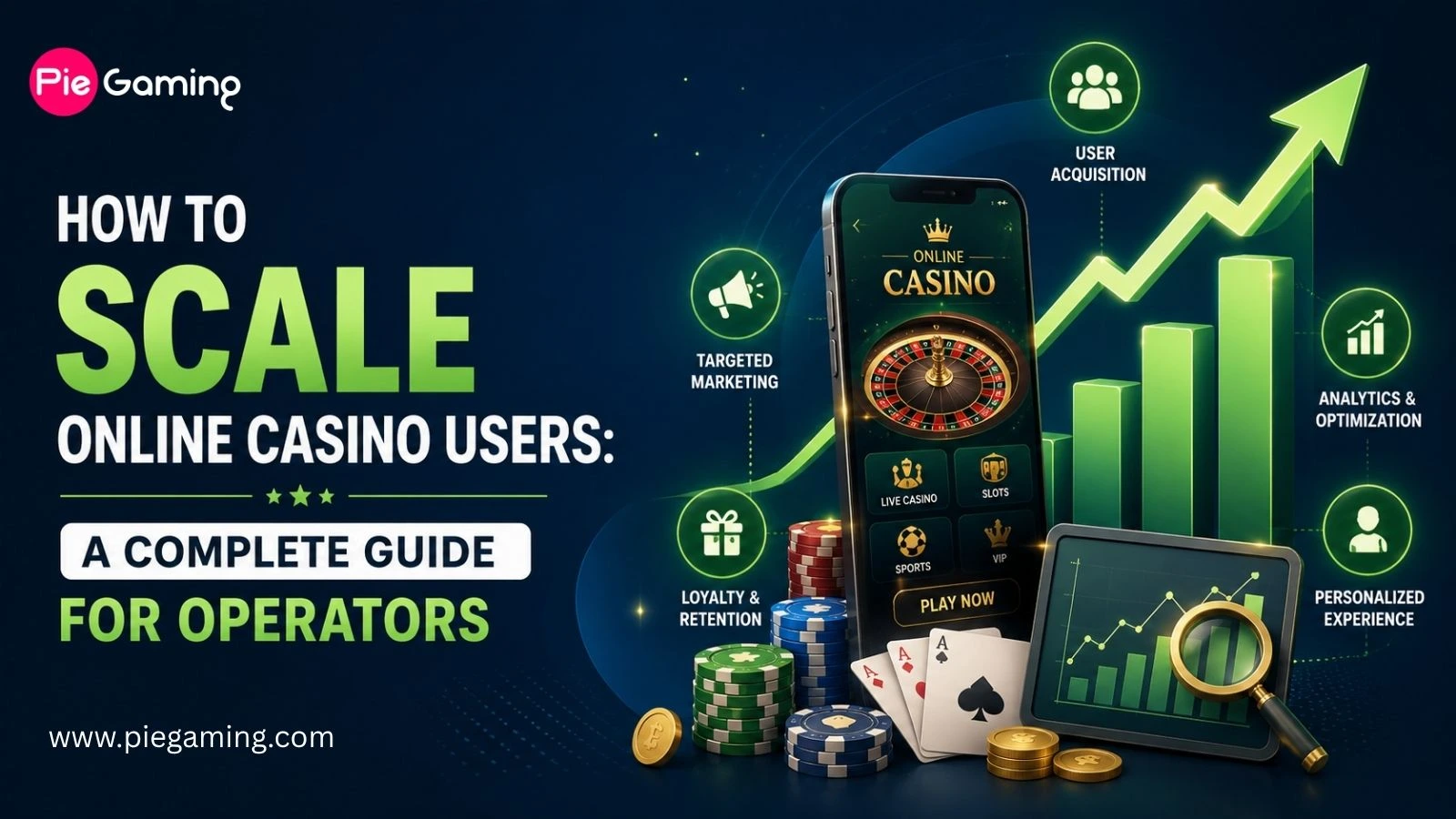
The key components of scaling online casino users can be summarized in four areas. The right acquisition channels, delivering personalized engagement, developing loyalty programs, and making data-driven decisions. Creating a mobile experience, maintaining player engagement and translating markets that you want to attract are all just as crucial to sustainable growth.

This blog breaks down the key strategies of top iGaming operators in 2026 and how you can grow like them as a market leader. Stay tuned until the end.
Starting an online casino sounds exciting. But many new operators fail within a few months due to evitable mistakes. Here are the top 10 mistakes you must steer clear of.
Learn how to start an online casino in Turkey in 2026. Get easy tips on laws, licenses, payments, and more to run your business smoothly.
GGR vs NGR are the two-revenue metrics every casino operator needs to track. GGR is total wager minus player payouts, reflecting gaming performance before any deductions. NGR is GGR after bonuses, taxes, payment fees, provider royalties, and chargebacks are deducted. The gap between the two reveals where margin pressure is building.

See you in your inbox soon!

Stay ahead of the game. Subscribe for exclusive content, updates, and insiders!