
Online casino and sports betting regulations in Spain allow gambling activities only through licensed operators. The industry is governed by strict rules covering licensing, taxation, advertising, and player protection, making it one of Europe’s most tightly regulated yet rapidly growing iGaming markets.
If you’re looking to enter the Spanish online gambling market, understanding the regulatory landscape is your first step. The market is overseen by the Dirección General de Ordenación del Juego (DGOJ), which controls everything from who gets a license to how operators can advertise and what player protections must be in place.
Spain keeps its licensed operator pool deliberately tight, with only around 30 operators currently authorized, but the opportunity is real.
Spain’s online gambling market generated approximately €1.6 billion in Gross Gaming Revenue in 2025, reflecting around 18% year-on-year growth. Sports betting accounted for roughly 41 to 42% of total activity, making it the single largest segment in the market.
Getting in, however, means meeting some of the strictest compliance standards in Europe, from hefty licensing costs to advertising restrictions and mandatory responsible gambling tools.
This guide breaks down Spain’s regulatory framework, licensing requirements, and what operators need to know before entering one of Europe’s most tightly controlled yet rewarding iGaming industry.
Is Online Gambling Legal in Spain?
Check online gambling legality in Spain
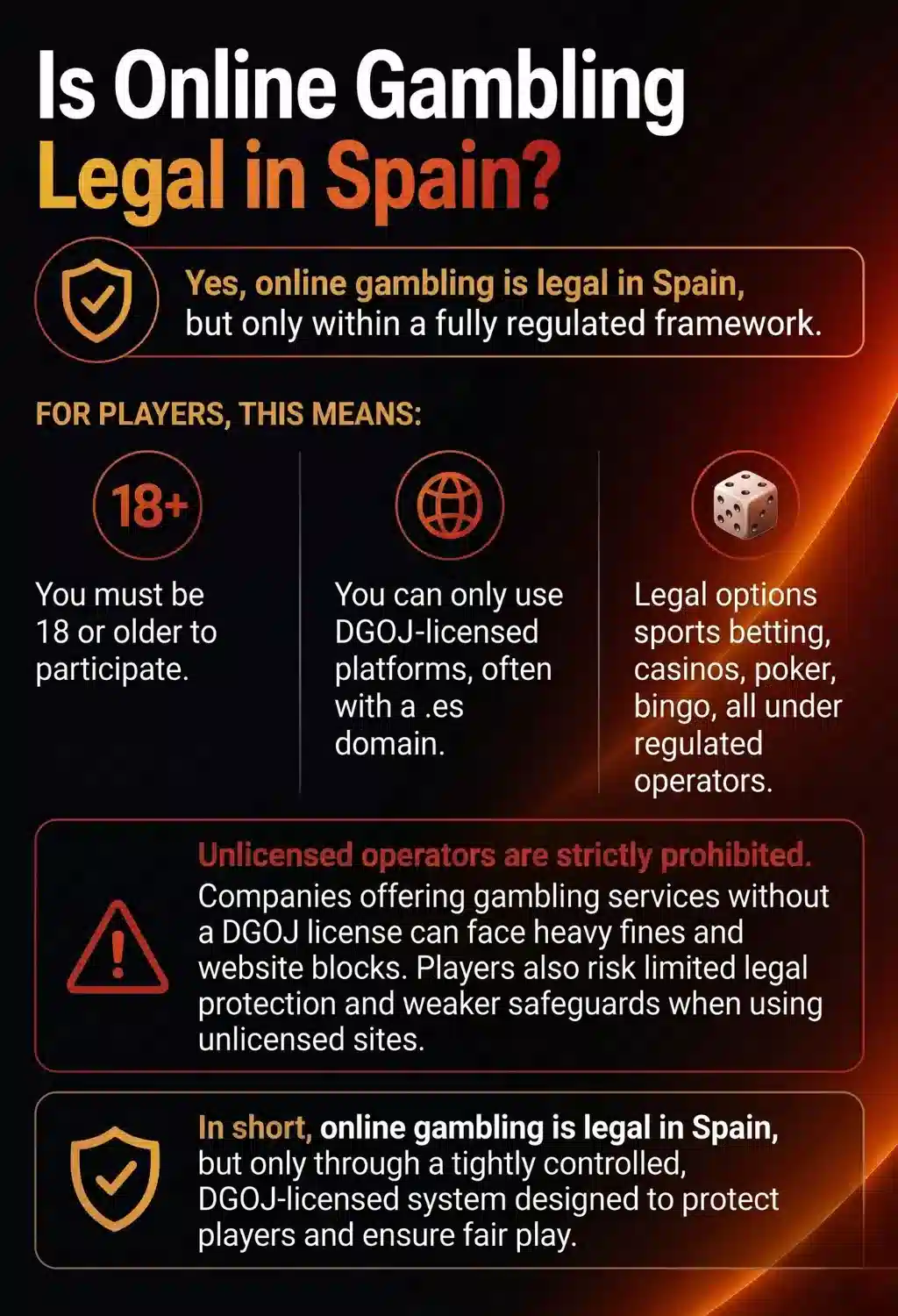
In Spain, online gambling is legal, but it must be regulated. The Spanish Gambling Act (Law 13/2011) regulates this sector by introducing a national licensing and control system.
The national regulator, the Direccion General de Ordenacion del Juego (DGOJ) must license the operators. In addition to general licences per product (sports betting, poker, casino), operators are also required to have specific licences.
This implies to the users:
- To play, they must be 18 or above.
- They can only use operators licensed by DGOJ (typically having a domain of .es).
- Online casinos, poker and bingo, sports betting are legal, but only when licensed.
Unlicensed operators are strictly prohibited. Companies offering gambling services without a DGOJ license can face heavy fines and website blocks. For players, using unlicensed sites also comes with real risks, including limited legal recourse and weaker consumer protection, since those platforms operate outside Spain’s regulatory system.
In short, online gambling is legal in Spain, but only when offered through a tightly controlled, DGOJ-licensed system designed to protect players and ensure fair play.
Legal Framework Governing Gambling in Spain
The Spanish gambling market is well-organised and regulated. The Spanish Gambling Act (Law 13/2011) governs all aspects of online gambling nationally, including how operators are licensed and how consumers are protected. This is all regulated by the Dirección General de Ordenación del Juego (DGOJ), the main gambling authority in Spain.
To legally operate in Spain, companies need to clear a two-step licensing process. First, they need a general license that covers the broad category they want to operate in, such as betting or gaming. Then, they need singular licenses for each specific product they plan to offer, whether that’s slots, poker, or sports betting.
The DGOJ issues all of these and getting them isn’t straightforward. Operators must meet strict technical, financial, and compliance standards. Foreign operators are not exempt either. If you want to offer services in Spain, there is no way around this process.
Once licensed, operators don’t get to operate freely. The DGOJ keeps a close eye on the market and has real teeth when it comes to enforcement:
- Licensed operators are regularly supervised and audited.
- Unauthorized gambling websites are blocked.
- Serious violations can lead to fines running into millions.
On top of this, Spain employs state-of-the-art monitoring technologies, such as risk detection and profiling systems, to ensure operators are meeting their end of the responsible gambling bargain.
Responsible gambling is a priority. Operators must age-verify all players to protect against underage gambling, deny access to anyone on the national self-exclusion list, and provide responsible gambling tools with transparent game rules.
This has recently been taken further, with operators now required to identify early signs of risky gambling and take action, whether that’s cutting back promotions or even blocking players who might be vulnerable.
It’s also important to note the split nature of the regulation in Spain. The DGOJ is responsible for regulating online gambling nationally, but land-based gambling (casinos, betting shops and bingo halls) is regulated by Spain’s regional governments, the Autonomous Communities, which have their own regulations.
Under this framework, the following activities are legal when offered through a licensed operator:
- Online casinos, including slots, blackjack, and roulette.
- Sports betting, both pre-match and live in-play.
- Poker, which runs under a closed liquidity model, keeps player pools within regulated markets.
- Bingo and lottery, including state-backed options.
In short, Spain runs a tight ship. The framework is layered, the oversight is active, and the expectations for operators are high, but so is the clarity around what’s required to operate legally.
What are Types of Gambling Licenses in Spain?
Spain follows a two-tier licensing system for online gambling, regulated by the Dirección General de Ordenación del Juego (DGOJ). To legally operate, companies must obtain both a General License and one or more Singular Licenses. One without the other simply does not work.
General Licenses (Licencias Generales) are the starting point. Without one, no gambling activity can be offered in Spain. There are three categories under this tier:
| General License Type | What it Covers | Key Use Case |
| Bets (Apuestas) | All types of betting activities | Sports betting, horse betting |
| Contests (Concursos) | Skill-based competitions | Prize competitions, quizzes |
| Other Games (Otros Juegos) | Casino-style games | Slots, poker, blackjack |
These licenses are issued through public tender processes and are typically valid for 10 years, with the option to renew.
Singular Licenses (Licencias Singulares) come next. Operators must already hold a general license before they can apply for these. Each singular license corresponds to a specific gambling product, and every vertical needs its own approval:
| Singular License Type | Covers Specific Game |
| Slots License | Online slot machines |
| Roulette License | Casino roulette |
| Blackjack License | Table games |
| Poker License | Online poker (regulated pools) |
| Bingo License | Online bingo |
| Sports Betting License | Fixed-odds and live betting |
| Horse Betting License | Horse racing bets |
| Exchange Betting License | Peer-to-peer betting |
These licenses are usually valid for one to five years and can be renewed.
To put it in practical terms, an operator looking to offer both sports betting and popular casino games would need a general license covering both categories, plus individual singular licenses for each specific game or betting type they plan to run. Here is how the two tiers sit together:
| License Type | Purpose | Mandatory? | Scope |
| General License | Allows operator to offer gambling categories | Yes | Broad (bets, contests, casino games) |
| Singular License | Allows offering specific games | Yes | Specific (slots, poker, betting types) |
Beyond the two main license types, Spain also requires additional technical and operational authorisations before an operator can go live. These include:
- Platform certification.
- Random Number Generator (RNG) approval.
- Security and compliance audits.
These are not standalone licenses but are mandatory approvals designed to ensure fairness and system integrity.
In short, Spain does not work on a single blanket license. Every gambling activity is individually regulated and approved, making it one of the more tightly controlled licensing markets in Europe.
Explore Casino & Sports Betting Regulations in Different Countries
iGaming Licenses Costs in Spain
Securing a gambling license in Spain is not a straightforward, single-fee process. There are multiple cost components involved, all set by the DGOJ, and every one of them is mandatory before approval is granted.
This includes administrative fees, technical certification costs, and registry charges. On top of that, operators are also required to meet financial guarantee requirements, which are there to protect players and keep operators accountable.
The costs reflect what Spain is trying to achieve as a regulator, which is a market built on system integrity, fraud prevention, and financial stability. In practical terms, this means operators need to come in with serious upfront capital, and that’s before even thinking about ongoing expenses like taxes or compliance audits.
Here is what the key licensing costs look like:
| Cost Component | Amount (€) | What it Covers |
| Technical report / system certification | ~€38,000 | Testing and approval of gaming systems |
| License issuance fee | ~€10,000 per license | Paid when a license is granted |
| Registration fee | ~€2,500 per license | Entry into the official registry |
| Homologation (technical approval) | ~€40,340 | System compliance validation |
| Registry inscription | ~€2,650 | Official license listing |
Disclaimer: These figures are based on DGOJ-aligned regulatory summaries and may vary slightly depending on the specifics of each application.
iGaming Licensing Requirements for Operators in Spain
To legally run an online casino or betting platform in Spain, operators need to clear a high bar. Here’s what you need to have.
Legal and Corporate Requirements
The first thing operators need to sort out is their legal standing. Companies must be registered within the EU or EEA, have a clear and transparent ownership structure, and make sure directors and key stakeholders pass background and integrity checks.
Any history of involvement in illegal gambling is an automatic disqualifier. And for foreign operators, holding a license from another country doesn’t help here. If you want to operate in Spain, you need a DGOJ license, full stop.
Licensing Structure
Operators need both license layers in place before they can legally offer services or accept players:
| Requirement | Details |
| General License | Required to operate across broad categories like betting, contests, or popular casino games |
| Singular Licenses | Required for each specific game or product such as slots, poker, or sports betting |
Financial and Compliance Requirements
Operators also need to show they are financially sound. This means putting up security deposits as financial guarantees, submitting audited financial statements, and being transparent about where funding comes from.
There are also ongoing tax obligations, including roughly a 20% tax on Gross Gaming Revenue, along with regular reporting and audits. The idea is simple: operators need to prove they can pay out winnings and keep the business running long term.
Technical and System Requirements
Spain is thorough when it comes to platform integrity. Gaming systems must be tested and certified by approved labs, Random Number Generators must meet fairness standards, and platforms must comply with Royal Decree 1613/2011.
Continuous monitoring and audit trails are required, and the DGOJ carries out active inspections to make sure everything holds up.
AML, KYC, and Player Verification
Before any player can access gambling services, operators must have the following locked in:
- KYC verification for every player.
- Age verification confirming players are 18 or older.
- Monitoring of suspicious transactions to stay on top of AML requirements.
- Secure handling of all player data.
Responsible Gambling and Player Protection
This is not optional. Operators must connect to Spain’s national self-exclusion register (RGIAJ), offer deposit limits and session controls, have systems in place to spot problem gambling behavior early, and clearly display rules, odds, and risks to players.
Operational and Advertising Compliance
Platforms typically need to run under a .es domain; advertising is tightly controlled, especially around bonuses and promotions, and operators must avoid targeting minors or vulnerable users at all times.
Transparent terms and conditions are a must. Get any of this wrong, and operators are looking at heavy fines, site blocking, or losing their license altogether.
Taxation Breakdown in Spain’s Gambling Industry
Spain’s gambling tax system is built around one core principle: operators are taxed on their Gross Gaming Revenue (GGR), players are taxed on their net winnings, and land-based activities can vary depending on the region. It is a structured model, but one with enough moving parts that operators need to understand clearly before entering the market.
Here is a full breakdown of how taxation works across the board:
| Tax Category | Applies To | Tax Rate | Tax Base |
| Online Gambling Tax (IAJ) | Licensed operators (casino, betting, poker, bingo) | 20% | Gross Gaming Revenue (GGR) |
| Reduced Rate (Ceuta & Melilla) | Operators based in special regions | ~10% | GGR |
| Land-based Casino Tax | Physical casinos | 15% to 58% | GGR (sliding scale) |
| Land-based Sports Betting | Betting shops | 10% to 20% | GGR |
| Gaming Machines (Slots/VLTs) | Machine operators | ~€3,500 to €5,300/year | Per machine |
| Player Tax (General Gambling) | Individual players | 19% to 47% | Net winnings (profit) |
| Player Tax (Savings Base) | Gambling profits | 19% to 28% | Net winnings |
| Lottery Tax (SELAE/ONCE) | Lottery winners | 20% (above €40,000) | Prize amount |
| Corporate Tax | Gambling operators | 25% | Company profits |
| VAT (IVA) | Gambling services | Exempt | — |
| Local/Municipal Taxes (IAE) | Land-based operators | Variable | Business activity |
To summarize the key points:
- Operators pay a 20% GGR tax, plus corporate tax and any applicable regional levies.
- Players are only taxed on net winnings, not on the total amount they bet.
- Land-based operations are subject to regional variation, making them less uniform than online gambling.
What are Recent Updates & Future Trends?
Spain’s gambling market is changing fast. The regulatory direction is clear: tighter controls, stronger player protection, and less tolerance for non-compliance. Here is what operators need to be aware of heading into this environment.
Stricter Advertising and Marketing Regulations
Restrictions on bonuses & promotions, and sponsorships continue to tighten. Sports sponsorships are banned, and TV and radio ads face strict time-based limits. The direction is toward a highly controlled marketing environment, pushing operators to rely more on digital engagement and retention rather than mass advertising.
Advanced Player Protection Measures
Cross-operator deposit limits are in the pipeline, allowing authorities to track total player spending across platforms. AI-driven risk detection systems are also being introduced to flag problematic behavior in real time, alongside an expansion of self-exclusion tools across the board.
Mandatory Risk Warnings and Safer Gambling Messaging
Generic “play responsibly” messages are being replaced with specific, data-based risk warnings, similar in approach to tobacco-style disclosures. The goal is to make the real risks of gambling more visible and harder for players to ignore both ads and platforms.
Increased Enforcement and Heavy Penalties
Over €142 million in fines were issued to gambling operators in 2024 alone. Actions against unlicensed operators and illegal advertising have intensified, and compliance audits are becoming more frequent. Non-compliance in Spain is not just a reputational risk; it is a very expensive one.
Regulatory Evolution and Policy Uncertainty
Spain’s legal landscape is actively evolving. Consultations on new advertising rules are ongoing; stricter bonus bans could return, and the framework keeps shifting around public health goals. For operators, compliance is not a one-time exercise but an ongoing commitment.
Market Growth Despite Regulatory Pressure
Despite tighter controls, Spain remains one of Europe’s faster-growing iGaming markets. Mobile betting, live betting, and digital adoption continue to drive momentum, painting a picture of regulated growth where expansion is real but happening under increasingly tight oversight.
In short, the future of gambling in Spain is not just about growth. It is controlled, data-driven, and heavily regulated growth, and operators who want a place in this market need to be built for that reality.
Wrapping Up…
Spain is one of Europe’s most tightly regulated gambling markets, and that is precisely what makes it attractive. A clear framework, active enforcement, and a growing player base create a stable environment for operators who are serious about compliance. Get the foundations right, and Spain is a market that rewards long-term commitment.

FAQs
-
Who regulates gambling in Spain?
The Dirección General de Ordenación del Juego (DGOJ), operating under the Ministry of Consumer Affairs, is responsible for regulating all gambling activities in Spain. This covers online betting, casino games, and poker. The DGOJ enforces laws like Law 13/2011, issues licenses, and monitors compliance with standards, including AML regulations.
-
What license is required to operate in Spain?
Operators need a General License, valid for 10 years and renewable, covering broad categories like betting and casino games. On top of that, Singular Licenses are required for each specific game. Applications must include financial guarantees, technical certification, and a .es domain.
-
What is the gambling tax rate in Spain?
Licensed operators pay a 20% tax on Gross Gaming Revenue (GGR), which drops to around 10% for operators based in Ceuta or Melilla. For players, winnings are taxed progressively through personal income tax, with rates going up to 45%.
-
Can foreign operators enter the Spanish market?
Yes, foreign operators can enter the Spanish market by obtaining the necessary DGOJ licenses, maintaining a physical office or legal representative in Spain, and meeting local requirements such as bank guarantees and technical certification standards.
-
Who is liable under local law/regulation?
Gambling operators are primarily liable for infringements like unlicensed operations and can face fines of up to €10 million alongside potential bans. However, liability does not stop there. Promoters such as advertising agencies and affiliates, as well as other facilitators, can also face sanctions for their involvement.


Palak Madan has been writing about the iGaming industry since 2024. She focuses on helping operators and founders understand their options when launching an online casino, from choosing the right software provider to figuring out costs and compliance requirements across different markets. At PieGaming, she covers topics like white label casino solutions, platform selection, and market entry, turning complex industry information into practical guidance for people building iGaming businesses. She also keeps a close eye on licensing and regulatory changes; particularly how new rules shape the way operators enter and grow in different jurisdictions.

A GCGRA Gaming License is required to operate commercial gaming in the UAE, including online casinos and sportsbooks. Foreign operators can apply, but must meet GCGRA’s suitability, financial, compliance, and operational requirements before they can launch.
Online casino gaming is not allowed in Australia under Interactive Gambling Act 2001. But operators can still apply for an internet gaming license via specific jurisdictions like the Northern Territory, which allows them to offer gambling services legally- generally outside Australia.
Bulgaria’s iGaming license enables operators to legally provide services in the areas of online casino, betting, poker, and bingo in accordance with the regulations of the EU. Typically, a licensing process can take 60 to 90 days, and it will need to be approved by the NRA, technical certification, AML compliance, and data storage in the local area. Minimum capital requirements range from BGN 50,000 for betting operators to BGN 1.5 million for online casino operators.
To obtain the Anjouan Gaming License, applicants must collect and submit all the important documents. Learn the process of obtaining Anjouan iGaming license.
Algeria has no online casino or sports betting regulation to speak of — instead, the country enforces a near-total gambling ban rooted in civil law and Islamic principles. Yet despite the prohibition, offshore platforms continue to pull in millions of users every month, driven by high demand and a near-total absence of legal local alternatives.
A Kahnawake iGaming license is a credible and cost-effective licensing solution for online casinos and sportsbook operators. The process to obtain this license includes multiple steps, key benefits, and licensing costs.
Malta pays attention to the credibility of the regulatory framework and to access regulated markets, which is more conducive to long-term growth and industry reputation. However, Curaçao places a strong emphasis on speed and affordability, making it a good choice for startups and businesses focused on cryptocurrencies that are keen to establish a presence rapidly and at a lower cost. If you are constructing a major operation, select Malta. Pick Curaçao when you are just getting started and have to get your product to market quickly.


See you in your inbox soon!

Stay ahead of the game. Subscribe for exclusive content, updates, and insiders!