
Read about what horse racing betting software includes — tote and fixed-odds markets, race feeds, and payments — plus what a build or a full license costs.

Horse racing has been around for a thousand years, but today, it has gone digital. The global horse betting market hit around $47 billion in 2025, and more than 60% of bets are now placed online. People aren’t heading to the track like they used to. They are watching races, placing bets, and checking results right from their phones.
That’s where horse racing betting software comes into the picture, either as a standalone build or as a racing module inside your sportsbook software. This guide will break down everything you need to know to build one, including must-have features and the technology behind them, costs, and how to make your mark in a competitive sports betting market.
What Is Horse Racing Betting Software?
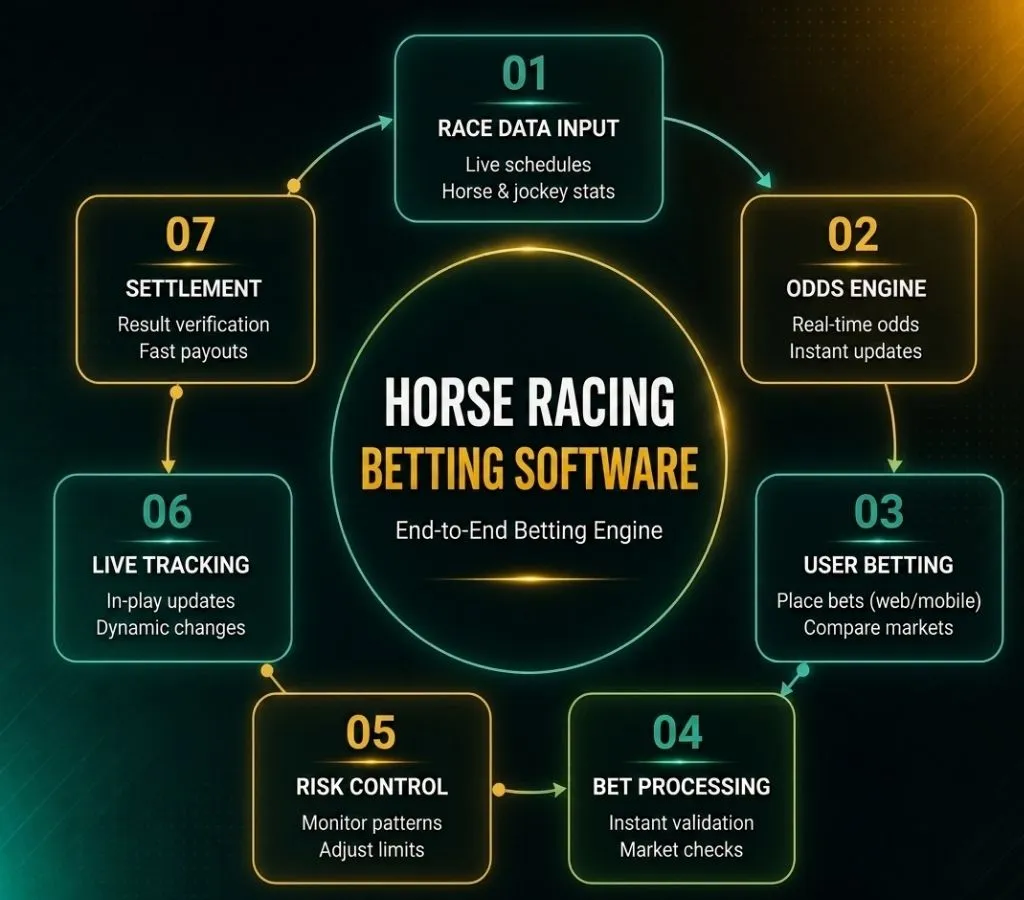
Complete horse racing betting system
Horse racing betting software is a digital platform built to handle everything that happens between a race being announced and a bettor getting paid. It’s not a generic sportsbook with a horse racing tab bolted on. It’s built from the ground up for the speed, data, and complexity that horse racing demands.
To users, it implies that one can see the live race schedules, monitor the performance of a horse and jockey, compare odds, and make bets on the phone or the browser. The site accesses data on a continuous basis, race scenarios, historical statistics, and live odds, therefore, punters are not making informed guesses on their bets.
To operators, it functions as a full engine that runs in the background, taking bets, adjusting odds, monitoring risks, and processing payouts across multiple races simultaneously. The majority of modern systems also support third-party racing data providers via APIs, which allows features such as in-play betting, automated odds updates, and multi-market coverage to be supported.
Put simply, it’s not just a platform to place bets. It’s an interconnected system that ties racing events, odds logic, and user activity together into one smooth experience.
Top Horse Racing Betting Software Development Companies
Not every development company understands the pace and complexity of horse racing. These five have built a track record worth paying attention to.
1. Innosoft Group
Founded: 2014
Headquarters: Indore, India
Core Expertise: iGaming, sports betting software, blockchain, and AI-driven platforms.
Key Features:
- Custom horse racing betting solutions built for operators of all sizes.
- Live race tracking and odds integration in real-time to provide a dynamic betting experience.
- Secure payment gateways with multiple payment methods.
- Risk management tools to keep betting exposure under control.
- Flexible wagering through custom betting markets and bet slip management.
- Multi-language assistance to access international markets.
- Clear performance insights via analytics and reporting dashboards.
- Scalable design with API connections to third-party data providers.
Ideal For:
- Startups seeking white-label or turnkey horse racing services.
- Betting ecosystem agnostic operators desiring a custom-built ecosystem.
- Companies intending to go big with AI, blockchain, or crypto-ready systems.
- Businesses that appeal to international markets and localized user experience.
Why Choose Innosoft Group
Innosoft doesn’t do rigid, off-the-shelf products. Instead, it focuses on building flexible, high-performance betting platforms that can be shaped around your business needs. That makes it a solid choice whether you’re just entering the market or scaling an existing operation.
2. GR8 Tech
Founded: 2013
Headquarters: Limassol, Cyprus
Core Expertise: B2B iGaming software provider specializing in sportsbook and casino solutions.
Key Features:
- High-performance sportsbook engine supporting over 25,000 daily events and a wide range of betting markets.
- GR8 Feed combines odds aggregation with in-house models for accurate, customizable odds.
- Managed Trading Services capable of handling up to 30,000 bets per minute with advanced risk controls.
- iFrame and API integration options that allow fast deployment, sometimes in as little as one week.
- Personalization based on AI that encompasses customized odds, suggestions, and user interaction features.
- Multi-language, multi-currency, and regional odds formats, such as American, Asian, and LATAM.
- Betting markets in horse racing in win, each-way, forecast, tricast, and multiples.
- Risk management and anti-fraud systems driven by real-time AI monitoring.
Ideal For:
- Mid-to-large operators looking for a scalable, high-volume sportsbook
- Businesses that need advanced trading support and automated risk management
- Platforms wanting to expand quickly through plug-and-play iFrame or API integrations
- Operators targeting global markets with localized betting experiences
Why Choose GR8 Tech
GR8 Tech is not just a software provider. Its proprietary odds technology, coupled with managed trading services, also makes it stand out from the majority of its competitors. GR8 Tech is worth considering in case you require a platform that can accommodate large betting volumes, provide real-time odds, and integrate with existing systems without a lengthy run-up.
3. GammaStack
Founded: 2012
Headquarters: India, with global operations across multiple regions
Core Expertise: Horse racing betting software, sportsbook solutions, and turnkey and white-label platforms.
Key Features:
- White-label offerings that are fully customized to your business requirements.
- Live odds management and data integrations.
- Risk management and anti-fraud systems with KYC, AML, and real-time notifications.
- Multi-user panel system: User, Agent, and Admin access to control the entire operation.
- Integration of multi-currency and crypto payments with wallets and global gateways.
- Intelligent analytics and predictive models to enhance betting insights.
- A large variety of betting markets and types of wagers, such as trifecta, exacta, and accumulator, plus API and iFrame connections for easy third-party integration.
- User tracking and engagement tools like player account management and CRM.
- Cross-platform support across web, mobile, and retail or kiosk betting.
Ideal For:
- Startups which require a ready-to-launch or white-label horse racing platform.
- Players seeking in-depth customization and complete control over betting options.
- Companies that are aimed at international markets and which have multilingual and multi-currency services.
- Companies that need AI-driven insights backed by strong backend management tools.
Why Choose GammaStack
GammaStack encompasses the entire process, including development and integration, as well as post-launch support. Its flexibility is a true strength, as it enables the operators to shape the platform around their particular needs instead of operating around a rigid system.
Add in AI-powered analytics and a vast array of betting markets and it becomes a compelling choice to anyone who is developing a scalable, feature-rich horse racing betting platform.
4. Alpha Sports Tech
Founded: Not publicly disclosed
Headquarters: New York, United States
Core Expertise: Web3 and decentralized sports betting software, including horse racing platforms.
Key Features:
- Decentralized betting architecture based on blockchain and smart contracts to provide transparency and security.
- Cryptocurrency-based betting platform that facilitates quick and low-cost transactions with worldwide connectivity.
- White-label horse racing solutions to be deployed quickly and be branded flexibly.
- Real-time decision making tools for live betting, odds tracking, and race analytics.
- Complete data management of horses, jockeys, races, and performance statistics.
- Online racing and the development of a custom betting system to offer more products.
- Integrated multi-chain and DeFi wallets to make secure, decentralized payments.
- User engagement capabilities, such as leaderboards, rewards, notifications, and expert tips
Ideal For:
- Startups exploring crypto-based or Web3 betting platforms
- Operators targeting global, borderless betting audiences
- Businesses that want a decentralized and transparent betting ecosystem
- Companies looking to stand out with blockchain-powered innovation
Why Choose Alpha Sports Tech
If your vision extends beyond a conventional sportsbook, Alpha Sports Tech may be an option. It is constructed on decentralized technology, employing blockchain, smart contracts, and crypto payments to build a betting environment that is more transparent, more secure, and available to users anywhere in the world.
It is a narrow and progressive choice to businesses that are developing next-generation platforms or leaning toward Web3. Operators weighing that route against a fiat-first setup can compare it with dedicated crypto sportsbook software.
5. AIS Technolabs
Founded: 2011
Headquarters: Ahmedabad, Gujarat, India
Core Expertise: Custom software development, iGaming solutions, and mobile app development
Key Features:
- Horse racing betting software that includes betting, race tracking, analytics, and operations. White-label and completely custom solutions with various business models.
- Live betting and real-time odds updates to provide a dynamic betting experience.
- High-level risk management tools, such as betting limits, alerts, and monitoring systems.
- Multi-language and multi-currency to reach the global market.
- Safe payment gateways (through trusted third-party gateways).
- CRM, marketing, and promotion built-in to motivate user engagement.
- Agents’ system and multi-user role management of bettors, admins, and operators.
- Mobile-first and full Android and iOS app support. Long-term growth and high traffic architecture.
Ideal For:
- Companies desiring a highly personalized horse racing betting system.
- Emerging businesses interested in affordable, scalable options and long-term support.
- Betting, CRM, and marketing tools in a single place. Betting companies with mobile-first audiences.
Why Choose AIS Technolabs
AIS Technolabs does not merely give a betting engine. It provides an entire ecosystem comprising marketing tools, CRM and operational support, all under the same roof. It is an efficient option because it allows companies to develop, operate and expand their platform without having to balance between a multitude of vendors and assembling fragmented systems.
Read Blog – top sports betting software providers
Cost Breakdown for Horse Racing Betting Software Development
The development of horse racing betting software is not a project with a definite price.
The amount you spend varies greatly based on the features you require, integrations you have, and the size you are building. In 2026, realistic budgets vary between approximately $25,000 for a simple MVP to $250,000 and above for enterprise-grade platforms with live streaming, AI-enhanced features, and global compliance options integrated.
Licensing a turnkey sportsbook instead of building shifts most of this into a setup fee and a monthly platform charge, which is worth modelling alongside the build costs below.
To give you a clearer picture of where your budget actually goes, here’s a consolidated breakdown by development stage and component.
Cost Breakdown Table
| Development Stage / Component | What It Covers | Estimated Cost (USD) |
| Planning and Discovery | Market research, requirements, roadmap | $2,000 – $5,000 |
| UI/UX Design | Wireframes, app design, branding | $4,000 – $10,000 |
| Frontend Development | User interface for web and mobile | $8,000 – $20,000 |
| Backend Development | Servers, database, APIs | $10,000 – $30,000 |
| Core Betting Engine | Bet slip, odds logic, settlements | $8,000 – $20,000 |
| Live Odds and Data Integration | Real-time feeds, race data APIs | $5,000 – $15,000 |
| Live Streaming Integration | Real-time race streaming | $10,000 – $25,000 |
| Payment Integration | Wallets, gateways, crypto (optional) | $5,000 – $15,000 |
| Admin Panel and Analytics | Dashboard, reporting tools | $4,000 – $10,000 |
| Security and Compliance | KYC, AML, encryption | $3,000 – $8,000 |
| Testing and Deployment | QA, bug fixing, launch | $4,000 – $10,000 |
| Post-Launch Support | Maintenance for 3 to 6 months | $5,000 – $15,000 |
| Total Estimated Cost | Based on complexity | $25,000 – $250,000+ |
Disclaimer: The cost figures in this section are approximate, based on industry research and general market trends. Actual development cost can differ based on the technology stack you use, the development team, location, the complexity of your project, and any special business needs.
Key Features of a Horse Racing Betting Software

Key Features of Horse Racing Betting Software
To stay competitive in 2026, a horse racing betting platform should be able to provide speed, real-time data, and other tools that would enable users to make smarter decisions. These are the five characteristics that separate a high-performing system from one that struggles.
1. Real-Time Odds and Live Data Integration
Contemporary products are built and broken by data feeds. The betting odds should be updated in real time based on the market action, and users should be able to access horse statistics, performance of the jockeys, and race conditions in real time. Anything less starts to feel unreliable fast, and unreliable platforms lose users quickly. Choosing the feed behind it is covered in our guide to sports betting odds providers.
2. Live Race Streaming and In-Play Betting
This is one of the biggest engagement drivers on any horse racing platform. When users can watch a race live and place bets while it’s happening, with odds shifting in real time as the race progresses, activity goes up and so does betting volume. It turns passive viewers into active participants, which is exactly what operators want.
3. AI-Based Analytics and Predictions
Basic stats aren’t enough anymore. The platforms that are gaining ground are applying AI-based analysis to reveal insights that consider form, weather, betting trends, and historical data. This provides users with probability and betting advice they could not compute themselves and assist operators to make wiser decisions on the backend, as well.
4. Multiple Betting Markets and Bet Types
A platform that only supports basic bet types will lose experienced bettors quickly. Covering standard options like win, place, and each-way alongside advanced bets like exacta, trifecta, and accumulators is what keeps both beginners and seasoned punters engaged. Custom markets for different user segments take it even further.
5. Risk Management and Admin Control Panel
Strong backend tools aren’t nice-to-have. Solid player account management is what allows operators to remain profitable and in control when bet volumes increase. Real-time monitoring of betting exposure, automated odds changes, and an easy-to-read administrator dashboard covering users, markets, and financials are all critical components of a sustainable platform. Risk tooling sits underneath every other feature on this list.
Read Blog – AI in sports betting
Legal & Compliance Considerations
Horse racing betting platforms operate within strict regulatory frameworks, and compliance isn’t optional. It directly determines whether your platform can legally function, and gaps can get you suspended even after you’ve gone live.
Licensing is where everything starts. Before launching, you need approval from a recognized gambling authority. Regulators have the power to suspend operations or impose restrictions at any point if compliance standards aren’t met, so getting this right from the beginning isn’t just important, it’s non-negotiable.
Once your platform is live, several ongoing obligations kick in:
KYC (Know Your Customer) must be enforced at onboarding. Platforms are required to verify identity, age, and location before a single bet is placed. During high-traffic events like the Grand National, where over 13 million UK adults place bets, a weak KYC system creates serious fraud and operational risk.
AML (Anti-Money Laundering) controls are heavily scrutinized. Operators must track transactions and flag suspicious activity in real time. The cost of getting this wrong is high. Betting companies have faced fines exceeding £582,000 and £594,000 for weak AML and due diligence systems.
Responsible gambling features are no longer just best practice. Affordability checks, spending limits, and intervention tools are actively enforced in many markets. In some cases, stricter controls have contributed to measurable drops in betting turnover, including a reported 6.8% decline linked directly to tighter risk checks.
Audit trails and data monitoring are a regulatory requirement, not a technical afterthought. Regulators expect full records of transactions and betting activity to detect fraud or match-fixing. Missing or incomplete monitoring is one of the most common compliance failures operators face.
All-in-One Sportsbook with Horse Racing
Horse racing markets and premium data feeds come pre-loaded in the PieGaming sportsbook platform, so you are not starting from scratch. Skip the development delays, skip the feed negotiations, and go live faster on infrastructure that is already handling racing volume across multiple markets.
Adding racing to an existing book and launching a brand from scratch are different jobs, and the second one is where our white-label sportsbook solution fits, shipping the same racing markets under your own name.
Wrapping Up…
Building a horse racing betting platform in 2026 is as much about strategy as it is about technology. The right software, the right features, and the right development partner can make a real difference in how fast you grow and how well you compete.
Whether you are starting fresh or scaling up, the opportunities in this space are wide open. The key is knowing what to build and who to build it with.

FAQ's
-
What is horse racing betting software and how does it work?
It's a digital platform that manages the full betting process, from displaying live race data and odds to accepting wagers and settling results, all in real time.
-
What features does a horse racing betting platform need to have?
The essentials include real-time odds, live streaming, in-play betting, multiple bet types, AI-driven analytics, secure payments, and a strong admin panel for backend control.
-
How much does it cost to build a horse racing betting platform?
Costs typically range from $25,000 for a basic MVP to $250,000 or more for a fully featured platform with live streaming, AI integration, and global compliance built in.
-
Is horse racing betting legal everywhere?
No. Legality varies by country and region. Always check local gambling laws and secure the necessary licenses before launching your platform in any market.
-
Can virtual horse racing actually be profitable?
Yes, it can be. Virtual racing runs around the clock and attracts consistent betting activity. Profitability depends on your platform setup, odds management, and how well you retain users.
-
Where can I watch live horse racing streams for betting?
Most licensed betting platforms offer built-in live streaming. You can also use dedicated racing channels and official broadcaster websites, depending on your region and the races available.


Palak Madan has been writing about the iGaming industry since 2024. She focuses on helping operators and founders understand their options when launching an online casino, from choosing the right software provider to figuring out costs and compliance requirements across different markets. At PieGaming, she covers topics like white label casino solutions, platform selection, and market entry, turning complex industry information into practical guidance for people building iGaming businesses. She also keeps a close eye on licensing and regulatory changes; particularly how new rules shape the way operators enter and grow in different jurisdictions.

Micro betting is a type of live sports betting that focuses on the small moments within a game. Instead of wagering on the final result, bettors place bets on what happens next, such as the outcome of the next pitch in baseball, point in tennis, possession in basketball, or ball in cricket. Because these events are settled almost instantly, micro betting offers a faster and more dynamic experience than traditional sports wagers.
Esports betting offers a major opportunity to operators, and choosing the right partner can greatly impact profitability, player engagement, and operational efficiency.
Learn what retail sports betting is, how on-premise sportsbooks operate, and what the retail model costs and returns compared with going online only.

Learn how automated sports betting software handles odds, bet acceptance, risk, and payouts – what operators can automate and what still needs a trader.
Learn about how sports betting algorithms price odds and manage risk, plus the leading algorithm software compared on data, models, and integration options.
Learn how esports betting works as a vertical — titles, markets, odds feeds, and the software operators need to add esports to an existing sportsbook.
Learn how AI is used in sports betting for odds pricing, fraud detection, live markets, and player segmentation — and what it changes for operators.








See you in your inbox soon!

Stay ahead of the game. Subscribe for exclusive content, updates, and insiders!