
Learn how automated sports betting software handles odds, bet acceptance, risk, and payouts – what operators can automate and what still needs a trader.

Sports betting moves fast. Blink and you’ve missed a line of change, a surge in bets, or a golden opportunity. Yet many operators are still relying on manual systems that simply can’t keep pace. And the stakes are enormous: the global sports betting market pulled in over $100 billion in GGR in 2025 alone.
When you are working on that scale, even small delays and errors start costing real money. That’s where automated sports betting software comes in. In 2026, the smartest operators are not just moving faster, they are running sportsbook software that reacts on its own.
They are letting algorithms handle heavy lifting. From adjusting odds in real-time to managing risk and executing bets instantly, automation takes care of what no human team realistically can at speed and scale.
Let’s understand what automated sports betting software is!
How does the Automation Flow Work?
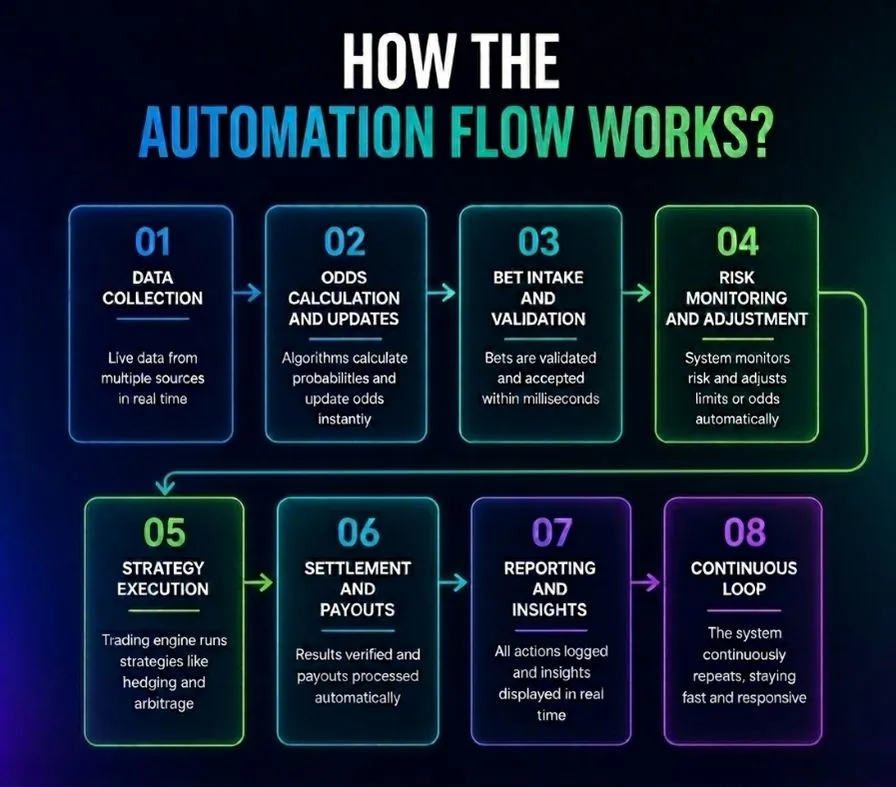
Overview of how automation flow works
Behind automation sits a sports betting software development process with a direct, continuous flow in which data flows rapidly, and decisions are made instantly. Every step connects to the next, so the system reacts in real time without waiting for a human to catch up.
1. Data Collection in Real Time
All this begins with live data feeds. Statistics of a match, player statistics, trends in history, and real-time information such as goals, injuries, or fouls. The system has various sources simultaneously to ensure that nothing is wrong or out of date.
2. Odds Calculation and Updates
That incoming data flow feeds directly into the odds engine. The numbers are crunched using algorithms and AI models, the probability is calculated, and odds updated dynamically. A red card occurs; a goal is scored, and the odds change across all the markets you may be involved in before you even have time to digest it.
3. Bet Intake and Validation
The moment a user places a bet, the system gets to work. It checks the odds, validates the stake, confirms the market status, and either accepts or flags the bet in milliseconds. No queues, no lag.
4. Risk Monitoring and Adjustment
Running in the background the whole time is the iGaming risk management module. It tracks betting patterns and watches for anything unusual, like a flood of bets landing on one outcome. When it spots a red flag, it adjusts limits, tweaks odds, or suspends the market automatically to keep exposure in check.
5. Strategy Execution
The trading engine doesn’t sit idle either. It runs predefined strategies like hedging or arbitrage, placing and adjusting positions as the market moves, all without needing anyone to press a button.
6. Settlement and Payouts
At the end of the game, the system checks the results by referring to the trusted data sources and automatically settles bets. The payouts are made fast, reducing the time taken to make payment and also limiting the number of disputes.
7. Reporting and Insights
All the actions are logged and processed into real-time dashboards. Whenever they wish, operators can follow their performance, assess their exposure to risk, and pull reports of compliance or strategy review.
The entire flow is maintained in a continuous loop ensuring the platform is responsive, accurate and prepared to whatever event the next event throws at it.
Read Blog – Expected value in betting: margin explained
Core Components of an Automated Betting Platform
A high-performance betting platform is only as good as what’s running under the hood. The interface might be what users see, but it’s the backend ecosystem that keeps everything fast, accurate, and reliable. Here’s a look at the components that actually make it work.
1. Odds Engine
Think of the odds engine as the brain of the whole operation. It’s constantly pulling in live data, race conditions, horse performance history, jockey stats, betting volumes, even weather, and using AI-driven models to calculate and update betting odds in real time.
There are no static numbers here. If a heavily backed horse starts showing signs of fatigue, or a sudden wave of bets shifts the liability, the engine recalibrates instantly.
A last-minute withdrawal, a track condition change, a betting spike, it reacts to all of it in milliseconds, keeping the platform competitive while protecting its margins.
2. Risk Management Module
This is the platform defense system, and it never sleeps. It monitors every bet that comes in, looking for patterns that don’t add up. If multiple high-value bets land on an underdog from linked accounts at the same time, the system flags it immediately.
From there, it can reduce betting limits for specific users, adjust odds to manage exposure, or suspend a market altogether, all without anyone needing to intervene. More advanced systems even build user risk profiles, separating casual bettors from sharp ones, so the platform can apply more precise controls where they matter most.
3. Betting and Trading Engine
This is where execution actually happens. Bets get processed, matched against available markets, and completed in an instant, even when volumes are running high.
The more advanced versions of this engine go beyond just processing bets. They run automated trading strategies like arbitrage, hedging, and market-making, adjusting positions continuously as markets move.
Speed is everything here. A delay of even a few seconds can mean mismatched odds or unexpected financial exposure.
4. Settlement Engine
When the race is over, the settlement engine takes the wheel. It connects to official race data providers, verifies results, calculates payouts, and updates user wallets automatically. No manual steps, no waiting around.
This matters more than it might seem. Manual settlement creates delays, and delays create distrust. A clean, automated settlement process keeps things transparent and keeps disputes to a minimum.
5. Analytics and Reporting
Raw data is not useful unless you can do something about it. This element transforms all the data gathered on the platform into easy-to-understand actionable data via real-time dashboards. At a glance, operators are able to view betting volumes, market-based profit and loss, user behavior, and retention trends.
It also handles the less glamorous but equally important side of things: compliance. The system automatically produces audit-ready reports of transactions, user activity, and financial flows, thus operators do not have to scramble whenever regulators knock on the door.
High-tech platforms go a step further with predictive analytics and alert on demand spikes or a bad-performing market before it becomes a reality.
6. Integration Layer
All the above-mentioned components must communicate with one another and with the outside world. The integration layer does that. It manages the APIs that connect live odds and race data providers, iGaming payment solution providers, KYC and AML verification systems, and user account management into one seamless flow.
A user must be able to place a bet which will be validated by the system, the latest odds should be retrieved, the bet should be confirmed, and the transaction should be logged in a matter of seconds. The integration layer is what makes that possible without anything slipping through the cracks.
Read Blog – AI in sports betting
Manual Vs Automated Sports Betting Operations
In sports betting, how efficiently you operate has a direct impact on your margins and your users’ experience. The difference in manual and automated systems is larger than most operators think, and being aware of the difference is the first step towards creating something that does scale.
| Aspect | Manual Betting Operations | Automated Betting Operations |
| Odds Management | Traders set and adjust odds by hand, which means slower updates and room for human bias to creep in. | AI-driven engines update odds instantly, reacting to live data, betting patterns, and risk exposure in real time. |
| Speed of Execution | Bet placement and validation can lag, especially when traffic spikes during major events. | Bets are executed with ultra-low latency, even at peak volumes. No queues, no slowdowns. |
| Risk Management | Manual monitoring makes it difficult to catch fraud or unusual patterns before damage is done. | Real-time algorithms detect anomalies instantly and can auto-adjust limits or suspend markets without human input. |
| Scalability | Growth is capped by a headcount. More volume means more hiring, more training, more overhead. | Built to scale. Thousands of concurrent users and bets handled simultaneously, no extra manpower needed. |
| Accuracy | Human error in odds setting, settlement, and reporting is an ongoing risk. | Automated calculations keep pricing and payouts accurate, with far less room for costly mistakes. |
| Settlement Process | Manual result verification slows things down and opens the door to disputes. | Settlement happens instantly using integrated data feeds and automated payout processing. |
| Operational Costs | Staffing, training, and oversight add up over time, making long-term costs hard to control. | Higher upfront investment, but significantly lower operational costs as the platform scales. |
| User Experience | Slow updates and delays frustrate users, especially during live betting, where every second matters. | A seamless, real-time experience with instant updates and faster transactions across the board. |
| Data Utilization | Historical and real-time data rarely get used to its full potential in decision-making. | Advanced analytics and AI work through large datasets continuously, driving smarter pricing and sharper insights. |
| Compliance and Reporting | Manual reporting is time-consuming and more likely to contain inaccuracies when it counts most. | Audit-ready reports generated automatically in real time, keeping operators compliant without scrambling. |
Manual systems can hold their own at smaller scales, but they hit a ceiling fast. Automated betting platforms deliver the speed, precision, and scalability that competing in today’s high-frequency betting environment actually demands.
Benefits of Automation for Sportsbook Operators
Automation is not nice to have anymore. For operators looking to scale, protect margins, and deliver a betting experience, users actually want to stick around for; it is the baseline.
1. Higher Profit Margins Through Smarter Odds
Every margin matters in sports betting. Real-time data and AI are used to maintain odds at optimal levels at all times, tightening spreads, equalizing books, and reducing exposure to sharp punters. The result is an operation that stays ahead of market movements instead of scrambling to catch up.
2. Real-Time Risk Control
The earlier a threat is identified the cheaper it is. Automation identifies suspicious patterns and arbitrage and unusual activity as it occurs and reacts immediately by changing limits, suspending markets, or repricing odds. No waiting, no manual examination, no damage that could have been prevented.
3. Scalability Without Operational Overhead
More users should mean more revenue, not more hiring. Automated systems handle thousands of concurrent bets and markets without needing additional staff, making it straightforward to grow across regions and sports without costs spiraling alongside volume.
4. Faster Bet Processing & Settlement
Users expect speed, and automated engines to deliver it. Bets are processed instantly, outcomes are settled as soon as results are confirmed, and payouts move quickly. That kind of reliability builds trust, and trust keeps users coming back.
5. Enhanced User Experience
What is running in the background is reflected in the experience. Real-time odds, instant confirmations, customized suggestions and even a platform that will not collapse even when the events are in full swing. With a pleasant experience, users will remain longer and place more bets.
6. Data-Driven Decision Making
A sportsbook produces a huge amount of data every day. It is put into use through automation. Betting behavior, market trends, and performance metrics are all fed into dashboards to enable operators to make smarter decisions on pricing, promotions and user engagement.
Read Blog – How sports betting algorithms price odds
Technology Stack Behind Automated Betting Software
The technology stack behind any high-performance and quick betting site is designed to do only one thing: maintain the entire system running smoothly when it counts. The core components deal with the logic and operations; however, this is the layer which ensures that none of it fails when it matters the most.
1. Data Pipeline and Stream Processing
Automated platforms do not wait for updates. They process data continuously, ingesting live match information, betting activity, and external feeds as events unfold. That means odds, risk signals, and user actions are always based on what is happening right now, not what happened a few seconds ago.
2. Low-Latency Infrastructure
In betting, milliseconds matter. The stack is built to cut delays at every stage; from the moment data comes into the moment a bet is confirmed. In-memory databases and edge computing keep response times tight, so whether it is an odds update or a bet confirmation, it happens fast, even when traffic is running high.
3. Microservices Architecture
Instead of running one large system that lives or dies together, modern platforms are broken into smaller, independent services. Each one handles a specific job and can scale on its own. That makes the platform easier to update, more flexible to manage, and far more resilient. If one service hits a problem, the rest keep running without missing a beat.
4. Cloud-Native Deployment and Auto Scaling
Betting traffic is unpredictable. A major event can send volumes surging in minutes. Cloud-native deployment handles that by scaling up automatically when demand spikes and pulling back once things settle down. The platform stays performant when it needs to be and cost-efficient when it does not.
5. Monitoring, Logging, and Fault Tolerance
No system is immune to issues, but a well-built one catches them before users ever notice. Continuous monitoring tracks performance across the entire platform, centralized logging keeps a clear record of every action, and failover mechanisms kick in automatically if something goes down. Operations stay uninterrupted, and when something does need fixing, the information to fix it is already there.
Challenges in Implementing Automated Betting Systems
Automation solves a lot of problems, but it comes with its own set of challenges that operators need to get right from the start. Speed and efficiency mean little if the foundations are shaky.
Data Dependency and Accuracy Issues
A delayed feed or a few seconds of bad data during a live event can mean wrong odds and incorrect settlements. Multiple data providers, validation layers, and fallback systems are what keep costly mistakes from slipping through.
High Initial Setup Cost
Infrastructure, data feeds, AI models, and third-party integrations all add up before a single bet is placed. The challenge is staying clear-eyed about the upfront commitment while keeping focus on what the long-term returns actually look like.
Balancing Automation with Human Oversight
Automation is fast but does not always read the room. Unexpected events and edge cases can catch a fully automated system off guard. The real challenge is knowing where to let it run freely and where to keep human judgment in the loop.
Regulatory Compliance in Automated Decisions
Betting regulations vary by region and change frequently. Every automated decision needs to be compliant and traceable. When it falls short, the consequences go beyond fines and can put operating licenses at risk.
Transparency in Algorithmic Systems
When a platform behaves like a black box, explaining outcomes to regulators and resolving user disputes becomes difficult. Clear logs, explainable models, and traceable decision trails are what keep operators genuinely in control.
Read Blog – Sports betting site checklist for operators
How to Choose the Right Automated Betting Software
Picking the right automated betting software comes down to more than a feature checklist. It is about finding a system that fits how you operate, grows your business, and slots into your existing setup without friction. Most operators end up weighing a custom build against a white-label sportsbook solution. Here are the key factors worth evaluating:
| Factor | What to Look For | Why It Matters |
| Custom vs White-Label Solutions | Custom platforms give you full control but take longer to build. A white-label solution is pre-built and ready to launch faster. | If getting to market quickly is the priority, white label makes sense. If your model needs deep customization, a custom build is worth the extra time and investment. |
| Integration Capabilities | Check how easily the software connects with data providers, payment gateways, KYC systems, and CRM tools through APIs. | Weak integrations slow everything down and create data gaps. Clean, well-built integrations keep operations running in real time with fewer technical headaches. |
| Vendor Reliability and Support | Look for proven experience, solid uptime guarantees, regular updates, and a support team that actually responds when things go wrong. | Downtime costs money and erodes user trust fast. A reliable vendor keeps the platform stable and makes sure issues get resolved before they escalate. |
These three factors will not cover every decision, but they are the ones that tend to matter most when operators are choosing between platforms. Get this right, and the rest becomes a lot easier to manage.
How PieGaming Supports Automated Betting
|
Wrapping Up…
Automated sports betting software is not just about keeping up with the competition. It is about building an operation that is genuinely built to last. Faster decisions, smarter risk control, and scalability all come from getting the right system in place. Whether you take the white-label route or a turnkey sportsbook, the automation should already be wired in.
Operators who invest in automation today are not just solving today’s problems. They are setting themselves up to win in a market that is only going to get more demanding.

FAQ's
-
What is automated sports betting software?
Automated sports betting software uses algorithms to manage odds, bets, and risk without needing manual input. It processes real-time data to keep sportsbook operations running faster, with better accuracy and room to scale.
-
How does automated betting software work?
It collects live data, calculates odds, accepts bets, monitors risk, and settles outcomes, all in real time. Every step happens automatically, so the platform reacts instantly without anyone needing to step in.
-
Is automated sports betting legal in 2026?
It depends on where you operate. In regulated markets, automated betting is permitted as long as operators meet licensing requirements, follow compliance standards, and stick to responsible gambling guidelines set by local authorities.
-
Is AI used in automated sports betting tools?
Yes, and it is central to how these platforms perform. AI analyzes data, predicts outcomes, and adjusts odds in real time, helping operators improve accuracy, catch risks early, and run smarter betting strategies across markets.


Palak Madan has been writing about the iGaming industry since 2024. She focuses on helping operators and founders understand their options when launching an online casino, from choosing the right software provider to figuring out costs and compliance requirements across different markets. At PieGaming, she covers topics like white label casino solutions, platform selection, and market entry, turning complex industry information into practical guidance for people building iGaming businesses. She also keeps a close eye on licensing and regulatory changes; particularly how new rules shape the way operators enter and grow in different jurisdictions.

Micro betting is a type of live sports betting that focuses on the small moments within a game. Instead of wagering on the final result, bettors place bets on what happens next, such as the outcome of the next pitch in baseball, point in tennis, possession in basketball, or ball in cricket. Because these events are settled almost instantly, micro betting offers a faster and more dynamic experience than traditional sports wagers.
Esports betting offers a major opportunity to operators, and choosing the right partner can greatly impact profitability, player engagement, and operational efficiency.
Learn what retail sports betting is, how on-premise sportsbooks operate, and what the retail model costs and returns compared with going online only.
Read about what horse racing betting software includes — tote and fixed-odds markets, race feeds, and payments — plus what a build or a full license costs.
Learn about how sports betting algorithms price odds and manage risk, plus the leading algorithm software compared on data, models, and integration options.
Learn how esports betting works as a vertical — titles, markets, odds feeds, and the software operators need to add esports to an existing sportsbook.
Learn how AI is used in sports betting for odds pricing, fraud detection, live markets, and player segmentation — and what it changes for operators.








See you in your inbox soon!

Stay ahead of the game. Subscribe for exclusive content, updates, and insiders!