
Armenia has a regulated iGaming market with clear licensing and operational guidelines. This guide explores casino and sports betting regulations in Armenia, covering legal requirements, compliance standards, and how operators can establish a presence in this growing market.
Not all iGaming market rewards scale—some reward timing, strategy, and compliance. And Armenia is among them.
Armenia has emerged as one of the appealing and opportunity-rich gambling markets in Eastern Europe. Not because it’s easy to venture into, but because it is moving towards becoming a highly regulated, compliance-centric market.
The legislative changes between 2022 and 2025 introduced strict licensing rules, real-time centralized monitoring, and a 10% turnover tax. The reason for these changes was to prioritize transparency, accountability, and long-term revenue generation.
This opens doors for operators who can meet the regulatory demands. This guide covers everything about Armenia’s online casino and sports betting regulations and what it takes for operators to succeed in this market.
The Current State of Gambling in Armenia
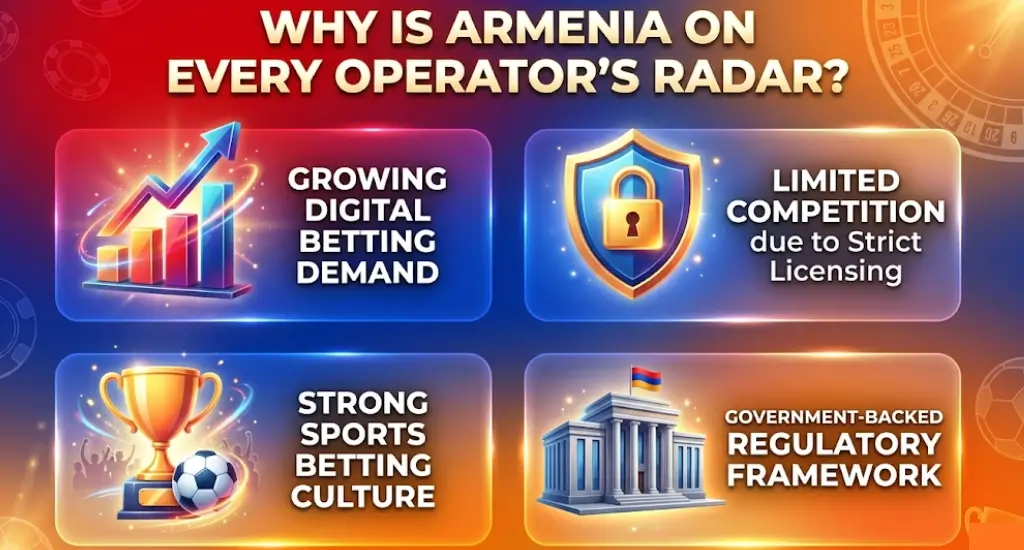
Armenia on Operators’ Radar
Over the past few years, Armenia has followed a liberal approach to gambling. This made Armenia a regional gambling hub, enticing international operators and players from countries where gambling is prohibited.
Armenia follows a relatively liberal gambling policy compared to neighboring countries, making it a regional hub for operators and players. As of 2025, the industry significantly contributes to the economy through taxes, jobs, and foreign investment. However, the government is also focusing on strengthening regulations to ensure controlled and responsible growth.
What’s Legal in Armenian Gambling?
The legality of casino or sports betting activities depends on the jurisdiction and its laws. Let’s discuss which gambling activities are legal and not legal in Armenia.
Online Casinos
Is online Gambling legal in Armenia?
Online casinos are fully legal and regulated in Armenia under a valid license issued by the Ministry of Finance. However, operators must fulfill the key requirements asked by the regulators:
- Must have a government-issued license
- Certified RNG systems
- Minimum RTP compliance
- Integration with centralized monitoring systems
Land-Based Casinos
Land-based casino operations are allowed but are restricted geographically. Key regulations for land-based casino operations include the following:
- Operations are only allowed in selected zones
- High licensing fees
- Strict monitoring and reporting requirements
Sports Betting
Sports betting is one of the most active gambling markets in Armenia. It is fully legal for licensed operators across both retail and online platforms. Here are the key licensing requirements that the operators must fulfill:
- Retail betting platforms should operate across major cities.
- Online sportsbook activities are widely acceptable.
- Local and international brands should operate through a local licensing structure.
Must have compliance rules include the following:
- Responsible gambling tools
- Age verification
- Self-exclusion tools
- Advertisement restrictions
Lottery and Gaming Machines
In Mexico, lotteries and gaming are run and controlled by the state. Further, gaming machines are operated in licensed gaming halls and casinos, subject to technical certification and regular inspection.
Further, the Ministry of Finance issues a separate lottery license for operators to run physical or online lottery games.
Taxation on Online Casino & Sports Betting
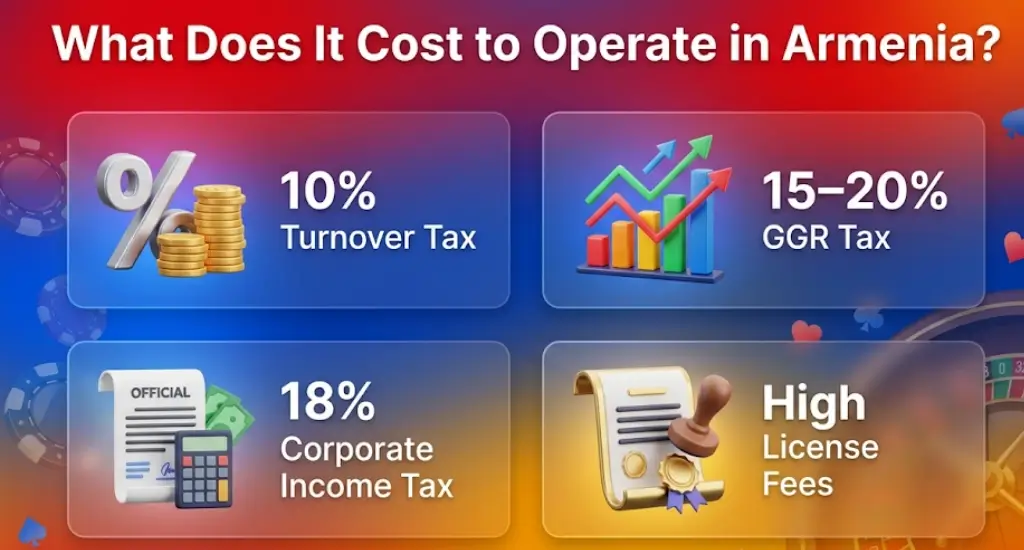
COST to operate in Armenia
In 2025, Armenia significantly revised its taxation model to generate more state revenue from gambling activities. Since then, there have been key regulatory changes in the system, which include:
Current Tax Structure (2025 Update)
- 10% turnover tax on all bets placed with online casinos effective from 1 July 2025. Presently, this tax is not allowed on bookmakers.
- 18% corporate income tax applied to gaming organizers’ profits.
- 15-20% GGR tax based on the vertical.
License Fee Changes
Before April 2025, annual license fees were:
- Online casinos: AMD 175 million
- Sportsbooks: AMD 50 million
However, the fees doubled in April 2025, as follows:
For instance,
- Online casinos: AMD 350M
- Sportsbooks: AMD 100M
Impact on Operators
The collective effect of these changes impacts operators in the following way:
- Higher entry barriers
- Doubled operational and compliance cost
- More focus on serious and well-funded operators
Compliance & Player Protection Regulations in Armenia
Running an online casino or sports betting platform isn’t a walk in the park. Operators must ensure that they meet different regulatory requirements issued by the jurisdiction.
KYC & AML Requirements
Operators must ensure that they’re compliant and implement required Know Your Customer (KYC) and Anti-Money Laundering (AML) processes:
- Essential identity verification for all registered players.
- Bank-linked account verification for players.
- Continuous transaction monitoring.
- Reporting suspicious activities to authorities.
Responsible Gambling Measures
As per the 2025 legal framework, it’s important for licensed operators to include a set of all responsible gambling tools in their platforms. This includes:
- Deposit & loss limit
- Self-exclusion tools mandatory for all registered users
- Problem gambling detection systems
- Strict age verification
Technical Compliance
All online casino or sports betting platforms should meet technical standards, including:
- Certified RNG and software validated by globally recognized testing bodies.
- Minimum RTP standards (~90%) across all casino games.
Read More – Risk Management Tools for iGaming Busines
Explore Casino & Sports Betting Regulations in Different Countries
Restrictions for Foreign Operators
Armenia’s iGaming market is restricted and doesn’t allow offshore operators to run online casino businesses directly. So, what challenges can foreign operators face in Armenia’s gambling market? Let’s decode the challenges below:
Market Entry Barriers
Armenia presents a clear pathway for foreign operators, but it requires a full domestic incorporation. Here’s what operators have to meet:
- Register a local business in the country.
- Offshore operators must obtain a domestic license.
- They should comply with all tax and monitoring obligations.
Enforcement Mechanisms
Armenian states employ multiple tools to enforce compliance:
- IP blocking for unlicensed platforms targeting Armenian players.
- Payments can be blocked through local banks to prevent transactions.
- Legal penalties for unlicensed operators.
- International cooperation agreements with other regulatory bodies for cross-border enforcement.
Recent Regulatory Changes (2024–2025)
Tax Reform
- In 2024, the country introduced a tiered player-winning tax, imposing a 10% rate on winnings exceeding AMD 5 million.
- April 1, 2025 – Licensed fees for operators doubled across all online gambling activities.
- July 1, 2025—a 10% turnover tax on online casinos’ revenues comes into force.
Source: Armenian Ministry of Finance, regional iGaming reports
Stricter Licensing
- Background verification and strict beneficial ownership disclosure requirements.
The aim of these regulatory changes is to tighten control and increase transparency.
Government Monitoring Expansion
The Armenian government has taken all the important steps to ensure every iGaming activity or operation is carried out clearly. Here are these:
- A new body is established to monitor the gaming sector and real-time transaction tracking and anti-fraud enforcement.
- A gaming operator institute is established for operator registry maintenance, software audits, and consumer protection enhancement.
Read More – White Label Vs Turnkey Casino Solutions
Centralized Monitoring Body in Armenia
In recent years, Armenia has shifted from a loosely controlled market to a data-driven regulatory model to keep the iGaming industry transparent.
Real-time Monitoring
In Armenia, the Gaming Sector Monitoring Center oversees all gambling transactions in real-time and enforces anti-fraud measures. Operators have to maintain direct system connectivity. This allows regulators to access transaction data, bet volumes, and player activity without delays.
Further, the Gaming Operators Institute ensures a detailed operator registry and audits of gaming software systems for compliance with RTP and RNG standards.
Advertising & Market Restrictions for Operators
Armenia has introduced and implemented some strict rules for casino and sportsbook operators around advertising and unlicensed sites.
Advertising Ban
In Armenia, advertisement of lotteries, online and offline gambling, or casinos is strictly prohibited under the following:
- If it conveys that gambling leads to social, professional, and sporting success.
- Creates the impression of guaranteed profits.
- If an advertisement is seen conveying that it guarantees regular income or serves as an alternative to employment.
Further, all permitted gambling-related advertisements should include health warning information about the restriction on gambling under the influence of alcohol.
Unlicensed Sites
All Armenian players are restricted from accessing offshore unlicensed gambling platforms. According to 2025 Gaming Law, it allows IP blocking, payment blocking, and criminal liability for unlicensed operators actively targeting Armenian players.
Read More – Secure a Gaming License
Operator-Level Taxation
Below is the taxation summary table for operators highlighting all types of taxes and fees imposed.
| Type of Taxes | Before 2025 | Post -April 2025 |
| Casino License Fee | AMD 175M (~$444K) | AMD 350M (~$890K) |
| Sportsbook License Fee | AMD 50M (~$126K) | AMD 100M (~$253K) |
| Turnover Tax (online casinos) | None | 10% (from July 1, 2025) |
| Compliance Income Tax | 18% | 18% |
| Player Winning Tax (Std.) | N/A | 5% |
| Player Winnings Tax (>AMD 5M) | N/A (Pre-2024) | 10% |
| Player Winning (Unlicensed) | N/A | 20% |
| VAT | Exempt | Exempt |
Conclusion
All in all, Armenia’s iGaming market brings a compelling opportunity but only for operators ready to navigate regulatory complexity and invest in compliance. However, the shift towards regulatory shifts, higher taxation, and centralized monitoring highlights that the market is maturing and prioritizing transparency, responsible gambling, and sustainable revenue generation for operators.
For software companies like PieGaming, this opens the door to providing scalable, compliant, and future-ready iGaming solutions catering to regulated landscapes like Armenia.

Armenia’s Regulated igaming market
FAQs
-
Are casinos legal in Armenia?
Yes, land-based and online casinos are legal in Armenia with proper licensing. However, they are geographically restricted to particular tourism zones like Sevan, Jermuk, Meghri, and Tsakhkadzor.
-
What are the new casinos' rules for Armenia in 2026?
The new casino rules in Armenia include a higher license fee, stricter taxation, centralized monitoring, and tight advertising regulations.
-
Is Armenia part of the GDPR?
No, Armenia is not a part of the European Union; thus, it is not subjected to GDPR (General Data Protection Regulation). But Armenia has its data protection legislation aligned with international standards.
-
Is sports betting allowed in Armenia?
Yes, sports betting is permitted in Armenia. Both land-based and online sports betting operate legally under a bookmaker license issued by the Ministry of Finance.
-
Who regulates gambling in Armenia?
The gambling industry in Armenia is regulated by state authorities under the Ministry of Finance. Further, the State Revenue Committee oversees day-to-day compliance and enforcement.

Monika Gola is an iGaming content specialist at PieGaming. Since 2020, she has been researching and developing content around software selection, online casino & sports betting regulations, and operator growth strategies. Her research includes analyzing market opportunities in regions like Europe, Africa, and Southeast Asia, as well as evaluating regulatory frameworks and entry barriers. She is actively monitoring industry trends, compliance updates, and evolving player demands across global iGaming markets to help operators navigate this industry seamlessly.

A GCGRA Gaming License is required to operate commercial gaming in the UAE, including online casinos and sportsbooks. Foreign operators can apply, but must meet GCGRA’s suitability, financial, compliance, and operational requirements before they can launch.
Online casino gaming is not allowed in Australia under Interactive Gambling Act 2001. But operators can still apply for an internet gaming license via specific jurisdictions like the Northern Territory, which allows them to offer gambling services legally- generally outside Australia.
Bulgaria’s iGaming license enables operators to legally provide services in the areas of online casino, betting, poker, and bingo in accordance with the regulations of the EU. Typically, a licensing process can take 60 to 90 days, and it will need to be approved by the NRA, technical certification, AML compliance, and data storage in the local area. Minimum capital requirements range from BGN 50,000 for betting operators to BGN 1.5 million for online casino operators.
To obtain the Anjouan Gaming License, applicants must collect and submit all the important documents. Learn the process of obtaining Anjouan iGaming license.
Algeria has no online casino or sports betting regulation to speak of — instead, the country enforces a near-total gambling ban rooted in civil law and Islamic principles. Yet despite the prohibition, offshore platforms continue to pull in millions of users every month, driven by high demand and a near-total absence of legal local alternatives.
A Kahnawake iGaming license is a credible and cost-effective licensing solution for online casinos and sportsbook operators. The process to obtain this license includes multiple steps, key benefits, and licensing costs.
Malta pays attention to the credibility of the regulatory framework and to access regulated markets, which is more conducive to long-term growth and industry reputation. However, Curaçao places a strong emphasis on speed and affordability, making it a good choice for startups and businesses focused on cryptocurrencies that are keen to establish a presence rapidly and at a lower cost. If you are constructing a major operation, select Malta. Pick Curaçao when you are just getting started and have to get your product to market quickly.


See you in your inbox soon!

Stay ahead of the game. Subscribe for exclusive content, updates, and insiders!