
To start an online casino in South Africa, operators need to obtain a bookmaker’s license or partner with a licensed bookmaker. The country doesn’t offer a standalone online casino license as of now.
Launching an online casino business in South Africa requires careful planning across business model, regulations, technology, and marketing. Though online casino games are prohibited, sports betting licenses issued by provincial provide a viable market entry for casino operators as well.
With growing demand for digital entertainment, the South African iGaming market is becoming an attractive business opportunity for operators. But understanding the legal, technological, and operational requirements to start a seamless business in the South African market.
If you’re searching for how to start an online casino in South Africa, this is your go-to guide. Here, you will learn a step-by-step process to launch a hassle-free and seamless business.
South Africa Online Casino Market Overview
South Africa’s online gambling market is a large and growing market in the world. Gambling has become a part of everyday spending in people’s lives. People invest more in lottery tickets, casinos, sports betting, bingo, and Limited Payout Machines. The growth is closely linked to growing betting apps and online platforms in South Africa. The reason for this growth is also due to the rising adoption of mobile technologies and improved internet connectivity. Currently, 90% of mobile users are accessing the internet via smartphones.
In terms of revenue, South Africa accounted for 1.8% of the global online gambling market in 2025. Further, the industry generated revenue of USD 1,541.8 million in 2025 and is expected to reach USD 2,774.5 million by 2033, as per the Grand View Research report.
Also, sports betting is one of the most preferred segments, registering the fastest growth. This gives operators an opportunity to open an online casino in South Africa. However, people use offshore operators, which leads to challenges. Therefore, understanding online casino and sports betting regulations in South Africa is important for operators to start an online casino business.
The most played games in the country include:
- Online slots – #1 choice
- Live dealer games(Live blackjack, baccarat)
- Crash/ instant games (Aviator)
- Classic Table games (Roulette, Blackjack)
What is legal in South Africa?
Land-based casino and sports betting are regulated and licensed at the provincial level. Online casino gaming is regulated at the national level.
10 Steps to Start an Online Casino in South Africa
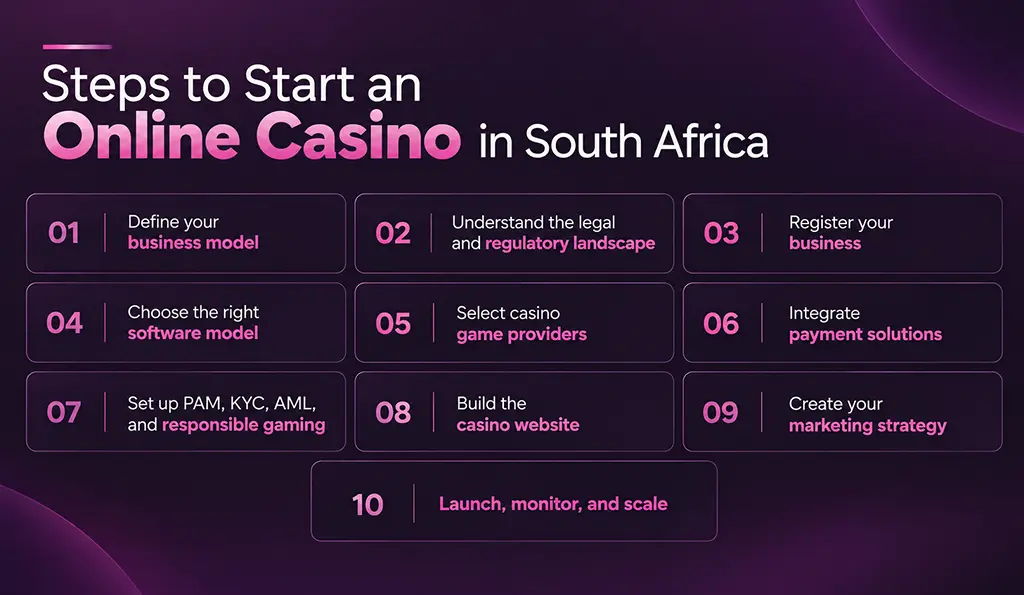
Steps to launch an online casino in SA
Below are the actual steps. Just follow this path and establish a legitimate and player-centric online casino in South Africa.
Step 1: Define Your Business Model
As per South African law, the National Gambling Act 7 of 2004, most new entrants will be sportsbook-first and then plan to add a casino when they have a bookmaker’s license. Thus, they could, for example, run a sportsbook with “bets” on casino games or choose to focus only on casino games by entering a partnership with a local sportsbook licensee or waiting for a change in the law. Operators can still enter the market under the current provincial licensing regime. Once you clarify your business model, it will further help you with the licensing process.
Step 2: Determine Your Regulatory and Licensing Route
Where and how to get a gambling license in South Africa?
To operate legally, operators will need a bookmaker’s license from a well-known South African provincial gambling board. The popular licensing bodies in South Africa include:
- Western Cape Gambling and Racing Board
- Gauteng Gambling Board
- KwaZulu-Natal Gaming and Betting Board
Note that each board has its own list of contingencies. This is the route most new entrants are likely to choose, with either Gauteng or the Western Cape being the most probable choice.
Dual Structure (Land + Online): Some land-based casinos enter the online space by launching an affiliated website through a partnership with a bookmaker who has a provincial license. This eases entry for casino operators as well.
Further, the offshore model is for international operators. They need to obtain a license from an offshore regulator such as Malta or Curaçao. However, without having local permission, you will face potential payment blocks and legal uncertainty.
Provincial License as a strategic entry point:
Provinces like the Western Cape and North West Gambling Board are seen as entry points for gambling-related licensing, particularly for betting and land-based operations. Why? Because these provinces are known for:
- Structured license framework
- Established gambling rules
- Regulating bookmakers and casino operators
Operators can use provincial licenses for:
- Sports betting operations
- Retail betting shops
- Land-based casino
Step 3: Register the Business
The entity is required to be registered in South Africa (or the relevant province, depending on the structure). Decisions will need to be made in relation to the structure (private company PTY LTD, holding company, LLC) and ownership (local vs foreign ownership – note that some provinces require a certain level of local ownership).
Tax and accounting considerations also need to be taken into account (note that income from winnings is generally tax-free). It is advisable to consult local lawyers in relation to the most suitable structure and to obtain relevant documentation for the application process. The completion of this step will facilitate the next step (obtaining the license).
Step 4: Obtain a Gambling License
At present, the country doesn’t issue a dedicated national online casino license. So, obtaining a license depends on operators’ business model, risk-bearing ability, and market entry strategy.
So, the question arises…
How to obtain an online casino license in South Africa?
Operators must procure an offshore online casino license to align with South African laws. However, some operators go with a dual–structure model:
- Provincial bookmaker license in SA for sports betting
- Offshore license for online casino business
The licensing process usually comprises the following stages, based on business model and province.
Submit Application: Operators need to submit a detailed business plan, corporate structure, financial disclosure, and technical documentation to the provincial gambling board.
Due Diligence: Authorities conduct background checks on stakeholders, directors, and key personnel to assess financial and legal credibility. Make sure to maintain a transparent track record to get the license without complications.
Technical Assessment: Whether it’s gaming platforms, RNG systems, or software, they undergo technical evaluation and certification to meet regulatory standards. Your platform must be AML and KYC compliant and have responsible gambling tools as well.
Approval and Issuance: Once the evaluation is successfully completed, licenses are granted subject to compliance with conditions and payments of fees.
Timeline: The licensing process can take several months, depending on the province, the complexity of the business model, and the documentation of readiness.
Step 5: Choose White Label, Turnkey or Custom Software
The online platform is the casino’s first impression on the player, and it can make or break the business. There are three main options:
| White label | Turnkey | Custom |
| A ready-made platform comes pre-integrated with PAM, casino games, back office, CMS, and payment solutions. It can go live within 14 days, making it a suitable model for startup operators. It comes with a lower upfront cost. | Similar to the white label but with more flexibility around customization. It can be launched within 4-6 weeks. You can customize branding, add new features, and your license as well. | This involves building the platform from scratch or substantially reworking an existing one. This is the most expensive and time-consuming option (development can take 12 months or more) but gives the operator full control over the product. It is only suitable for established operators with significant budgets.
|
For most startups, white label and turnkey casino software are ideal ways to enter the market.
Step 6: Integrate Payment Solutions and Casino Games
South African players tend to prefer local payment methods such as Electronic Funds Transfer (Ozow Instant, SiD Instant, and PayFast), e-wallets, cards, prepaid vouchers like 1ForYou, EasyPay, instant bank apps (Capitec Pay is widely used among South African players), and cryptocurrency. Africa is a mobile-first market, and payment preferences directly impact conversion rates, retention, and player lifetime value.
A crypto gateway should be set up separately to collect crypto deposits, and operators should be aware that KYC procedures still apply to crypto transactions. The payment experience is crucial to the player, and deposits that are declined are a major cause of player churn. Players will also appreciate the convenience of mobile-friendly payment methods.
Also, choosing the right game or game provider for South African players is crucial. Operators should ensure that new games are added on a regular basis (ideally every month). Games should also be mobile-friendly and optimized for local players. Given that SA players tend to bet heavily on sports, operators should consider cross-selling by, for example, using sports-themed slots. It is also important to check that the games comply with local regulations (note that there are few games that are outright banned in South Africa).
Step 7: Set Up PAM, KYC, AML and Responsible Gaming
PAM (Player Account Management) is one of the most underrated aspects of setting up an online casino. PAM solutions provide operators with end-to-end management of the player lifecycle, from registration to withdrawals.
Further, South Africa has very strict KYC/AML requirements under the Financial Intelligence Centre Act (FICA). Operators must ensure that appropriate procedures are in place to verify the identity of all players. An automated KYC solution or a third-party supplier can be used to check government-issued ID, age, and residential address against sanctions lists and politically exposed persons (PEPs).
Also, South Africa has some of the strictest, responsible gambling laws in the world. Operators must ensure that they have appropriate responsible gambling features in place, such as self-exclusion and deposit limits. Operators should also partner with gambling organizations like PGA South Africa and add information about responsible gambling on the website.
Step 8: Build the Casino Website
The website is the first point of interaction with the player and must be optimized to encourage sign-ups and deposits. Make sure your website is mobile-first and localized for South African players, provides a seamless UI/UX experience, and includes SSL certification to ensure that players’ data is safe and protected.
Also, the site should be accessible to players even on low-data plans. And it should work on both iOS and Android devices.
Step 9: Create Your Marketing Strategy
To promote online casinos in SA, operators need to work on marketing. Also, marketing requires a compliance-first approach due to restrictions on direct advertising and regulatory frameworks.
Effective marketing strategies include:
- Affiliate Marketing Programs: Partner with South African local affiliates to drive targeted traffic and conversions
- Influencer Marketing: Collaborate with local influencers while adhering to responsible gambling and advertising guidelines.
Step 10: Launch, Monitor and Scale
Once the website has been launched, operators should focus on driving growth and improving the player experience. Some of the key activities are outlined below.
- KPI and monitoring
- Player acquisition and retention
- Game performance
- Payment performance
- Compliance audits
- Updating the website
Operators should bear in mind that running an online casino is a continuous process, and that regular maintenance and improvements are essential.
How Much Does It Cost to Start an Online Casino in South Africa?
Cost in South Africa can vary widely, but here’s a breakdown of major categories:
| Category | Estimated Cost (ZAR) | Description |
| Compliance & Monitoring Fees | R9,300 – R37,300 per year | System audits, ongoing oversight, and monitoring tools required by gambling board. |
| Software Certification | R56,000 – R186,500 + | One time cost. GLI or similar labs test the platform. |
| Gambling Employee Licences | R93 – R466 per person | Required for staff involved in the betting operations. |
| Technical Monitoring Tools | R18,650 – R93,250 setup | Integration with regulatory platforms like central monitoring system. |
| Gross Gaming Revenue (GGR) Tax | 15% | Need to pay monthly or quarterly; rate depends on the province and business type. |
| Advertising Permits or Reviews | R4,663 – R18,650 | Some provinces may charge for advertising reviews or permissions. |
| Legal & Compliance Consulting | R18,650 – R93,250 annually | Ongoing legal assistance to remain compliant with marketing, advertising, and operations. |
Disclaimer: The above-mentioned cost is just the estimation and may vary depending on the province and as per the recent updates.
Provincial License Applications Entry Cost
Cost may vary depending upon province, with Western Cape and Northwest applications requiring substantial fees and documentation expenses.
| Province | License Type | Application Fee | Annual Fee | Remarks |
| Western Cape | Casino | €31,730 | €15,865 | Application fee: €598.85; Annual fee: €120.15 |
| North West | Casino | €10,505 | €5,250 | Application fee: €300; Annual fee: €250 |
| Gauteng | Sports betting | €10, 212 | Differs | Differs based on the operation |
Understanding Local Players: Behaviour & Preferences
Operators entering the South African gambling market must understand the local players’ behaviour and preferences. South African players are highly mobile-driven due to high internet coverage and more affordable data plans, especially in urban and peri-urban areas. This includes the following:
Game Preferences
South African players have varied tastes when it comes to casino games:
Slots: Slots have huge popularity among South African players. But progressive jackpots like Major Millions and Mega Moolah are widely played. Also, high RTP rates and bonus features attract players a lot.
Table & Card Games: Games like blackjack and roulette are very popular in a live casino format. Players in South Africa prefer live casino more as it builds trust, as they can see game live and interact.
Crash Games: The simplest games (Aviator) are booming in popularity among a younger audience. Easy to play on a phone and offer the possibility of both small bets and big wins.
Community/Mobile Games: More casual games (Rummy or Ludo) sometimes have a wagering element and are played as an informal pastime. Some operators offer these as a separate category to attract a different type of player.
Fantasy/Sports Tournaments: While not a casino game, many SA players are interested in fantasy sports and eSports – a chance to engage in a different segment if you can offer these.
Payment Methods
South Africans are highly inclined towards value and convenience when making deposits. Here are the payment methods you should integrate into your platform.
Local Bank Transfers (EFT): Extremely popular. Consider offering instant EFT (via Ozow) as an option.
Debit Cards: Debit cards (Visa/Mastercard) are much more popular than credit cards – players are aware of the dangers of overspending with the latter.
Mobile Money & Cards: Airtime (prepaid mobile credit) and voucher providers (1ForYou) are popular with those without a bank account; consider using these as a deposit method.
E-Wallets: Skrill, Neteller and ECOcard (ecoPayz) have a strong presence in the local market.
It’s important to note that most South Africans will want to see prices in ZAR – avoid options that only display USD or EUR. Where possible, provide multiple deposit/withdrawal options, and make sure your website/app displays its prices in ZAR.
Cryptocurrency as preferred payment method
A small but growing proportion of players use crypto wallets – either Bitcoin or stablecoins. According to SiGMA World News, “In countries like Kenya and South Africa, you can already see there’s a lot of crypto transactions within businesses.”
The familiarity with cryptocurrency makes it easier for casino and sportsbooks operators to use tokens like Bitcoin (BTC) and USDT on the platform.
Further, Frank Deya, Director Africa at Bitcoin, put it succinctly: “Crypto has played a key role in bridging the financial and distance issue that the African iGaming space is facing.”
Preferred Languages
South Africa is a multi-lingual country, but English has a huge impact online, particularly with younger players. However, Afrikaans is also widely spoken and understood. Depending on the budget, operators can translate the site into Afrikaans.
Further, operators must localize the content and platform to South African English, and if possible, Afrikaans. Mentioning ZAR and the local market in general helps to reassure players that they are dealing with a trustworthy operator.
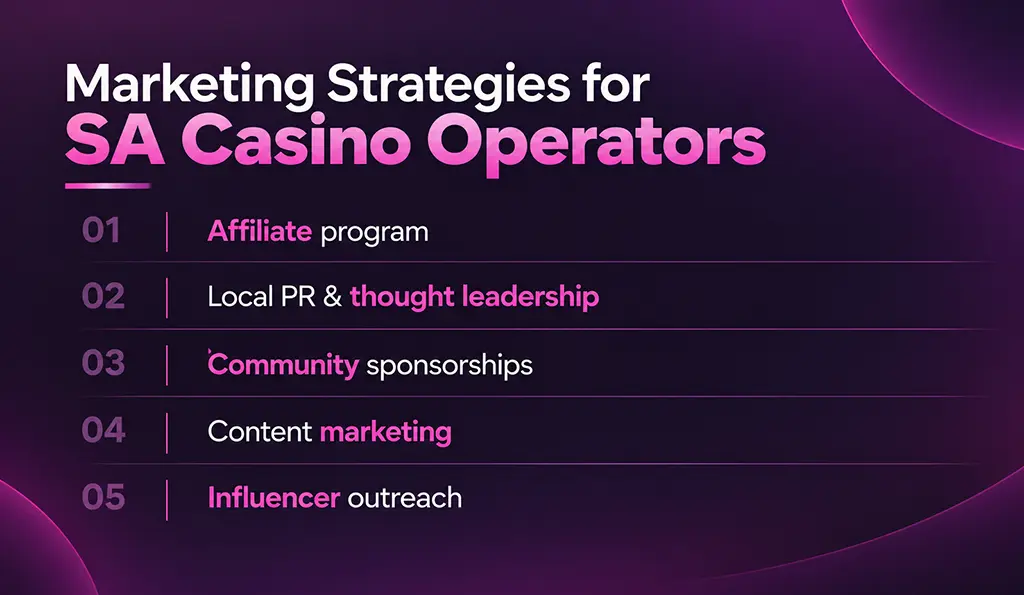
Online Casino Marketing Strategies for Operators
Why Choose PieGaming to Launch an Online Casino in South Africa?
PieGaming is a renowned name in the iGaming industry in South Africa. We’ve been serving operators for more than 10 years and have helped them establish a profitable online casino business.
Whether you’re a startup or an established operator who wants to grow a business, we can help.
White label and turnkey solution: 5000+ popular casino games, live dealers, crash games, and other types of casino games from 150+ providers. All games can be localized (translated) into numerous languages, including Afrikaans.
Complete technology solution: you get a PAM (player account management) system, bonus engine, back-office CRM/reporting, and payment processing solution. Everything is ready to go!
ZAR and local payment methods: we support South African Rand and all major local payment methods like Ozow, PayFast, 1ForYou, Capitec Pay, and others. You can also accept crypto transactions.
Go live quickly: with our white label software solution, you can launch your own branded casino within 14 days after contract signing. We take care of all technical aspects: hosting, technical support, and maintenance.
Conclusion
South Africa gives operators a unique opportunity to operators looking to start an online casino in South Africa. But entering this jurisdiction goes beyond having some text for your website. You will have to handle license processes, select suitable technology, and work on the right marketing strategy targeting local players.
Operators need to always stay alert for national legislation. With the right approach, you can earn players’ loyalty and capture a share of Africa’s fastest-growing gambling market.

Contact Us
FAQs
-
What license is the easiest for a new casino operator?
South African law currently doesn’t offer any dedicated “online casino” license. Most new operators get a Provincial Bookmaker License (for sports betting) and integrate casino-style games under permitted contingencies.
-
How much money do I need to start an online casino in South Africa?
Startup costs vary, but they can go around six figures at a minimum. Major expenses include the license application, software setup, game licenses, payment integration, marketing budget, and working capital. But it will cost you from R812,000 to R1.625 million for a basic launch.
-
How to get game content/slots licensed from providers for the South African market?
You don’t get licensed games from the government. Rather, your platform provider or you must sign agreements with game developers or aggregators to integrate their games.
-
What happens if I operate an online casino in South Africa without a license?
Running an online casino without a provincial license is illegal and could lead to penalties. In practice, enforcement is limited to offshore operators. But it is still risky as local banks can block your transactions.
-
What are common compliance mistakes new casino operators make in South Africa?
Common mistakes include skipping KYC/AML checks, ignoring responsible gambling rules, using misleading advertising, and misreporting financials. Another big mistake is misunderstanding licenses.
-
White-label casino platform vs building your own — which should early-stage operators choose?
For early-stage operators, white labels and turnkeys are the best. It allows you to launch quickly with lower technical risks. But building your own platform gives you maximum control and potentially higher margins long-term.

Monika Gola is an iGaming content specialist at PieGaming. Since 2020, she has been researching and developing content around software selection, online casino & sports betting regulations, and operator growth strategies. Her research includes analyzing market opportunities in regions like Europe, Africa, and Southeast Asia, as well as evaluating regulatory frameworks and entry barriers. She is actively monitoring industry trends, compliance updates, and evolving player demands across global iGaming markets to help operators navigate this industry seamlessly.

Starting a turnkey online casino means getting a ready-made platform with pre-designed software and pre-integrated games but rebranding as per your choice. Important steps are doing research on the market deciding on a budget picking the partners getting a gaming license setting up ways to pay and more.
Online casino problems can affect operators at every stage, from market entry and payment to player retention, technology, and profitability. Learn the key challenges and practical ways to address them.
Kenya has a growing online gambling market supported by increasing internet adoption and mobile payment systems. This guide clarifies the steps and protocols you can follow for setting up an online casino business in Kenya, including regulations and licensing requirements.
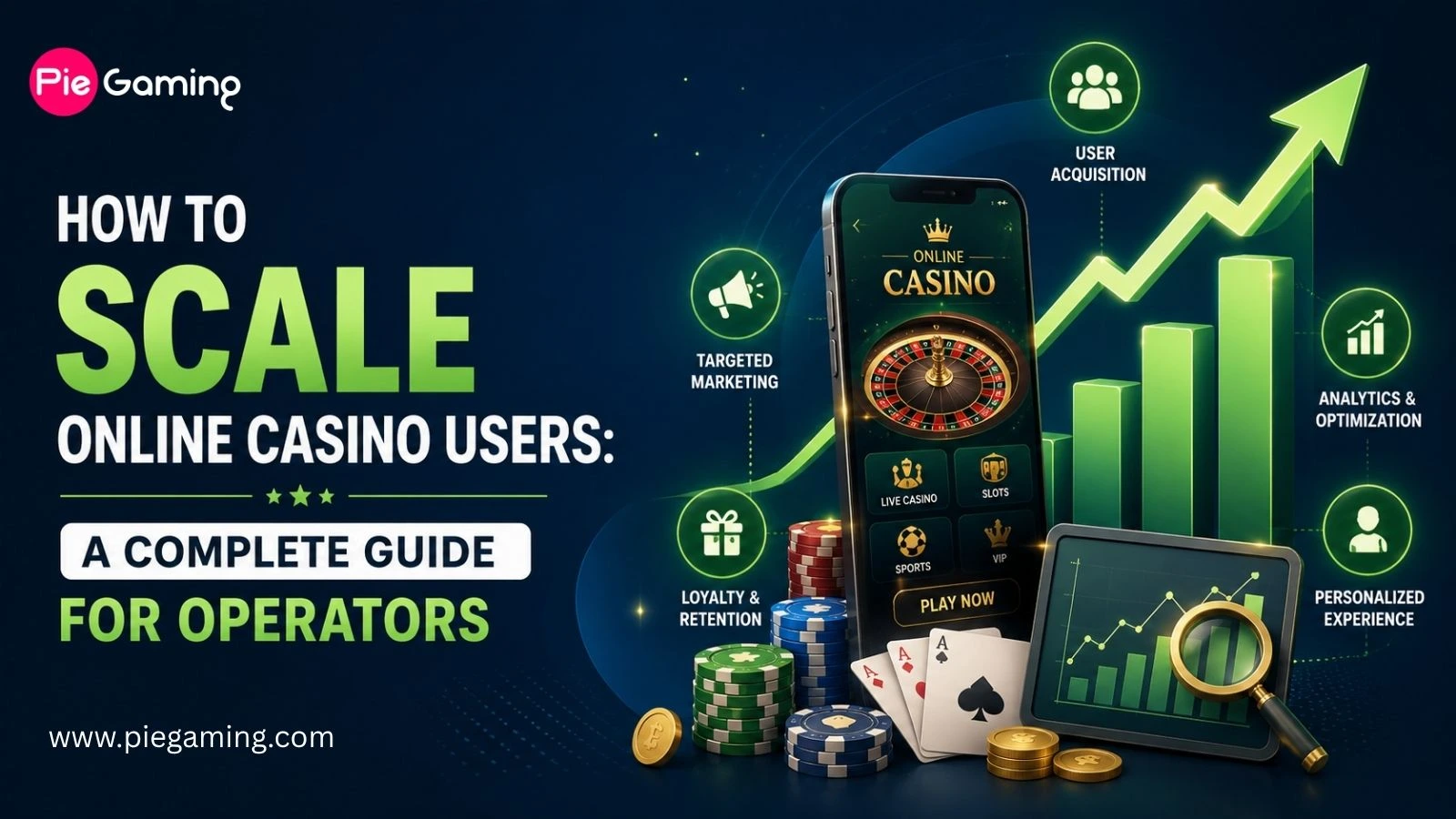
The key components of scaling online casino users can be summarized in four areas. The right acquisition channels, delivering personalized engagement, developing loyalty programs, and making data-driven decisions. Creating a mobile experience, maintaining player engagement and translating markets that you want to attract are all just as crucial to sustainable growth.
This blog breaks down the key strategies of top iGaming operators in 2026 and how you can grow like them as a market leader. Stay tuned until the end.

Starting an online casino sounds exciting. But many new operators fail within a few months due to evitable mistakes. Here are the top 10 mistakes you must steer clear of.
Learn how to start an online casino in Turkey in 2026. Get easy tips on laws, licenses, payments, and more to run your business smoothly.


See you in your inbox soon!

Stay ahead of the game. Subscribe for exclusive content, updates, and insiders!