
Bulgaria’s iGaming license enables operators to legally provide services in the areas of online casino, betting, poker, and bingo in accordance with the regulations of the EU. Typically, a licensing process can take 60 to 90 days, and it will need to be approved by the NRA, technical certification, AML compliance, and data storage in the local area. Minimum capital requirements range from BGN 50,000 for betting operators to BGN 1.5 million for online casino operators.
Bulgaria is quickly becoming a favorite destination for iGaming operators, and it’s easy to see why. A single EU-aligned license covers online casinos, sports betting, and other remote games all at once, under the National Gambling Act. That’s a big deal if you are running multiple verticals and don’t want to juggle separate licenses.
New operators need to set up a local or EU/EEA-based company. They must also have the minimum paid-up capital of BGN 1.5 million (about EUR 760,000). Not only that, but they have to conform to a number of stringent technical, compliance, and AML obligations.
This is a 2026 guide to what you really need to know. The key licensing requirements, realistic costs, and how long the whole process of securing an iGaming license typically takes. So, if you are new to the Bulgarian market, then this blog is for you.
Understanding Bulgaria’s Gambling Regulatory Framework
Understanding Bulgaria’s Gambling Regulatory
The gambling market in Bulgaria is regulated by the Bulgarian Gambling Act that applies to both physical and online gambling. The framework covers aspects such as licensing, taxes, advertising, technical standards, player protection, and monitoring compliance.
In 2026, the sector is unified under one regulatory system, in order to ensure even greater transparency and improved regulation of the market.
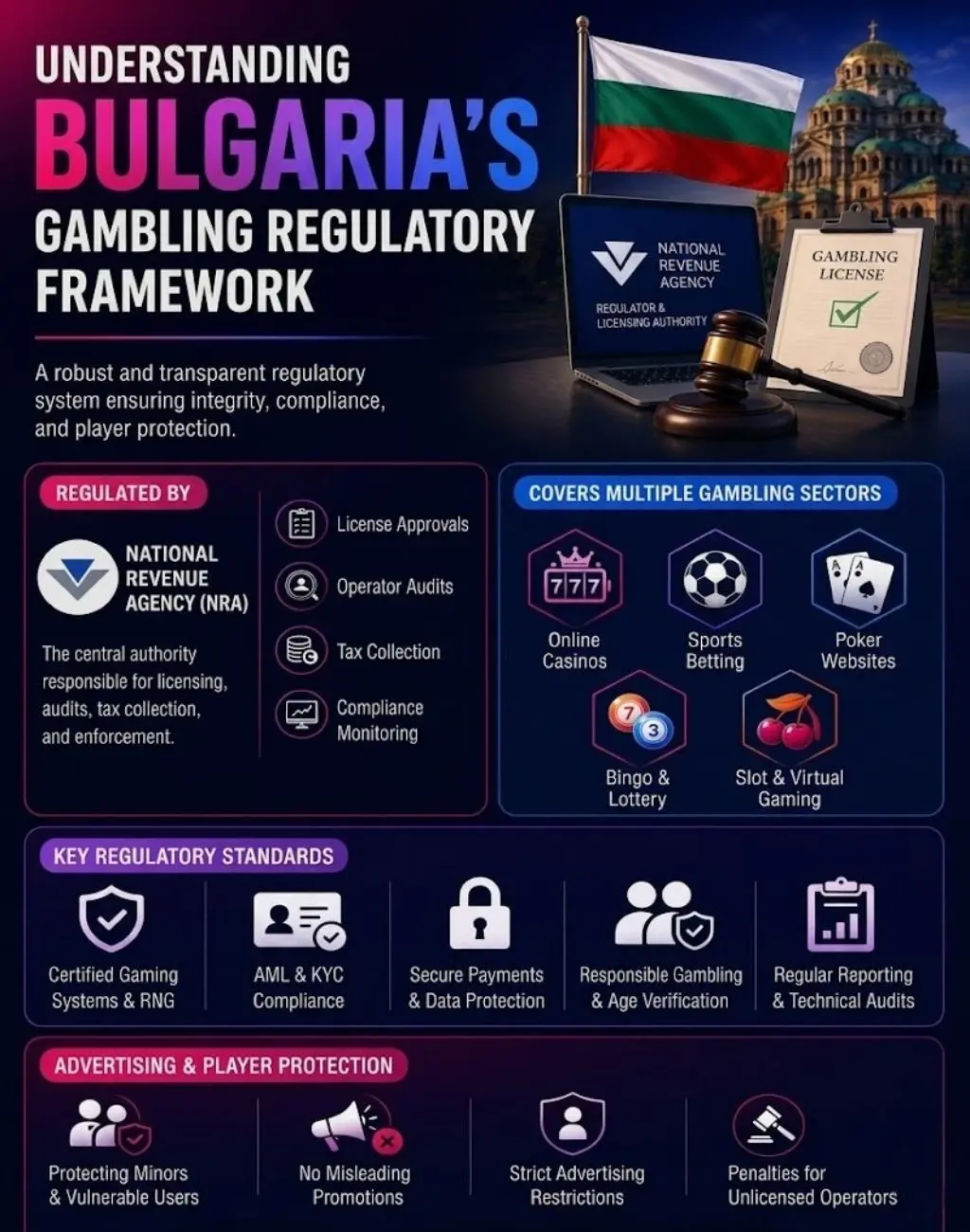
The body in charge is the National Revenue Agency (NRA). It deals with licensing, audit of operators, tax collection, as well as enforcement of non-compliant enterprises. The NRA also monitors whether the operators are fulfilling their financial, technical, and reporting requirements.
The regulatory framework applies to multiple gambling sectors, including:
- Online casinos.
- Sports betting platforms.
- Poker websites.
- Bingo and lottery products.
- Slot and virtual gaming activities.
There are a number of legal requirements that gambling companies must meet in order to do their business:
- RNG software, and certified gaming systems.
- AML and KYC compliance processes.
- Secure payment and data protection systems.
- Responsible gambling measures and age verification.
- Regular reporting and technical audits.
There are also strict advertising and consumer protection laws in Bulgaria. Promotions should be avoided by operators, as they may advertise inaccurate content, and operators should adhere to restrictions to safeguard individuals under 18 years of age and vulnerable users. The NRA can fine and restrict those operators who are not licensed and who are violating the local gambling rules.
As of 2026, Bulgaria is still working on adapting its legislation to the EU’s requirements for compliance and the changing payment landscape, alongside the growth of digital gambling.
Types of iGaming Licenses Available in Bulgaria
iGaming Licenses Available in Bulgaria
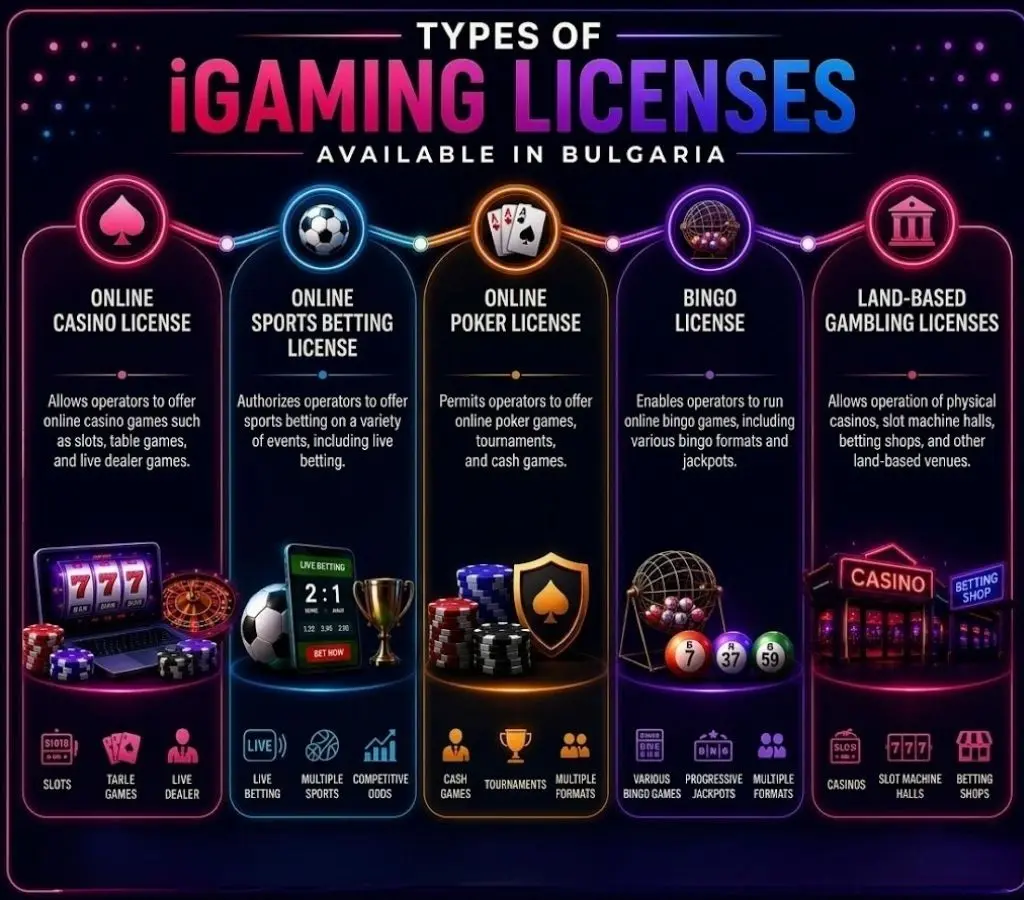
Bulgaria regulates iGaming through a category-specific licensing framework under the Bulgarian Gambling Act. Operators cannot use a single universal license to offer all gambling products. Instead, each gambling activity requires separate approval from the National Revenue Agency (NRA), depending on the nature of the service being offered.
Read More – How to Start An Online Casino
Online Casino License
The online casino license covers digital casino operations such as:
- Online slot games.
- Blackjack.
- Roulette.
- Baccarat.
- Live dealer casino games.
- RNG-based table games.
Operators must use certified game software, approved RNG systems, and technically compliant platforms connected to the NRA’s monitoring infrastructure. Before approval, the gaming environment undergoes technical testing and certification by authorized independent laboratories.
Online Sports Betting License
This license applies to operators offering:
- Fixed-odds sports betting.
- Live betting.
- Esports wagering.
- Horse racing betting.
- Virtual sports betting.
Sports betting operators must maintain real-time transaction records, betting integrity controls, and suspicious activity monitoring systems. The NRA may also require operators to provide detailed betting data during audits or investigations.
Online Poker License
Peer-to-peer poker operations require separate authorization due to the nature of player-versus-player gaming. This includes:
- Tournament poker.
- Cash Games.
- Sit-and-go formats.
Poker platforms must implement anti-collusion systems, player behavior monitoring tools, and advanced monitoring obligations. However, bingo activities remain regulated separately from lottery operations under Bulgarian law.
Bingo License
Private operators may apply for licenses to offer bingo-related gambling products, subject to regulatory approval and compliance obligations. However, bingo activities remain regulated separately from lottery operations under Bulgarian law.
State-Controlled Lottery Operations
Unlike casino gaming and sports betting, online lottery activities in Bulgaria operate under a state monopoly model. Traditional lottery products and online lottery draws are exclusively operated by Bulgarian Sports Totalisator (BST), the state-owned gambling entity.
Land-Based Gambling Licenses
Separate licenses are also available for physical gambling establishments, including:
- Land-based casinos
- Slot machine halls
- Betting shops
- Gaming arcades
These licenses involve additional location approvals, municipal permits, and physical security compliance requirements.
Who Can Apply for a Bulgaria iGaming License?
Bulgaria allows both local and foreign companies to apply for an iGaming license, provided they meet the eligibility requirements under the Bulgarian Gambling Act. Applications are reviewed and approved by the NRA, which evaluates each applicant’s financial stability, ownership transparency, and legal background.
The following are likely to be eligible:
- Bulgarian-registered companies.
- Gambling operators based in the EU and the EEA.
- Foreign companies that are present in the country either as a local entity or as a branch.
The company’s shareholders, directors, and ultimate beneficial owners (UBOs) are subject to rigorous fit-and-proper checks by the regulator. Applicants will need to provide information regarding their ownership, capital source, tax record, and any prior experience in a gambling business.
Eligibility for financial requirements is different depending on the gambling activity:
- The minimum paid-up capital for an online betting operator is BGN 50,000.
- The minimum paid-up capital of the online casino operators is BGN 1.5 million.
Candidates may be disqualified if:
- Poorly defined ownership.
- Are affiliated with illegal gambling establishments.
- Owe unpaid taxes or have financial violations.
- Were previously approved by gambling authorities.
Bulgaria also does not allow private operators to distribute lottery products online, and lottery is still regulated by the Bulgarian Sports Totalisator (BST).
Bulgaria iGaming License Requirements
Obtaining an iGaming license in Bulgaria comes with several conditions set by the NRA. These span legal, financial, technical, and compliance requirements. Before granting approval, the NRA reviews your business structure, funding sources, and platform.
Registered Legal Entity
Applicants must operate through a legally registered company with a transparent ownership structure and clearly identify ultimate beneficial owners (UBOs). Foreign operators typically need a Bulgarian entity or locally registered branch for regulatory and tax purposes.
Minimum Share Capital Requirements
Required paid-up capital depends on the license type:
- Online betting operators: minimum BGN 50,000 (approximately EUR 25,600)
- Online casino operators: minimum BGN 1.5 million (approximately EUR 767,000)
The NRA may request proof of capital origin, audited financial records, and evidence of sufficient operational funding.
Mandatory Investment Requirement
Licensed operators must invest at least BGN 1 million (approximately EUR 511,000) within six months of receiving the license, covering infrastructure, technology systems, operational setup, and local business activities.
Bank Guarantee Submission
A bank guarantee must be submitted as part of the application, acting as financial security to cover tax obligations, player payouts, and regulatory liabilities.
Technical Certification and System Compliance
Prior to the launch of any platform, gaming software, or RNG system, it needs to be tested by an approved independent laboratory. The NRA assesses game fairness, platform security, transaction recording, payment infrastructure, and cybersecurity controls. Systems should also be linked to NRA monitoring systems.
Local Data Storage Requirement
All gambling-related operational data must be stored within Bulgaria, including:
- Player identification records
- Betting history
- Financial transactions
- Payout information
- Gaming activity logs
The regulator may access this data during inspections, audits, or investigations.
AML and KYC Compliance
AML and KYC should be consistent with Bulgarian and EU requirements and include identity verification, suspicious activity reporting, record-keeping, risk assessments, and transaction monitoring procedures. The failure to properly control AML could result in suspension of the license or monetary fines.
Tax and Regulatory Compliance
Licensed operators must comply with Bulgaria’s gambling taxation framework:
- 20% tax on Gross Gaming Revenue (GGR) for betting, bingo, and related activities
- 10% corporate income tax on profits
Operators must also submit periodic reports, maintain accounting transparency, and cooperate with NRA audits.
Application Documentation
The application requires a range of documents. These typically include corporate registration certificates, shareholders and directors’ information, and proof of paid-up capital. You will also need to submit business plans, technical system certifications, and AML and compliance policies. Bank guarantee documentation and tax clearance certificates round out the list.
Step-by-Step Application Process
Applying for an iGaming license in Bulgaria follows a structured process overseen by the NRA. Understanding each stage upfront helps operators avoid costly delays and submission errors.
Step 1: Business Registration and Corporate Setup
Operators need to form a legally registered company in Bulgaria before they can apply for a license. The majority of international operators either establish a Bulgarian limited liability company (OOD/EOOD) or a local branch of an EU/EEA based company.
The company has to be registered in the Bulgarian Commercial Register, have a Tax Identification Number (TIN), open a corporate bank account and declare UBOs. The NRA looks closely at the structure of ownership and inactivity in respect of transparency on shareholders and/or politically exposed persons (PEPs) may result in delay or refusal of the application.
Step 2: Preparing Documentation
The documentation phase is one of the most critical parts of the process. The NRA requires extensive corporate, financial, technical, and compliance records before accepting an application. Typical documents include:
- Certificate of company incorporation and articles of association
- Shareholder and director identification documents
- Criminal record certificates for key individuals
- Audited financial statements and source of funds declarations
- AML, KYC, and responsible gambling policies
- RNG and software certification reports
- Bank guarantee documentation
Foreign-language documents need certified Bulgarian translations and apostille certification. Operators must also provide details on payment providers, hosting infrastructure, data storage systems, and security protocols. Incomplete documentation is one of the most common reasons for delays.
Step 3: Application Submission
Once documentation is complete, the operator submits the application to the NRA along with the required fees, which generally range between EUR 5,000 and EUR 20,000 depending on the license category.
The application package includes a formal application form, technical certification reports, proof of paid-up capital, tax clearance certificates, and financial guarantee proof. An initial review is made by the NRA to ensure the submission is complete and can ask for clarifications before proceeding further.
Step 4: Technical and Regulatory Review
This is typically the longest stage of the process. The NRA conducts a detailed assessment covering ownership of transparency, financial stability, tax compliance, criminal background checks, AML exposure, and technical infrastructure. Gaming systems and RNG software must be certified by approved independent laboratories.
The NRA also ensures that the platform is compatible with the state monitoring systems and that all player data, wagering, and payout information is kept in Bulgaria. At this stage, further technical demonstrations, inspections, or additional evidence might be requested.
Step 5: Approval and License Issuance
After fulfilling all the requirements, the NRA issues the license, which specifies the type of gambling, conditions in which it operates, reporting obligations, validity, and taxes.
Operators might have to do a few technical integrations, enable local monitoring access, register their approved gaming domains, and finalize payment system approvals before they can go live.
Operators are continually supervised by the NRA, including periodic audits, AML inspections, financial reporting, and responsible gambling compliance. Penalties, suspension, or revocation may be imposed for failing to comply with standards of post-licensing.
Bulgaria Gambling License Cost Breakdown
The price of getting a Bulgarian iGaming license does not end at the application fee. Gambling tax, minimum capital requirements, bank guarantees, technical certification costs, and payment of licensing fees must be taken into account by operators.
The ultimate cost of the system can differ considerably when you’re launching an online sportsbook, casino, poker space, or multiple gambling verticals.
On top of regulatory fees, businesses should also budget for local company formation, compliance systems, legal advisory services, and technical infrastructure certification.
The following is a list of all key costs involved in the issuance and renewal of a Bulgarian gambling license in 2026.
| Cost Category | Estimated Cost (2026) | Details |
| Application Fee | EUR 5,000 – EUR 20,000 | Depends on the gambling activity and license scope |
| Online Betting License Capital Requirement | BGN 50,000 (approx. EUR 25,600) | Minimum paid-up share capital for sportsbook operators |
| Online Casino License Capital Requirement | BGN 1.5 million (approx. EUR 767,000) | Required paid-up capital for online casino operators |
| Mandatory Investment Requirement | BGN 1 million (approx. EUR 511,000) | Must generally be invested within 6 months after licensing |
| Bank Guarantee | Variable | Amount depends on operational scope and gambling category |
| Technical Certification and Testing | EUR 10,000 – EUR 50,000+ | Includes RNG certification, platform audits, and lab testing |
| Company Registration and Legal Setup | EUR 3,000 – EUR 15,000 | Includes local incorporation, legal support, and translations |
| AML and KYC Compliance Setup | EUR 5,000 – EUR 25,000 | Internal compliance systems, monitoring tools, and policy preparation |
| Server and Data Localization Costs | Variable | Required for storing gambling-related operational data in Bulgaria |
| Annual Regulatory Compliance Costs | EUR 10,000 – EUR 100,000+ | Ongoing audits, reporting, legal support, and technical maintenance |
| Gambling Tax (Betting and Bingo Activities) | 20% GGR | Applied to gross gaming revenue |
| Corporate Income Tax | 10% | Standard Bulgarian corporate tax rate |
| Software and Platform Integration | EUR 20,000 – EUR 200,000+ | Depends on platform provider and gaming vertical |
| Payment Processing Integration | Variable | PSP onboarding, fraud prevention, and transaction monitoring systems |
Disclaimer: The figures presented are approximate estimates for informational purposes only and may vary based on regulatory changes, business scope, and individual circumstances. Consult with a licensed legal or financial advisor before making licensing decisions.
The overall cost of entering the Bulgarian iGaming market can range from tens of thousands to several million euros, depending on the business model, license type, and scale of operations.
Online casino operators generally face significantly higher financial requirements compared to sportsbook-only businesses, due to stricter capital obligations and technical compliance standards.
Timeline to Obtain a Bulgarian iGaming License
The process of obtaining a Bulgarian iGaming license typically takes around 2 to 3 months, depending on the complexity of the application and how complete the submitted documents are. The timeline covers company setup, document preparation, technical certification, NRA review, and final approval.
Compliance Requirements After License Approval
Obtaining a Bulgarian iGaming license is only the beginning. After approval, operators must continuously meet strict financial, technical, AML, and responsible gambling obligations.
Continuous NRA Monitoring
Licensed operators are subject to ongoing regulatory supervision by the NRA. Gambling platforms must remain connected to the regulator’s monitoring systems, allowing authorities to track betting activity, player transactions, payout records, gaming sessions, and revenue reporting.
Operators may also face periodic inspections, technical audits, and compliance reviews throughout the license period.
Data Storage and Record Retention
Licensed operators must continue storing gambling-related operational data within Bulgaria, including player account information, betting history, deposit and withdrawal transactions, bonus activity, and communication logs. The NRA may request access to these records during inspections or investigations.
Responsible Gambling Compliance
Operators are expected to actively enforce responsible gambling measures, including:
- Age verification controls
- Self-exclusion systems
- Responsible gambling messaging
- Player protection tools
- Monitoring of excessive gambling behavior
Marketing and promotional activities must also comply with Bulgarian advertising restrictions designed to protect minors and vulnerable users.
Technical System Maintenance
Any major changes to gaming systems, software providers, payment infrastructure, or platform functionality may require additional NRA approval or technical recertification.
Operators must ensure RNG systems remain certified, cybersecurity protections stay updated, platform integrity is maintained, and technical logs remain accessible for inspections.
Using unapproved software or modifying certified systems without authorization may lead to regulatory action.
Benefits of Getting a Bulgaria iGaming License
Bulgaria has become an increasingly attractive licensing destination for iGaming operators seeking a regulated European market with comparatively lower operational costs. While compliance standards are strict, the licensing framework offers several practical advantages worth considering.
EU Jurisdiction and Market Credibility
A Bulgarian iGaming license allows operators to run their business within an EU-aligned regulatory framework, strengthening credibility with payment providers, software vendors, banking partners, affiliate networks, and investors. It also supports player trust and corporate reputation.
Low Corporate Tax Rate
At 10%, Bulgaria offers one of the lowest corporate tax rates in the EU, which can meaningfully reduce long-term operational costs compared to higher-tax Western European jurisdictions.
More Accessible Than Other EU Licenses
Overall setup and licensing costs are generally lower than jurisdictions such as Malta, Germany, the Netherlands, and Sweden, making Bulgaria a realistic option for mid-sized operators wanting EU regulatory recognition without prohibitive entry costs.
Faster Licensing Timeline
With a well-prepared application, the process typically completes within 60 to 90 days, often faster than many comparable European markets.
Clear Regulatory Structure
The Bulgarian Gambling Act covers casinos, sports betting, poker, bingo, and land-based gambling under a centralized NRA oversight model, simplifying regulatory communication and supervision.
Stronger Payment and Banking Access
Licensed operators generally face fewer difficulties with payment processors and financial institutions, improving access to merchant accounts, PSP integrations, and EU banking services.
Legal Market Positioning
A Bulgarian license allows operators to legally advertise and offer approved gambling services, reducing exposure to website blocking, financial penalties, and broader regulatory enforcement actions.
Read More – Top Bitcoin Casino Software Providers
Wrapping Up…
Bulgaria presents a practical and well-regulated entry point into the European iGaming market. With a clear licensing framework, competitive tax rates, and a manageable approval timeline, it offers genuine appeal for operators at various stages of growth.
That said, meeting the NRA’s compliance, technical, and financial requirements demands thorough preparation before the process begins.
FAQs
-
Is online gambling legal in Bulgaria?
Yes. Online gambling is fully legal in Bulgaria. Casino games, sports betting, poker, and bingo are all permitted under the Bulgarian Gambling Act. The one exception is online lotteries, which remain a state monopoly operated exclusively by the Bulgarian Sports Totalisator (BST).
-
Is Bulgaria a good jurisdiction for iGaming?
For many operators, yes. Bulgaria offers EU compliance, a low 10% corporate tax rate, a relatively straightforward licensing process, and direct access to the EU market. With online casino activity forecast to grow by around 30%, it is shaping up as an attractive jurisdiction for scalable iGaming operations in 2026.
-
Can foreign companies apply for a license?
Yes. EU, EEA, and Swiss-registered companies can apply without needing a local partner. Operators based outside these regions must establish a Bulgarian legal entity or appoint a locally registered representative before applying.
-
How much does a Bulgarian iGaming license cost?
Application fees range between EUR 5,000 and EUR 20,000, depending on the gambling activity. Online casino operators must also meet a minimum paid-up capital requirement of BGN 1.5 million, plus invest at least BGN 1 million within six months of receiving the license.
-
How long does the licensing process take?
The NRA typically reviews applications within 60 to 90 days. Once approved, licenses are generally valid for five years before renewal is required.

Palak Madan has been writing about the iGaming industry since 2024. She focuses on helping operators and founders understand their options when launching an online casino, from choosing the right software provider to figuring out costs and compliance requirements across different markets. At PieGaming, she covers topics like white label casino solutions, platform selection, and market entry, turning complex industry information into practical guidance for people building iGaming businesses. She also keeps a close eye on licensing and regulatory changes; particularly how new rules shape the way operators enter and grow in different jurisdictions.

A GCGRA Gaming License is required to operate commercial gaming in the UAE, including online casinos and sportsbooks. Foreign operators can apply, but must meet GCGRA’s suitability, financial, compliance, and operational requirements before they can launch.
Online casino gaming is not allowed in Australia under Interactive Gambling Act 2001. But operators can still apply for an internet gaming license via specific jurisdictions like the Northern Territory, which allows them to offer gambling services legally- generally outside Australia.
To obtain the Anjouan Gaming License, applicants must collect and submit all the important documents. Learn the process of obtaining Anjouan iGaming license.
Algeria has no online casino or sports betting regulation to speak of — instead, the country enforces a near-total gambling ban rooted in civil law and Islamic principles. Yet despite the prohibition, offshore platforms continue to pull in millions of users every month, driven by high demand and a near-total absence of legal local alternatives.
A Kahnawake iGaming license is a credible and cost-effective licensing solution for online casinos and sportsbook operators. The process to obtain this license includes multiple steps, key benefits, and licensing costs.
Malta pays attention to the credibility of the regulatory framework and to access regulated markets, which is more conducive to long-term growth and industry reputation. However, Curaçao places a strong emphasis on speed and affordability, making it a good choice for startups and businesses focused on cryptocurrencies that are keen to establish a presence rapidly and at a lower cost. If you are constructing a major operation, select Malta. Pick Curaçao when you are just getting started and have to get your product to market quickly.
The best jurisdiction depends on your target market. Malta suits operators who want a credible European base with strong banking. The UKGC is required for Great Britain. The Isle of Man suits B2B and platform-led operators. Curaçao is the usual low-cost route for global launches. Anjouan is typically quoted as the cheapest and fastest, but with limited banking and lower recognition.

See you in your inbox soon!

Stay ahead of the game. Subscribe for exclusive content, updates, and insiders!