
To obtain the Anjouan Gaming License, applicants must collect and submit all the important documents. Learn the process of obtaining Anjouan iGaming license.
The iGaming industry is strictly regulated across the world. Starting an online casino or sportsbook business in the industry isn’t as easy as it sounds. You should have a license to operate legally and to earn player trust. Many operators choose offshore (international) for broader market access and lower entry barriers. Recently, Anjouan (an island in the Comoros) has emerged as one such jurisdiction that permits iGaming operators globally. It covers casino, sports betting, poker, and more. The Anjouan iGaming license is a perfect choice for both startups and experienced operators seeking to enter the international gambling market.
This guide will walk you through ‘How to get an Anjouan iGaming License,’ license types, cost, application steps, and more. This will help you decide whether an Anjouan Gaming license is ideal for you or not.
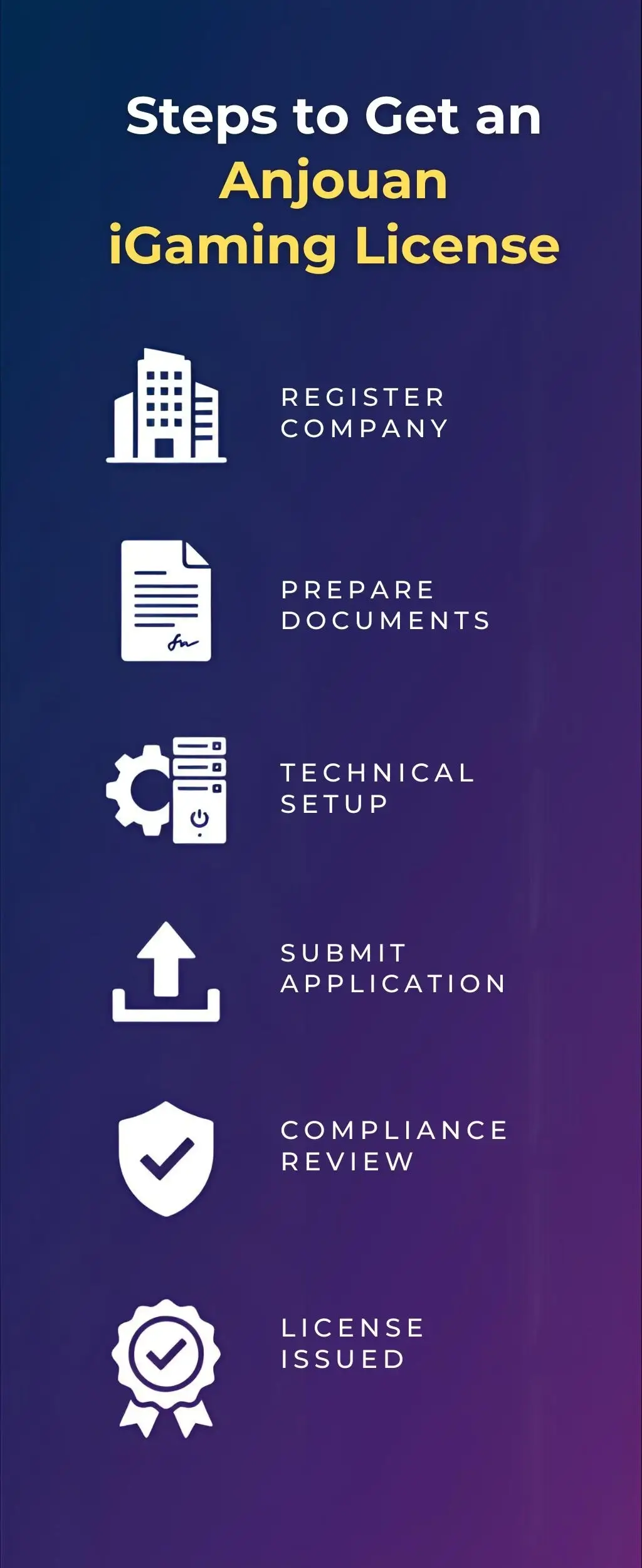
Step-by-Step Application Process to Get an Anjouan iGaming Licenses
Get an Anjouan iGaming Licenses
How to get an Anjouan gambling license? Here is the Anjouan license application process that will help you know how to apply for an Anjouan license easily.
Get Your Company Registered
First, you have to register a license company. Then, incorporate an Anjouan International Business Company (IBC) or designate an existing approved offshore company to act as the licensee. The company’s Memorandum and Articles of Association must state that the business will include gaming activities.
A licensed registered agent in Anjouan will be appointed to represent the company before the regulator. The agent will help in registering the entity with AOFA, provide a local registered address, and file the initial paperwork with the relevant authority. Once the company is incorporated, it becomes eligible to apply for a gaming license.
Documents Required for the Licensing Process
Next, you have to gather all the essential documents, which will verify the company’s ownership, compliance readiness, and technical infrastructure. The documents that will fulfil Anjouan licensing requirements include:
- Business plan
- Ownership structure
- Company incorporation documents
- Passport copies
- Proof of address
- Police clearance certificate
- Source of Fund Declaration
- AML/ CFT copy
- KYC procedures
- Responsible gaming policy
- Data protection and privacy policy
- Terms and Conditions
- Software agreements
- RNG certification
- Technical documentation
Always ensure that every document meets the regulatory formatting.
Complete the Technical Setup of the Platform
Before submitting the application to the authority, operators need to arrange the technical infrastructure of the gaming platform. This means setting up a casino or sportsbook platform, game integration, and payment solutions.
Also, all RNG-based casino games must have a Random Number Generator (RNG) certification from a certified testing laboratory. Operators should also give information on game servers, hosting infrastructure, and data storage systems.
Also, the platform must implement SSL/ TLS encryption and cybersecurity measures like firewalls, DDoS protection, etc.
Read More – Role of the RNG In Online Casinos
Submit Application to the Regulator
Once everything is ready, the formal license application can be submitted with ALSI. This can be done through their online portal. At this stage, operators must submit the following documents:
- The complete application form
- All mandatory supporting documents
- Technical platform information
- Proof of company incorporation
- Payment of the first-year license fee
Keep all forms, documents, and pay the first-year license fee (around €14,000) upon submission. Once payment is done, the application becomes official. If your application is refused, the fee gets refunded to you (minus admin charges).
Regulatory Review & Due Diligence
After application submission, the regulators start the review process. They will start with a background check on your company directors and shareholders, verify all important documents, and may pose questions or request clarifications.
Further, the regulators conduct a thorough compliance audit and technical verification of your platform. They verify all submitted documents and check the technical setup of the gambling platform.
In practice, this stage takes around 4-6 weeks, which might also extend up to 2 months depending on the complexity of the review process.
License Approval & Issuance
If everything goes well, the gaming license gets approved. The Anjouan Gaming Board (ABGB) issues an official Anjouan iGaming License Certificate and validates the company’s approved gaming domain.
This license confirms that the operator is authorized to offer iGaming activities within the jurisdiction of Anjouan iGaming. After receiving the license, operators can officially launch and run an online casino or sportsbook platform under the approved license.
Anjouan Gaming License Cost Breakdown
Here is the Anjouan iGaming license cost breakdown:
| Particulars | Description | Estimated Cost |
| Government license fee | This is the official regulatory fee paid to the Anjouan Gaming Authority for issuing your license. | €14,128 |
| Due diligence fee | This fee covers the regulator’s background verification process. | €3,700 |
| Compliance officer cost | The jurisdiction asks operators to maintain proper AML and compliance oversight. The yearly compliance/ AML officer fee is generally included in the renewal. | €15,000 per year |
| Company incorporation fee | Before you apply for a license, you need a legal entity. If you go with a new Anjouan International Business Company (IBC). | A few thousand euros one-time |
| Annual renewal fee | After the first year, you have to renew your license every year. This includes license extension and routine checks. | €15,000 |
| Total estimated first-year cost | This includes the main regulatory fees, such as the license fee and due diligence costs required to obtain approval. | €17,800–18,000 |
| Ongoing yearly expenses | From the second year onwards, you have to pay a renewal and compliance fee to maintain the license. | €15K+ |
Complete Eligibility Requirements for Anjouan iGaming Licenses
In this guide on how to get an Anjouan iGaming license, getting a gaming license means you have fulfilled all the corporate, personal, and compliance requirements. Let’s thoroughly understand them below:
Corporate Requirements
You need to register a legal entity to hold the license. This could be a new Anjouan IBC or an existing offshore company, represented by a local agent. The company’s Memorandum & Articles of Association must permit iGaming activities. You also need a local registered address provided by your agent.
Director & Shareholder Requirements
All owners and directors must undergo strict background checks and should have required documents such as Passport copies, Proof of address, Police clearance certificate, Source of funds declaration, and Fit & Proper checks. Also, the applicant must be 18+ and have a strong business reputation.
Compliance Requirements
Operators must have robust compliance frameworks. It’s crucial to prepare and submit the following policies and procedures:
- AML policy – Anti-money laundering program that implements risk-based KYC for customers.
- KYC procedures – Know Your Customer help in verifying players’ identities and funds.
- Responsible Gaming Policy – This is for age verification, players limit, self-exclusion, etc.
- Data protection policy
- Terms & Conditions – Complete T&Cs game rules covering gameplay, deposits/ withdrawals, disputes, etc.
Timeline: How Long Does It Take?
Speed is one of the major benefits of the Anjouan iGaming license. However, everything depends on the hygiene of your application. If the application is well-prepared, you get an approval within a few weeks. In many cases, 1-2 weeks is required for company setup and document preparation, and then another 4-6 weeks for the regulatory review. In total, a complete process takes around 6-8 weeks, depending on the readiness.
Fees and Taxes
When it comes to taxes and fees, Anjouan’s fiscal regime is quite favorable to iGaming operators and companies. The license fees are transparent, as mentioned above, whereas the tax is 0% on all Gross Gaming Revenue (GGR).
Offshore Anjouan International Business Companies (IBCs) don’t need to pay corporate income tax on revenue from outside Comoros, and no VAT on gaming revenues. That means you just need to pay fixed regulatory fees, and the profit is with you.
Why Choose Anjouan? (Key Benefits)
Here are the key benefits of choosing an Anjouan iGaming license.
Affordable licensing structure
The initial licensing fee is very low. However, the official fees are between €17,000–18,000 in total. This cost is much cheaper than that in the EU markets. For instance, PieGaming notes Anjouan’s fee (€17K) is generally less than that of Curacao or Malta. Since it’s a budget-friendly option, startups find it a perfect fit for their iGaming venture.
Fast approval timeline
Everything is streamlined here. Once you have a list of complete documents, you can get a license in 2-4 weeks. This is much quicker than many jurisdictions like Curacao (6-12 weeks); this shows that Anjouan offers one of the industry’s fastest licensing timelines.
0% GGR tax structure
Yes, with an Anjouan iGaming license, operators enjoy 0% tax on GGR. Furthermore, offshore companies do not need to pay corporate income tax on foreign earnings. This means operators keep all their on-site profits with them.
No local office requirement
In most jurisdictions, having a physical casino or sportsbook is mandatory. In Anjouan, you don’t need to open a physical casino, and the jurisdiction allows you 100% remote ownership through a licensed agent. But you must have a legal address on Anjouan (no requirement for a company).
Crypto-friendly framework
Anjouan openly supports cryptocurrency gaming. Operators can legally accept Bitcoin, Ethereum, Litecoin, USDT, and other tokens on an Anjouan iGaming license. The crypto-friendly attitude, combined with low costs, makes it a perfect choice for blockchain-based casinos.
Simplified regulatory model
Compared to other jurisdictions, Anjouan’s regulatory framework is quite simple. The 2005 Gaming Act combines all games into one license, and ALSI has made the application process digital. This means it’s a simple ‘plug-and-play’ regime compared to many other options.
Overview of Anjouan as a Jurisdiction
Anjouan is a small volcanic island in the Indian Ocean, part of the Union of the Comoros. It lies between Madagascar and Africa’s east coast. The island was previously under French rule and joined the independent Comoros in 1975. Here, political instability has been an issue, but the island is stabilizing its government. Anjouan’s economy is mostly agricultural. Anjouan is diversifying beyond agriculture by attracting offshore businesses like iGaming under its financial authority.
The Anjouan Offshore Finance Authority (AOFA) administers all financial services, which include gaming also. Since mid-2023, a dedicated agency named Anjouan Licensing Services Inc. (ALSI) has managed the gaming license applications to streamline the process. In 2005, Anjouan approved the Computer Gaming Licensing Act 007, which created an ‘all-in-one’ online gaming license. Since then, this law has become the backbone of Anjouan’s gaming regime.
Essential iGaming License Guides for Online Casino & Sportsbook Operators
What is an Anjouan iGaming License?
In simple words, an Anjouan iGaming license is a universal online gambling permit that allows operators to legally offer online sportsbooks and casino games. This license is typically used once a year and renewed annually. Basically, it’s a single license that covers all types of gaming categories under one umbrella.
This simply means, Anjouan iGaming license allows operators to run a casino, sportsbooks, sports betting, poker rooms, lotteries, live games, bingo, and crypto casinos. This license is majorly popular among startups and experienced operators seeking a quick market entry. In simple terms, if you want to launch a global iGaming platform, Anjouan’s iGaming license covers it all in one go.
Read More – Understanding Online Casino Software
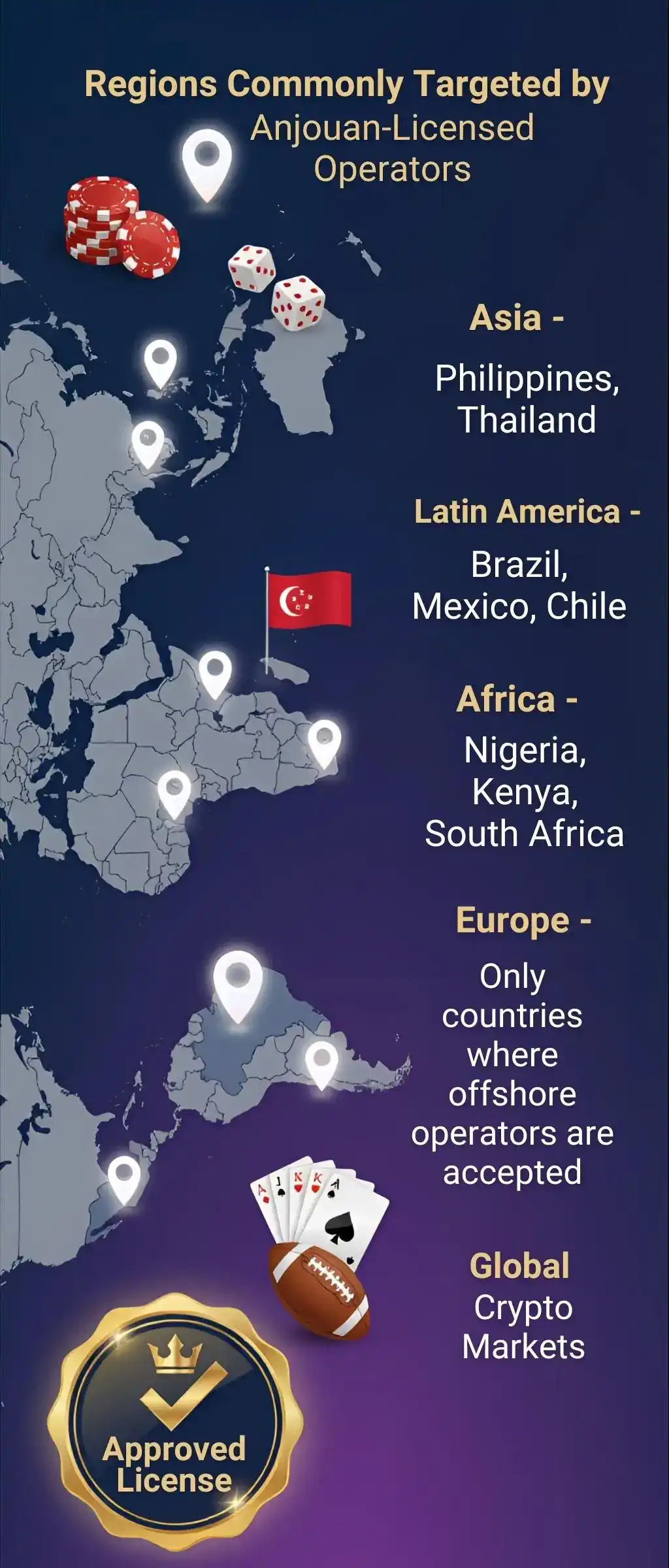
Anjouan Licensed Operators Targeted Countries
What are the Types of Anjouan iGaming Licenses?
Anjouan issues two broad licensing categories to operators, which include:
B2C License
This license is issued to operators who run a gambling business. This license covers all player-centric and betting games. For instance, operators can legally offer the following games to the players:
- Online casino – slots, table games, live dealer
- Sports betting – eSports, live/ in-play, fixed odds wagering
- Poker and card games – peer-to-peer card games, online poker rooms, tournaments
- Lottery & bingo – online bingo
- Crypto casino solutions/ sports betting platforms
- Fantasy sports and skill-based games
B2B License
This license is for businesses supplying casino games, casino, and sportsbook software to the iGaming industry. Every game or software provider needs this license to provide these services to B2C iGaming operators. This includes:
- Software providers like PieGaming
- Casino or sportsbook platform providers
- Game studios or game developers
- White label providers
In short, an operator running an iGaming platform requires a B2C license, while companies offering gaming technology or service should have a B2B license.
Conclusion
In the present scenario, many experts believe that the Anjouan iGaming license is fast, flexible, and affordable. For operators exploring how to get an Anjouan iGaming license, the process is simple and straightforward, allowing startups to quickly enter the iGaming market without huge upfront costs. For established operators, it gives a simple way to expand into emerging or crypto-friendly markets. With the Anjouan gaming license, operators don’t need to have multiple licenses for casino, sportsbook, poker, slots, etc.
Operators also need to understand that this license is only ideal for gray or light-regulated markets. That means it won’t replace the prestige of EU licenses for every partner. In short, Anjouan is best for businesses that want a rapid global reach.
FAQs
-
What’s New for Anjouan Gaming Licences?
From 2023-2025, Anjouan has tightened its rules in two ways: 1) All B2B providers working with the Anjouan licensees need their own Anjouan B2B License. 2) ALSI has taken over the official administration of all licenses, streamlining processes and online applications.
-
How to Verify an Anjouan Gaming Licence?
Once the license is issued, always confirm the license’s authenticity. Anjouan Licensing Services maintains a list of licensed companies, where this can be checked. You can also validate it through their official website, ALSI, or request a copy of the certificate.
-
Is an Anjouan licence suitable for crypto casinos?
Of course, the jurisdiction openly allows crypto gambling to operators. Its welcoming stance on blockchain and low cost make it a popular choice for crypto-focused casinos. Also, it’s important to implement strong KYC/ AML controls for crypto transactions.
-
How long does it take to get approved?
A well-prepared application with complete documents can be approved in as little as 4-6 weeks.
-
Is the Anjouan license legal worldwide?
The Anjouan license is legal worldwide as a valid legal permit, but it doesn’t override local laws. Operators need to comply with gambling regulations in each country they serve. For example, jurisdictions such as the UK, the USA, and France are very restrictive. So operators who want to operate their business in these jurisdictions must abide by local laws.
-
Can I operate a crypto casino with this license?
Yes, you can operate a crypto casino with an Anjouan iGaming license, which allows you to accept cryptocurrency payments.
-
Does Anjouan require a local office?
No, Anjouan doesn’t require a local physical casino. All you need is a registered address on the island. Your licensed agent will provide this.

Monika Gola is an iGaming content specialist at PieGaming. Since 2020, she has been researching and developing content around software selection, online casino & sports betting regulations, and operator growth strategies. Her research includes analyzing market opportunities in regions like Europe, Africa, and Southeast Asia, as well as evaluating regulatory frameworks and entry barriers. She is actively monitoring industry trends, compliance updates, and evolving player demands across global iGaming markets to help operators navigate this industry seamlessly.
A GCGRA Gaming License is required to operate commercial gaming in the UAE, including online casinos and sportsbooks. Foreign operators can apply, but must meet GCGRA’s suitability, financial, compliance, and operational requirements before they can launch.
Online casino gaming is not allowed in Australia under Interactive Gambling Act 2001. But operators can still apply for an internet gaming license via specific jurisdictions like the Northern Territory, which allows them to offer gambling services legally- generally outside Australia.
Bulgaria’s iGaming license enables operators to legally provide services in the areas of online casino, betting, poker, and bingo in accordance with the regulations of the EU. Typically, a licensing process can take 60 to 90 days, and it will need to be approved by the NRA, technical certification, AML compliance, and data storage in the local area. Minimum capital requirements range from BGN 50,000 for betting operators to BGN 1.5 million for online casino operators.
Algeria has no online casino or sports betting regulation to speak of — instead, the country enforces a near-total gambling ban rooted in civil law and Islamic principles. Yet despite the prohibition, offshore platforms continue to pull in millions of users every month, driven by high demand and a near-total absence of legal local alternatives.
A Kahnawake iGaming license is a credible and cost-effective licensing solution for online casinos and sportsbook operators. The process to obtain this license includes multiple steps, key benefits, and licensing costs.
Malta pays attention to the credibility of the regulatory framework and to access regulated markets, which is more conducive to long-term growth and industry reputation. However, Curaçao places a strong emphasis on speed and affordability, making it a good choice for startups and businesses focused on cryptocurrencies that are keen to establish a presence rapidly and at a lower cost. If you are constructing a major operation, select Malta. Pick Curaçao when you are just getting started and have to get your product to market quickly.
The best jurisdiction depends on your target market. Malta suits operators who want a credible European base with strong banking. The UKGC is required for Great Britain. The Isle of Man suits B2B and platform-led operators. Curaçao is the usual low-cost route for global launches. Anjouan is typically quoted as the cheapest and fastest, but with limited banking and lower recognition.

See you in your inbox soon!

Stay ahead of the game. Subscribe for exclusive content, updates, and insiders!