
Mexico’s iGaming market is offering golden opportunities to operators, but navigating this market is complex. Why? Because sports betting is fully regulated, casino activities are operated in a more restrictive environment.
Today, Mexico is swiftly gaining a reputation as one of the most attractive iGaming markets in Latin America. The country has a population of over 130 million and increasing internet penetration, which presents a golden opportunity for online casino operators and sportsbook operators as well.
It is not as easy as it sounds to get into the Mexican gambling market. Mexico has a strict regulatory framework with regard to iGaming. This makes compliance and strategic planning crucial for iGaming operators’ long-term success.
Understanding the online casino & sports betting regulations in Mexico isn’t optional but necessary to stay competitive in the industry.
This guide will walk you through the Mexican regulatory laws on casino & sports betting, licensing, taxation, and future outlook.
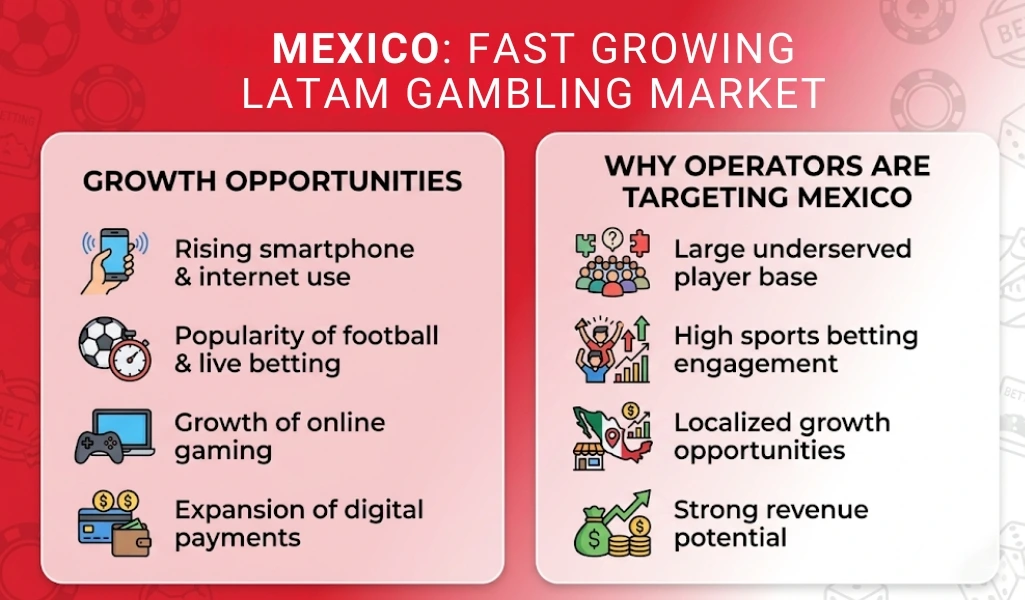
Mexico’s iGaming Market Growth Opportunities
Is Online Gambling Legal in Mexico?
Yes, online gambling is legal and regulated in Mexico, but within a specific and complex regulatory framework.
Mexico lets operators run gambling businesses under federal law. But the twist is that the country doesn’t issue standalone iGaming licenses; rather, it regulates iGaming activities via land-based licensing frameworks.
So, how do operators run an online casino business in Mexico? Online operators are strictly bound to follow the land-based licensing structure. Meaning? Operators seeking to offer iGaming products must have either a land-based operating permit issued by the federal government or formally partner with an entity that does.
This makes online gambling operations partially legal but strictly regulated.
Land -Based Vs. Online Gambling in Mexico
The table below highlights key differences between land-based gambling and online gambling in Mexico and helps operators evaluate market entry strategy.
| Factors | Land-based Gambling | Online Gambling |
| Legal status | Fully legal and regulated under the Mexican gaming license. | Legal but regulated indirectly via a land-based framework. |
| Licensing model | Requires direct license issued by SEGOB | Operates under an existing land-based license. |
| Market entry | Requires local presence in the country. | Requires collaboration with licensed land-based operators. |
| Operations | Operators can operate independently. | Standalone licenses are not issued; that’s why operators can’t operate independently. |
| Operational scope | Restricted to physical casinos. | Mobile, web, and remote betting platforms. |
| Compliance requirements | Strict compliance with security, audits, and operations. | AML/KYC, Data protection, fair gaming, and digital compliance. |
| Players reach | Limited to on-site visitors. | Accessible across the country through online platforms. |
| Revenue stream | Limited to location-based growth. | High growth due to online platforms. |
| Offshore operator entry | Allowed through partnership or investment. | Only possible via locally licensed operators. |
For players, the minimum legal gambling age in Mexico is 18+, which is applicable across all types of gambling activities, including both land-based and online.
Casino & Sportsbook Gambling laws in Mexico
Mexico’s gambling laws have evolved over the years. With updated legacy legislation and modern regulatory updates, here’s a clear breakdown of casino & sportsbook gambling laws in Mexico.
Federal Gaming and Raffles Law (1947)
The Federal Gaming and Raffles Law, enacted in 1947, is known as the foundation of all gambling regulations in Mexico. This law, enacted decades ago, continues to serve as the primary governing body regulating gambling in Mexico.
What does this law signify?
- Legalizes all gambling activities within the country
- Gives authority to the federal government
- Forms the legal base for licensing and oversight
2004 Regulatory Update
The Regulation of the Federal Law of Games and Lotteries (2004) was a revolutionary phase in the history of Mexican gambling law. This law streamlined the regulatory framework and added provisions for remote and online gambling.
Here are the guidelines set by this law:
- Outlined detailed compliance and operational requirements
- Defined proper licensing procedures
- Enabled SEGOB to issue the first federal license for remote gambling
2023 Regulatory Changes
An important development came in November 2023 when a presidential decree introduced amendments targeting 2004 regulatory laws. The newly introduced changes tightened the gambling regulatory landscape.
Changes introduced under this law:
- Prohibition on new online casino licenses
- Established operators can continue operating until license expiry
- Increased scrutiny on compliance operations
- Discussions around a proposed 2025 Bill to expand and modernize online gambling
For operators, this simply means introducing a stricter and more structured regulatory framework.
iGaming Regulatory Authorities in Mexico
Every land-based and online gambling operator should know the reigning regulatory bodies for compliance and licensing in Mexico.
SEGOB (Secretaría de Gobernación)
The Ministry of the Interior (Secretaría de Gobernación, or SEGOB) is the main federal governing body overseeing iGaming regulations in Mexico. SEGOB holds the power to authorize, give permits, and supervise all gambling activities within Mexican territory; the law is also applicable to operators licensed in foreign jurisdictions.
SEGOB is responsible for:
- Issuing licenses and permits
- Defining regulatory policies
- Supervising all types of industry operations
Dirección General de Juegos y Sorteos (DGJS)
The General Directorate of Games and Lotteries (Dirección General de Juegos y Sorteos, or DGJS) is the dedicated regulatory body overseeing the day-to-day administration of gambling activities in Mexico. DGJS operates under SEGOB.
The main role of DGJS is in issuing permits and enforcement, particularly around iGaming activities.
Here’s what this regulatory body does:
- Handles licensing and approvals
- Monitors operator compliance
- Enforces gambling laws and regulations
Licensing Requirements for Operators
Mexico enforces strict gambling laws, which every operator must follow. Operators entering Mexico’s gambling market must fulfill licensing requirements.
Here are the key licensing requirements operators must follow:
- Obtain authorization from SEGOB
- Offshore operators are not allowed to operate independently
- Collaboration with a locally licensed operator is necessary
- No standalone online casino licenses are available
Types of Licenses
There are typically three types of gambling licenses in Mexico available for operators. These include:
1. Land-based casino license
This is one of the primary licenses available, particularly for land-based casino operators. It allows physical casino activities like table games, sports betting, and slot machines within the jurisdiction. This license is issued by SEGOB/ DGJS, which ensures that all online operations are authorized.
2. Sports betting license
As the name suggests, this license is for operators seeking to run a sports betting business in the country. In Mexico, sports betting is a more regulated and commercially mature gambling market than casino market. Sports betting operators can procure this license from SEGOB.
3. Online betting authorization
It has been clear that there is no standalone online casino license available for operators in Mexico. Online betting authorization is linked to an existing land-based license. Once an operator obtains a land-based license, they can offer online casino services.
Read Blog – How to Secure a Gaming License?
Regulations for Online Casinos in Mexico
Online casinos in Mexico are operated under the framework of land-based gambling, which creates challenges for operators.
Here is the core regulatory reality for operators:
- Every online casino platform exists in a legal grey area
- 2023 regulatory updates have restricted the issuance of new licenses
| Note to Remember:
Operating an online casino business without holding a SEGOB license while serving a Mexican audience is illegal. |
As per AIEJA (the Association of Permit Holders, Operators, and Suppliers of the Entertainment and Gambling Industry in Mexico), 60% of bookmakers operating in Mexico in 2024 were operating without a SEGOB license.
Compliance requirements:
Operators must stick to the following licensing requirements asked by the Mexican gambling law:
- Fair gaming platform
- AML/KYC policies
- RNG certification
- Robust data protection
- Cybersecurity measures
Not meeting these requirements will lead to penalties and license revocation.
Read Blog – How to Buy Online Casino Software
Regulations for Online Sports Betting
Unlike online casinos, sports betting is a fully legal and regulated market in Mexico. It requires proper authorization from SEGOB/ DGJS to operate legally within the jurisdiction.
The activities covered under this include the following:
- Pre-match betting
- Live betting (in-play)
- Mobile betting
| Key Point to Remember:
Sports betting is a growing gambling segment in Mexico, making it a key entry point for operators. |
Explore Casino & Sports Betting Regulations in Different Countries
Taxation on Gambling in Mexico
For running an iGaming business in Mexico, operators must understand the taxation laws of the country. This is important for financial planning and the profitability of the business. The country imposes taxation on both operators and players:
Taxation on Operators
- Operators are required to pay 30% tax on Gross Gaming Revenue (GGR).
Taxation on Players
- Players must pay tax on their winning amount, typically around 1%, along with local or state taxes.
Read Blog – Strategies To Optimize GGR And NGR
Future of Online Gambling Regulations in Mexico
The iGaming regulatory framework in Mexico is evolving, bringing both challenges and opportunities for operators. The law in the country lacks a dedicated legal framework for online gambling; still, iGaming activities operate under the grey area.
Challenges in Mexico’s Gambling Regulations
- Outdated legal framework: a 1947 law is still in force.
- Restrictions on new casino regulatory laws and licenses.
- The licensing structure poses a significant challenge for offshore operators.
Though gambling activities are federally regulated, there are certain states where gambling is restricted for new land-based casinos. The states include Coahuila, Nuevo León, Tlaxcala, Guanajuato, and Baja California Sur.
Operators have to go through both federal and state-level regulations when planning land-based or online casino operations.
What Lies in the Future?
Today, the government of Mexico is actively working towards a reform of the 1947 law. Apart from this, many goals might be implemented in the future, including
- Modernization of gambling laws
- Expansion of regulated iGaming under new legislation
- Continuous growth in sports betting adoption
- Strict compliance and monitoring requirements
- Implementation of tax deduction at source (TDS)
It’s crucial for operators to stay ahead of regulatory updates to maintain compliance.
Read Blog – Top 10 Sports Betting Software Providers in 2026
Conclusion
The iGaming market in Mexico is the fastest-growing market in Latin America. Although the regulatory environment is a little challenging for operators, it is still navigable. Success in this market can only be achieved when you navigate its complex legal framework, build the right partnership, and ensure strict compliance.
For sportsbooks and casino operators, the opportunity is real. In the future, Mexico’s laws are going to be more comprehensive and stricter for operators, so keeping a regulation-first mindset is crucial for operators to sail through this market.

FAQs
-
Who regulates gambling in Mexico?
SEGOB is the primary regulatory body that regulates online gambling in Mexico via its regulatory arm Dirección General de Juegos y Sorteos (DGJS).
-
Can offshore operators venture into the Mexican market?
Yes, but not directly. Operators must connect with a locally licensed operator to run gambling businesses in the country. Offshore or foreign operators are not allowed to enter the market directly.
-
Is sports betting legal in Mexico?
Yes, sports betting is fully legal and regulated in Mexico, including online and mobile betting. Operators should have proper authorization from SEGOB/ DJIS and cover pre-match, live, and mobile betting.
-
How much is the gambling tax in Mexico?
Operators have to pay a tax on Gross Gaming Revenue (GGR) of 30%. This makes Mexico one of the higher-tax gambling jurisdictions in the world.


Monika Gola is an iGaming content specialist at PieGaming. Since 2020, she has been researching and developing content around software selection, online casino & sports betting regulations, and operator growth strategies. Her research includes analyzing market opportunities in regions like Europe, Africa, and Southeast Asia, as well as evaluating regulatory frameworks and entry barriers. She is actively monitoring industry trends, compliance updates, and evolving player demands across global iGaming markets to help operators navigate this industry seamlessly.

A GCGRA Gaming License is required to operate commercial gaming in the UAE, including online casinos and sportsbooks. Foreign operators can apply, but must meet GCGRA’s suitability, financial, compliance, and operational requirements before they can launch.
Online casino gaming is not allowed in Australia under Interactive Gambling Act 2001. But operators can still apply for an internet gaming license via specific jurisdictions like the Northern Territory, which allows them to offer gambling services legally- generally outside Australia.
Bulgaria’s iGaming license enables operators to legally provide services in the areas of online casino, betting, poker, and bingo in accordance with the regulations of the EU. Typically, a licensing process can take 60 to 90 days, and it will need to be approved by the NRA, technical certification, AML compliance, and data storage in the local area. Minimum capital requirements range from BGN 50,000 for betting operators to BGN 1.5 million for online casino operators.
To obtain the Anjouan Gaming License, applicants must collect and submit all the important documents. Learn the process of obtaining Anjouan iGaming license.
Algeria has no online casino or sports betting regulation to speak of — instead, the country enforces a near-total gambling ban rooted in civil law and Islamic principles. Yet despite the prohibition, offshore platforms continue to pull in millions of users every month, driven by high demand and a near-total absence of legal local alternatives.
A Kahnawake iGaming license is a credible and cost-effective licensing solution for online casinos and sportsbook operators. The process to obtain this license includes multiple steps, key benefits, and licensing costs.
Malta pays attention to the credibility of the regulatory framework and to access regulated markets, which is more conducive to long-term growth and industry reputation. However, Curaçao places a strong emphasis on speed and affordability, making it a good choice for startups and businesses focused on cryptocurrencies that are keen to establish a presence rapidly and at a lower cost. If you are constructing a major operation, select Malta. Pick Curaçao when you are just getting started and have to get your product to market quickly.



See you in your inbox soon!

Stay ahead of the game. Subscribe for exclusive content, updates, and insiders!