
Shifting provincial laws are a crucial factor for navigating Canada’s iGaming landscape. This guide dissects the legal details of Casino & Sports Betting Regulations in Canada from the booming open market in Ontario to the recent regulatory expansion in Alberta. Understand how federal laws such as Bill C-218 and local licensing regulations are shaping the course for Canadian gambling going into 2026.
For decades, Canada’s gambling market was a rigid, government-run monopoly. Yet entering 2026, the country is increasingly a leader in iGaming around the world. This shift is a feature of a unique legal structure; though the federal backbone, defined by the Criminal Code of Canada, acts as a technical barrier to unauthorized gambling, Section 207 provides a necessary carve-out. That permits provincial governments to “conduct and manage” lottery schemes, effectively devolving legal control to provinces.
In August 2021, Bill C-218, the industry hit a turning point. This landmark law changed the Criminal Code to provide legal status for single-event sports betting, ushering in an end to Canadian games, which used to be limited to “parlay” bets (a combination of the results of several events). Not only did this modernize the law, but it also allowed provinces like Ontario and, more recently, Alberta to create competitive, multi-operator marketplaces that have shaped a new nationwide player experience. Let’s learn more about Casino & Sports Betting Regulations in Canada.
Is online gambling legal in Canada?
In Canada, the legal status of online casinos and sports betting reflects a complex interplay of federalism and provincialism: where the territory is governed by federal jurisdictions, the individual regions decide how it operates. Where it used to be dominated by government-operated, government-run lotteries, the landscape is now more open and regulated, emphasizing player safety and tax revenue.
Legal Status of Online Casinos & Sports Betting
All gambling is technically unlawful in Canada under federal law unless it has a protected exception. Such exceptions permit provinces to “conduct and manage” gambling operations. In other words, an online casino cannot be “legitimate” in the strictest manner; it must have the express approval of a provincial authority. These sites are legal and secure, obeying Canadian consumer protection regulations and ensuring that payouts are assured, regardless of whether they are on land or online, and the fairness of these games is audited.
Regulatory Framework Governing Gambling
The Canadian framework is divided into two parts with federal oversight as one wing and provincial implementation on the other.
Role of Federal Law
The Criminal Code of Canada (specifically Sections 201–206) is the main gatekeeper. Its original aim was to prevent gambling to combat organized crime and money laundering. But contemporary amendments have updated this position:
- What is allowed: Single-event sports betting (which became legal under Bill C-218 in 2021), horse racing, and games permitted by provinces.
- What is prohibited: Operating a gambling house or an online betting site without provincial approval is a criminal offense. The reason the country is seeing interest in offshore sites today is that the federal government does not penalize individual residents for playing on them, leading many to refer to it as the “grey market.”
Under Section 207 of the Criminal Code, provinces have jurisdiction to control and license gambling within their territory only. That decentralization means betting varies if you are in Toronto or Calgary. In every province, there is its own regulatory authority whose function is to ensure game quality, security, and responsible gaming.
Province-Wise Regulation Structure
| Province | Regulatory Body | Primary Legal Platform | Legal Age |
| Ontario | iGaming Ontario / AGCO | Multiple (Open Market) | 19 |
| Alberta | AGLC | Play Alberta / Open Market | 18 |
| British Columbia | IGCO / BCLC | PlayNow.com | 19 |
| Quebec | Loto-Québec | Espacejeux | 18 |
| Manitoba | LGCA / MBLL | PlayNow Manitoba | 18 |
| Atlantic Canada | Atlantic Lottery Corp (ALC) | ALC.ca | 19 |
| Saskatchewan | SLGA / SIGA | PlayNow SK | 19 |
*Applies to New Brunswick, Nova Scotia, P.E.I., and Newfoundland & Labrador.
That decentralized model lets the provinces be nimble. For example, the choice to allow private competition has made Ontario one of the biggest iGaming jurisdictions in North America, but other provinces prefer the stability of a single government-controlled platform to maintain firm control over social responsibility.
Legal Gambling Activities in Canada
From the slots of a digital casino to last-minute parlay adrenaline, Canada’s legal gambling menu is more varied than ever in 2026. But while it is the federal government who sets boundaries, the provinces decide precisely what takes the seats at the table.
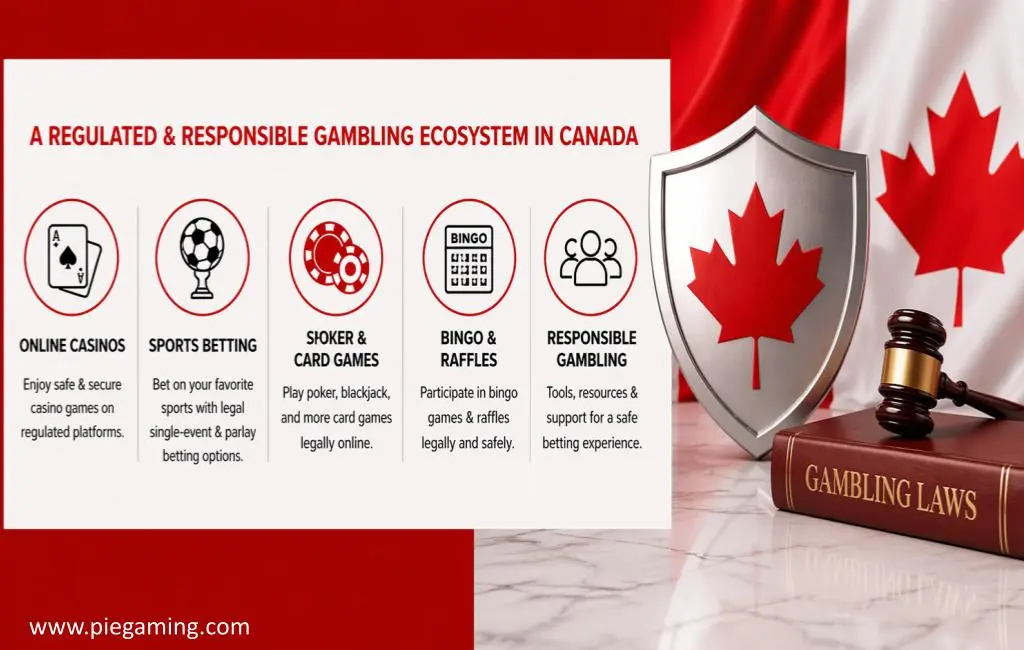
Canada’s regulated and responsible gambling system
Legal gambling in Canada
Today, Canadian players have access to a range of fully regulated betting options. Whether you opt for an app or the ambience of a local store, here is the legal option:
- Online Casinos: Players can legally play thousands of slots, table games (Blackjack and Roulette, amongst others), and access live dealer experiences through province-regulated platforms. In most provinces, this is done through the official lottery site (such as PlayNow), though there’s competition in Ontario and Alberta from private brands.
- Sports Betting: After single-event betting was legalized in 2021, you can now place a bet on only one hockey game or UFC fight. Conventional parlays (the mixture of many bets) continue to rule the roost on all provincial platforms.
- Poker & Card Games: Well regulated online poker is doing great. Ontario has a “ring-fenced” market where residents can play each other, or access legal international pools via government-approved mechanisms in other provinces.
- Bingo and Raffles: Ongoing for both entertainment and charitable fundraising. The age-old features of bingo halls are currently available at most provincial iGaming websites, the more digital the better.
Rules For Gambling Formats & Operators
Before starting a sportsbook business, it is important to understand that the “Who” of the game is more than just the game. Canadian laws separate and regulate public and private operators.
Government-Run Lotteries: The bedrock of Canadian gambling. Entities like Loto-Québec or the OLG manage national and provincial draws, scratch tickets, and their corresponding online portals.
Land-Based & Online Casinos: You will find many world-class physical casinos (such as Caesars Windsor or Casino de Montréal in Canada). “Legal” in the digital realm means sites that are approved by provincial regulators.
Pari-Mutuel Betting (Horse Racing) is among Canada’s earliest legal betting structures under CPMA regulation in Canada. It is still distinct from standard sports betting.
The Public vs Private Split:
- Public Operators: Crown corporations (such as the BCLC) that reinvest profits into provincial health care and education.
- Private Operators: Commercial giants (e.g., FanDuel, BetMGM, or DraftKings) licensed to operate in addition to or instead of government sites.
The Ontario Model: Ontario provides a gold standard for private competition. With access to dozens of private companies to become licensed through iGaming Ontario, they have successfully removed more than 86% of players from high risk, unproven offshore sites into a safe, taxed and monitored environment.
Canadian Casino Regulator Licensure
In Canada, there is neither a “federal gambling license.” Rather, all the power to give permission to operate belongs entirely to the provinces. This composes a quilt of rules where an operator may be legal in Toronto but limited in Vancouver.
An operator seeking a legal way for him or her to take bets in Canada needs to obtain a licence from a provincial casino or enter a commercial agreement with a provincial gaming authority. It is a painstaking process, typically spanning months of financial auditing and technical vetting.
Types of Licenses
- Land-Based Casino Licenses: For physical venues such as the Fallsview Casino or Parq Vancouver. These are extensively regulated over floor space and safety standards, and local community impact.
- Online Gambling Licenses: Offers digital platforms slots, poker and sports betting. In most provinces the license is owned by a government Crown corporation, which then contracts “service providers” to operate the technology.
Licensing: The Gold Standard
In order to gain a license in 2026, operators face stringent Compliance Standards with social ethics taking priority over profitability. Key requirements include:
- Player Protection: Operators should present players with tools to limit deposits, “cool off” periods, and a mandatory identity verification (KYC) to identify and prove their identity to prevent underage gambling.
- Fair Gaming Audits: All software ought to be tested independently in labs (e.g., GLI, eCOGRA) to ensure that Random Number Generators (RNGs) are actually random and that Return to Player (RTP) percentages are accurate.
- Centralized Self-Exclusion: A 2026 mandate for many of the provinces is participating in a Centralized Self-Exclusion (CSE) registry, which will permit a player to prohibit themselves from all legal websites in the province through a single click.
Specialized: Ontario’s Open iGaming Market
Ontario, in its first ever Open Market, changed the game in April 2022. In contrast to other provinces that permit only one government site, Ontario offers a qualification to any private company to apply for a position.
In 2026 Ontario had over 80 regulated brands which fosters competition and provides greater payouts and even better odds to its players. This model has so successfully earned its revenue that on July 13, 2026 Alberta formally followed suit, setting in motion its own doors for private international operators (often operating at similar levels) who could get licenses.
Good Practice: Look for the iGaming Ontario or AGLC emblem before clicking on a site’s logo. If you don’t see the seal of a provincial regulator, you’re likely playing on some offshore “grey market” site with no Canadian legal recourse in hand.
Explore Casino & Sports Betting Regulations in Different Countries
Provincial Regulation: Who Controls Gambling in Canada?
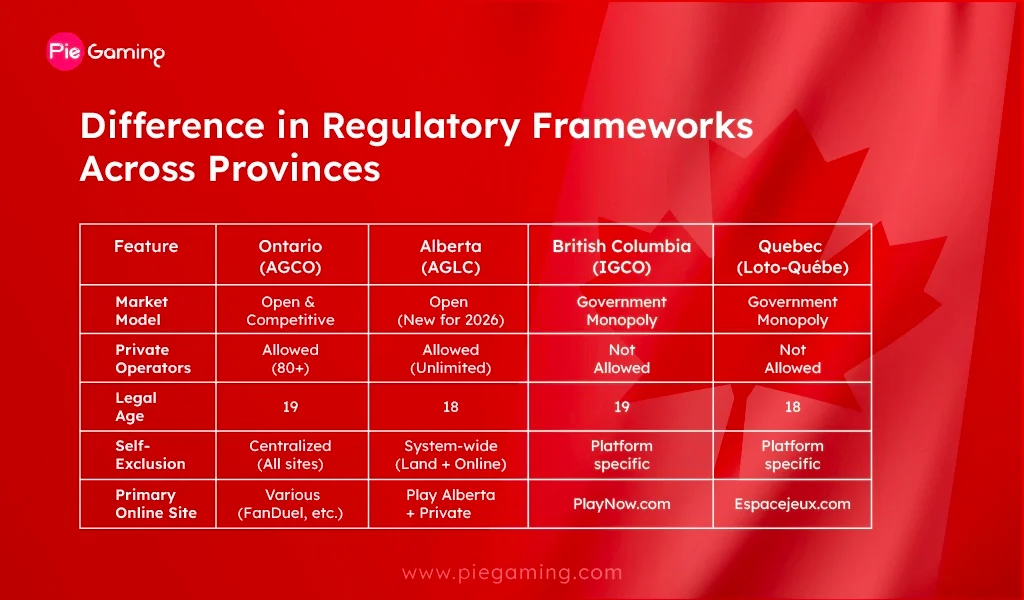
Provincial regulatory differences overview.
The federal government specifies the “ground rules,” but gambling on a day to day basis is managed by the provinces. That’s why you can bet on an app in Toronto, but this might be restricted to a government website in Montreal. Each province has set up a “watchdog” to oversee how fair the games are, how much taxes get collected and how much players are protected.
Provincial officials act as gatekeepers of the industry. They’re in control of issuing licenses, setting software technical standards, and running provincial self-exclusion programs. As of 2026, we’re witnessing a seismic shift as more provinces move away from government monopolies to “open market” models.
Examples of Provincial Authorities
- Alcohol and Gaming Commission of Ontario (AGCO): The gold standard of Canadian regulation. It controls the relationship with more than 80 private operators through its subsidiary, iGaming Ontario.
- Loto-Québec: Unlike Ontario, Quebec operates under a centralized approach. It is both the regulator and operator through its site, Espacejeux, and emphasizes a “social responsibility first” model.
- Independent Gambling Control Office (IGCO) – B.C.: Established in April 2026, the IGCO assumed regulatory responsibility in British Columbia to provide clearer oversight of the British Columbia Lottery Corporation (BCLC).
- Alberta Gaming, Liquor and Cannabis (AGLC): Transitioning Alberta into an open market (launched July 13, 2026), akin to Ontario, moving past the single “Play Alberta” platform.
Why is the regulatory framework across provinces important?
The “Patchwork” character of Canadian law means that consumer protections are not uniform everywhere. If, for example, you ever have a dispute with an operator in Ontario, you have a direct link to follow via iGaming Ontario through the rules of law. Playing on an offshore site while in a monopoly province such as Quebec means you lack those legal protections.
That’s why 2026 is driving a huge push for provinces like Alberta and B.C. to update their frameworks to align with the levels of safety found in Ontario.
Compliance Requirements for Gambling Operators
For companies to operate in Canada’s legal iGaming market, they need to be more than just games; they need to comply with some of the strictest compliance standards in the world. These requirements are now evolving to focus more heavily on digital security and social ethics throughout 2026.
The AGCO must be followed by every operator that wants to hold their license, with at least three core pillars of compliance enforced by regulatory bodies like Ontario’s AGCO and Alberta’s AGLC being the standard. Players who receive their cards and get their IDs signed off must also be assured of the security and safety measures in place to prevent any fraud on their contracts. Operators should have stringent Know Your Customer (KYC) rules and regulations. This isn’t simply about verifying a name. Rather, it involves the following:
I am a new and better idea for identity scanning that is part of the new era in technology. Using AI-based facial recognition technology and government documents to see through the image on screen, the person inside the screen is who they say they are.
Geofencing: Advanced technology that blocks access if a player crosses the border and enters a province where the operators are not licensed.
Digital Gate: Very strict digital ‘gates’ will prevent anyone underage at present from even seeing a betting line when they are only 18-19 years old.
So too should the money be monitored. All of this must comply with the Proceeds of Crime (Money Laundering and Terrorist Financing) Act, to which it all conforms. Suspicious activity – be it substantial deposits with no time period for them, not even an instant payment after which they are withdrawn immediately by the money provider – should be reported to FINTRAC.
- In 2026 most regulated sites now include automated triggers for any transaction greater than $10,000 CAD.
Responsible Gambling Obligations
This is the most critical area for 2026 compliance. Operators must:
- Limit-Setting Resources: At least once, every day–weekly and monthly–can remind players about the limits of deposit and loss allowed.
- Ad Standards: All iGaming ads would have to conform to the new CGA Code beginning January 1, 2026, in order to be accepted as valid. Under it, celebrity and athlete ads are no match for minors who are susceptible to underage viewing.
- Active Intervention: Operators must be able to use behavioral analytics to note what plays are considered “at-risk,” and then will have to send some people corresponding with support services.
Player-Level Regulations in Canada
While the operator should bear the burden of compliance, players have their own set of rules.
Legal Gambling Age by Province
This is based on the age at which you can legally place a bet. In Canada, it has ties to the provincial drinking age:
- 18 Years Old: In Alberta, Manitoba, and Quebec.
- 19 Years Old: Ontario, British Columbia, Saskatchewan, all Atlantic provinces (NB, NS, PEI, NL).
The majority of Canadians enjoy non-taxation on gambling payouts. The Canada Revenue Agency (CRA) considers these as “windfalls”, not income.
The Exception: If the CRA defines you as a professional gambler (if you don’t have any other sources of income and use systematic, business-like strategies, then your winnings may be taxed as business income). Recreational players, though, $10 or $10,000, you hold onto it all.
Offshore Platforms Usage
Technically, offshore (or “grey market”) site use isn’t illegal for a Canadian player—You won’t be arrested for it. But the mood of players has flipped huge in 2026. Without a provincial licence, you have no legal recourse if a site refuses to pay your winnings. Regulated Canadian platforms can provide a safety net that offshore sites simply cannot match.
Challenges in Canada’s Gambling Regulatory System
Despite the massive strides made in 2026, the Canadian landscape remains a complex puzzle for operators and regulators alike. In Canada, establishing a presence can be daunting with its own “red tape.” There are three major hurdles for operators:
- Fragmented Provincial System: Since there is no federal license, an operator is forced to navigate distinct regulatory roadblocks in every province. That means disparate fees, varied technical standards, and customized compliance teams for Ontario, Alberta, and elsewhere.
- Offshore Competition: While regulated markets are expanding with their own volume, “grey market” offshore sites still attract players with aggressive (and unregulated) bonuses. Competing with sites that do not pay local taxes or that take advantage of strict Canadian “celeb-ban” advertisement rules will be an uphill climb for them.
- Regulatory Inconsistencies: In some provinces what is legal may not be legal in others. Ontario’s so-called “open market” gives dozens of brands to choose from while Quebec still operates like a monopoly. Because of the sheer number of brands, in those cases a confusing patchwork for the whole country’s marketing campaigns.
Opportunities for Operators in the Canadian Market
For forward-thinking brands like PieGaming, the Canadian market is currently one of the most profitable “greenfield” opportunities in iGaming.
- Potential for scale: With Alberta formally implementing the Ontario Model in July 2026 the floodgates have opened. So the trend of multi-operator environment growth across Prairies and possibly even potentially British Columbia represents a huge upside.
- Great player demand: Canadians are some of the world’s most active bettors. The high-value LTV (Lifetime Value) generated by localized content — particularly around the NHL, CFL, and niche winter sports — is also high for players.
- Emerging Regulated Ecosystem: The move toward regulation is a win for stability. Operators using robust turnkey solutions can enter these markets with confidence, knowing that their platform will meet the strict compliance and security regulations from 2026 onward.
The PieGaming Advantage:
In a fragmented market, speed to market is everything if you are using a turnkey software provider that understands Canadian-specific integrations, such as Interac payment processing and provincial KYC requirements. Using this provider can turn those challenges into an absolute market share.
Betting Restrictions in Canada
Although Canada has a very strong gambling market, it is not a “free-for-all” market. There exist many strict limitations to ensure that the rules of integrity are applied in all provinces across Canada, that make this province true:
Age Restrictions:
Most of Canada has these sorts of hard restrictions; you must be at least 19 years old if you want to play in most of the country. The only exceptions are Alberta, Manitoba, and Quebec, where the age is only 18.
Advertising and Promotion:
Toward the end of 2026, the standards are quite strict. Operators cannot use cartoon-like graphics and active athletes in marketing so that ads do not target minors. In Ontario, bonus inducements (such as “Bet $5 Get $100”) are not allowed to be placed on public billboards or advertisements for such ads on television or billboards; they can be presented only on the operator’s own site.
Self-Exclusion Policies:
In every controlled province, a “Self-Exclusion” list is required by law. At the point a player signs up, operators are legally obligated to block a player there on the dotted line and stop all marketing communications to that player.
AML & Financial Limits:
Any transaction or series of transactions exceeding $10,000 CAD is subject to FINTRAC guidelines, which automatically triggers an audit. Many provinces also prohibit the use of credit cards for gambling because players are prohibited from betting with “borrowed” money.
National Responsible Gambling Program in Canada
Canada is known around the world for its “safety-first” attitude to betting. It is overseen by a blend of independent non-profits and government-led programs.
Responsible Gambling Council (RGC): A non-profit entity working with operators to find ways to minimize the risk of gambling without destroying society in the process. Their RG Check accreditation is the highest level any casino in Canada might offer.
GameSense: Originally created in British Columbia and now available throughout several provinces (and in some U.S. states), this program offers “Player Health Specialists” who provide impartial information about what games actually do.
Resources & Obligations Related to Players
Regulated platforms shall furnish a “Player Dashboard” with the following features:
Deposit & Loss caps: Schedule daily or monthly caps that can’t be increased instantly.
Time-Outs: Systems that pop up as part of a gaming session, reminding players how long they have been online. It is the job of the provincial governments to make sure some or all of their revenue is spent on research, treatment, and prevention programs.
This is what should work most well with all kinds of gambling.
Future Outlook of Online Gambling Regulations in Canada
The “Ontario Model” has shown that regulation is more profitable and safer than prohibition. Turning to 2027 and beyond, we expect some key shifts in the online casino and sports betting market:
- The Multi-Province Open Market: Similar to Alberta in 2026, British Columbia (along with potential Saskatchewan) will consider private operator licenses to recover revenue lost to offshore sites.
- Federal Harmonization: Although provinces will retain their influence, there is increasing contention that a National Self-Exclusion Registry may exist so that a player can ban themselves from every legal site in Canada at the same time.
- Stiffer AI Regulation: New laws around AI being applied for “predictive modeling” will help ensure operators aren’t using data to prey on vulnerable players.
Conclusion
The Casino & Sports Betting Regulations in Canada are now quite mature. The wild west of the “grey market” is dead. The industry is now a sophisticated and multi-billion-dollar one, balancing entertainment and strict consumer protection. On behalf of users, this means guaranteed payouts and a safer game.
As a result, for operators and stakeholders, it represents good economics for some, if only they can meet the demanding requirements of Canada’s law. It also means that as the market expands from Ontario to Alberta and beyond, one must keep an eye out for variations between regions if he or she wants to steer a steaming ship through the future as well.

FAQs
-
Is online casino gambling legal in Canada?
Yes. Online gambling is legal when managed or licensed by provincial governments. While the federal Criminal Code technically prohibits unauthorized gambling, Section 207 allows provinces to "conduct and manage" their own regulated iGaming platforms and licensing systems.
-
Is sports betting legal in Canada?
Yes. Since the passage of Bill C-218 in August 2021, both single-event betting and parlay wagers are legal across Canada. Each province determines its own rules and approved platforms for sports wagering.
-
Which province has the most advanced iGaming market?
Ontario currently holds the most advanced market. Launched in April 2022, it is the only province with a fully open, competitive iGaming ecosystem featuring over 80 regulated private brands. Alberta is following this model with its own open market launch in 2026.
-
Who regulates online gambling in Canada?
Regulation is handled at the provincial level. Key bodies include the Alcohol and Gaming Commission of Ontario (AGCO), Loto-Québec, and the newly established Independent Gambling Control Office (IGCO) in British Columbia. There is no central national regulator.
-
What are the compliance requirements for operators?
Operators must meet rigorous standards, including KYC (Know Your Customer) identity verification, AML (Anti-Money Laundering) monitoring via FINTRAC, and Responsible Gaming mandates (such as deposit limits and self-exclusion tools). As of January 2026, operators must also adhere to strict new advertising codes that ban the use of athletes and celebrities to target minors.


Jaya Swaroop has been covering iGaming and betting technology since 2019, with a specialization in online casino platforms, sportsbook solutions, and licensing frameworks. Her work involves analyzing platform capabilities and evaluating cost structures, compliance requirements, payment integrations, market strategies, and regulatory updates that impact operators entering or scaling in the iGaming space. With a background in B2B marketing and content strategy, she has contributed to SEO-led growth and demand generation initiatives for global businesses. Jaya holds a Bachelor’s degree in Science (Chemistry & Mathematics) and is certified in content writing, email marketing (HubSpot), project management, and Google Analytics.

A GCGRA Gaming License is required to operate commercial gaming in the UAE, including online casinos and sportsbooks. Foreign operators can apply, but must meet GCGRA’s suitability, financial, compliance, and operational requirements before they can launch.
Online casino gaming is not allowed in Australia under Interactive Gambling Act 2001. But operators can still apply for an internet gaming license via specific jurisdictions like the Northern Territory, which allows them to offer gambling services legally- generally outside Australia.
Bulgaria’s iGaming license enables operators to legally provide services in the areas of online casino, betting, poker, and bingo in accordance with the regulations of the EU. Typically, a licensing process can take 60 to 90 days, and it will need to be approved by the NRA, technical certification, AML compliance, and data storage in the local area. Minimum capital requirements range from BGN 50,000 for betting operators to BGN 1.5 million for online casino operators.
To obtain the Anjouan Gaming License, applicants must collect and submit all the important documents. Learn the process of obtaining Anjouan iGaming license.
Algeria has no online casino or sports betting regulation to speak of — instead, the country enforces a near-total gambling ban rooted in civil law and Islamic principles. Yet despite the prohibition, offshore platforms continue to pull in millions of users every month, driven by high demand and a near-total absence of legal local alternatives.
A Kahnawake iGaming license is a credible and cost-effective licensing solution for online casinos and sportsbook operators. The process to obtain this license includes multiple steps, key benefits, and licensing costs.
Malta pays attention to the credibility of the regulatory framework and to access regulated markets, which is more conducive to long-term growth and industry reputation. However, Curaçao places a strong emphasis on speed and affordability, making it a good choice for startups and businesses focused on cryptocurrencies that are keen to establish a presence rapidly and at a lower cost. If you are constructing a major operation, select Malta. Pick Curaçao when you are just getting started and have to get your product to market quickly.


See you in your inbox soon!

Stay ahead of the game. Subscribe for exclusive content, updates, and insiders!