
Online casino and sports betting in Italy are legal under ADM regulation. Operators must obtain licenses, follow strict compliance rules, and adhere to advertising and player protection laws, ensuring a highly controlled and transparent iGaming market.
Italy’s iGaming industry is booming, bringing in over €5 billion in 2024. But with that growth comes a lot of confusion. Players don’t know what’s allowed, and operators struggle to keep up with rules that change regularly.
The ADM (Agenzia delle Dogane e dei Monopoli) is the authority that oversees it all, and their standards are high. Licenses are hard to get; compliance takes real effort, and the regulations keep evolving. The 2023 decree tightening bonus rules is a good example of how quickly things can shift.
The scale of the industry makes up all of this matter. Online casino games, driven largely by slots, generated around €3 billion in 2024. Italy wants the market to grow, but not at the expense of players.
This guide breaks down what you need to know to operate legally, stay compliant, and build a sustainable presence in the Italian market.
Who Regulates Gambling in Italy?
Gambling in Italy is controlled by the ADM (Agenzia delle Dogane e dei Monopoli), the national authority responsible for licensing, supervision, and enforcement. If you want to operate legally in Italy, you need a valid ADM concession. There are no workarounds. Any unlicensed or offshore operator targeting Italian players is considered illegal and can face domain blocking, financial penalties, and even criminal liability.
ADM is both the regulator and the enforcer. Its responsibilities cover the full scope of market oversight:
- Issuing and managing gambling licences and concessions
- Monitoring operator compliance, financial reporting, and technical systems
- Maintaining a blacklist of illegal gambling websites
- Enforcing sanctions for violations, including fraud and tax evasion
Holding a licence is not a one-time achievement. It is an ongoing obligation, and ADM has the authority to suspend or revoke concessions when breaches occur.
In April 2024, Legislative Decree No. 41/2024 came into force and reshaped how the market operates. It restructured the licensing system, raised legal, technical, and financial requirements, and gave ADM real-time access to operational and transaction data. It also expanded responsible gambling obligations across the board. In short, it gave ADM more control, more visibility, and more power to act.
From November 2025, all operators must hold licences under the new framework. The key changes operators need to be aware of include:
- Stricter eligibility criteria, reducing the number of licensed operators
- A single-domain rule, requiring each licensee to operate through one authorised website
- Enhanced compliance monitoring and data reporting obligations
- Expanded player protection tools, including updated self-exclusion systems
ADM’s regulatory approach is built around three core priorities: consumer protection through age verification and responsible gambling tools, anti-money laundering through financial transparency and transaction oversight, and market control to keep illegal operators out and maintain fair competition among licensed ones.
For operators, this is not background knowledge. It is the foundation on which everything else is built.
Types of Game and Specific Regulations
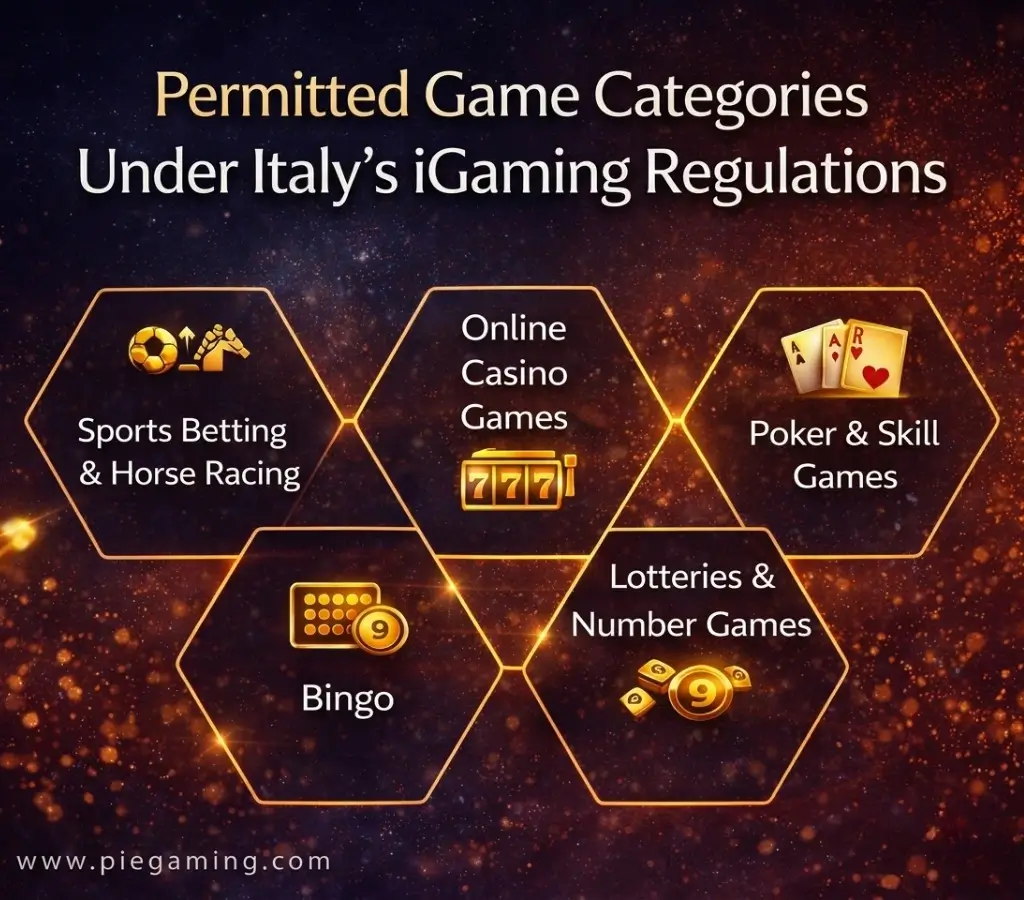
Italy regulates gambling by category. Each type of game has its own set of legal, technical, and operational requirements, and only games explicitly authorised by ADM are allowed. Legislative Decree 41/2024 strengthened this structure, and from November 2025, all operators must hold concessions under the updated framework.
Sports Betting and Horse Racing
This covers fixed-odds sports betting, pool betting, and horse racing. Operators must be ADM-licensed, and all events, odds, and markets need prior approval. Real-time connectivity with ADM systems is required for transaction tracking, and a single tax regime applies to betting revenues. Restrictions on amateur and minor events also apply.
Online Casino Games
Slots, roulette, blackjack, baccarat, and other RNG-based games fall here. Operators need to meet the following requirements:
- ADM-certified RNG software and platforms
- Audited RTP rates and game algorithms
- Continuous data reporting to ADM
- Strict controls on bonuses, game mechanics, and player interaction
Poker and Skill Games
Italy separates games of pure chance from skill-based or hybrid games, and poker sits in the hybrid category. Allowed formats include tournament poker and online cash poker, with cash poker formally authorised after a 2011 update. All online poker must run on ADM-controlled platforms with liquidity and fraud monitoring. How a game is classified, whether chance or skill, directly affects its tax treatment, licensing requirements, and compliance obligations.
Bingo
Land-based and online bingo both require a dedicated ADM concession. Ticket prices, prize structures, and game frequency are all regulated. Online bingo must meet the same technical standards as casino platforms, and draws must be transparent and auditable.
Lotteries and Number Games
This includes Lotto, SuperEnalotto, instant lotteries, and fixed-odds number games. These run under exclusive concessions, with centrally supervised draws and predefined payout ratios. Online distribution is limited to authorised platforms. Given how much these games contribute to state revenue, they are among the most strictly controlled.
Gaming Machines
AWP machines and VLTs must stay connected to ADM’s central control network at all times. Stake limits, payout caps, and session rules are set by law, and machines can only be placed in authorised venues under Article 110 of TULPS. VLTs come with stricter rules than AWPs but allow higher jackpots.
Gambling Laws and Legal Structure in Italy
Gambling is legal, but under a tight state-controlled monopoly. Only activities explicitly authorised by the government are allowed, and every operator needs a valid concession. Step outside that, especially with offshore platforms targeting Italian players, and you’re looking at criminal charges, heavy fines, and even domain blocking.
The legal backbone here is solid, built on:
- Articles 86, 88, and 110 of the TULPS (the Public Security Law)
- Law No. 401/1989 covering criminal offences related to gambling
- Legislative Decree 231/2007 for anti-money laundering
Bottom line: Italy treats gambling as a controlled public activity, not a free-for-all market.
What Does It Take to Operate Legally?
If you want to operate, you need to win a concession through a public tender. And thanks to Legislative Decree 41/2024, the requirements have become significantly stricter.
Here’s what’s involved:
- A €7 million one-off licence fee per concession
- Annual fees: 3% of net gaming revenue plus a 0.2% contribution to responsible gambling initiatives, along with additional contributions for responsible gambling programmes
- Proof of financial stability and operational capability
- Full compliance with AML, KYC, and technical standards
- Mandatory integration with ADM’s real-time monitoring systems
Licences last up to 9 years and cannot be renewed. They are limited in number, creating a controlled but competitive field.
How Italy’s Gambling Laws Have Evolved
Italy’s market has been shaped by a series of key reforms:
- 2006 (Bersani Decree): Opened the market and introduced the concession system
- 2009 Gambling Law: Legalised online casino games and expanded digital gambling
- 2011: Legalised online casino games and cash poker, further expanding the regulated digital sector
- 2018 (Dignity Decree): Introduced a near-total ban on gambling advertising
- 2024 (Legislative Decree 41/2024): A full-scale reorganisation of the sector, especially online ([Digital Policy Alert][3])
- 2025 Reform Implementation: A new licensing cycle with stricter entry rules and fewer operators, coming into force on 13 November 2025
The 2024 reform focuses on:
- Stronger consumer protection.
- Combating illegal gambling.
- Greater transparency and technical oversight.
- Standardising licensing and compliance obligations.
And Where Does the EU Fit In?
Italy is subject to EU principles such as the freedom to provide services across borders. However, gambling is a special case.
EU law allows restrictions where justified by:
- Consumer protection
- Public order
- Prevention of fraud and addiction
As a result, foreign operators must obtain an Italian licence to operate legally. Cross-border services are limited unless compliant with national regulations.
Games of Skill vs. Games of Chance: Why It Matters
Italian law distinguishes between games of chance (slots, roulette, primarily luck-based) and games of skill (where player decisions influence the outcome). This distinction directly affects regulation and licensing.
Poker is classified as a hybrid game:
- Tournament poker is treated as a structured competition
- Cash poker (peer-to-peer) is more tightly controlled due to fraud and liquidity risks
- This distinction influences:
- Licensing requirements
- Tax treatment
- Permitted formats and platforms
Consumer Protection and Compliance
Consumer protection is a central pillar of Italian gambling law and has been significantly strengthened under Legislative Decree 41/2024.
Key measures include:
- Strict age verification (18+) with a complete prohibition on underage gambling.
- A nationwide self-exclusion system called RUA (Registro Unico delle Autoesclusioni) that allows players to block access across all licensed platforms.
- Mandatory KYC identity verification before account activation.
- Player protection tools such as deposit limits and behaviour monitoring.
- Real-time transaction monitoring and data reporting to ADM via centralised systems, including the SOGEI infrastructure.
- Mandatory contributions to responsible gambling programmes.
The Dignity Decree (2018) imposes a comprehensive ban on gambling advertising, including sponsorships, endorsements, and digital promotions. This makes Italy one of the strictest markets in Europe.
Additionally, operators must comply with:
- AML regulations
- Data protection rules
- Continuous system audits and reporting requirements
Failure to meet these obligations can lead to licence suspension, revocation, and financial penalties.
Explore Casino & Sports Betting Regulations in Different Countries
Recent and Future Reforms in Italy’s iGaming Landscape (2024-2026)
Italy is overhauling its online gambling rules for the first time in nearly 20 years. The result? Fewer operators, tighter controls, and much better player protection. Here’s what you need to know, phase by phase.
2024 Reform – Legislative Decree 41/2024 Kicks Off a New Era
Back in April 2024, Italy passed Legislative Decree 41/2024. Think of it as the starting gun for a complete reset of online gaming.
Key changes right out of the gate:
- A brand‑new concession system – no more endless licence extensions.
- A €7 million licence fee per operator (yes, million).
- Annual costs for operators:
- 3% of net gaming revenue (NGR)
- 0.2% to fund responsible gambling initiatives.
- Every operator must connect to ADM’s central monitoring systems.
- Much stronger AML (anti‑money laundering), KYC checks, and real‑time transaction reporting.
Why? To raise the bar for entry, make every euro traceable, and squeeze out illegal gambling.
2025 Licensing Reform – Market Consolidation in Action
On 13 November 2025, the new licensing system went fully live. The old concessions? Gone.
What happened next:
- Licensed operators dropped from over 80 to around 46 (holding 52 concessions, according to early 2026 ADM data).
- Licences now last 9 years – and they cannot be renewed.
- The “multi‑skin” model (one operator running many websites) is dead. Each operator gets one authorised domain.
- Player accounts had to be migrated by the late 2025 deadlines to stay compliant.
The results:
- A tighter, more stable market.
- Smaller operators either left or merged.
- More mergers and acquisitions activity.
Italy is shifting to a low‑volume, high‑compliance operator model.
2025–2027 Compliance Strategy – Real‑Time Monitoring and AI
In March 2025, the ADM launched a multi‑year compliance plan (2025–2027) focused on tech‑driven enforcement.
Key upgrades:
- Real‑time data monitoring expanded across all licensed operators.
- AI and advanced analytics now help detect:
- Fraud
- Money laundering
- Suspicious betting patterns
- KYC and AML enforcement tightened significantly.
- Better player protection tools:
- Behavioural tracking
- Spending controls
- Improved self‑exclusion systems
The goal: a fully transparent gambling ecosystem watched 24/7.
2026 Reforms – Bringing Land‑Based Gambling Into the Fold
By 2026, the reforms reached physical gambling – slot parlours, betting shops, bingo halls. The aim? Align them with online rules.
What’s new:
- New concession tenders launched in Q1 2026 by ADM.
- Licensing packages for gaming machines (AWP/VLT) start at around €25 million per package.
- Retail betting and bingo concessions restructured.
- Stricter rules on:
- Venue licensing
- Operating hours
- Location bans (e.g., near schools, churches, hospitals)
Plus: a new revenue‑sharing system with local authorities to smooth over national vs. regional tensions.
At the same time, authorities are cracking down on the illegal gambling market – estimated at €30–32 billion annually across Europe, facing Italian activity.
By 2026, Italy will be building a high‑control, high‑compliance iGaming model. That looks like:
- A smaller but more stable base for licensed operators.
- Much better transparency and enforcement.
- Higher barriers for new operators trying to enter.
- Online and land‑based rules are finally aligned under one framework.
Italy is fast becoming one of Europe’s strictest gambling markets, putting sustainability, compliance, and player safety ahead of rapid growth.
How Italy Taxes Gambling?
Italy taxes gambling operators, not players. This means if you win money on a licensed Italian gambling site, you generally keep all of it. The casino or bookmaker pays the tax bill, not you.
The system is called GGR-based taxation. GGR stands for Gross Gaming Revenue, which is basically what operators earn after paying out winnings. Tax is calculated on that leftover amount, not on every bet placed.
| What’s Being Taxed | Rate | How It’s Measured |
| Online Sports Betting | 24.5% | On operator profits |
| Online Casino (Slots & Tables) | 25.5% | On operator profits |
| Online Poker & Bingo | 25.5% | On operator profits |
| Retail Sports Betting | 20.5% | On operator profits |
| Horse Racing | 20.5% | On operator profits |
| Gaming Machines (AWP) | ~19.25% | On total stakes |
| Video Lottery Terminals (VLTs) | ~6.25% | On total stakes |
| Retail Bingo | 11.12% | On ticket sales |
Online casino games carry the highest tax at 25.5%, while physical betting shops pay less than their online counterparts.
The lower rates for retail and horse racing are intentional, designed to keep those sectors financially viable. Gaming machines work a little differently, too, since they’re taxed on total money put in rather than just profits.
On top of those rates, licensed operators carry a few extra financial responsibilities. There’s a 3% annual fee on net gaming revenue as a cost of holding the licence, plus a 0.2% contribution ringfenced for responsible gambling programmes.
Operators also make monthly tax payments to the regulator, and every bet and payout gets logged through Italy’s centralised SOGEI/JTS reporting systems.
The big takeaway is that Italy runs a tightly regulated, operator-taxed system. Players walk away with clean, tax-free winnings, while operators carry a significant and closely monitored financial load.
Wrapping Up…
Italy’s regulatory framework is one of the most defined in Europe, and for operators, that clarity is actually an advantage. You know the licensing requirements, the tax obligations, and you know what compliance looks like.
Entering the Italian market comes with a serious checklist, but it also comes with the confidence of operating in a well-governed, high-value jurisdiction that rewards operators who do things right.

FAQs
-
Is it legal to sports bet in Italy?
Yes, sports betting is completely legal in Italy for anyone aged 18 and over, as long as you are using a platform licensed by the ADM. Licensed operators cover everything from fixed-odds and virtual betting to totalizer bets. Offshore sites are still illegal, so sticking to regulated platforms is the only way to ensure your bets are protected and above board.
-
What can you get fined for in Italy?
Fines in Italy are aimed squarely at illegal gambling activity. Using unlicensed sites can cost anywhere from €500 to €3 million, and cash transactions over €100 per week; bonus abuse and underage betting are all on the radar too. Operators risk losing their licence entirely, while players can face account freezes and blacklisting.
-
Are gambling winnings taxable in Italy?
Not for players. If you are winning through a licensed ADM operator, that money is yours to keep, no tax applied. The tax burden sits with operators, who pay between 20.5% and 25.5% on their gross gaming revenue. The one exception worth knowing is offshore winnings, which can attract personal income tax of 20% to 43%, another good reason to stay on regulated sites.
-
Is Bet365 legal in Italy?
Yes. Bet365 holds a valid ADM concession awarded in 2025, covering both sports betting and casino products. It operates under Italy's reformed one-site-per-license framework, which means it is fully compliant and accessible to Italian players without any grey area.
-
What are the new licensing costs in Italy?
The upfront cost of an ADM concession is €7 million per licence, followed by a 3% annual fee on net gaming revenue and a 0.2% levy ringfenced for responsible gambling. Land-based bundles require financial guarantees of €25 million or more. Licences run for nine years from 2025 to 2034 with no renewal option, and the high entry barriers mean only around 46 operators currently hold concessions.


Palak Madan has been writing about the iGaming industry since 2024. She focuses on helping operators and founders understand their options when launching an online casino, from choosing the right software provider to figuring out costs and compliance requirements across different markets. At PieGaming, she covers topics like white label casino solutions, platform selection, and market entry, turning complex industry information into practical guidance for people building iGaming businesses. She also keeps a close eye on licensing and regulatory changes; particularly how new rules shape the way operators enter and grow in different jurisdictions.

A GCGRA Gaming License is required to operate commercial gaming in the UAE, including online casinos and sportsbooks. Foreign operators can apply, but must meet GCGRA’s suitability, financial, compliance, and operational requirements before they can launch.
Online casino gaming is not allowed in Australia under Interactive Gambling Act 2001. But operators can still apply for an internet gaming license via specific jurisdictions like the Northern Territory, which allows them to offer gambling services legally- generally outside Australia.
Bulgaria’s iGaming license enables operators to legally provide services in the areas of online casino, betting, poker, and bingo in accordance with the regulations of the EU. Typically, a licensing process can take 60 to 90 days, and it will need to be approved by the NRA, technical certification, AML compliance, and data storage in the local area. Minimum capital requirements range from BGN 50,000 for betting operators to BGN 1.5 million for online casino operators.
To obtain the Anjouan Gaming License, applicants must collect and submit all the important documents. Learn the process of obtaining Anjouan iGaming license.
Algeria has no online casino or sports betting regulation to speak of — instead, the country enforces a near-total gambling ban rooted in civil law and Islamic principles. Yet despite the prohibition, offshore platforms continue to pull in millions of users every month, driven by high demand and a near-total absence of legal local alternatives.
A Kahnawake iGaming license is a credible and cost-effective licensing solution for online casinos and sportsbook operators. The process to obtain this license includes multiple steps, key benefits, and licensing costs.
Malta pays attention to the credibility of the regulatory framework and to access regulated markets, which is more conducive to long-term growth and industry reputation. However, Curaçao places a strong emphasis on speed and affordability, making it a good choice for startups and businesses focused on cryptocurrencies that are keen to establish a presence rapidly and at a lower cost. If you are constructing a major operation, select Malta. Pick Curaçao when you are just getting started and have to get your product to market quickly.

See you in your inbox soon!

Stay ahead of the game. Subscribe for exclusive content, updates, and insiders!