
Online casino gaming is not allowed in Australia under Interactive Gambling Act 2001. But operators can still apply for an internet gaming license via specific jurisdictions like the Northern Territory, which allows them to offer gambling services legally- generally outside Australia.
Australia has a deeply rooted betting culture and the highest gambling participation rates worldwide. For gambling operators, Australia offers a golden opportunity to run an online casino business. Though market potential is one side of the coin, Australia is also known for its strict gambling regulations, state-based licensing requirements, etc.
For operators, it’s undeniably crucial to navigate federal laws, advertising restrictions, ongoing compliance requirements, and responsible gambling obligations.
Whether you plan to launch a sportsbook or casino or explore market-entry opportunities, understanding gambling laws in Australia is important.
Is iGaming Allowed in Australia?

Overview of gambling market in Australia
Yes, online gambling is legal in Australia, but only partially. Licensed iGaming operators can offer sports betting and racing wagering services to players. But popular online casino games, slots, and live dealer games are restricted under the Interactive Gambling Act 2001.
But the online gambling laws in Australia are mostly understood when explained properly, with a distinction between legal, restricted, and prohibited gambling activities.
Legal vs Illegal Gambling Activities in Australia
The following table represents the different types of gambling activities and their status in the jurisdiction.
| Activity | Status | Remark |
| Online sports betting | Legal | Requires Australian license |
| Racing wagering | Legal | Highly regulated at the state level |
| Lotteries | Legal | State-controlled framework |
| Online casino games | Prohibited | Restricted under Interactive Gambling Act |
| Online slots (real money) | Prohibited | Not permitted under federal law |
| Live dealer casino games | Prohibited | Offshore targeting restricted |
Key insights for operators:
Under the Interactive Gambling Act 2001, it is illegal for domestic as well as offshore operators to offer “interactive casino services” to Australian residents. But licensed domestic operators can legally offer sports betting and racing wagering.
Market overview
There are many restrictions for operators when it comes to offering gambling services to Australian players. But the country remains highly attractive due to:
- High mobile-first betting adoption
- Mature digital payment ecosystem
- Among the highest gambling spends per capita worldwide
- Deep sports culture (cricket, horse racing, rugby)
Australia’s Multi-Layered Gambling Regulatory System
Australia operates in the gambling industry under a hybrid regulatory structure. Basically, it is a multi-layered regulatory framework that combines federal legislation with state and territory-level oversight.
The dual regulatory system is designed to regulate various aspects of gambling activity, from online betting and player protection to licensing and land-based casino operations.
Federal vs State Gambling Regulation
The gambling regulatory framework in Australia is divided into parts: the federal government, individual states, and territories.
Federal Government
The federal government is responsible for online gambling legislation, consumer protection measures, offshore operator enforcement, and anti-money laundering obligations.
This authority put legal boundaries on online gambling through the Interactive Gambling Act 2001.
State & Territories
The key responsibilities of states and territories include licensing, wagering approvals, casino regulations, responsible gambling requirements, and local compliance enforcement.
The regulators here oversee licensing, operational, compliance, and gambling activities through their respective jurisdictions.
Who Regulates Gambling in Australia?
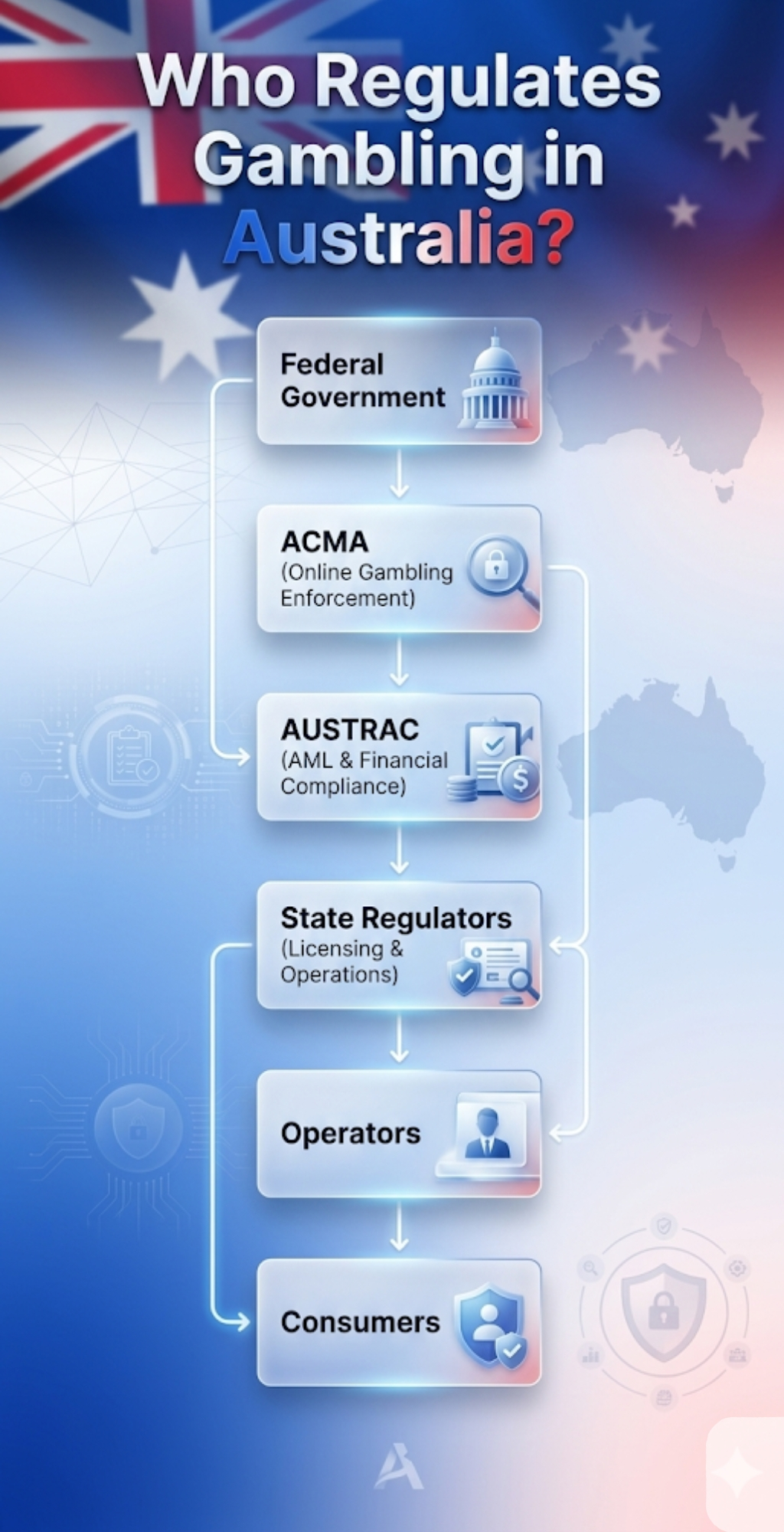
Australia’s gambling regulatory authorities
Gambling in Australia is regulated by various authorities, including ACMA, AUSTRAC, and individual state gambling commissions such as the Northern Territory Racing Commission, etc.
The following are the top regulatory bodies that operators in Australia must know.
ACMA
The Australian Communications and Media Authority (ACMA) is the main federal regulator responsible for enforcing the Interactive Gambling Act 2001. It plays a crucial role in Australia in fighting illegal offshore gambling services.
Key responsibilities of the ACMA include the following:
- Investigates breaches of Australian gambling laws
- Blocks illegal gambling websites that target Australian residents
- Issues a formal warning against the culprits
- Monitors compliance with online gambling regulations
For operators, ACMA gambling rules ensure that gambling products and services are aligned with gambling laws in Australia before entering the market.
AUSTRAC
The Australian Transaction Reports and Analysis Centre (AUSTRAC) is the financial intelligence agency and anti-money laundering regulator. So, any operator seeking to run a gambling business in Australia must comply with AUSTRAC’s Anti-Money Laundering and Counter Terrorism Financing (AML/CTF) requirements.
Key responsibilities of AUSTRAC include:
- Monitors financial transactions
- Prevents money laundering and terrorism financing
- Enforces customer verification (KYC) requirements
- Reviews AML compliance programs
- Investigates suspicious transaction activity
Any operator who fails to comply with AUSTRAC’s requirements will face financial penalties and regulatory action.
State and Territory Gambling Regulators
Every state and territory gambling regulator in Australia has its own laws for issuing licenses and overseeing gambling operations within its jurisdiction.
The major regulators include:
- Northern Territory Racing and Wagering Commission (NTRWC) – It is a preferred jurisdiction for many online sportsbook operators.
- Victorian Gambling and Casino Control Commission (VGCCC) – This regulatory body oversees gambling compliance and licensing in Victoria.
- Office of Racing, Gaming, and Liquor (Western Australia) – These regulators assess license applications, monitor compliance, and enforce responsible gambling standards.
Consumer protection agencies
Apart from gambling-specific regulators, many government agencies and consumer protection bodies safeguard players and promote responsible gambling practices.
Their responsibilities include:
- Enforces responsible gambling policies
- Manages self-exclusion programs
- Addresses consumer complaints
- Promotes player protection initiatives
- Monitors gambling-related harm prevention measures
Key Gambling Laws Australian Operators Must Know
Apart from gambling regulatory bodies, operators should also know and comply with online gambling laws in Australia. The key Australian gambling laws operators must understand before entering the market include the following:
Interactive Gambling Act 2001 (IGA)
The Interactive Gambling Act 2001 is an important law for gambling operators in Australia. The Act was introduced by the Australian government, which regulates the provision of online gambling services to Australian residents.
| Under IGA law, operators can offer sports betting and racing wagering services. Whereas online casino activities (online slots and live dealers) are restricted. |
Casino Control Act 1982
This act was specifically introduced to oversee land-based casino operations and licensing standards. The ACT offers requirements related to:
- Casino licensing and approvals
- Operational integrity standards
- Regulatory oversight and auditing
- Responsible gambling obligations
Through this act, Australia ensures the maintenance of transparency, integrity, and consumer protection within the gambling sector.
Anti-Money Laundering and Counter-Terrorism Financing (AML/CTF) Act
Australia is quite strict when it comes to financial compliance requirements, which are enforced through the AML/CTF Act. This act is enforced by AUSTRAC. Operators who fail to follow the requirements will have to face penalties, regulatory investigations, and reputational damage.
The key requirements that gambling operators must comply with include the following:
- Customer identity verification (KYC)
- Record keeping
- Transaction monitoring
- Ongoing customer due diligence
- Risk-based AML compliance programs
Privacy Act 1988
Since the gambling business collects plenty of players’ data, the Privacy Act 1988 plays a crucial role in protecting players’ data. The regulators check how operators collect, store, and use players’ personal information. The data includes the following:
- Customer onboarding data
- Payment details
- Marketing preferences
- Behavioral information
Responsible Gambling Legislation
Responsible gambling is one of the major focuses of Australia’s regulatory framework. Whether it’s federal or state regulators, both demand that operators implement measures that reduce gambling-related harm and promote a safer gambling environment.
The common requirements for responsible gambling include:
- Deposit limit tools
- Self-exclusion programs
- Player activity monitoring
- Customer intervention procedures
- Responsible gambling messaging
Consumer Protection Framework
Australian gambling laws focus more on protecting consumers and ensuring fair treatment of players. This act basically focuses on the following:
- Fair gaming practices
- Transparent terms and conditions
- Clear bonus wagering requirements
- Accurate advertising and promotions
- Compliant handling procedures
Operators must maintain transparent communications and avoid misleading marketing practices that can impact customers negatively.
Advertising and Marketing Rules for Gambling Businesses
Australia has a strict gambling advertising framework globally. Because the regulators place more emphasis on consumer protection and responsible gambling.
Major advertising restrictions operators should know:
Australian gambling regulators always ensure that operators comply with both federal and state-specific advertising requirements. As per ACMA guidelines, the restrictions include the following:
- No misleading bonus promotions
- Restrictions on gambling advertisements during live sporting events
- Social media advertising should include responsible gambling messaging
- Restrictions on encouraging irresponsible gambling behavior
Operators who are planning to enter the Australian market, following a well-structured advertising compliance framework, can help protect licenses and reduce risk.
Read Blog – Complete Guide to Turnkey Sportsbook Solutions
Can Foreign Operators Enter Australia’s Gambling Market?

Australia iGaming market
Yes, foreign operators can enter the Australian market via proper licensing or a partnership with licensed local operators. Unlike other jurisdictions, Australia doesn’t offer a single national gambling license, and compliance with the state-level framework is mandatory.
Market entry options for foreign operators
There are various options through which offshore operators can enter the Australian market, including the following:
- Establish a local Australian entity
- Partner with licensed operators in the region itself
- Operators can use a white-label sportsbook from a technology provider
Common regulatory challenges faced by the operators
Australia offers a strong opportunity for operators, but they should be prepared for multiple regulatory challenges, including:
- Must comply with both federal and state-level regulatory requirements
- Follow strict advertising and marketing restrictions
- Meet all responsible gambling obligations
- Implement AML/CTF compliance programs
- Maintain ongoing reporting and audit requirements
Licensing Pathways for Foreign OperatorsAustralia doesn’t offer a single gambling license; rather, licenses are issued by individual states and territories. Each state or territory has its own licensing system, approval process, and compliance requirements. The Northern Territory Racing and Wagering Commission is the most popular licensing jurisdiction for online sportsbooks and wagering operators. Before a license is given, operators must go through suitability and probity requirements. Key areas assessed during licensing:
Once the license is approved, operators must be aware that regular audits, regulatory reporting, compliance reviews, and frequent monitoring will be crucial for Australia’s gambling regulatory framework. |
Major Compliance Risks for Gambling Operators
Though Australia offers significant opportunities to operators, it is also the most regulated gambling jurisdiction in the world. The regulatory authorities actively monitor operators, check non-compliant activities, and penalize those who fail to meet legal and operational requirements.
ACMA Enforcement Risks
If operators fail to follow ACMA rules, the authority will block their website, preventing players from accessing unlawful gambling services. ACMA regularly checks and blocks offshore operators who offer prohibited services to Australian residents.
AML Breaches
Operators who don’t follow Anti-money laundering measures will face major financial penalties and regulatory scrutiny. Common compliance failures include:
- Insufficient customer verification
- Weak transaction monitoring system
- Failure to report suspicious activities
- Insufficient AML risk management procedures
Advertising Violations
Australia has strict gambling regulations in the iGaming industry. If operators do misleading promotions, non-compliant bonus offers, advertising targeting minors, and irresponsible gambling messaging will lead to regulatory investigations.
In fact, operators are also liable to monitor affiliate and influencer marketing activities because third-party violations may cause compliance risks for operators.
Consumer Protection Failures
Non-compliance with consumer protection, like transparent terms and conditions, complaint resolution processes, or responsible gambling tools, results in reputational harm.
License Suspension Risks
If an operator continues to make repeated compliance breaches, it will put their gambling business or compliance at risk. In this case, the regulators may impose more conditions, suspend operations, or remove licenses entirely if operators fail to meet ongoing compliance obligations.
Read Blog – What is a Casino API Integration? Complete Guide
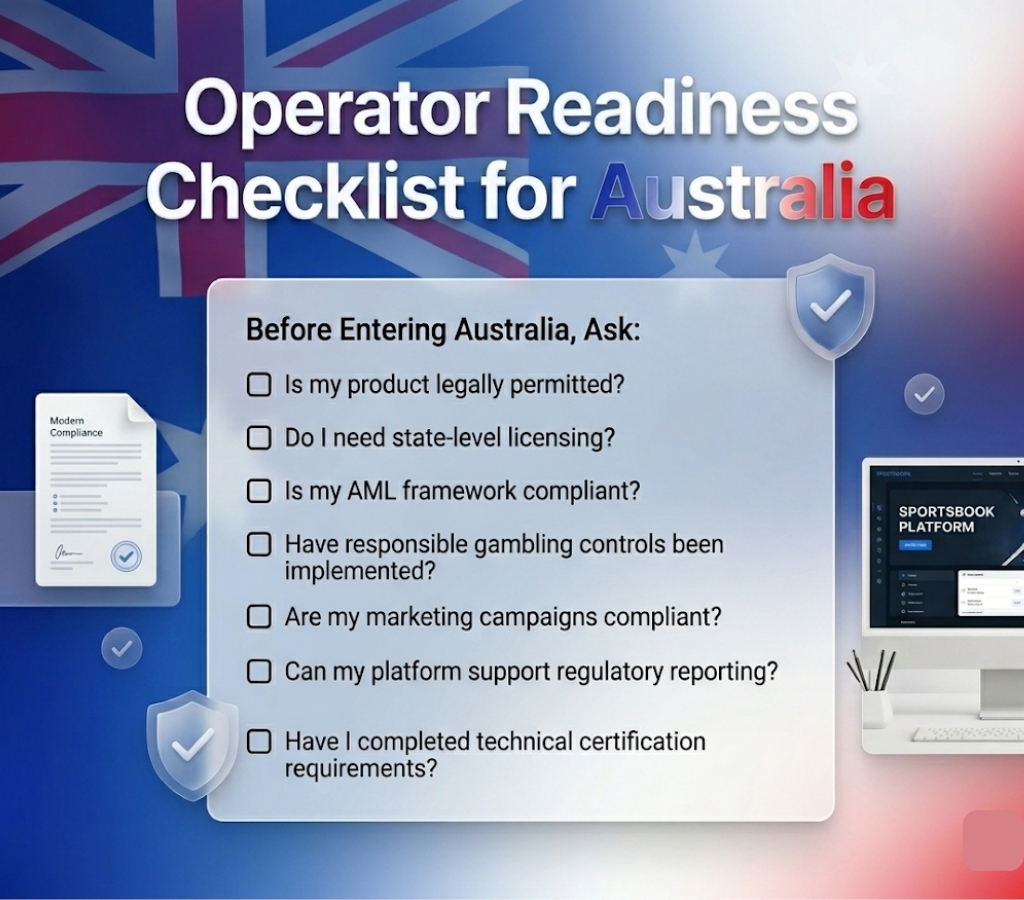
Australian gambling market checklist for operators
Conclusion
Australia offers one of the most lucrative opportunities for operators in the world. Though the market is vast, success depends on how well you understand gambling laws in Australia, along with its licensing framework and compliance.
Operators entering this market must do careful planning, align with regulatory laws, and ensure compliance with the infrastructure. It is true that for gaming and sportsbook businesses, Australia presents a good opportunity. But operators must stick with high-barrier jurisdictions, as it will define long-term success.

FAQ's
-
Is online gambling legal in Australia?
Yes, but only licensed sports betting and racing wagering are legal. Whereas online casino games are prohibited.
-
What is the Interactive Gambling Act (IGA) in Australia?
The Interactive Gambling Act (IGA) is the federal law governing online gambling services and prohibiting offshore casino offerings.
-
Which authority regulates gambling in Australia?
ACMA and AUSTRAC authorities regulate gambling in Australia at the federal level, with strict suitability checks.
-
How do gambling licenses work in Australia?
Gambling licenses in Australia are issued at the state level with a strict suitability check.
-
Which Australian states issue gambling licenses?
Northern Territory, Victoria, Queensland, NSW, and other state regulators issue various gambling licenses.


Monika Gola is an iGaming content specialist at PieGaming. Since 2020, she has been researching and developing content around software selection, online casino & sports betting regulations, and operator growth strategies. Her research includes analyzing market opportunities in regions like Europe, Africa, and Southeast Asia, as well as evaluating regulatory frameworks and entry barriers. She is actively monitoring industry trends, compliance updates, and evolving player demands across global iGaming markets to help operators navigate this industry seamlessly.

A GCGRA Gaming License is required to operate commercial gaming in the UAE, including online casinos and sportsbooks. Foreign operators can apply, but must meet GCGRA’s suitability, financial, compliance, and operational requirements before they can launch.
Bulgaria’s iGaming license enables operators to legally provide services in the areas of online casino, betting, poker, and bingo in accordance with the regulations of the EU. Typically, a licensing process can take 60 to 90 days, and it will need to be approved by the NRA, technical certification, AML compliance, and data storage in the local area. Minimum capital requirements range from BGN 50,000 for betting operators to BGN 1.5 million for online casino operators.
To obtain the Anjouan Gaming License, applicants must collect and submit all the important documents. Learn the process of obtaining Anjouan iGaming license.
Algeria has no online casino or sports betting regulation to speak of — instead, the country enforces a near-total gambling ban rooted in civil law and Islamic principles. Yet despite the prohibition, offshore platforms continue to pull in millions of users every month, driven by high demand and a near-total absence of legal local alternatives.
A Kahnawake iGaming license is a credible and cost-effective licensing solution for online casinos and sportsbook operators. The process to obtain this license includes multiple steps, key benefits, and licensing costs.
Malta pays attention to the credibility of the regulatory framework and to access regulated markets, which is more conducive to long-term growth and industry reputation. However, Curaçao places a strong emphasis on speed and affordability, making it a good choice for startups and businesses focused on cryptocurrencies that are keen to establish a presence rapidly and at a lower cost. If you are constructing a major operation, select Malta. Pick Curaçao when you are just getting started and have to get your product to market quickly.
The best jurisdiction depends on your target market. Malta suits operators who want a credible European base with strong banking. The UKGC is required for Great Britain. The Isle of Man suits B2B and platform-led operators. Curaçao is the usual low-cost route for global launches. Anjouan is typically quoted as the cheapest and fastest, but with limited banking and lower recognition.



See you in your inbox soon!

Stay ahead of the game. Subscribe for exclusive content, updates, and insiders!