
Esports betting offers a major opportunity to operators, and choosing the right partner can greatly impact profitability, player engagement, and operational efficiency.

The sportsbook industry is leading the next phase of the iGaming industry with its new segment– Esports Betting. The best thing is that both operators and players have recognized the opportunity in Esports betting. Today, Esports has become a multi-million-dollar industry and a revenue channel for operators to engage younger audiences (especially tech-savvy Gen Z).
In 2026, the global Esports betting market is projected to be USD 18.53 billion. With continued growth, the market is estimated to attain USD 59.42 billion by 2035. However, the market is forecast to grow at a CAGR of 13.7% over the period 2026 to 2035.
Players now demand real-time odds updates, extensive live betting options, a seamless mobile experience, and support for emerging payments like cryptocurrencies. Fulfilling these requirements requires a specialized technology stack and experienced sports betting partners.
Since the market is filled with numerous platform providers, it makes it difficult for operators to find the right provider. Picking the wrong provider will lead to higher risk exposure and missed growth opportunities.
This guide will walk you through the top 8 Esports betting platform providers for sportsbook operators.
Why Are Operators Expanding Beyond Traditional Sportsbooks?
For the past few years, sportsbook growth has been led by traditional sports like football, basketball, tennis, and horse racing. Since player preferences are changing, it is pushing operators to expand their portfolio. Let’s see how:
Global Esports Audience and Betting Market Growth
The global Esports market has experienced remarkable growth over the past decade. According to a Business Research Insights report, “The Esports Betting Market has more than 640 million global Esports viewers, of which nearly 280 million are classified as Esports enthusiasts, participating in competitive events.”
This growth is driven by viewer engagement, mobile gaming penetration, high internet access, and the availability of scalable Esports betting software.
Esports betting software offers multiple benefits to the operators, including the following:
- Build high trust among younger players
- Cross-selling opportunities with casino and sportsbook operators
- Frequent tournament schedules
- High-volume live betting markets
Furthermore, young players are deeply engaged with games like Dota 2, League of Legends, Valorant, and Counter Strike 2. So, this creates a big opportunity for operators to attract players who are less interested in traditional sports betting.
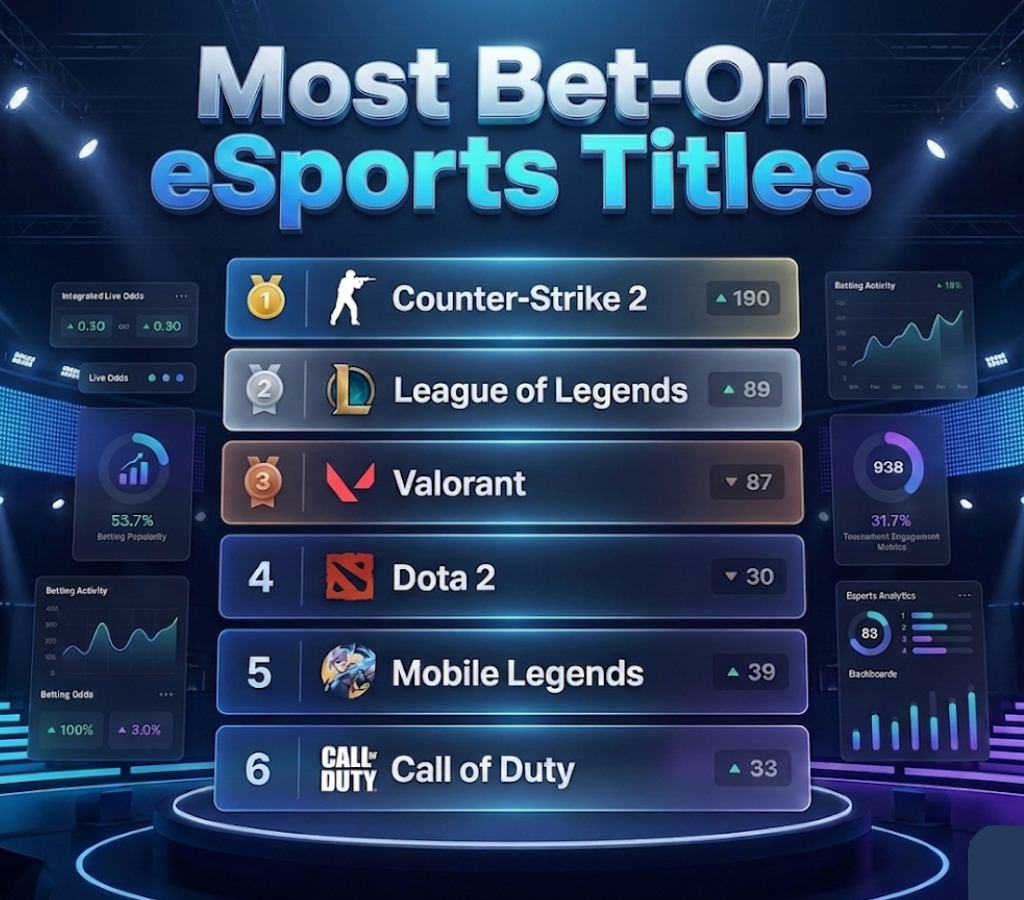
Most played Esports betting titles
How Do Esports Platforms Differ from Sportsbooks?
There are many operational and technological differences that operators must understand. This includes the following:
| Key factor | Traditional Sportsbook | Esports Betting Platforms |
| Odds quality vs. Market volume | Broad market coverage across traditional sports | Prioritize accurate, real-time Esports betting odds powered by official data feeds. |
| Live betting capabilities | Limited in-play events based on sport. | Opportunities driven by in-game events like first kill, round winner, and map outcomes. |
| Data & feed requirements | Sports data is widely available from multiple suppliers. | Relies on Esports data provider and a low-latency feed. |
| Player demographics | Broad audience across age groups. | Primarily attract Gen Z and digitally native bettors. |
| Crypto betting support | Regarded as an additional feature | Actively used by crypto native bettors. |
| Risk & integrity management | Mature risk models and established systems | Greater risk of match-fixing, lower tier tournaments, and rapid market shift. |
8 Best Esports Betting Platform Providers
Below are some of the top-tier Esports betting platform providers serving sportsbook operators.
1. PieGaming
Founded Year: 2014
Company Overview
PieGaming is a leading iGaming software provider, offering its sportsbook, crypto casino, and Esports betting solutions to operators across the world. Their software is designed for operators looking for scalable, customizable, and ready-to-launch platforms. Their solutions are for both established and emerging betting markets.
Unlike other software providers, PieGaming’s solutions focus more on flexibility. This allows operators to launch multi-vertical gaming businesses from one system only. Their sportsbook solutions offer access to 50,000+ betting markets across various sports and Esports events, giving visibility to every sport across the world. With their built-in tools like back office, risk management, affiliate solutions, and more, operators can acquire and retain players easily.
Best Fit For
- Startups venturing into sports betting
- White-label sportsbook operators
- Emerging market operators
- Businesses looking for multi-market gaming platforms
Pros
- Mobile-first optimized
- Multi-lingual support
- Customizable UI and branding
- Frequent updates & support
- Risk management
Limitations
- Operators may have additional integrations based on their market needs.
2. TrueiGTech
Founded Year: 2018
Company Overview
TrueiGTech is a full-stack sportsbook software provider offering eSports-ready betting platforms for modern operators. They put a strong focus on customization, scalable architecture, and real-time wagering capabilities across regulated and emerging markets. Further, they support numerous betting verticals, which also include Esports betting.
Further, their sports betting platforms are flexible for regulated, hybrid, and crypto-friendly markets. Since their platform is flexible, it enables brands to customize front-end experiences, payment methods, and market offerings as per the regional requirements. Operators who enter competitive iGaming markets often choose to go with TrueiGTech.
Best Fit For
- Small and mid-sized operators
- Emerging market sportsbook operators
- White-label betting brands
Pros
- Cost-effective solutions
- Multi-vertical gaming support
- White-label deployment capabilities
Limitations
- Lower Esports specialization compared to other providers
3. Softswiss
Founded Year: 2009
Company Overview:
One of the most renowned iGaming software providers in this industry is SoftSwiss. It is also known as a crypto-friendly casino platform because they are the ones who first launched crypto platforms. Over time, the company extended its portfolio to include sportsbook and Esports betting capabilities via strategic partnerships and integrations.
Its Esports platform comes with player account management, casino integration, sportsbook technology, affiliate solutions, and payment solutions. This company is the best fit for those who want to get into crypto Esports betting opportunities.
Best Fit For:
- Crypto-focused operators
- International gaming brands
- Established casino businesses expanding into sportsbooks
Pros:
- Focus more on strong crypto expertise
- Multi-currency support
- Strong industry reputation
- A detailed gaming ecosystem
Limitations:
- It may require additional esports-specific integrations
4. BetConstruct
Founded Year: 2003
Company Overview:
The next industry’s most renowned sportsbook and gaming technology provider is BetConstruct. Their wide portfolio includes sportsbook software, Esports betting, casino solutions, retail gaming systems, live dealer gaming, power APIs, deep market coverage, and player management tools.
Since their solutions are comprehensive, it provides operators with both pre-match and live Esports betting experiences. Further, they cover wide market coverage, worldwide presence, and omnichannel capabilities, which make it a popular choice among operators looking for enterprise-grade sportsbook infrastructure. What makes it stand out in the market is its retail and hybrid betting capabilities, which usually appeal to big companies.
Best Fit For:
- Enterprise sportsbook operations
- Operators who seek to establish business in the regulated markets
- Multi-channel betting businesses
Pros:
- A wide market coverage
- Multi-jurisdiction licensing support
- Gamified engagement layer
- A wide global operator ecosystem
Limitations:
- Complexity in implementation
- Smaller operators may need high capital for investment
5. Kambi
Founded Year: 2010
Company Overview:
Another well-known name in the market is Kambi; it is a leading sportsbook technology provider. Their solutions are powered by Abios Division, delivering deep market insights, real-time data, odds feeds, and advanced engagement tools to operators who want to win in the competitive landscape.
Trusted by over 50 leading sportsbooks worldwide, the company has made a powerful presence in the global landscape. Their Esports betting platforms have multiple features that help them operate seamlessly, such as data, widgets, and bet builder capabilities, including Dota 2, League of Legends, FIFA, NBA, Valorant, etc.
Best Fit For:
- Mid-to-large-sized operators
- Regulated jurisdictions seeking a full-suite Esports betting solution
- Tier-1 operator
Pros:
- Enterprise-grade odds feeds & API
- A wide range of dynamic widgets
- ISO-Certified security practice implementation
- Strong compliance tooling
Limitations:
- High price structure
- Not suitable for startups and small operators
6.Data.bet
Founded Year: 2018
Company Overview:
One of the most esports-focused companies we have on the list is Data.bet. This company doesn’t offer Esports as an extension like others; rather, the company focuses solely on Esports betting operations. They offer real-time data from licensed sources, processed via mathematical models, and a reliable representation of valuable content for bettors.
Data.bet Esports betting platforms support titles that include League of Legends, Dota 2, Valorant, Counter-Strike 2, and Mobile Legends. Further, operators can also access esports-specific expertise, real-time market management, and advanced trading models, allowing operators to run businesses across the world.
Best Fit For:
- Operators who are venturing into Esports offerings
- Operators who want to target Gen-Z or younger audiences
Pros:
- Single-page application delivering 3x faster performance on the platform
- Flexible customization for operators
- Interactive tools enhancing the betting journey of players
- 90% + market uptime
- 3000+ sports market coverage
Limitations:
- Operators may need to integrate other products to complete the platform
7. GammaStack
Founded Year: 2012
Company Overview:
GammaStack offers turnkey and white label Esports betting software to operators with customization capabilities. They adhere to a higher standard of quality while creating Esports betting platforms. Their platform comes with 40+ Esports games, 70+ titles and tournaments, multiple Esports leagues, live streaming, and major cryptocurrency support.
The major Esports leagues covered by their platform are DOTA 2, Counter-Strike, Overwatch League, and many more. Apart from this, GammaStack puts more emphasis on speed-to-market and operational flexibility, which makes it more appealing to startups.
Best Fit For:
- White label operators
- New market entrants
- Regional betting brands
Pros:
- Ensures quick deployment
- Multi-vertical gaming support
- Customized ad modules
- Brand-specific UI
- Blockchain integration
Limitations:
- Limited Esports specialization compared to other providers
8. Digitain
Founded Year: 1999
Company Overview:
An international sportsbook and gaming platform provider, Digitain serves clients across Asia, Europe, Africa, and Latin America. The company offers Esports betting, virtual sports, and casino products as well. Their Esports software offers extensive market coverage and strong localization capabilities, which make it appealing for operators seeking to serve in various jurisdictions.
Further, the company has years of experience in diverse regulatory environments, which ensures international expansion.
Best Fit For:
- Global sportsbook operators
- Businesses expanding across multiple jurisdictions
Pros:
- Broad market coverage
- An established global presence
- Strong localization capabilities
Limitations:
- Custom integrations may vary
Quick Comparison Table: Top Esports Betting Platform Providers
The table below is a representation of all the providers, highlighting the major features.
| Provider | EsportsCoverage | Live Betting | Crypto Support | White Label | Best For |
| PieGaming |
High |
Yes | Yes | Yes | Startups |
| TrueiGTech | Moderate | Yes | Limited | Yes | Emerging operators |
| SoftSwiss | Moderate | Yes | Strong | Yes | Crypto-centric operators |
| BetConstruct | High | Yes | Yes | Yes | Enterprise operators |
| Kambi | High | Yes | Limited | No | Tier-1 sportsbook |
| Data.Bet | Very High | Yes | Yes | Limited | eSports-focused operators |
| GammaStack | Moderate | Yes | Yes | Yes | Startup sportsbook |
| Digitain | High | Yes | Yes | Yes | Global operators |
Leading Esports Data, Odds, and Trading Providers
Every operator must know that not every sportsbook or Esports betting software development company offers a complete platform. Many operators rely on specialized data feeds or odds service providers. For example, PieGaming integrates with BetBy, BetRadar, and SportsRadar for Esports betting odds, official data feeds, etc.
Also, companies like Oddin.gg, PandaScore, GRID, and Bayes Esports power the betting products offered by large sportsbook platforms.
These companies are the recognized names in the market and offer data and odds services, including:
- Esports APIs
- Betting data
- Statistical feeds
- Tournament data
- Match information
- Live event information
- Integrity data-focused solutions
Future Trends Shaping Esports Sportsbook Technology
The Esports betting industry is growing at a fast pace. Operators should be updated on trends that can help them stay competitive in the industry.
AI-Powered Odds Compilation
Artificial intelligence plays a crucial role in frequent game updates, roster changes, and emerging tournaments. With this, operators are using AI in Esports betting platforms to analyze millions of gameplays, adjust odds in real-time, and detect unusual betting patterns.
Official Data Partnerships
The focus for today’s operators is to have direct relationships with publishers, tournament organizers, and official data partners who provide the following:
- Faster odds update
- Greater betting integrity
- Enhance live betting experiences
- Accurate event information
In-Game Micro Betting
Esports feature frequent in-game actions, and microbetting creates more opportunities for users to stay engaged and place additional bets. For operators, this leads to higher betting activity, longer user sessions, and high revenue.
Crypto-Native Esports Sportsbooks
Cryptocurrencies are very high in demand among Esports bettors, and this gives operators a reason to run a crypto-centric platform to attract crypto-savvy players. Crypto platforms offer faster transactions, lower payment processing costs, and greater accessibility for international players.
Personalized Betting Experiences
Modern Esports betting platforms use personalized betting experiences for players to recommend events, markets, and promotions to match individual preferences.
Read Blog – Explore top esports games of 2026
Conclusion
Choosing an Esports betting software provider is a completely strategic choice. Since demand for Esports betting platforms is increasing, it brings a golden opportunity for operators to target young audiences. But success in this industry depends on choosing the right software provider.
Providers like PieGaming offer unique features and pros depending on operators’ goals, budgets, and target markets.
So, whether you’re launching a platform or expanding your existing one into Esports betting, picking the right platform provider will remove operational complexity and improve your position in the competitive market.

FAQ's
-
Which Esports games should an Esports betting provider support?
A trusted Esports betting provider must support popular titles like Counter-Strike, League of Legends, Dota 2, Valorant, Call of Duty, Rocket League, PUBG, and Rainbow Six Siege.
-
What should I look for in an Esports betting service provider?
Operators must look for multiple factors like odds quality, broad market coverage, live betting capabilities, risk management tools, data feed reliability, crypto support, and integration flexibility.
-
Can I integrate Esports betting into my existing sportsbook?
Yes, many Esports betting providers offer turnkey solutions, API integration facilities, and white-label platforms, which can easily be integrated into existing sportsbooks.
-
Do Esports betting providers offer live betting?
Yes, Esports betting software providers offer live betting coverage. It all depends on the game and tournament; operators can provide in-play markets like match winner, map winner, round winner, first kill, total kills, etc.
-
Is an Esports betting license required to operate legally?
Yes, in regulated jurisdictions, holding a license is mandatory to run a business legally. However, licensing requirements may vary depending on the jurisdiction.


Monika Gola is an iGaming content specialist at PieGaming. Since 2020, she has been researching and developing content around software selection, online casino & sports betting regulations, and operator growth strategies. Her research includes analyzing market opportunities in regions like Europe, Africa, and Southeast Asia, as well as evaluating regulatory frameworks and entry barriers. She is actively monitoring industry trends, compliance updates, and evolving player demands across global iGaming markets to help operators navigate this industry seamlessly.

Micro betting is a type of live sports betting that focuses on the small moments within a game. Instead of wagering on the final result, bettors place bets on what happens next, such as the outcome of the next pitch in baseball, point in tennis, possession in basketball, or ball in cricket. Because these events are settled almost instantly, micro betting offers a faster and more dynamic experience than traditional sports wagers.
Learn what retail sports betting is, how on-premise sportsbooks operate, and what the retail model costs and returns compared with going online only.
Read about what horse racing betting software includes — tote and fixed-odds markets, race feeds, and payments — plus what a build or a full license costs.

Learn how automated sports betting software handles odds, bet acceptance, risk, and payouts – what operators can automate and what still needs a trader.
Learn about how sports betting algorithms price odds and manage risk, plus the leading algorithm software compared on data, models, and integration options.
Learn how esports betting works as a vertical — titles, markets, odds feeds, and the software operators need to add esports to an existing sportsbook.
Learn how AI is used in sports betting for odds pricing, fraud detection, live markets, and player segmentation — and what it changes for operators.







See you in your inbox soon!

Stay ahead of the game. Subscribe for exclusive content, updates, and insiders!