
Big Data in iGaming is the aggregation and analysis of large amounts of player, transaction, and gameplay information to inform more intelligent decision-making. It enables operators to offer personalized experiences, optimize odds, identify fraud, and drive retention. Here’s how Big Data is crucial to staying competitive in the data-driven iGaming. Information is the currency at the highest stakes in online gambling.

Big data in iGaming usually denotes the enormous quantity and complexity of information that is produced each second by players, platforms, and payment gateways. For contemporary operators, this isn’t noise; it’s a strategic blueprint. Through big data, casino operators’ platforms will be able to transition away from guesswork to predictive management. The amount of this information is simply staggering.
As the worldwide market of iGaming is expected to rise above $130 billion by 2027, the explosion of data is powered by millions of simultaneous spins, bets, and logins all over the world.
The Digital Footprint: The Types of Data Collected
To compete, operators must capture and analyze four main data streams:
- Player Behavior Data: Data on session length, click-through rates, and game preferences.
- Transaction & Payment Data: Checking deposits, withdrawals, and bonus utilization.
- Game Performance Data: Calculations of games with the highest “return to player” ratings and engagement rates.
- Marketing & Traffic Data: It tells you in which channels (affiliates, social media, SEO) the most players get Lifetime Value (LTV).
Big Data is the core of every effective operation. It allows for personalization at scale, meaning a player who has opted for the live dealer blackjack isn’t inundated with ads for niche slots. In addition, real-time analytics allow operators who want to adjust odds or trigger rules or raise responsible gaming alerts to do so at that very moment in real time. It provides players with a safer and smoother experience.
For operators, it means more profitable margins and a resilient defense against “bonus hunters” and sophisticated fraud rings. Now that every millisecond matters, Big Data is no longer a luxury but the linchpin of the upcoming future iGaming ecosystem.
Why Big Data Matters for iGaming Operators
A game library is a powerful tool, but its importance does not stop there. With thousands of platforms in the field all offering similar games, it’s not only a matter of throwing out flashy bonuses to compete with one another anymore. For those embracing big data for the casino operators, the ability to generate actionable insights from raw numbers is what separates market leaders from the also-rans.
-
Competitive Advantage
Amid a Competitive Market Brought About by the Crowded Industry, the iGaming market is famously “noisy.” For operators to differentiate, they need to go beyond generic offerings.
Big Data lets you spot “micro-segments” inside your player base. Users who only play on the weekend, high-rollers who like certain volatility slots, or sports bettors who can bet only on European football. So by learning the ins and outs of these nuances, you can make sure you have a Unique Selling Proposition (USP) that hits home. Where your competitors are sending mass emails, you are offering surgical-strike marketing that taps into the player’s habits.
-
Real-Time Decision Making
Timing should not be forgotten when it comes to iGaming, it is everything. Big data in iGaming, which allows for “Edge Computing” and real-time operation, gives operators the capabilities to:
- Adjust Odds Instantly: For sportsbooks, responding to a rapid injury or a massive betting swing in milliseconds will help protect the margins.
- Trigger Responsible Gaming Protocols: Upon a player’s betting behavior indicating “chasing losses,” systems may automatically trigger a cooling-off period or pop-up alert to make the player safe and have the event completed before the session is over.
-
Improved Profitability & ROI
Big Data is the single most powerful asset for budget optimization. Rather than trying to think “spray and pray” in marketing, operators can instead find the True Cost of Acquisition (CPA) versus the Lifetime Value (LTV) for certain segments of players.
- Bonus Optimization: Data can make you recognize “bonus abusers” that consume resources but may not bring in lasting income.
- Operational Efficiency: Automatic data pipelines eliminate the need for enormous manual compliance teams, reducing costs and improving the bottom line.
-
Personalized Player Experience
The modern player now desires a more “Netflix-style” experience. They expect the platform to understand what they enjoy. Big Data supports this mechanism in the following way:
- Recommendation Engines: Recommending new games to users via mechanics of the titles they previously liked (e.g., recommending Megaways slots based on a player’s preference for high-payline games).
- Dynamic Interfaces: Adjusting homepage layout according to the past behavior of the user, putting out favorite sports and table games in the foreground.
The Result: And when a player feels that the platform “matches” them, loyalty rises. Results have demonstrated that personalized experiences can increase revenue by 10-15% for operators who manage to roll out data-driven journeys.
Read More – How to Start An Online Casino
What are Key Benefits of Big Data in iGaming?
Big Data in iGaming goes beyond just numbers; it delivers actionable insights that directly impact operations and strategy. By combining advanced analytics with AI-driven execution, operators can move away from broad, guesswork-based decisions and adopt a more precise, data-driven approach. This enables sharper targeting, improved player experiences, and more efficient business outcomes.
1) Player Personalization
Modern players expect an experience that feels tailor-made, just tailored to their individual experiences. By user behavior analysis for iGaming players, operators can go beyond “all-encompassing and one-size-fits-all” offers.
- Tailored Rewards: You don’t even have to offer a free bet on horse racing to a slot player so easily with your data the user can go on and set up a “Free Spins” bonus on their favorite high-volatility game the moment they log in.
- Game Suggestion Listing: And by utilizing a collaborative filter, like Amazon or Netflix, your website is able to recommend games to you based on the math (RTP, theme, mechanics) of games the user has played in the previous year.
2) Fraud Detection & Security
The foundation of the industry is trust. Big Data acts as a digital sentry, trawling through millions of transactions to notice abnormal behavior that the human eye would never have seen on its own, and thus is trained on millions.
- Suspicions of Betting Patterns: In sportsbooks, real-time betting data can be used to flag “syndicate” betting or match-fixing by noticing spikes of volume on low-level events.
- Multi-Accounting & Bonus Abuse: Through device fingerprinting and IP analysis, advanced algorithms can connect different accounts, preventing “bonus hunters” from draining your marketing budget.
3) Better Customer Retention
Retaining an existing player is much cheaper than obtaining him or her. Predictive analytics in iGaming turns out to be a superpower.
- Churn prediction: Analyzes changes in average bet size or decreased entry frequency, and the models can see that an existing player is “at risk” of leaving.
- Re-engagement: Once a potential churn is detected, the system can automatically raise a user re-engagement campaign, which might take the form of a “we miss you” cashback offer to bring the player back into its ecosystem.
4) Optimized Marketing Campaigns
Big Data cuts out the guesswork from how much you’re spending—ensuring each dollar goes off on its own to help cover that business.
- Targeting from Data: Through gambling data insights, you get indicators that affiliate / social media partners can bring in premium “whales” vs. those that can bring in “one-hit wonders.”
- ROI Tracking: Tracking Cost Per Acquisition (CPA) versus Lifetime Value (LTV) in real-time enables marketing departments to react and shift budgets immediately to the highest paying campaigns.
5) Risk Management
Managing the “house edge” in any sportsbook or casino is, for every sportsbook or casino, a mathematical balancing act. Sportsbook data analytics gives you the visibility required to remain profitable.
- Odds Optimization: Operators may monitor global market movements and local betting volume to fine-tune the lines to ensure they aren’t over-exposed on any given outcome.
- Betting Behavior Analysis: Tracking these “sharp” bettors (those who consistently beat the closing line) lets us better understand how to manage their limits to protect their margins from predatory betting strategies.
Read More – How to Start a Crypto Casino
Real-World Use Cases of Big Data in iGaming
In reality, the way big data in iGaming works depends on the industry giants that are working beyond theory to execution on a large scale. These are real-life examples of how data is taking operations out of the sportsbook and into the casino floor.
-
Entain: The ARC™ Program (Responsible Gaming)
Entain (the parent company of Ladbrokes and Coral) launched the Advanced Responsibility & Care™ (ARC™) program.
- The Tech: It uses big data and artificial intelligence to track over 40 different protective markers in real time.
- The Result: The system identifies players who are shown to be “chasing losses” or demonstrating erratic patterns of betting. In the preliminary trials, Entain found that 91% of high-risk players who experienced an automated “interceptor” (a data-driven pop-up or interaction) had their high-risk betting behavior drop immediately.
-
Bet365: Real-time odds and personalization
Bet365, as a leader in sportsbook data analytics, processes billions of data points daily to keep its position of “In-Play”.
- The Tech: They consume live match feeds (weather, player injuries, tempo, etc.) for updates on odds in milliseconds using massive data pipelines.
- The Result: The end result: thousands of niche markets (e.g., “next corner,” “next card”) that would be hard to manage manually.
Moreover, by bringing data transparency, it also means that their “My Activity” dashboard uses big data technology to enable users to see their own spending, win/loss ratio, and other metrics on their own playing records visually and visibly in real time, so they can clearly understand their activity and build trust through transparency by showing the user how their spend and win ratios are calculated.
-
DraftKings & FanDuel: Machine Learning on Retention
They’re US colossuses using predictive analytics in iGaming to offset the expensive purchase of a player.
- The Tech: Using machine-learning models, they analyze churn signals: a player who usually wagers on NFL Sundays misses two weeks, for instance.
- The Result: The system kicks off the personalized re-engagement offer (for example, “Risk-Free Bet” just for an NFL game) before the player leaves to go play for a competitor that is customized based on that user’s unique betting history. This “surgical marketing” greatly reduces their churn rate, far above the mass sales models.
Activision (Warzone/COD): Anti-Cheat Data
Strictly a gaming company, their Ricochet Anti-Cheat platform is a blueprint for big data for casino operators trying to prevent fraud.
- The Tech: It sifts through server-side data to pinpoint “impossible” movements or reaction times on the part of players.
- The iGaming Parallel: Casino owners deploy the same logic in detecting “botting” in online poker or “syndicate betting” in sportsbooks, where a group of players moves in perfect mathematical synchronicity and exploits bonuses.
Big Data Technologies Used in iGaming
To handle the massive inflow of information, operators shifted away from legacy configurations in favor of a new, modular “Data Stack.” One design to operate this infrastructure is the ability to process high-velocity data efficiently while ensuring peak performance upon platform usage.
- Data collection tools: Starting with the tracking pixels and SDKs inside the game client to capture every click in the game. APIs (Application Programming Interfaces) act as conduits, collecting external data, live sports scores, KYC (Know Your Customer) verification details, and global betting market odds.
- Data Storage: Contemporary operators depend on cloud-based systems (e.g., AWS, Google Cloud, Snowflake). Cloud “Data Lakes” provide infinite scalability, unlike traditional local servers: platforms can store petabytes of historical player data in a very cost-effective way.
- Real-Time Processing: “Stream processing” is performed with Apache Kafka, Spark, etc. This also guarantees that a player’s $500 investment in a live tennis match is analyzed and reflected in an operator’s risk exposure in milliseconds.
- Analytics & AI Models: When saved, AI/ML models comb through the data for noise. These models do the “heavy lifting” forecasting, which players could churn or recognize nuanced fraud patterns that might never be detected by human analysts.
Big Data vs Traditional Analytics in iGaming
The shift from traditional analytics to Big Data is the difference between looking at a rearview mirror and having a predictive GPS. While traditional methods tell you what happened yesterday, Big Data tells you what is happening now and what will likely happen tomorrow.
| Aspect | Big Data in iGaming | Traditional Analytics |
| Data Volume | Handles massive, high-velocity datasets from multiple sources | Limited to smaller, structured datasets |
| Data Types | Structured + unstructured (behavioral, real-time, logs) | Mostly structured (reports, historical data) |
| Processing Speed | Real-time or near real-time analytics | Batch processing (delayed insights) |
| Decision Making | Predictive and automated (AI-driven) | Reactive and manual |
| Personalization | Highly dynamic and user-specific experiences | Basic segmentation and static targeting |
| Fraud Detection | Real-time anomaly detection using ML models | Rule-based detection, often delayed |
| Scalability | Highly scalable via cloud infrastructure | Limited scalability |
| Use Case in iGaming | Live odds adjustment, instant bonuses, churn prediction | Monthly reports, basic performance tracking |
What are the Challenges of Implementing Big Data in iGaming?
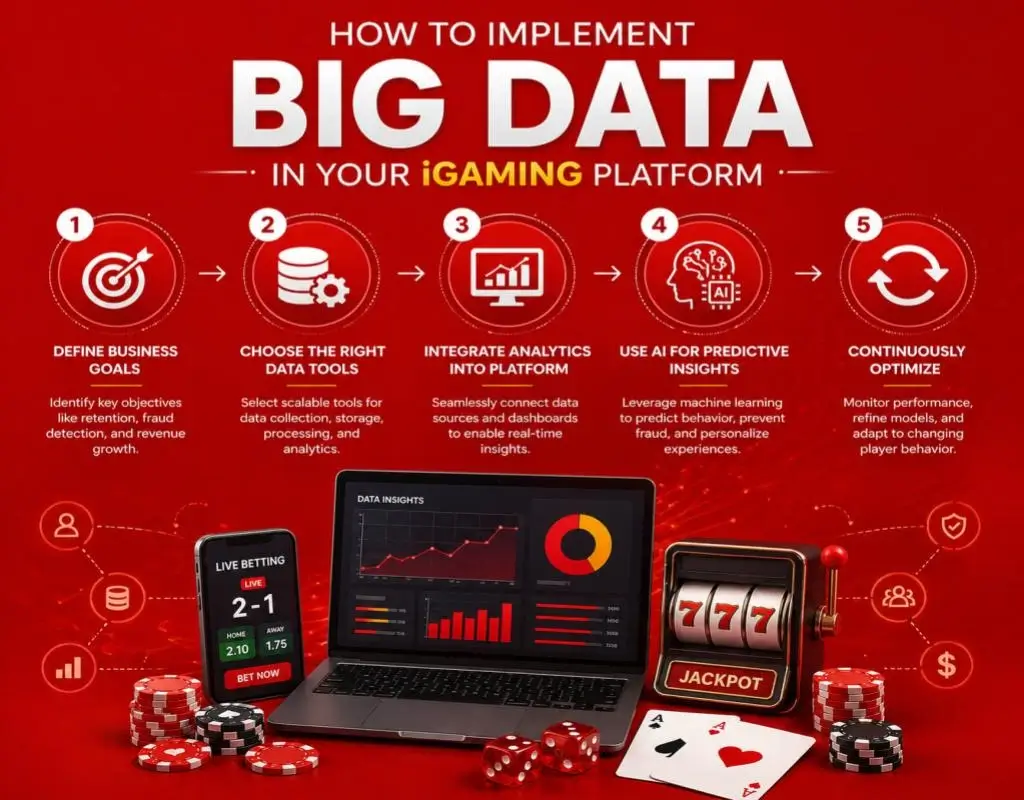
Implementing Big Data in iGaming
Despite the tremendous rewards, the path to being a data-driven operator is fraught with technical and regulatory challenges.
Data Privacy & Compliance: Being a multi-jurisdictional operator means wading through a minefield of rules and regulations, such as GDPR in Europe or KSA rules in the Netherlands. For this operation, the data must be anonymized and treated securely; in other words, one data breach can mean a huge penalty fee or lost license.
High Infrastructure Cost: Building a proper data pipeline is not cheap. To a small starting firm, the initial cost and build-up of cloud storage, real-time processing engines, security measures, and hardware that will carry with it no small sum of money is prohibitively big.
Data Integration Issues: Some of the legacy iGaming platforms are running on siloed systems where the sportsbook, casino, and payment gateway don’t communicate with each other. Combining these into one “Source of Truth” is a very sophisticated engineering trick.
Skilled Workers Needed: There’s an insufficient supply of skilled data scientists globally who understand and appreciate the nuances of gambling math, player psychology, and regulatory reporting.
Read More – How to Start a Sportsbook
How to Implement Big Data in Your iGaming Platform
Buying software isn’t what success looks like. That takes a strategic, systematic effort to roll it out.
- Define Business Objectives.
Start with the “Why.” Are you aiming to lower churn by 15%, spot bonus abusers, or optimize your live betting margins? Clear KPIs tell you what data to collect and store.
- Choose the Right Data Tools.
Go to the top stack that you grew with. Most contemporary operators will choose a Data Lake (such as Snowflake) for storage and a Stream Processor (like Apache Kafka) to update betting information in real-time. Keep your tools in compliance with the licensing regions.
- Add Analytics Content on your platform.
Connect your tools to your front-end. That’s where you build tracking pixels and APIs that record player activity on the fly. You are all to make sure data flows seamlessly from the user click to your analytics dashboard.
- AI for Predictive Insights
What’s this process about? After the data is flowing, machine learning models are deployed. Begin with some basic use cases e.g a recommendation engine to use in the casino lobby or an automated flag for suspicious betting volume in the sportsbook.
- Continuously Optimize
Big data is not a “set it and forget it” solution. And player behaviors shift, and novel fraud tactics spring up. Audit your models, regularly refresh your data sets, and narrow your marketing triggers to get a high ROI (return on investment).
How Piegaming helps to implement Big Data for your business
PieGaming empowers operators who want to create a new kind of experience via big data in iGaming with a full-service, data-informed solution.
As a B2B iGaming solution supplier, it has pre-deployed casino and sportsbook software packages that seamlessly integrate with leading back-office systems, including PAM and analytics functions.
Its platform aggregates and processes massive streams of player and transactional data that are dynamically captured as they happen, enabling operators to track user activity and to make decisions on optimal user flow, both for games and transaction processing.
Operators can incorporate reporting and analytics to improve retention strategies, customize gameplay, and even identify revenue opportunities.
Further, PieGaming cloud-based infrastructure provides for high concurrent user counts and real-time operations with latency-free operations, which make us well-suited for the use of big data for casino operators at scale.
From beginning to end, PieGaming is a blend of systems: technology, analytics, and integration, that enable businesses to convert raw data into actionable insights and profitability.
Conclusion
Big data in iGaming has evolved to act as the backbone of today’s platforms, allowing operators to take informed, quicker, and more player-centric decisions. From personalization and fraud detection to real-time analytics and revenue optimization, we can claim its influence. Though implementation does come with obstacles, the appropriate strategy and technology partner can unleash tremendous growth.
For operators still looking for a competitive advantage, the usage of big data by casino operators is no longer an option; it’s vital for a successful future in an increasingly data-driven market.

FAQs
-
How does Big Data improve player retention in the iGaming sector?
Big Data tracks player behavior, preferences, and engagement patterns to deliver personalized experiences, targeted bonuses, and timely re-engagement campaigns—reducing churn and increasing lifetime value.
-
How is Big Data used in Sportsbook Platforms?
It powers real-time odds calculation, analyzes betting patterns, detects suspicious activities, and enhances user experience through personalized betting suggestions and live insights.
-
Is Big Data expensive for small casino & betting operators?
It can be initially costly, but cloud-based solutions and scalable tools make Big Data more affordable. Many operators start small and expand as they grow, making it cost-efficient over time.
-
What tools are used for Big Data in iGaming?
Common tools include data collection APIs, cloud platforms (AWS, Google Cloud), analytics tools (AI/ML models), and real-time processing systems like Apache Kafka and Spark.

Jaya Swaroop has been covering iGaming and betting technology since 2019, with a specialization in online casino platforms, sportsbook solutions, and licensing frameworks. Her work involves analyzing platform capabilities and evaluating cost structures, compliance requirements, payment integrations, market strategies, and regulatory updates that impact operators entering or scaling in the iGaming space. With a background in B2B marketing and content strategy, she has contributed to SEO-led growth and demand generation initiatives for global businesses. Jaya holds a Bachelor’s degree in Science (Chemistry & Mathematics) and is certified in content writing, email marketing (HubSpot), project management, and Google Analytics.
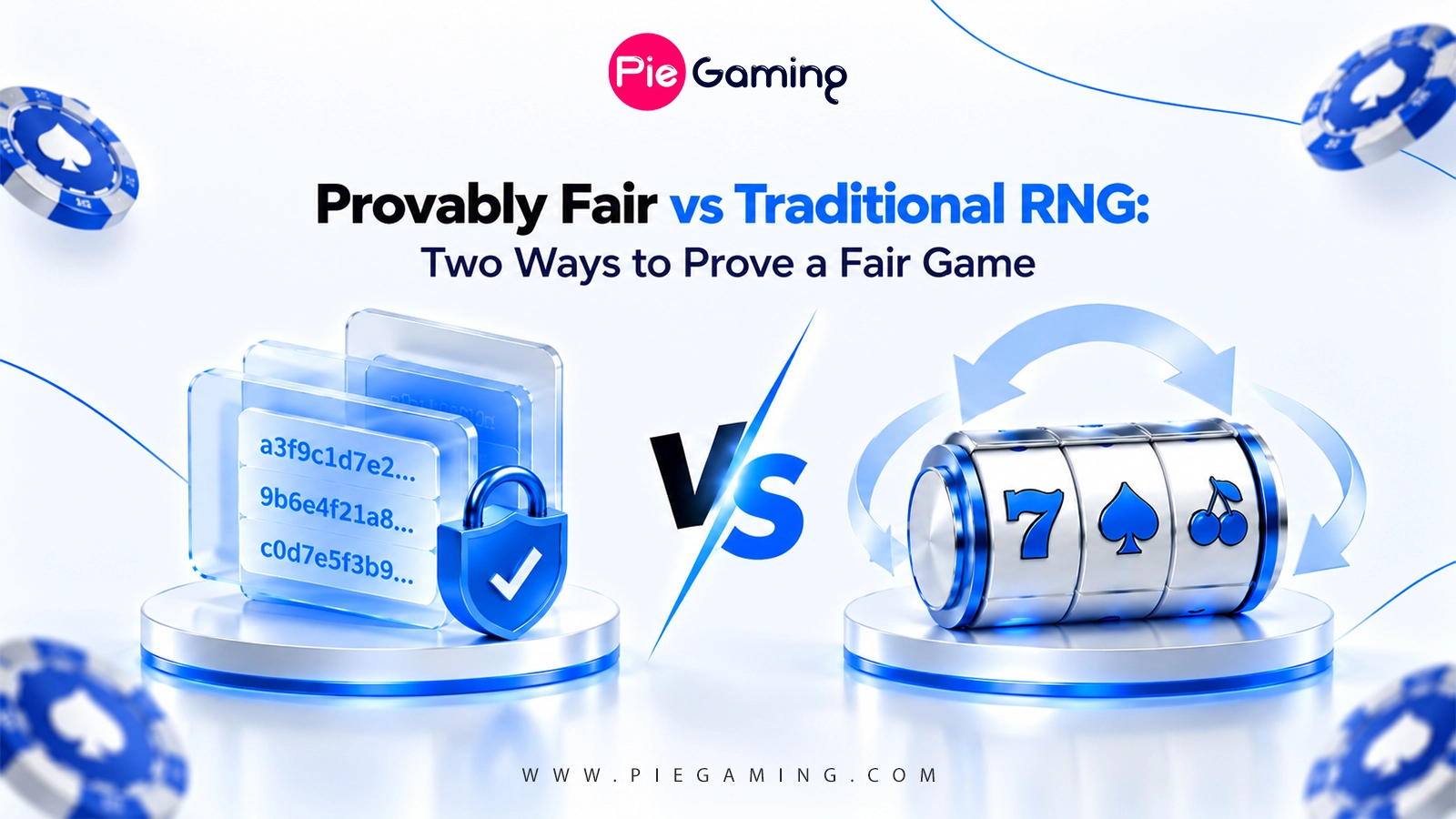
Certified RNG uses independent labs like GLI and eCOGRA to test game software before launching. Provably fair uses server seeds, client seeds, and a nonce, so players can verify individual round outcomes cryptographically after each bet.

The best lottery games to include on an online lottery platform are Lotto Games, Instant Win Games, Scratch Cards, Daily Numbers Games, Keno, Bingo, Raffle Games, Lottery Syndicates, and Progressive Jackpots. These games attract diverse player segments. They boost engagement and drive long-term revenue growth.

Top iGaming PAM providers in 2026 includes PieGaming,Pragmatic Solutions, EveryMatrix, SoftSwiss, Playtech, Digitain, BetConstruct, GammaStack, Tecpinion, Skilrock offering advanced player management, payments, CRM, fraud prevention, and scalable gaming infrastructure.
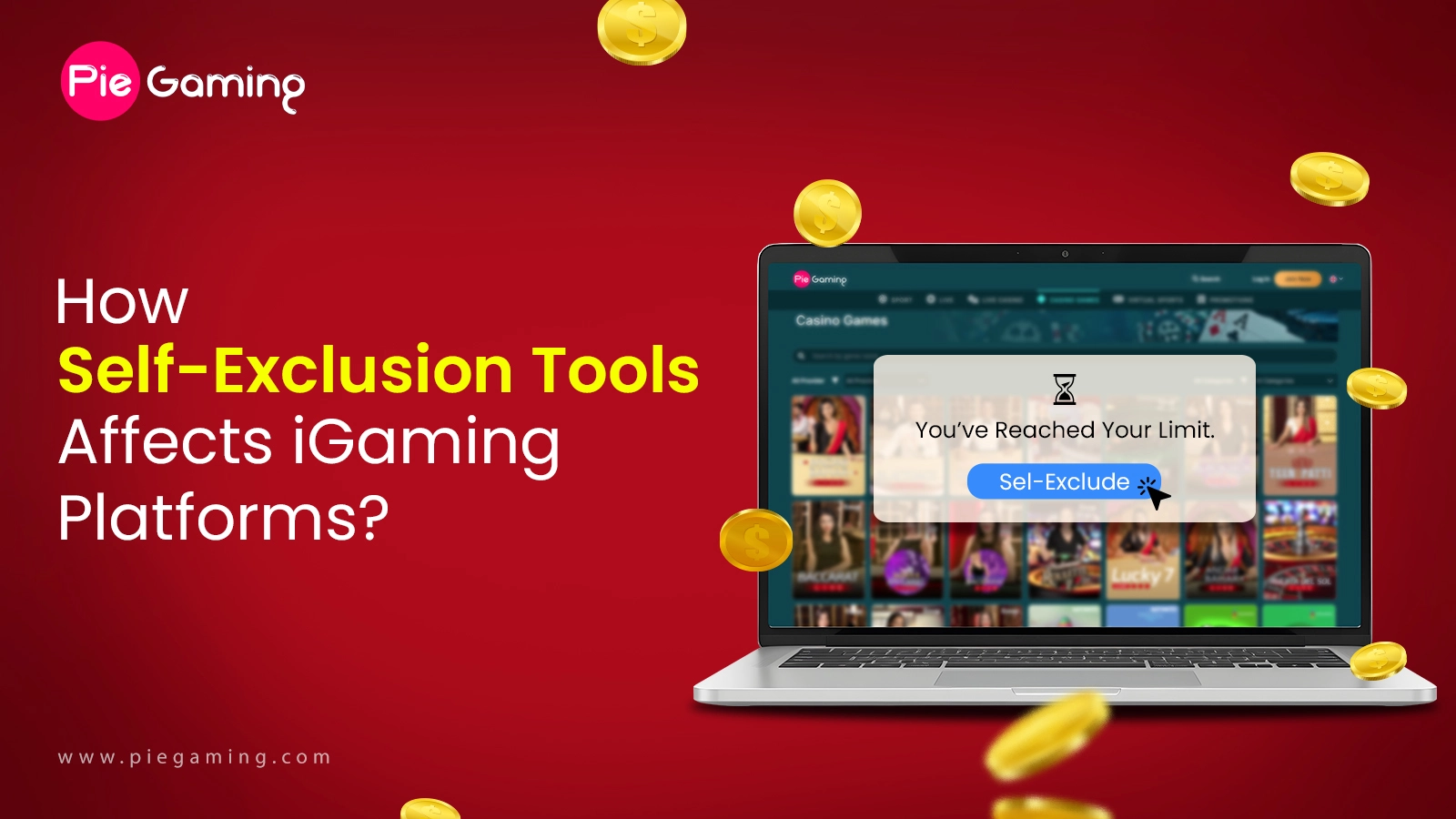
Self-exclusion tools are an important part of responsible gambling as they allow players to restrict their access to gaming platforms, allowing them to self-exclude or even just block out access. This article describes how these tools work and how they affect iGaming platforms in terms of compliance, player protection, and long-term platform credibility.
RTP, or Return to Player, is the percentage of total wagers a casino game is designed to give back to a player. For operators, RTP casinos directly influence the theoretical house edge, while for players, it gives a usual way to compare long-term mathematical returns of different casino games.
Explore how a casino back office system enhances profits through effective management, data analysis, and operational efficiency, driving success in the gaming industry.
An online casino bonus engine is a specialized software backend system. It is designed to automate the creation, management, distribution, and tracking of promotional rewards for iGaming platforms. Rather than manually providing free spins or match rewards, the casino bonus engine runs automated rules that deliver targeted player incentives in real time.

See you in your inbox soon!

Stay ahead of the game. Subscribe for exclusive content, updates, and insiders!