
A casino API integration is a software solution that connects your platform with games, payment gateways, wallets, KYC tools and other third-party solutions. It allows data to be exchanged between systems in real-time. This way you can launch quicker, automate tasks, and provide a smooth playable experience.
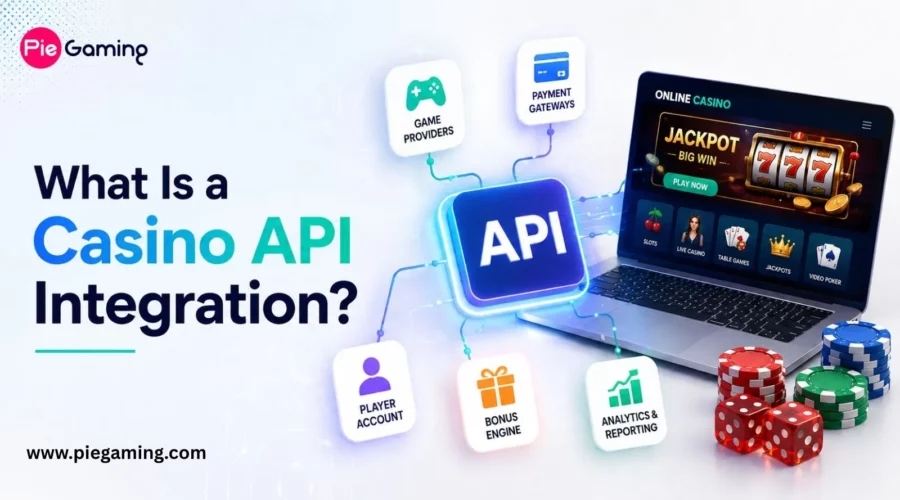
You’ve probably noticed how seamless online casino software works. Browse games, make deposits, and play; there are no glitches and no waiting around. But that smooth experience didn’t happen by accident.
It’s powered by something called casino API integration. An API is basically a bridge that lets different software systems communicate with each other. In the casino industry, it connects your game library, payment processors, and operator tools so that they all work together like a single, unified platform.
Without it? You’d have isolated systems that can’t share data or work together. With it? Your players get a fast, reliable, and frictionless experience.
Understanding Casino API Integration
Casino API integration is how you connect your platform to external iGaming software providers. Rather than building everything yourself, you use APIs to exchange data with third-party services in real time.
A casino API handles the heavy lifting across multiple areas:
- Connect game providers and pull their game libraries into your platform.
- Syncing player account info across different gaming systems.
- Processing deposits, withdrawals, and payment verification.
- Running bonus campaigns, promotions, and loyalty rewards.
- Tracking gameplay data, bets, wins, losses, and transactions.
- Supporting responsible gambling and compliance tools.
Here’s what actually happens. A player launches a slot game. Your platform sends an API request to the game provider. The provider authenticates the player, loads the game session, records bets, and sends gameplay data back. The whole thing takes seconds and happens without the player seeing any of it.
Most modern casinos don’t rely on just one API. A single player session might use a game API, a payment API, a KYC verification API, and a customer management API all at the same time. This setup gives you real advantages. You can add more games faster, roll out new features without rebuilding your platform, and keep everything running smoothly as you grow.
Why Casino API Integration Matters for Online Casino Operators
API integration allows you to launch and compete quickly. To create none of the features and concentrate on those that grow your business, you rely on specialized third-party services. Here’s why it matters:
1. Faster launches
You plug in ready-made games, payment gateways, and player account management systems instead of spending months building them. You live faster.
2. More game options
APIs let you add slots, live dealer casino games, table games, and instant wins from different providers all through one platform.
3. Easier expansion
Adding new payment methods, currencies, languages, or regional content doesn’t require rebuilding your platform. You just integrate what you need.
4. Less operational overhead
Real-time communication between games, payments, CRM, and back-office. Manual tasks and paperwork are reduced.
5. Room to scale
When demand for the game increases, you add more games and services without having to destroy your infrastructure and rebuild.
Consider it like this. You want to add a new live dealer provider. That content integrates in days, not months, with a strong API integration. You remain competitive, you’re able to keep up with market changes faster, and you continue to enhance the player’s experience without burning a hole in your development budget.
How Casino API Integration Works
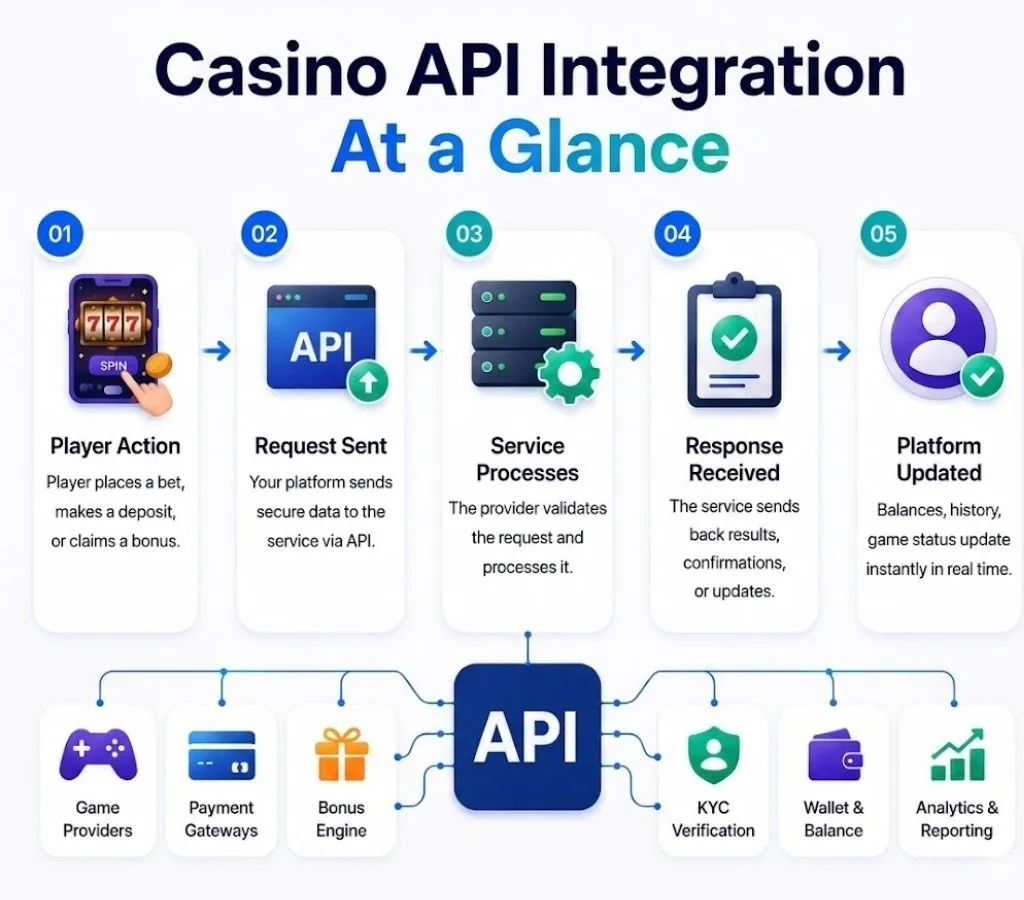
Casino API integration workflow
By integrating a casino API with your platform, you can enable real-time communication between your services and your platform. Think of it as a back-and-forth conversation between your casino, game providers, payment processors, KYC systems, and player management tools. The actual process is as follows:
1. Player takes an action
They launch a slot game, place a bet, deposit funds, or claim a bonus.
2. Your platform sends a request
It transmits the player and transaction data to the connected service through a secure API endpoint.
3. The external service processes it
The game provider, payment processor, or verification system validates the request and does what is needed.
4. You get a response back
The provider sends game results, payment confirmations, balance updates, or verification status.
5. Your platform updates instantly
Player accounts, transaction history, wallet balances, and gaming sessions all sync up right away.
The majority of operators manage everything through middle ware and API gateways. The gateway forwards requests to the appropriate service, authenticates the users, observes the traffic flows and maintains uniformity of the data formats. It’s cleaner and more efficient than wiring everything together individually.
This translates to live data flowing between gameplay, payment, and player information. Everything stays synchronized. No timeouts, no substitutions, no misunderstandings. Both you and your players have a seamless experience.
Read Blog – Complete Guide to Turnkey Online Casino Software
Types of Casino API Ecosystem
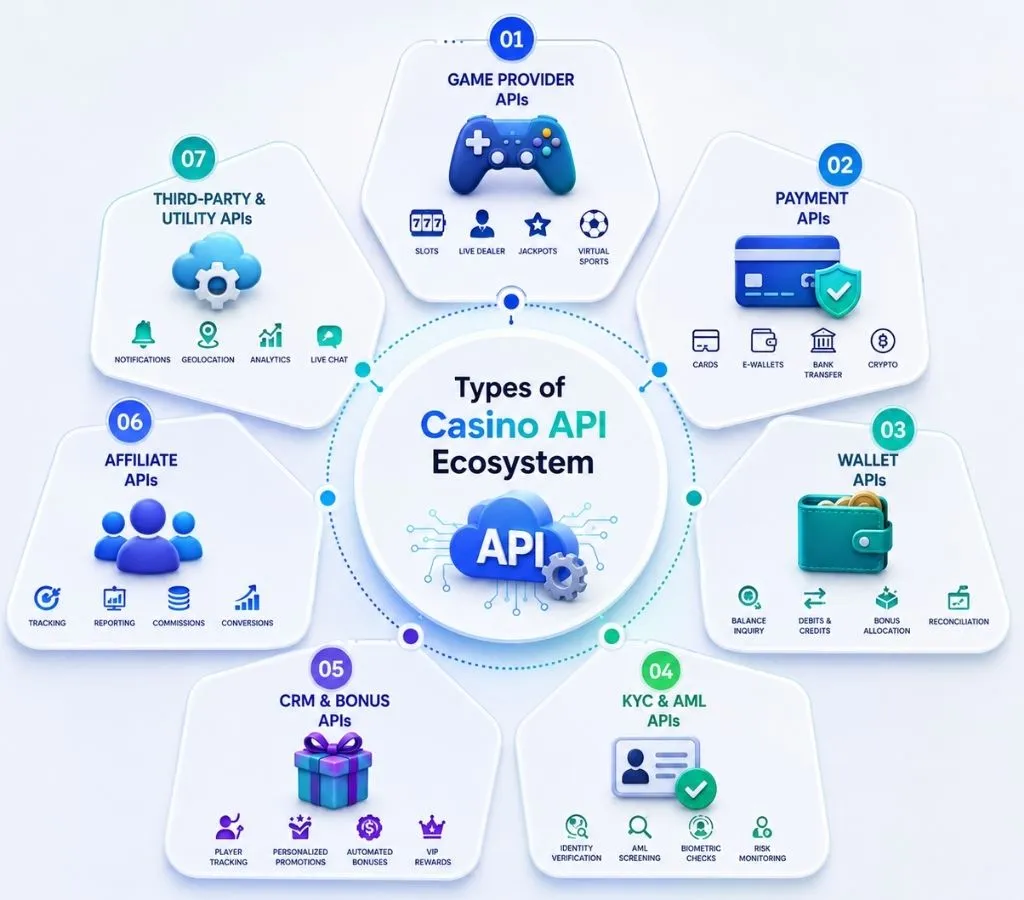
Different types of casino APIs
Everything from your casino launch speed to the complexity of your operations is determined by the API ecosystem you create around your casino. Let’s take a quick look at some of the most critical types of APIs you can use.
Game Provider APIs
The actual connections to the games are made by Game Provider APIs. They connect your platform with content providers and deliver slots, live dealer tables, jackpots, virtual sports and more in one integration point.
These APIs take care of game launches, player authentication, wagers, and real-time outcome reporting. The API will exchange session information between your platform and the game server and will record all bets and payouts when a player launches a slot game.
Most operators integrate multiple providers, so they can offer a diverse game library without managing separate game infrastructures.
Payment APIs
Payment APIs allow you to accept deposits and withdrawals securely from all methods of payment. You don’t connect directly to each payment processor; you connect via APIs with credit card, bank transfer, e-wallets, prepaid vouchers, and crypto gateways.
These APIs are used for transaction authorisation, payment status, currency conversion, and fraud checking. A good payment API is one that lets players quickly deposit money and helps you minimize payment failures and abandoned transactions.
CRM and Bonus APIs are designed to help you engage and retain players on a scale. They monitor activity, deposits, game selections, and betting habits allowing them to automate personalized promotions.
Wallet APIs
Wallet APIs create one unified balance system across all your games and providers. Without one, players end up with separate balances for different game vendors. That’s friction. A wallet API eliminates it by keeping a single account balance no matter where the player bets.
These APIs process balance inquiries, debits and credits, bonus fund allocation, and transaction reconciliation instantly. They’re essential when you’re running hundreds or thousands of games from multiple providers.
KYC & AML APIs
Know Your Customer (KYC) and Anti-Money Laundering (AML) APIs automate player verification and compliance. During registration, these APIs validate identity documents, verify addresses, run biometric checks, and screen players against sanctions or PEP databases.
AML APIs also monitor transactions in real time, flagging suspicious patterns like rapid deposits and withdrawals or unusual betting behavior. Automated verification speeds up onboarding while keeping you compliant with licensing requirements.
CRM & Bonus APIs
CRM and Bonus APIs let you automate player engagement and retention at scale. They track activity, deposits, game preferences, and betting patterns so you can trigger personalized promotions automatically. A player makes their first deposit? The API awards free spins.
Haven’t seen an inactive player in weeks? The API activates a cashback campaign. Hit a certain wagering volume? VIP rewards trigger automatically. Connect this data with your marketing tools, and you deliver targeted offers that actually improve retention and player lifetime value.
Affiliate APIs
Affiliate APIs provide live tracking and reporting capabilities for marketing partners. They capture sign-ups, deposits, betting actions, and revenue allocation for the particular affiliate marketing campaign.
API dashboards allow affiliates to view real-time performance data, commission calculations, and other conversion metrics without having to wait for manual reports. There are two common options when it comes to casino content integration: direct API integration or casino game aggregator API.
Read Blog – Explore what is PAM Software in iGaming
Direct API Integration vs Casino Aggregator API
There are two common options when it comes to casino content integration: direct API integration or casino aggregator API.
They both offer games and gaming services, but they’re quite different with regards to control, implementation, cost, and scalability. It is important to choose a suitable one according to the requirements of your platform and resources.
What Is Direct API Integration?
Direct API integration means connecting your platform individually to each game provider. You sign separate commercial agreements, handle individual technical integrations, and manage provider-specific requirements yourself.
The upside? You get control. You access exclusive provider features, customize game experiences, negotiate direct revenue-sharing deals, and build unique promotional campaigns. But every new provider means more development, testing, certification, and ongoing maintenance. It adds up fast.
What Is a Casino Aggregator API?
A casino aggregator API sits between you and multiple game providers. Instead of integrating each provider separately, you connect to one API and unlock access to a large network of games.
This cuts your development complexity significantly and speeds up your launch. New games and providers often activate through the aggregator’s backend without any coding on your end. That’s why startups and operators chasing a faster route to market usually go on this route.
Direct API Integration: Pros and Challenges
Advantages
- Direct relationships with game providers.
- Greater control over game settings and promotional tools.
- Access to exclusive provider features and content.
- Potentially better margins and commercial terms.
Challenges
- Multiple integrations to develop and manage.
- Longer implementation timelines.
- Higher technical and operational workload.
- Ongoing maintenance for every provider connection.
Casino Aggregator API: Pros and Challenges
Advantages
- Single API integration.
- Instant access to multiple game providers.
- Faster time to market.
- Reduced development and maintenance work.
- Easier to expand your content.
Challenges
- Less customization flexibility.
- Dependence on the aggregator’s infrastructure.
- Additional fees or revenue sharing costs.
- Limited access to provider-exclusive features.
Key Comparison Factors
| Factor | Direct API Integration | Casino Aggregator API |
| Time to Market | Slower due to multiple integrations | Faster through a single connection |
| Development Effort | High | Low to Moderate |
| Initial Costs | Higher | Lower |
| Scalability | More complex as you add providers | Easy to scale with new providers |
| Maintenance | Multiple systems to manage | Centralized through one provider |
| Provider Management | Individual contracts and support teams | Single point of contact |
| Revenue Potential | Higher margin opportunities | Convenience may come with additional fees |
Which Model Is Right for You?
If you’re a startup, new casino brand, or operator chasing a fast launch, a casino aggregator API usually makes the most sense. It simplifies everything, cuts costs, and gets you to market faster.
Direct API integration works better for established operators with dedicated technical teams. It requires more resources, but you get greater control, customization options, and stronger long-term commercial flexibility.
Read Blog – Top Online Casino Software Providers
Key Benefits of Casino API Integration
Casino API integration does more than just connect to software systems. It directly affects how fast you can launch, scale, and make money from your platform.
Faster Time-to-Market
Ready-made APIs mean you don’t build core casino features from scratch. You quickly connect game providers, iGaming payment solutions, and compliance tools instead. Development timelines drop from months to weeks. New brands enter the market faster and start generating revenue sooner.
Scalability
As your casino grows, APIs make expansion simple without tearing apart your existing infrastructure. Add new game providers, payment methods, or regional services through additional API connections. No need to rebuild your backend. You grow while keeping technical complexity manageable.
Enhanced Player Experience
Casino APIs create a smoother experience. Games launch faster; balances update in real time; deposits and withdrawals happen instantly. Players move between games from different providers using one account and a wallet. That consistency keeps them engaged.
Operational Efficiency
APIs automate the routine of work. Payment processing, player verification, bonus distribution, reporting—they all run without manual intervention. Your team does less busy work; errors drop, and you control everything from a single platform instead of juggling multiple systems.
Revenue Growth
Larger game libraries, personalized promotions, multiple payment options—API integrations let you offer all of it. Players engage more, stick around longer, and you get opportunities to cross-sell. Live casino games, sports betting, and VIP programs. More products, more revenue streams.
Read Blog – Explore white label casino software features
How Much Does Casino API Integration Cost?
Casino API integration costs vary widely. It depends on your operation scale, how many providers you connect, regulatory requirements, and platform complexity.
A startup can launch on a modest budget, but mid-sized and enterprise operators often spend hundreds of thousands on integrations, compliance, infrastructure, and maintenance. The table below breaks down what you should expect to spend in 2026.
| Cost Component | Low-End / Startup | Mid-Tier Operator | High-Traffic / Premium |
| One-time Setup Fee | $5,000 (or $250–$300 for budget APIs) | $15,000 | $40,000–$100,000+ |
| Monthly Minimum Fee | None | $3,000 | $10,000–$20,000 |
| Revenue Share (GGR) | 5% | 10% | 15% |
| Integration Fee | $1,000–$8,000 | $8,000–$20,000 | $20,000–$50,000 |
| Payment Gateway Integration | $5,000 | $10,000 | $20,000+ |
| Live Casino API | ~$1,200 | ~$2,400 | ~$3,600+ |
| KYC/AML Integration | $5,000 | $10,000 | $20,000+ + monthly fees |
| Game Certification (per provider) | $2,000–$5,000 | $5,000–$10,000 | $10,000–$15,000 |
| RNG Certification (Annual) | $15,000 | $25,000 | $35,000+ |
| Monthly Maintenance & Updates | $2,000–$5,000 | $5,000–$12,000 | $8,000–$20,000 |
| Infrastructure (Hosting/CDN) | $1,000–$3,000/month | $3,000–$8,000/month | $8,000–$25,000/month |
| Live Dealer Streaming | Variable | $3,000–$8,000/month | $10,000–$30,000/month |
| Crypto Support Add-on | +$3,000 setup | +$8,000 setup | +$15,000+ setup |
| Sportsbook API Setup | $10,000 | $25,000 | $40,000–$120,000 |
| Affiliate Commissions | 25% of net revenue | 30% of net revenue | 35–40% of net revenue |
| Transaction Fees | 1–2% per transaction | 2–3% per transaction | 3–5% per transaction |
| Total First-Year Cost | $35,000–$80,000 | $150,000–$350,000+ | $400,000–$1,000,000+ |
Disclaimer: These cost estimates are based on industry data and may vary significantly depending on your platform needs, providers, jurisdiction, and vendor agreements. Always consult directly with providers for pricing tailored to your requirements.
Your biggest expenses are game integrations, licensing and compliance, payment infrastructure, and ongoing maintenance. Use a casino aggregator API and you cut initial development costs. Go with direct integration and you spend more upfront but get better control and potentially stronger long-term margins.
Technical Requirements for Successful Casino API Integration
Successful casino API integration needs a stable, secure, and scalable technical foundation. Your platform processes thousands of game transactions, balance updates, and payment requests in real time. Your infrastructure has to handle that volume without breaking a sweat.
Core technologies you’ll rely on include:
- REST APIs for game launches, player account management, payment processing, and reporting
- WebSockets for real-time interactions like live dealer games, bet confirmations, jackpot updates, and instant balance syncing
- API Gateways to manage traffic routing, rate limiting, request validation, and communication across multiple providers
- OAuth 2.0 and JWT Authentication to securely verify users, applications, and API requests while protecting player data
- Encrypted API Keys to control access between your platform and third-party providers
Beyond just connecting everything, you need consistent data across all your integrated systems.
Key operational requirements:
- Webhooks for real-time notifications about deposits, withdrawals, bonus activations, and game results
- Data Mapping to sync player IDs, wallet balances, currencies, bonus funds, and transaction records between providers
- Unified Wallet Logic to keep balance updates accurate across all game vendors
Skip proper monitoring and infrastructure management, and you’re asking for trouble. Even minor API disruptions tank gameplay, break payments, and cost you players.
Read Blog – Mistakes to Avoid When Starting an Online
Common Casino API Integration Challenges
Casino APIs speed up development, but they come up with technical and operational challenges. Miss them and you risk performance problems, compliance issues, and a worse player experience.
Integration Complexity
Modern casinos connect to multiple game providers, payment processors, and compliance services. The problem is that each provider uses different API structures, authentication methods, and reporting formats. That means integrating and maintaining all these connections takes serious resources. Add more content and services, and complexity explodes.
Wallet Synchronization Issues
Keeping player balances accurate across multiple game providers is tough. Slow API responses, failed transactions, or communication errors to create balance mismatches between your platform and game servers. Without proper reconciliation, players lose trust, and your financial reporting gets messy.
Performance Bottlenecks
Your APIs handle thousands of real-time requests—game launches, wagers, payouts, and balance updates. High latency, overloaded servers, or poorly optimized integrations slow down gameplay, disrupt live casino sessions, and delay transactions. Players notice immediately.
Security Risks
Every API connection is a potential attack surface. Weak authentication, exposed API keys, or unsecured endpoints lead to unauthorized access, compromised accounts, and data breaches.
Compliance Challenges
You need to keep API integrations compliant with local regulations, KYC/AML requirements, and responsible gambling policies. Managing this across multiple iGaming jurisdictions gets complicated fast.
How to Choose the Right Casino API Provider
Picking the right casino API provider is a long-term business decision. It affects your platform’s stability, content options, compliance, and ability to scale. Look beyond just pricing and evaluate the technical and operational factors that matter.
Reliability
Your provider’s infrastructure needs to handle high transaction volumes, game sessions, and payment requests without breaking. Check out their uptime guarantees, system stability track record, redundancy measures, and outage history during peak hours. You need a partner who delivers when it matters most.
Game Portfolio
The API is only as good as the games it delivers. Evaluate how many game providers they’ve integrated, the variety of slots, live dealer games, jackpots, and virtual sports. How often do they add new releases? A broader portfolio helps you attract and keep different player types.
Documentation Quality
Good API documentation cuts integration time significantly. Clear endpoints, testing environments, implementation guides, and responsive developer support speed up your launch and make maintenance easier.
Compliance Support
Your provider should support regulations across your target markets. That includes licensing compatibility, audit reporting, KYC/AML integrations, responsible gambling tools, and certification support for regulated jurisdictions. Don’t skip this.
Scalability and Technical Support
As you grow, the API needs to handle more providers, markets, and transaction volumes without major infrastructure overhauls. Dedicated account managers, fast response times, and 24/7 support matter. When issues hit, you need answers fast before players notice.
| The Easier Alternative to Multiple API Integrations
Why juggle multiple API integrations when everything can work through a single platform? PieGaming gives you instant access to games, payments, wallets, KYC, CRM, and affiliate management in one unified ecosystem. Reduce development complexity, lower operational costs, and launch your online casino faster with infrastructure built to scale as your business grows. |
Wrapping Up…
Casino API integration isn’t just a technical setup. It’s your competitive advantage. It lets you launch faster, scale cheaper, and offer better player experiences without building everything from scratch. Whether you choose direct integration or an aggregator, the right API partner accelerates your growth and keeps your platform running smoothly. The investment pays dividends in speed, stability, and revenue.

FAQ's
-
Why does your casino need API integration?
API integration connects you to thousands of games instantly. You get a seamless user experience, faster game updates, and access to multiple providers without building custom code for each one.
-
How does casino API integration actually work?
Your platform sends requests to the provider server through the API. You get game data (slots, outcomes, balances) back in real time via JSON or XML. No need to negotiate separate contracts with each provider.
-
Which games can you add through an API?
Slots, live dealer games, poker, bingo, progressive jackpots, sports betting. Aggregators like Slotegrator give you access to 30,000+ titles from 270+ providers through a single integration.
-
How long does integration take?
Basic setup takes 3 to 7 days for small operators. Complex integrations with custom wallet logic or multiple providers can take 2 to 4 weeks.
-
Can you connect multiple game providers with one API?
Yes. Game aggregators give you single API access to 30,000+ games from 270+ providers. You skip the hassle of separate contracts with each one.
-
Is casino API integration actually secure?
Yes. Modern APIs use encrypted HTTPS connections, authentication tokens, and PCI-compliant payment processing. Providers add fraud detection and KYC verification on top.
-
What should you budget for integration costs?
Setup runs from $5,000 to $40,000. Monthly minimums range from $0 to $10,000. Revenue share is 5 to 15% of GGR. Total first-year cost: $35,000 to $400,000+ depending on your size.


Palak Madan has been writing about the iGaming industry since 2024. She focuses on helping operators and founders understand their options when launching an online casino, from choosing the right software provider to figuring out costs and compliance requirements across different markets. At PieGaming, she covers topics like white label casino solutions, platform selection, and market entry, turning complex industry information into practical guidance for people building iGaming businesses. She also keeps a close eye on licensing and regulatory changes; particularly how new rules shape the way operators enter and grow in different jurisdictions.

The best online casino slot providers in 2026 are Pragmatic Play, Evolution Group Studios, Play’n GO, Hacksaw Gaming, Relax Gaming, Games Global, Playtech, Push Gaming, Yggdrasil and Blueprint Gaming. Operators should compare them on six criteria: licensing and certification, RTP range, volatility, market fit, integration and commercial terms.
Casino gamification refers to the inclusion of goals, levels, rewards, and other video game elements around the core gambling area. Learn how operators can use gamification in igaming to create more engaging player journeys while managing costs.
Stake.Us, PlayFame, McLuck, MegaBonanza and Zonko are social casino platforms that are free-to-play casino games using virtual coins. These platforms offer hundreds of slots, tables, and instant-win games with daily free coins, tournaments, and bonus features.
Casino CRM strategies help operators to personalize campaigns, improve player retention, reduce churn rate, and maximize player lifetime value.
House Edge is the mathematical advantage built into online casino games and all other forms of gambling. It shapes the odds, influences your winnings and losses, and constitutes the cornerstone of any online casino or sportsbook operator’s overall financial strategy.
The Hi-Lo casino game is a simple card game where players predict whether the next card will be higher, lower, or equal to the current card. This guide explains how Hi-Lo works, its rules, betting options, payouts, gameplay, and strategies players can use when making predictions.
Casino CRM software is a specialized platform for online and land-based gambling operators that tracks player behavior, automates targeted promotions, manages VIP loyalty and supports regulatory compliance.






See you in your inbox soon!

Stay ahead of the game. Subscribe for exclusive content, updates, and insiders!