
House Edge is the mathematical advantage built into online casino games and all other forms of gambling. It shapes the odds, influences your winnings and losses, and constitutes the cornerstone of any online casino or sportsbook operator’s overall financial strategy.
Every casino game is designed to entertain players and generate revenue for operators. The underlying mechanism that makes this possible is called the House Edge. It is the numerical advantage that a casino, sportsbook, or betting platform has over players over time.
Players can win big short-term, but the House Edge ensures operators remain profitable over millions of wagers. At its core, the House Edge drives slots, roulette, sports wagering, live casino games, etc. Learning what the house edge is about allows players to make informed decisions and operators to create long-term competitive iGaming businesses.
Understanding House Edge in iGaming
The House Edge in an online casino or sportsbook represents the statistical advantage it uses to beat its players. It is the portion of each wager that an operator is looking to keep over time.
For instance, if a game has a 4 percent House Edge, the casino anticipates retaining ₹4 for each ₹100 wagered, over thousands or millions of bets.
| House Edge (%) = [(Total Amount Wagered − Expected Return to Players) ÷ Total Amount Wagered] × 100 |
The House Edge matters to casino owners because it has a direct effect on game profit, the value of the player, and the sustainability of the platform. For operators, it establishes a predictable revenue stream. For players, it gives them a clear overview of long-term expected outcomes. A lower House Edge is more likely to provide better odds, while a higher House Edge ultimately increases an operator’s profit over time.
House Edge vs RTP: Key Differences Explained
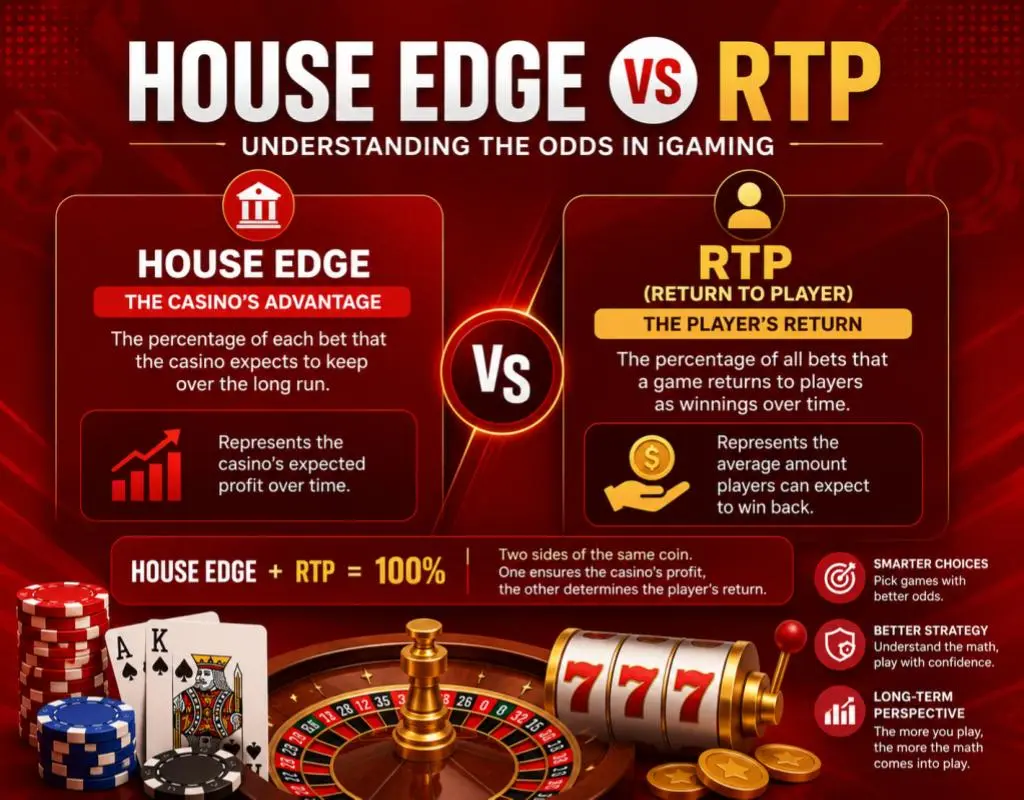
House Edge vs RTP comparison in online casino games
House Edge and RTP (Return to Player) are two sides of the same mathematical equation. While players use RTP to get an idea of potential earnings, operators use House Edge to anticipate the long-term profitability of a game.
RTP (Return to Player): What is it?
RTP is the proportion of the total wagers expected to return to players over time. It is expressed as a percentage and calculated across millions of game rounds. A 96% RTP, for example, indicates a slot game is supposed to pay ₹96 out of every ₹100 wagered over time. But that does not imply that every player will get ₹96 back. Some may lose their whole stake while others may win much more. RTP is a measure of long-term statistical average, not a certainty.
Interrelationship of RTP and House Edge
RTP and House Edge always add up to 100%. There is a simple formula for the relationship:
House Edge = 100% − RTP
For example:
- RTP: 96%
- House Edge: 4%
This means that over time, players will collectively receive back 96% of all wagers, while the operator retains 4% as gross gaming revenue (GGR). The higher the RTP, the lower the House Edge, and vice versa.
Balancing RTP and House Edge in a Casino Game
Finding the right balance between RTP and House Edge is a fundamental challenge for iGaming operators. A very high House Edge may improve short-term revenue but can negatively impact player retention. On the other hand, a higher RTP can often yield better player satisfaction as well as better session duration and lifetime value. This is why online casinos today offer games with varying RTP levels across slots, table games, and live casino products. The idea is to achieve a decent player experience for sustainable profitability. For successful operators, RTP and House Edge are not mutually exclusive, but rather complementary tools in reaching long-term growth.
Quick Comparison: RTP vs House Edge
| Metric | RTP | House Edge |
| Perspective | Player | Operator |
| Meaning | Expected return to players | Expected profit for operator |
| Higher Value Benefits | Players | Operators |
| Example | 96% | 4% |
| Formula | 100% − House Edge | 100% − RTP |
How House Edge Impacts Casino Winnings
House Edge influences each and every wager placed in an online casino. But its impact is often misunderstood. While House Edge helps the operator in long-term advantage, the effect doesn’t alter the performance of every single gaming session.
Short-Term vs Long-Term Outcomes
In the short term, anything can happen. A gambler can win a jackpot, win multiple bets in a row, or cash in on significant profits. These results are influenced by chance and randomness. The more wagers you place, the more the results tend to approximate the game’s theoretical probabilities. This is why casinos confidently offer games with enormous payouts and can remain profitable over millions of bets.
Bankroll Management
By understanding House Edge, players can manage their bankroll more effectively. Games with a lower House Edge usually offer more value and can help the player extend a game’s duration.
In fact, because no game can eliminate risk, when you select games with favorable odds, it tends to reduce expected losses over time.
For operators, House Edge helps predict revenue and manage risk, providing them with a balanced picture. This picture is not only of the financial situation but also ensures they are equipped with a balanced portfolio.
Strategic Decision-Making
House Edge is an essential factor in casino games and betting strategy selections. Players who compare RTPs, know game systems and mechanics, and refrain from chasing losses usually feel more able to make sensible decisions.
House Edge data is also utilized by operators to optimize the game’s offerings, make decisions on promotions, and establish a balance between profits and player engagement. In addition, when coupled with responsible gaming practices, operators make better-informed decisions.
Read Blog – Explore what does EV mean in Betting?
House Edge in Different Casino Games
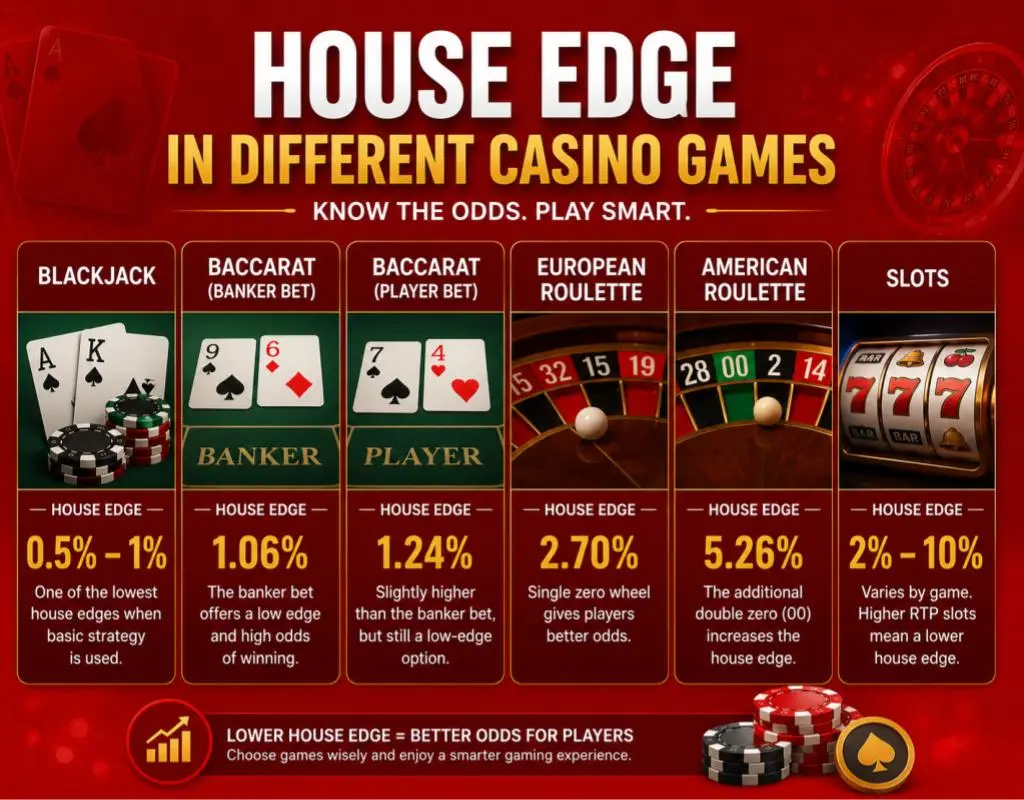
Comparison of House Edge in online casino games
House Edge differs greatly across casino games. Knowing these differences leads players to play games with higher probabilities and operators to create a balanced portfolio of games. Although lower House Edge games generally provide more benefit to players. Volatility, gameplay, and entertainment also contribute to their popularity on a day-to-day basis.
Blackjack House Edge
Blackjack’s House Edge is believed to be one of the best games to play at almost all levels of expertise. The House Edge can be between 0.5%- 1% with basic strategy applied. For every $100 wagered over time, the casino expects to retain less than $1. However, if players make bad decisions or play the wrong version, then this House Edge can rise enormously.
Baccarat House Edge
Baccarat is a lower-edge casino game, especially its Banker Bet, on which you can bet with a House Edge in the vicinity of 1.06%. The Player Bet is next at approximately 1.24%. In addition, Tie Bet tends to have a House Edge ratio of over 14%, which means it’s one of the worst betting games to be selected in the field.
Roulette House Edge
In the roulette game, the House Edge depends on the wheel variant being played.
European Roulette: 2.70% House Edge
American Roulette: 5.26% House Edge
The additional double-zero (00) pocket on the American wheel gives that difference a factor. This additional pocket in American roulette almost doubles the casino’s advantage. European Roulette offers a better chance for players who want to draw better odds.
Slots House Edge
A House Edge for slot machines can vary between 2% and 10%, as per the game’s RTP and design. So, a slot with 96% RTP gets a 4% House Edge.
Unlike table games, slots have a very broad range of volatility. A high-RTP slot can still lead to long losing streaks before offering significant wins. The combination of House Edge and volatility means slots are one of the most variegated game types in iGaming.
Read Blog – Best Baccarat Casino Game Software
House Edge Comparison Across Popular Casino Games
| Casino Game | Typical House Edge |
| Blackjack | 0.5% – 1% |
| Baccarat (Banker Bet) | 1.06% |
| Baccarat (Player Bet) | 1.24% |
| European Roulette | 2.70% |
| American Roulette | 5.26% |
| Online Slots | 2% – 10% |
Why House Edge Matters for iGaming Operators
House Edge is a metric that affects an operator’s revenue strategy, game offering, and player experience. When done right, it supports the development of a sustainable and competitive iGaming business.
-
Profitability & Revenue Optimization
House Edge provides predictable long-term revenue. By knowing the expected return for different games, operators can forecast earnings, manage risk, and keep their margins healthy.
-
Building a Balanced Game Portfolio
Successful casinos have both low and high House Edge games. These low-edge games, such as blackjack and baccarat, win over value-conscious players. Slots and specialty games also add to overall revenue diversification.
-
Improving Player Retention
Usually, a smaller House Edge contributes to longer playtime and a better playing experience. By strategically applying RTP and House Edge, operators can maximize user engagement and repeat visits, as well as player lifetime value, without compromising profitability.
How Can Players Use House Edge to Make Smarter Gaming Decisions
While players cannot eliminate the House Edge, they can still use it to make better and more informed decisions during gameplay. Smarter decisions and strategy will also improve their overall gaming experience.
-
Choosing Low House Edge Games:
Blackjack, baccarat, and European roulette are considered to have better odds than most slot machines or specialty games. Use games that have a lower House Edge; this can lower the expected loss over time.
-
Comparing Online Casino Brands:
Not all online casinos have the same game variants or RTP settings, with the same selection of game formats. Players benefit from comparing game libraries, RTP percentages, and bonus terms to find platforms that offer better long-term value.
-
Better Bankroll Management Practices:
A solid bankroll management strategy is integral to responsible gaming. You have to set financial limits in terms of spending (don’t get caught up in emotional betting). If your budget is limited, game selection will limit the time spent on the ball. House Edge may affect long-term results, but good bankroll management generally has a greater impact on how you perform as a player overall.
Read Blog – Explore what is PAM software in iGaming
Can Players Beat the House Edge?
No. The House Edge in iGaming allows operators to gain a mathematical advantage over the long run. But that doesn’t mean players can’t win an individual session or profitable stints.
Online casino games are designed for entertainment, not guaranteed profits. Understanding House Edge helps players set realistic expectations and make informed decisions. While there can be short-term wins, outcomes on a regular basis are usually driven by probability rather than luck alone.
Skill and Luck in iGaming
The role of skill varies depending on what game you play. In games like blackjack and poker, strategy can shift results and diminish the casino’s advantage. Meanwhile, slots and roulette rely almost entirely on chance. Even in skill-based games, players cannot fully eliminate the House Edge, but they can still make strategy-based decisions to increase their chances.
The Long-Term Effect of House Edge
House Edge is small on a single wager. But it multiplies over thousands of bets, making a big difference. This is also what makes House Edge one of iGaming’s most important concepts even now.
Casinos process millions of wagers every day on slots, table games, and sportsbooks. Even a tiny House Edge can generate consistent revenue when applied to large betting volumes. This kind of predictable advantage helps operators to cover expenses, fund jackpots, provide bonuses, and stay profitable.
The more players bet, the greater the chance that their results will align with a given game’s mathematical expectations. For instance, a 4% House Edge game would, in principle, retain $4 for every $100 wagered over the long run. Individual performance can differ greatly, but play over time can increase exposure to the House Edge, resulting in small expected losses accumulating over time.
Choosing the Right Games: House Edge Playbook
Whether you’re running an iGaming platform or playing casino games online, understanding House Edge can lead to better decisions and more sustainable outcomes.
Best Practices for Operators
Operators should aim for a balanced game portfolio that combines player-friendly games with strong revenue generators. Offering a mix of low-House Edge table games, engaging slot titles, and live casino experiences helps attract diverse player segments while maintaining profitability.
Regularly reviewing RTP settings, player behavior, and game performance can also improve retention and lifetime value. Modern iGaming solution providers, such as PieGaming, help operators build optimized casino ecosystems through curated game portfolios, advanced analytics, and player engagement tools.
Smart Game Selection for Players
Players should compare RTP percentages, understand game rules, and choose games that align with their risk tolerance. Blackjack, baccarat, and European roulette typically offer better long-term odds than many high-edge casino games.
Most importantly, players should view gambling as entertainment rather than a source of guaranteed income. Combining game knowledge with responsible bankroll management can lead to a more enjoyable gaming experience.
Read Blog – Best Online Casino Game Providers in 2026
Conclusion
House Edge is the mathematical foundation of every casino game. It determines how operators generate revenue while ensuring games remain fair and entertaining for players. Although short-term outcomes are unpredictable, the House Edge gives casinos a long-term statistical advantage across millions of wagers.
Whether you’re launching an iGaming platform or simply exploring online casino games, a clear understanding of House Edge is essential. The better you understand the math behind the games, the better equipped you’ll be to make informed decisions in the evolving world of iGaming.

FAQ's
-
What is House Edge in iGaming?
House Edge is the mathematical advantage that an online casino or sportsbook has over players. It represents the percentage of each wager that the operator expects to retain over the long run.
-
What is the difference between House Edge and RTP?
House Edge and RTP are opposite metrics. RTP (Return to Player) shows the percentage of wagers returned to players, while House Edge shows the percentage retained by the operator. Together, they add up to 100%.
-
Why does House Edge matter in online gambling?
House Edge determines the long-term profitability of a game for operators and the expected loss for players. Understanding it helps players choose games with better odds and helps operators optimize revenue.
-
Can players overcome the House Edge?
No, players cannot eliminate the House Edge in the long run. However, choosing low-edge games, using optimal strategies, and managing their bankroll effectively can reduce its impact.
-
Which casino games have the lowest House Edge?
Blackjack typically offers the lowest House Edge, often below 1% when played with basic strategy. Other low-edge games include baccarat (Banker Bet), crap, and European roulette.


Jaya Swaroop has been covering iGaming and betting technology since 2019, with a specialization in online casino platforms, sportsbook solutions, and licensing frameworks. Her work involves analyzing platform capabilities and evaluating cost structures, compliance requirements, payment integrations, market strategies, and regulatory updates that impact operators entering or scaling in the iGaming space. With a background in B2B marketing and content strategy, she has contributed to SEO-led growth and demand generation initiatives for global businesses. Jaya holds a Bachelor’s degree in Science (Chemistry & Mathematics) and is certified in content writing, email marketing (HubSpot), project management, and Google Analytics.

The best online casino slot providers in 2026 are Pragmatic Play, Evolution Group Studios, Play’n GO, Hacksaw Gaming, Relax Gaming, Games Global, Playtech, Push Gaming, Yggdrasil and Blueprint Gaming. Operators should compare them on six criteria: licensing and certification, RTP range, volatility, market fit, integration and commercial terms.
Casino gamification refers to the inclusion of goals, levels, rewards, and other video game elements around the core gambling area. Learn how operators can use gamification in igaming to create more engaging player journeys while managing costs.
Stake.Us, PlayFame, McLuck, MegaBonanza and Zonko are social casino platforms that are free-to-play casino games using virtual coins. These platforms offer hundreds of slots, tables, and instant-win games with daily free coins, tournaments, and bonus features.
Casino CRM strategies help operators to personalize campaigns, improve player retention, reduce churn rate, and maximize player lifetime value.
A casino API integration is a software solution that connects your platform with games, payment gateways, wallets, KYC tools and other third-party solutions. It allows data to be exchanged between systems in real-time. This way you can launch quicker, automate tasks, and provide a smooth playable experience.
The Hi-Lo casino game is a simple card game where players predict whether the next card will be higher, lower, or equal to the current card. This guide explains how Hi-Lo works, its rules, betting options, payouts, gameplay, and strategies players can use when making predictions.
Casino CRM software is a specialized platform for online and land-based gambling operators that tracks player behavior, automates targeted promotions, manages VIP loyalty and supports regulatory compliance.





See you in your inbox soon!

Stay ahead of the game. Subscribe for exclusive content, updates, and insiders!