
Casino CRM strategies help operators to personalize campaigns, improve player retention, reduce churn rate, and maximize player lifetime value.
Success in online casinos doesn’t come by just acquiring players. Player retention plays a big role. Every player is different, and so is their preference. To tackle this issue, many operators invest in CRM software but fail to achieve expected results due to a lack of strong strategy. In other words, just simply having a CRM won’t be enough; operators have to use smart casino CRM strategies to retain players.
According to industry sources, acquiring a player can cost 3-5x more than retaining one, so focusing on retention eventually pays off. That’s where a right CRM strategy will help operators:
- Increase Player retention
- Improve player lifetime value (LTV)
- Optimize marketing spend
- Strengthen player loyalty
- Drive sustainable long-term revenue
A right CRM strategy will help you avoid pitfalls and turn every action into profit. This guide covers the top casino CRM strategies and how to shape a CRM marketing strategy for casinos that operators should implement.
Why a Casino CRM Strategy Matters Now?
The online gambling industry is becoming competitive with each passing day. With increased competition, operators can’t just rely on acquisition and generic strategies. That’s where CRM helps operators understand player behavior and build more relevant engagement and retention strategies.
It has been observed that a well-planned CRM strategy helps operators turn players’ data into more relevant engagement throughout the player’s lifecycle.
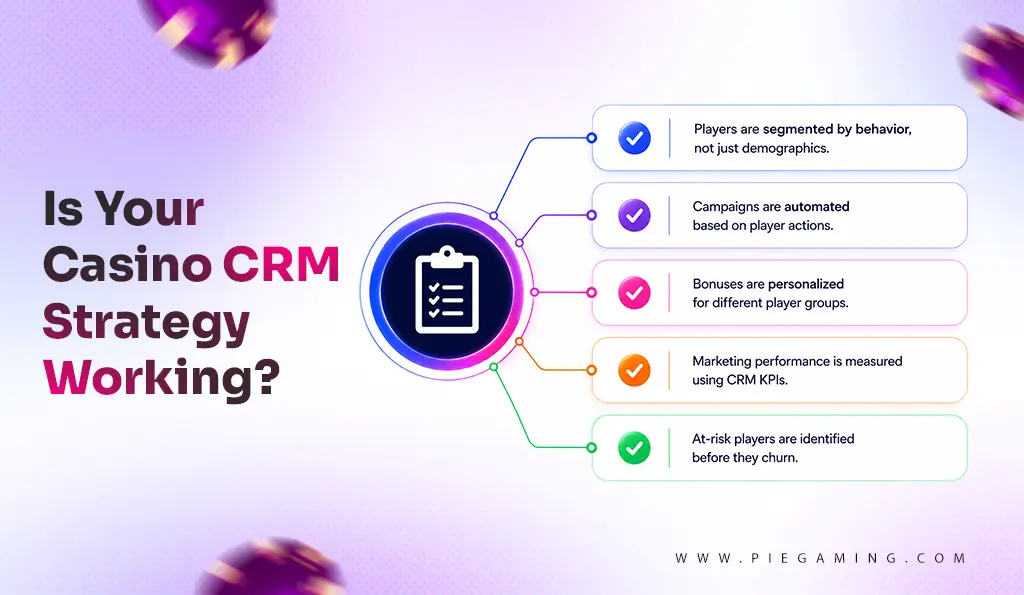
Casino CRM strategies
Top 8 Casino CRM Strategies That Drive Retention
A successful casino business is one that is driven by top CRM strategies. The strategies include the following:
1. Segment Players Beyond Demographics
Segmentation based on age, gender, and country is generic, which doesn’t give fruitful results. Operators have to take a step further by making advanced segmentation based on the following:
- Deposit frequency
- Bet size
- Preferred games
- Session duration
- Device
- Risk profile
- VIP status
This kind of segmentation is key to personalization, as it targets players based on how players actually play. Each segment of players gets their own targeted campaigns. For instance, slot lovers will get reel-specific bonuses. Whereas live table fans get tournament invites.
2. Build Lifecycle-Based CRM Campaigns
A right CRM strategy helps manage the entire player’s lifecycle. It defines campaigns for each stage rather than creating a one-size-fits-all solution. The typical stages include the following:
- New registrations
- First-time depositors
- Active players
- High-value/VIP players
- At-risk players
- Dormant players
- Reactivated players
Every stage has different messaging and goals. Operators must target inactive players within 7-14 days of last play to prevent lapses. Automating player journeys helps deliver relevant campaigns to each player at the right time.
3. Personalize Bonuses & Promotions
A one-size-fits-all 100% match bonus no longer cuts it. Use player data to create targeted offers based on individual behavior, preferences, and engagement. Personalizing bonuses & promotions can mean:
- Game-specific offers like free spins on the player’s favorite slot
- Cashback/reload bonuses
- Free spins
- Tournament invitations can be reserved for players who are loyal and active in a specific game category.
Offering relevant promotions to players feels rewarding rather than spammy. With proper CRM strategy, operators can minimize waste.
4. Automated Communication and Marketing
No matter how much effort you put into manual campaigns, it won’t scale. A modern CRM marketing strategy for casinos automates outreach based on player behavior, lifecycle events, and preferences. Following are the ways you can automate the marketing campaigns:
- Send a push notification if a player hasn’t logged in for 3 days.
- Notify through SMS when a VIP reaches a new tier.
- Offer a free spin after 7 days of inactivity.
Automation ensures that there is no delay in communication, and players get timely notifications. Many operators reveal that a data-driven automation approach helps them with reactivation campaigns more than manual pushes.
5. Use Omnichannel Communication
Players are omnipresent. As a casino operator, you can’t just rely on email or SMS. Today, players use multiple channels, so you must reach them where they can listen. Here are multiple channels that you can use to communicate. For instance,
- SMS
- Push notification
- Telegram
- WhatsApp (where applicable)
- In-app messaging
By following an omnichannel approach, you increase chances for player retention. For instance, you can send a churn-risk alert, or a birthday offer might be sent via email.
6. Reward Loyalty
A successful player retention campaign depends on loyalty programs. Don’t just reward players for big deposits but reward them for their positive behavior and loyalty. Here’s how you can implement rewards into casino CRM strategies:
- Referral – Give bonus credit to one who refers to a friend
- Daily login— Offer small credit or free play for each day to players who consistently log in.
- Tournament participation— Reward players for simply joining free tournaments or skill games.
- Community Engagement – Recognize social media contests
7. Gamify the Entire Experience
To improve the game experience of players, you need to add gaming elements to your CRM strategy. Gamification makes engagement fun and helps in player retention as well. Gamification features you can include in your CRM strategy include:
- Leaderboards
- Achievements
- Levels
- Badges
- Daily Missions
- Seasonal Events
By adding points, challenges, and competition, it significantly boosts player retention. For instance, a daily challenge with a leaderboard encourages habitual login.
8. Predictive Analytics to Flag At-Risk Players
Predictive analytics is one of the new CRM strategies, which uses player behavior to predict and prevent churn. Predictive analytics use player data to identify players who are likely to stop playing (churn) before they leave. It retains players by identifying churn risks early.
How does it work? Suppose a player who frequently deposits and suddenly stops depositing, logs in less frequently, and spends less time playing; the CRM can flag the player at risk. With this data, operators can run appropriate campaigns to offer personalized messages or relevant offers.
What is Responsible Gambling in CRM?
Responsible gambling in casino CRM means using player data, segmentation, and CRM automation to support and promote safe gambling practices. This includes self-exclusion tools, deposit-limit triggers, timeout campaigns, behavior monitoring, and other responsible gaming measures designed to protect players.
Types of Casino CRM Strategies
The different types of casino CRM strategies include:
- Operational CRM
Operational CRM supports day-to-day activities by automating tasks like campaigns, bonus management, and player communication.
- Analytical CRM
Analytical CRM uses data to decode player behavior patterns, preferences, segments, and retention opportunities.
- Collaborative CRM
Collaborative CRM helps different teams like marketing, VIP, support, and compliance work with a more unified view of the player.
Benefits of an Effective Casino CRM Strategy
A strong casino CRM strategy delivers real business results. Key benefits of implementing an effective casino CRM strategy.
-
Increase player retention
With the right CRM strategy, operators can retain players to a great extent. Proper segmentation and right bonus delivery boost player engagement, which leads to higher retention rates.
-
Maximize player lifetime value
Proper CRM strategies help keep players active longer; each player yields more revenue over their lifetime. Repeat players tend to spend more than new ones. A targeted CRM approach turns a one-time depositor into loyal players who wager more over time.
-
Support revenue growth
Casino CRM strategies help you get more value from players you already have rather than burning budget on new players.
-
Automate repetitive CRM tasks
Automated CRM workflows eliminate manual work and follow-ups. With automation, operators can automatically send bulk emails, app messages, and SMS based on clear rules.
-
Delivers personalized player experience
Today’s players demand relevance. By creating every campaign as per the individual experience, you create a more engaging experience. In practice, personalized campaigns drive higher response rates because players feel valued.
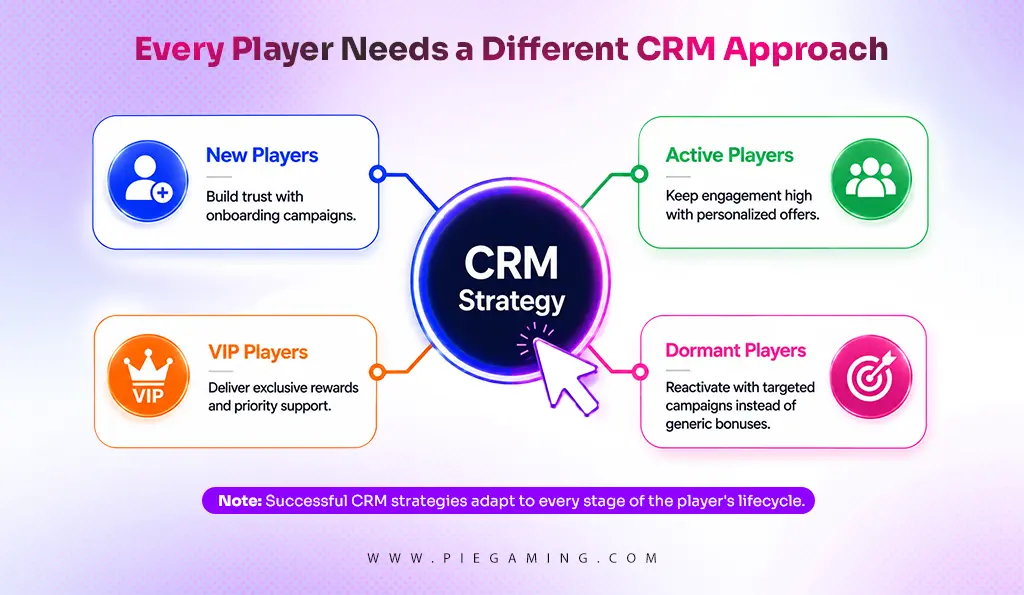
CRM marketing strategy for casinos by player segment
Common CRM Mistakes Casino Operators Make
No matter how advanced the CRM software is, some operators end up making mistakes without the right strategy. The common mistakes include:
-
Sending the same offer to everyone
Bulk emails, messages, or promotions annoy players and waste bonuses. A generic “Deposit Now” SMS or email to all segments rarely works.
-
Too many bonuses
Too many bonuses and promotions lose their impact on players. Players can get bonus fatigue if everything seems like a commission-driven pitch.
-
Ignoring churn signals
Many operators fail to monitor declining activity, which means players can slip away unnoticed. By the time you notice, it’s too late to win them back.
-
No segmentation
It is often noticed that operators treat all players as identical, which leads to irrelevant communication. If high-rollers and newbies both receive low-spend offers, engagement will surely drop.
-
Manual campaigns
Operators who rely on spreadsheets or one-off email are unscalable. Manual errors lead to missed opportunities.
-
CRM without automation
Many operators send manual messages to every player, which creates delays and inconsistencies. Competitors who use automation at work will outperform you.
-
No data privacy or compliance safeguards
Casino CRM deals with very sensitive data like ID documents, transaction history, and betting patterns. Operators who don’t follow GDPR, AML, data encryption, access control, and licensing rules face major consequences. CRM should also work alongside KYC, fraud prevention, and risk management system, which helps operators maintain clear data.
A smart CRM strategy will address these issues with strict segment rules, automated campaigns, multi-channel automation, and built-in compliance checks.
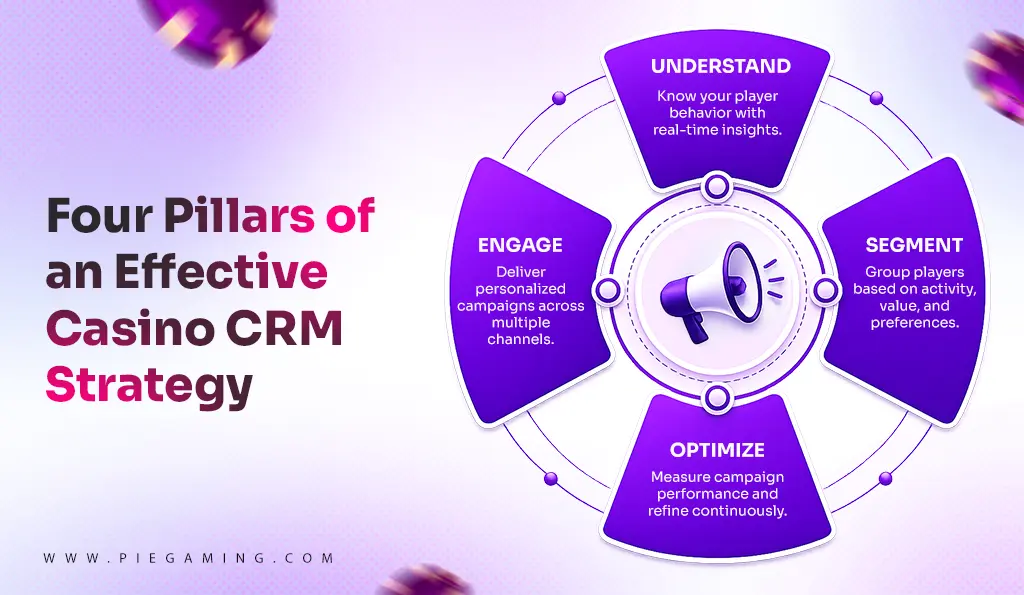
Four Pillars of an Effective Casino CRM Strategy
How Does PieGaming Help Operators Execute These CRM Strategies?
PieGaming understands the challenges operators face, and that’s why we help operators execute CRM strategies. Our CRM is built natively into our online casino software platform, including our white label casino software. Our CRM is powerful, scalable, and quick to respond.
Here’s how we tackle each challenge of operators and help with execution.
| Operator Challenge | How PieGaming Helps |
|---|---|
| Manual segmentation | Advanced player segmentation |
| Generic campaigns | Personalized campaign management |
| Multiple tools | CRM integrated with PAM Software and Casino Back Office System |
| Slow campaign execution | Automated workflows and triggers |
| Limited player insights | Real-time player analytics |
| Managing bonuses | Integrated casino bonus engine |
| Multi-channel engagement | Unified player communication capabilities |
| Scaling operations | Centralized CRM within the operator platform |
How to Measure CRM Strategy Success?
No matter how solid a strategy you implement, you can’t improve unless you measure it. Key metrics for operators to measure CRM strategy:
-
First-Time Deposits (FTD)
Track the number of new players who make their first deposit. Checking a healthy conversion of registration shows effective and fruitful onboarding.
-
Deposit Conversion Rate
Track the percentage of players who make a deposit after registering or receiving a marketing campaign. It reflects how well your campaigns turn contacts into customers.
-
Retention Rate
It is the percentage of players who remain active for a long period of time. For instance, a 30-day retention of 50% means 50% of last month’s players played again. A higher retention rate is better.
-
Churn Rate
The opposite side of retention is churn. So, players who stop playing during a set period of time are considered churning or inactive. You need to check which players have stopped playing.
-
Lifetime Value (LTV)
LTV is the total net revenue a player is expected to yield over their entire relationship with the casino platform. This includes all deposits, bonus costs, win/loss, etc. CRM strategies increase LTV by extending active days and increasing average bets.
-
Gross Gaming Revenue (GGR)
It is the percentage of total bets minus player winnings (before bonus and taxes). It is a raw turnover, and GGR indicates if overall play is healthy or not.
-
Net Gaming Revenue (NGR)
Revenue, which is left after bonus/fees/taxes, is Net Gaming Revenue. NGR measures actual revenue after paying back players their winnings and bonuses. Having details of NGR helps identify if promotions are hurting profit or not.
-
Campaign ROI
It is the measurement of revenue or deposits yielded per marketing dollar spent. Operators must measure this for each campaign or bonus type.
-
Deposit Frequency
It measures the average time between a deposit done by a player. The shorter the interval, the higher the engagement.
-
VIP Retention
The percentage of VIP-tier players who remain in the tier or above. Keeping VIPs engaged is crucial as they contribute to a large portion of revenue.
-
Session Frequency
With session frequency, you can measure how frequently players log in over a week or month. The higher session frequency is a sign of enhanced engagement from CRM efforts.
By tracking the aforementioned KPIs, you will be able to see which CRM strategies are working.
Conclusion
Having a powerful casino CRM is useless if you don’t have the right casino CRM strategies behind it. The successful casino operators are the ones who convert data into action. They segment players intelligently, automate lifecycle campaigns, and personalize every communication. It means you simply focus on players you already have. Industry sources suggest that it’s 3-5x cheaper to keep an existing player than to acquire a new one.
Operators that combine behavioral data, automation, personalization, and continuous optimization into a structured CRM marketing strategy for casinos are better positioned to improve retention, increase player lifetime value, and achieve stronger long-term profitability.

Contact Us
FAQs
-
What are some CRM strategies for casinos?
Key CRM strategies for casinos include advanced player segmentation, personalized bonuses, lifecycle campaigns, omnichannel outreach, automated marketing, and predictive analytics for churn prevention.
-
What are the 5 aspects of the CRM strategy?
A detailed CRM strategy often covers the following 5 aspects: Data & segmentation Personalization Communication Loyalty programs Measurement and optimization
-
What are common mistakes in casino CRM strategy?
Common mistakes in casino CRM strategy include overloading players with irrelevant bonuses, failing to segment players by behavior, running purely manual campaigns, overlooking early churn warning signs, not automating workflows, and ignoring data privacy/regulations. These mistakes lead to poor engagement.
-
How can AI improve casino CRM strategies?
AI can enhance CRM by powering predictive analytics, dynamic segmentation, and personalized recommendations. AI chatbots or agents can also assist VIPs or handle support inquiries.
-
How do casino bonuses fit into a CRM strategy?
Bonuses are a tool within CRM, not the entire strategy. Instead of random bonuses, a CRM-driven bonus strategy uses data to deliver the right bonus to the right player at the right time. For instance, a cashback bonus to a nearly inactive player or free spins on a favorite game for a loyal/regular player.
-
Can casino CRM software reduce compliance risks for operators?
Yes, casino CRM software can reduce compliance risk by automating marketing tasks, monitoring player behavior, supporting KYC and AML workflows, and maintaining player interaction records.


Monika Gola is an iGaming content specialist at PieGaming. Since 2020, she has been researching and developing content around software selection, online casino & sports betting regulations, and operator growth strategies. Her research includes analyzing market opportunities in regions like Europe, Africa, and Southeast Asia, as well as evaluating regulatory frameworks and entry barriers. She is actively monitoring industry trends, compliance updates, and evolving player demands across global iGaming markets to help operators navigate this industry seamlessly.

The best online casino slot providers in 2026 are Pragmatic Play, Evolution Group Studios, Play’n GO, Hacksaw Gaming, Relax Gaming, Games Global, Playtech, Push Gaming, Yggdrasil and Blueprint Gaming. Operators should compare them on six criteria: licensing and certification, RTP range, volatility, market fit, integration and commercial terms.
Casino gamification refers to the inclusion of goals, levels, rewards, and other video game elements around the core gambling area. Learn how operators can use gamification in igaming to create more engaging player journeys while managing costs.
Stake.Us, PlayFame, McLuck, MegaBonanza and Zonko are social casino platforms that are free-to-play casino games using virtual coins. These platforms offer hundreds of slots, tables, and instant-win games with daily free coins, tournaments, and bonus features.
A casino API integration is a software solution that connects your platform with games, payment gateways, wallets, KYC tools and other third-party solutions. It allows data to be exchanged between systems in real-time. This way you can launch quicker, automate tasks, and provide a smooth playable experience.
House Edge is the mathematical advantage built into online casino games and all other forms of gambling. It shapes the odds, influences your winnings and losses, and constitutes the cornerstone of any online casino or sportsbook operator’s overall financial strategy.
The Hi-Lo casino game is a simple card game where players predict whether the next card will be higher, lower, or equal to the current card. This guide explains how Hi-Lo works, its rules, betting options, payouts, gameplay, and strategies players can use when making predictions.
Casino CRM software is a specialized platform for online and land-based gambling operators that tracks player behavior, automates targeted promotions, manages VIP loyalty and supports regulatory compliance.


See you in your inbox soon!

Stay ahead of the game. Subscribe for exclusive content, updates, and insiders!