
The Hi-Lo casino game is a simple card game where players predict whether the next card will be higher, lower, or equal to the current card. This guide explains how Hi-Lo works, its rules, betting options, payouts, gameplay, and strategies players can use when making predictions.

Casinos are full of games that take time to figure out. Hi-Lo isn’t one of them. The concept is immediate; a card is drawn, and players predict whether the next will be higher or lower. That’s the whole game.
What makes it more than a coin flip is the probability angle: with each card revealed, the likelihood of what comes next quietly shifts. It gives players who pay attention to a genuine advantage over those who are simply guessing.
In this guide, we’ll walk you through the rules, show you the best strategies, break down the odds, and give you practical tips so you can play with more confidence.
How Does the Hi-Lo Casino Game Work?
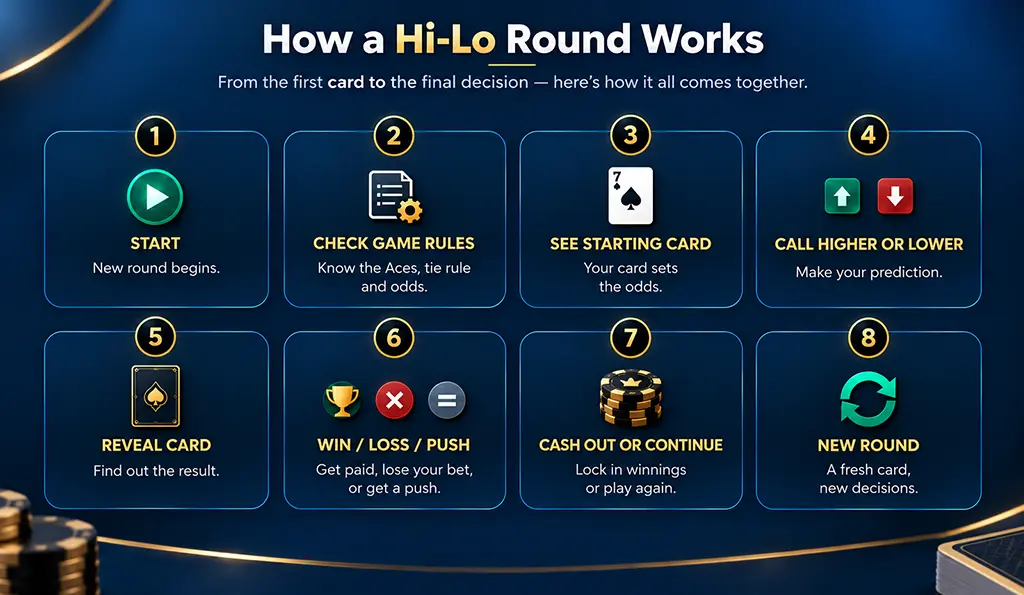
How a Hi-Lo Casino Game Round Works
Most casino games layer rule upon rule before the real action starts. Hi-Lo skips all of that. The entire mechanic rests on one decision made in real time, and that’s what sets it apart from nearly every other game on the floor.
Each round begins with a card placed face-up. The player then calls it: will the next card be higher or lower? If the prediction is correct, the round is won.
A few mechanics sit underneath that simple loop:
- Ace rankings: Aces rank either as the highest card or the lowest, depending on the version. The game specifies which, but it directly affects the odds, so it’s worth checking before playing.
- Ties and pushes: Most versions treat a matching card as a push, returning the bet and resetting the round. Some rule it as an automatic loss. That one difference has a real impact on the house edge.
- How the deck shifts: Every revealed card changes what’s left, which shifts the odds of the next draw. Single-deck versions let players factor this in. Continuous-shuffle versions, common online, keep odds consistent throughout but remove that tracking layer entirely.
- Fixed vs. dynamic odds: Fixed-odds versions pay the same regardless of difficulty. Dynamic odds versions adjust payouts based on probability, rewarding sharper, riskier calls with higher returns.
How to Play Hi-Lo Casino Game: Step-by-Step
A round of Hi-Lo takes seconds to complete. Here’s a step-by-step breakdown of everything that happens between the first card and the final result.
Step 1: Choose your Hi-Lo game
Hi-Lo looks identical across most online casino gaming software until the fine print tells a different story. Before placing a bet, check out three things: how Aces are ranked, how ties are handled, and whether the odds are fixed or dynamic.
A version that counts a tie as a loss instead of a push quietly increases the house edge. A fixed-odds version pays the same whether the call was obvious or genuinely risky. These aren’t minor details. They change how the game actually plays.
Step 2: Understand the starting card
The starting card tells you exactly how much probability is sitting in your favour before you call anything. A 2 showing means 47 of the remaining 51 cards are higher. Calling higher, there isn’t a prediction. It’s close to certainty.
Flip that to a King, and the situation reverses entirely, with almost every remaining card falling below it. A 7 or 8 is where it gets genuinely uncertain, splitting the deck almost down the middle with no clear edge in either direction. The starting card isn’t just context. It’s the most useful piece of information in the round.
Step 3: Choose Higher or Lower
With the starting card showing, one call is made: higher or lower. That’s it. But the starting card already contains everything needed to make that call an informed one rather than a guess. A low starting card makes the logical call higher.
A high starting card points the other way. Middle cards are where the decision gets harder and where gut feeling tends to take over from probability. Knowing which situation, you’re in before calling is the difference between playing Hi-Lo and just flipping a coin.
Step 4: Reveal the next card
The next card is drawn and the result lands immediately in one of three ways:
- Win: The card matches the prediction. The bet pays out, and the player moves to the next decision.
- Loss: The card goes against the prediction. The bet is lost and the round is over.
- Push: The drawn card matches the current card in value. Most versions return the bet and reset the round. Some count it as a loss. This is exactly why checking the tie rule in Step 1 matters. It shows up here.
Step 5: Decide whether to cash out or continue
After a correct prediction, the next decision is whether to take the winnings or let them ride. This is where most of the real thinking in Hi-Lo actually happens. Three approaches cover most of how players handle it:
- Conservative: Cash out after two or three correct predictions. The multiplier won’t be dramatic, but the winnings are locked in before a bad call can erase them. A solid approach when the starting cards have been middle-range, and the probability edge hasn’t been particularly strong.
- Probability-aware: Let the current card decide. A 6, 7, or 8 showing means the next call is close to a coin flip. Not the right moment to keep going. A 2 or a King showing means the odds are heavily skewed in one direction, making continuation a calculated move rather than just chasing a streak.
- High variance: Stay in and build the multiplier across multiple correct predictions. The payouts grow significantly with each successful round, but one wrong call ends with everything. This only makes sense as a deliberate choice, not as a reaction to winning a couple of hands in a row.
Step 6: Repeat within your bankroll limits
A new starting card lands, and the process runs again from the top. What makes bankroll discipline specifically important in Hi-Lo is the pace. Rounds close in seconds, which means a session burns through a budget faster than most other popular casino games.
Decide on a per-session limit before the first card is drawn, not after a losing streak has already started. The game itself hasn’t changed. Having a clear ceiling on what’s in play keeps the decisions in Steps 3 and 5 rational rather than reactive.
Hi-Lo Game Variations: How Different Rules Change Your Odds
Hi-Lo’s core mechanic stays the same across versions, but the prediction type, difficulty, and payout structure shift depending on which variation is being played. Here’s how the main versions compare.
| Hi-Lo Variation | What You Predict | Difficulty | Potential Payout | Player Consideration |
| High/Low | Higher or lower | Low | Standard | Best for beginners |
| Red/Black | Card color | Low | Standard | Simple probability |
| Odd/Even | Number type | Low | Standard | Easy to understand |
| Number Range | Specific range | Medium | Higher potential | Higher variance |
| Joker | Special card outcome | Medium | Variable | Rule-dependent |
| Progressive/Multiplier | Continue streak | High | Higher potential | Greater variance |
High/Low is the standard version and the most straightforward entry point for new players.
Red/Black and Odd/Even both sit close to 50/50 probability on every draw, keeping difficulty low but limiting any real probability edge.
Number Range introduces variance by asking players to predict a specific range rather than simply higher or lower. Narrower ranges pay more but land less frequently.
Joker variations add a wildcard outcome that can trigger a bonus, void the round, or produce a specific payout depending on the platform. Always check the Joker rules before playing since the impact varies significantly between versions.
Progressive/Multiplier carries the highest variance of all. Multipliers build across a correct streak, but one wrong call ends with everything. Suited players comfortable with volatility over consistent returns.
Is Hi-Lo Casino Game Rigged? Understanding RNG and Provably Fair
A fair question for any card game played online: is the result actually random, or is something working against the player behind the scenes? For Hi-Lo, two separate systems answer that question, and understand both matters before putting real money on the table.
RNG stands for Random Number Generator, the system that determines which card appears next. Licensed Hi-Lo games are audited by independent testing bodies that confirm the system produces genuinely random results within accepted statistical standards:
- eCOGRA, GLI, and BMM Testlabs are the three main agencies that carry out this testing across licensed online casino platforms.
- Certification means a third party has verified randomness on the player’s behalf. It does not mean the player can check individual results themselves.
Provably fair goes a step further. Used primarily by crypto casinos, it allows players to verify each result independently. It runs on three inputs:
- Server seed: Generated by the casino before the round and shared as a hash upfront so it cannot be changed mid-round.
- Client seed: Contributed by the player, ensuring the casino cannot predetermine the outcome alone.
- Nonce: A counter that increments every bet, making each round’s result unique even with identical seeds.
After the round, the casino reveals the full server seed. The player combines it with their client seed and nonce to confirm the result matches. Most platforms include a built-in verification tool that handles this without any technical knowledge required.
What provably fair does not cover is just as important:
- It confirms that the result was not manipulated. It does not verify the house edge or RTP.
- A Hi-Lo game can pass every provably fair check and still carry a higher house edge than the player expects.
- Checking both the verification system and the stated RTP together gives a more complete picture of what the game is actually offering.
Common Hi-Lo Mistakes That Can Increase Your Losses
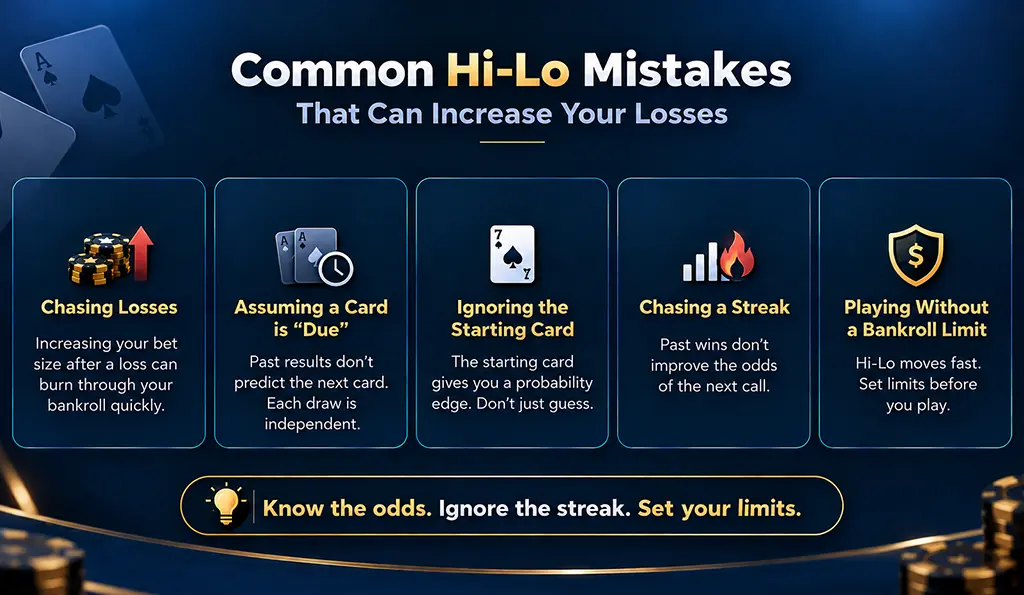
Common Hi-Lo casino game Mistakes
The rules of Hi-Lo take seconds to learn. The mistakes that cost players the most take a little longer to spot. Here are the five worth knowing.
Mistake 1: Chasing a losing streak
Increasing the bet size after a loss to recover what was lost is one of the fastest ways to burn through a bankroll in Hi-Lo. The logic feels sound — a win is coming, so bet more to make up the difference.
The problem is that each round in Hi-Lo is independent. A losing streak carries no obligation to end on the next card. Larger bets on uncertain calls don’t accelerate recovery. They accelerate losses when the next call goes wrong too.
Mistake 2: Assuming a card is “due”
If five high cards have appeared in a row, a low card must be coming next. This is the gambler’s fallacy, and Hi-Lo is particularly vulnerable to it. In a continuous-shuffle version, previous results have zero influence on the next card.
In a single-deck version, card removal does shift the odds slightly, but not in a way that makes any specific card “due.” The deck doesn’t balance itself out round by round. Each draw is its own event.
Mistake 3: Ignoring the starting card
Making a call without factoring in the starting card is essentially guessing. A 7 showing means the deck splits almost evenly, and neither call carries a real edge.
A 3 showing puts roughly 85% of the remaining deck above it. These are not the same decision, and treating them as if they are removing the one probability advantage that Hi-Lo actually gives the player before the call is made.
Mistake 4: Continuing a streak without considering the risk
Winning three or four calls in a row feels momentum, but the deck doesn’t reward streaks. Each additional call in a streak carries its own independent probability, and that probability doesn’t improve because the previous calls were correct.
Middle cards showing a mid-streak are a clear signal to cash out. Continuing past 6, 7, or 8 because the streak feels strong is when multipliers get handed back to the house.
Mistake 5: Playing without a bankroll limit
Hi-Lo moves fast. Rounds close in seconds, which means a session without clear limits can deplete a budget before the pace even registers. Four specific limits keep a session in check:
- Session budget: The total amount available for the session, decided before the first card is drawn. Once it’s gone, the session ends.
- Stop-loss: A lower threshold within the session budget. If losses hit a set point, play stops regardless of how much of the session budget technically remains.
- Win limit: A ceiling on winnings. Deciding in advance when to walk away from a profitable session stops a strong run from being handed back through continued play.
- Fixed bet sizing: Keeping each bet at a consistent percentage of the session budget rather than adjusting based on results. This removes the temptation to chase losses with larger bets or overextend on the back of a winning streak.
How to Choose a Hi-Lo Casino Game?
Not every Hi-Lo game is worth sitting down to. A few checks before playing separate a well-structured game from one that quietly works against the player from the start.
Platform Licensing and Regulation
Look for a licence from the MGA, UKGC, or Curaçao eGaming before anything else. These aren’t just logos on a footer. They mean the platform is held to specific standards on game fairness, payout processing, and player fund protection. No licence information on the platform is a clear reason to find a different game.
RNG Certification vs. Provably Fair
RNG-certified Hi-Lo games have been audited by bodies like eCOGRA or GLI, which confirm the card draws are genuinely random.
Provably fair versions go further, letting the player verify each individual result using the server seed, client seed, and nonce after the round ends. Both indicate a fair game. The difference is whether a third party verified it, or the player can verify it themselves.
Free or Demo Version Availability
Hi-Lo rules vary more than they appear to be from the outside. Tie handling, Ace rankings, and payout structures differ between versions, and a demo removes the cost of learning those differences between mid-session with real money. If the platform offers a free version of the specific Hi-Lo game being considered, use it before switching to real stakes.
Fixed Odds vs. Dynamic Odds
Fixed odds return the same payout regardless of how safe or risky the starting card makes the call. Dynamic odds adjust the return based on probability, paying more for a correct call from a 7 than from a 2. Players who want straightforward, consistent returns suit fixed odds. Players who factor in the starting card before every call get more out of dynamic odds since the payout actually reflects the difficulty of the prediction.
Minimum Bet Size and Stake Flexibility
A table minimum that takes up a significant chunk of the session budget per round limits how many decisions can be made before the bankroll is gone. This matters most when using fixed bet sizing as a strategy, where each bet should sit at a small, consistent percentage of the total budget. Check the minimum and maximum bet range before sitting down, not after the first few rounds have already run.
Wrapping Up…
Hi-Lo casino game is one of the few games where understanding the mechanics actually changes how the game plays out. The rules are simple, but the decisions around starting cards, cash-out timing, and bankroll limits are what separates a structured session from an expensive one. Whether playing for the first time or returning to it, the fundamentals covered in this guide give every round a sharper foundation than guesswork alone.

Contact Us
FAQ's
-
What is the Hi-Lo casino game?
Hi-Lo is a card game where players predict whether the next drawn card will be higher or lower than the current one. It is one of the most straightforward games in any casino, built entirely around a single repeating decision backed by probability.
-
Can beginners play high low casino games for free?
Yes. Most online casinos and crypto platforms offer a free or demo version of Hi-Lo. Playing the demo first is worth doing since tie rules, Ace rankings, and payout structures vary between versions, and a free round costs nothing to learn from.
-
How to play high or low in a casino game?
A card is placed face-up, and the player calls whether the next card will be higher or lower. If the prediction is correct, the round is won. The starting card determines how much probability sits behind each call before the next card is drawn.
-
Can the high and low game be played with real money?
Yes. Hi-Lo is available for real money across licensed online casinos and crypto platforms. Before playing with real stakes, check out the platform licence, how ties are handled, and whether the RTP is clearly stated on the game page.
-
What is a good RTP for Hi-Lo?
Most Hi-Lo games sit between 95% and 99% RTP depending on the version and platform. Provably fair crypto versions tend to sit at the higher end. Anything below 95% is worth questioning before playing, especially in versions where ties count as a loss rather than a push.


Palak Madan has been writing about the iGaming industry since 2024. She focuses on helping operators and founders understand their options when launching an online casino, from choosing the right software provider to figuring out costs and compliance requirements across different markets. At PieGaming, she covers topics like white label casino solutions, platform selection, and market entry, turning complex industry information into practical guidance for people building iGaming businesses. She also keeps a close eye on licensing and regulatory changes; particularly how new rules shape the way operators enter and grow in different jurisdictions.

The best online casino slot providers in 2026 are Pragmatic Play, Evolution Group Studios, Play’n GO, Hacksaw Gaming, Relax Gaming, Games Global, Playtech, Push Gaming, Yggdrasil and Blueprint Gaming. Operators should compare them on six criteria: licensing and certification, RTP range, volatility, market fit, integration and commercial terms.
Casino gamification refers to the inclusion of goals, levels, rewards, and other video game elements around the core gambling area. Learn how operators can use gamification in igaming to create more engaging player journeys while managing costs.
Stake.Us, PlayFame, McLuck, MegaBonanza and Zonko are social casino platforms that are free-to-play casino games using virtual coins. These platforms offer hundreds of slots, tables, and instant-win games with daily free coins, tournaments, and bonus features.
Casino CRM strategies help operators to personalize campaigns, improve player retention, reduce churn rate, and maximize player lifetime value.
A casino API integration is a software solution that connects your platform with games, payment gateways, wallets, KYC tools and other third-party solutions. It allows data to be exchanged between systems in real-time. This way you can launch quicker, automate tasks, and provide a smooth playable experience.
House Edge is the mathematical advantage built into online casino games and all other forms of gambling. It shapes the odds, influences your winnings and losses, and constitutes the cornerstone of any online casino or sportsbook operator’s overall financial strategy.
Casino CRM software is a specialized platform for online and land-based gambling operators that tracks player behavior, automates targeted promotions, manages VIP loyalty and supports regulatory compliance.





See you in your inbox soon!

Stay ahead of the game. Subscribe for exclusive content, updates, and insiders!