
Mini casino games are fast versions of classic casino games and slots made for quick play. They cut out rules and long animations, making them perfect for casual players and mobile users. Each round usually takes between 30 seconds and two minutes.
Online casinos are trying hard to get attention in the iGaming industry . Players switch between apps in a few seconds. A slow or complicated game can lose them just as quickly. That is the challenge that operators are facing now.
Mini casino games are becoming the solution. The instant games market, which includes these fast-play games, is worth $3.3 billion in 2026. It is expected to reach $9.3 billion by 2034, growing at a 13.9% CAGR.
This kind of growth does not happen by chance. Players are looking for easy games they can play anywhere. Operators who do not provide that are already falling behind.
What Is a Mini Casino?
Search “mini casino,” and you might land on two very different things.
In the United States, “mini casino” is a term. Pennsylvania calls it a Category 4 casino, a land‑based license that limits it to 300 to 750 slot machines and up to 40 table games. It is a building with real limits on the gaming floor. That is not what this guide covers.
This guide talks about casino games, compact, fast‑play games that you add to an online casino platform. The same words, a different world.
What Are Mini Casino Games?
Mini casino games are simplified versions of classic casino games made for quick play on any device. Mini casino games cut a game down to its core. Rounds finish in seconds, not minutes. Mini casino games have rules that’re easy to follow even for a first‑time player.
Mini casino games usually have stakes, so players can jump in with little risk. Mini casino games are built on mobile‑first because most players play on mobile. In Europe, mobile devices already drive 58% of online gambling revenue, a figure projected to climb to 67% by 2029.
They have two kinds of roots. Some, like roulette and mini blackjack are smaller versions of traditional table games. Others, like crash and dice games, grew from fair crypto gaming, where every result can be checked independently. Both paths lead to the place: games that are fast, simple, and easy to trust.
Mini Casino Games vs. Traditional Casino Games
Mini casino games are made for speed. Rounds end in seconds; the rules are simple. Everything is created for quick choices on a small screen.
Traditional casino games move at a pace. They have rules, longer rounds, and often reward thinking along with luck. Both types have a place on a platform, but they help different players with different needs.
Read More: Player Retention Strategies for Mini Casinos
Top Mini Casino Games to Add to Your Online Casino
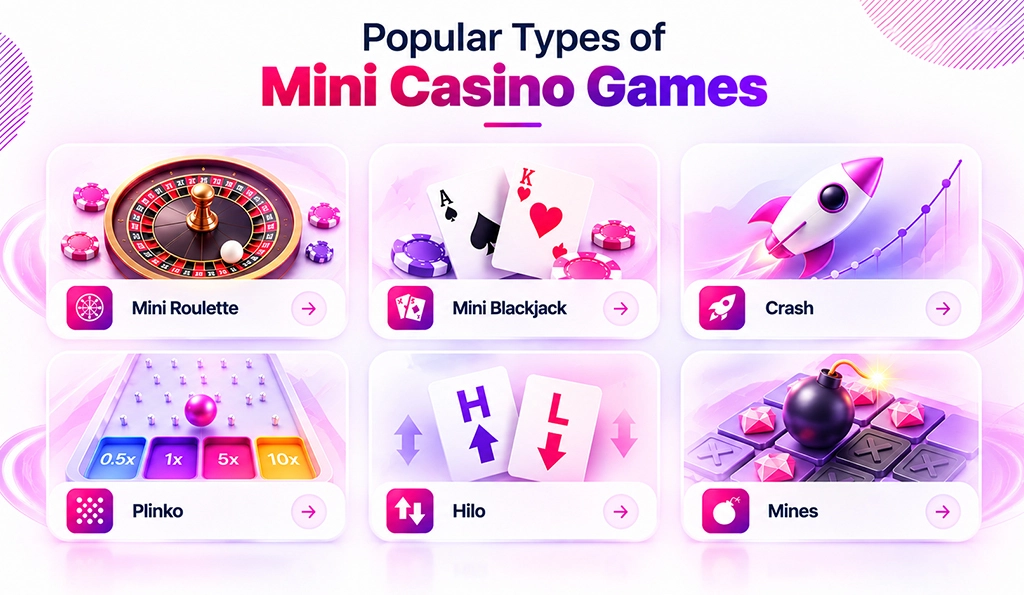
Popular Types of Mini Casino Games
Operators who are thinking to start online casino and introducing mini casino games, here’s what each of these games really offers to your platform and why it’s worth the effort.
1. Crash Games (Aviator-style)
Crash games work with a growing multiplier and one choice: take the money or keep going. This simple design makes it easy to bring in from providers and features like live multipliers and rankings make players promote the game on their own. Data from crash-game operators shows that these games are played again often than regular slot games.
Why add it: sharing through social and ranking features plus strong player growth without paid ads.
2. Plinko
Plinko uses a fixed chance of where the piece lands, which makes it one of the mini games to get a license for or build yourself. There is no need for random number settings or handling multiple tables, so getting the game out quickly is easy. It also keeps players interested in over sessions without needing new content.
Why add it: Great repeat play at a cost to develop with very little work needed after launch.
3. Mines
Mines use a grid where players uncover spots, and the risk grows with every step. This setup makes sessions last longer because players keep deciding whether to go further. Operators often use risk levels, which lets you change how risky the game is for different areas or groups of players.
Why add it: Grid-based play that keeps people coming and strong daily return rates.
4. Mini Roulette
Mini roulette keeps the name. Look of regular roulette but makes the wheel smaller and the bets simpler. Because players already know the game, there is almost no need for teaching when it starts, which makes the sign-up process easier. It is a choice for platforms that want a familiar table game without all the work of building one from scratch.
Why add it: Players recognize the game. The start is easy and people join quickly.
5. Mini Blackjack
Mini blackjack keeps the thinking parts of regular blackjack but plays faster. This appeals to a kind of player than games that are all chances. People who play longer and often have more value over time. It is worth showing it in your game list to get those players who like to use skill.
Why add it: Gets players who like to use skill. These players usually stay longer and play more.
6. Dice / Hi-Lo
Dice and Hi-Lo games are based on chances, which makes them perfect for proving they are fair. This openness helps reduce player complaints and makes your paperwork easier. They also get approved quickly because the math is simple for auditors to check.
Why add it: Fast games that are easy to prove are fair, which saves time on rules and checks.
7. Mini Baccarat
Baccarat is very popular in markets, and a mini version keeps that appeal but makes the rounds much shorter. If you are looking to grow in Asia, this game type usually does better than games in that area both in how many people use it and how often they come back.
Why add it: A game that works well for platforms aiming at markets with a lot of demand already there.
8. Scratch Cards / Instant Win
Scratch cards have no rules to explain. No tutorial is needed, which makes them perfect for new players to try first. Operators often use them in messages or with small deposits because the quick result keeps new players interested before they look around the rest of the site.
Why add it: A way to get new players started and keep them interested, from the very first click.
Why Mini Casino Games Matter for Operators
Player acquisition costs are not getting any cheaper. That makes every new signup more expensive to earn and more important to keep.
This is where mini casino games earn their place on a platform.
Because mini casino games are cheap to build and quick to launch, they work well as free‑to‑play or demo experiences. A player can try a crash game or a round of Plinko with zero commitment. That low‑pressure entry point brings people in without the cost of a paid campaign, which softens your overall CAC.
Once they are in mini casino games, keep them there. Short rounds mean players’ log sessions per day. Simple rules mean fewer players drop off mid‑game out of confusion. Because mini casino games finish quickly, they naturally lead players toward your full‑length titles next whether that is a slot, a live table or a sportsbook bet placed between rounds.
None of this works by accident. It works because of what mini casino games offer players
- Fast‑paced rounds that fit into a two‑minute break, not a 20‑minute session.
- Simple rules that do not need a tutorial before someone plays the mini casino game.
- Low stakes that make trying a new mini casino game feel risk‑free.
- Luck‑based mechanics that do not ask for skill or prior experience.
- Variety that keeps a lobby feeling fresh without new development.
Put together, that is a retention engine and an acquisition funnel in one, and it is why mini casino games are becoming a standard line item on operator roadmaps.
What Early-Stage Operators Should Know Before Adding Mini Game
Adding casino games looks simple from the outside. It is not if you skip the groundwork. Here is what to check:
RNG certification: Every mini casino game needs a certified number generator behind it. Skip this and you are building a foundation that will not pass review.
Fair verification: For crash, dice and similar mini casino games players increasingly expect to verify results themselves. Build this in from day one not as an afterthought.
Licensing and jurisdiction fit: Not every mini casino game format is approved in every market. Check your target jurisdictions rules before you commit development time to a mini casino game type.
Aggregator versus provider: Aggregators give you a catalog faster, but direct provider integrations often mean better margins and more control over mini casino game behavior. Decide based on your timeline and budget, not speed.
Mobile optimization: Mini casino games are consumed entirely on mobile. If a mini casino game does not run smoothly on a mid‑range phone, it is not ready to launch.
User‑friendly UI/UX: These mini casino games are meant to be picked up. If a player needs to think before the click, the design has failed its main job.
Catalog diversity: Start with 3 to 5 well‑chosen casino game titles instead of a large unfocused library. A tight, high‑quality selection outperforms a one that dilutes player’s attention.
Lower minimum bets: Setting minimum stakes on mini casino games makes them a natural entry point, for new or cautious players without pressuring them into bigger bets before they are ready.
Get these right and mini casino games to become a genuine growth lever. Skip them. You are left with a catalog that looks good in a demo but creates problems the moment real players and regulators get involved.
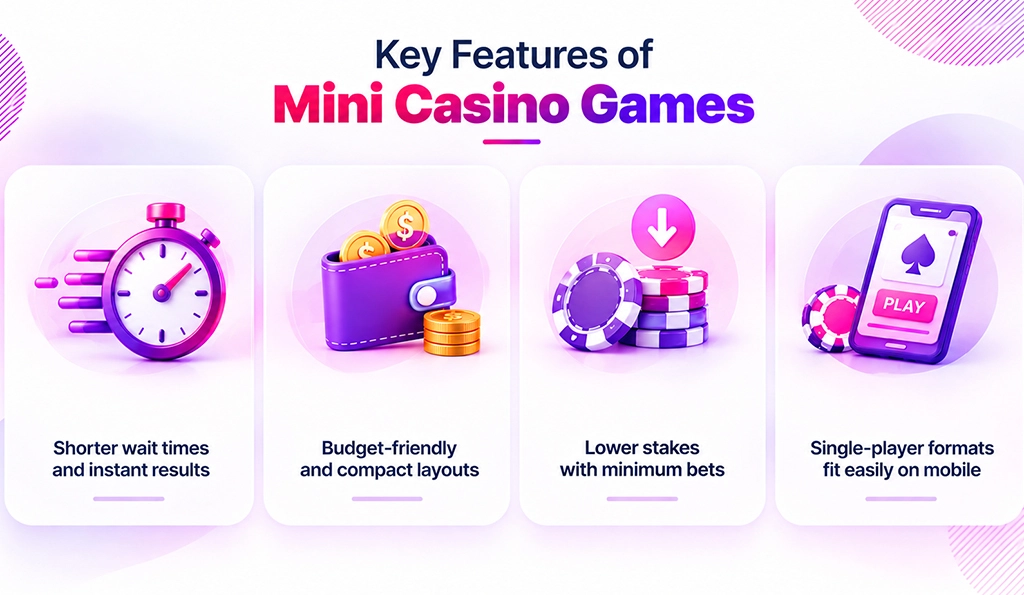
Key Features of Mini Casino Games
How to Vet a Mini Games Provider on Fairness and Security?
Cyber incidents targeting casino operators surged by 400% since 2025 and one confirmed breach at a major operator exposed data for up to 800,000 users. A mini games catalog adds integrations, more data flow and more surface area for something to go wrong.
Before signing with any provider, get answers on these five points.
Is the game provably fair. Can players verify it themselves?
For crash, dice and similar formats “trust us” is no longer enough. Players expect to verify a game outcome against a hash or seed. Ask the provider to show the verification process and not just describe it. If the provider cannot demonstrate the process to live this is a flag.
How is player data encrypted?
Ask specifically about encryption standards when data is at rest and during transit not just say “we are secure.” Find out where data is hosted, who has access and what happens to data if the providers’ systems are compromised. A vague answer usually signals a security policy.
How often are the games independently audited?
RNG certification is not a one‑time checkbox. Ask how often the provider re‑tests games with a laboratory and ask to see the most recent audit report. A provider confident in fairness will provide this report without hesitation.
What verification tools do players actually get?
Some providers hide fairness data in a document that nobody reads. Better providers build an in‑game way for players to check results themselves. Visible transparency builds trust faster than any marketing claim.
How fast does the provider actually respond when something breaks?
A game going down during peak hours costs money and player trust. Before signing anything ask for the provider’s support of SLA in writing. Ask for a reference operator that can be called. The provider’s response speed during a crisis tells more than a sales pitch ever will.
Ask these five questions before every vendor contract. You will filter out providers who talk about fairness, from those who can actually prove it.
Conclusion
Mini casino games are not a passing trend. They are becoming a part of how companies keep players interested in managing the cost of getting new players and set themselves apart in a busy industry.
Doing this well requires more than just picking some well-known games. It means selecting games that match the people who play them, checking the companies that provide the games for fairness and safety, and creating a collection that’s simple, not too large.
That is where PieGaming comes in. Our platform helps companies add casino games without uncertainty. It includes certified number generators, games that are proven to be fair, and all the rules and regulations already, in place. Whether you are just starting out and adding your mini games or growing an existing collection, we make it easy to bring in the games and ensure that fairness is a must.

Contact Us
-
Mini casino vs. full casino platform: which is better for retention?
Neither replaces the other. Mini casino games boost retention through short, frequent sessions, while a full casino platform drives higher lifetime value through slots, live tables, and sportsbook depth. The best retention strategy uses mini games as a daily engagement layer inside your existing platform, not as a standalone replacement.
-
How much does it cost to add a mini casino module to an existing app?
Cost depends on integration path. Going through an aggregator is typically faster and cheaper upfront, often a licensing fee plus revenue share, while direct provider integration costs more initially but gives better long-term margins. Most operators can add a lean mini casino games module within a mid five-figure budget, depending on the number of games and the platform's existing infrastructure.
-
Why isn't my mini casino feature increasing daily active users?
Usually it's placement, not the games themselves. If mini casino games are buried in your lobby, players never find them. Low visibility, missing mobile optimization, or a catalog that's too large and unfocused can also suppress engagement. Fix discoverability first, then test with a lean 3-5 game selection before assuming the format itself isn't working.
-
Is it worth hiring a specialized agency to design mini casino retention strategy?
It depends on your in-house expertise. An agency helps if you lack data on player segmentation, game placement, or lifecycle marketing specific to mini casino games. If you already have a strong product and analytics team, you can likely build this strategy internally using performance data from your existing platform.
-
Are mini casino games profitable for operators?
Yes, when implemented correctly. Mini casino games are cheap to build or license, drive frequent low-stakes play, and lower acquisition costs through free-to-play funnels. Profitability comes from volume and retention rather than high individual bet sizes, making them a strong margin contributor over time.
-
Are mini casino games skill-based or luck-based?
Most mini casino games, like crash games, Plinko, and dice, are luck-based. A few, such as mini blackjack, retain an element of skill and strategy. This mix lets operators appeal to both casual, luck-driven players and those who prefer strategic decision-making.
-
How long does it take to integrate mini casino games into a platform?
Through an aggregator, integration can take a few weeks. Direct provider integrations, which offer more customization, typically take longer, often one to three months depending on compliance requirements and the number of games being added.
-
What's the difference between mini casino games and crash games?
Crash games are one type of mini casino games. "Mini casino games" is the broader category that includes crash, Plinko, mini roulette, dice, and similar formats. Crash games specifically use a rising multiplier that players cash out before it crashes, making them a distinct sub-category within the wider mini games space.


Jaya Swaroop has been covering iGaming and betting technology since 2019, with a specialization in online casino platforms, sportsbook solutions, and licensing frameworks. Her work involves analyzing platform capabilities and evaluating cost structures, compliance requirements, payment integrations, market strategies, and regulatory updates that impact operators entering or scaling in the iGaming space. With a background in B2B marketing and content strategy, she has contributed to SEO-led growth and demand generation initiatives for global businesses. Jaya holds a Bachelor’s degree in Science (Chemistry & Mathematics) and is certified in content writing, email marketing (HubSpot), project management, and Google Analytics.

See you in your inbox soon!

Stay ahead of the game. Subscribe for exclusive content, updates, and insiders!