
Evolution, Playtech, Pragmatic Play, Ezugi, Vivo Gaming, BetGames, and Creedroomz are among the leading live casino software providers in 2026. Providers differ in game selection, studio coverage, market availability, integration options, and commercial models, so you should compare these factors carefully before settling on a solution.
Ask any operator where their revenue is actually coming from, and live casino will top the list.
Live casino now drives player engagement and retention for most operators. Revenue often matches slots, and in some markets, it pulls ahead. That’s why picking the right live casino software matters more than ever.
It’s not about stacking up the most tables. You need the right games, a smooth experience, and features that keep players coming back for more.
It’s a decision that affects how much your platform runs, how happy your players are, and how much you spend, and even which markets you can legally operate in.
This guide goes beyond the basics. We’ll cover what live casino software actually includes, but the real focus is on how to evaluate providers using criteria that matter, how to compare them for your specific market and business, and how to integrate your choice smoothly.
Along the way, we’ll cover key features, evaluation criteria, integration steps, and the questions you should be asking before you sign up with anyone.
What Is Live Dealer Casino Software?
Live dealer casino software is the technology that lets you offer real-time; dealer-hosted casino games on your online casino platform. It connects the provider’s live studio to the operator’s platform, handling everything from the video stream to game data, player bets, results, and settlement.
Live dealer software acts as the technical layer between the live studio and your player-facing casino interface. It lets your players watch a live dealer run the game while they place bets through your digital interface.
But live dealer casino software doesn’t work in isolation. This software needs to integrate with your PAM, your wallet, your lobby, your bonus system , and your reporting tools. So, its performance isn’t just about video quality. API reliability, latency, accurate game data, scalability, and integration capabilities all play a role too.
Here’s the typical flow, from the studio to your player’s screen:
1. Live studio
The dealer runs the game from a professional studio equipped with cameras, microphones, gaming tables, and monitoring systems.
2. Game capture
Cameras and connected gaming equipment capture the physical game activity. Depending on the game, this might involve a Game Control Unit (GCU) or optical recognition systems that pick up key events and outcomes.
3. Game data
Physical events, like a roulette number landing or cards being dealt with, get converted into digital game data your system can process.
4. Streaming
The dealer and table get streamed to the player in real time. Low latency matters here. It keeps the video, betting window, and game status all in sync.
5. API integration
The provider’s API connects their live dealer solution to your casino platform. It handles the exchange of data on games, player sessions, wagers, game states, and results.
6. Bet processing and settlement
Your platform checks the player’s wager against their balance. Once the dealer completes the game and the result is confirmed that result passes back through the integrated systems, and the player’s wallet is updated.
Why Live Dealer Casino Software Matters?
Live dealer games now account for a meaningful share of total casino GGR at many operators, often rivaling or exceeding slots in markets like the UK, Europe, and parts of Asia. If your platform doesn’t offer a strong live casino product, you’re leaving that revenue on the table.
The live dealer segment is projected to grow at a CAGR of nearly 13% between 2025 and 2030, according to Grand View Research, driven by rising player demand for real-time dealer interaction and streamed gameplay.
Beyond revenue, live dealer content plays a specific role in your business:
- Retention: Players who engage with live tables tend to have longer session times and return more often. The format combines the trust of watching a real dealer with the convenience of playing online, which drives higher lifetime value per player.
- Competitive baseline: In mature markets, live casino isn’t a differentiator anymore; it’s a baseline expectation. Most licensed operators already offer it. Not having it puts you at a visible disadvantage, not just a missed opportunity.
- Market access: Several regulated markets, including certain US states and parts of Europe, treat live dealer content as a distinct product category with its own certification requirements. Getting your live casino software right can be a prerequisite for launching in these jurisdictions at all.
- Brand trust: Poor stream quality, laggy betting windows, or unreliable settlement damage player trust quickly, and that trust is hard to win back once lost.
Core Components of Live Casino Software
When you’re comparing live casino software providers, specifications on paper only tell part of the story. Understanding the core components behind live casino software tells you what actually drives performance.
1. Streaming Infrastructure
Streaming infrastructure delivers the live dealer feed from the studio to the player’s device. It typically covers video encoding, content delivery networks (CDNs), bitrate management, and latency control.
- Encoding:Converts the studio’s camera feed into formats that work across browsers and mobile devices.
- CDN:Distributes video through servers positioned across different regions, cutting down delivery delays for players wherever they are.
- Latency:Determines how closely the player’s video feed follows what’s actually happening in the studio. Lower latency matters most around betting cut-off and the moment results are revealed.
- Bitrate:Controls how much data the video stream sends. Adaptive bitrate can adjust quality based on the player’s connection, which helps cut down on buffering.
If you are targeting multiple regions, don’t just look at advertised video quality. Check the streaming infrastructure against your expected concurrent players, targeted geographies, mobile traffic, and peak-session loads.
2. Studio & GCU Technology
The studio is where the physical game happens. The Game Control Unit (GCU) captures and processes the events generated during play.
Studio technology can include:
- Multiple cameras covering the dealer and gaming table.
- Dealer consoles and communication equipment.
- Automated game results capture.
- Physical card and roulette tracking systems.
- Lighting and audio equipment.
- GCU-connected gaming equipment.
The GCU picks up information from physical gaming equipment and sends the relevant game events to the gaming system. In roulette, for example, it captures the winning number and matches it to the right game round.
What matters most for you as an operator is how accurately and quickly physical game events get converted into digital game data and passed to your platform.
3. Player UI/UX & Multi-Camera
The player interface is where the live video, betting controls, game information, and account actions all come together. A good interface lets players watch the dealer while still clearly seeing their betting options, limits, balance, previous results, and game status.
Multi-camera functionality can let players switch between different views, such as:
- Full-table view.
- Dealer-focused view.
- Close-up of the cards or wheel.
- Alternative table angles.
The video feed and betting interface need to stay in sync. If the video lags or the betting status isn’t clear, players won’t know whether their wager went through, closed, or settled.
Key things to check here: mobile responsiveness, supported browsers and devices, camera-switching functionality, loading speed, and how consistent the video stays with the game-state information.
4. Back-Office, Reporting & Analytics
The back office gives you visibility into live dealer operations and player activity. Don’t settle for basic revenue reports. Look for reporting that lets you dig into game-level, table-level, and player-level performance.
Relevant data can include:
- Bets and settlements.
- Game rounds.
- Gross Gaming Revenue (GGR).
- Player activity.
- Table utilization.
- Average bet size.
- Game and table performance.
- Session activity.
- Errors and rejected transactions.
Analytics can show you which tables are pulling off the strongest activity and where players are dropping off. You can use that data to adjust table availability, game placement, betting limits, and your promotional strategy.
5. PAM, CRM & Bonus Engine Integration
Live casino software doesn’t run as a standalone system. It needs to exchange players and transaction data with your Player Account Management (PAM), CRM, wallet, and bonus engine.
PAM Integration covers player authentication, account information, balances, and gaming sessions.
CRM integration lets you use live casino activity for player segmentation and lifecycle management. You could group players with their preferred games, betting frequency, or activity level, for instance.
Bonus engine integration lets you apply eligible promotions to live casino activity, like cashback, free bets where supported, loyalty rewards, or wagering-based campaigns.
The technical requirement that matters most here is accurate, real-time data synchronization. A player’s balance, wager status, bonus eligibility, and game result all need to stay consistent across your live casino platform and your core systems.
Live Casino Software Solutions: Build, Buy, Aggregate or Turnkey?
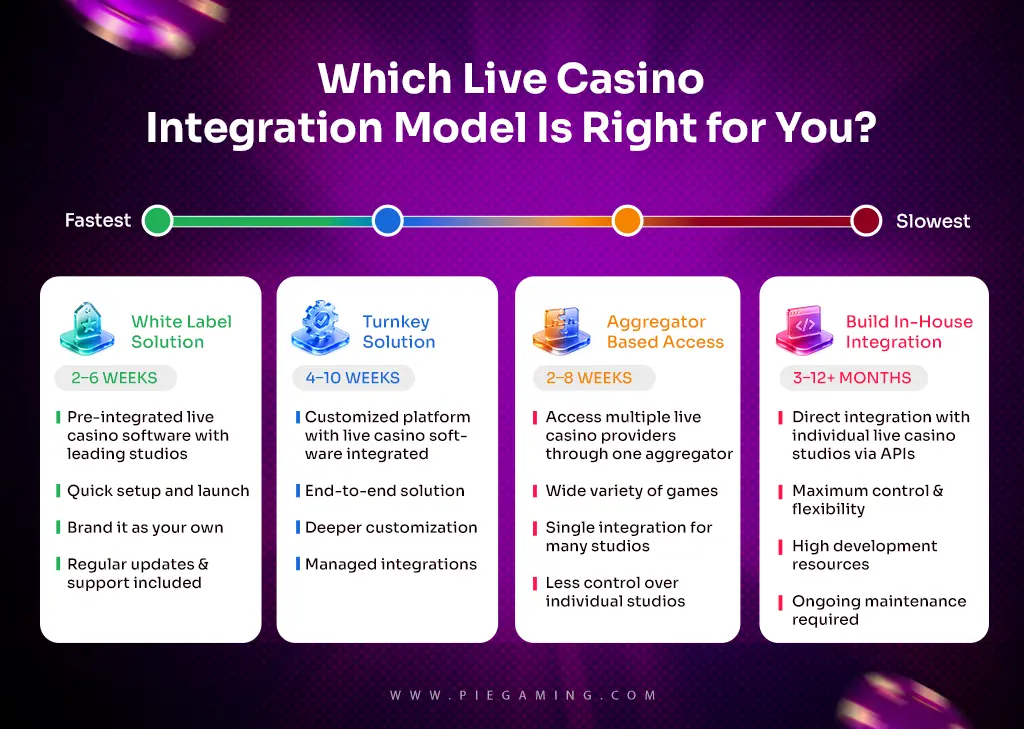
Live Casino Software Integration Model
Live casinos don’t come with a single setup path. You can build it, buy it, aggregate it, or go turnkey, and each route has a different cost and effort attached. Let’s take a look at each model.
1. Direct Studio Integration
With direct studio integration, you connect straight to individual live casino providers instead of going through an aggregator.
This gives you direct control over the provider relationship and your game portfolio. You can pick specific studios based on table limits, game variants, studio locations, languages, currencies, and target markets.
The only limitation to direct integration is that every additional provider will mean another technical and commercial relationship to manage. Each integration can come with its own:
- API specifications and certification processes.
- Game launch procedures.
- Wallet and session requirements.
- Reporting structures.
- Technical support channels.
- Commercial agreements.
- Game catalogs and table configurations.
For example, if you integrate three separate live casino providers, you might end up maintaining three different integration environments and three separate provider relationships, instead of one aggregation layer.
Best suited for: Operators who want direct relationships with selected studios and have the technical resources to manage multiple integrations.
2. Aggregator-Based Access
A live casino games aggregator gives you one integration layer that connects to games from multiple live casino providers.
Instead of integrating every studio yourself, you connect to the aggregator’s API and get access to its entire provider network. This can cut down the technical work involved in growing your live casino lobby significantly.
The big advantage is portfolio breadth through a single integration. You can combine different studios, game variants, betting limits, and regional offerings without building a separate technical integration for every single provider.
Best suited for: Operators who want a broad live casino portfolio while keeping the number of individual technical integrations low.
3. White Label & Turnkey
White label casino software and turnkey solutions give you a more complete route to launching a casino operation than just integrating live casino content on its own.
A white label vs turnkey comparison often comes down to the level of control and customization you need. White label solution usually comes with a pre-built casino platform, including existing infrastructure, games, integrations, and operational components. Turnkey Casino Software typically let you customize the platform and business setup more.
For live casino software solutions specifically, check whether the platform already includes:
- Live dealer game content.
- Multiple studio integrations or an aggregator.
- PAM and wallet integration.
- Casino lobby and game management.
- Bonus and CRM integration.
- Back-office reporting.
- Payment integrations.
- Mobile-ready front end.
The trade-off here is speed and less technical workload versus platform-level control. If you’re launching casinos quickly, ready-made infrastructure probably suits you better.
Best suited for: New operators or businesses entering online casinos who want to launch live casinos without building and connecting the entire platform infrastructure themselves.
4. Building In-House
Building a live casino operation entirely in-house means developing and maintaining the technology behind studio operations, game capture, streaming, game-state management, APIs, settlement, reporting, and platform integrations.
You’d also be taking on responsibilities a third-party provider would normally handle for you, including:
- Studio and equipment maintenance.
- Video encoding and distribution.
- Game event capture.
- Real-time synchronization.
- Infrastructure scaling during peak traffic.
- Game integrity controls.
- Platform and API maintenance.
- Technical monitoring and incident response.
For most operators, the cost and operational complexity are hard to justify when established live casino providers already have this infrastructure built and running.
Best Suited For: Building in-house only really makes sense in specific cases, like a large operator with proprietary studio technology, substantial engineering resources, and a strategic reason to treat live casino infrastructure as a differentiator.
For most operators, buying, aggregating, or integrating established live casino technology beats trying to recreate the entire stack from scratch.
How to Evaluate Live Dealer Casino Software Providers?
Choosing between live casino software providers isn’t about picking the biggest name on the list. It’s about checking specific criteria that directly affect your players, your operations, and your costs.
1. Streaming Quality & Latency
Assess the provider’s actual performance in your target markets, not just their advertised video quality. Ask about typical latency, uptime history, and how they monitor performance during peak traffic. A short test with real users, or time in a sandbox environment, can tell you more than any spec sheet.
2. Licensing, Certification & Compliance
Verify that the provider has the regulatory coverage and certifications relevant to your intended markets. Check which jurisdictions its games are approved for, and whether independent testing has actually been carried out. The provider should also be able to hand over the documentation your compliance team needs before you launch.
3. Game Portfolio Breadth & Localization
Look at whether the provider’s game selection actually matches your target audience. Consider popular game types , table limits, VIP options, languages, currencies, and market-specific content. A smaller portfolio with the right games for your audience can be worth more than a huge catalog that’s mostly irrelevant to your market.
4. Integration Timeline & API Docs
Before you choose a provider, figure out how much development work is required on your end and what the provider actually handles. Review the documentation, testing requirements, certification process, and estimated time from integration to launch. This helps you spot providers that look easy to integrate upfront but end up requiring significant work later.
5. Customization & Branding Options
Determine how much freedom the provider gives you to maintain your own casino identity and player experience. Some solutions offer extensive control over presentation and game placement, while others hand you a largely standardized interface. The right level of customization depends on how differentiated you want your casino experience to be.
6. Security, Fairness Audits & Data Protection
Look for evidence that the provider has independent testing, established security practices, and proper data protection measures in place. Ask for the actual audit or certification documents rather than taking general claims about security and fairness at face value.
7. Support, SLAs & Managed Services
Evaluate what happens once the integration goes live. Review support availability, escalation procedures, SLA commitments, and whether the provider offers dedicated technical or account management. For a live casino operation, clear responsibility for resolving production issues matters a lot, because downtime directly affects active games and player sessions.
Quick Comparison of Top Live Casino Software Providers
Top 10 Live Casino Software Providers in 2026
Here are the top 10 live dealer casino software providers in 2026, ranked by studio scale, game portfolio and market focus. Some providers lead on a studio scale, others on niche markets or specific game types. Here’s a snapshot of where some of the established names in live casino stand today.
1. Evolution
Evolution is the global market leader in live dealer casino solutions, known for studio-grade production quality, the industry’s largest game show catalogue, and being first-to-market in newly regulated states
Content portfolio / specialty
- Live dealer table games: roulette, blackjack, baccarat poker, Sic Bo, and Dragon Tiger.
- Large proprietary game show library: Crazy Time, Lightning Roulette, Monopoly Live, Dream Catcher, Deal or No Deal, Mega Ball, Football Studio.
- RNG slots through acquired studios: NetEnt, Red Tiger, Big Time Gaming, and Nolimit City.
- “Dual Play” tables that stream live from land-based casino floors alongside dedicated studio tables.
Studio jurisdictions
- Europe/LatAm hub network: Latvia, Malta, Georgia, Spain, Bulgaria, the Czech Republic, and Colombia.
- North America: Vancouver, Canada.
- US (fastest-growing segment):New Jersey (Atlantic City, including Hard Rock, Tropicana, and Ocean Casino Resort, with a new Showboat studio in development), Pennsylvania (Philadelphia), Michigan (Metro Detroit plus a second studio in Grand Rapids), and Connecticut (Fairfield).
Key platform features:
- Multi camera, broadcast grade streaming.
- Low latency mobile delivery.
- Blue screen technology for operator branded backgrounds.
- Regulated market compliance, independently audited by eCOGRA (Certified Live Dealer Seal).
- Fast market entry capability, evidenced by being the first to secure preliminary waiver approval in New Jersey and repeating that first-to-market position in Pennsylvania and Michigan.
Best suited for:
Established operators in regulated, high-compliance markets.
2. Pragmatic Play Live
Pragmatic Play Live is a major live casino provider known for a state-of-the-art Bucharest studio hub, a fast-growing game show catalogue, and strong multilingual and regulatory reach across Europe and Latin America.
Content portfolio / specialty:
- Core table games: Roulette, Blackjack, Baccarat, Dragon Tiger, Andar Bahar, Mega Sic Bo
- Game show titles: Mega Wheel, Mega Roulette, Sweet Bonanza CandyLand, PowerUP Roulette
- VIP tables: Privé Lounge Blackjack and Privé Lounge Russian Poker
Studio jurisdictions:
- Primary broadcast hub in Bucharest, Romania, with dedicated and branded studio environments available for operator customization
Key platform features:
- HTML5-based streaming, in-house-built architecture, with glass-to-glass latency as low as 1.5 to 2 seconds.
- Multiple 4K cameras for immersive gameplay.
- Multilingual UI supporting 28 languages.
- Real-time back-office customization tool for banners, fonts, colors, and table settings.
- Dedicated or fully branded studio environments, customizable down to language, dealer uniforms, and dealing style.
Best suited for:
Operators needing strong multilingual coverage and studio branding flexibility across European and LatAm markets.
3. Playtech Live
Playtech Live is a global live casino provider known for its major licensed brand tie-ins, purpose-built studios across Europe, the US, and LatAm, and its leading market share in regulated markets like Greece and Spain.
Content portfolio / specialty:
- Traditional card and table games, including Quantum Roulette and multiple Blackjack variants.
- Major licensed brand tie-ins: Family Feud, Who Wants to Be a Millionaire?, Deal or No Deal, and Jumanji: The Bonus Level Live.
- Original game show suite: Mega Fire Blaze™ Roulette, Blackjack, and Lucky Ball.
- Hybrid format: Blackjack VZN, a multiplayer RNG-based blackjack experience without live dealers.
Studio jurisdictions:
- Europe hub in Latvia, with additional studios in Romania and Spain.
- LatAm presence in Peru and Brazil.
- US footprint in Michigan, New Jersey, and Pennsylvania, plus a Las Vegas studio in partnership with MGM.
Key platform features:
- Fast streaming with high uptime across its studio network.
- Multi-vertical content approach connecting live casino with sportsbook and slots for cross-sell opportunities.
- Bespoke and dedicated studio environments for brand differentiation.
- Trivia Show Live, a customizable, free-to-play quiz format for player engagement campaigns.
- Large-scale integration capacity, having onboarded over 90 new customer sites and instances in the past year.
Best suited for:
Operators wanting licensed brand content and a strong regulated market presence.
4. Ezugi
Ezugi is a regionally focused live casino provider, part of the Evolution Group since 2018, known for tailoring its game portfolio and dealer teams to emerging and regional markets across Asia, Latin America, and India.
Content portfolio / specialty:
- Regional and localized titles: Andar Bahar, Teen Patti, and other India-focused games with native-language dealers.
- Core table games: Roulette, Blackjack, Baccarat, Sic Bo, Dragon Tiger, Casino Hold’em.
- Game show formats: EZ Marble Race, Ultimate Roulette, Ultimate Flip.
Studio jurisdictions:
Studio network spanning multiple regions, including Europe, Latin America, and Asia, with dealer teams supporting local languages for markets such as India and Latin America.
Key platform features:
- HD streaming with a focus on regional customization, including native-speaking dealers and market-specific table setups.
- Distribution, back-office, support, and player retention tools built for licensees operating in emerging markets.
- Backed by Evolution’s broader infrastructure and quality standards following the 2018 acquisition.
Best suited for:
Operators targeting, LatAm, or other emerging, regionally specific markets.
5. Vivo Gaming
Vivo Gaming is a live dealer casino software provider known for its extensive global studio network, strong LatAm and Asian regional focus, and a proprietary game portfolio built for both online and land-based operators.
Content portfolio / specialty:
- Core table games: Live Roulette, Jackpot Roulette, Auto Roulette, Live Blackjack, Limitless Blackjack, Live Baccarat, Live Casino Hold’em, Live Sic Bo.
- Regional titles: Live Dragon Tiger, Live Andar Bahar, Live Teen Patti.
- Additional formats: Live Game Shows, Live Bingo, and RNG slots and casino games.
Studio jurisdictions:
A global network of live dealer studios, including a dedicated Asian studio broadcasting from a regulated resort, alongside expanding coverage across Latin America.
Key platform features:
- Data Feed API and Seamless API for platform integration.
- AI-powered technology tools.
- Back-office management suite.
- Customizable Chromakey for branded environments.
- Studio hosting for dedicated or co-branded environments.
- VLB (Vivo Live Bar) solution for in-resort and land-based casino integration.
- Full Spanish-language suite for the LatAm market, including native dealers and regional support.
Best suited for:
Operators targeting LatAm and Asian markets with regional game variety.
6. Authentic Gaming
Authentic Gaming is a live casino specialist known for streaming directly from real land-based casino resorts, with a strong focus on live roulette and a growing table games portfolio, now part of Light & Wonder.
Content portfolio / specialty:
- Roulette specialist, including Authentic Roulette, Auto Roulette LIVE, XL Roulette, Grand Roulette, and 24/7 Roulette.
- Casino Floor Studio games streamed directly from partner land-based casino resorts.
- Recently expanded into live Blackjack, with Baccarat on its product roadmap.
Studio jurisdictions:
- Games streamed from a mix of proprietary studios (including its own Arena studio) and land-based casino floors at partner resorts worldwide.
- Expansion plans underway for dedicated U.S. studios to support localized product for American operators.
Key platform features:
- Multiple camera angles, HD video feeds, and clear audio for an immersive, casino-floor feel.
- RFID-enabled tables and sensors for accurate real-time game data capture.
- Green screen studio technology for operator branding.
- Distinctive betting features like Bet on Stats, High Roller, and Neighbours betting.
- Full mobile and cross-device compatibility.
Best suited for:
Operators wanting an authentic, casino-floor feel with a roulette-first specialization.
7. BetGames
BetGames is a live dealer provider that bridges sportsbook and casino gaming, known for fast-paced, low-stakes betting games designed to convert sports bettors into casino players.
Content portfolio / specialty:
- Card and dice games: 6+ Poker, War of Bets, Bet on Poker, Bet on Baccarat, Dice Duel.
- Lottery-style games: Lucky 5, Lucky 6, Lucky 7, Instant Lucky 7.
- Wheel and roulette formats: Wheel of Fortune, Live Roulette, Flash Roulette, Classic Roulette, Instant Roulette.
- Sports-adjacent titles: Lucky Kicks, T-Basket, T-Kick, Football Grid.
- RNG slot titles, including Buffalo Wilds, Olympus Gold, and Plinko!
Studio jurisdictions:
Broadcast infrastructure supporting a global partner base, with games delivered live 24/7 across online and retail betting channels.
Key platform features:
- Quick and easy API integration.
- Optimized for both desktop and mobile.
- Individual styling and configuration options for operator branding.
- Robust data security, including ISO 27001 certification.
- Back-office management for all settings.
- Wide odds range (1.01 to 2000), suited for both casual and high-frequency betting.
- Retail and online solution support, useful for operators bridging land-based and digital channels.
Best suited for:
Sportsbook-led operators wanting quick, low-stakes games that bridge betting and casino.
8. SA Gaming
SA Gaming is an Asia-rooted live casino provider with 17 years in the market, known for its strong presence across Southeast Asia and expanding reach into Africa and Latin America.
Content portfolio / specialty:
- Core table games: Baccarat, Roulette, Ultra Roulette, Sic Bo, Dragon Tiger.
- Regional Asian titles: Thai HiLo, Fish Prawn Crab, Pok Deng, Xoc Dia.
- Blackjack variants: Boundless Blackjack, Deluxe Blackjack.
- Carnival Treasure, a themed game show format.
Studio jurisdictions:
Global footprint with players across more than 100 countries, supported by multi-currency and multi-language infrastructure.
Key platform features:
- Dedicated tables for operator-specific branded environments.
- Promotion Suite for bonus and campaign tools.
- Broad currency and language support built for cross-regional deployment.
- Localization and branding customization for operator-specific requirements.
Best suited for:
Operators targeting Southeast Asian markets with expanding reach into Africa and LatAm.
9. Superspade
Superspade Games is a UK-founded, B2B live dealer provider best known for pioneering Indian-market titles like Andar Bahar and Teen Patti, serving Asian, European, and South American operators.
Content portfolio / specialty:
- India-focused originals: Live Teen Patti 20-20, Live Andar Bahar, Live Amar Akbar Anthony.
- Asian regional titles: Live Lucky7, Live Dragon Tiger, Live High Low.
- Classic table games: Live Baccarat, Live Roulette.
Studio jurisdictions:
Live games streamed from a dedicated HD studio based in Eastern Europe (Belarus).
Key platform features:
- Integration API for platform connectivity.
- Agent Management System (AMS) for operator and sub-agent control.
- Management tools for back-office oversight.
- HTML5-based games, device-agnostic for consistent desktop and mobile play.
- Multi-language and multi-currency support, including fiat, crypto, and virtual currencies.
Best suited for:
Operators targeting Indian and Asian diaspora audiences with regional game specialization.
10. Creedroomz
Creedroomz is a live casino software provider under the SoftConstruct group, known for its region-specific game development, flexible dedicated studio options, and strong crypto casino capabilities.
Content portfolio / specialty:
- Core table games: Roulette, Blackjack, Casino Hold’em, Russian Poker.
- Asian and regional titles: Baccarat, Sic Bo, Dragon Tiger, Andar Bahar, Teen Patti.
- Game show formats: Richie Wheel, Speed Blackjack, Crypto Market.
- ROBA, an exclusive robot croupier line of titles.
Studio jurisdictions:
Operates under SoftConstruct (Malta) Ltd, with studio and platform infrastructure supporting dedicated tables and full studio setups for partners globally.
Key platform features:
- Live Casino API for straightforward platform integration.
- Dedicated tables and studios, custom-built to partner branding and interior requirements.
- “Land to Live” solution for land-based casinos moving online.
- Crypto Casino solution with dual wallets and crypto-specific cashback features.
- Virtual Studios, offering end-to-end custom virtual studio development.
- Multi-game view with multiple camera angles.
- Live chat between dealers and players.
- Broad currency support, including local and cryptocurrencies.
- Full device compatibility across desktop and mobile.
Best suited for:
Operators wanting regional game variety with strong crypto casino and land-to-live capabilities.
Live Dealer Casino: Integration Process
Once you’ve picked a provider, the real work begins. Knowing what each stage involves helps you set realistic timelines and avoid surprises once players are involved.
Here’s what a typical integration looks like:
1. Technical discovery and API review
You and the provider start by defining the integration scope. This means reviewing API documentation, authentication, supported wallet models, game-launch methods, callbacks, reporting requirements, and how it all fits with your existing platform architecture.
2. Sandbox and credentials
The provider gives you a test environment and credentials. Your developers can then test game launches, player sessions, bet requests, game results, errors, and callbacks, all without touching real-money transactions.
3. Wallet and PAM integration
The live dealer solution gets connected to your PAM and wallet, so player authentication, balances, wagers, wins, and session information all exchange correctly. This is one of the most important stages, since an error in balance or transaction handling can affect real-money play.
4. Game lobby and configuration
Once the core connection is working, you configure the live dealer lobby. Games, tables, limits, currencies, languages, and availability can all be mapped to your target markets.
5. Testing and certification
The integration gets tested across key scenarios: successful bets, rejected wagers, insufficient balances, interrupted sessions, game results, reversals, and settlement. The provider may also require technical certification before you get production access.
6. Production launch and monitoring
Once approved, production credentials are enabled and the live dealer games go live for players. During the initial launch period, keep a close eye on game availability, failed transactions, stream performance, settlement accuracy, and API errors.
How PieGaming Approaches Live Casino Software?
PieGaming integrates leading live casino software providers directly into its platform. Operators get live dealer software from multiple studios through one ecosystem, no need to build separate integrations from scratch. You can add and manage live casino content right alongside your other casino games.
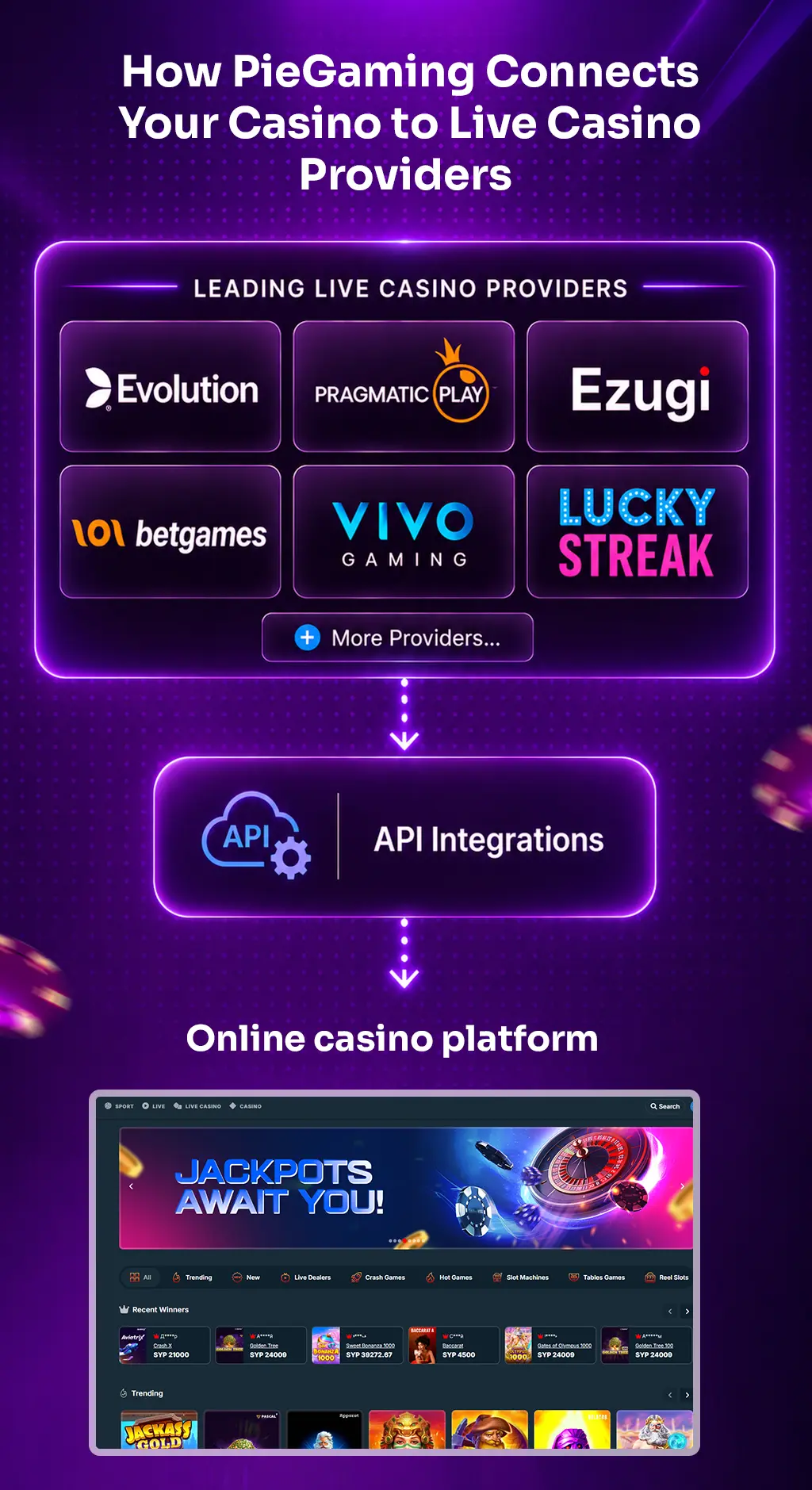
Connect Casino to Live Casino Providers
Wrapping Up…
Choosing live casino software solutions goes well beyond game catalogs. They shape your streaming quality, compliance standing, and operational stability long after launch. No provider is universally “best,” only the one suited to your target markets, budget, and business model.
Evaluate criteria that actually matter, compare shortlisted providers carefully, and give integration the same attention as selection. A well-planned decision now saves costly rework later.

Contact Live Casino Providers
FAQs
-
Who are the top live casino software providers?
The top live casino software providers in 2026 are Evolution, Pragmatic Play Live, Playtech Live, Ezugi and Vivo Gaming. They supply the live studio infrastructure, game interfaces, streaming technology, and table-game content.
-
What is live casino software?
Live casino software is the technology that lets online players join dealer-hosted table games streamed from a studio or casino in real time. It combines live video, betting interfaces, game-control systems, and automated settlement to recreate a land-based gaming experience digitally.
-
How does live casino software work?
Players join a live table, place bets through an on-screen interface, and watch a real dealer manage physical cards, wheels, or dice. Cameras stream the action, while OCR or similar recognition technology captures outcomes. Backend systems then validate bets, calculate payouts, and update balances.
-
What are the key components of live casino software?
Core components include HD multi-camera streaming, professional studio and dealer operations, physical gaming equipment, a player-facing betting interface, game-management and settlement systems, OCR/RFID result capture, chat tools, payment integration, APIs, and operational monitoring. Together, they support real-time gameplay, accurate results, and scalable delivery.
-
How secure is live casino software?
Security depends on the provider, the operator, and the licensing jurisdiction. Reputable regulated solutions use encryption, access controls, surveillance, game logs, and independent audits. UK-licensed live dealer operations, for example, must be independently auditable, use controlled access and video monitoring, and maintain detailed game records.

Palak Madan has been writing about the iGaming industry since 2024. She focuses on helping operators and founders understand their options when launching an online casino, from choosing the right software provider to figuring out costs and compliance requirements across different markets. At PieGaming, she covers topics like white label casino solutions, platform selection, and market entry, turning complex industry information into practical guidance for people building iGaming businesses. She also keeps a close eye on licensing and regulatory changes; particularly how new rules shape the way operators enter and grow in different jurisdictions.

Casino gamification refers to the inclusion of goals, levels, rewards, and other video game elements around the core gambling area. Learn how operators can use gamification in igaming to create more engaging player journeys while managing costs.

Stake.Us, PlayFame, McLuck, MegaBonanza and Zonko are social casino platforms that are free-to-play casino games using virtual coins. These platforms offer hundreds of slots, tables, and instant-win games with daily free coins, tournaments, and bonus features.
Casino CRM strategies help operators to personalize campaigns, improve player retention, reduce churn rate, and maximize player lifetime value.
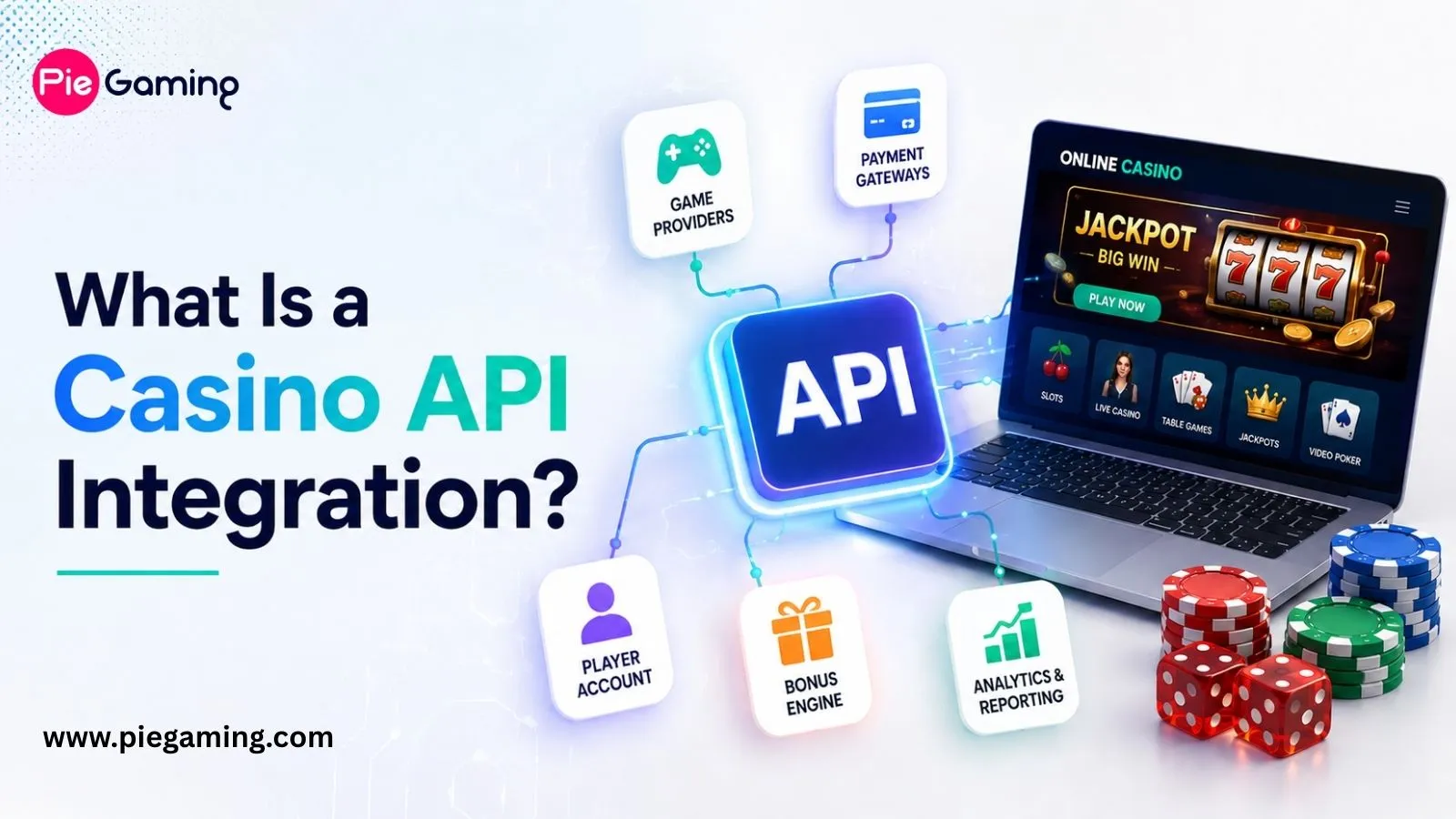
A casino API integration is a software solution that connects your platform with games, payment gateways, wallets, KYC tools and other third-party solutions. It allows data to be exchanged between systems in real-time. This way you can launch quicker, automate tasks, and provide a smooth playable experience.

House Edge is the mathematical advantage built into online casino games and all other forms of gambling. It shapes the odds, influences your winnings and losses, and constitutes the cornerstone of any online casino or sportsbook operator’s overall financial strategy.

The Hi-Lo casino game is a simple card game where players predict whether the next card will be higher, lower, or equal to the current card. This guide explains how Hi-Lo works, its rules, betting options, payouts, gameplay, and strategies players can use when making predictions.
Casino CRM software is a specialized platform for online and land-based gambling operators that tracks player behavior, automates targeted promotions, manages VIP loyalty and supports regulatory compliance.

See you in your inbox soon!

Stay ahead of the game. Subscribe for exclusive content, updates, and insiders!