
Starting a white label online casino business involves multiple steps from platform selection to licensing support, game integration, payment solutions, and launch strategies.

Are you planning to start an online casino? Start with a white label casino solution, which is a ready-to-launch platform that goes live within 2 weeks. It is the easiest business model to start an online casino, which is why so many new operators ask how to start a white label casino first. Still, operators face a lot of difficulties while launching it.
From choosing the right provider to obtaining a license, integrating third-party providers, and player retention, operators find it all challenging while launching an online casino. The white label market is projected to reach USD 667.20 million in 2026, at a CAGR OF 9.05% to reach USD 1,129.76 million by 2032, as per 360iResearch. Though the opportunity is significant, operators must work on every step to make a brand.
For startup operators, this is a complete guide on ‘how to start a white label online casino’ in the highly competitive industry.
Key takeaway
- White label casino software offers pre-built technology with games, payments, PAM, and other tools.
- Building a white label casino involves planning, customization, configuration, testing, licensing, and launch.
- Customization in white label typically includes branding, design, game selection, payment methods, and other platform settings.
- Post-launch support covers platform management, updates, performance monitoring, and ongoing technical assistance.
How Does a White Label Online Casino Business Model Work?
The white label casino model is quite simple, as below:
White label provider
→
Platform + infrastructure + integrations
→
Operator
→
Branded casino
→
Players
The white label casino software is designed and developed by the provider, but once the platform is customized and branded, players will see it as your platform. In the first stage, the white label casino templates are shown to you, and you choose the one that meets your business requirements. Then, discuss your branding guidelines with the provider so that they can customize UI/UX as per your brand identity.
Further, check the list of features provided by the provider. In case you need extra features based on your target market and audience, ask your provider to integrate on-demand additional features in the software.
Payment solutions and popular casino games also come pre-integrated in the software. But if you want to remove or add any from your platform, it can be done by your provider.
A white label software provider reduces the burden from the operator by managing the crucial task of building the online casino software platform.
Whether you’re a provider or an operator, you must know your responsibilities, which include:
Step-by-Step Process to Start a White Label Casino
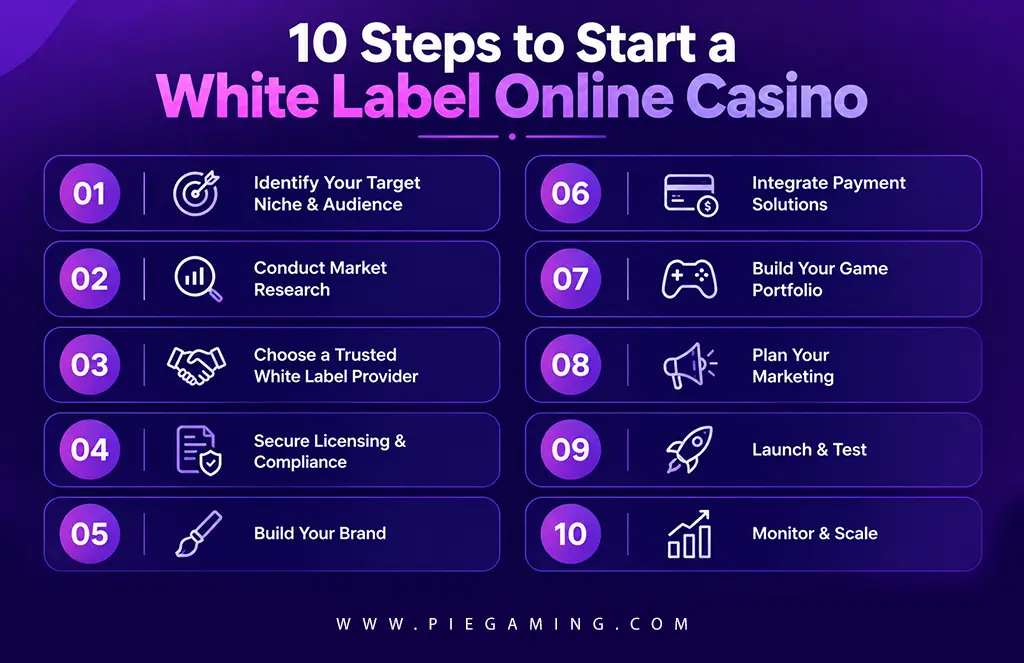
Steps to launch a white label casino platform
How to start a white label online casino? Launching a white label online casino involves various steps. It requires a lot of research, planning, and strategy to launch a successful casino platform.
Step 1 – Identify Your Target Niche & Audience
Before you sign up with any provider, it’s crucial for you to decide your target niche and market — the same first decision covered in our guide on how to start an online casino. Online casino market is competitive and to succeed in the industry, you must pick the right niche.
- Sports-focused casinos (integrated)
- Crypto-focused casino targets blockchain-savvy players
- Localized or global casino markets like the UK, Europe, and South Africa with localized payment methods and languages.
Also, look for the factors like targeted regions and types of games that will appeal to your players. Once you’re clear with the niche, you can tailor your marketing and branding to attract the right audience.
Step 2 – Conduct In-Depth Market Research
If you’re sorted with the chosen niche, it’s time to conduct in-depth market research and understand your competitors’ strengths and weaknesses. You must explore industry trends like gamification, VR casinos, and mobile adoption. Check your markets’ legal & compliance issues, advertising restrictions, and payment preferences.
White doing market research, ask these questions to yourself:
- Is online casino legally permitted in the target market?
- Who are the top competitors?
- What kind of casino games and payment methods do players prefer?
- How expensive is player acquisition?
- What are the regulatory and tax obligations that apply?
Step 3 – Choose a Trusted White Label Casino Software Provider
Choosing the right white label casino provider is important as entire casino operations depend on it. Partner with a provider who provides you with everything pre-integrated in the software so that you don’t need to hop for third-party integration separately — if you want more control over branding and setup than white label allows, turnkey casino software is worth comparing too. For instance, the provider must offer you:
- A wide casino game library
- PAM/back office
- Customization options
- Marketing tools like CRM, CMS, affiliate tracking & bonus engine
- Robust technology (mobile responsiveness, APIs, & modular design)
- Compliance/legal support
Here you can also ask relevant questions before signing, which include:
- Who owns player data?
- Who handles KYC?
- Who manages payment failure?
- What happens during downtime?
- Can you add third-party integrations later?
A good software provider will make these things clear in the agreement.
White Label or Turnkey: Which Path Fits Your Casino Business?
Understand how costs, customization, licensing, and operational control differ between the two models before choosing the right approach for your business.
Step 4 – Secure Licensing & Legal Compliance
Licensing is the most important part of launching an online casino. Without obtaining a license, it’s hard to run an online casino in the big jurisdictions like the UK, Malta, and Europe. The appropriate license also depends on the target market, business structure, and games offered. Some white label software providers assist you in the licensing process while others just leave it on you.
Popular licensing jurisdictions include Malta, Curacao, the UKGC, and Gibraltar.
Malta, Curacao, and Gibraltar are the popular iGaming licensing jurisdictions. However, obtaining a license from one jurisdiction doesn’t authorize operators to launch an online casino anywhere in the world.
But operators have to comply with the licensing requirements of each target market, obtaining additional local licenses wherever required to operate legitimately.
But some jurisdictions require their own localized license to operate legitimately.
Step 5 – Build a Strong Brand Identity
Though white label platforms don’t give much option for customization, it can’t stop you from differentiating your brand from others. In any way, you must build a recognizable brand around the following:
- Keep an easy-to-remember name and logo for the target market.
- Seamless UI/UX to keep registrations, deposits, and withdrawals simple.
- Work on brand voice to match local expectations and player demographics.
- Give your players a localized experience through localized games, content, bonuses, rewards, and responsible gambling information.
- Make your platform mobile-friendly
Remember that your platform should give reasons for your players to choose your casino than competitors.
Step 6 – Integrate Secure Payment Solutions
Poor payment solutions directly affect registration, deposit, acquisition, conversion, and retention. Now, players no longer stick to just one payment solution i.e., fiat; they go beyond it – crypto. Regardless of which market you target, always ensure that you offer the following payment methods to players:
- Bank transfers
- Visa and Mastercard
- e-wallets like PayPal, Skrill, and Neteller
- Local payment solutions
- Open banking and instant bank transfers
- Cryptocurrencies like Bitcoin, Ethereum, USDT, etc.
Don’t just randomly integrate the payment methods rather than prioritizing the methods your target audience uses. Make sure you provide the seamless payment experience to your players with minimal delays and clear transactions flow for better convenience.
Step 7 – Build a Diverse & Engaging Game Portfolio
A casino platform without a vast gaming portfolio doesn’t attract players. Don’t just add high-quality content but a variety of games that players find engaging. Either partner with well-known game providers or get pre-integrated games from software providers. Make sure your game portfolio includes the following:
- Slots
- Poker
- Baccarat
- Blackjack
- Live dealer
- Bingo
- Table games
- Jackpot
- Crash games
- Instant-win games
Apart from casino games, you must also integrate sports betting, eSports, and virtual sports games, if you also want to target a sports audience. Ensure that the games you integrate into the platform are mobile-friendly, engaging, reliable, market-relevant, etc.
Step 8 – Plan a Solid Marketing Strategy
Technology brings platforms online, and marketing brings players to it. Without having a solid marketing plan, you can’t grow your online casino business. You must build a 360-degree marketing strategy around multiple acquisition strategies, including SEO, PPC, advertising, influencer partnerships, and affiliate networks to drive traffic.
Moreover, you can run retention campaigns using email marketing, in-game notifications, and loyalty bonuses. Also, implement gamification features like leaderboards, achievements, and missions to increase player engagement.
Step 9 – Launch & Test
Once everything is integrated in the platform, just conduct a structured pre-launch test to check if everything is seamless and going well. You can start with a beta phase to gather user feedback and fine-tune performance. Just follow the checklist below to ensure things go well:
- Registration
- Login
- KYC flows
- Deposits/withdrawals
- Bonus activation
- Games launch
- Mobile responsiveness
- Account limit
- Responsible gambling controls
- Affiliate tracking
- Customer support
To check, you can conduct testing in a controlled environment before launching the account to the public.
Step 10 – Monitor, Analyze & Scale
Once your online casino is up and running, you’ll want to track its performance. You have to use data to check which channels, games, bonuses, and player segments generate more revenue. This can be done by following a 90-day plan.
Days 1–30 Establish a performance baseline
Track key metrics such as registrations, FTDs and deposit conversion rates to understand how well your players are signing up and depositing. You can also track how much they are depositing on average along with how many withdrawals you are getting. Tracking fraud and suspensions will help you know where issues may lie.
Days 31–60 Test and optimize
To get more deposits, you can try some new bonus offers, payment methods, and lobby designs. Try and check player retention and churn rate to understand where players are losing interest. Also look at your affiliates and see how they are performing and driving valuable players.
Days 61–90 Scale what worked and cut what didn’t
In this window, you have to check what worked and what didn’t work. Check out retention, LTV, GGR/NGR and affiliate performance to understand how well they’re doing commercially. Also, keep tracking withdrawals, frauds, and other metrics to measure the performance.
How Much Does It Cost to Start a White Label Casino?
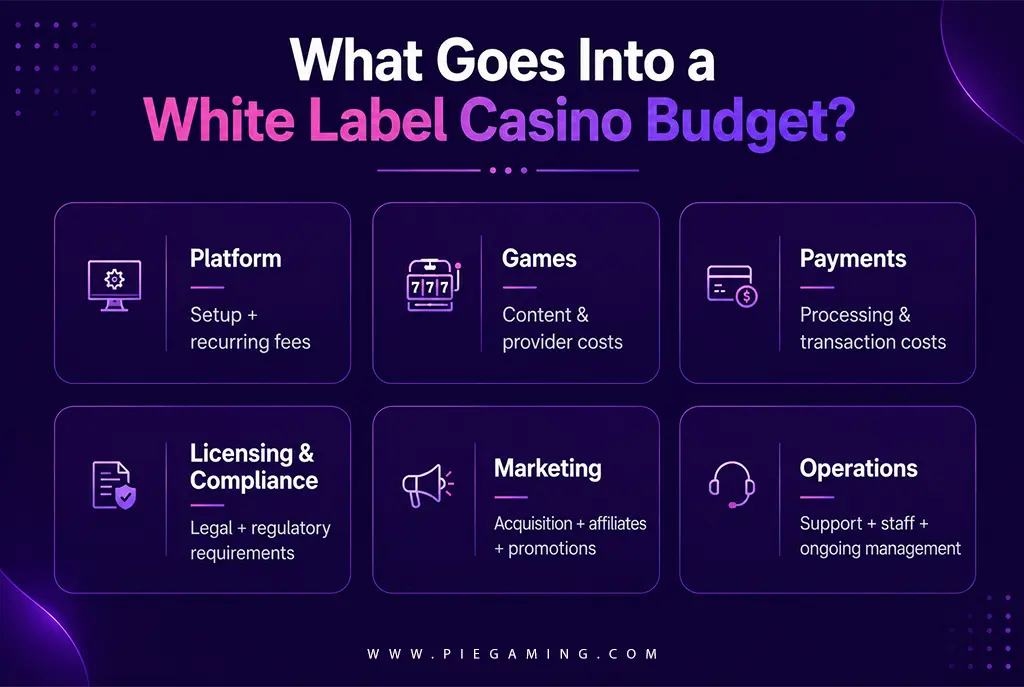
White label casino software cost
How to start a white label online casino? To start with, casino operators must know the cost of launching a white label casino. Though there is no universal fixed price for casino platform, cost depends on the provider, license type, a practical cost structure includes the following:
How PieGaming White Label Casino Software Supports Launch
PieGaming offers a ready-to-launch white label casino solution covering core technology and operational requirements. Its current offerings include PAM, CRM, game lobby management, bonus & rewards, loyalty tools, multilingual functionality, payment integrations, crypto support, KYC/AML, and fraud controls. Further, its platform provides access to more than 5000 casino games and can be launched in 2 weeks, based on requirements and setup.
From scratch to launch process includes the following:
- Understanding the operator’s requirement
- Providing solution blueprint
- Branding and UI/UX customization
- Platform configuration
- Game and payment integrations
- Testing and compliance checks
- Go-live and post-launch support
This is suitable for startups that want to allocate more of their initial budget toward licensing, player acquisition, and brand development rather than building it from scratch.
Conclusion
Launching a white label casino is the most effective solution for fast market entry into the iGaming business. Just knowing how to start a white label online casino isn’t just about finding the right provider or putting a logo on a website.
A successful casino business starts with the right market, ensuring legal compliance, implementing robust KYC/AML processes, and localizing the platform as per the target market. Software providers should support these requirements so that operators can launch a platform without hassle.
Still, success depends on the right platform provider, scalable solution, and powerful integrations that work with the long-term business plan.

Contact Us
FAQ's
-
Does white label casino software support multiple languages and currencies?
A white label casino software does support multiple languages and currencies including fiat and crypto. Operators can integrate the languages as per their targeted countries.
-
How long does it take to launch a white label casino?
A white label casino software can be launched within 2-4 weeks. However, it depends on the level of customization, payment setup, testing, and other business requirements.
-
Can I start a white label casino with no industry experience?
Yes, you can start a white label casino with no prior industry experience. You need a scalable white label casino solution integrated with PAM, affiliate management, games, and payment integrations. But you still need to understand target market, licensing requirements, and day-to-day operations.
-
Is white label casino software better for startups than custom development?
Yes, it can be, especially when startup wants to test a market without higher investment. Whereas custom development is more suitable when an operator requires extensive product differentiation and control over its technology stack.
-
What are the common mistakes to avoid while starting a white label casino platform?
The most common mistakes include: Choosing a provider based on price Entering a market without understanding its regulatory requirements Selecting games without knowing local preferences Underestimating marketing & acquisition costs Ignoring responsible gambling tools Launching without clear KPIs and analytics
-
What support will I get from a white label software provider after launching?
The post launch support can include technical assistance, platform maintenance, software updates, troubleshooting, performance monitoring, and help with integration. However, the exact level of support depends on the provider.


Monika Gola is an iGaming content specialist at PieGaming. Since 2020, she has been researching and developing content around software selection, online casino & sports betting regulations, and operator growth strategies. Her research includes analyzing market opportunities in regions like Europe, Africa, and Southeast Asia, as well as evaluating regulatory frameworks and entry barriers. She is actively monitoring industry trends, compliance updates, and evolving player demands across global iGaming markets to help operators navigate this industry seamlessly.

The best online casino slot providers in 2026 are Pragmatic Play, Evolution Group Studios, Play’n GO, Hacksaw Gaming, Relax Gaming, Games Global, Playtech, Push Gaming, Yggdrasil and Blueprint Gaming. Operators should compare them on six criteria: licensing and certification, RTP range, volatility, market fit, integration and commercial terms.
Casino gamification refers to the inclusion of goals, levels, rewards, and other video game elements around the core gambling area. Learn how operators can use gamification in igaming to create more engaging player journeys while managing costs.
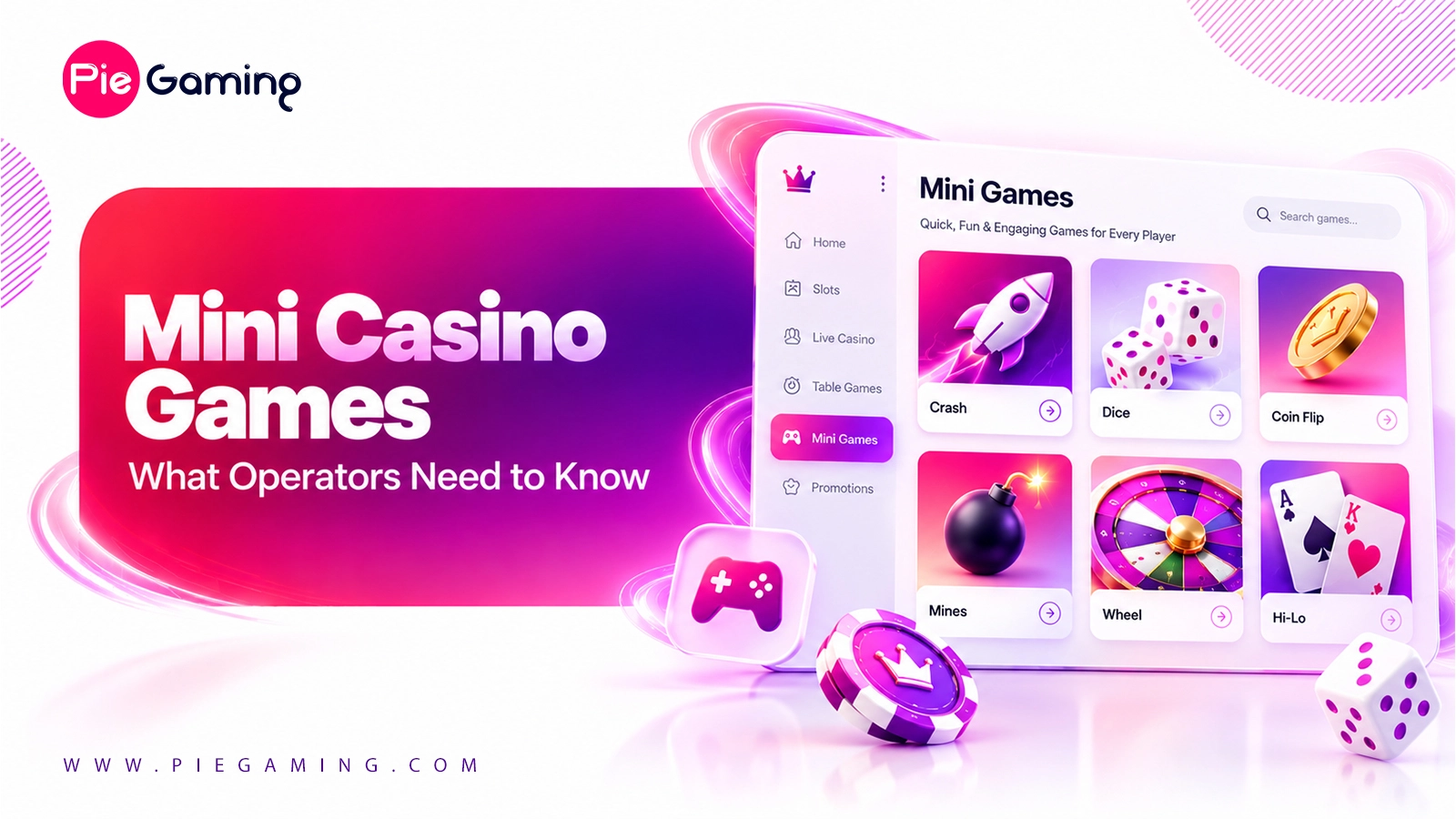
Mini casino games are fast versions of classic casino games and slots made for quick play. They cut out rules and long animations, making them perfect for casual players and mobile users. Each round usually takes between 30 seconds and two minutes.

Stake.Us, PlayFame, McLuck, MegaBonanza and Zonko are social casino platforms that are free-to-play casino games using virtual coins. These platforms offer hundreds of slots, tables, and instant-win games with daily free coins, tournaments, and bonus features.
Casino CRM strategies help operators to personalize campaigns, improve player retention, reduce churn rate, and maximize player lifetime value.
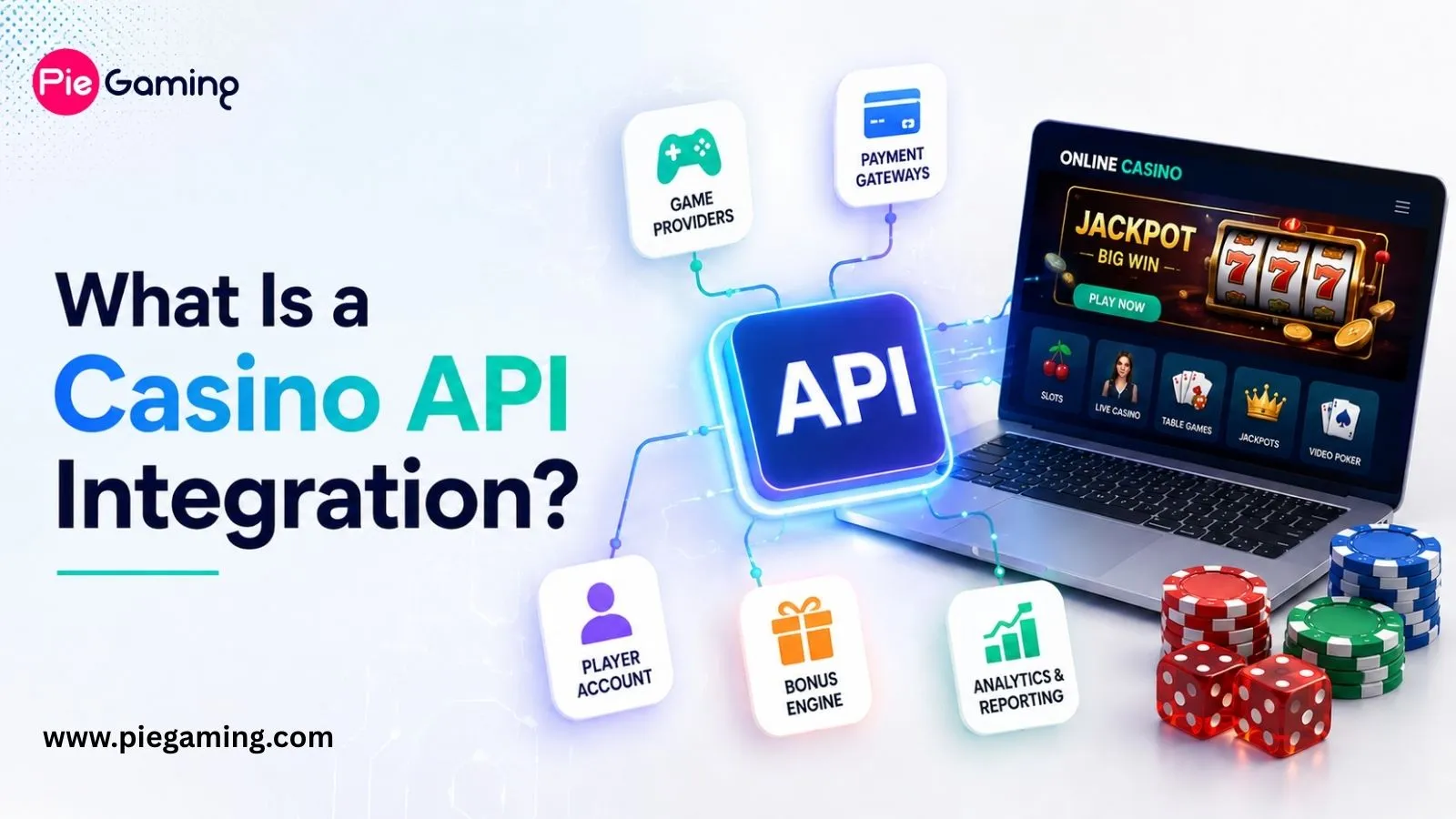
A casino API integration is a software solution that connects your platform with games, payment gateways, wallets, KYC tools and other third-party solutions. It allows data to be exchanged between systems in real-time. This way you can launch quicker, automate tasks, and provide a smooth playable experience.

House Edge is the mathematical advantage built into online casino games and all other forms of gambling. It shapes the odds, influences your winnings and losses, and constitutes the cornerstone of any online casino or sportsbook operator’s overall financial strategy.

See you in your inbox soon!

Stay ahead of the game. Subscribe for exclusive content, updates, and insiders!