
Compare PieGaming, Slotegrator, SoftGamings, TRUEiGTECH, Digient, AIS Technolabs, SDLC Corp, Sirplay, BETFOC, and PlaylogiQ on pricing, licensing, games, launch time, support, and platform capabilities.
You’ve compared pricing decks, sat through three demos, and every provider still sounds identical. “Full suite.” “Scalable.” “24/7 support.”
At some point, the pitch stops mattering, and the product has to speak. So instead of another provider comparison that reads like a brochure, here’s what operators actually ask before they sign — and which white label partners hold up when you go looking for real answers.
Key takeaway
- A white label casino solution is ready-to-launch software with pre-integrated games, payments, PAM, and other tools.
- Selecting a provider requires comparing games, payments, customization, launch time, and overall costs.
- Total cost may include setup fees, revenue share, payment charges, integrations, and ongoing support.
How White Label Casino Providers Actually Work?
A white label casino provider is a company that gives you pre-built online casino software — licensed, stocked with games, and technically operational — that you rebrand and take to market as your own product. You’re not buying software from scratch. You’re buying a running business infrastructure with your name on it.
The core of any white label deal is game content, usually delivered through an aggregation layer that pulls from multiple studios, so your lobby isn’t dependent on a single supplier. Alongside that:
- Payment processing: Card, crypto, and e-wallet integrations, sometimes pre-negotiated with PSPs
- Licensing coverage: Either under the provider’s master license or with support obtaining your own
- Back office: Player management, reporting dashboards, transaction monitoring
- CRM and bonus tools: Segmentation, bonus engine, free spin campaigns, loyalty mechanics
- Support infrastructure: Live chat, ticketing, sometimes fully managed player support
What’s actually included varies more than most providers advertise. Some bundle everything into a flat monthly fee. Others treat payments, CRM, or managed support as add-ons. A few offer licensing coverage only in select jurisdictions, which matters significantly if you’re targeting regulated markets. Always confirm what’s in the base package versus what gets invoiced separately.
Top White Label Casino Providers Compared 2026
Narrowing a white label partner from a crowded market isn’t straightforward. To make it easier, we’ve broken down the leading providers of 2026 across the factors that actually move the needle for operators.
1. PieGaming
PieGaming
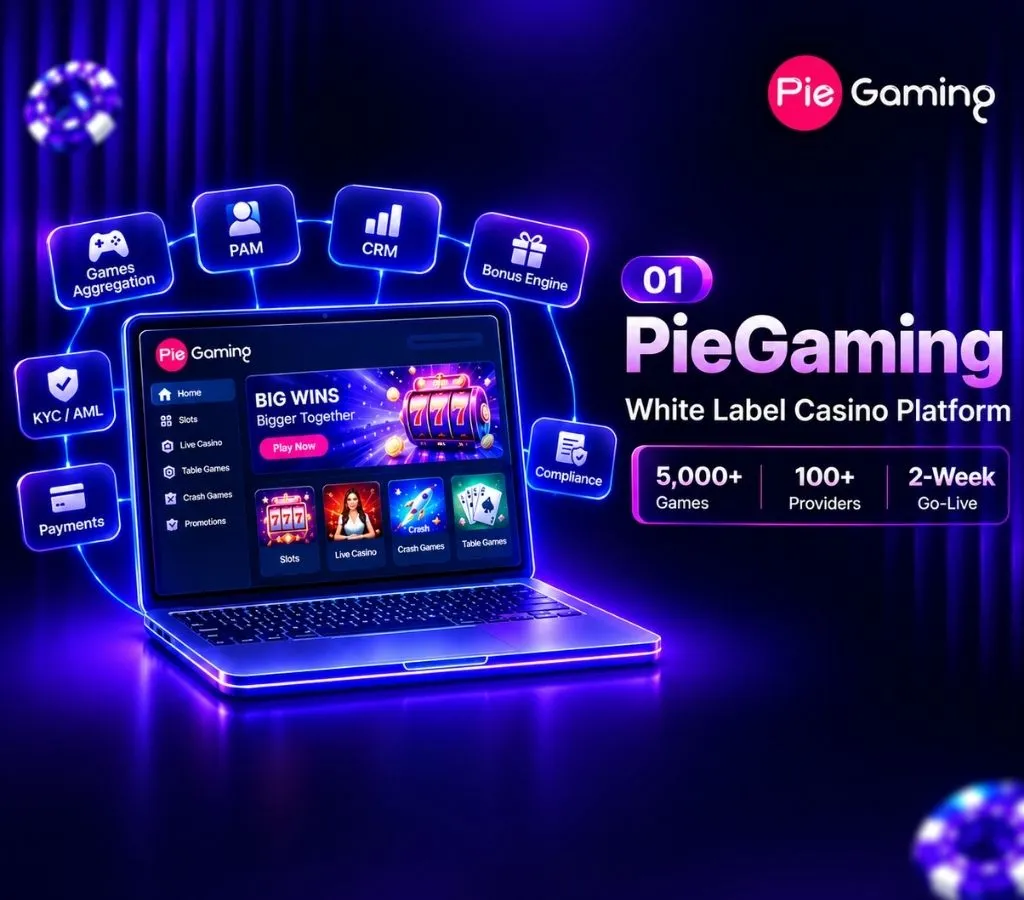
PieGaming is an iGaming software provider offering a white label casino platform that covers the full operational stack, from game aggregation and payments to CRM and compliance, designed to get operators live within two weeks.
Key Features
- 5,000+ games from 100+ game providers including Evolution, Pragmatic Play, Spribe, NetEnt, and PG Soft.
- Integrated PAM solution with KYC, segmentation, player activity tracking, and rewards management.
- Bonus system covering free spins, cashback, redeposit offers, and loyalty programs.
- Player CRM with automated communication flows and campaign management.
- Crypto support for Bitcoin, Ethereum, USDT, and Tether.
- Built-in KYC/AML tools, anti-fraud systems, and responsible gambling controls.
- Multi-language and multi-currency support across 30+ countries.
- Mobile-first platform compatible across desktop, Android, and iOS.
- Telegram casino solution with native bot integration, allowing operators to run a fully functional casino directly inside Telegram without a standalone app or website.
Best For
Startups and first-time operators looking for a low-investment, fast-deployment casino solution with minimal operational complexity.
Strengths
- Go-live timeline of two weeks, one of the faster deployment timelines in the market.
- Transparent pricing with one of the industry’s lowest GGR rates.
- Wide game library across slots, live dealers, crash games, and table games.
- Strong crypto infrastructure for operators targeting crypto-first markets.
Limitations
- Customization is limited to UI elements like themes, colors, and logos; deeper feature-level customization requires a turnkey build.
- Best suited for operators who don’t need a fully custom platform.
2. Slotegrator
Slotegrator is an established iGaming software provider offering a white label casino solution that bundles platform development, licensing coverage, and player support under one business structure.
Key Features
- 30,000+ games from 180+ licensed providers covering slots, live dealer games, table games, poker, virtual sports, and lottery
- 150+ payment options integrated through a unified API
- Operation under Slotegrator’s legal entity and Curacao sublicense
- B2C player support included in the white label package
- 24/7 technical assistance and account management
- Built-in modules for BI reporting, risk management, and affiliate management
- Customizable bonus system covering sign-up bonuses, cashback, free bets, and promotions
- Interface templates configurable by target market
Best For
Operators who want to bypass the licensing process entirely and prefer to delegate both technical maintenance and player support to the provider.
Strengths
- One of the largest game libraries in the white label space at 30,000+ titles
- Full operational handoff available, including player-facing support
- Unified API simplifies third-party integrations
- Established since 2015 with API certifications in Lithuania and Georgia
Limitations
- Launch timeline of approximately one month, slower than some competitors.
- Curacao sublicense only, which limits entry into more strictly regulated markets like the UK or Malta.
- Deeper customization requires moving to their turnkey solution.
3. SoftGamings
SoftGamings is a white label casino software provider offering a fully licensed, ready-to-launch platform with games, payments, and operational support, built for operators who want fast market entry with minimal technical involvement.
Key Features
- 10,000+ games from 250+ studios including Evolution Gaming, NetEnt, Pragmatic Play, Betsoft, and Quickspin.
- Payment options covering Visa, Mastercard, Skrill, Neteller, bank transfers, open banking solutions, and crypto.
- Operate under SoftGamings’ existing gambling license with the option to switch to an independent license later.
- Full back office with user management, KYC/AML tools, bonus engine, affiliate system, and CRM.
- Loyalty and gamification tools including tournaments, achievements, and promotional setups.
- Customizable website templates with branding adjustments.
Best For
New operators looking for a cost-effective, low-complexity entry into the market who want the provider to handle licensing, hosting, and technical maintenance from day one.
Strengths
- Broad game library spanning slots, live dealer, poker, virtual sports, and blockchain casino content.
- Flexible upgrade path from white label to turnkey as the business scales.
- Open banking integrations give payment coverage beyond standard card and e-wallet options.
- Full technical, legal, and operational support included.
Limitations
- Launch timeline of approximately six weeks, on the slower end for a white label product.
- Customization is limited compared to their turnkey offering.
- Curacao license is the default option, which restricts access to tightly regulated markets.
4. TrueiGTech
TRUEiGTECH is an iGaming software provider offering a white label casino platform built around a flat-fee model, multi-jurisdiction licensing coverage, and a 45-day go-live framework for operators across regulated and crypto markets.
Key Features
- 5,000+ games from 100+ studios covering slots, live dealer, and sportsbook content.
- Licensing coverage across UKGC, MGA, Kahnawake, Anjouan, Tobique, and Isle of Man.
- Pre-integrated fiat and crypto payment gateways with built-in fraud protection.
- Advanced PAM with multi-currency wallets, session controls, and player segmentation.
- Centralized back office for player tracking, payment processing, and risk configuration.
- CRM, VIP management, affiliate support, and bonus campaign tools.
Best For
Operators targeting regulated markets who need broad licensing coverage, or crypto-first operators looking for an entry-level setup starting at $10,000.
Strengths
- Flat-fee pricing model with zero GGR share, which protects operator margins at scale.
- One of the wider jurisdiction coverage sets among white label providers.
- Sweepstakes and Telegram casino variants available for US and social gaming markets.
- Offices across the US, UK, Germany, Spain, Malta, and Brazil.
Limitations
- Smaller track record with 50+ casino launches compared to more established providers.
- Platform branding and feature depth are not fully transparent without a demo call.
- Enterprise-tier pricing requires a custom quote with no public benchmarks beyond the base $10,000 tier.
- 45-day launch timeline is slower than some competitors in the white label space.
5. Digient
Digient is an iGaming-focused software provider delivering a compliance-ready white label casino platform for operators who want a fully branded, revenue-generating casino live within 3 to 5 weeks.
Key Features
- 15,000+ games from 150+ certified providers covering slots, live dealer, crash games, table games, virtual sports, and progressive jackpots.
- 100+ payment methods supporting fiat and crypto, including BTC, ETH, USDT, and BNB.
- Compliance modules for MGA, UKGC, Curacao, Isle of Man, and Kahnawake with built-in KYC/AML workflows and responsible gaming tools.
- Full player CRM with registration, segmentation, VIP tiering, and real-time reporting.
- Fully customizable frontend including lobby design, email templates, and player notifications.
Best For
Operators across Europe, Asia, LATAM, and Africa looking for a fully managed white label solution with strong compliance coverage and transparent pricing.
Strengths
- One of the faster launch timelines in the market at 3 to 5 weeks.
- Broad jurisdiction compliance coverage built into the platform.
- 100% iGaming focused, not a generic SaaS provider.
- Transparent pricing with no hidden revenue share.
Limitations
- Relatively newer provider with limited public track record data on launch volume.
- Custom game development is available but as a separate service, not bundled into the white label package.
6. AIS Technolabs
AIS Technolabs is a software development company with 16+ years of experience offering white label casino software across web, mobile, land-based, and crypto casino formats, serving operators in 45+ countries.
Key Features
- 30,000+ games from 50+ providers covering slots, live dealers, crash games, roulette, baccarat, blackjack, and virtual sports.
- Crypto and fiat payment support including Bitcoin, Ethereum, and major altcoins.
- Full back office with PAM, CMS, transaction management, access roles, and anti-fraud module.
- Bonus management system covering welcome offers, cashback, free spins, and loyalty programs.
- Affiliate management platform with referral tracking, commission management, and conversion reporting
- Multi-platform support across web, mobile, land-based terminals, and self-service kiosks.
Best For
Operators who want full platform ownership and need flexibility across multiple deployment formats, including land-based and mobile casino environments alongside online.
Strengths
- One of the largest game libraries listed at 30,000+ titles.
- Full source code ownership, which is uncommon among white label providers.
- Broad engagement model options including fixed cost, flexible time and cost, and dedicated team.
- Strong multi-market reach with offices in the US, UK, India, and Canada.
Limitations
- Primarily a software development company, not a dedicated iGaming operator infrastructure provider.
- Licensing support is not clearly detailed.
- Launch timeline not publicly specified.
7. SDLC Corp
SDLC Corp is a software development company offering a white label casino solution on a one-time fixed fee model with zero revenue share, covering games, payments, back office, and KYC from launch day.
Key Features
- 5,000+ games from 100+ certified studios including Pragmatic Play, NetEnt, Play’n GO, Evolution Gaming, Ezugi, Betsoft, Quickspin, Hacksaw, and Push Gaming.
- Payment support covering Visa, Mastercard, e-wallets, USDT, BTC, and ETH.
- Casino back office with player management, revenue reporting, bonus engine, and affiliate system.
- Cloud-hosted infrastructure with 99.9% uptime SLA and CDN delivery.
- Tiered pricing from $15,000 with clearly defined scope per tier.
Best For
Cost-conscious operators who want a one-time investment model with no ongoing revenue share and clear pricing transparency from the start.
Strengths
- Only provider on this list with publicly tiered pricing starting at $15,000.
- Zero revenue share model protects long-term operator margins.
- Sportsbook add-on available on the Premium tier.
Limitations
- SDLC Corp does not provide gambling licenses; operators must secure their own.
- Launch timeline of 4 to 12 weeks is wider than most, making planning harder.
- Partial backend ownership only; full ownership requires moving to a custom build.
8. Sirplay
Overview
Sirplay is an iGaming software provider offering a white label casino platform built around one of the largest game libraries in the market, with a strong focus on performance, payment flexibility, and crypto-native operations.
Key Features
- 50,000+ games across slots, table games, live dealer, video poker, and other categories from 75+ providers.
- 15,000+ slot titles, 500+ table games, 700+ video poker variants.
- Payment integrations covering Flutterwave, Paystack, PayU, Mercado Pago, and all major cryptocurrencies and Web3 wallets.
- Bonus tools, campaign builder, and game tournament management.
- Affiliate marketing tools, referral system, and social media integrations.
- Player account controls with KYC, fraud detection, and geolocation tools.
- Mobile push notifications, web push notifications, and in-app messaging.
- API and iFrame integration options.
Best For
Operators targeting Africa, Latin America, or crypto-first markets who need strong regional payment coverage and a large game library without heavy infrastructure requirements.
Strengths
- Largest game library on this list at 50,000+ titles.
- Strong regional payment coverage across Africa and Latin America with Flutterwave, Paystack, PayU, and Mercado Pago.
- Full crypto and Web3 wallet support.
- ISO 27001 and GLI certifications add credibility on security and fairness.
Limitations
- Website and product information are sparse, making it harder to evaluate platform depth before a demo.
- Launch timeline of 4 to 6 weeks is an estimate with limited detail on what’s included.
9. BETFOC
BETFOC is a B2B iGaming software provider offering a white label casino platform with a claimed 72-hour launch timeline, international licensing support, and 10,000+ games across a ready-to-deploy solution.
Key Features
- 10,000+ casino games from multiple providers.
- 100+ ready-made casino website design templates.
- Payment gateway integrations with multi-currency support.
- Anti-fraud detection with real-time monitoring.
- Risk management tools for betting control and financial oversight.
- Player engagement and retention features.
- Multi-language support for global market reach.
- Licensing support across Curacao, Malta, Belgium, Greece, Belarus, and Latvia.
Best For
Operators who need the fastest possible time to market and want licensing consultation bundled with the platform setup.
Strengths
- 72-hour launch claim is the fastest on this list by a significant margin.
- Broad licensing coverage across multiple regulated jurisdictions, including MGA and Belgian license.
Limitations
- Very limited public detail on game providers, payment methods, and back office features.
- The 72-hour launch claim lacks supporting detail on what’s actually live at that stage versus what’s configured later.
10. PlayLogicQ
PlaylogiQ is an award-winning iGaming platform provider with a strong focus on Africa and high-growth markets, offering a fully managed white label solution covering casino, sportsbook, and esports under one contract.
Key Features
- 15,000+ casino games from 200+ providers including live casino, crash games, and SIS-powered esports.
- 150+ payment methods through a dedicated payment hub.
- CRM and gamification engine with bonus tools, jackpots, free spins, loyalty features, and tournaments.
- Dedicated account manager from setup through ongoing operations.
Best For
Operators targeting Africa and other high-growth emerging markets who need a combined casino and sportsbook solution with fully managed trading and risk services.
Strengths
- Multiple industry awards including SiGMA Africa 2025, SiGMA Eurasia 2024, and Sports Betting East Africa 2024 and 2026.
- One of the few providers with a dedicated Africa market focus and proven track record in the region.
- Fully managed trading and risk removes a major operational burden from the operator.
Limitations
- Curacao license only included as standard, which limits entry into stricter regulated markets.
- Heavier sportsbook focus means casino-only operators may find the package broader than needed.
Quick Comparison: Top White Label Casino Providers
| Provider | Best For | Game Content | Crypto Support | Typical Launch Time |
| PieGaming | Startups and first-time operators | 5,000+ games, 100+ studios | Yes | 2 weeks |
| Slotegrator | Operators wanting full support delegation | 30,000+ games, 180+ providers | Not specified | ~1 month |
| SoftGamings | New operators, low-complexity entry | 10,000+ games, 250+ studios | Yes | ~6 weeks |
| TRUEiGTECH | Regulated market and crypto operators | 5,000+ games, 100+ studios | Yes | 45 days |
| Digient | Operators across Europe, Asia, LATAM, Africa | 15,000+ games, 150+ providers | Yes | 3–5 weeks |
| AIS Technolabs | Operators needing multi-format deployment | 30,000+ games, 50+ providers | Yes | Not specified |
| SDLC Corp | Cost-conscious operators, one-time investment | 5,000+ games, 100+ studios | Yes | 4–12 weeks |
| Sirplay | Africa and LATAM crypto-first operators | 50,000+ games, 75+ providers | Yes | 4–6 weeks |
| BETFOC | Operators needing fastest time to market | 10,000+ games | Not specified | 72 hours |
| PlaylogiQ | Africa and high-growth market operators | 15,000+ games, 200+ providers | Not specified | Not specified |
The Real Cost of a White Label Casino Platform
The platform fee is almost never the number that matters most. What operators actually pay across year one looks significantly different once payments, compliance, licensing, and hosting are added to the base cost.
Setup fees vs. revenue-share models
White label pricing follows one of two structures.
- Setup fees range from ~$5,000 for very basic templates to $20,000 at the starter tier, $50,000 to $150,000 at the mid-to-enterprise tier, with some custom deals exceeding $200,000. The $5,000 figure is the extreme low end and not typical for a market-ready build.
- The alternative is revenue share, where the provider takes roughly 10 to 35% of GGR or NGR monthly. At $100,000 monthly GGR, that is $10,000 to $35,000 going to the provider every month, indefinitely. Note that many contracts use NGR or hybrid bases rather than GGR, so always confirm what the percentage applies to before signing.
Most white-label and turnkey casino providers charge through fixed monthly platform fees, revenue share, or a hybrid of both. Revenue-share agreements typically sit at 10%–30% of GGR, with fixed monthly fees running into the tens of thousands of euros.
Payment costs add another layer. Gambling merchants pay more than standard e-commerce rates, with card processing alone running 3%–8% per transaction. On top of that, you’re looking at:
- FX spreads on cross-currency transactions
- Chargeback and dispute fees that can spike depending on your player mix
- Rolling reserves held by your payment provider
- Payout costs for processing player withdrawals
These fees compound quickly, so your cost-of-acceptance picture looks very different from the headline processing rate alone.
Hidden costs to budget for
The setup fee covers the platform. Everything below is almost always paid by the operator on top of it.
| Cost Category | Typical Range | Structure | Who Pays |
| Payment gateway fees | 2–5% per transaction (fiat); 0.5–1.5% (crypto, variable) | Per-transaction | Operator |
| KYC/AML tooling | $0.50–$3.00 per check; $2,000–$8,000/month for full compliance stack | Per-check or monthly | Operator or bundled |
| Licensing sub-fees | Curacao sub-licence: low five figures all-in; MGA/Isle of Man: $35,000–$80,000+; UKGC and Tier-1 markets: mid-five to low-six figures annually | Flat annual | Operator |
| Hosting | $1,000–$5,000/month if separate; often bundled into platform fee | Monthly or bundled | Provider or operator |
| Game provider margins | 8–18% of GGR or NGR on top of platform fee; combined platform and game shares can consume 25–40%+ of GGR | % of GGR or NGR | Operator |
The honest number to model is 24-month total cost of ownership across all categories above, not just the setup fee, before signing anything.
Risks and Limitations to Understand Before You Sign
White label get operators to market fast. What it does not always get them is control, and that gap becomes expensive as the business grows.
Reduced control over the technology stack
You are building on someone else’s infrastructure. The core platform cannot be modified if a feature does not exist on the provider’s roadmap; you wait for it or work around it.
Providers set their own development priorities, and your business needs rarely drive those decisions. Operators who need custom game logic, unique player flows, or market-specific functionality will consistently hit walls that a white label contract was never designed to remove. As operational requirements become more complex, many teams begin exploring solutions that offer greater ownership, flexibility, and control over the platform architecture.
Revenue-share margin compression
Percentage-based models work against operators as they scale. At low GGR, a 20% revenue share is manageable. At $500,000 monthly GGR, that same percentage sends $100,000 to the provider every month. The platform cost stays proportional to revenue rather than to actual platform usage, which means your unit economics get worse, not better, as the business grows.
License and jurisdiction dependency
If you are operating under a provider’s master license, your ability to take bets is directly tied to that license remaining active and in good standing. A license suspension, revocation, or jurisdiction-level regulatory change at the provider level can take your operation offline with little to no notice. This is an operational risk most operators underestimate at the contract stage.
Difficulty transitioning to an independent platform later
Exiting a white label is rarely as simple as switching providers. The main friction points are:
- Data portability: Player data, transaction history, and KYC records are often held by the provider. Getting clean, exportable data is not guaranteed unless it is written into the contract.
- Player account migration: Moving active player accounts to a new platform without disrupting balances, bonuses, and session history is technically complex and operationally risky.
- Rebuilding under a new license: If you move to an independent platform, you will likely need your own license, which adds three to six months and cost before you can legally operate independently.
How to Evaluate a White Label Casino Software Provider
How to Evaluate a White Label Casino Software Provider
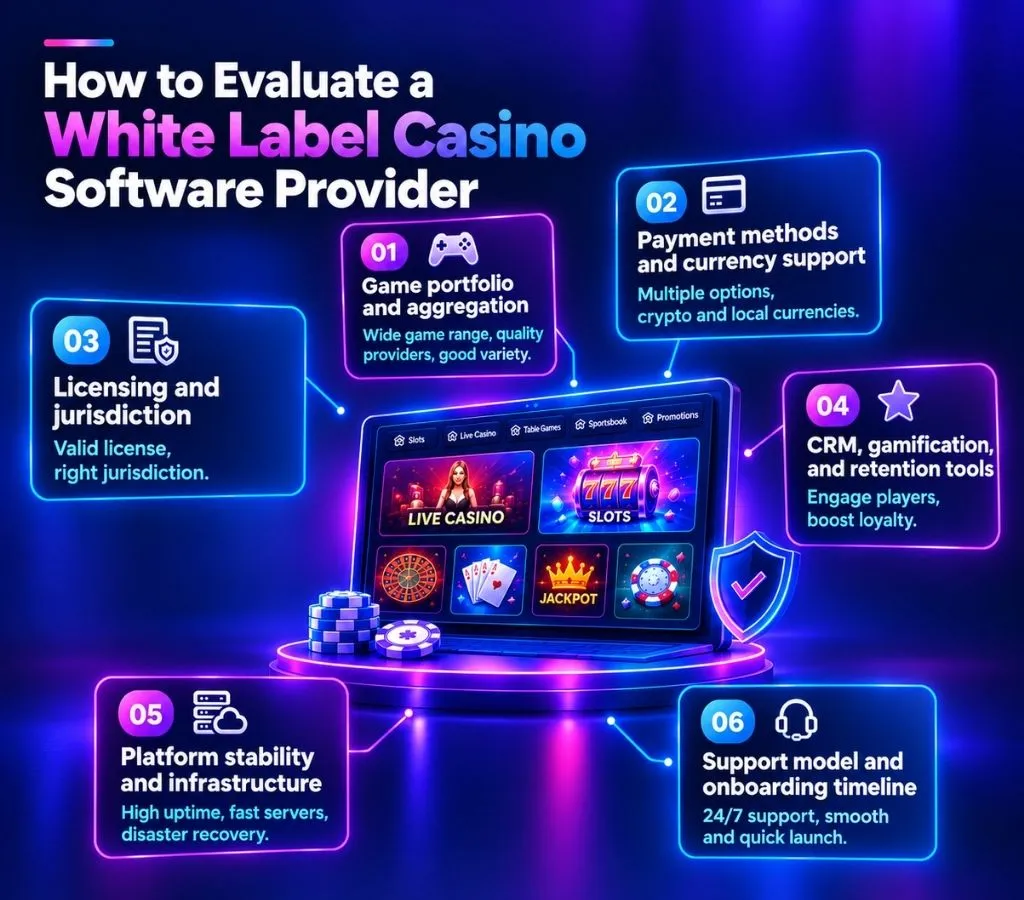
Choosing a white label partner is not just a technology decision. It determines what markets you can enter, how much revenue you keep, and how fast you can respond when something breaks.
Game portfolio and aggregation
The game library number in a pitch deck tells you less than the depth behind it. For live casinos, what matters is studio variety, whether providers are tier-one names or filler, dealer localization in your target market’s language, table range across low-limit and VIP segments, and streaming latency. Test the stream before signing, not after.
Payment methods and currency support
Evaluate payment coverage against your specific target market, not the provider’s global list. Visa and Mastercard are baseline. Beyond that, confirm multi-currency support, crypto settlement capability, and regional payment coverage. LATAM operators need PIX and Mercado Pago. African operators need mobile money. A long payment list means nothing if your market is missing.
Licensing and jurisdiction coverage
| Jurisdiction | Typical Cost | Turnaround |
| Curacao eGaming | $15,000–$30,000 all-in | 8–12 weeks |
| MGA (Malta) | $25,000–$50,000+ annually | 3–6 months |
| UKGC | $30,000–$60,000+ annually | 3–6 months |
| Isle of Man | $35,000–$50,000 annually | 3–5 months |
Always confirm whether the provider’s license covers your target geography and whether sub-licensing is available.
CRM, gamification, and retention tools
Confirm the bonus engine handles wagering logic without custom development, that loyalty tools go beyond basic point systems, and that segmentation allows behavioral targeting rather than broadcast-only messaging.
Platform stability and infrastructure
Get uptime guarantees in writing. Anything below 99.9% SLA is a red flag. Confirm server location relative to your player base, CDN coverage, and documented disaster recovery procedures.
Support model and onboarding timeline
Email-only support is not acceptable for a 24/7 operation. Confirm whether a dedicated account manager is included post-onboarding, and get the launch timeline in writing with milestone dates, not just a headline number.
Wrapping Up…
Choosing the right white label casino provider is less about finding the biggest game library and more about finding the partner whose infrastructure, licensing coverage, and cost structure align with where your business is going, not just where it is starting. Knowing how to start a white label casino can help you evaluate providers more effectively and avoid costly mistakes during the launch process.
Get the contract details right, model the 24-month cost honestly, and treat the exit terms as seriously as the launch timeline.

Contact-us
FAQs
-
What is a white label casino provider?
A company that supplies a ready-built, licensed casino platform that operators rebrand and take to market as their own product, without building the underlying technology from scratch.
-
How do I choose the best white label casino platform provider?
Evaluate licensing coverage, game depth, payment flexibility, CRM tools, uptime guarantees, and total cost of ownership over 24 months, not just the headline setup fee.
-
Do white label casino providers support mobile play?
Yes. Most modern white label platforms are built mobile-first, with responsive web interfaces and, at higher tiers, dedicated iOS and Android apps included in the package.
-
What services do white label casino software providers offer?
Typically: game aggregation, payment processing, KYC/AML compliance, back office, CRM and bonus tools, licensing support, hosting, and post-launch technical support, though inclusions vary by provider.
-
What technologies do the best white label casino software providers use?
Cloud infrastructure for scalability, REST APIs for third-party integrations, certified RNG systems for game fairness, HTML5 for cross-device compatibility, and increasingly AI for player segmentation and retention.
-
White label or turnkey: what’s the difference?
The main difference between white label and turnkey lies in the level of customization, control, and technical involvement. White label is best for operators looking for fast launch with less capital while turnkey is designed for businesses requiring more customization and control.

Palak Madan has been writing about the iGaming industry since 2024. She focuses on helping operators and founders understand their options when launching an online casino, from choosing the right software provider to figuring out costs and compliance requirements across different markets. At PieGaming, she covers topics like white label casino solutions, platform selection, and market entry, turning complex industry information into practical guidance for people building iGaming businesses. She also keeps a close eye on licensing and regulatory changes; particularly how new rules shape the way operators enter and grow in different jurisdictions.

The best online casino slot providers in 2026 are Pragmatic Play, Evolution Group Studios, Play’n GO, Hacksaw Gaming, Relax Gaming, Games Global, Playtech, Push Gaming, Yggdrasil and Blueprint Gaming. Operators should compare them on six criteria: licensing and certification, RTP range, volatility, market fit, integration and commercial terms.
Casino gamification refers to the inclusion of goals, levels, rewards, and other video game elements around the core gambling area. Learn how operators can use gamification in igaming to create more engaging player journeys while managing costs.
Stake.Us, PlayFame, McLuck, MegaBonanza and Zonko are social casino platforms that are free-to-play casino games using virtual coins. These platforms offer hundreds of slots, tables, and instant-win games with daily free coins, tournaments, and bonus features.
Casino CRM strategies help operators to personalize campaigns, improve player retention, reduce churn rate, and maximize player lifetime value.
A casino API integration is a software solution that connects your platform with games, payment gateways, wallets, KYC tools and other third-party solutions. It allows data to be exchanged between systems in real-time. This way you can launch quicker, automate tasks, and provide a smooth playable experience.
House Edge is the mathematical advantage built into online casino games and all other forms of gambling. It shapes the odds, influences your winnings and losses, and constitutes the cornerstone of any online casino or sportsbook operator’s overall financial strategy.
The Hi-Lo casino game is a simple card game where players predict whether the next card will be higher, lower, or equal to the current card. This guide explains how Hi-Lo works, its rules, betting options, payouts, gameplay, and strategies players can use when making predictions.


See you in your inbox soon!

Stay ahead of the game. Subscribe for exclusive content, updates, and insiders!