
Casino game aggregators are platforms that integrate games from multiple providers through one API, helping online casinos launch faster, reduce technical complexity, and offer a diverse, scalable game portfolio.

Slots, live dealer games, roulette, blackjack, crash games, and thousands of other titles are what keep your players coming back. But integrating every game provider individually? That means managing multiple APIs, contracts, technical certifications, and constant maintenance.
A casino game aggregator solves this. It connects you to multiple game providers through one single API integration. Instead of building separate connections, you gain access to a massive game portfolio through one centralized platform. Less development time. Simpler operations.
Whether you’re launching a new casino, expanding an existing platform, or moving into a new regulated market, you need to understand how casino game aggregators work. This guide walks you through how they operate, their revenue models, key benefits, potential limitations, and how to pick the right aggregator for your business.
What Is a Casino Game Aggregator?
If you’ve ever wondered how an online casino manages to offer hundreds of games from dozens of different studios without the whole thing falling apart behind the scenes, the answer is usually a game aggregation software.
Casino games aggregator is a software solution that provides operators with access to content offered by multiple game providers in a single integration. A typical casino game aggregator connects providers such as Evolution, Pragmatic Play, Playtech, NetEnt, Hacksaw Gaming, BGaming, Relax Gaming, and hundreds of independent studios through a unified API.
It may also be referred to as a game aggregation platform, casino content hub, or iGaming aggregation software. The term varies in accordance with the speaker; however, the task remains the same: to make casino content easy to source, control, and deliver at scale.
Under the hood, three parties are always involved:
- The operator is the casino brand that puts games in front of players.
- The game provider is the studio that actually built those games.
- The platform is the casino’s backend, covering the PAM system, wallet infrastructure, and reporting tools that keep everything running.
The casino games aggregator sits in the middle of all three, connecting them through a unified API. It handles the communications between systems, smooths out the technical differences between providers, and keeps data flowing cleanly across bets, wins, updates and reporting.
In plain terms, it’s the infrastructure layer that makes running a multi-provider casino possible without turning your tech team into a full-integration unit.
Casino Game Aggregator vs Direct Integration vs Casino Platform
Your integration choice shapes everything: how fast you launch, what you’ll spend, how many games you’ll have, and whether you can scale. All three approaches work, but they’re built for different operators.
| Feature | Casino Game Aggregator | Direct Integration | Casino Platform |
| API integrations | One integration provides access to multiple game providers | Separate integration required for every provider | Usually none, as integrations are managed within the platform |
| Time to launch | Weeks | Months | Depends on the platform configuration and customization requirements |
| Maintenance | Low. Updates, API changes, and provider connections are handled by the aggregator. | High. Your development team must maintain every provider’s integration individually. | Medium. Most maintenance is handled by the platform, but customization and platform updates may still require developer involvement. |
| Provider relationships | Managed by the aggregator through existing commercial agreements | Direct contracts and commercial negotiations with each game provider | Mixed. Some providers are included through the platform, while others may require separate agreements. |
| Scalability | High. New providers and game categories can typically be added through the same API connection. | Medium. Scaling requires additional integrations, testing, and maintenance for each new provider. | Medium. Expansion depends on the platform’s supported providers and roadmap. |
Which one is the best?
- Game Aggregator – One API connects you to hundreds of games from multiple studios. Your team stays lean, and maintenance becomes someone else’s job. Fastest path to launch.
- Direct Integration – You control terms, schedules, and provider-specific features. But you’ll need a dedicated technical team to build and maintain every integration. Best for enterprise operators only.
- Casino Platform – Everything bundled together (games, payments, player management). Convenient for new operators, but limits provider choice and flexibility.
How Does a Casino Games Aggregator Work? (Technical Breakdown)
Most people see the game library on a casino site and assume someone just uploaded a bunch of titles. The reality behind the scenes is a lot more layered than that. Here is what is actually happening technically when a game aggregator is doing its job.
1. Single API Gateway
Think about what it would take to connect individually with 50 different game studios. Each one has its own technical protocols, data formats, and authentication methods. That is months of development work before a single game goes live.
An aggregator solves this by acting as a central API gateway. The operator integrates once, and the aggregator handles all the backend connections to every provider on their behalf.
It normalizes the protocols, standardizes how bets and wins are communicated, and manages session authentication across the board. For many operators, this cuts development cycles by 60 to 80 percent, depending on how many providers are involved.
2. Remote Gaming Server (RGS) Connection
The games themselves live on each provider’s Remote Gaming Server, or RGS. When a player launches a game, the request travels to the aggregator, which then connects to the relevant provider server.
The bet is processed there, the outcome is calculated, and the result comes back to the player in real time. The aggregator is responsible for keeping that entire chain secure and fast. Encrypted transactions, accurate balance updates, and compliance logging for audits.
Even a delay of milliseconds affects how the experience feels, which is why serious aggregators operate with uptime SLAs of 99.9 percent or higher.
3. Single Wallet vs Multiple Wallet Model
This is one of the more consequential technical decisions in the whole setup. With a single wallet model, the player has one balance that works across every game on the platform. No manual transfers, no fragmented bonus logic, no friction. It is a cleaner experience, and it directly supports retention.
The alternative is a multiple wallet model where each provider holds a separate balance. Players sometimes need to move funds between wallets manually, reporting becomes fragmented, and the bonus application gets complicated fast. Most modern operators go with a single wallet architecture precisely because the user experience difference is not subtle.
4. Back Office & Reporting Layer
Without an aggregator, pulling performance data means logging into each provider’s system separately. With one, everything lands in a unified dashboard. Game-level and provider-level performance, GGR, NGR, RTP tracking, player activity, and KPI monitoring. All of it in one place.
That unified picture simplifies identifying the games that are generating revenue, the successful promotions, and the titles that are not performing well and can be discontinued. In the case of operators operating across brands or markets, this centralized analytics layer is no longer just a convenience but a real operational benefit.
5. Content Updates & Version Control
Game content is never really finished. New titles, revised versions, RTP modifications, and compliance modifications are regularly pushed by the providers. It would be a full-time job in itself to do all that manually across dozens of providers.
A good aggregator handles it automatically. New games are deployed; jurisdiction-specific versions are applied where necessary, geo-restrictions limit content depending on the location of the player, and censorious titles are removed from regulated markets without the operator having to track all updates.
In tightly regulated environments, automation meaningfully reduces both legal exposure and operational overhead.
What Does a Casino Game Aggregator Actually Manage?
A casino game aggregator doesn’t just connect you with multiple game providers. It becomes your central integration layer. It standardizes everything and handles the entire game delivery process for you.
- API normalization – Converts different provider APIs into one single integration standard, so you don’t have to rebuild for each provider.
- Game catalog management – Automatically organizes and updates game libraries across all connected studios.
- Wallet synchronization – Keeps player balances in real-time across your whole platform using a seamless or transfer wallet.
- Bonus compatibility – Maps bonus features and free spins across supported providers, so your promo mechanics work everywhere.
- Player authentication – Maintains secure player sessions and identity verification across all game studios.
- Reporting and analytics – Pulls gameplay, revenue, and performance data into one dashboard, so you see everything at once.
- RTP and localization – Configures RTP variants, currencies, languages, and regional settings without manual setup for each game.
- Compliance and updates – Handles certification changes, provider onboarding, game releases, and API updates, so your team doesn’t have to manage them individually.
How to Choose the Right Casino Game Aggregator?
Not all casino game aggregators work the same way. Beyond the provider count, you need to consider the platform’s technical architecture, compliance coverage, reporting capabilities, and commercial terms before committing.
Number of Game Providers
Some aggregators brag about hundreds of studios, but half of them are low-performing titles nobody plays. Focus on platforms with established providers and a solid mix of slots, live dealers, table games, and crash games.
Regular content updates matter too. A portfolio of 15–20 quality providers usually drives better player engagement than 50 providers with overlapping or dead game libraries.
Integration Model
A good aggregator simplifies your technical work, not adds to it.
- Single API – Connect once and access every supported provider through one integration.
- REST API – Standardized communication for game launches, player sessions, and transaction handling.
- Webhook Support – Real-time notifications for game updates, transactions, and error monitoring.
Wallet Architecture
Your wallet model shapes player experience and how efficient your operations run.
- Single Wallet – Players keep one balance across all games. Seamless gameplay. Easier bonus management.
- Transfer Wallet – Funds move between your platform and each provider when sessions start and end. Simpler for some integrations, but may add extra transaction steps and slow down player experience.
Compliance and Market Coverage
Choose an aggregator that covers the markets you want to operate in. Check for GLI-certified games, MGA, UKGC, and Curaçao compliance. Built-in geo-restrictions, currency support, and localized game availability make expansion into regulated markets easier.
Reporting and Analytics
Centralized reporting cuts your operational overhead. Data from every provider lives on one dashboard. Look for detailed player activity reports, revenue and GGR analytics, fraud monitoring, game performance metrics, and exportable data for your finance and compliance teams.
Technical Support
Game availability is revenue. Responsive support is essential. Check whether the aggregator offers 24/7 technical help, a dedicated account manager, clear Service Level Agreements, and proactive monitoring for provider outages or API issues.
Commercial Model
Pricing varies across aggregators. You’ll see revenue share, fixed monthly subscriptions, one-time setup fees, or hybrid pricing that mixes recurring fees with revenue-based commissions. The right option depends on your projected player volume, launch budget, and long-term growth strategy. Don’t just pick the lowest upfront cost.
Types of Casino Content Integration
When it comes to adding games to the platform, operators are essentially choosing between two paths. You either connect directly with each provider one by one, or you go through an aggregator that has already done that work for you. The model you pick shapes everything downstream, from how fast you can launch to how much your technical team has to manage on an ongoing basis.
The table below breaks down the key differences between the two models in plain terms, covering the operational and technical factors that actually matter when making this decision.
| Criteria | Direct Integration (You Connect to Each Provider) | Via Game Aggregator (One Middle Platform) |
| Number of Integrations Needed | One integration per provider | Only one integration for all providers |
| API Complexity | Different API rules and formats for each provider | One standardized API for all games |
| Time to Add New Provider | Weeks or months per provider | Usually instant or very fast after initial setup |
| Technical Work Required | High – your team handles each connection separately | Low – aggregator handles provider-side complexity |
| Game Hosting (RGS Connection) | You connect directly to each provider’s game server | Aggregator connects to providers and links them to you |
| Wallet System | May require custom logic per provider | Single wallet across all games |
| Player Experience | Can feel slightly different between providers | Smooth and consistent experience across games |
| Reporting & Analytics | Separate reports from each provider | One unified dashboard for all performance data |
| Revenue Tracking | Must combine data manually from multiple sources | Centralized tracking in one place |
| Compliance & Licensing | Approval needed separately for each provider | Often pre-approved through aggregator |
| Geo-Restrictions | Managed provider by provider | Managed centrally |
| Contract Negotiations | Separate contracts and negotiations per provider | One master agreement |
| Operational Workload | Heavy – more vendors to manage | Lighter – aggregator manages relationships |
| Scalability | Slower – workload increases with each provider | Faster – adding providers requires little extra work |
| Upfront Costs | Can be higher due to multiple setups | Lower initial integration cost |
| Long-Term Margins | Potentially higher if you negotiate strong deals | Slightly lower due to the aggregator fee |
| Best Suited For | Large operators with big tech teams | Startups and fast-growing casinos |
Direct integration makes sense for operators working with a small number of providers and a capable internal development team. But for anyone looking to build a large game library and scale without the complexity multiplying alongside it, the aggregator model is the more practical long-term structure.
Revenue Model of Casino Game Aggregators
Before signing anything with an aggregator, it is worth understanding exactly how they make their money. The commercial structure you agree to has a direct impact on your GGR, your margins, and how profitable the relationship looks as you scale.
Most aggregators work within one of the following models, and in practice, many agreements blend elements of more than one.
Revenue Share
This is the most common structure. The aggregator takes a percentage of the gross gaming revenue generated from their content. Rates typically sit between 8 and 15 percent for small to mid-sized operators, and can come down to 5 to 8 percent for higher volumes.
The appeal is straightforward. There is no high upfront cost, and you only pay when you are earning. The thing to watch is that margins can quietly erode as you scale if the rate was never renegotiated to reflect your growth.
To put some numbers to it: if your monthly GGR from aggregator content is $500,000 and the agreed rate is 10 percent, you are handing over $50,000 before anything else gets factored in.
Fixed Monthly Fee
Some aggregators offer flat licensing fees regardless of how much revenue you generate. If your GGR is stable and high enough, this can work in your favor. A flat $30,000 monthly fee starts looking attractive the moment your GGR climbs past $400,000, since that is where a 10 percent revenue share would cost you more.
This model suits operators with predictable traffic and a clear sense of where their numbers sit month to month.
Hybrid Model
A lot of real-world agreements land somewhere in between. A base monthly fee combined with a lower revenue share percentage reduces risk for the aggregator while easing the percentage pressure on the operator. Something like a $10,000 base fee plus 5 percent GGR is a common structure, and it tends to show up more often in regulated markets where compliance and certification costs push both sides toward shared risk arrangements.
Markup Structure
It is also worth knowing that aggregators often apply a margin on top of what the game provider charges. If a studio’s base rate is 12 percent GGR and the aggregator adds 2 percent, you are paying 14 percent total. That markup typically falls somewhere between 1 and 4 percent depending on your volume and how established the relationship is.
The justification from the aggregator’s side is the infrastructure they are providing: unified API, centralized reporting, compliance handling, and faster time to market. Whether that markup is worth it depends on what alternatives look like for your operation.
Tiered Pricing
Most contracts include volume-based tiers, meaning your rate improves as your GGR grows. A typical structure might look like this:
|
Monthly GGR |
Revenue Share |
|
$0 to $250,000 |
12% |
|
$250,000 to $1M |
9% |
|
$1M+ |
6% |
This creates a built-in incentive for both sides to grow the relationship over time.
Operators generating $1M or more in monthly GGR from aggregator content are in a genuinely different position at the negotiating table. Lower revenue share, reduced or removed fixed fees, exclusive content bundles, priority access to new releases. These are all realistic outcomes because aggregators value volume stability more than high margins on smaller brands.
At the top end, some large operators negotiate direct provider passthrough pricing where the aggregator margin becomes minimal.
For smaller operators, the main advantages are lower entry barriers and a faster path to launching. For high-volume operators, the leverage shifts and the focus moves to margin optimization and custom commercial terms.
The models are flexible, but your final profitability comes down to three things: how much traffic you are driving, how well you negotiated going in, and whether your projected GGR growth was built into the agreement from the start.
Read Blog – Optimize GGR And NGR For Your Online Casino
Key Benefits of Using a Casino Game Aggregator
Game aggregation for casino operators is not just a way to access more content. It is a structural decision that affects how fast you launch, how much your team has to manage, and how efficiently the business scales. Here is what that actually looks like in practice.
Faster Time to Market
Integrating directly with 20 to 50 providers can take anywhere from 6 to 12 months when you factor in certification, testing, and compliance approvals across each one. With an aggregator, a single API integration unlocks hundreds or thousands of popular casino games, the technical setup typically completes in 4 to 8 weeks, and adding new providers after that requires no additional development work.
In competitive markets, that time difference is not trivial. Launching 3 to 6 months earlier can mean capturing traffic and establishing a player base before rivals have even gone live.
Lower Technical Complexity
Every iGaming software provider has its own API structure, bonus logic, reporting format, and error handling system. Managing all of that directly means your development team is maintaining dozens of separate integrations, troubleshooting across different environments, and handling deployment cycles for each one individually.
An aggregator standardizes everything into a single format. Your team maintains one integration, deals with fewer bugs, and operates under significantly less DevOps pressure over the long run.
Cost Efficiency
Direct integration carries real costs that are easy to underestimate upfront. Dedicated developers, QA testing per provider, certification costs per jurisdiction, and ongoing version management. It adds up quickly.
An aggregator absorbs much of that at scale. Yes, you are paying a markup, typically somewhere between 1 and 4 percent, but you are avoiding additional engineering hires, long certification cycles, and separate compliance processing for each studio. For operators in the early stages, especially, that reduction in capital burn during the launch phase matters.
Portfolio Diversity
Player retention is closely tied to content variety. Through a single aggregator agreement, operators can access slots, live dealer games, crash games, table games, specialty content, and regionally preferred titles without negotiating with 30 studios individually.
More variety keeps sessions longer. Longer sessions improve lifetime value. It is a fairly direct chain.
Scalability Without Operational Stress
With direct integration, every new provider you add increases your workload proportionally. With an aggregator, adding new games requires no additional technical work, expanding into new jurisdictions is more straightforward, and reporting stays centralized regardless of how many titles you are running.
That means you can grow from tens of thousands of active users to hundreds of thousands without having to rebuild your backend infrastructure to keep up.
Built-in Promotions and Tournament Tools
Many aggregators now come with promotional mechanics built in. Network tournaments, leaderboard systems, free spin campaigns, prize drop mechanics. These are engagement tools that would otherwise require custom development to build and maintain.
The impact is meaningful. Slot tournaments can lift daily active users during campaign periods, and network jackpots tend to push average bet sizes up because of the progressive prize pools attached to them. Getting access to that layer without additional engineering effort is a genuine operational advantage.
Centralized Support and Account Management
Managing 25 different provider relationships means 25 different contacts, support channels, reporting systems, and dispute processes. An aggregator consolidates all of that into one commercial manager, one technical support channel, one reporting system, and one place to resolve issues.
The reduction in vendor management friction alone saves meaningful time for operational teams.
Pulling it all together: lower development costs, fewer engineers needed, shorter integration timeline, earlier launch date, faster access to a full content portfolio. Each of those individually moves the needle. Combined, they compress the time between investment and revenue generation.
If launching four months earlier generates $200,000 in additional GGR, the aggregator fee stops looking like an overhead cost and starts looking like the thing that made that revenue possible. That is the straightforward case for why operators who run the numbers tend to land on the aggregator model.
How to Choose the Right Game Aggregator
Not all aggregators are built the same way. Some advertise access to 50 providers but run on thin infrastructure. Others offer 200 studios but fall short on reporting depth or compliance coverage. The partner you choose has a direct bearing on your uptime, your margins, your regulatory standing, and what players actually experience on your platform. Here is what to look at beyond the marketing pitch.
Number of Providers
A headline figure of 10,000 games tells you very little on its own. What matters is how many of those providers are actively maintained, how many are Tier-1 studios with real player recognition, and whether the content is certified for the markets you are operating in.
A strong aggregator typically offers somewhere between 100 and 250 or more providers, a balanced mix across slots, live dealer casino, crash games, table games, and region-specific content, and a steady flow of new additions throughout the year. If the game count looks inflated but the studio names are unfamiliar, that is worth probing.
Tier-1 Partnerships
Recognized studios drive traffic and conversion in ways that lesser-known providers simply do not. Players search for specific game brands, and if your platform cannot deliver them, acquisition costs go up.
When evaluating an aggregator, ask directly whether their provider relationships are direct contracts or sub-licenses, and whether revenue terms are passed through or marked up along the way. Genuine Tier-1 partnerships tend to mean better platform stability, faster access to new releases, and stronger compliance coverage as a byproduct.
API Uptime and Infrastructure Reliability
99.9 percent uptime is not a nice-to-have. It is mandatory. The difference between 99.9 and 99.5 percent might sound small, but it translates to the difference between roughly 43 minutes of downtime per month and 3.5 hours. For a casino generating $50,000 per day, three hours of downtime is $6,000 or more in lost GGR, and that is before factoring in player trust and churn.
Ask for historical uptime reports, not just promised figures. Understand their redundancy architecture, whether they run multi-region hosting, and how load balancing and failover are handled. Anything below a 99.9 percent SLA commitment deserves scrutiny.
SLA Policies
A credible aggregator puts its commitments in writing. That means a guaranteed uptime percentage, defined incident response times for critical issues, typically in the range of 15 to 30 minutes, and financial penalties or credits if those commitments are not met.
Without SLA-backed terms, the operational risk sits entirely with you.
Wallet Model
A single digital wallet model means players have one balance that works seamlessly across every game on the platform. Session transitions are faster, payment friction is lower, and the experience feels coherent. Multi-wallet setups introduce confusion, can suppress conversion rates, and create reconciliation complexity on the back end.
Most modern operators have moved firmly toward single-wallet architecture, and for good reason.
Jurisdiction Coverage
If you are operating in regulated markets, the aggregator needs to support certified content for the relevant authorities, whether that is the MGA, UKGC, Curaçao Gaming Control Board, or others. Each jurisdiction comes with its own requirements around certified game versions, approved RNG audits, and geo-restriction enforcement.
An aggregator with broad jurisdiction coverage makes expanding into new markets a significantly smoother process than one that leaves you to handle certification gaps on your own.
Support Response Time
Slow support costs money. During a live incident, every hour that passes without resolution is revenue leaving the platform. Ask what their 24/7 technical support coverage actually looks like, what the average first response time is for critical issues, and whether you will have access to a dedicated account manager.
If urgent incidents are measured in hours rather than minutes, player complaints and churn follow quickly behind.
Back Office Depth
A basic dashboard is not enough to run a competitive operation. The back office should give you real-time GGR and NGR tracking, game-level RTP monitoring, player segmentation reports, provider performance comparisons, and bonus cost tracking. You need enough granularity to identify which games are driving the top 10 percent of your revenue, spot underperforming providers early, and understand bet size distribution across your player base.
Without that level of data, margin optimization becomes guesswork.
Who Should Use a Casino Game Aggregator?
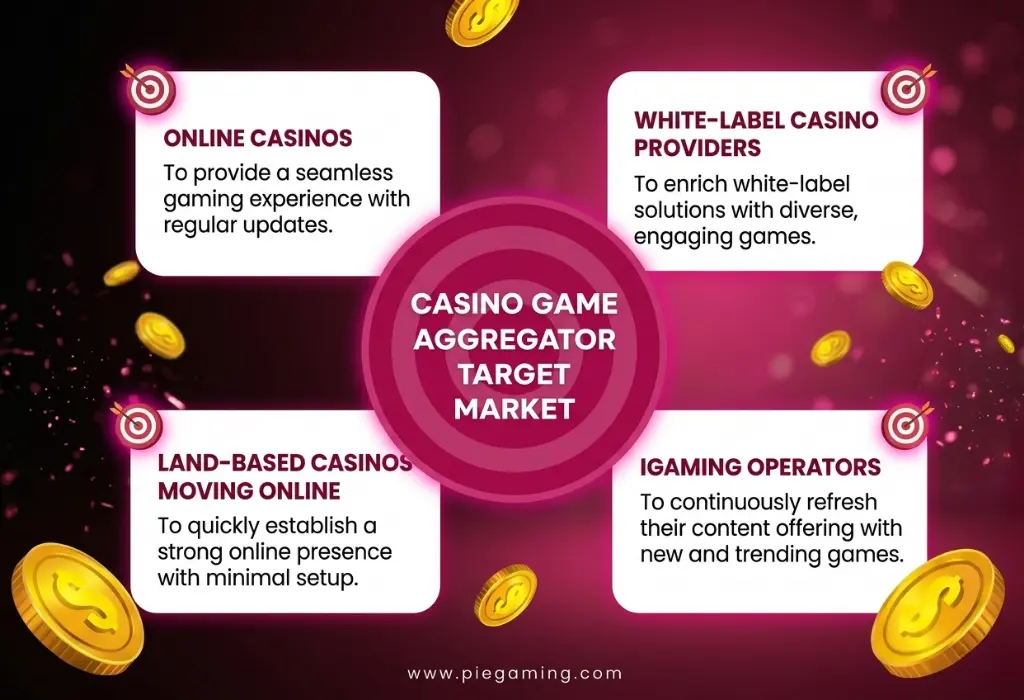
Casino aggregator target market segments
Game aggregators are not exclusively a tool for operators just starting out. They serve a range of business models, and the value they deliver depends on where an operator is in its growth journey.
Startup Casino Operators
Startups benefit the most. Building direct integrations with even 15 game providers can take six months or more and requires a dedicated technical team. A casino game aggregator compresses that timeline to weeks, providing instant access to thousands of games through a single API while reducing development costs.
White Label Casino Operators
White label casinos can launch faster without negotiating and integrating with dozens of individual game providers. An aggregator also simplifies future content expansion as new providers and games become available.
Sportsbook Operators Expanding into Casino
Sportsbooks looking to diversify revenue can quickly add a full casino offering without developing an entirely new content infrastructure. This helps increase player engagement and reduce seasonal revenue fluctuations.
Multi-Brand Casino Groups
Operators managing multiple casino brands benefit from centralized game management, reporting, and content distribution across all brands while maintaining operational consistency.
Operators Entering New Regulated Markets
Casino game aggregators often provide access to jurisdiction-specific game versions and certified content, reducing the complexity of entering new regulated markets while supporting faster launches.
Sweepstakes and Social Casino Operators
Operators in the rapidly growing sweepstakes and social casino markets can also benefit from aggregation by accessing diverse game libraries without maintaining individual integrations with multiple studios. This enables faster content expansion while keeping technical operations manageable.
Potential Limitations of Game Aggregators
Aggregators offer real advantages in speed and scalability, but they are not the right fit for every operator. Understanding the trade-offs upfront protects your margins and prevents commercial surprises down the line.
Less Control Over Direct Provider Deals
Working through an aggregator means you are not negotiating directly with game studios, which leads to:
- Limited influence over revenue share terms
- No automatic access to exclusive game launches
- Less flexibility in shaping commercial structures
Dependency Risk
If the aggregator experiences technical downtime, financial instability, or a contract dispute with a key provider, your entire game portfolio feels the impact. Uptime history, SLA terms, and financial standing deserve scrutiny before signing anything.
Revenue Share Markup
Aggregators typically add a 1 to 4 percent markup on top of provider base rates. Easy to absorb at lower volumes, but for operators generating $1M or more monthly, even 2 percent compounds into a serious margin of conversation over time.
Limited Custom Negotiation
Direct provider relationships sometimes unlock exclusive tournaments, custom jackpot structures, and branded launches. Through an aggregator, those options are often more standardized unless premium terms are specifically negotiated.
The aggregator model trades control for speed and efficiency. A worthwhile trade-off for many, but always worth evaluating against your scale and long-term profitability goals.
Why PieGaming is a Smarter Alternative to Standalone Game Aggregators?
Piegaming is not a standalone game aggregator. It is the best full-stack iGaming software provider that delivers a complete online casino solution with aggregation already built into the core of the platform.
Instead of integrating an aggregator separately and then connecting it to your platform, Piegaming brings everything under one roof:
- A fully developed casino platform
- Integrated sportsbook, live casino, and slots
- 5,000+ casino games
- Direct integrations with top-tier providers including Evolution, Evoplay, Pragmatic play and more.
- Single wallet infrastructure
- Back-office management system
- Bonus engine and promotional tools
Because the aggregation layer is already embedded into the software, operators do not just get access to games. They get the entire operational ecosystem required to run a scalable casino from day one.
That built-in structure means time to market is significantly reduced, technical complexity is minimized, compliance-ready content is pre-integrated, and reporting and wallet systems are unified from the start.
For startups, sportsbooks expanding into casino, or operators entering regulated markets, this removes the need to manage multiple vendors and stitch together separate systems.
Piegaming combines the benefits of a game aggregator with the power of a complete iGaming platform, giving operators a faster path to launch, a cleaner structure to scale, and a stronger foundation for long-term profitability.
Read Blog – Future of Casino Game Aggregators
Wrapping Up…
Casino conetnt aggregators sit between operators and game providers, simplifying how content is accessed, integrated, and managed at scale. They reduce technical workload, compress time to market, and give operators the portfolio depth needed to compete without the complexity of managing dozens of direct relationships.
There are commercial trade-offs involved, and for high-volume operators those conversations around margins and control are worth having. But for most operators at most stages of growth, the operational efficiency an aggregator delivers comfortably justifies the cost.
In a market as competitive as iGaming is today, aggregators are not simply a convenience. They are a strategic decision that shapes how fast you grow and how sustainably you do it.

FAQs
-
What is a casino game aggregator?
A casino games aggregator is a platform that connects operators to multiple game providers through one integration. Instead of signing deals with each studio separately, you get access to slots, live casinos, and table games from one single connection point.
-
How does a casino game aggregator work?
Casino games aggregator works by integrating with a network of game providers, then exposing their content through one unified API. You plug into the aggregator once, and it handles the backend connections, content updates, and provider relationships for you.
-
What is the difference between a casino game aggregator and an API provider?
A casino game aggregator connects you to multiple providers through one API. An API provider only offers their own games and requires separate integrations for each studio.
-
How many providers should a casino game aggregator offer?
Fifteen to twenty strong providers with regular updates usually deliver better player engagement than fifty providers with overlapping or inactive games.
-
Can operators switch casino game aggregators later?
Yes. You'll need to update integrations, transfer game configurations, and test wallet compatibility. Standardized APIs make the switch easier and faster.
-
What is a seamless wallet in casino game aggregation?
Players maintain one balance across all games without transferring funds between wallets. Simpler for players and easier accounting for your team.
-
How much does a casino game aggregator cost?
A casino game aggregator typically runs you USD 7,000 to USD 40,000+ upfront. On top of that, you'll pay either a monthly minimum or a revenue-share fee. What you spend depends on how many games you want, your player volume, and how much customization you need.

Palak Madan has been writing about the iGaming industry since 2024. She focuses on helping operators and founders understand their options when launching an online casino, from choosing the right software provider to figuring out costs and compliance requirements across different markets. At PieGaming, she covers topics like white label casino solutions, platform selection, and market entry, turning complex industry information into practical guidance for people building iGaming businesses. She also keeps a close eye on licensing and regulatory changes; particularly how new rules shape the way operators enter and grow in different jurisdictions.

The best online casino slot providers in 2026 are Pragmatic Play, Evolution Group Studios, Play’n GO, Hacksaw Gaming, Relax Gaming, Games Global, Playtech, Push Gaming, Yggdrasil and Blueprint Gaming. Operators should compare them on six criteria: licensing and certification, RTP range, volatility, market fit, integration and commercial terms.
Casino gamification refers to the inclusion of goals, levels, rewards, and other video game elements around the core gambling area. Learn how operators can use gamification in igaming to create more engaging player journeys while managing costs.
Stake.Us, PlayFame, McLuck, MegaBonanza and Zonko are social casino platforms that are free-to-play casino games using virtual coins. These platforms offer hundreds of slots, tables, and instant-win games with daily free coins, tournaments, and bonus features.
Casino CRM strategies help operators to personalize campaigns, improve player retention, reduce churn rate, and maximize player lifetime value.
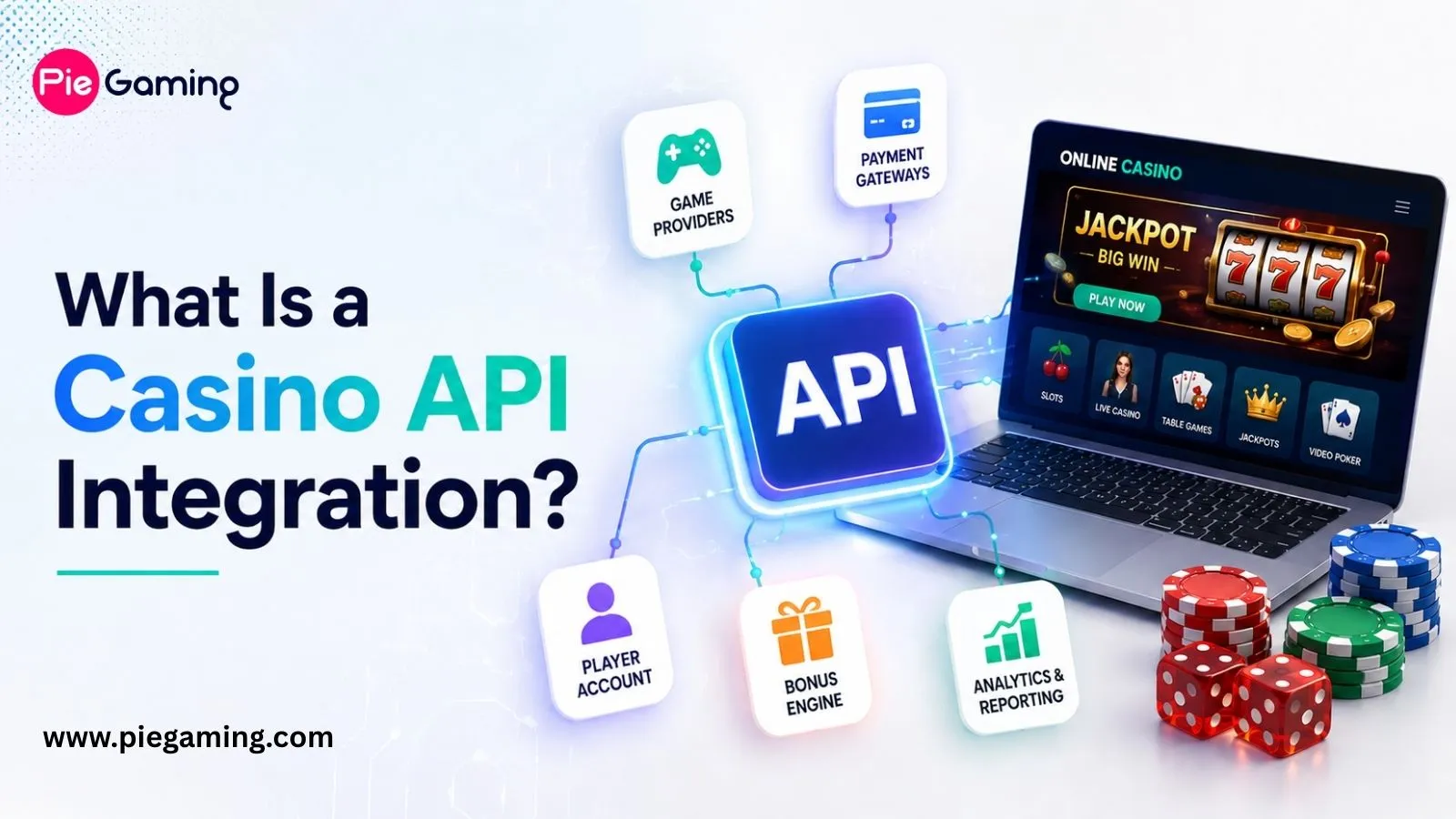
A casino API integration is a software solution that connects your platform with games, payment gateways, wallets, KYC tools and other third-party solutions. It allows data to be exchanged between systems in real-time. This way you can launch quicker, automate tasks, and provide a smooth playable experience.
House Edge is the mathematical advantage built into online casino games and all other forms of gambling. It shapes the odds, influences your winnings and losses, and constitutes the cornerstone of any online casino or sportsbook operator’s overall financial strategy.
The Hi-Lo casino game is a simple card game where players predict whether the next card will be higher, lower, or equal to the current card. This guide explains how Hi-Lo works, its rules, betting options, payouts, gameplay, and strategies players can use when making predictions.





See you in your inbox soon!

Stay ahead of the game. Subscribe for exclusive content, updates, and insiders!