
If you’re working out how to start an online casino, the process covers market research, licensing, software selection, game integration, payment setup, platform testing, and marketing. A structured launch process cuts risk, speeds up time-to-market, and sets you up for long-term growth.

Launching an online casino takes more than buying software. The wrong license or a platform that can’t scale can cost you months and a big part of your budget.
Competition and regulation are both tightening in 2026, so there’s little room for costly missteps. Sequence matters. You need to get your market, license, technology, payments and compliance right, in the right order.
This guide walks you through the 8 steps to start an online casino, from choosing where to open it and how to create the platform to launching and growing the business, so you can avoid the trial and error that derails many launches.
How to Start an Online Casino Business: 8 Steps
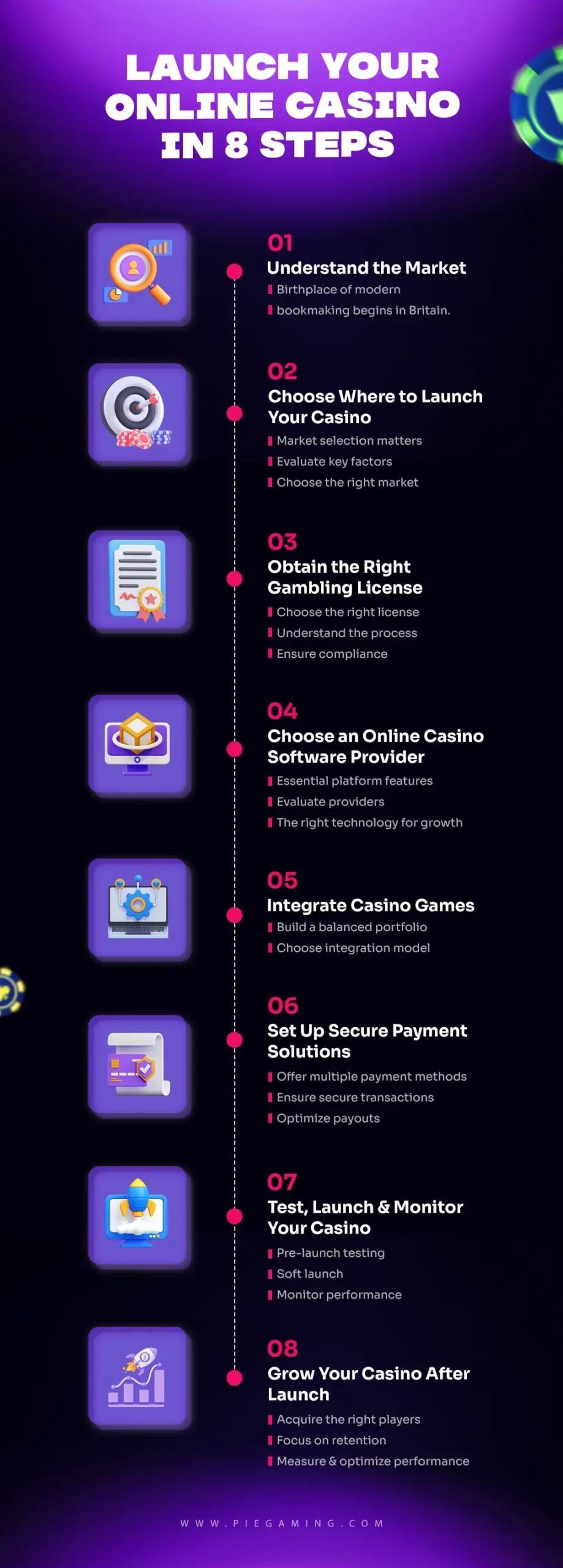
8-Steps to Start an Online Casino Business
Starting an online casino involves more moving parts than most operators expect. Here’s exactly how to start an online casino, from market research and licensing to platform selection and launch, so you don’t miss a critical step.
STEP 1: Understand The Online Casino Market
Casino operators should be aware of the market they are entering before investing in online casino software or applying for a gambling license. Do not rush this step.
The global online gambling market, which includes casino and sports betting, was valued at about USD 78.87 billion in 2024. One industry forecast projects it will reach USD 156.40 billion by 2030.
This growth comes from a few clear drivers: more players going digital, more markets getting regulated, and rising demand across the board. But the industry isn’t getting easier to enter. Competition is tougher, and regulations keep tightening. If you’re planning to launch, you need a solid strategy before you start.
A successful operator doesn’t pick a market just because the forecasts look good. They weigh player demand, competition and profitability first, and only then decide where to launch. Step 2 covers how to compare markets and jurisdictions in detail.

Global Online Gambling Revenue Forecast
Identify Your Target Audience
Understanding the market is only half the equation. Knowing your audience matters just as much. Different player segments bring different gaming preferences, spending patterns, and expectations, all of which should shape your product offering and marketing strategy.
Ask yourself:
- Do you have casual players or high dollar VIPs in mind?
- Who do you think are the main age groups of your target market?
- What type of games do players prefer: slots, live dealer games, or sports betting?
- Which devices do they primarily use?
- What are the forms of payment that they really trust?
Players’ expectations are very different these days. Recent industry research shows that 74% of casino players now consider digital convenience more important than they did just a few years ago, while more than half say digital engagement directly influences their loyalty. Seamless navigation, personalization, and fast transactions, in other words, are no longer differentiators. They’re the baseline players expect.
Evaluate Your Competitors
Competitor analysis helps operators understand what’s already working in a given market, and just as importantly, where the gaps are. Rather than replicating what successful operators are doing, it’s often more valuable to identify what they’re missing and build there instead.
Evaluate competitors based on:
- Game portfolio
- Website performance and mobile experience
- Welcome bonuses and loyalty programs
- Payment options
- Customer support quality
- Licensing and trust signals
- Player reviews and ratings
Pay close attention to how leading operators position themselves. Some compete on game variety, others on localized experiences, faster payouts, or premium VIP programs, and understanding which lever a competitor is pulling can reveal exactly where the opportunity lies.
Define Your Unique Value Proposition (UVP)
With thousands of online casinos competing for the same pool of players, a compelling Unique Value Proposition isn’t optional. It’s essential. Your UVP should make it immediately clear why a player should choose your platform over an established alternative.
Rather than relying solely on generous welcome bonuses, consider building your competitive edge around:
- Exclusive or premium game content
- Faster deposits and withdrawals
- Localized payment methods
- AI-driven personalization
- Superior mobile experience
- Cryptocurrency support
- VIP rewards and loyalty programs
- Responsible gambling tools
Today’s most successful operators compete on the overall player experience, not simply on the size of their bonus offers. A strong UVP does more than attract new players. It improves retention, delivering consistent value at every stage of the customer journey.
STEP 2: Choose Where to Launch Your Online Casino
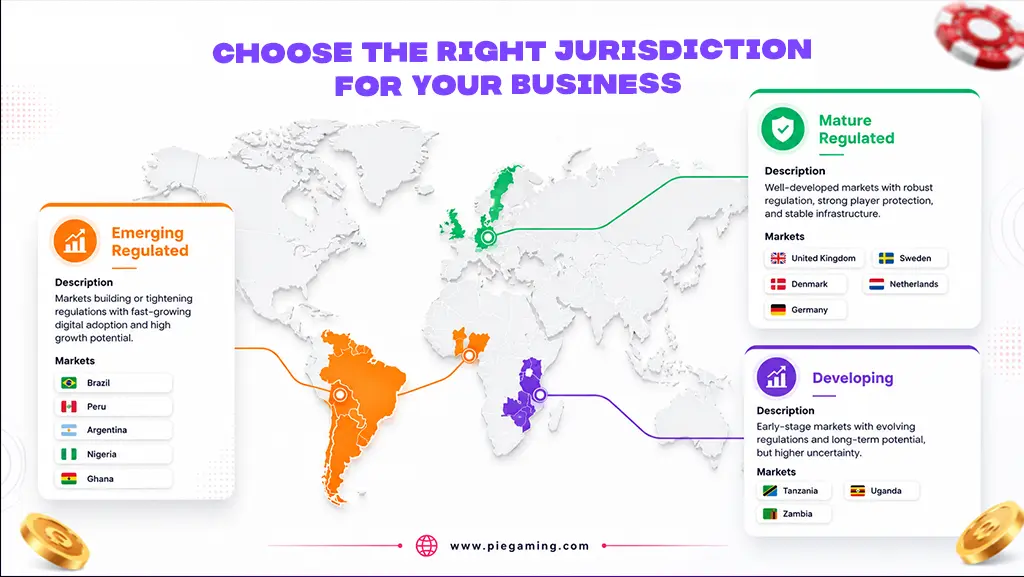
Choose Where to Launch Your Online Casino
One of the most important choices when you open an online casino is selecting the right market.
Your jurisdiction will affect your business’s licensing, work compliance, payment options, marketing guidelines, and running expenses. Instead of chasing the biggest market, smart operators pick up a jurisdiction that actually fits their business, budget, and growth plans.
The regulatory picture keeps shifting too. There are over 130 gambling jurisdictions monitored by industry trackers, which are then broken down into categories of regulated, opening, restricted, and prohibited. The one thing to keep in mind with choosing a market is that it’s not about chasing demand. It’s about looking for a venue that allows you to stay within the law, improve gradually, and remain compliant over time.
Before you shortlist a market, compare the factors below. Each one changes your cost, your timeline or your growth ceiling.
- Market size and projected growth
- Licensing and regulatory landscape
- Tax and compliance requirements
- Mobile vs. desktop gaming behavior
- Popular game categories
- Local payment preferences
- Competitive landscape
- Customer acquisition costs
Taxes deserve early attention. Gambling taxes vary widely. Some markets tax gross gaming revenue (GGR), others tax turnover or stakes, and some add VAT or corporate tax on top. These rates can affect your margins more than the license fee does, so model them before you commit to a market. Confirm current rates with the local regulator or a tax advisor, because they change often.
Mature Regulated Markets
Well-developed markets have robust gambling legislation, well-defined licensing procedures, and robust player protection measures. They are time-tested and have solid payment structures that make them attractive for those seeking a more stable investment.
However, all this stability comes with a cost. Expect strict responsible gambling rules, steep customer acquisition costs, high competition and tough compliance checks.
Examples: United Kingdom, Sweden, Germany, Netherlands, Denmark
Best suited for: Well-established operators, teams with established compliance and legal support, businesses with a larger budget to launch, and companies that are looking forward to sustained expansion in regulated markets.
Challenges: High licensing and compliance costs, tough competition for players, strict ad restrictions, focus on responsible gambling, and data protection.
Emerging Regulated Markets
Emerging regulated markets are building or tightening their gambling laws while digital gaming adoption grows fast. These markets let you get in early, before competition catches up to mature-market levels.
Growth here comes from more smartphones, wider digital payment use, better internet access, and friendlier regulations. Some Latin American markets have recently implemented full licensing systems, and many African markets are still developing their systems.
Examples: Brazil, Peru, Argentina, Nigeria, Kenya, Ghana
Best suited for: Operators who are growing and expanding, companies entering new markets with regulatory requirements, and businesses looking for a first-mover advantage.
Growth opportunities: High growth market for players, less competition than in Europe, increasing adoption of digital wallets and mobile payments, and more rules that are easier to understand and better for long-term investment.
Keep an eye on how these laws evolve. Licensing terms, tax rules, and technical standards can still change.
If you’re targeting this region, our guide on how to launch an online casino in Europe walks through the market-specific steps.
Developing Markets
Developing markets are still early in online gambling adoption or regulation. They have a longer-term yield but are more uncertain when it comes to licensing, payments, and enforcement.
Don’t see these as “easy wins”. Consider the legal implications, localization requirements, and potential changes in regulation before making a final decision.
Examples: Tanzania, Uganda, Zambia, and select Asian and African markets with evolving rules
Best suited for: Seasoned operators with regional expertise, companies looking to expand over the longer term, and companies willing to evolve as rules change.
Expansion potential: rising internet and smartphone use, growing demand for digital entertainment, and a chance to build brand recognition early.
Challenges: Patchy or shifting regulations, inconsistent payment infrastructure, greater operational uncertainty, and greater reliance on local partners and market knowledge.
Market Comparison
Disclaimer: Treat these groupings as a general guide, not a legal assessment. Rules change quickly, so confirm the current position with local counsel before you commit.
Tip: Prioritize regulated or soon-to-be-regulated markets wherever possible. Licensing requirements may raise your initial investment, but regulated jurisdictions typically offer greater long-term stability, stronger player trust, and easier scalability.
STEP 3: Choose Your Business Model and Get the Right License
Before you start evaluating individual providers, decide how you want to enter the market. Every operator chooses between three paths, and the right one shapes your budget, your timeline, and how much control you have from day one.
Note: These are rough market ranges only. Actual pricing varies by jurisdiction, licensing requirements, integrations, customization level, and revenue-share structure.
Custom-built gives you complete ownership, from the license to the tech stack to player data, but it demands the largest budget and the longest runway, so it suits operators with an established tech team and patient capital.
Note: If you plan to build a casino from scratch, you’ll also need to hire or contract online casino developers for the platform, back office and integrations. That’s a big reason custom builds carry the longest timelines and the highest budgets.
Turnkey sits in the middle. You hold your own license while the provider supplies the platform and infrastructure, giving you more independence than white label without the cost and time of building from scratch.
White label gets you live the fastest. The provider holds the license and handles compliance behind the scenes, so you can focus on branding, marketing, and player acquisition. The trade-off is less control and, often, a revenue-share arrangement that affects long-term margins.
There’s no universally “right” model. Match it to your budget, your timeline, and how much control you want over your license and tech stack from day one
Every real-money casino has to operate under a gambling license, either its own or its provider’s. If you choose white label, you operate under your provider’s license, so you don’t apply yourself, but you should confirm that it covers your target markets. For turnkey and custom builds, you hold the license, and your choice affects every partnership that follows, because many payment providers, studios and regulators won’t work with an unlicensed operator.
The right license depends on your target market, not just cost or processing time. Picking the cheapest or fastest option rarely pays off long term.
If you already run a land-based casino and are moving online, our tips for land-based casinos starting online cover what changes when you take the business to a digital audience. Recreating the retail experience isn’t enough, so adapt your technology, player journey and marketing for online players.
Your license category determines which payment processors will onboard you, which game studios will sign a direct deal with you, and how much player trust you start with on day one. Choose the category that matches your growth plan, not just your launch budget.
Keep this trend in mind when you’re planning past year one. Regulators are steadily narrowing how far international licenses reach.
Curaçao has moved to a new licensing regime with stricter oversight, and more markets across Latin America and Europe are building out their own national frameworks instead of accepting offshore licenses.
An international license that gets you to market fast in 2026 may not carry the same reach in a few years. If long-term stability matters more than speed, weigh a local license or a phased approach: launch under an international license, then add local licenses as target markets mature.
Compare jurisdictions
Malta’s timeline covers company setup, documentation, and MGA review, and complex or incomplete applications can take longer. Curaçao’s process runs through preparation, regulator review, and an IT audit before launching. Isle of Man’s full project includes incorporation, banking, and certification alongside the regulator’s review.
Local licenses vary the most. The UKGC doesn’t guarantee a fixed timeline, and reviews can take several months depending on how complete your application is. Brazil’s licensing framework is still maturing, so treat any timeline here as a moving target.
Every jurisdiction checks for solid AML and KYC controls and technical compliance such as RNG testing and IT audits. Licensed operators also take on responsible gambling duties, including deposit limits and self-exclusion tools. Some markets, such as the UK, require you to join a national self-exclusion scheme.
Tip: Start your licensing process early. Regulatory approval, certification, and payment setup often run in parallel, and a delay in any one of them can push back your entire launch.
STEP 4: Choose an Online Casino Software Provider
A major decision when you create an online casino is choosing the right software provider.
Every aspect of your platform, from player registration to payments, game management, and regulatory compliance, is powered by your software provider. Many operators begin by comparing the best white label casino providers to identify a solution that offers the right balance of speed, scalability, compliance support, and customization.
Switching providers after launch is expensive and disruptive, so pick a technology partner that can support both your immediate launch and your long-term growth.
With your business model chosen in Step 3, the next step is finding the provider that can deliver it. To see what a platform should include, from the player-facing lobby to the back office, read our guide to the core components of online casino software. Then evaluate providers on these factors:
Key factors to evaluate:
- Industry expertise: Choose a provider with proven experience in your target markets. A vendor that’s strong in Europe may not have the regulatory knowledge, payment integrations, or localization skills you need for Latin America or Africa.
- Scalability: Pick a platform that can handle rising player traffic, multiple brands, and future expansion into sportsbooks, live dealers, or crypto casino software without forcing a full platform migration.
- Customization: Make sure the platform is flexible enough to tailor your branding, player journey, bonus campaigns, languages, currencies, and localized content across different markets.
- Third-party integrations: Look for smooth integrations with leading game providers, payment gateways, affiliate platforms, KYC/AML tools, CRM systems, and analytics. Pre-built integrations save implementation time and simplify future upgrades.
- Compliance capabilities: The platform should include tools for KYC verification, AML monitoring, responsible gambling features, audit trails, and jurisdiction-specific reporting.
- Technical support: Prioritize providers offering dedicated onboarding, 24/7 technical assistance, regular platform updates, and clear SLAs so you avoid disruption after launch.
Beyond the technology itself, look at the provider’s reputation in the industry. Check their client portfolio, years of experience, implementation approach, and product roadmap.
A provider that keeps investing in innovation and compliance is better positioned to keep up as player expectations and market requirements shift.
Choose a long-term technology partner, not just a vendor.
STEP 5: Integrate Casino Games
Your game portfolio is one of the biggest drivers of player acquisition and retention. Players may be tempted to make their initial deposit on games through promotional deals, but it’s the quality, variety, and freshness of your game library that keeps them coming back. Don’t chase a high game count for its own sake. Instead, create a portfolio that supports the various player’s tastes and financial attitudes.
A well-rounded online casino should typically include:
- Slots: The primary revenue driver for most online casinos, offering a mix of classic, video, jackpot, and branded titles.
- Live Casino: Real-time games like Blackjack, Roulette, Baccarat, and Game Shows that recreate the land-based casino experience and appeal to high-value players.
- Table Games: Digital versions of Blackjack, Roulette, Baccarat, Poker, and other classics that stay popular across regulated markets.
- Instant Games: Fast-paced titles like scratch cards, keno, and plinko that attract casual players looking for quick gameplay.
- Crash Games: Multiplayer games like Aviator and JetX, which have grown fast, especially in Latin America, Africa, and other mobile-first markets.
When picking games, prioritize quality over quantity. Partnering with well-known studios like Evolution, Pragmatic Play, Playtech, NetEnt, and Spribe builds player trust and helps you compete with established operators.
Localize your portfolio, too. Offer games that are actually popular in your target market instead of running the same catalogue everywhere.
Next, decide how you’ll integrate these games into your platform. Operators usually pick between two approaches:
- Direct integrations: You connect with each game provider individually through separate APIs. This gives you more control over commercial terms, game availability, and promotions, but it also means more development time and ongoing maintenance, since every integration needs to be managed on its own.
- Casino game aggregators: An aggregator gives you access to hundreds of game studios through a single API. This cuts development effort significantly, speeds up your time-to-market, and makes it easier to grow your game portfolio over time. For most startups and growing operators, an aggregator is the faster, more scalable choice.
Your integration strategy should match your business goals. Direct integrations tend to suit large operators with dedicated technical teams and exclusive commercial deals. On the other hand, game aggregators offer quicker deployment and more flexibility for businesses looking to launch and scale efficiently.
STEP 6: Set Up Secure Payment Solutions
An efficient payment infrastructure is essential if you want to open an online casino that players trust. Players expect deposits to process instantly, and withdrawals to go through without unnecessary delays. A slow or unreliable payment experience increases cart abandonment, damages player trust, and hurts retention.
Don’t rely on one or two payment options. Offer a mix of global and locally preferred methods that match your target market.
Your payment ecosystem should typically include:
- Credit and debit cards for broad international coverage.
- E-wallets for faster deposits and withdrawals in established markets.
- Bank transfers for players who prefer direct account payments, particularly in regulated jurisdictions.
- Cryptocurrencies if you’re targeting crypto-friendly markets or players looking for faster cross-border transactions.
- Local payment methods that match regional preferences, like PIX in Brazil, SPEI in Mexico, or M-Pesa in Kenya. Supporting familiar payment methods cuts friction during deposits and can significantly boost conversion rates.
Security should be a core factor when picking payment providers. Work with partners who comply with:
- PCI DSS standards
- Use end-to-end encryption to protect payment data
- Offer built-in fraud prevention tools like transaction monitoring, device fingerprinting, and risk scoring.
These measures reduce chargebacks, prevent fraud, and keep you compliant with regulatory requirements.
The withdrawal experience matters just as much as deposits. Operators often focus on making deposits seamless, but delayed payouts are one of the most common reasons players lose trust in a casino. Prioritize payment providers that support:
- Fast and reliable withdrawals.
- Multi-currency transactions for international player bases.
- Automated payment processing where regulations permit.
- Clear transaction tracking and status updates.
Your payment strategy should reflect the habits of your target market. Players in Brazil increasingly expect PIX as a standard option, while mobile money solutions like M-Pesa remain widely used in Kenya
Aligning your payment methods with local player preferences creates a smoother onboarding experience and improves both deposit conversion and long-term retention.
A well-designed payment ecosystem does more than process transactions. It builds trust, supports regulatory compliance, and removes friction throughout the player’s journey.
STEP 7: Test, Launch, and Monitor Your Casino
Before launching your online casino, test the platform thoroughly to make sure every feature performs as expected. Even small issues, like payment failures, broken game sessions, or slow page loading, can hurt player trust and retention from day one. A structured testing process helps you catch and fix these problems before real users run into them.
Your pre-launch checklist should include:
- Quality assurance (QA): Test the complete player journey, including registration, login, deposits, withdrawals, bonuses, and gameplay.
- Security testing: Verify KYC and AML workflows, identify vulnerabilities, and make sure player and payment data are protected.
- Mobile optimization: Confirm the platform delivers a seamless experience across smartphones, tablets, and desktop devices, since mobile drives the majority of iGaming traffic in many markets.
- Performance testing: Check how the platform holds up under peak traffic to avoid downtime during major campaigns or tournaments.
- Responsible gambling tools: Make sure features like deposit limits, self-exclusion, reality checks, and session limits work correctly and meet regulatory requirements.
Instead of launching to everyone at once, consider a soft launch. Releasing your casino to a limited group of players lets you validate platform performance, catch operational issues, and gather real-world feedback before a full-scale rollout. This approach lowers your risk and gives your team room to fine-tune the platform.
Once your casino goes live, continuous monitoring matters just as much as pre-launch testing. Track key metrics across technical performance, player behavior, payment processing, and overall system stability.
STEP 8: Grow Your Online Casino After Launch
Launching your online casino is only the beginning. Sustainable growth depends on attracting qualified players, keeping them around, and continuously refining your strategy based on real performance data. Don’t lean on a single marketing channel. Invest in a balanced approach that supports both short-term growth and long-term profitability.
Focus your player acquisition strategy on a mix of channels, including:
- SEO to generate consistent organic traffic and attract high-intent players.
- Affiliate marketing to leverage trusted casino review sites and industry partners on a performance-based model.
- Paid advertising to boost brand visibility and acquire players quickly in markets where gambling advertising is permitted.
- Social media to engage your audience, promote new games and campaigns, and build brand awareness.
Attracting players is only half of the challenge. As customer acquisition costs keep rising, retaining existing players becomes just as important. Encourage repeat engagement with a personalized gaming experience instead of generic promotions.
Effective retention strategies include:
- Loyalty and rewards programs that encourage repeat play.
- Personalized bonuses based on player activity and preferences.
- VIP programs with exclusive benefits for high-value players.
- Regular tournaments, seasonal campaigns, and fresh game releases to keep the platform engaging.
Growth should always be backed by measurable results. Track key casino KPIs such as,
- First-Time Depositors (FTDs)
- Cost Per Acquisition (CPA)
- Player retention rate
- Gross Gaming Revenue (GGR)
- Net Gaming Revenue (NGR)
- Lifetime Value (LTV)
This is to understand how well you’re acquiring players, retaining them, and generating revenue. Successful online casinos don’t stop optimizing after launch.
They keep testing marketing campaigns, refining promotional strategies, and analyzing player behavior to improve performance. A data-driven approach helps you make informed decisions, get more out of your marketing spend, and scale your business more efficiently in competitive markets.
Essential Features Every Successful Online Casino Needs
The features built into your online casino platform directly shape player experience, operational efficiency, and regulatory compliance. Before you launch, make sure your platform covers the following.
While all operators’ requirements differ, these features form the foundation of a competitive online casino. Choosing a platform that supports them from day one cuts operational complexity, improves player satisfaction, and makes it easier to scale into new markets.
Common Challenges When Starting an Online Casino (and How to Overcome Them)
Not every challenge is avoidable, but most are manageable with the right preparation. Understanding these issues early is one of the best ways to avoid online casino startup mistakes that can delay your launch or increase operating costs.
Choosing the Wrong Technology Partner
Your software provider shapes everything from platform stability and game integrations to future scalability. Choosing a provider on price alone often leads to limited customization, poor technical support, frequent downtime, and expensive platform migrations down the line.
Evaluate providers based on their implementation track record, regulatory expertise, client portfolio, and ability to support your long-term growth—not just the number of years they have been in business.
Licensing Delays
Licensing is often the most time-consuming stage of launching an online casino. Delays usually come from incomplete documentation, failed due diligence checks, or technical requirements that are not met during the application process.
Preparing your licensing documentation early and working with experienced legal or compliance specialists can significantly reduce approval timelines and help avoid costly delays during the licensing process.
Payment Integration Issues
Offering payment methods that don’t match local player preferences hurts deposit conversions and creates friction during onboarding.
Before launching, thoroughly test deposits, withdrawals, refunds, and payment failure scenarios across every payment method you support. Prioritize payment providers that are widely adopted in your target markets and fully aligned with local regulatory requirements.
High Player Acquisition Costs
Acquiring new players keeps getting more competitive, especially in mature regulated markets. Relying only on paid advertising drives up your customer acquisition costs fast and eats into profitability.
A balanced acquisition strategy that combines SEO, affiliate marketing, strategic partnerships, and player retention initiatives creates a more resilient growth engine and supports sustainable long-term success.
Fraud and Chargebacks
Online casinos are frequent targets for bonus abuse, identity fraud, payment fraud, and chargebacks.
Robust KYC verification, AML monitoring, fraud detection systems, transaction risk analysis, and secure payment processing help identify suspicious activity early while protecting both your business and legitimate players.
Staying Compliant with Regulations
Regulatory compliance doesn’t end once your casino goes live. Operators need to keep meeting evolving requirements around responsible gambling, anti-money laundering (AML), data protection, and financial reporting.
Regular compliance reviews, supported by technology built to adapt to jurisdiction-specific requirements, help reduce legal exposure, strengthen operational resilience, and support sustainable business growth.
Customer Retention
Attracting players is only the first step. Keeping them engaged is what actually drives long-term profitability. With players facing countless alternatives, retention takes more than a generous welcome bonus.
How Much Does It Cost to Start an Online Casino?
Online casino costs can be divided into two categories: one-time setup expenses required to launch the platform and recurring costs needed to keep the business running and compliant. The breakdown below covers both.
One-Time Launch Costs
These are the upfront expenses you incur before going live. They vary depending on jurisdiction, platform choice, and build type.
Recurring Operating Costs
These are the ongoing expenses you carry through year one and beyond.
Disclaimer:
These figures are indicative estimates based on industry benchmarks and publicly available operator guides. Real costs depend on your intended jurisdiction, selected technology partner, business model, and market size. This information is provided as a directional planning reference only and should not be considered a fixed quotation. Please consult your licensing advisor and software provider for pricing specific to your launch requirements.
Taken together, these benchmarks suggest a realistic first-year budget for a white-label iGaming startup typically falls in the low-to-mid six figures. Industry-specific cost estimates put an offshore white-label casino launch at approximately $150,000 to $300,000 in first-year costs, depending on licensing, platform setup, game integrations, payment infrastructure, and working capital.
Ready to Launch Your Online Casino?
Building a successful online casino takes more than a license and software. It takes the right technology, the right expertise, and support that doesn’t disappear after launch. Whether you’re entering iGaming for the first time or expanding into new markets, PieGaming helps you start an online casino business and get to market faster. From platform setup and game integration to payment solutions and post-launch support, our team helps operators build scalable online casino businesses tailored to their goals. Talk to PieGaming today and see how our online casino platform can help you launch, operate, and grow your iGaming business with confidence.
Wrapping Up…
Opening an online casino is a serious undertaking, but it doesn’t have to be overwhelming. Get your licensing, platform, payments, and compliance right from day one, and everything else becomes easier to manage.
The operators who succeed aren’t the ones who move fastest. They’re the ones who plan carefully and choose the right partners. Follow this step-by-step guide on how to start an online casino, and you’ll be ready to launch with confidence.

Online Casino Brand
FAQ
-
How much does it cost to start an online casino?
Starting an online casino typically requires $100,000 to $500,000+ in capital, covering licensing, platform, games, payments, marketing, compliance, and operational reserves for at least 12 months.
-
Do I need a gambling license to open an online casino?
Yes. In most jurisdictions, you need a valid gambling license to operate legally, access reputable payment providers, run marketing campaigns, and avoid regulatory or bank account enforcement risks.
-
What is the difference between white-label and turnkey casino software?
When comparing white label vs turnkey, white label uses the provider's license, payments, and tech, so you mainly handle branding and marketing. Turnkey gives you your own license and more control, but costs more upfront and takes longer to set up.
-
How long does it take to open an online casino?
Launch timelines range from 1-3 months with white-label solutions to 6-12 months or more for turnkey or custom platforms, depending on licensing, integrations, testing, and marketing prep.
-
How do online casinos make money?
Online casinos earn from player losses through house-edge games and sportsbook margins. Revenue comes from deposits, retention, and player value, minus bonuses, payment fees, licensing, marketing, and operating costs.
-
What games should a new online casino offer?
Start with recognized video slots, table games like blackjack and roulette, and live dealer content. Expand with jackpots, crash games, and sports betting based on what your target market wants.


Palak Madan has been writing about the iGaming industry since 2024. She focuses on helping operators and founders understand their options when launching an online casino, from choosing the right software provider to figuring out costs and compliance requirements across different markets. At PieGaming, she covers topics like white label casino solutions, platform selection, and market entry, turning complex industry information into practical guidance for people building iGaming businesses. She also keeps a close eye on licensing and regulatory changes; particularly how new rules shape the way operators enter and grow in different jurisdictions.
Starting a turnkey online casino means getting a ready-made platform with pre-designed software and pre-integrated games but rebranding as per your choice. Important steps are doing research on the market deciding on a budget picking the partners getting a gaming license setting up ways to pay and more.
Online casino problems can affect operators at every stage, from market entry and payment to player retention, technology, and profitability. Learn the key challenges and practical ways to address them.

Kenya has a growing online gambling market supported by increasing internet adoption and mobile payment systems. This guide clarifies the steps and protocols you can follow for setting up an online casino business in Kenya, including regulations and licensing requirements.

The key components of scaling online casino users can be summarized in four areas. The right acquisition channels, delivering personalized engagement, developing loyalty programs, and making data-driven decisions. Creating a mobile experience, maintaining player engagement and translating markets that you want to attract are all just as crucial to sustainable growth.

This blog breaks down the key strategies of top iGaming operators in 2026 and how you can grow like them as a market leader. Stay tuned until the end.

Starting an online casino sounds exciting. But many new operators fail within a few months due to evitable mistakes. Here are the top 10 mistakes you must steer clear of.

Learn how to start an online casino in Turkey in 2026. Get easy tips on laws, licenses, payments, and more to run your business smoothly.

See you in your inbox soon!

Stay ahead of the game. Subscribe for exclusive content, updates, and insiders!