
Online casino KPIs help track how well a business is doing financially, how many people are using the site, and how marketing strategies are performed. Important numbers include Gross Gaming Revenue (GGR) and Net Gaming Revenue (NGR), what’s the financial profit. Customer Acquisition Cost (CAC) tells how much it costs to bring in players. Customer Lifetime Value (LTV) and Retention Rate show how much each player is worth over time and how many stay engaged.

Your dashboard has fifty numbers. Your finance team has one way to define an “active player”. Your CRM team has another way. Meanwhile, the weekly meeting becomes a fight over which report is correct.
Does this sound like a familiar situation? Many operators collect a lot of data. Still have trouble using it. The issue is not that there is no data. The problem is that there are no online casino KPIs and no shared rules, about what counts.
This guide solves that problem. Here, we will talk about important casino performance metrics and how to utilize them for better business decisions.
What are Online Casino KPIs, and Why Do They Matter?
Online casino KPIs are numbers that can be measured. These numbers show how well an online casino is doing in reaching its business goals. They track player behavior, revenue, and business operations. Operators use them to find problems before they get worse to see how things are changing over time and to know where to invest.
Is a KPI another number? Not exactly. A metric is any number you can measure. Things like website visits, logins and how times players spin the slots are all metrics. A KPI is a metric that helps make decisions. If a number does not change what your team does next, it is not a KPI.
Imagine casino performance metrics as all the data you have. KPIs are the small set you pull out of it. They answer one question: are we on track?
Why does this matter? The online casino software market is very big and full of competition. In Britain, online casino made £1.4 billion in profit between July and September 2025. That was 70% of all online casinos, betting, and bingo money.
At that size even small changes add up quickly. A little drop in the amount of money kept or a rise in bonus costs can mean a lot of money over the year. Good KPIs help you see these changes early.
Which KPI Is Most Important for an Online Casino?
NGR is an important KPI for an online casino. NGR shows what you keep after player winnings, bonuses and taxes. No single KPI works alone. NGR can look strong while retention falls or costs climb.
Why is NGR chosen over GGR? GGR is bets minus wins. GGR ignores bonus costs. A casino can post GGR and still make little profit. NGR gives a truer picture.
I know that one number cannot run a business. Each team owns a part of the player’s journey. So, each team needs a North Star KPI.
North Star KPI by role
A North Star is a starting point. It needs partner KPIs to keep it honest. A marketing team that chases low CAC may bring in players who never return. LTV catches that.
Core Online Casino KPIs Every Operator Should Track
Here is your master list. Use it as a quick reference sheet. Definitions vary by operator and market, so write down your own version of each one.
Revenue and Profitability KPIs
Revenue and Profitability KPIs show whether the casino makes money. Start with turnover then move down to GGR and NGR. Each step removes a cost layer.
For example: Players bet 1,000,000. Win 960,000. GGR is 40,000. Bonuses cost 12,000 and taxes cost 6,000. NGR is 22,000. That is 55% of GGR.
Hold % tells you how much of each bet you keep. Here it is 4%. Track it by game, not overall.
Player Acquisition KPIs
Player Acquisition KPIs show how well you turn traffic into paying players. Registration-to-deposit rate is the one. If it drops, check your KYC flow and payment options first. CAC tells you what each new player costs. On its own CAC can be misled. A cheap player who never returns is not a bargain. Always read CAC next to LTV.
Engagement and Player Value KPIs
Engagement and Player Value KPIs show how valuable your players are. Active players are your base. ARPU shows what each one is worth. Set one definition of “active player.” Many teams skip this step. Then finance and CRM end up with numbers. LTV adds the view. Calculate it by cohort; older players do not skew the result.
Operational & Payments KPIs
Operational and Payments KPIs are easy to ignore. They shouldn’t be. A failed deposit is a lost player. A slow withdrawal is a reputation. Track payment success rate by method and country. Track withdrawal time, at both the average and the slowest end. One bad payout can undo a lot of marketing.
Which KPIs Improve Player Retention?
No KPI improves retention by itself. A KPI shows you where players stop playing, and your team takes action based on what it shows. These five casino performance metrics provide the view:
- Cohort retention (D1, D7, D30, D90): the percentage of a player group still playing after 1, 7 30 or 90 days.
- Churn rate: the percentage of players you lose in a period. Formula: Players lost divided by players at the start multiplied by 100. You must also define “lost.” Many operators consider a player churned after 30 days or more without a real-money bet or deposit. Some use shorter time frames of 14 to 21 days.
- Reactivation rate: lapsed players who come back divided by lapsed players you contacted.
- Deposit frequency: the average number of deposits each active player makes every month.
- Days between sessions: the time between a player’s visits.
What is a good retention rate?
Be careful with benchmarks. Published day-30 retention numbers for casinos range from about 2% to 80%. The difference comes from the denominator. One source includes all registrations. Another includes first-time depositors. A third includes players who were already in the last period. Each gives a result.
One CRM vendor says the average iGaming operator has a 15% to 25% retention rate at day 30. That is a sample, from its platform, not an industry-wide study. Your best benchmark is your past groups.
Metrics Used to Evaluate Casino Loyalty Program Performance
Even if a loyalty program looks busy, it can still lose money. These are the metrics that help evaluate casino loyalty program performance.
- Enrollment rate: how many eligible players join = Enrolled members ÷ eligible players.
- Active participation rate: how many members earn or redeem = Active members ÷ total members.
- Tier migration: how players move between tiers = Players who changed tier ÷ players in the starting tier.
- Redemption rate: how much of the points issued get used = Points redeemed ÷ points issued.
- Points of liability and breakage: liability is what you owe = outstanding points × cost per point. Breakage is points that expire unused ÷ points issued.
- Reward cost as % of NGR: what does the program cost you = Total reward cost ÷ NGR × 100.
- Retention lift: the extra retention the program creates = Member retention − holdout retention.
- Incremental NGR per member: NGR per member − NGR per holdout player. This is the truest test of profit.
A warning about post campaign revenue: Revenue after a campaign does not prove the program worked. Those players may have spent the money anyway. Keep a holdout group, a set of players who receive no rewards. Then compare the two groups.
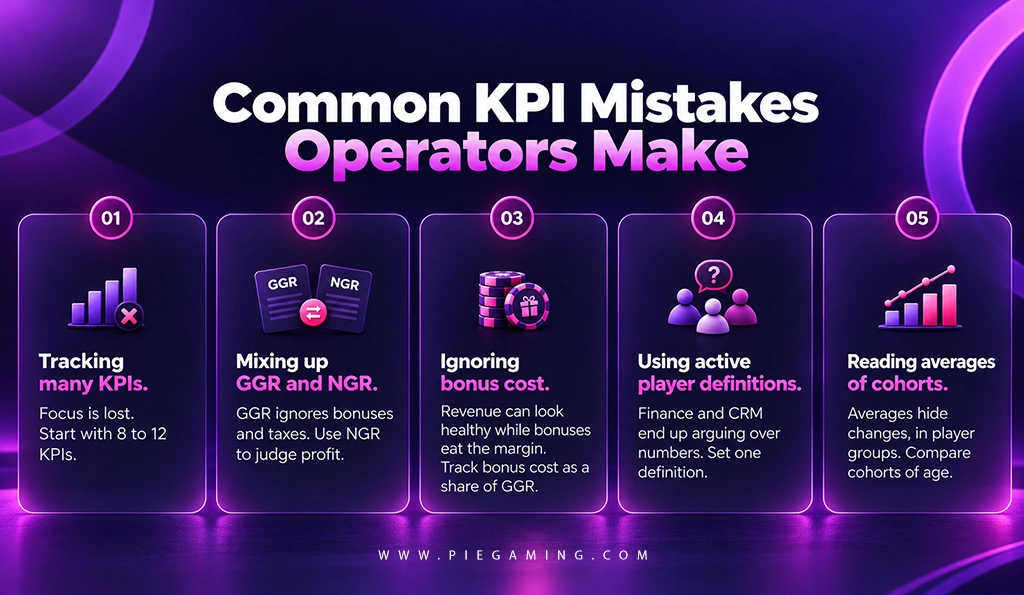
Common KPIs Mistakes
Casino Performance Metrics for Slots and Games
Games drive your revenue so track each of them one by one.
- GGR per game: bets minus wins for each game.
- Unique players: how many different players played the game.
- Repeat play: the share of players who return to the game.
- Realized vs RTP: realized RTP equals total wins divided by total bets. Compare this figure with the providers stated by RTP. Small samples can swing, so wait for volume.
- Hit frequency: winning spins divided by spins.
- Volatility: how widely payouts swing. High volatility games pay amounts but rarely. Use the providers rating then verify with the payout spread.
Exposure vs performance: a game with a GGR is not always weak. It may simply be hidden. Check how many players saw the game, not how many played it. If players who see the game play it and come back the placement is the issue. If they see the game and skip it the game itself is the problem. Fix placement first then evaluate the game.
How Do Operators Build a KPI Dashboard?
Operators build a KPI dashboard by starting with the decisions they need to make. Then they pick the KPIs that support those decisions. Tools come last. Follow these six steps.
- Define the decisions: List what your team needs to decide. For example: cut a bonus switch to a payment provider or push a game. Every KPI must serve one of these decisions.
- Choose 8 to 12 KPIs: Pick a mix of revenue, acquisition, retention and payments. Then twelve KPIs and no one reads the dashboard. Keep it simple.
- Standardize definitions: Write down the formula, time window, and data source for each KPI. Define “player” once. Use it everywhere. Consistency is key.
- Connect your data sources: Pull in your platform, payments, CRM, game providers and marketing data. Aim for one source of truth. No conflicting numbers.
- Design the layers: Build a summary view for top-line numbers like NGR and deposits. Add a drill-down view by game, market, channel and payment method. Include a cohort view for retention and LTV by sign-up date.
- Set owners and alerts: Give each KPI one owner. Set alerts for drops, like payment success or deposits. Clear ownership prevents gaps.
How Often Should Casino KPIs Be Monitored?
Check revenue and payment of KPIs daily. Review retention and bonus cost weekly. Look at value metrics monthly. Revisit definitions every quarter.
Faster is not always better. Daily checks catch problems fast. Slower reviews show trends over time.
Which Analytics Tools Help Track Online Casino KPIs (Including Slot KPIs)?
Most operators use a mix of tools. Each tool covers a part of the picture.
- Player account and platform reporting: the built-in reports on your platform. They cover deposits, bets, wins, and player activity.
- BI tools: dashboards and charts built on your data. Good for custom views. Sharing across teams.
- Data warehouses: a store that joins data from every source. It keeps numbers consistent.
- CRM and player analytics: segmentation, retention and campaign results. These track. Churn.
- Game and provider analytics: the tools for slot KPIs. They cover GGR per game, RTP, hit frequency and player counts by title.
- Real-time monitoring: views and alerts for payments, traffic and unusual activity.
What to look for:
- Definition consistency: the formula everywhere.
- Drill-down: From a top-line number to the cause.
- Cohort analysis: LTV by player group.
- Data freshness: how quickly new data shows up.
- Integrations: easy links to payments, CRM and game providers.
Many operators start with the reporting built into their platform. PieGamings platform gives operators a reporting layer to build on then add BI and CRM tools as needs grow.
Conclusion
online casino KPIs work when they are few clears and tied to decisions. Start with NGR. Add retention, payments, loyalty, and game metrics. Agree on definitions. Review them on a steady schedule.
Get these basics right. Your team spends less time debating data and more time acting on it.

Contact Us
FAQ's
-
Which KPI is most important for an online casino?
Net gaming revenue (NGR) is the most important KPI. It shows what you keep after player winnings, bonus costs, and taxes. But no single KPI tells the whole story. Pair NGR with retention, bonus cost ratio, and LTV to see if profit is lasting.
-
How do operators build a KPI dashboard?
Operators start by listing the decisions the dashboard must support. Then they pick 8 to 12 KPIs, fix one definition for each, and connect their data sources. Next, they build summary, drill-down, and cohort views. Finally, they assign an owner and set alerts for each KPI.
-
Which KPIs improve player retention?
No KPI improves retention on its own, but these five show where to act: cohort retention (D1, D7, D30, D90), churn rate, reactivation rate, deposit frequency, and days between sessions. Track them by cohort, not as one blended number, so you can spot problems early.
-
How often should casino KPIs be monitored?
It depends on the KPI. Review GGR, NGR, deposits, and payment success daily. Check cohort retention, bonus cost, and game performance weekly. Review LTV, CAC payback, and loyalty metrics monthly. Revisit benchmarks and KPI definitions every quarter.
-
Which analytics tools help track online casino KPIs?
Most operators combine several tools. Platform reporting covers deposits, bets, and player activity. BI tools build custom dashboards. A data warehouse joins all sources in one place. CRM and player analytics track retention and churn. Real-time monitoring flags, payment or traffic issues. Look for consistent definitions, drill-down, and fresh data.
-
Which analytics tools help track slot KPIs?
Game and provider analytics tools track slot KPIs. They show GGR per game, unique players, repeat play, hit frequency, and realized vs theoretical RTP. Platform reports give game-level data. BI dashboards let you compare titles and placements. Check exposure as well as results, so you know if a game is weak or just poorly placed.


Jaya Swaroop has been covering iGaming and betting technology since 2019, with a specialization in online casino platforms, sportsbook solutions, and licensing frameworks. Her work involves analyzing platform capabilities and evaluating cost structures, compliance requirements, payment integrations, market strategies, and regulatory updates that impact operators entering or scaling in the iGaming space. With a background in B2B marketing and content strategy, she has contributed to SEO-led growth and demand generation initiatives for global businesses. Jaya holds a Bachelor’s degree in Science (Chemistry & Mathematics) and is certified in content writing, email marketing (HubSpot), project management, and Google Analytics.

Starting a turnkey online casino means getting a ready-made platform with pre-designed software and pre-integrated games but rebranding as per your choice. Important steps are doing research on the market deciding on a budget picking the partners getting a gaming license setting up ways to pay and more.
Online casino problems can affect operators at every stage, from market entry and payment to player retention, technology, and profitability. Learn the key challenges and practical ways to address them.
Kenya has a growing online gambling market supported by increasing internet adoption and mobile payment systems. This guide clarifies the steps and protocols you can follow for setting up an online casino business in Kenya, including regulations and licensing requirements.
The key components of scaling online casino users can be summarized in four areas. The right acquisition channels, delivering personalized engagement, developing loyalty programs, and making data-driven decisions. Creating a mobile experience, maintaining player engagement and translating markets that you want to attract are all just as crucial to sustainable growth.
This blog breaks down the key strategies of top iGaming operators in 2026 and how you can grow like them as a market leader. Stay tuned until the end.

Starting an online casino sounds exciting. But many new operators fail within a few months due to evitable mistakes. Here are the top 10 mistakes you must steer clear of.
Learn how to start an online casino in Turkey in 2026. Get easy tips on laws, licenses, payments, and more to run your business smoothly.








See you in your inbox soon!

Stay ahead of the game. Subscribe for exclusive content, updates, and insiders!