
Online casino problems can affect operators at every stage, from market entry and payment to player retention, technology, and profitability. Learn the key challenges and practical ways to address them.
The online casino industry is lucrative, offering operators an exciting opportunity to grow their business. But every opportunity comes with a lot of challenges. Operators face numerous challenges like licensing & compliance, fraud and bonus abuse, higher player acquisition cost, weak player retention, game content gaps, and technology limitations.
In fact, the challenges become more complex when operators expand across jurisdictions. The key is not simply identifying problems but planning for them before they affect operations.
Whether you’re a startup or an established operator, challenges in the online casino business can put you behind in the competition. So, let’s learn about common online casino problems operators face and how to solve them.
Common Online Casino Operator Challenges from Pre-Launch to Scale
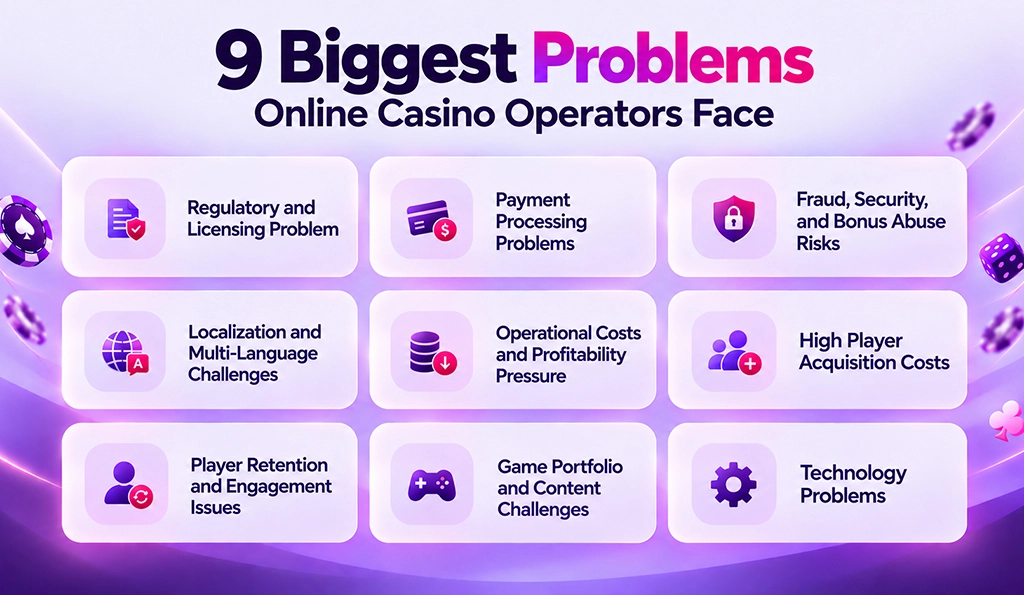
Problems Online Casino Operators Face
While entering the online casino industry, every operator faces challenges (familiar or unfamiliar); knowing these challenges and overcoming them is crucial to running casino operations seamlessly. Let’s understand these challenges.
1. Regulatory and Licensing Problems in Online Casinos
Licensing is one of the first challenges to be addressed by an operator. The requirements can be different for each jurisdiction, including matters of licensing, responsible gaming, KYC, AML, customer funds, advertising, and reporting.
There is a total of 195 countries in the world, and among them, 77 countries are iGaming-friendly. Each country has different laws and regulations, and constant regulatory changes mean compliance is an ongoing task (even within Europe or the U.S.). What challenges do operators face here?
- Constant regulatory updates
- High upfront costs
- Lengthy approval process
- KYC/AML rules
- Implementing player protection policies
Solutions:
- Operators should track new laws and adapt to stay compliant
- Budget both time and money to manage licensing costs and the approval process
- Implement all player protection rules to avoid heavy penalties
- Monitor regulatory changes after launch
- Work with qualified legal and compliance professionals for jurisdiction-specific advice
Responsible gambling and player protection: Regulators are now requiring operators to go beyond licensing. In some cases, they must provide deposit and loss limits, self-exclusion options, reality checks, and identity and age verification tools, as well as staff training on spotting risky behaviors. All of these have an impact on the design and implementation of bonuses, VIP programs, and retention strategies, which is why they must be considered at the conceptual stage and integrated into the product and marketing strategies.
2. Payment Processing Problems for Online Casinos
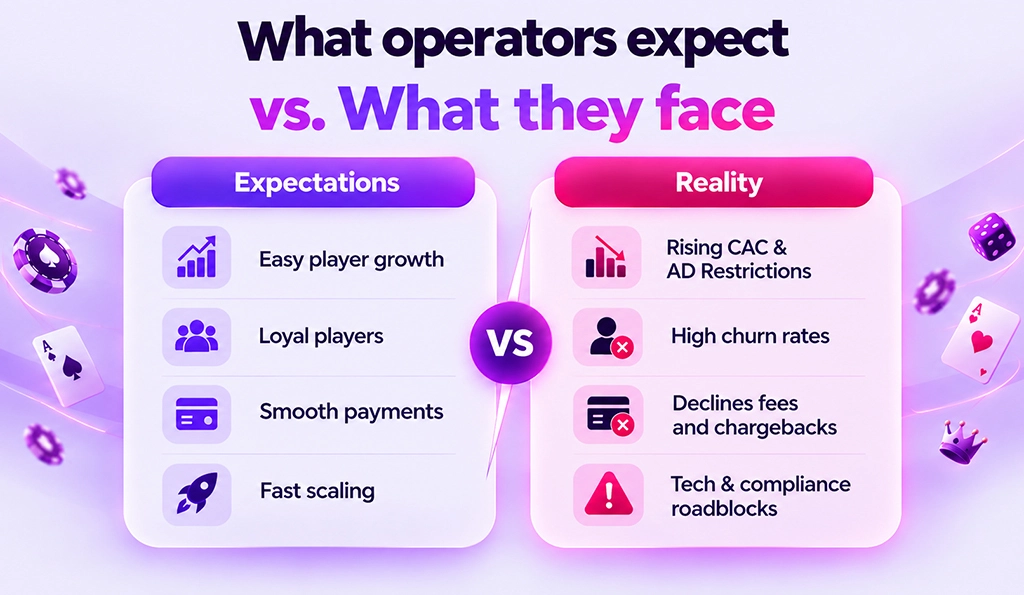
Payments can directly impact the player’s journey. Failed deposits, slow withdrawals, a limited range of payment methods, transaction friction, and disputes can all contribute to additional support overhead and a poor user journey.
Operators need to consider the risk of PSP (Payment Service Provider) termination or account restrictions. A payment provider can impose restrictions or terminate the operator’s account based on risk assessments, contractual requirements, compliance with regulations, or the markets and transaction types that the operator is operating in. Having dependency on one provider can put operators at risk.
In Great Britain, for example, casino operators can only accept a set of customer payments through qualifying payment service providers, and the Gambling Commission has raised concerns over third-party funding and open-loop processes.
Solutions:
- Offer payment methods relevant to the target market
- Avoid unnecessary concentration on a single PSP
- Monitor deposit failure, withdrawal processing time, declines and chargebacks
- Carry out appropriate customer and payment-method checks
- Make the deposit and withdrawal process clear to customers before launch
3. Fraud and Bonus Abuse Risks
Fraud is not limited to stolen card details. It can involve identity fraud, money laundering, bonus abuse, account takeover, and payment fraud. According to Sumsub’s State of Identity Verification in the iGaming Industry 2025 report, 41.9% of surveyed operators identified deposits as their primary fraud flashpoint, with 23.8% selecting onboarding/registration and 22.9% selecting withdrawals.
Further, Poor registration and onboarding UX also create unnecessary friction. If players face unclear verification requirements, they may leave the platform before completing registration.
The operators identified identity fraud, money laundering, and bonus abuse as their most pressing fraud threats. The operators’ primary fraud dilemma involves the balance between the friction in the customer journey and the level of verification and control needed to prevent fraud.
Solutions:
- Applying risk-based KYC and verification processes
- Monitoring suspicious deposits, withdrawals, and account activity
- Detecting pattern frauds such as multiple accounts and bonus abuse
- Transaction and risk monitoring combined with customer verification
- Periodic fraud rule reviews due to the dynamic nature of abuse patterns.
4. Localization and Multi-Language Challenges
Launching in a new market involves more than translating website content. Giving a localized feel to their players is key to this business. Operators must consider registration flows, customer expectations, payment preferences, game preferences, support, and local market requirements.
A multinational business should offer language-specific support and make sure the processes for payments, account management, verification, and bonuses are well-documented and localized.
Solutions:
- Simplify the account opening and onboarding processes.
- Test the mobile version’s performance in the targeted markets.
- Offer multilingual support
- Review player behavior by market and adjust the experience accordingly
- Localize payment methods and currencies as per each targeted market.
5. Operational Costs and Profitability Pressure
Most operators believe that running an online casino is a one-time investment, which is very wrong. Running an online casino is a continuous investment that can eat into profits. For instance, maintenance costs, marketing, and affiliate expenses put profitability pressure on operators. Operators forget about maintenance costs and don’t spare money, due to which they face cash flow problems.
Gaming taxes and license fees also cut into margins, and the rates and structure (for example, a percentage of gross gaming revenue) vary significantly by jurisdiction, so operators should take them into account when selecting a market to operate in.
Solutions:
- Search for budget-friendly casino models like white label casino software
- Optimize marketing with ROI-focused strategies
- Build in-house marketing channels to reduce dependency on affiliates
- Invest in a loyalty program and personalized offers to improve profitability
- Diversify revenue stream via sports betting, live dealer games, and VIP programs
6. High Player Acquisition Costs and Marketing Challenges
Acquiring new players is one of the most common online casino problems for operators. Why? Because advertisements or marketing channels are mainly restricted. For instance, online gambling markets in Europe or the U.S. are saturated, which eats up high advertising costs.
Some iGaming industry data suggest that acquiring new players can cost 250-500. Further, many casinos rely on affiliate partners to bring in traffic, who often demand 30-50% of new revenue share. These commissions eat significantly into margins.
Solutions:
- Leverage organic acquisition channels like blogs, guides, and comparison pages.
- Run geo-focused campaigns to target emerging markets like Asia and LATAM, where permitted by local regulations and where CAC is often lower than in the EU/US.
- Invest in lifecycle marketing like email, SMS, and push notifications, as they are cheaper than paid ads.
- Build in-house affiliate programs
- Invest in brand-building and native advertising methods
7. Player Retention and Engagement Issues
Acquiring new players is half the battle; retaining them is very difficult. An average casino site loses a majority of new players almost immediately. According to some iGaming experts, casino operators might lose over 90% of new signups within a week if they fail to engage them.
Some case studies conducted on online casino operators reveal that personalized rewards can boost engagement by 20%, but operators fail to implement these engagement tools on the platform.
Solutions:
- Offer instant rewards on first deposit, first bet, and first win
- Segment players based on behavior and value
- Implement AI-driven personalization
- Build a strong VIP and high-value player strategy via exclusive perks
- Use omnichannel engagement
8. Game Portfolio and Content Challenges
A casino platform is known for having a variety of popular casino games. And some operators choose to compromise with a game library. Having limited games on the casino platform, operators may face issues with player acquisition, engagement, and retention.
Some operators prefer integrating high-demand casino games like poker, slots, crash games, live dealers, scratch cards, etc., and they face integration issues. Leading casino platforms partner with numerous gaming studios.
Solutions:
- Use casino game aggregators to simplify integrations instead of connecting each provider individually.
- Add new games regularly (weekly/monthly releases)
- Feature “New Arrivals” and “Trending Games” sections
- Stay updated with market trends and competitors’ offerings
- Implement AI-based suggestions (Games You May Like)
- Avoid heavy graphics, which slow down gameplay
9. Technology Problems Faced by Online Casinos
Selecting the right online casino software is important, as any technical issue in the software can paralyze operations overnight. If you choose to work with an inexperienced software provider, they may not update your systems quickly or fix bugs promptly.
Also, if a platform doesn’t let you do easy UI customization or quick feature changes, it will limit marketing or product strategies. Many operators face issues with adding new game providers or localizing content, which leads to heavy deployment.
Solutions:
- Partner with a reliable and experienced software provider
- Go with a scalable and future-ready platform
- Get a modular or API-driven architecture
- Optimize user experience (UX) across devices
- Pick a platform based on player preferences and market trends
Casino operators’ problems
Mistakes Online Casino Operators Should Avoid
Below are the common mistakes that operators should avoid making.
Choosing software on price alone
The cheapest software option may not offer the required payment integrations, PAM capabilities, game coverage, reporting, scalability, and support.
Instead: balance the operational requirements and long-term costs before selecting a provider.
Not planning for scalability and load before launch
A system that works under low traffic may experience issues as the number of registrations, transactions, games, and markets increases.
Instead: estimate the expected traffic, transaction volumes, integrations, and market expansion before launch.
Depending on a single payment provider or platform vendor
A single-provider dependency can expose the operator to risks in the event of downtime, restrictions, or termination by the provider.
Instead: understand the alternatives and the integration requirements for each provider.
Launching without KPIs, a baseline, and unit economics targets
Without predefined targets, operators may realize that revenue is growing, but acquisition and retention are not being driven profitably.
Instead: set targets for CAC, LTV, conversion, retention, churn, GGR & NGR, and payment performance.
No support process before go-live
Payment, verification, account, and bonus queries can begin as soon as the casino launches.
Instead: establish customer support channels, escalation procedures, FAQs, and ownership before the first player joins.
Choosing a business model without understanding licensing
White-label, turnkey, and other models can have significantly different levels of customization, control, and responsibility. The business model should therefore also be balanced against the regulatory requirements of the target market.
Instead: understand the licensing requirements and responsibilities before choosing the operating and marketing model.
How PieGaming Helps Operators Address Common Online Casino Problems?
No software can remove regulatory challenges, but it can definitely reduce operational complexities in areas that operators manage every day. That’s what PieGaming software does.
Payment challenges → payment integrations
PieGaming’s casino software offers payment integrations that let operators connect relevant payment options for their target markets.
Player management → PAM
The Player Account Management system can help operators manage registration, player accounts, wallets, payments, KYC-related workflows, player activity, segmentation, and other player-management processes.
Retention → CRM/Segmentation
The software’s CRM and segmentation capabilities can help operators organize player data and deliver more personalized engagement based on player behavior.
Operational management → Back office
The back-office tools can provide operators with a central environment to manage operational activities, reporting, configurations, and other administrative functions.
Game availability → Pre-integrated game providers
The availability of pre-integrated game providers can help reduce the operational burden of sourcing and connecting individual game suppliers.
Conclusion
Most online casino issues come from decisions made before launch — what markets to enter, which license to obtain, what payment processors and software to use, and what metrics to track. Operators who make the right choices before launching avoid most of the issues affecting their growth and profitability.
Some problems never go away. For instance, regulations, fraudulent schemes, and acquisition and retention strategies require constant attention. The best way to approach such operators’ issues is to have them on the radar at all times and respond promptly.
In particular, prior to launch, operators should research and comply with the licensing requirements in all target jurisdictions, select a reliable platform able to scale with the business, integrate multiple payments processors, and set up a customer support system.
At launch, operators should optimize the onboarding and KYC procedures, localize the product for each market, and prepare an appropriate game catalog.
Post-launch activities should involve analyzing such metrics as customer acquisition cost (CAC), lifetime value (LTV), retention rates, and payment performance, reviewing and updating anti-fraud measures, and adapting to regulatory and market changes.
Contact Us
FAQs
-
Is starting an online casino profitable in 2026?
Profitability depends on various factors like the target market, licensing and operating costs, player acquisition costs, retention, game content, revenue per player, etc.
-
Why do so many online casinos fail within the first two years?
Online casino businesses can struggle because of high acquisition costs, poor retention, unsuitable software, regulatory issues, payment problems, weak fraud controls, underestimating ongoing costs, insufficient market research, etc.
-
Turnkey vs. white-label online casino: which has fewer operational problems?
White label software generally uses a more standardized setup, which enables faster deployment. Whereas a turnkey solution allows greater customization and control over the technology and integrations. The operational technologies depend on the provider, business model, and target jurisdiction.
-
What is the biggest operational mistake new online casino operators make after launch?
One common mistake is focusing too much on player acquisition while overlooking the operational systems. Payment issues, weak customer support, poor onboarding, limited game choice, and the lack of clear KPIs can quickly affect player experience and operating costs.
-
How can online casino operators reduce player churn and increase retention?
Operators can reduce player churn by identifying changing player behavior and responding with relevant, timely engagement. CRM and player segmentation can help operators personalize promotions and communication.


Monika Gola is an iGaming content specialist at PieGaming. Since 2020, she has been researching and developing content around software selection, online casino & sports betting regulations, and operator growth strategies. Her research includes analyzing market opportunities in regions like Europe, Africa, and Southeast Asia, as well as evaluating regulatory frameworks and entry barriers. She is actively monitoring industry trends, compliance updates, and evolving player demands across global iGaming markets to help operators navigate this industry seamlessly.
Starting a turnkey online casino means getting a ready-made platform with pre-designed software and pre-integrated games but rebranding as per your choice. Important steps are doing research on the market deciding on a budget picking the partners getting a gaming license setting up ways to pay and more.

Kenya has a growing online gambling market supported by increasing internet adoption and mobile payment systems. This guide clarifies the steps and protocols you can follow for setting up an online casino business in Kenya, including regulations and licensing requirements.

The key components of scaling online casino users can be summarized in four areas. The right acquisition channels, delivering personalized engagement, developing loyalty programs, and making data-driven decisions. Creating a mobile experience, maintaining player engagement and translating markets that you want to attract are all just as crucial to sustainable growth.

This blog breaks down the key strategies of top iGaming operators in 2026 and how you can grow like them as a market leader. Stay tuned until the end.

Starting an online casino sounds exciting. But many new operators fail within a few months due to evitable mistakes. Here are the top 10 mistakes you must steer clear of.

Learn how to start an online casino in Turkey in 2026. Get easy tips on laws, licenses, payments, and more to run your business smoothly.
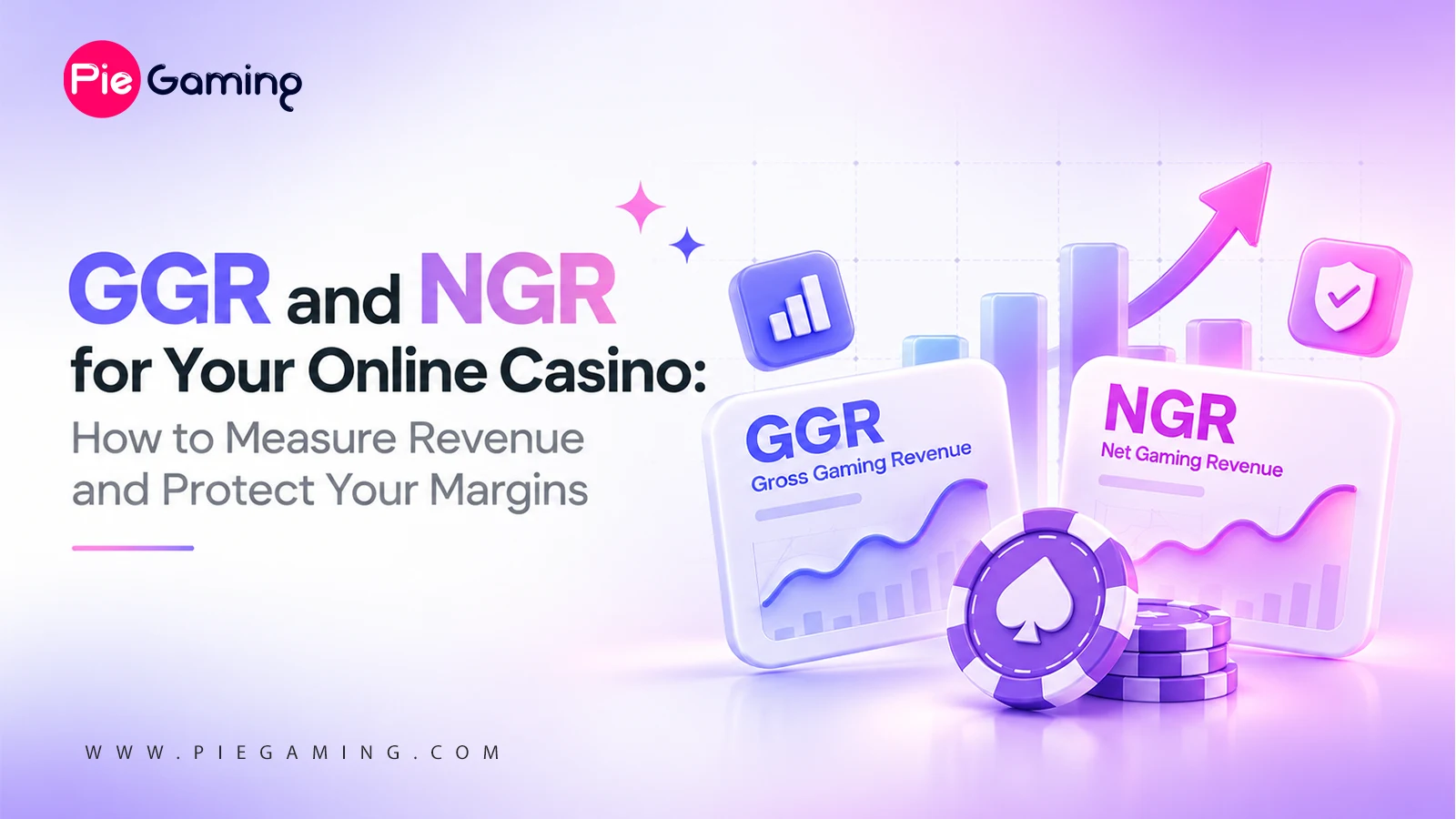
GGR vs NGR are the two-revenue metrics every casino operator needs to track. GGR is total wager minus player payouts, reflecting gaming performance before any deductions. NGR is GGR after bonuses, taxes, payment fees, provider royalties, and chargebacks are deducted. The gap between the two reveals where margin pressure is building.

See you in your inbox soon!

Stay ahead of the game. Subscribe for exclusive content, updates, and insiders!