
Online casinos can legally operate in regulated markets such as the UK, Malta, several European countries, parts of North America, Latin America, and selected markets across Africa and Asia.
A casino that’s fully legal in Malta can be a criminal offense in the country right next door. Online gambling laws don’t follow borders; they follow individual governments, and each one writes its own rulebook.
Out of 195 countries worldwide, only 145 have regulated online casino gaming as of 2026. Another 72 bans it completely, and the remaining 45 haven’t made up their minds, leaving operators to navigate legal gray zones with no clear rules to follow.
Some regions welcome operators with open licensing frameworks. Others ban online casinos outright. A few sits in legal gray zones that change every year. For operators, this patchwork means the wrong market pick isn’t just risky; it’s expensive.
This guide maps where online casinos are legal in 2026 and what it takes to enter each market the right way.
- Legal — The activity isn’t banned by law.
- Licensed — An operator holds official permission to run it.
- Regulated — Ongoing oversight applies: audits, player protections, compliance checks.
Where Is Gambling Legal? Global Status by Region
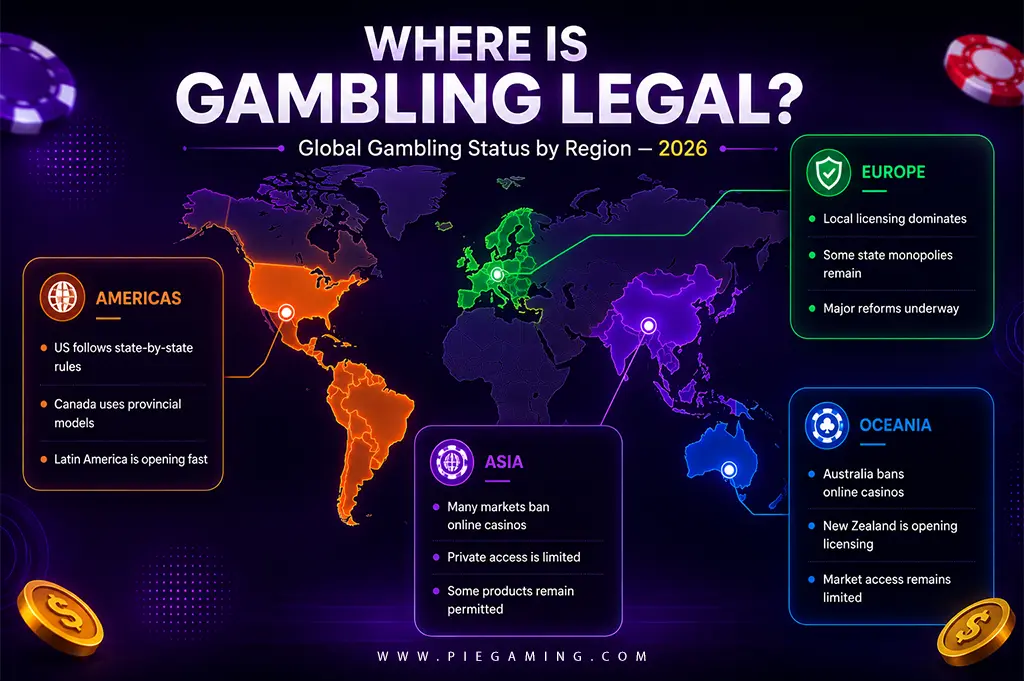
Where Is Gambling Legal?
Gambling laws vary by country, and there’s no single body that decides where online casinos can operate. Every country writes its own rules, and plenty of them rewrite those rules every year. Treat this as a snapshot of where things stand right now, not a permanent map. Always double-check with local counsel before you put money behind the market.
Europe
The EU doesn’t issue one gambling license that works everywhere. Each country runs its own system. That means your Malta Gaming Authority or United Kingdom Gambling Commission license won’t automatically let you serve players in France or Germany. You’ll need a local license in most EU markets, even though EU rules technically support cross-border trade.
Some countries keep the whole market closed to private operators. Poland hands online casino gaming entirely to one state-run brand, Total Casino. Private companies can only get a sports betting license there, nothing more. Austria works the same way for now, with Österreichische Lotterien holding the sole concession for lottery and online casino games.
But that’s about to shift. Austria has already sent the EU a draft law to end the monopoly and let multiple operators in, with a launch targeted around October 2027. Norway still runs a two-player system, Norsk Tipping and Norsk Rikstoto, with zero room for private online casino licenses. Hungary only opens its doors to operators that already run a land-based casino in the country, so newcomers are mostly locked out.
Finland is the one to watch closely. It signed a new Gambling Act in January 2026, opens license applications in March 2026, and lets licensed operators go live from July 2027. Lotteries and land-based games stay with Veikkaus, but betting, online slots, casino games, and bingo all open up to competition.
| Country | Model | Operator Access |
| Malta | Open licensing (MGA) | Streamlined, EU hub |
| UK | Open licensing (UKGC) | Open, with affordability checks |
| Austria | State monopoly (casino/lottery) | Closed now; opening targeted ~Oct 2027 |
| Poland | State monopoly (casino) | Closed for online casino |
| Norway | State duopoly | Closed |
| Finland | Transitioning monopoly | Closed until mid-2027 |
| Hungary | Restricted licensing | Land-based license required first |
Americas
There’s no federal law covering online casinos in the US. Each state decides for itself. Right now, only eight states allow it: New Jersey, Delaware, Pennsylvania, Michigan, Connecticut, West Virginia, Rhode Island, and Maine. Seven are already live.
Maine passed its law but hasn’t launched yet, with 2027 pegged as the likely start. Three states alone, New Jersey, Pennsylvania, and Michigan, bring in nearly 90% of all US iGaming revenue. Most other states stick to sports betting and won’t touch online casino games.
Canada follows a similar pattern. Ontario is the open market here, with dozens of private operators running under iGaming Ontario. Everywhere else, provinces mostly stick to their own government-run platforms, like Loto-Québec and BCLC, instead of letting private companies in.
Latin America is where the real movement is happening. Colombia has run a regulated market through Coljuegos since 2016. Mexico licenses operators through SEGOB. Argentina hands licensing to individual provinces, so terms vary depending on where you apply.
Brazil is the standout: it moved from grey market to full federal licensing on January 1, 2025. By the end of that year, 78 operators covering 138 brands were already licensed, and that number has kept climbing through 2026. The rulebook itself isn’t finished either. Brazil’s regulator opened a public consultation in mid-2026 to lock down permanent licensing rules.
| Country/Region | Model | Operator Access |
| US (8 states) | State-by-state licensing | Open, fragmented |
| Canada (Ontario) | Provincial open licensing | Open |
| Canada (other provinces) | Provincial monopoly | Mostly closed |
| Mexico | Federal licensing (SEGOB) | Open |
| Colombia | Federal licensing (Coljuegos) | Open |
| Argentina | Provincial licensing | Open, fragmented |
| Brazil | Federal licensing (SPA) | Open, growing fast, rules still finalizing |
Asia
Asia has two clear patterns: full bans and narrow, tightly controlled exceptions. The Philippines shut down its entire offshore gaming industry under the Anti-POGO Act of 2025. What’s left runs only through PAGCOR-licensed domestic operators.
Hong Kong keeps a tight grip too, with the Hong Kong Jockey Club holding the only license for online betting on horse racing, football, and the Mark Six lottery. Private casino operators have no way in. Macau licenses land-based casinos freely but draws a hard line at online casino games, allowing only a state-run sports lottery online.
China bans gambling almost completely, online or off, with one small carve-out for state-run welfare and sports lotteries. Everything else stays illegal, and enforcement is serious.
| Jurisdiction | Model | Operator Access |
| Philippines | Domestic licensing (PAGCOR) | Open, inland-only |
| Hong Kong | Single monopoly (HKJC) | Closed to private operators |
| Macau | Land-based licensing only | Online casino banned |
| China | Full prohibition | Closed, lottery exception only |
Oceania
Australia lets you bet on sports, racing, and lotteries with a license, but online casino games are off the table entirely. The Interactive Gambling Act 2001 makes it a criminal offense for any operator, local or offshore, to offer real-money casino games like slots or blackjack to Australians. The law targets operators, not players, which is why offshore sites still get Australian traffic despite having no legal way to hold a local license.
New Zealand just closed a long-standing gap. For years, online casinos based in New Zealand were banned, but offshore operators could legally serve Kiwi players with no local oversight at all.
That changed on May 1, 2026, when the Online Casino Gambling Act came into force, opening a licensing process capped at 15 operators. Existing offshore operators can keep operating under transitional arrangements until December 1, 2026. After that, only licensed or licensing-pending operators can legally serve New Zealand players.
| Country | Model | Operator Access |
| Australia | Sports/racing/lottery licensed; casino banned | Closed for online casino |
| New Zealand | New licensing regime (2026) | Opening, capped at 15 licenses |
Top Jurisdictions to License an Online Casino
Picking a licensing jurisdiction decides which markets you can serve, which banks and payment processors will work with you, and how much trust players place in your brand from day one. Here’s how the major jurisdictions stack up in 2026.
Curaçao
For years, Curaçao was the default starting point for new operators. It was cheap, fast, and didn’t ask too many questions. That made it the go-to choice for startups and crypto casinos that needed to go live quickly and prove their business model before spending real money on a premium license.
What changed under the 2023 licensing reform
That old system is gone. Curaçao ran on a master/sub-license model for decades, where four private companies, Antillephone, Curaçao eGaming, Gaming Curaçao, and Cyber Rock Entertainment, sold sub-licenses to operators with almost no oversight.
The Netherlands pushed Curaçao to clean this up in exchange for pandemic recovery funds, and the result was the National Ordinance on Games of Chance (LOK), which came into force on December 24, 2024. The old sub-license system was formally abolished on January 1, 2025, and the Curaçao Gaming Authority (CGA) now issues every license directly.
If you’re still running on an old sub-license, that phase is over. Transitional “orange seal” licenses expired permanently on October 15, 2025, and from January 1, 2026, licensees must have a Curaçao-registered entity, a local registered office, and at least one Curaçao-resident managing director.
A further local key-person staffing requirement is being phased in too, though enforcement has been pushed out to April 2027 for many operators. Compliance expectations post-reform now include transaction monitoring, tax good-standing checks with the local authority, and ongoing supervision, not a one-time sign-off.
Malta (MGA)
Malta is the benchmark for reputable, EU-facing licensing. The Malta Gaming Authority has regulated the market since 2004 and is recognized well beyond the EU. An MGA license opens the door to EU banking relationships and gives players and payment processors real confidence in your brand.
It costs more and takes longer than Curaçao, and how much more depends on how much compliance substance you build in-house versus outsource. This is where operators land once they outgrow Curaçao, usually after proving the business model and needing EU market access or stronger banking relationships to keep scaling.
Isle of Man
The Isle of Man carries a strong reputation, built on the Online Gambling Regulation Act (OGRA) and continuous regulatory refinement since 2001. It offers 0% corporate tax on gaming profits, alongside gambling duty that falls as revenue grows rather than rises.
This jurisdiction suits established operators who want UKGC-adjacent credibility and a genuinely favorable tax structure, without applying for the UK license itself. It’s also a common choice for crypto-friendly platforms that need a reputable, tax-efficient base.
Gibraltar
Gibraltar’s biggest asset is its tie to the UK market and its reputation among established operators. It’s known for being selective, and first-time operators without a track record are often turned away. It’s usually a jurisdiction operators add alongside MGA, not a first license.
UK Gambling Commission
The UKGC sits at the top of the cost and compliance ladder. It’s the only license on this list that actually lets you serve UK players directly, and that market access is the entire reason operators put up with the expense.
The compliance burden matches the price tag: rigorous source-of-funds checks, ongoing reporting, and some of the strictest player-protection rules anywhere. Operators pursue it anyway because UK market access and UKGC-grade reputation open doors, with payment processors, banks, and players, that no offshore license can.
Kahnawake
The Kahnawake Gaming Commission, run out of Mohawk Territory in Canada, is the standard choice for operators building a North American footprint. It sits below Malta and the UK in reputation but above most offshore jurisdictions, and it’s well recognized specifically within Canada.
There’s no gaming tax and no minimum capital requirement, though the license requires primary servers to be hosted within Mohawk Territory, which some operators find limiting.
It suits operators targeting Canadian players or building a credible North American base, rather than those chasing EU or UK market access. It doesn’t grant direct entry to the US market, so operators still need separate state-level licensing to serve American players.
Jurisdiction Comparison at a Glance
| Jurisdiction | Year-One Cost (approx.) | Timeline | Tax/Duty | Best For |
| Curaçao | €70,000–€110,000 | 3–6 months | 0% gaming tax | Startups, crypto casinos, fast global entry |
| Malta (MGA) | €60,000–€500,000 (lean vs. full substance) | 4–6 months (up to 8–12 for complex cases) | 5% capped compliance contribution | Operators outgrowing Curaçao, EU market access |
| Isle of Man | £150,000+ (incl. substance) | 3–6 months | 0% corporate tax; 0.1%–1.5% GGY duty | Established operators, UKGC-adjacent credibility |
| Gibraltar | £75,000+ annual | Selective, track record required | 0.15% GGR duty | Established operators adding to an MGA license |
| UK Gambling Commission | Up to £794,000 annual (scales with GGY) | Lengthy, rigorous review | 40% GGR duty (from April 2026) | Direct UK market access, top-tier reputation |
| Kahnawake | $40,000 initial, $20,000/year renewal | 8–12 weeks | 0% gaming tax | North American footprint, Canada-facing operators |
“Not every major market works like Curaçao or Malta.
Switzerland and Norway are legal, active gambling markets, but structurally closed to new operators. Moving further, you will understand what makes them different, and what your options actually are if you’re eyeing either one.”
Online Casino Switzerland: Legal but Tightly Controlled
Switzerland doesn’t ban online casinos, but it regulates them tightly enough that most international operators can’t get a license at all.
How Switzerland’s licensing model actually works?
The Federal Act on Money Games (BGS) took effect on January 1, 2019. The ESBK (Swiss Federal Gaming Board) oversees casino gaming; Gespa regulates lotteries and sports betting.
The law divides Switzerland into 23 zones, each eligible for one casino concession:
- Type A for large casinos (GGR above CHF 30 million/year)
- Type B for smaller ones.
These are 20-year concessions granted by the Federal Council. In November 2023, the Council awarded concessions but only 22 of the 23 zones received one (10 Type A, 12 Type B). Only concession holders can apply to extend their license to cover online games, and as of early 2026, 10 casinos hold that online extension.
Why foreign operators can’t simply apply for a Swiss license?
There’s no standalone online gambling license in Switzerland. The only route is to already hold a Swiss land-based concession and apply to the ESBK for an online extension. This locks out international operators by design: an MGA or UKGC license carries zero weight here, since Switzerland doesn’t recognize foreign licenses for its domestic market.
White-label solutions aren’t permitted either, since licensed casinos must run their core operations themselves rather than outsourcing them to a foreign platform.
The cooperation-with-licensed-casino path
Swiss casinos can partner with international B2B and B2C companies without those partners needing a Swiss entity or license. If a foreign partner counts as an “important business partner,” they must pass a good reputation test, which checks whether they’ve illegally targeted Swiss players from abroad in the past. Operators with that history typically face a five-year cool-down before they qualify. Pure game suppliers get lighter scrutiny than platform providers or major commercial partners.
In practice, this usually looks like a foreign game studio or platform provider supplying content or tech to an existing Swiss-licensed casino brand, with that casino staying the accountable party to the ESBK.
What this means if you’re evaluating the Swiss market?
For foreign operators, the realistic path is partnership with one of the 10 Swiss casinos already running online, not licensing. There’s no fixed cost or timeline since it’s a private negotiation, but expect vetting, background checks, source-of-funds review, reputation assessment, to take several months.
Demand is strong because winnings from licensed Swiss casinos are tax-free for players with no upper limit, while lottery-style large games carry a CHF 1 million tax-free threshold.
Supply stays gated because Switzerland enforces hard: the 3,000 blocked domains in early 2026 and keeps growing, and the Federal Supreme Court has upheld its legality against foreign operators’ challenges. High demand, tightly capped supply, active blocking of everyone else, that’s why this market stays lucrative for the few who can legally serve it.
Online Casino in Norway
Norway runs one of Europe’s strictest gambling markets. There’s no licensing process to apply to, because the market itself isn’t open.
Norsk Tipping and Norsk Rikstoto’s monopoly explained
Under Norway’s Gaming Scheme Act, only two state-owned operators can legally offer gambling: Norsk Tipping and Norsk Rikstoto. Norsk Tipping holds the exclusive right to online casino games, lotteries, and sports betting.
Norsk Rikstoto covers horse race betting only. No private operator, domestic or foreign, can get a Norwegian license for online casino games. This isn’t a restrictive licensing regime you can apply into, like Sweden or the Netherlands. It’s a closed state monopoly with no application process for private companies at all.
DNS and banking blocks on offshore operators
Norway backs its monopoly with real enforcement, not just a law on paper. Norwegian banks have been required to block card transactions to gambling sites since 2010, and the Norwegian Gambling Authority (Lotteritilsynet) began DNS blocking in January 2024.
That escalated on January 1, 2025, when the DNS blocking mechanism moved into full enforcement, and in March 2025, Lotteritilsynet issued its first formal orders forcing ISPs to block 57 illegal gambling websites tied to 23 different companies, including major names like Betsson, bet365, and Kindred-owned brands.
The impact shows up in the numbers. Norsk Tipping’s active online player base grew 11% , reaching two million users. Enforcement measures, including the DNS-blocking regime that began in 2025, helped push players back to the state operator. Individual players aren’t prosecuted for accessing offshore sites, so there’s no legal risk on their end.
But for operators, offshore isn’t a viable workaround: banking rails are cut off, domains get blocked, and advertising, including Norwegian-language TV ads historically broadcast from London, is also restricted.
What legitimate market entry into Norway-adjacent markets looks like?
Be direct with yourself here: there’s no legal path to operate an online casino targeting Norwegian players right now. No license tier to apply for, no partnership structure like Switzerland’s, no workaround. Any Norway-facing content strategy needs to account for that.
The more realistic play is regional. Operators can hold licenses in neighboring Nordic or EU markets, Malta or the Isle of Man, for instance, and build audience or brand presence across the wider Nordic region without directly targeting Norwegian players, since serving Norway itself remains illegal regardless of where the license is held.
Finland’s own move away from its Veikkaus monopoly toward a multi-license system, opening for applications in March 2026, is worth watching too, since it signals that Nordic monopolies aren’t permanently fixed.
For now, the honest advice for operators is to treat Norway as closed and watch the political calendar, not to look for a side door in.
Countries Where Online Gambling Is Illegal or Restricted
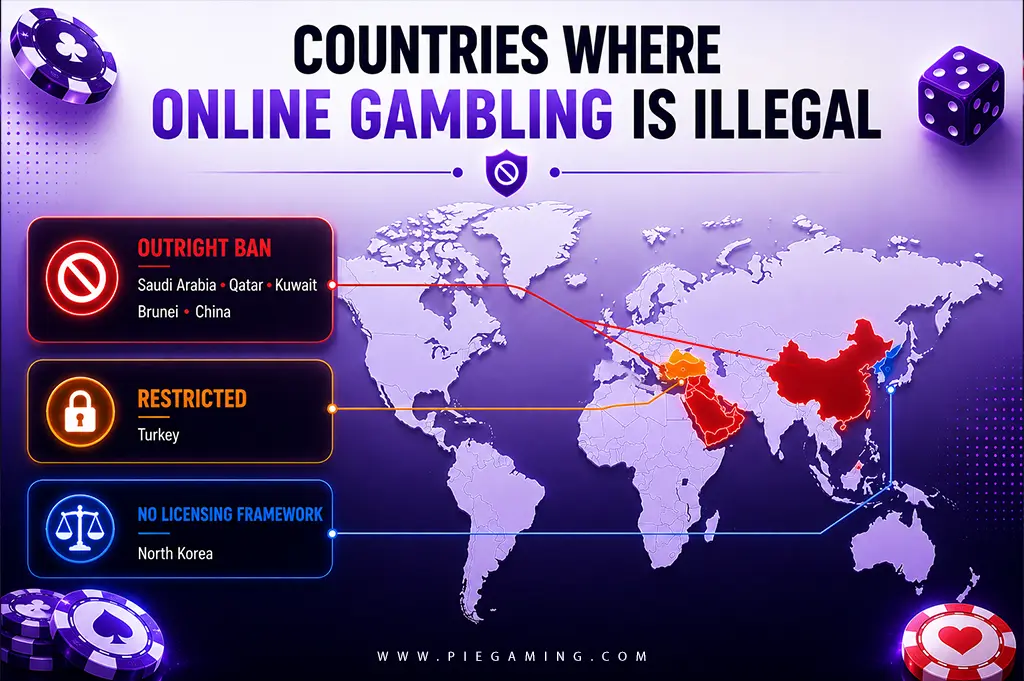
Where online gambling is illegal
Not every closed market works the same way. Some jurisdictions expressly prohibit online gambling, while others have no dedicated licensing framework but may still restrict the activity through criminal, payment, advertising, or cybercrime laws. That distinction matters when you’re deciding whether a market is worth entering.
Outright bans (short list + why)
Industry estimates place the number of jurisdictions that broadly prohibit online gambling at around 40, though the total varies depending on how state lotteries, limited betting exceptions, and player liability get classified.
| Country | Why it’s restricted |
| Saudi Arabia | Prohibited under Sharia-based law; no ordinary route to a private online-casino license |
| China (mainland) | Private gambling, including online, is prohibited under the criminal-law framework; state-run welfare and sports lotteries are a separate, permitted exception |
| Turkey | Online gambling is generally restricted to state-authorized products; offshore sites face blocking and enforcement |
| Qatar | Criminalized under the Penal Code, with penalties that can include imprisonment and fines |
| Kuwait | Private gambling is prohibited, with no established private online-casino licensing route |
| North Korea | No transparent licensing framework exists; treat the market as inaccessible and high-risk |
| Brunei | Prohibited under Brunei’s statutory and Syariah framework, with criminal penalties attached |
Operator liability and player liability aren’t identical across these countries, so check the specifics before assuming a rule applies to both.
Grey markets: what “unregulated” really means and the risk it carries
Some countries simply have no dedicated online-gambling statute, but that gap doesn’t automatically mean serving those players is safe. Other laws, criminal, payment, advertising, or cybercrime, may still make it unlawful.
A Curaçao or Anjouan license may authorize an operator under that licensing jurisdiction’s own framework, but it doesn’t grant permission to target players in a country where gambling is prohibited, restricted, or reserved for locally licensed operators. Treat legal uncertainty as a risk, not as a green light.
Enforcement risk
Indonesia shows how far enforcement can reach beyond just blocking websites. By April 2026, Indonesia’s Financial Services Authority reported that more than 33,000 bank accounts suspected of links to online gambling had been blocked, with later reports placing the figure above 36,000.
Payment and banking risk
Payment processors and banks generally treat unregulated or prohibited markets as high-risk, since there’s no local regulatory framework backing the transactions. That exposure can show up as declined transactions, suspended merchant accounts, or frozen funds, with no local regulator to appeal to.
Reputational risk
Past activity in prohibited or unauthorized markets can complicate future licensing and partnership applications. Regulators and commercial partners commonly examine ownership, integrity, criminality, source of funds, regulatory history, and previous enforcement exposure before approving an operator or supplier. The consequences depend on the jurisdiction and how serious the prior conduct was, not a fixed, automatic penalty.
How to Choose the Right Jurisdiction for Your Casino Business?
Most operators pick a jurisdiction based on price. That’s backwards. The real question isn’t “what’s the cheapest license I can get,” it’s “which license actually lets me legally serve the players I’m targeting.” Get that sequence wrong, and you’ll spend months building a business you can’t operate in your own target market.
Match your target player market to a compliant license
License choice starts with geography, not cost. Holding a license doesn’t automatically authorize you to serve every market outside where it’s issued. Each target country has its own rules on licensing, blocking, and payments, so check those before assuming a license “covers” a region.
Common mismatches to avoid:
- Assuming a Curaçao license is a passport into Latin America, Asia, or Africa. Plenty of countries there still restrict offshore gambling, and local licensing may still apply.
- Targeting Great Britain with only an MGA license. It doesn’t replace the UKGC license mandatory for serving players there.
- Targeting Brazil without SPA authorization, required since January 1, 2025.
- Assuming an MGA license lets you serve Switzerland. It doesn’t. Switzerland requires a Swiss casino concession with an online extension, and no foreign license substitutes for that.
Map your target countries first, then work backward to the license, or combination of licenses, that actually covers them.
Match your license to compatible software (white label vs turnkey vs full build)
White label
It means you operate under a licensed partner’s authorization, with that partner remaining legally responsible for compliance. Curaçao was historically the license most tied to this model, through its old master-license and sub-license structure. That structure is gone.
Curaçao’s LOK reform took effect on December 24, 2024, and operators now need a direct license from the Curaçao Gaming Authority. A provider can still supply the platform and operational services, but you can no longer simply “rent” a master license.
White-label availability elsewhere is jurisdiction-specific. In Great Britain, for instance, white-label partnerships exist, but the UKGC is explicit that compliance responsibility can’t be transferred to the partner. Check the current rule for your target market rather than assuming it’s allowed or banned outright.
Turnkey
turnkey casino software the same pre-built stack, game lobby, cashier, back office, compliance tooling, but you hold your own license instead of operating under someone else’s. This suits markets where the regulator expects the operator itself to be the accountable license holder, and it generally takes longer to launch since your licensing runs alongside the technical buildout.
Full custom build
It tends to make sense at real scale, once you’re operating across multiple regulated jurisdictions with needs off-the-shelf platforms can’t meet, or once revenue justifies owning infrastructure outright.
Many operators start with White label, then migrate to turnkey or custom as volume grows. Negotiate data portability and KYC file access into any contract upfront, since migration isn’t always simple later.
Budget and timeline reality check
Treat these as indicative estimates, not fixed standards. Actual costs vary by jurisdiction, product scope, and how much compliance you build in-house.
| Model | What to budget for |
| Direct Curaçao license | CGA annual fees run around €47,450, plus company formation, local substance, compliance, and platform costs. |
| Turnkey with own license | Several months to launch, driven by licensing, technical integration, and certification readiness. |
| MGA (Malta) B2C | A lean setup may start around €60,000; a fully staffed multi-market operation can run several hundred thousand euros. Applications typically take four to six months. |
| UKGC or similar | Budget beyond the license fee for compliance staff, testing, and legal advice. Fees scale with gross gambling yield. |
Wrapping Up…
Online casino licensing isn’t a one-time decision, it’s a moving target. Malta tightens its rules, Curaçao overhauls its entire system, New Zealand opens a market that didn’t exist a year ago. What’s compliant today can shift by next quarter.
Your best move as an operator isn’t chasing the cheapest license or the fastest launch. It’s building a jurisdiction strategy that matches your actual player base, then staying close enough to the regulatory calendar that you’re never caught off guard.

Contact US
FAQs
-
What makes an online casino legal and regulated?
A casino is legal when it holds the right local license, verifies its players, protects their funds, prevents fraud, follows responsible-gambling rules, and only accepts players from places where it's actually permitted to operate.
-
What countries is online gambling legal in?
Online gambling is legal across a fair number of regulated markets, including Great Britain, Sweden, Malta, Switzerland, Brazil, Denmark, Spain, Italy, Portugal, and select US states. Rules vary by location, so what's legal in one market won't necessarily fly in another.
-
What's the difference between a licensed casino and a legal casino?
A licensed casino holds regulatory authorization somewhere. A legal casino is authorized to accept players in your specific country or state. One doesn't guarantee the other. A license from Curaçao or Malta doesn't automatically make a casino legal everywhere.
-
What factors determine whether a jurisdiction is favorable for launching an online casino?
Target-market access, licensing requirements, tax rates, application costs, approval timelines, AML obligations, technical standards, payment access, advertising rules, local-substance requirements, and regulator reputation all shape whether a jurisdiction fits your business.
-
Which regions currently offer the most operator-friendly gambling regulations?
Curaçao offers flexible costs and speed. Malta and the Isle of Man offer stronger credibility. Some Latin American, African, and European markets look promising too, but local authorization still matters most.

Palak Madan has been writing about the iGaming industry since 2024. She focuses on helping operators and founders understand their options when launching an online casino, from choosing the right software provider to figuring out costs and compliance requirements across different markets. At PieGaming, she covers topics like white label casino solutions, platform selection, and market entry, turning complex industry information into practical guidance for people building iGaming businesses. She also keeps a close eye on licensing and regulatory changes; particularly how new rules shape the way operators enter and grow in different jurisdictions.
A GCGRA Gaming License is required to operate commercial gaming in the UAE, including online casinos and sportsbooks. Foreign operators can apply, but must meet GCGRA’s suitability, financial, compliance, and operational requirements before they can launch.
Online casino gaming is not allowed in Australia under Interactive Gambling Act 2001. But operators can still apply for an internet gaming license via specific jurisdictions like the Northern Territory, which allows them to offer gambling services legally- generally outside Australia.
Bulgaria’s iGaming license enables operators to legally provide services in the areas of online casino, betting, poker, and bingo in accordance with the regulations of the EU. Typically, a licensing process can take 60 to 90 days, and it will need to be approved by the NRA, technical certification, AML compliance, and data storage in the local area. Minimum capital requirements range from BGN 50,000 for betting operators to BGN 1.5 million for online casino operators.
To obtain the Anjouan Gaming License, applicants must collect and submit all the important documents. Learn the process of obtaining Anjouan iGaming license.
Algeria has no online casino or sports betting regulation to speak of — instead, the country enforces a near-total gambling ban rooted in civil law and Islamic principles. Yet despite the prohibition, offshore platforms continue to pull in millions of users every month, driven by high demand and a near-total absence of legal local alternatives.
A Kahnawake iGaming license is a credible and cost-effective licensing solution for online casinos and sportsbook operators. The process to obtain this license includes multiple steps, key benefits, and licensing costs.
Malta pays attention to the credibility of the regulatory framework and to access regulated markets, which is more conducive to long-term growth and industry reputation. However, Curaçao places a strong emphasis on speed and affordability, making it a good choice for startups and businesses focused on cryptocurrencies that are keen to establish a presence rapidly and at a lower cost. If you are constructing a major operation, select Malta. Pick Curaçao when you are just getting started and have to get your product to market quickly.

See you in your inbox soon!

Stay ahead of the game. Subscribe for exclusive content, updates, and insiders!