
To get an iGaming license in the UK, you’ll need to apply to the UK Gambling Commission (UKGC). It will take approximately 16 weeks and will involve comprehensive documentation of policies and extensive background checks and corporate structure. The amount of your first application fees will vary depending on your anticipated income, ranging from £370 up to more than £91,000.
If you are interested in offering gambling services to Great Britain (GB) residents legally, you should secure a gambling license from the UK, including online casino licenses, sportsbook licenses, bingo licenses, and betting service licenses.
These licenses are granted by the UK Gambling Commission (UKGC), a strict regulator in terms of compliance, player protection, anti-money laundering (AML), and financial transparency. Though the application process could be lengthy, it is worth the effort.
You’ll be able to enter one of the most trusted and profitable regulated gambling markets in the world. It is estimated that the UK gambling market will be worth £16.8bn between April 2024 and March 2025. It’s the largest legal gambling market in Europe.
This guide will explain everything you should know about securing an iGaming license, iGaming requirements, iGaming costs, and timelines for 2026.
Understanding UK Gambling Regulations
The UK has one of the world’s most respected and tightly regulated gambling markets. If you want to offer online casino games, sports betting, bingo, lottery products, or gambling software to players in Great Britain, you’ll need to comply with the Gambling Act 2005 and get a license from the UKGC.
The UKGC is the primary regulator responsible for licensing, monitoring, and enforcing gambling laws across Great Britain. Their job goes beyond issuing licenses.
They will actively monitor operators to ensure that you are adhering to high levels of player protection, anti-money laundering (AML) compliance, financial transparency, and responsible gambling. Operators who fail to comply with these standards may be subject to regulatory action that can include fines, license suspension or license revocation.
The License Conditions and Codes of Practice (LCCP) outline the ongoing obligations you’ll need to meet:
- Customer identity verification.
- AML controls.
- Protection of customer funds.
- Responsible advertising.
- Safeguarding vulnerable players.
The latest LCCP amendments came into force in March 2026, with additional provisions added in April 2026 as part of the UK’s broader gambling reform programme.
Remote gambling operators also need to comply with the Remote Gambling and Software Technical Standards (RTS). These standards include security, fairness of the games, transparency of transactions, protection of players, and responsible product design. You will need to prove that your systems, policies and internal controls comply with the standards expected by the UKGC before you start trading.
The regulatory landscape keeps evolving. The UKGC is focusing more on revenue risk assessments, consumer protection, and safer gambling initiatives. When looking for a UK gambling licence, you should be prepared to create a strong compliance system and sustain it all through the licence process.
Types of UK iGaming Licences
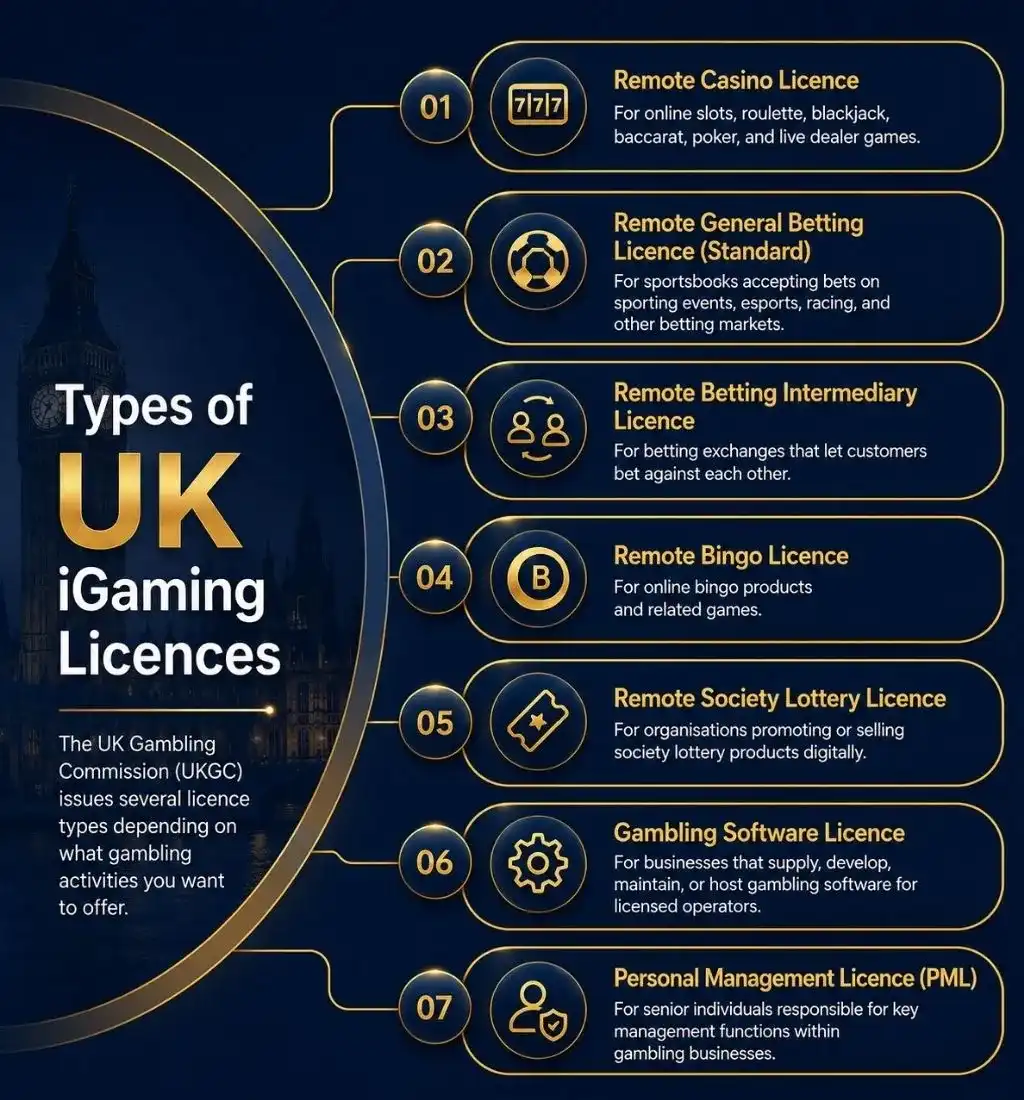
UK iGaming Licence Types Explained
The UK Gambling Commission (UKGC) has several types of licences depending on the type of gambling activities you wish to offer. For most operators, an Online Operator will need an Operating Licence to provide gambling services to customers in Great Britain.
The requirements are largely dependent on the type of products, the business model, and whether you are a direct-to-consumer business (B2C) or a technology and service provider to other operators (B2B). The most common licence for online gambling establishments is the Remote Operating Licence, which allows for online gambling via the Internet, mobile software, or other electronic channels. Inside this class of gambling, you will require gamblers to acquire approval for the gambling activities you want to provide:
- Remote Casino Licence – for online slots, roulette, blackjack, baccarat, poker, and live dealer games.
- Remote General Betting Licence (Standard) – for sportsbooks accepting bets on sporting events, esports, racing, and other betting markets.
- Remote Betting Intermediary Licence – for betting exchanges that let customers bet against each other rather than against you as the bookmaker.
- Remote Bingo Licence – for online bingo products and related games.
- Remote Society Lottery Licence – for organisations promoting or selling society lottery products digitally.
Gambling Software Licence – for businesses that manufacture, supply, install, adapt, maintain, or host gambling software used by licensed operators.
Some gambling businesses also need a Personal Management Licence (PML) for senior individuals. These are typically required for people responsible for key management functions like compliance, finance, anti-money laundering controls, marketing, gambling operations, and IT.
The UKGC assesses these individuals separately to make sure they’re suitable for positions of significant responsibility.
If you’re providing a gambling service on your land, then you’ll also require a Premises Licence issued by your local licensing authority. This includes physical establishments, such as casinos, betting shops, and bingo halls. If you don’t have a UKGC licence, you need to get that before trying to get a premises licence. A number of operators require several licenses to operate.
A casino that provides online games as well as sports betting, for instance, will likely need a Remote Casino Licence and a Remote General Betting Licence. In general, a B2B platform provider which creates gaming technology for licensed operators will require a Gambling Software Licence. The structure of your licence is important from the outset as this will impact your application process, costs, compliance, and timelines to approval.
| Licence Type | Purpose | Who Needs It? |
| Remote Casino Licence | Lets you run an online casino in Great Britain. | Casino operators and gaming brands. |
| Remote General Betting Licence (Standard) | Lets you take bets on sporting events and other real-world outcomes. | Sportsbook operators and betting platforms. |
| Remote Betting Intermediary Licence | Let customers bet against each other instead of against you. | Betting exchanges. |
| Remote Bingo Licence | Lets you offer online bingo. | Online bingo operators. |
| Remote Society Lottery Licence | Lets you sell lottery tickets online for charities and societies. | Registered societies and charitable organisations. |
| Gambling Software Licence | Lets you build, sell, or run gambling software for other operators. | Game developers, platform providers, sportsbook tech companies, RNG providers. |
| Personal Management Licence (PML) | Required for senior staff in key roles within your business. | Senior executives and decision-makers. |
| Premises Licence | Lets you run gambling at a physical location (issued by your local council, not the UKGC). | Land-based gambling operators. |
Eligibility Requirements for a UK iGaming License
Eligibility for a UK iGaming licence depends on demonstrating suitability in your ownership, finances, staff qualifications, compliance controls, and operational technology. Here’s what matters.
Business Structure
You’ll need to disclose your ownership setup and management hierarchy. Provide detailed information about all shareholders and who have control over the business. Those that are very significant owners or decision makers will be subject to additional checks and balances during the process.
Financial Suitability
Demonstrate to the UKGC how the business will be financed and the source of the funding. You may be required to submit bank statements, loan arrangements, and audited financial statements, depending on your funding sources. Submit financial forecasts and business plans so they can assess whether your business is financially stable, and your funding is legitimate.
Key Personnel
Senior staff who are responsible for compliance, finance, gambling operations, marketing, IT and anti-money laundering might require a Personal Management Licence (PML). They undergo checks of their suitability to ensure they possess the integrity, experience and competence to operate licensed gambling activities.
Compliance Controls
You need to establish anti-money laundering (AML) policies and customer due diligence procedures before you launch. Implement responsible gambling measures, complaints of handling processes, and safeguards for children and vulnerable people. The UKGC wants to see how these controls actually work in practice, not just policy documents on paper.
Technical Readiness
For online businesses, you need to comply with the UKGC’s Remote Gambling and Software Technical Standards (RTS). This means demonstrating platform security, game integrity, and transaction monitoring. Provide operational maps, system diagrams, testing strategies, and details about your third-party technology providers.
Ultimately, the UKGC is checking whether you have the financial resources, governance structure, operational controls, and management expertise to operate responsibly in the Great Britain gambling market. If you can’t demonstrate suitability in any of these areas, you might face delays, additional information requests, or rejection.
Step-by-Step Process to Obtain a UKGC License
Getting a UK Gambling Commission licence takes time and preparation. Here’s a breakdown of the eight steps you’ll go through from choosing your licence type to launch.
Step 1: Choose the Required Licence Type
Start by identifying what gambling activities your business wants to offer. The UKGC issues different permissions for remote casino gaming, sports betting, betting exchanges, bingo, society lotteries, and gambling software.
Many operators need multiple permissions. For example, an online casino that also offers sports betting typically needs both a Remote Casino Licence and a Remote General Betting Licence. Getting the licence type right from the start helps avoid delays.
Step 2: Register the Company Structure
Before you apply, set up your legal entity and define your ownership structure. The UKGC wants full disclosure of shareholders, ultimate beneficial owners, directors, and any group companies. You’ll need to show who controls the business and how ownership is structured across all related entities.
Step 3: Prepare Compliance Documentation
This step takes the most time. You need to prepare comprehensive documents covering your business operations, source of funds, financial projections, AML controls, responsible gambling measures, customer verification procedures, and technical infrastructure. The UKGC wants to see how your compliance policies actually work in practice, not just template documents.
Step 4: Submit the UKGC Application
Submit your application through the UKGC’s online licensing portal. You’ll provide company information, licence activity details, ownership disclosures, key personnel information, and supporting documentation. Make sure nothing is missing. Any gaps can cause delays or requests for more evidence.
Step 5: Pay the Application Fee
The UKGC won’t start assessing your application until you’ve paid the required fee. Fees vary depending on your licence activities and your projected gross gambling yield (GGY). If your fee isn’t paid, the review process won’t start.
Step 6: Undergo UKGC Due Diligence Review
Once your application is accepted, the UKGC conducts a detailed suitability assessment. They focus on five key areas:
- Identity and ownership
- Financial standing and source of funds
- Integrity and honesty
- Professional competence
- Criminal background checks
The regulator also reviews your business plans, funding arrangements, corporate governance, and compliance controls to determine whether you can meet the licensing objectives.
Step 7: Respond to Additional Information Requests
During the review, the UKGC may ask for clarification, supporting evidence, or additional documentation. These requests often relate to funding sources, ownership arrangements, AML frameworks, or technical controls. Quick and accurate responses help keep your application moving.
Step 8: Licence Approval and Operational Readiness
If the UKGC is satisfied that you meet all suitability and compliance requirements, you’ll get your operating licence.
But approval isn’t the end. Before you launch, make sure all your compliance controls, responsible gambling tools, reporting systems, and ongoing monitoring procedures are fully operational.
Once you’re licensed, you’re subject to continuous regulatory oversight and must comply with the Licence Conditions and Codes of Practice (LCCP) throughout your licence.
Read Blog – Explore Top iGaming software provider
UK Gambling License Costs & Taxation
Getting a UK gambling licence isn’t just about paying the application fee. You need to budget for annual licence fees, gambling duties, compliance expenses, technology investments, and ongoing regulatory obligations. UKGC fees are based on your licence activity and your projected or actual Gross Gambling Yield (GGY).
| Cost Category | What It Covers | Key Considerations |
| Application Fees | One-time fee when you submit your UKGC application. | Fees vary by licence type and projected GGY. A remote casino operator with annual GGY below £550,000 currently pays £4,224. |
| Annual Licence Fees | Recurring fee to keep your licence active each year. | Based on your licence category and actual GGY. A remote casino operator in the lowest fee band currently pays around £4,199 per year. |
| Personal Management Licence (PML) Costs | Licensing costs for key management staff. | Applies to compliance officers, finance directors, AML officers, and senior executives. Separate costs per individual. |
| Compliance Costs | AML systems, KYC verification, responsible gambling tools, audits, and reporting systems. | Costs depend on your operator size, transaction volume, and regulatory requirements. This is ongoing and non-negotiable. |
| Technology & Platform Costs | Gaming platforms, payment integrations, security infrastructure, monitoring tools, and testing. | B2C operators typically spend more due to player-facing systems and compliance requirements. |
| Legal & Advisory Costs | Regulatory consulting, legal reviews, licence preparation, and compliance support. | Often needed during application preparation and ongoing regulatory reviews. |
| Remote Gaming Duty (RGD) | Tax on remote gaming profits from UK customers. | As of April 2026, this is 40% of your remote gaming profits. |
| General Betting Duty (GBD) | Tax for betting operators. | Fixed-odds betting operators currently pay 15% of net stake receipts. |
| Ongoing Operational Costs | Staff training, compliance monitoring, reporting obligations, and regulatory updates. | Required throughout your licence lifecycle to maintain UKGC compliance. |
Application and annual licence fees get the attention, but taxes, compliance infrastructure, and ongoing regulatory obligations typically cost more in the long run. If you’re planning to enter the Great Britain market, budget for both licensing costs and the broader compliance framework you’ll need to maintain your licence.
UK Gambling License Renewal Process
The UKGC doesn’t make you renew your licence on a schedule like other jurisdictions do. Once you get it, your licence stays valid forever. The catch? You have to keep meeting regulatory requirements, pay your annual fees, and stay suitable to hold it.
Maintaining your licence isn’t passive. You’re under continuous oversight and need to show you’re complying with the Licence Conditions and Codes of Practice (LCCP). If you slip up, you could face regulatory reviews, enforcement action, suspension, or even loss of your licence.
What You Need to Do
- Pay your annual fees on time based on your licence category and Gross Gambling Yield (GGY).
- Submit regulatory reports by the deadlines.
- Tell the UKGC about major changes like new owners, new management, or changes to your business.
- Keep your anti-money laundering (AML) controls and customer checks working properly.
- Follow responsible gambling rules and protect your customers.
- Make sure your gambling systems meet UKGC standards.
- Keep your licensing information up to date.
The UKGC can review your compliance at any time. They look at your AML controls, how you treat customers, your governance, and your finances. If you can’t show you’re complying, you face extra conditions, fines, or serious action.
Think of licence maintenance as something ongoing, not a one-time renewal. Build solid controls and monitoring systems to keep your licence and stay in the market for the long term.
Benefits of UK Getting a License
A UK Gambling Commission (UKGC) licence is one of the most valuable regulatory approvals in the global iGaming industry. It requires investment but offers real commercial and operational advantages that support long-term growth.
Market Access and Customer Reach
The most immediate benefit is legal access to customers in Great Britain. A UKGC licence lets you offer online casino games, sports betting, bingo, and other regulated gambling products across England, Scotland, and Wales. The UK market is mature with high consumer adoption, giving you access to a large, engaged customer base.
Stronger Business Partnerships
Payment providers and financial institutions are more willing to work with you when you’re fully licensed. A UKGC licence demonstrates you meet strict anti-money laundering (AML), customer due diligence, and financial transparency standards. This opens doors to payment processors, e-wallet providers, and banks.
Game developers and platform providers prefer licensed operators. You gain access to established software suppliers, live casino providers, sportsbook technology vendors, and content aggregators. You can offer a broader portfolio of games while staying compliant.
Building Consumer Trust
UKGC-licensed operators follow strict rules on customer verification, responsible gambling, complaint handling, and player fund protection. These safeguards build consumer confidence and encourage player retention, especially among customers who prioritise security.
Supporting Future Growth
Regulators, investors, and business partners view UKGC licensing as evidence of strong governance. Successfully operating under UK regulation strengthens your reputation and supports expansion into other regulated jurisdictions. A UK licence is a valuable credential when pursuing international growth.
Competitive Advantage
As regulators crack down on unlicensed operators, a UKGC licence gives you a clear edge. You can market legally, build trusted relationships, and operate transparently. This strengthens brand positioning and makes your business more sustainable.
Challenges of Getting a UK license
Getting a UKGC licence isn’t easy. The regulator applies rigorous suitability assessments and expects you to demonstrate strong governance, financial transparency, and robust compliance controls. Here’s what you’re up against.
Documentation and Due Diligence
The UKGC asks for a lot of paperwork. You’ll need corporate records, ownership structure diagrams, source-of-funds evidence, business plans, financial forecasts, AML policies, responsible gambling procedures, and technical documentation.
The regulator also conducts extensive due diligence on shareholders, beneficial owners, and directors. Incomplete submissions or complex ownership structures often trigger additional requests, which delays everything.
Timelines and Compliance Framework
The UKGC says complete applications take about 16 weeks, but timelines stretch if your application is complex or documentation is missing. Building a UKGC compliant compliance framework is harder than many operators expect.
Generic policies won’t cut it. You need effective anti-money laundering (AML) controls, customer due diligence procedures, responsible gambling measures, and governance tailored to your actual business model.
Technical Standards and Costs
You must comply with UKGC’s Remote Gambling and Software Technical Standards (RTS). This means investing in platform security, transaction monitoring, game testing, and data protection.
On top of application fees, you’ll spend money on legal advice, compliance consulting, KYC solutions, audits, and ongoing reporting. These costs add up quickly.
Ongoing Oversight
Unlike some jurisdictions, UKGC regulation doesn’t end after approval. You’re subject to continuous compliance assessments, reporting obligations, and licence reviews. Compliance is an ongoing operational function, not a one-time requirement.
The greatest challenge is building the governance, compliance, and technical infrastructure needed to meet UKGC expectations before you apply.
Wrapping Up…
Getting a UK gambling licence is demanding, but it’s worth the effort for operators serious about long-term growth. Yes, you’ll invest time, money, and resources in building compliance systems and navigating a rigorous application process.
But you gain access to one of the world’s most respected regulated markets, stronger business partnerships, and consumer trust. The key is planning ahead, investing in proper governance and compliance infrastructure, and viewing it as an ongoing commitment rather than a one-time hurdle.

FAQ's
-
Is gambling legal in the UK?
Yes, gambling is legal in the UK when you're licensed by the UK Gambling Commission. The Gambling Act 2005 regulates everything—online casinos, sports betting, bingo, lottery tickets. You need a license to operate legally in Great Britain.
-
How long does it take to get a UK gambling license?
The UKGC typically takes about 16 weeks to process a complete license application. That's assuming you submit everything correctly upfront without delays or requests for more information. If things get complicated, it can take longer.
-
How much does a UKGC license cost?
Application fees start at £4,224 and go up to £91,686 depending on your licence type. Annual fees can reach £793,729. The exact cost depends on your gambling activity, revenue projections, and whether you're running a casino, sportsbook, bingo operation, software business, or something else.
-
What is an iGaming license in the UK?
An iGaming licence is a Remote Operating Licence from the UKGC. It lets you legally offer online gambling services like casinos, sportsbooks, or bingo to players in Great Britain.
-
Who regulates iGaming licenses in the UK?
The UK Gambling Commission (UKGC) handles everything. They issue licences, supervise operators, enforce the rules, and make sure you're protecting players, following anti-money laundering requirements, and running fair games. They work under the Gambling Act 2005.

Palak Madan has been writing about the iGaming industry since 2024. She focuses on helping operators and founders understand their options when launching an online casino, from choosing the right software provider to figuring out costs and compliance requirements across different markets. At PieGaming, she covers topics like white label casino solutions, platform selection, and market entry, turning complex industry information into practical guidance for people building iGaming businesses. She also keeps a close eye on licensing and regulatory changes; particularly how new rules shape the way operators enter and grow in different jurisdictions.
A GCGRA Gaming License is required to operate commercial gaming in the UAE, including online casinos and sportsbooks. Foreign operators can apply, but must meet GCGRA’s suitability, financial, compliance, and operational requirements before they can launch.
Online casino gaming is not allowed in Australia under Interactive Gambling Act 2001. But operators can still apply for an internet gaming license via specific jurisdictions like the Northern Territory, which allows them to offer gambling services legally- generally outside Australia.
Bulgaria’s iGaming license enables operators to legally provide services in the areas of online casino, betting, poker, and bingo in accordance with the regulations of the EU. Typically, a licensing process can take 60 to 90 days, and it will need to be approved by the NRA, technical certification, AML compliance, and data storage in the local area. Minimum capital requirements range from BGN 50,000 for betting operators to BGN 1.5 million for online casino operators.
To obtain the Anjouan Gaming License, applicants must collect and submit all the important documents. Learn the process of obtaining Anjouan iGaming license.

Algeria has no online casino or sports betting regulation to speak of — instead, the country enforces a near-total gambling ban rooted in civil law and Islamic principles. Yet despite the prohibition, offshore platforms continue to pull in millions of users every month, driven by high demand and a near-total absence of legal local alternatives.
A Kahnawake iGaming license is a credible and cost-effective licensing solution for online casinos and sportsbook operators. The process to obtain this license includes multiple steps, key benefits, and licensing costs.
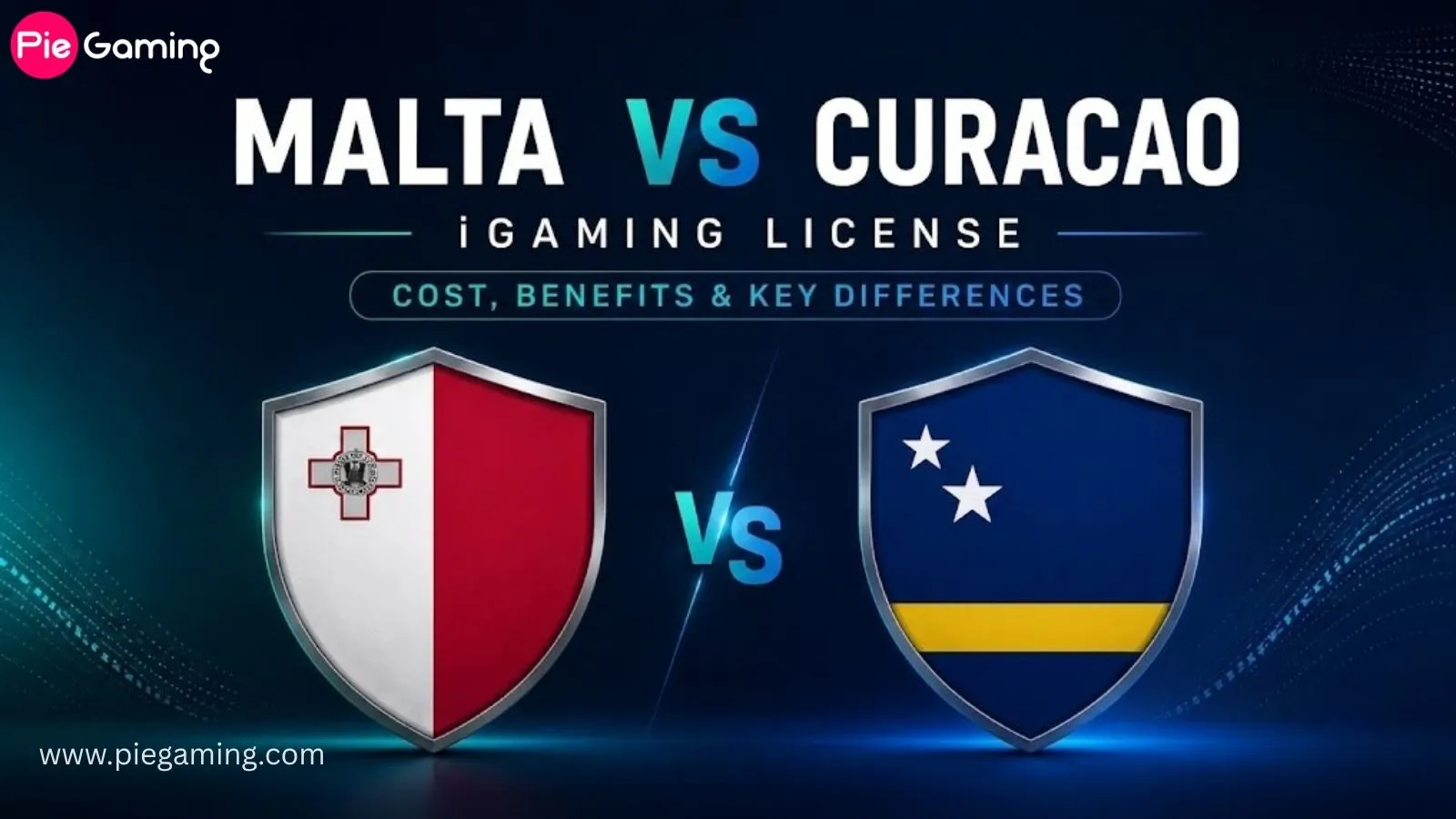
Malta pays attention to the credibility of the regulatory framework and to access regulated markets, which is more conducive to long-term growth and industry reputation. However, Curaçao places a strong emphasis on speed and affordability, making it a good choice for startups and businesses focused on cryptocurrencies that are keen to establish a presence rapidly and at a lower cost. If you are constructing a major operation, select Malta. Pick Curaçao when you are just getting started and have to get your product to market quickly.

See you in your inbox soon!

Stay ahead of the game. Subscribe for exclusive content, updates, and insiders!