
Online casinos and crypto casinos can provide similar casino games, but they differ in terms of payments, currencies, transaction processing, as well as regulation and operational requirements. Online Casino vs Crypto Casino comparison highlights the key differences for operators and players.

The choice between a traditional online casino and a crypto casino involves more than just the payment methods. Both for the operator and the player, there are additional differences – be it in the transaction process, KYC/AML requirements, legal aspects, or the target audience’s specific requirements. While both these types of platforms can provide almost the same sets of games, they still differ significantly in their features and benefits. So, operators need to understand what each model requires before choosing their payment and software setup, while players need to know how the differences can affect their overall casino experience.
In this guide, we compare online and crypto casinos across payments, transaction speed, privacy, security, regulation, bonuses, currency, and accessibility.
Online Casino vs Crypto Casino Comparison
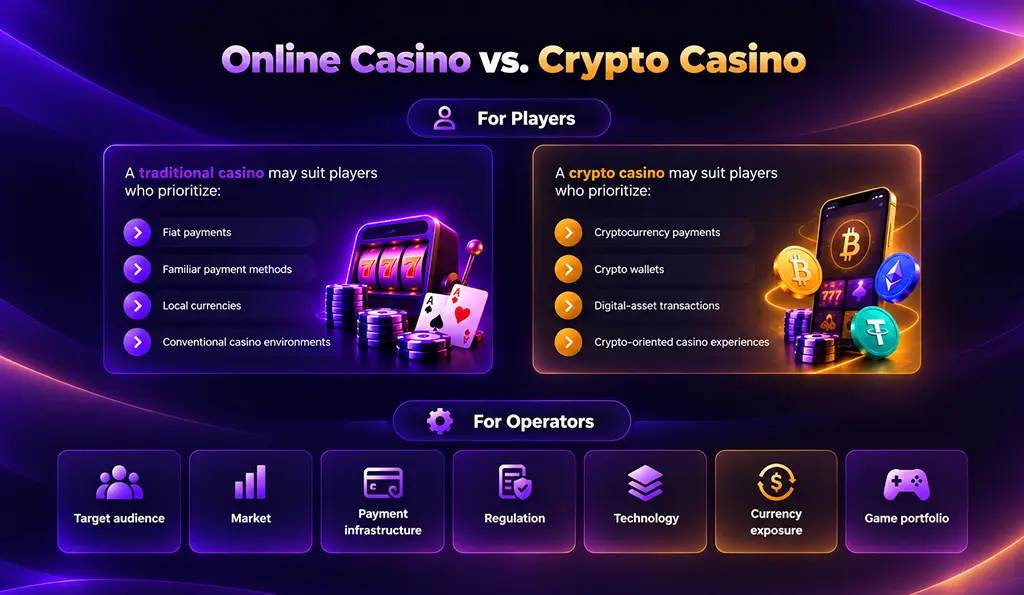
Online Casino vs. Crypto Casino
Knowing the differences between these two models is what enables operators and players to make informed decisions. Here is a breakdown of the areas that matter the most.
Payment Methods and Banking Systems
Online casino software runs on fiat currencies. Depending on the market, this may include debit cards, bank transfers, e-wallets, and other regulated payment services. Crypto casinos eliminate all those layers by implementing blockchain payments such as Bitcoin, Ethereum, Litecoin, USDT, and Solana.
Players can make and withdraw funds via banks, credit cards, wire transfer, or e-wallets and can fund the account in USD, EUR, GBP, etc.
For operators, this makes payment architecture an important consideration. The payment stack must support deposits, withdrawals, transaction monitoring, reconciliation, and fraud controls.
The structural differences are significant:
- Fiat casinos depend on banking approval systems.
- Crypto casino solutions use direct wallet-to-wallet transfers.
- Traditional payments allow chargebacks and reversals.
- Blockchain transactions are irreversible once confirmed.
- Payment gateway delays are a common reality in fiat systems.
For operators, the last point matters more than it sounds. Delays in payouts affect a player’s trust, and a player’s trust affects retention.
Transaction Speed
This is where crypto casinos have a clear edge. Traditional casino withdrawals typically take:
- 24 hours to several business days.
- Additional time for bank verification on top of that.
Crypto casino withdrawals are usually processed with:
- Minutes to a few hours.
- Depending on blockchain congestion and confirmation requirements.
Players notice how fast they get paid. Operators should too.
Privacy and Anonymity
Online casinos require full KYC verification before withdrawals. That means ID proof, banking documents, and a process that adds friction for players who just want to cash out. Whereas crypto casinos have historically allowed wallet-based gambling with minimal verification.
Key differences to keep in mind:
- Some crypto casinos still have anonymous gambling options.
- Fiat casinos operate on verified player systems.
- Compliance standards vary significantly across jurisdictions.
Security Infrastructure
Both models take security seriously, but the approach is different. Online casinos use encrypted banking systems and centralized payment security. Crypto casinos rely on blockchain transparency and smart contract-based transactions.
So, account protection, transaction monitoring, fraud detection, access controls, and secure integration with payment providers—all ensure overall security architecture. This is important for both players and operators.
Regulation and Licensing
Traditional casinos typically operate under well-established regulatory frameworks. Authorities like the UK Gambling Commission and Malta Gaming Authority set clear standards around player protection, fair play, and financial compliance.
Cryptocurrency brings in a number of additional considerations. For instance, the UK Gambling Commission, in particular, requires operators to take into account factors such as the volatility of the crypto-asset against fiat currency and how customer deposits will be handled.
As the requirements vary depending on the jurisdiction, operators should research the target market to choose the payment or software model.
Bonus Structures
Both online casino and crypto casinos can offer bonuses, free spins, loyalty rewards, and other promotional mechanisms.
But crypto casinos have expanded the playbook:
- Token cashback programs.
- Crypto deposit bonuses.
- NFT-based VIP memberships.
- Staking rewards and on-chain loyalty systems.
For operators looking to differentiate, this is one area where crypto casinos offer genuinely creative rooms. This is something players also love in casino platforms.
Supported Currencies
Fiat currencies are accepted in traditional casinos via local banking networks. Additionally, crypto casinos offer a range of payment options and stablecoins, facilitating faster and more cost-effective transactions across different international borders. Bitcoin, Ethereum, USDT, and Solana are some of the popular cryptocurrencies.
Accessibility and Geographic Restrictions
Online casinos are often restricted by regional banking laws and iGaming regulations. Crypto casinos have an advantage here. Blockchain payments bypass many of the banking limitations that restrict fiat platforms, making global access more achievable.
That said, access is not unconditional. Operators still need to account for:
- Local crypto gambling laws in target markets.
- Regional crypto regulations that are evolving fast.
- Jurisdiction-specific licensing requirements that vary by country.
Bonus: Key Factors to Consider in Online and Crypto Casino
A broader comparison must consider both the player experiences and operator’s infrastructure as highlighted in the table below:
Responsible Gambling in Online and Crypto Casinos
Everyone knows that gambling is risky and to protect players’ interest and money, the Responsible Gambling Council requests operators to promote safe gambling platform by integrating the following tools:
- Deposit limits
- Self-exclusion
- Session limits
- Reality checks
- Account controls
For example, in Great Britain, the Gambling Commission’s updated requirements state that, from 30 September 2026, operators must offer gross “deposit limits” and prevent further deposits once the applicable limit is reached, subject to the specified rules.
Similarly, the Malta Gaming Authority requires online casino operators to offer Self-exclusion and either deposit or wagering limits, as well as reality checks. They also encourage additional tools like loss and betting limits.
For crypto operators, responsible gambling controls also take into account the volatility of cryptocurrency against fiat. The Gambling Commission explicitly states that this factor is taken into account when crypto assets are accepted directly.
Provably Fair and Crypto Volatility: What Operators and Players Need to Know
Two areas stand out when we compare crypto casinos with traditional online casinos: provably fair gaming and crypto volatility.
What Does Provably Fair Mean in Crypto Casinos?
Provably fair is a cryptographic approach that allows players to verify whether a game outcome was generated according to the stated mechanism.
Usually, this involves elements such as:
Server seed: a value generated by the casino system;
Client seed: a value provided or influenced by the player;
Nonce: a varying value between game rounds
Hashing: cryptographic operation(s) to generate or verify the result.
The player can use the disclosure of information as inputs to verify the outcome once the game is finished. This is contrasted with the conventional RNG model, where randomness is derived from an RNG, and the gaming system is subject to testing, technical controls and, depending on the jurisdiction and product, independent certification or auditing.
For operators, provably fair technology can provide transparency around specific game outcomes. It should not, however, be regarded as proof of an entire casino being licensed, secure, and compliant.
How Crypto Volatility Affects Players and Operators?
Crypto volatility refers to fluctuating market values of a cryptocurrency against fiat currencies or other assets.
For players, this means the fiat value of a crypto deposit or withdrawal has the potential to change while the transaction is being processed or while funds are held in a crypto balance.
For operators, the issue extends to treasury management. An operator accepting crypto needs to determine how balances are stored, converted and settled, and how fluctuations are reflected in accounting and customer-facing balances.
Stablecoins can be one mechanism to mitigate some exposure to price volatility, though the use of these introduces its own considerations in terms of payment, liquidity, and regulatory aspects.
Network fees are another consideration: the final cost and processing experience will depend on the blockchain, network, and payment infrastructure utilized.
The UK’s Gambling Commission specifically expects operators that accept crypto-assets to consider how fluctuations against fiat currency will be handled, including the impact on responsible gambling tools and AML triggers.
Security Risks in Online and Crypto Casinos
Every platform carries risks. The difference is where that risk lives and who is responsible for managing it. For operators, understanding both sides is not optional. It is part of building a platform that players can trust.
Where Online Casinos Are Vulnerable
Traditional online casinos are built on centralized systems. That means customer data, banking details, and KYC documents all sit in one place. And centralized systems are targets.
Because players are required to submit personal and financial information before they can withdraw, a single breach can expose a significant amount of sensitive data.
The risks operators need to account for include:
- Payment fraud involving stolen credit cards or unauthorized transactions
- Banking breaches targeting casino payment processors or customer databases
- Identity theft through leaked KYC documents like passports or utility bills
- Chargeback abuse where players fraudulently reverse completed transactions
Third-party payment providers add another layer of exposure, particularly for operators running across multiple international markets with several processors involved.
Where Crypto Casinos Are Vulnerable
Crypto casinos remove the banking dependency, but they bring a different set of risks with them. And because blockchain transactions are irreversible, the stakes around security are higher in a very specific way. If funds are stolen, recovering them is rarely straightforward and often impossible.
The risks that matter most here include:
- Wallet theft caused by compromised private keys or hacked devices
- Smart contract exploits targeting vulnerabilities in decentralized casino systems
- Phishing attacks through fake casino websites or malicious wallet connection requests
- Volatile asset exposure where crypto price swings affect bankroll value and actual winnings
For operators running crypto platforms, this also means being transparent with players about how funds are held and what safeguards are in place. That transparency is part of the product.
Online Casino vs. Crypto Casino: Which One Is Better?
There is no universal answer here. Both models have real strengths, and both have genuine limitations. The right choice comes down to what your players expect and what kind of platform you are building for them.
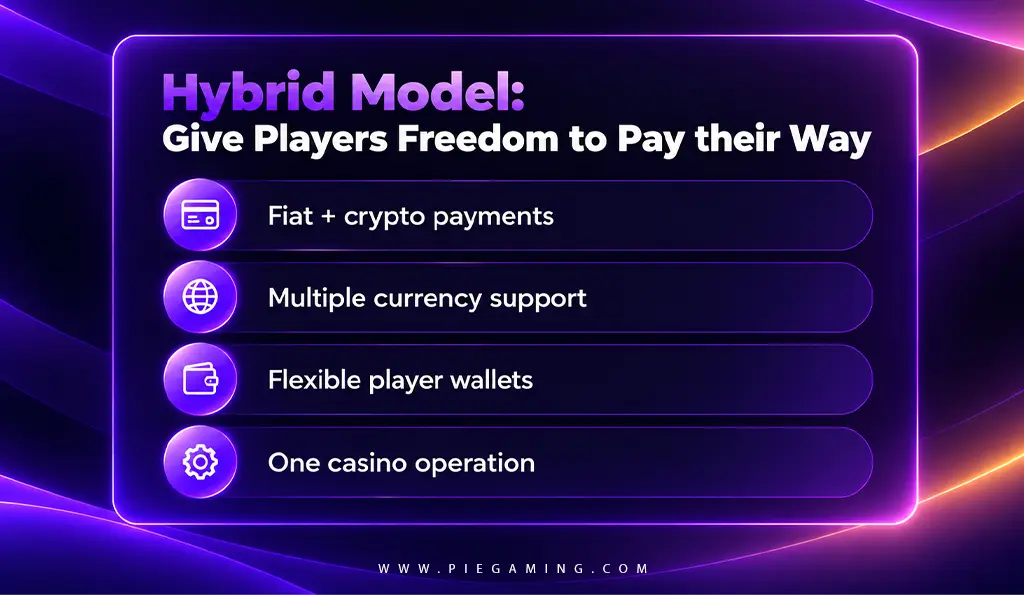
Hybrid casino model
Conclusion
The debate on online casino vs. Crypto casino extends beyond the type of currency for placing bets. It includes variations in the payment stack process, means of payment, KYC approach, and regulatory differences and, for operators, impacts the treasury and operations.
For players, the differences are likely to relate to payment methods, withdrawal experience, privacy, currency support, and security, and accessibility.
For operators, the question is more involved and depends on factors such as the relevant licensing, target markets, payment infrastructure, KYC/AML controls, responsible gambling solutions, currency exposure, and the technology required to support both fiat and crypto transactions.
For businesses looking to appeal to both customer segments, a hybrid fiat-and-crypto casino could be considered if permitted by the target jurisdiction.

Contact Us
FAQ's
-
Can I run both online and crypto payment options on the same casino platform?
Yes. A simple casino platform can be designed to support both fiat and crypto payment options. The operator is required to manage various transaction flows, currencies, reconciliation requirements, and risk controls.
-
Do Online casinos or crypto casinos have higher operating margins?
There is no universal margin advantage. Operating margins depend on factors like game provide fees, payment costs, customer acquisition costs, bonus, taxes, compliance, fraud losses, etc.
-
How much does it cost to set up an online casino and crypto casino?
There is no single setup cost for either model. The budget covers the factors like licensing, software, payments integration, game content, KYC/ AML tools, etc. A crypto casino may also require crypto payment processing, wallet infrastructure, conversion, or settlement capabilities. The costs are determined by the target market and the technology required.
-
What should operators look for in an online & crypto casino software provider?
Operators must look for the following: Casino and sportsbook software capabilities, where relevant Fiat and crypto payment support KYC/AML integrations Player account and wallet management Game-provider integrations Back-office controls Responsible gambling tools Reporting and transaction management Scalability across target markets Support for the operator's licensing and compliance requirements The provider should also disclose what capabilities are provided, and what licensing, compliance, or other third-party services are the responsibility of the operator.
-
What are the biggest regulatory risks of running a crypto casino in 2026?
The risks will vary depending on the jurisdiction, but operators should consider licensing, AML/KYC, payment control, responsible gambling, treatment of customer funds and crypto-specific transaction risks and restrictions by geography. Regulators may also request further information concerning crypto payment terms. For example, the UK Gambling Commission requires licensees to report any changes in payment methods and processors and to assess the AML impact of new payment methods. Operators should therefore check the requirements of each target market before launching rather than treating crypto acceptance as a separate avenue around gambling regulation.
-
How does KYC/AML compliance differ between crypto and traditional casino operations?
Both are subject to KYC and AML controls, depending on the jurisdiction and model of operation. Crypto assets can raise additional transaction-monitoring considerations because funds flow through crypto exchanges, processors or other virtual asset service providers. FATF standards require that those providing virtual asset services apply measures including customer due diligence, record keeping and suspicious transaction reporting.


Monika Gola is an iGaming content specialist at PieGaming. Since 2020, she has been researching and developing content around software selection, online casino & sports betting regulations, and operator growth strategies. Her research includes analyzing market opportunities in regions like Europe, Africa, and Southeast Asia, as well as evaluating regulatory frameworks and entry barriers. She is actively monitoring industry trends, compliance updates, and evolving player demands across global iGaming markets to help operators navigate this industry seamlessly.

Telegram casinos are a new gaming channel where users access casino games directly via Telegram bots or mini app-driven channels. This guide explains how Telegram casinos work, including how they are built, their key features, why they function, and why many companies want to explore this growing platform.

Starting a crypto casino involves multiple steps. From choosing your target market to obtaining a license, casino model, game integration, and compliance management, you’ll need to consider a lot of things in between.
Choosing the right Bitcoin casino software provider is crucial for building a secure, scalable, and profitable online casino business. Here’s a quick look at the top providers and how to pick the right one.

Bitcoin casinos are online casinos that feature slots, blackjack, roulette, and live casino games and accept bitcoin payments. This guide explains how Bitcoin casinos operate, their advantages and disadvantages, payment methods, security measures, licensing requirements, and the steps required to launch a crypto casino in 2026.

Crypto iGaming solutions are transforming online gambling with blockchain powered payments, faster transactions, and greater transparency. As cryptocurrencies continue to evolve, new trends are shaping how players engage with digital gaming platforms.

The top 10 crypto casino software providers in 2026 are PieGaming, SoftGamings, Digient, Slotegrator, NuxGame, GR8 Tech, TRUEiGTECH, Tecpinion, BetConstruct, and KodeDice. Each is ranked across six factors including crypto payments, game depth, compliance, and deployment speed.

Bitcoin’s speed, privacy, and security are some of the reasons why Bitcoin is becoming a popular payment method in online gambling. The purpose of this guide is to reveal the major pros and cons of using Bitcoin for online betting, helping both operators and players decide whether crypto is the right choice for their gaming transactions.

See you in your inbox soon!

Stay ahead of the game. Subscribe for exclusive content, updates, and insiders!