
Bitcoin casinos are online casinos that feature slots, blackjack, roulette, and live casino games and accept bitcoin payments. This guide explains how Bitcoin casinos operate, their advantages and disadvantages, payment methods, security measures, licensing requirements, and the steps required to launch a crypto casino in 2026.

The global online gambling market is estimated at $108 billion in 2026 and is forecast to grow to over $200 billion by 2032. So, what is a Bitcoin casino? It is an online gambling platform that runs entirely or primarily on cryptocurrency, offering players faster withdrawals, lower fees, and a level of privacy that conventional online casino software simply cannot match.
But with hundreds of platforms stating they are the ‘best’ crypto casino, it is important to know what to look for and what to avoid, more than ever. This guide tells you everything you need to know.
How Does Bitcoin Gambling Work?
A bitcoin casino is an online gambling platform that accepts cryptocurrency (Bitcoin, Ethereum, stablecoins) for deposits, bets, and withdrawals, or offer it alongside traditional fiat currencies.
Instead of relying on banks or card processors, these transactions are processed through blockchain technology. That’s the core structural difference from a traditional online casino. Not all bitcoin casinos are crypto-only either; many operate as hybrid platforms accepting both.
Here’s how mechanics work in practice.
Account creation is lighter than a fiat casino. Players typically sign up with an email address or wallet address only, with no mandatory card details upfront.
Deposits work by the player sending crypto from their personal wallet to the casino’s deposit address. The time it takes for an on-chain confirmation varies according to the network congestion, typically from 2 to 10 minutes
Withdrawals run in reverse. The player asks for the payment to their wallet, and it will take 5-60 minutes for the payment to be confirmed on-chain, depending on the network. Bitcoin takes longer, while Ethereum and USDT settle quicker.
On the operator’s side, the funds are usually divided into two wallets, a hot wallet for everyday withdrawals and a cold storage wallet for the majority of the funds, which are kept offline for security purposes.
One structural advantage worth flagging: blockchain transactions are immutable once confirmed. No chargebacks, no reversals, which removes a major fraud vector that card-based casinos deal with constantly.
What Games Can You Play at a Bitcoin Casino?
Most Bitcoin casinos offer the same core game categories as traditional platforms, plus a few formats that are crypto-native:
- Slots – Including provably fair variants where results are independently verifiable.
- Live Dealer Games – Blackjack, roulette, and baccarat streamed in real time.
- Table Games – Digital versions of poker, crap, and baccarat.
- Sports and Esports Betting – Common on hybrid crypto platforms.
- Crash Games and Instant Win – Crypto-native formats rarely found on fiat casinos.
Bitcoin Casinos Vs. Traditional Online Casinos
It’s not just about the payment options when choosing between a Bitcoin casino and a traditional online casino. The infrastructure revolution affects the way money is flowing, the markets an operator can access, and the risks faced by both sides of the table. Let’s look at the key differences, by area, in the table below.
| Feature | Bitcoin Casino | Traditional Online Casino |
| Deposit Speed | Minutes (on-chain settlement) | Hours to 1-3 business days for bank wires |
| Withdrawal Speed | Minutes to hours depending on blockchain | 1-5 business days depending on method |
| Processing Fees | 0.5-2% network fees | 2-5% via card networks and banks |
| Chargeback Risk | Effectively zero; blockchain transactions are final | 0.5-2% in chargeback and dispute losses |
| Geographic Reach | Global; accessible in markets where card processors won’t work with gambling platforms | Limited by banking partnerships and processor restrictions |
| Regulatory Standing | Legal grey zone for most; formal crypto licenses available in Malta, Curaçao, and Anjouan | Established licenses (MGA, UKGC) with defined player protections and dispute frameworks |
Advantages of Bitcoin Casinos
Faster deposit & withdrawal – Blockchain transactions can process payments faster than some traditional banking methods. It is also because there is no involvement in the third party.
Lower processing fee – Crypto payments reduce costs associated with banks, fiat currency, card networks and other payment intermediaries.
No chargeback risk – Since confirmed bitcoin transactions are generally irreversible, there is no chargeback risk for operators.
Global reach – Unlike traditional or fiat currency, bitcoin enables cross-border payments without relying on traditional banking infrastructure.
Provably fair verification – A cryptographic system allows players to independently verify eligible game outcomes.
How Crypto Casinos Protect Your Money and Guarantee Fair Play?
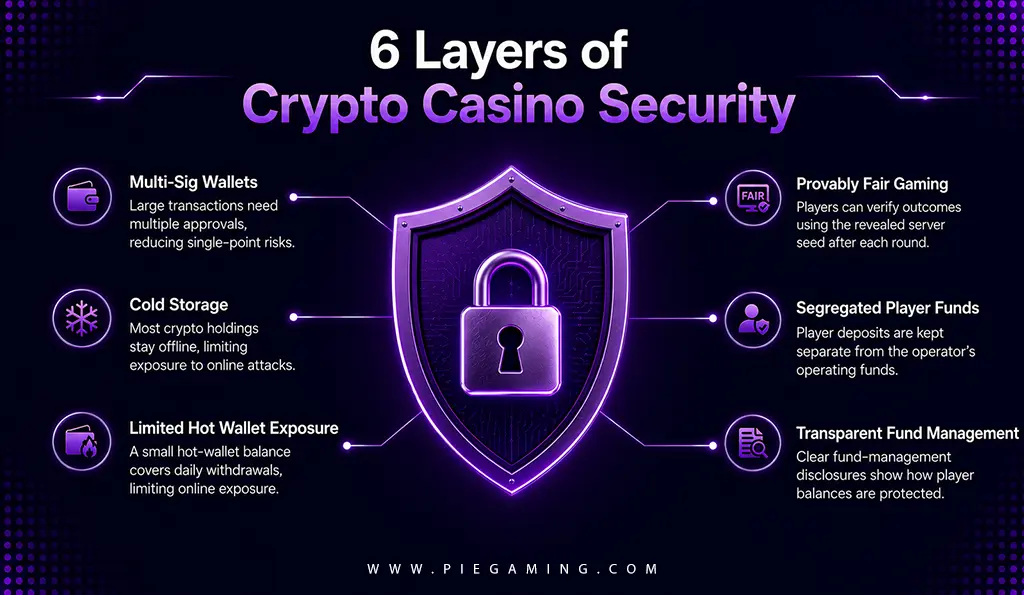
Crypto Casino Security
Security and fairness are the two questions every player should ask before depositing anywhere. Crypto casinos handle both differently from traditional platforms, and in some areas, meaningfully better. Here is how the better-run platforms approach it.
Multi-Signature Wallets
Reputable crypto casinos use multi-signature wallet architecture for large fund movements. This means any significant transaction requires approval from two or more private keys rather than one.
No single person or system can move a large sum unilaterally, which eliminates a common single-point-of-failure risk that has led to high-profile exchange and casino hacks in the past.
Cold Storage
The bulk of player funds on a well-run platform never sit online. Reputable operators keep between 90% and 95% of holdings in cold storage, meaning offline wallets with no live internet connection.
Only a small operating balance stays in a hot wallet to cover day-to-day withdrawals. If a platform is ever breached, the exposure is limited to that smaller online balance rather than the full reserve.
Provably Fair Gaming
Crypto casino fairness is what makes them differ from all the traditional online casino in this regard. Here is how it works: before a game round begins, the casino hashes the outcome using a server seed and shares that hash with the player.
The player will not know what the actual seed is but only a hash of the seed. After the round, the casino reveals the original seed. The player can now independently run the same hash function and compare the result with the one computed by the other player to see that indeed it was locked in before anybody acted on it and was not changed. It’s a significant distinction. A normal RNG certificate is one that assumes that at some time in the recent history, a third party audited the system correctly.
With provably fair, the verification actually becomes the player’s responsibility, and it’s something that any basic technical savvy individual can perform on their own.
Segregated Player Funds
A trust signal worth looking for is whether a platform keeps player deposits separate from its own operating capital. Segregated funds mean that if the operator runs into financial trouble, player balances are ringfenced and not at risk of being used to cover business costs.
This is standard practice under stricter licensing regimes like the MGA, but it is not universally enforced across crypto casinos operating under lighter-touch licenses. If a platform does not disclose its fund management structure, that is worth noting before you deposit.
Is Bitcoin Casino Legal? Regulatory Landscape
There are two key questions that determine the legality of a Bitcoin casino: does the operator have a proper gambling license, and does it have the right to serve customers in a certain country?
No universal licence permits a crypto casino to be legal globally. The broad map is divided into 3 categories: markets where operators can get a local licence, markets where crypto casino are available but not locally licensed, and markets where operators can’t access or are prohibited from accessing crypto casinos.
Formally Licensed Jurisdictions
Malta’s Gaming Authority licenses online operators under its standard remote-gaming framework. Where a business also provides crypto-asset services, it may fall within the EU’s crypto-asset regulatory regime separately. An MGA licence is not a standalone Bitcoin casino licence; the legal position depends on the operator’s services, payment flows and compliance structure.
Curaçao has changed its licensing system, based on the National Ordinance for Games of Chance (LOK). The Curaçao Gaming Authority has now adopted a direct-licensing approach, and strengthened the AML/CFT requirements and local-substance requirements as part of the change. As of January 2026, from now on, licensees will have to have a true presence in Curaçao, with a registered office and local management.
Anjouan is often cited as an offshore alternative to cheaper options for those that accept cryptocurrencies. The starting costs for commercial licenses are estimated to be in the range of €17,000 to €22,000, excluding any further compliance and service fees. The operator must check with the regulator prior to relying on these figures for the current scope of the licence and complaints handling procedures.
Markets With Restrictions
Germany requires licensed operators to process transactions in euros, so crypto deposits and withdrawals are not permitted at regulated German sites. France does not license online casino games at all, whether paid in crypto or fiat.
Online slots, roulette and blackjack don’t form a “licensed vertical” there, so the restriction is not on the type of game, but rather the payment method. In the United States, real-money online casino legality is determined state by state, and the picture is fragmented enough that a federal grey zone should not be treated as a green light.
Note: A Bitcoin casino never is the lawful option for the players in a certain country, provided that it is not verified by an offshore licence. The key factors are whether the casino is licensed to offer games in this market, whether crypto payments are allowed in this country, and whether the casino can comply with the relevant KYC and AML/CFT requirements. Regulations change and a gray market can be set up today to limit access with little warning.
Choosing a Bitcoin Casino Platform
Not every Bitcoin casino platform is built the same. These are the criteria that separate a provider worth shortlisting from one that costs you more than it delivers.
Licensing and Compliance Support
A platform that has navigated Curaçao’s post-LOK reforms or Anjouan’s licensing process before is worth more than one that hands you a checklist and wishes you luck. Look for built-in KYC tooling, AML/CFT workflow support, and a provider that has active relationships with recognised licensing jurisdictions. If compliance infrastructure needs to be sourced separately, that is an additional cost and timeline risk that rarely appears in the headline price.
Crypto-Native Payment Functionality
There is a difference between a platform that accepts crypto and one built around it. Look for native wallet management, direct on-chain settlement across Bitcoin, Ethereum, Litecoin, USDT, and ideally TON for Telegram-facing products, and automated conversion handling. A payment processor sitting between the player’s wallet and your platform adds fees, settlement delays, and a point of failure that a genuinely crypto-native stack does not have.
Game Library Quality and Provider Diversity
Volume alone is not the metric. Check out which aggregators and direct integrations are in place, whether live dealer content from tier-one studios like Evolution is included, and how the platform handles new title releases. A library that skews toward low-quality slots with no live dealer depth is a retention problem waiting to happen.
Technical Scalability
A platform that performs well at launch can degrade fast under promotional traffic or a player base that grows quicker than anticipated. Ask for documented uptime figures, load testing results, and specifics on how infrastructure scales under spike conditions. For crypto casino solutions running provably fair mechanics, on-chain verification adds processing overhead that not every platform is built to handle cleanly at volume.
Cost Structure
Model the total cost over 12 and 24 months, not just the setup fee. Revenue share percentages that look reasonable at low GGR volumes can significantly compress margins as the business scales. Factor in transaction fees, monthly licensing costs, and any per-integration charges for payment methods or game providers that are not included in the base package.
Support Responsiveness
A platform issue during a high-traffic promotional window is a direct revenue loss event. Before signing, run a pre-sales test: submit a technical query and measure the response time and quality. Providers who are slow or vague before you are a customer do not improve afterwards. Documented SLAs and a named account manager are minimum expectations, not premium add-ons.
Bitcoin Casino Risks You Should Know
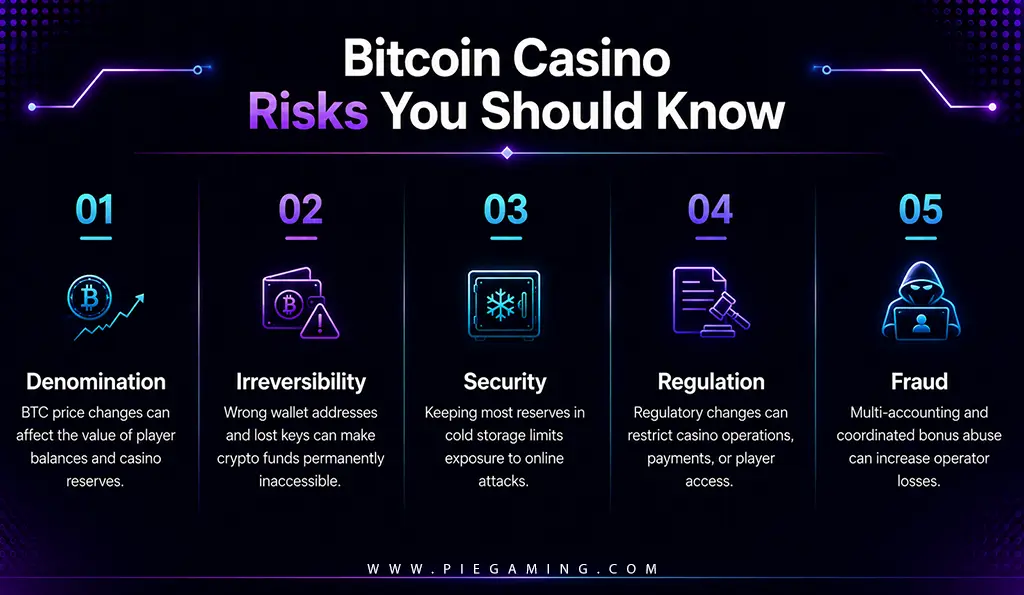
Bitcoin Casino Risks
Crypto removes a lot of friction from online gambling. It also removes some of the safety nets. These are the risks operators and players need to understand before going live or depositing.
Denomination Risk
A player who deposits 1 BTC at $60,000 and withdraws when it has dropped to $45,000 has lost 25% of their balance before the house edge has done anything. The same exposure applies to operator reserves held in volatile crypto.
Most serious operators now treat stablecoins like USDT or USDC as the default settlement currency to stop treasury results being decided outside the business. Players who want to sidestep this risk should look for platforms that support stablecoin denomination throughout the session, not just at the deposit stage.
Irreversibility Risk
Blockchain transactions have no undo button. A withdrawal sent to the wrong wallet address is gone. A lost or compromised private key means the funds it controls are permanently inaccessible, with no customer support team, bank dispute process, or regulator to call.
It requires a level of operational discipline that traditional online gambling simply does not demand.
Security Risk
Hot wallets are a persistent target. Reputable operators keep 90 to 95% of reserves in cold storage, with only 5 to 10% in hot or operational tiers covering day-to-day withdrawals. Platforms that do not operate to this standard carry meaningfully higher breach exposure.
Post-FTX, proof-of-reserves and transparent custody disclosures have become baseline trust signals. A platform that does not disclose its storage practices is one where that question is worth asking before depositing.
Regulatory Risk
A Curaçao or Anjouan license does not guarantee long-term market access. Grey-zone jurisdictions can restrict crypto gambling with limited notice, and even licensed platforms can lose access to local players if regulators target crypto payment rails directly.
In EU, UK, and US regulated markets, operating without proper KYC and age verification is not legally viable, which makes abrupt access loss a real operational risk for crypto-first brands. For players, this can mean withdrawals becoming difficult if a platform loses regional payment infrastructure faster than it can respond.
Fraud Vectors
Bonus abuse and multi-accounting cost iGaming operators with an estimated 4 to 7% of GGR, and crypto casinos are disproportionately exposed. Wallet addresses alone are weak identifiers.
Without on-chain analytics, device fingerprinting, and behavioural monitoring in place before bonuses are issued, rapid deposit-bet-withdraw cycles and coordinated bonus rings are difficult to catch until the damage is done.
How to Get Started with a Bitcoin Casino
Whether you are a player depositing for the first time or an operator planning a crypto casino launch, the starting point is the same: understand the process before you commit funds or capital to it.
For Players
Choosing a Platform
Pick a platform with a verifiable licence, readable player reviews, and support for the coins you hold. Check the licence against the issuing regulator’s public register rather than taking the footer badge at face value.
Making Your First Deposit
Set up and fund a personal crypto wallet before initiating any deposit. Send a modest test amount first. Verify the deposit address twice before confirming, as blockchain transfers are irreversible, and a mistyped address means permanent loss with no recourse. Once the test deposit reflects your balance, you can deposit more confidence.
Withdrawals
Request payouts to your personal wallet rather than leaving funds on the platform. Most Bitcoin casinos process withdrawals within 5 to 60 minutes once blockchain confirmation clears, though this varies by coin and network congestion.
For Operators
The Launch Sequence
Jumping to provider evaluation before confirming market legality and available capital is one of the most common ways early-stage operators waste time and money. The sequence that works:
- Confirm legal position in target markets and viable licence jurisdiction
- Assess capital and timeline honestly, as both determine which platform model is realistic
- Evaluate providers against compliance support, crypto payment functionality, game library depth, scalability, and 12 to 24-month cost structure
- Run integration and compliance setup in parallel: KYC tooling, AML/CFT workflows, responsible gambling controls, and payment configuration
- Soft launch before full marketing activation to stress-test payment flows and compliance tooling under real conditions
Realistic Timeframes by Model
| Platform Model | Launch Window |
| White Label casino software | 8 to 12 weeks |
| Hybrid / API | 12 to 16 weeks |
| Turnkey casino software | 16 to 24+ weeks |
Common Misconceptions & Pitfalls About Crypto Casinos
A lot of what gets replaced with Bitcoin casinos is either outdated, oversimplified, or wrong. These are the misconceptions worth correcting before they cost your players or credibility.
Myth 1: Bitcoin Casino are Fully anonymous
Anonymity on a crypto casino is partial and conditional, not structural. Most platforms enforce KYC once a player crosses a withdrawal threshold.
A player can sign up without full verification, but the moment they try to withdraw meaningful winnings, identity checks kick in. Platforms marketing themselves as “no KYC” are either operating without a licence or will introduce verification later under regulatory pressure.
Myth 2: Crypto Changes the Odds
It does not. The house edge is determined by the game’s math, not the payment method. A game with a 4% house edge in fiat has a 4% house edge in Bitcoin. Provably fair mechanics let players verify results were not manipulated, but that is a transparency tool, not an odds improvement.
Myth 3: Instant Withdrawals Are Actually Instant
Instant is a marketing word. Actual settlement depends on blockchain confirmation times, which vary by network and congestion. What “instant” usually means is that the platform processes the request immediately while the blockchain does the rest on its own schedule.
Myth 4: Over-Promising “No Verification” at Signup
Platforms that lead with “no KYC” as a selling point to create the exact friction they were trying to avoid. When regulatory pressure forces verification later, players who signed up to avoid it react badly. Being upfront about risk-based KYC from the start causes less damage than a bait-and-switch on verification policy.
Myth 5: Supporting Only One Cryptocurrency
A Bitcoin-only platform leaves a significant share of the market untouched. Most successful crypto casinos support minimum Bitcoin, Ethereum, and stablecoin. Single-currency support is a launch constraint that should be resolved before full marketing activation, not after.
What’s Next in Crypto Casino: Emerging Trends
The infrastructure underneath crypto casinos are moving faster than most operators currently building on it. These are the shifts that will define the next 12 to 24 months.
Faster Settlement Rails
Bitcoin’s Lightning Network and Ethereum’s Layer 2 networks are pushing transaction speeds and costs to a point where the gap between crypto and traditional payment rails effectively disappears. Lightning enables near-instant Bitcoin transfers with fees measured in fractions of a cent.
Ethereum Layer 2s like Arbitrum and Base are processing transactions at comparable speed and cost. For casino operators, this matters because one of the remaining friction points in crypto gambling, the wait for blockchain confirmation, starts to collapse. Platforms that integrate these rails early will have a meaningful UX advantage over those still settling on base-layer Bitcoin or Ethereum.
Stablecoin-First Platforms
Denomination risk is a real barrier for a segment of players who want the payment benefits of crypto without exposure to price swings mid-session. Stablecoin-first platforms are a direct response to that.
Rather than treating USDT or USDC as one option among many, these platforms make stablecoins the default currency for deposits, bets, and withdrawals. For operators, it also simplifies treasury management. Expect this model to grow, particularly among platforms targeting players in high-inflation markets where stablecoins already function as a practical store of value.
Regulatory Clarity Is Coming, In Both Directions
Over the next one to two years, more jurisdictions will move off the fence. Some will introduce formal crypto gambling licensing frameworks. Others will move to restrict or ban it.
The grey zone that most crypto casinos currently operate in is narrowing, and operators relying on regulatory ambiguity as a business model will find that window closing. Platforms that have invested in compliance infrastructure ahead of that shift will be better positioned than those scrambling to retrofit it.
Provably Fair as Baseline, Not Differentiator
Provably fair mechanics are becoming a table-stakes expectation rather than a feature worth marketing. As player awareness grows and more platforms adopt the standard, the question shifts from whether a casino offers provably fair games to how transparently it implements and communicates the verification process.
Platforms that still treat provably fair as a headline selling point in 2026 are already behind the curve. The next frontier is real-time auditability and on-chain game logic, where the entire game mechanic, not just the outcome seed, is verifiable.
Wrapping Up…
Understanding what a Bitcoin casino is goes beyond knowing it accepts crypto. The payment infrastructure, licensing landscape, platform economics, and risk profile are all meaningfully different from traditional online gambling.
Whether you are a player evaluating where to deposit or an operator deciding how to build, the fundamentals covered in this guide give you a more accurate picture of what you are actually working with.

Contact-us
FAQs
-
How does Bitcoin gambling work?
In bitcoin casino you deposit cryptocurrency into your casino account, place bets on available games, and withdraw winnings back to your personal wallet. Transactions settle on the blockchain, cutting out banks and card processors entirely.
-
How is a Bitcoin casino different from a regular online casino?
The core difference is infrastructure. Bitcoin casinos settle payments on the blockchain instead of through banks, which means faster withdrawals, lower fees, and access for players in markets traditional payment rails do not serve.
-
Is Bitcoin gambling legal?
It depends on where you are. Some jurisdictions formally license crypto casinos, others tolerate them without licensing, and some restrict or ban them outright. Always check your local laws before depositing.
-
Do I need a crypto wallet to gamble with Bitcoin?
Yes. You need a personal wallet to fund your casino account and receive withdrawals. Never use an exchange account as your withdrawal destination, as many exchanges block gambling-related transactions.
-
Do Bitcoin casinos offer bonuses like regular casinos?
Yes, and often more generously. Welcome bonuses, reload offers, and free spins are standard. Always check wagering requirements before claiming, as bonus terms on crypto casinos vary significantly between platforms.
-
Bitcoin casino vs Ethereum casino: which is better?
Bitcoin and Ethereum casinos differ in their blockchain networks, transaction characteristics, and supported features. Bitcoin is a widely used currency which is supported by crypto casinos. Ethereum casinos can offer faster settlements and support smart contract-based applications. The right option, however, depends on factors like speed, network fees, and wallet compatibility.


Palak Madan has been writing about the iGaming industry since 2024. She focuses on helping operators and founders understand their options when launching an online casino, from choosing the right software provider to figuring out costs and compliance requirements across different markets. At PieGaming, she covers topics like white label casino solutions, platform selection, and market entry, turning complex industry information into practical guidance for people building iGaming businesses. She also keeps a close eye on licensing and regulatory changes; particularly how new rules shape the way operators enter and grow in different jurisdictions.

Telegram casinos are a new gaming channel where users access casino games directly via Telegram bots or mini app-driven channels. This guide explains how Telegram casinos work, including how they are built, their key features, why they function, and why many companies want to explore this growing platform.

Starting a crypto casino involves multiple steps. From choosing your target market to obtaining a license, casino model, game integration, and compliance management, you’ll need to consider a lot of things in between.

Crypto iGaming solutions are transforming online gambling with blockchain powered payments, faster transactions, and greater transparency. As cryptocurrencies continue to evolve, new trends are shaping how players engage with digital gaming platforms.
Online casinos and crypto casinos can provide similar casino games, but they differ in terms of payments, currencies, transaction processing, as well as regulation and operational requirements. Online Casino vs Crypto Casino comparison highlights the key differences for operators and players.

The top 10 crypto casino software providers in 2026 are PieGaming, SoftGamings, Digient, Slotegrator, NuxGame, GR8 Tech, TRUEiGTECH, Tecpinion, BetConstruct, and KodeDice. Each is ranked across six factors including crypto payments, game depth, compliance, and deployment speed.

Bitcoin’s speed, privacy, and security are some of the reasons why Bitcoin is becoming a popular payment method in online gambling. The purpose of this guide is to reveal the major pros and cons of using Bitcoin for online betting, helping both operators and players decide whether crypto is the right choice for their gaming transactions.

See you in your inbox soon!

Stay ahead of the game. Subscribe for exclusive content, updates, and insiders!