
The top 10 crypto casino software providers in 2026 are PieGaming, SoftGamings, Digient, Slotegrator, NuxGame, GR8 Tech, TRUEiGTECH, Tecpinion, BetConstruct, and KodeDice. Each is ranked across six factors including crypto payments, game depth, compliance, and deployment speed.

Around 17% of iGaming bets in the first three quarters of 2024 were placed in crypto, a figure widely cited as evidence that crypto’s share of iGaming wagering is rising. But as operators move to launch or expand crypto casino platforms, most “top provider” lists offer little help. Many are written by the vendors themselves or lack any transparent, independent evaluation.
This guide is different. It ranks the 10 best crypto casino software providers across full-stack platforms, game aggregators, and live casino specialists, evaluated against a clear 6-factor framework. No paid placements, no vendor bias. We’ll also define what crypto casino software actually means before getting into the rankings.
Top 10 Crypto Casino Software Providers in 2026
The crypto casino software market is crowded. These ten providers stand out, and this section breaks down exactly why each one made the list.
1. PieGaming
PieGaming white label crypto casino platform
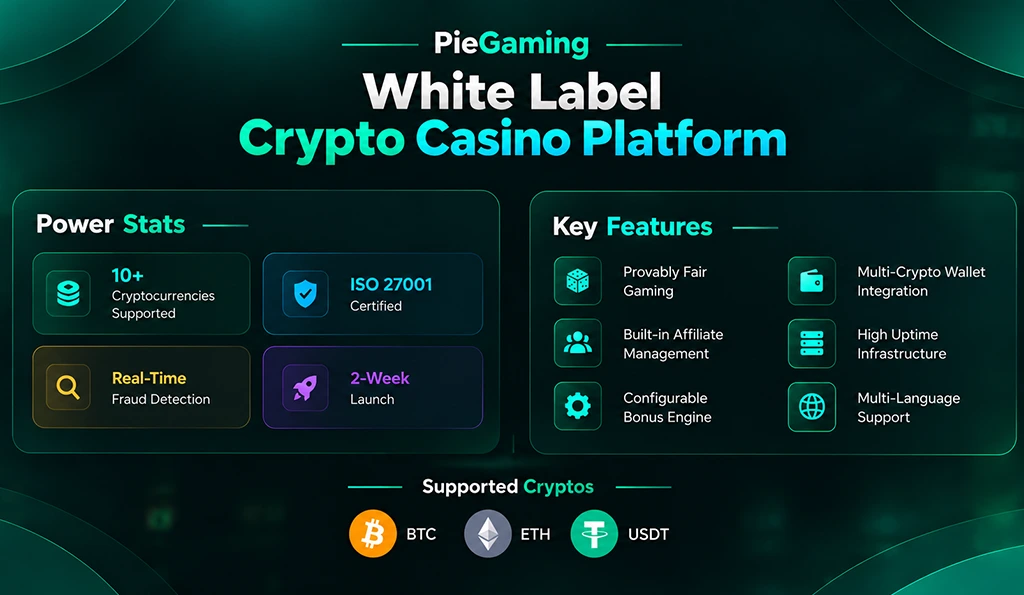
PieGaming is a white label crypto casino platform built to go live fast, scale without friction, and handle every major cryptocurrency your players want to use.
Key Features & Crypto Capabilities
- Provably fair gaming backed by blockchain verification for full transparency on game outcomes.
- Real-time fraud detection that monitors and flags suspicious transactions as they happen.
- Built-in affiliate management with real-time tracking and crypto payout support.
- Configurable bonus engine covering welcome offers, redeposit bonuses, and sign-up rewards.
- High uptime infrastructure that keeps gaming and payments running without interruption.
- Multi-language support for operators targeting players across multiple jurisdictions.
- Multi-crypto wallet integration letting players connect, manage, and fund accounts in their preferred currency.
Supported Cryptocurrencies
Bitcoin (BTC), Ethereum (ETH), USDT, Dogecoin (DOGE), BNB, EOS, ATOM, ETC, APE, BUSD.
Licensing & Compliance Support
PieGaming’s platform is ISO 27001 certified, covering information security standards across player data and operational infrastructure. The platform also includes advanced risk management tools to help operators stay compliant with financial monitoring requirements across target markets.
Best For
Operators looking for a ready-to-deploy white label crypto casino with full back-office control, broad cryptocurrency support, and built-in tools for affiliates, bonuses, and player management.
2. Softgamings
For operators who want depth over shortcuts, SoftGamings delivers a complete crypto casino stack with 10,000+ games, multi-crypto payments, and white label flexibility in under 60 days.
Key Features & Crypto Capabilities
- Multi-currency and unlimited language support across all platform tiers.
- Crypto payment system covering Bitcoin, Litecoin, Ethereum, and other leading cryptocurrencies.
- 10,000+ games from 250+ providers including Evolution Gaming, NetEnt, Pragmatic Play, and Microgaming.
- Built-in loyalty system, tournaments, casino shop, and bonus engine.
- Advanced reporting system, internal CMS, mailing system, and affiliate management tools.
Supported Cryptocurrencies
Bitcoin (BTC), Litecoin (LTC), Ethereum (ETH), and other major cryptocurrencies.
Licensing & Compliance Support
SoftGamings offers licensing assistance as part of its service package, alongside banking and IT support. Operators can discuss jurisdiction-specific requirements directly with the SoftGamings team.
Best For
- Operators wanting 10,000+ games out of the box.
- White label, turnkey, or self-service casino models.
- Crypto casino operators needing licensing and banking support.
3. Digient
Digient gives operators a secure, brandable crypto casino platform with multi-currency wallet support, Provably fair gaming, and the infrastructure to run a serious real-money operation.
Key Features & Crypto Capabilities
- Multi-currency wallet support with seamless crypto deposits and withdrawals.
- Comprehensive game library spanning casino, poker, rummy, lottery, and sportsbook.
- Built-in affiliate management system with real-time tracking.
- Comprehensive analytics dashboard for player behaviour and operational data.
- Mobile-optimised platform across all device types.
- Provably fair gaming integration for player transparency.
- Fully customisable front end to match operator branding.
- Automated back-office systems for operational efficiency.
Supported Cryptocurrencies
Bitcoin (BTC), Ethereum (ETH), Litecoin (LTC), and additional cryptocurrencies on request
Licensing & Compliance Support
Digient’s platform is built with regulatory compliance as a core feature, designed to meet international standards. Operators can discuss jurisdiction-specific compliance requirements directly with the Digient team.
Best For
- Startup casino brands entering the crypto market.
- Traditional online casinos add crypto payment capabilities.
- White label platform resellers and affiliate networks.
4. Slotegrator
Slotegrator is a full-stack crypto casino platform with 30,000+ games, 100+ cryptocurrencies, and a modular product suite that covers everything from game aggregation to licensing and affiliate management.
Key Features & Crypto Capabilities
- Supports 100+ cryptocurrencies and 150+ additional payment methods on request.
- 30,000+ casino games via single API integration across slots, live dealer, poker, bingo, and virtual sports.
- In-built online casino builder for custom front-end design without backend rebuilds.
- Ready-to-use platform with BI reporting, risk management, affiliate module, KYC, and transaction monitoring.
- Configurable loyalty programs, bonus engine, and marketing tools for player retention.
- Telegram casino solution for mobile-first crypto player acquisition.
Supported Cryptocurrencies
100+ cryptocurrencies supported natively, with additional payment methods available on request.
Licensing & Compliance Support
Slotegrator offers gambling licence acquisition as a standalone service, alongside advisory services for regulatory compliance. The white label solution operates under Slotegrator’s own Curaçao sublicence, giving new operators a faster path to legal operation.
Best For
- Operators wanting maximum game volume from day one.
- New operators needing a licence and platform in one package.
- Crypto casino brands targeting Telegram-native player audiences.
5. Nuxgame
NuxGame connects crypto payments, 18,500+ games, and full back-office controls in one environment, making it one of the few platforms where funding events and gameplay activity are genuinely linked.
Key Features & Crypto Capabilities
- Supports Bitcoin, ETH, USDT, DOGE, and 30+ additional crypto assets tied directly to player balances.
- Multi-balance accounts handling fiat, crypto, and stablecoin in one player profile.
- Native wallet integration with MetaMask, Phantom, and Petra for faster account funding.
- Direct crypto purchasing inside the platform so players never need to leave.
- Stablecoin settlement support for USDT and USDC with connected ledger and reporting.
- 18,500+ games from 140+ crypto-friendly providers including Evolution Gaming, NetEnt, and BGaming.
- Crypto risk and AML controls covering wallet activity, deposits, withdrawals, and suspicious patterns.
Supported Cryptocurrencies
Bitcoin (BTC), Ethereum (ETH), USDT, USDC, Dogecoin (DOGE), and 30+ additional cryptocurrencies across 180+ fiat and crypto currencies total.
Licensing & Compliance Support
NuxGame offers dedicated legal services covering licensing direction, market entry planning, KYC, and AML requirements. Operators can review business models and compliance needs with the NuxGame team before launch, with Anjouan Gaming licensing support available.
Best For
- Operators building hybrid fiat and crypto casino platforms.
- Crypto-native brands needing stablecoin settlement and on-chain screening.
- Teams wanting crypto deeply integrated into the platform rather than bolted on as a payment method.
6. GR8Tech
GR8 Tech gives operators a fully unified crypto iGaming ecosystem where casino, sportsbook, wallet, CRM, and BI operate as one platform, not a collection of integrated tools.
Key Features & Crypto Capabilities
- Crypto transactions processed in under 15 seconds with only 0.5% per transaction fee.
- Multi-wallet functionality supporting 15+ cryptocurrencies alongside fiat in one player account.
- Unified back office covering casino, sportsbook, CRM, payments, PAM, CMS, BI, and affiliate platform.
- Zero chargeback model with irreversible, instant crypto transactions.
- KYC and responsible gambling tools built into the platform.
- Risk and anti-fraud controls with proactive issue monitoring.
- 500+ in-house engineers supporting platform development and operations.
Supported Cryptocurrencies
15+ cryptocurrencies supported alongside fiat currencies within a single multi-wallet account structure.
Licensing & Compliance Support
GR8 Tech’s platform includes built-in KYC, responsible gambling tools, and risk and anti-fraud controls. Compliance support is built into the platform architecture, with operator-specific regulatory requirements handled through direct partnership engagement.
Best For
- Established operators scaling crypto operations globally.
- Brands running combined casino and sportsbook under one platform.
- High-volume operators prioritising transaction speed, low fees, and VIP player acquisition.
7. TrueIGTech
TRUEiGTECH gives operators a production-grade crypto casino platform with multi-chain wallet orchestration, provably fair gaming, and AML monitoring built into the architecture, not bolted on afterward.
Key Features & Crypto Capabilities
- Multi-chain wallet orchestration with automated hot, warm, and cold storage routing.
- Supports Bitcoin, Ethereum, USDT, BNB, and 100+ additional cryptocurrencies across 20+ payment gateways.
- Provably fair gaming engine with cryptographic verification and dispute-grade replay capability.
- On-chain AML monitoring covering wallet clustering, mixer exposure scoring, and suspicious activity reporting.
- Crypto treasury and volatility controls with real-time price oracle integration and liquidity forecasting.
- Adaptive gas fee optimization to reduce withdrawal costs without slowing confirmation speed.
Supported Cryptocurrencies
Bitcoin (BTC), Ethereum (ETH), USDT, BNB, and 100+ cryptocurrencies across multiple blockchain networks including EVM-compatible chains and TRON.
Licensing & Compliance Support
TRUEiGTECH supports operators across 25+ licensed jurisdictions including UKGC, MGA, Kahnawake, Anjouan, Tobique, and Isle of Man. The platform includes built-in KYC integration, AML workflows, geo-blocking, responsible gaming tools, and audit logs compliant with multi-market regulatory requirements.
Best For
- Enterprise operators needing full source code ownership and custom blockchain architecture.
- Growth-stage operators launch turnkey crypto casinos in 4 to 8 weeks.
- Startups validating the market with a white label entry at the lowest upfront cost.
8. Tecpinion
With over 8 years of experience in the iGaming industry, Tecpinion is a crypto casino software developer that provides white label, turnkey and custom builds that come with AI-powered player intelligence tools integrated into the platform from the outset.
Key Features & Crypto Capabilities
- Changing your money into bitcoins, ether, litecoin, ripple, dogecoin, bitcoin cash, solana, monero, dash and more.
- AI-based LTV Segmentation for high-value crypto players identification and targeting.
- Predictive deposit forecasting tools for forecasting wallet activity and assisting in bonus distribution.
- Personalizing content based on player behaviour, also known as a Game recommendation engine.
- Rewards for achievements, missions and daily streaks.
- True RNG for gaming results that are guaranteed to be provable.
- Progressive jackpots, cashback and loyalty features with badges.
Supported Cryptocurrencies
Bitcoin (BTC), Ethereum (ETH), Litecoin (LTC), Ripple (XRP), Dogecoin (DOGE), Bitcoin Cash (BCH), Solana (SOL), Monero (XMR), Dash.
Licensing & Compliance Support
Tecpinion’s platform includes built-in KYC modules, risk management tools, and anti-fraud systems. The platform is ISO and GLI certified. Operators targeting specific jurisdictions can discuss compliance requirements directly with the Tecpinion team.
Best For
- Operators wanting AI-driven player analytics built into the crypto casino platform.
- Startups needing a low-cost white label entry with room to scale.
- Businesses needing on-demand crypto casino developers without full-time hiring.
9. BetConstruct
BetConstruct is the choice for operators who need both crypto casino and crypto sportsbook under one platform, backed by MGA and UKGC licensing and 70K+ live monthly events.
Key Features & Crypto Capabilities
- Multi-wallet solution supporting Bitcoin, Ethereum, USDT, Litecoin, and more alongside fiat in one account.
- Separate crypto and fiat wallet options within a single player account structure.
- 100+ game providers with full catalogue of slots, live dealer games, and regular tournaments.
- Crypto sportsbook with 70K+ live matches and 140K+ pre-match events per month.
- Custom token integration for branded in-game crypto economies.
- Customised branded crypto games including Crash, Blackjack, and Roulette.
- MetaMask-style wallet connectivity with no restrictions on preferred crypto wallets.
- BetChain crypto gaming platform available as a ready-made crypto-native product.
Supported Cryptocurrencies
Bitcoin (BTC), Ethereum (ETH), Tether (USDT), Litecoin (LTC), and additional cryptocurrencies with custom token support available.
Licensing & Compliance Support
BetConstruct operates under MGA Gaming Services Licence (MGA/B2B/286/2014) and holds a UK Gambling Commission licence (account number 40767), making it one of the few crypto casino software providers with dual Tier-1 regulatory coverage out of the box.
Best For
- Operators wanting MGA and UKGC licensed crypto casino software from day one.
- Brands combining crypto casino and crypto sportsbook under one platform.
- Partners looking to launch custom-branded crypto games with their own token economy.
10. Kodedice
By allowing smart contracts to manage all actions — wagers, payouts and transactions — automatically, KodeDice provides an autonomous platform for crypto casino operators, limiting the reliance on operations and ensuring the provable fairness of games.
Key Features & Crypto Capabilities
- Smart contract automation for wagers, payouts, and in-game transactions with full on-chain transparency.
- Multi-crypto wallet integration supporting MetaMask, Petra, MyEtherWallet, and more.
- 2,000+ games from 20+ providers covering slots, progressive jackpots, and live dealer with HD streaming.
- Provably fair gaming via RNG certification and algorithmic fairness implementation.
- Secure crypto payment gateway with support for Bitcoin, Ethereum, Dogecoin, and additional cryptocurrencies.
- 20+ front-end themes with fully customisable game lobby and payment configuration.
Supported Cryptocurrencies
Bitcoin (BTC), Ethereum (ETH), Dogecoin (DOGE), Solana (SOL), and additional major cryptocurrencies with Web3 wallet support.
Licensing & Compliance Support
KodeDice’s platform includes built-in KYC and AML compliance tools with automated regulatory checks. Operators launching under their own licence can deploy rapidly with KodeDice’s turnkey solution, while those needing licensing guidance can discuss jurisdiction-specific requirements with the KodeDice team directly.
Best For
- Operators want smart contract automation at the core of their crypto casino.
- Startups entering the market with a low-investment white label build.
- Brands need a customisable front end without full platform reconstruction.
| Provider | Deployment Model | Crypto Depth | Standout Differentiator | Ideal If You |
| PieGaming | White label, Turnkey | 10 cryptocurrencies | Fastest launch with full back-office control | Want to go live fast without compromising on crypto payment breadth |
| SoftGamings | White label, Turnkey, Self-service | BTC, LTC, ETH + more | 10,000+ games from 250+ providers | Need the deepest game library with licensing hand-holding |
| Digient | White label | BTC, ETH, LTC + on request | Multi-vertical game library including poker, rummy, lottery | Are a startup or traditional casino adding crypto for the first time |
| Slotegrator | White label, Turnkey | 100+ cryptocurrencies | 30,000+ games and Telegram casino solution | Want maximum game volume and a ready-made licence from day one |
| NuxGame | White label, Turnkey, Custom | 30+ crypto, stablecoin settlement | Crypto built into the core, not added as a payment layer | Need stablecoin settlement, on-chain screening, and hybrid fiat-crypto accounts |
| GR8 Tech | Turnkey | 15+ cryptocurrencies | Sub-15 second transactions at 0.5% fee with 99.99% uptime | Are an established high-volume operator targeting VIP crypto players |
| TRUEiGTECH | White label, Turnkey, Custom | 100+ across multiple chains | Multi-chain wallet orchestration with hot, warm, cold storage routing | Need enterprise-grade blockchain architecture with full source code ownership |
| Tecpinion | White label, Turnkey, Custom | BTC, ETH, LTC, XRP, DOGE, BCH, SOL, XMR, DASH | AI-powered LTV segmentation and deposit forecasting | Want data-driven player retention tools built into the crypto platform |
| BetConstruct | Full-stack, Turnkey | BTC, ETH, USDT, LTC + custom tokens | Tier-1 dual licensing and a crypto sportsbook | Need MGA and UKGC compliance covered and want casino and sportsbook in one |
| KodeDice | White label, Turnkey, Custom | BTC, ETH, DOGE, SOL + Web3 | Smart contract automation at the core of every wager and payout | Want decentralised, autonomous transaction logic without operational overhead |
The 6-Factor Framework for Evaluating Crypto Casino Software
6-Factor Framework for Evaluating Crypto Casino Software
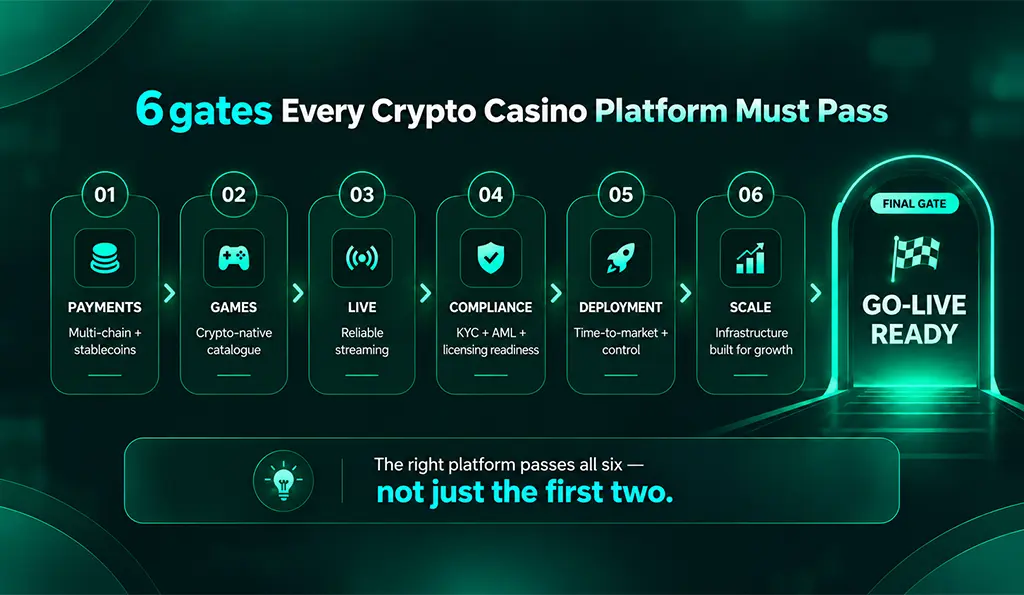
The right crypto casino software depends on what you are building, who you are serving, and where you plan to scale. These six factors help you evaluate exactly that.
1. Crypto Payment Architecture
Not all crypto payment systems are built the same, and the difference becomes obvious the moment something goes wrong. Platforms with native multi-chain support handle Bitcoin, Ethereum, TRON, and BNB directly, while bridged assets route through intermediaries that add unnecessary failure points to every transaction. Stablecoin support is worth looking at closely too.
Platforms that handle USDT and USDC with connected ledger logic give operators a practical way to protect margins from crypto volatility without pushing players toward fiat. One more thing to confirm before signing: how does the platform settle exchange rates? Some lock the bet value at the moment of wager, others at withdrawal. That distinction matters more than most operators realise.
2. Game Aggregation Depth & Crypto-Native Content
When it comes to games, the number on the homepage is rarely the most useful figure. What matters more is whether the catalogue was built with crypto players in mind. It is more important to see if the catalogue was created with crypto players in mind. Crash, plinko, dice and provably fair mechanics aren’t perks placed in the depths of thousands of fiat-first slots, they’re expected as the standard.
At first glance, a library of 30,000 titles sounds like a lot but if crash games and dice studios aren’t in the list, and only certain games are provably fair, then it’s not much. You don’t want to have a hard conversation later if you can ask those questions now.
3. Live Casino Infrastructure
Live casino is the area where crypto platforms tend to overpromise the most. Studio quality, streaming reliability, dealer language options, and access to game show titles are what actually keep live casino players coming back.
Mobile performance deserves its own evaluation too, because a studio that streams perfectly on desktop can still feel clunky and slow on a phone. Don’t accept uptime claims as they are stated, request SLA documentation. Before you commit, find out precisely what game show titles are part of your contract tier, as they’re not necessarily the same that will be sent with your package.
4. Compliance & Licensing Readiness
Crypto does not simplify compliance. In most markets, it adds a layer to it. KYC and AML tooling needs to handle both standard identity verification and blockchain-specific risk signals like wallet screening and mixer exposure detection.
Jurisdiction fit matters just as much as licence availability. Curaçao LOK, MGA, UKGC, and Anjouan each open different markets and carry different ongoing obligations. Responsible gambling features should also be configurable without needing a developer every time a regulator updates its rules, because in this industry, that happens more often than you would expect.
5. Deployment Model & Time to Market
The deployment model you choose at the start shapes everything that comes after it. White label casino software gets you live in two to four weeks with shared licensing and a ready-made setup, but customisation is limited.
Turnkey casino software gives you your own licence and more control over the product, usually within four to eight weeks. If you want a deeper comparison, our guide to top turnkey casino software providers breaks down the leading options. Custom builds offer full ownership and full flexibility, but you are looking at four to nine months and a higher upfront investment.
6. Scalability & Infrastructure Architecture
A platform that handles launch traffic well can still struggle six months later if the infrastructure was not built to grow. Cloud-native setups scale on demand, which means player load spikes during promotions or major events do not become an operator problem.
On-premise deployments give you more control over your data but require planning ahead when capacity needs to increase. When talking to providers, ask for concrete load capacity figures rather than uptime percentages, which rarely tell the full story. Modular architecture is also worth prioritising. It lets you swap out individual components like a payment gateway or a CRM tool as your needs change, without rebuilding the entire platform around it.
Bitcoin-Only vs. Multi-Crypto Casino Software: Which Should Operators Choose?
Bitcoin-Only vs. Multi-Crypto Casino Software
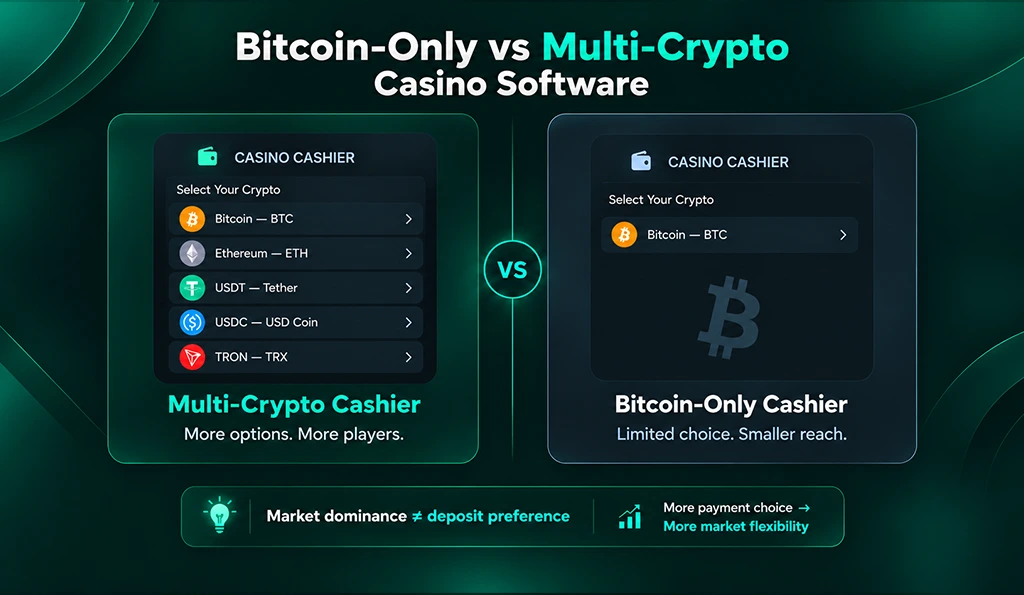
Bitcoin still dominates the crypto market with around 66% of total volume, but even in the bitcoin casino sector, dominance at the market level does not always translate to dominance at the deposit screen. Players choose the currency that is most convenient for them, and that is increasingly not Bitcoin.
Stablecoin growth tells that story clearly. USDT and USDC have become the deposit currency of choice for players who want crypto speed and anonymity without exchange-rate anxiety. Regional preferences add another layer:
- In Latin America and Southeast Asia, ETH, TRX, and USDT are more widely held and actively used than Bitcoin.
- High-value players and VIPs increasingly favour stablecoins for large deposits, precisely because the value does not shift between deposit and withdrawal.
- Operators targeting these regions with a Bitcoin-only setup are effectively making a market entry decision without realising it.
Bitcoin-only does make sense in one specific scenario: a crypto-native brand built deliberately around Bitcoin as an identity, not just a payment method. For operators positioning around that niche, the constraint becomes part of the brand. For everyone else, it is just a constraint.
The more common mistake is launching with limited crypto support and planning to expand later. Payment architecture decisions get embedded deeply into the platform early, and unpicking them post-launch often means rebuilding more than just the cashier. A few things operators consistently underestimate:
- Retrofitting multi-currency support is significantly more expensive and disruptive than building it in from day one.
- Exchange-rate settlement logic, stablecoin ledger connections, and chain architecture all need to be considered at the platform selection stage, not after go-live.
- Multi-crypto is not a feature upgrade. It is a market expansion decision that should be made before the contract is signed.
Among the crypto casino software providers reviewed in this guide, multi-crypto support is the baseline, not a differentiator. The real evaluation question is not whether a provider supports multiple cryptocurrencies, but how well they handle it across chain architecture, stablecoin settlement, and exchange-rate methodology.
Wrapping Up…
No two casino operators have the same priorities, and no single crypto casino software provider on this list is the right fit for everyone. The framework and rankings here give you a structured starting point.
What comes next is matching your launch model, target market, and compliance requirements to the platform that actually fits. Because in this market, the longest feature list rarely belongs to the best platform for your specific operation.

Contact Us
FAQ's
-
What should I compare when evaluating crypto casino software providers?
Start with payment architecture, game depth, compliance tooling, deployment model, and infrastructure scalability. Apply the same criteria to every provider you evaluate, because the ones that look similar on paper often differ significantly where it actually counts.
-
Do I need a provider with multi-crypto support, or is one coin enough?
One coin works only if you are building a deliberate Bitcoin-native brand. For everyone else, player deposit preferences vary too much by region to rely on a single currency. Build multi-crypto support in from day one. Retrofitting it later costs more than most operators expect.
-
What security features should Operators look into while choosing crypto casino software?
On-chain AML monitoring, wallet screening, KYC integration, double-spend protection, and real-time transaction monitoring are the ones to start with. Fraud detection needs to work across both traditional player behaviour and blockchain-specific risk signals, especially on platforms handling high deposit volumes across multiple chains.
-
How fast can I realistically launch with a white-label crypto casino provider?
Most providers quote two to four weeks. Realistically, factor in KYC setup, payment configuration, and game content onboarding before settling on a go-live date. Four to six weeks is a more honest timeline for a platform that is properly configured and ready to acquire players from day one.
-
How much does gamification tooling matter when comparing crypto casino providers?
More than most operators budget for. Tournaments, loyalty programmes, missions, and leaderboards have a direct impact on player retention and lifetime value. Crypto players churn quickly without engagement mechanics in place, so gamification tooling deserves a place in your platform evaluation, not just your post-launch roadmap.

Palak Madan has been writing about the iGaming industry since 2024. She focuses on helping operators and founders understand their options when launching an online casino, from choosing the right software provider to figuring out costs and compliance requirements across different markets. At PieGaming, she covers topics like white label casino solutions, platform selection, and market entry, turning complex industry information into practical guidance for people building iGaming businesses. She also keeps a close eye on licensing and regulatory changes; particularly how new rules shape the way operators enter and grow in different jurisdictions.

Telegram casinos are a new gaming channel where users access casino games directly via Telegram bots or mini app-driven channels. This guide explains how Telegram casinos work, including how they are built, their key features, why they function, and why many companies want to explore this growing platform.

Starting a crypto casino involves multiple steps. From choosing your target market to obtaining a license, casino model, game integration, and compliance management, you’ll need to consider a lot of things in between.

Choosing the right Bitcoin casino software provider is crucial for building a secure, scalable, and profitable online casino business. Here’s a quick look at the top providers and how to pick the right one.

Bitcoin casinos are online casinos that feature slots, blackjack, roulette, and live casino games and accept bitcoin payments. This guide explains how Bitcoin casinos operate, their advantages and disadvantages, payment methods, security measures, licensing requirements, and the steps required to launch a crypto casino in 2026.

Crypto iGaming solutions are transforming online gambling with blockchain powered payments, faster transactions, and greater transparency. As cryptocurrencies continue to evolve, new trends are shaping how players engage with digital gaming platforms.
Online casinos and crypto casinos can provide similar casino games, but they differ in terms of payments, currencies, transaction processing, as well as regulation and operational requirements. Online Casino vs Crypto Casino comparison highlights the key differences for operators and players.

Bitcoin’s speed, privacy, and security are some of the reasons why Bitcoin is becoming a popular payment method in online gambling. The purpose of this guide is to reveal the major pros and cons of using Bitcoin for online betting, helping both operators and players decide whether crypto is the right choice for their gaming transactions.

See you in your inbox soon!

Stay ahead of the game. Subscribe for exclusive content, updates, and insiders!