
The process of slot machine game development is an amalgamation of RNG systems, RTP design, gameplay mechanics, and contemporary technology, all of which are meant to deliver experiences that players are truly looking to return to. From development stages and monetization models to the challenges every business needs to plan for, getting it right means building something scalable, compliant, and built to perform over the long run.
What keeps players coming back to a slot game? It’s not luck. It’s a design.
Slot machine games have cracked the code on engagement. The near misses, the unpredictable rewards, the rush of almost winning. All of it triggers the real dopamine responses that make players want one more spin. It’s simple, exciting, and deeply human.
For businesses, that stickiness translates directly into opportunities. The slot machine market is sitting at $11.42 billion in 2025 and is on track to hit $12.53 billion by 2026, growing at a steady 9.7% CAGR.
The best iGaming platforms are already capitalizing on this, hitting retention rates of 75% double what most of the industry manages, by leaning into gamification and personalization done right. , by leaning into gamification and personalization done right.
But none of that happens by accident. Behind every great slot game is a clear plan, thoughtful design, and a development approach that actually fits the goal
This guide breaks all of it down, so you can build a slot machine game that players love, and that delivers real results for your business.
How Do Slot Machine Games Work?
A Random Number Generator (RNG) is a software algorithm that generates 3,000 combinations of numbers per second, even when no one is playing, which is the way that modern slot games are run.
As soon as a player presses spin, the game locks in on one of those sequences and draws symbols based on those on the reels and wins or losses are determined accordingly.
Every spin is completely independent. Past results have zero influence on what comes next, which is why hot streaks and cold streaks are a myth, not a mechanic.
-
Reel Mapping and Symbol Selection
What you see on screen isn’t just the visual layer. Beneath it, each reel holds a predefined set of symbols tied to specific number ranges produced by the RNG. When a number gets selected, it points to a position on the reel, and that’s what the player sees.
This mapping gives developers control over how often certain symbols show up, which is how high-paying symbols are kept rare.
-
Paylines and Winning Combinations
Paylines are the patterns across the reels that determine whether a spin pays out. Match the right symbols along an active payline, and the game’s pay table decides what you win. More advanced slots ditch fixed lines altogether and use “ways to win” systems, like 243 ways, where adjacent matching symbols from left to right are enough to trigger a payout.
-
Return to Player (RTP) and House Edge
Every slot is built with a Return to Player percentage, usually somewhere between 92% and 98%. That number reflects the expected payout over millions of spins, not any single session. The rest is on the house edge. It’s a long-term statistical average, not a per-spin guarantee.
-
Volatility
The nature of the game is determined by volatility. Slot machines with low volatility pay out more often, but for smaller amounts of money. High volatility slots rarely pay out, but when they do, they pay out large amounts. This is regulated by the developers who can change the symbol distribution, bonus frequency, and payouts.
-
Bonus Features and Game Logic
Free spins, multipliers, wilds and bonus rounds. All of these features are RNG-based, but they may be implemented in a different logic layer. For example, a bonus round could have its own set of weighted probabilities instead of the regular reel probabilities.
Technologies Used in Slot Game Development
Building a slot game that works at scale is a serious technical undertaking. Each layer of the stack has a specific purpose, and when all these layers are well integrated, the game is easily played by the player and is easy to operate by the operator.
Here’s what powers it all:
- Visuals, animations, and player interactions are managed by the Frontend, which is based on the HTML5, WebGL, and libraries such as PixiJS.
- RNG systems run on a set of certified algorithms that are mapped to reel outcomes by means of a set of configuration tables, which ensures the system is fair and auditable.
- Using either Node.js or Java with Redis and PostgreSQL, sessions are very fast and transactions are accurate even under load.
- Monte Carlo simulations are performed with millions of spins before releasing to ensure that the RTP and volatility are correct.
- Payment systems handle real money transfers securely, complying with regulations such as PCI DSS.
- Security measures such as encryption, hash verification, and third-party certification from organisations like eCOGRA ensure the protection of players and operators alike.
- A single game can be published to dozens of casino platforms with very little changes using a modular API-based architecture.
A slot game isn’t necessarily good because of a single technology. It is a combination of specialized systems working together from the start for speed, fairness, and compliance.
Read Blog – Different Types of Slots and their Features
Step-by-Step Slot Game Development Process
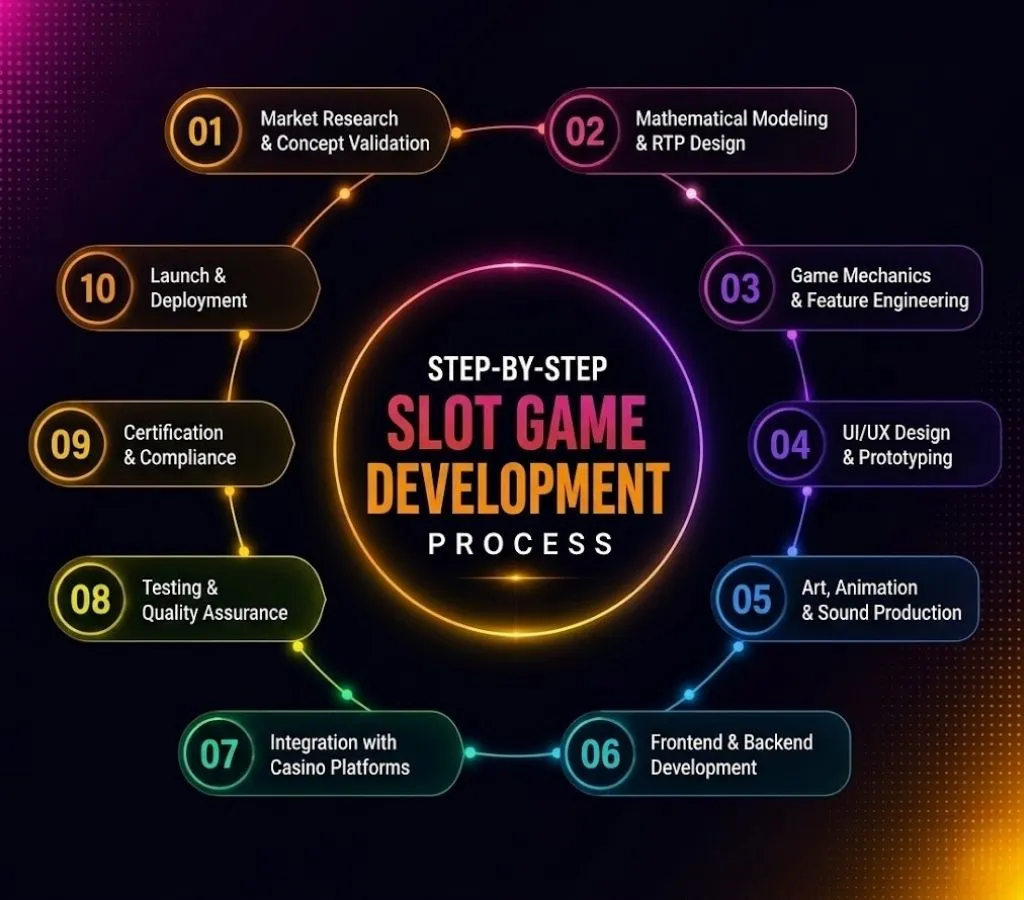
Online slot game development process
Creating the slot game isn’t a solitary creative jump. It is a linear process in which each step is dependent on the next. It’s assembled in this way. Here is how it comes together.
1. Market Research and Concept Validation
Everything starts with understanding what players actually want. Teams study player trends and analyze competitor titles and define the target audience before a single line of code gets written.
Key decisions made at this stage include:
- Theme
- Whether mythology
- Adventure
- Pop culture, or something else entirely.
- Target markets, since regions like the UK, EU, and Asia each carry different compliance requirements.
- Monetization model, including RTP range and betting limits.
This stage wraps up with a Game Design Document that outlines the mechanics, features, and compliance needs for the entire project.
2. Mathematical Modeling and RTP Design
This is where the game gets its backbone. Mathematicians build algorithms that define how the slot will actually behave, covering RTP percentage, volatility, hit frequency, and the full pay table structure.
Millions of simulated spins are run to confirm statistical accuracy and regulatory compliance. The goal is a game that works for operators on the numbers side and keeps players genuinely engaged.
3. Game Mechanics and Feature Engineering
With the math locked in, developers design the core gameplay loop. This includes the reel structure, special symbols like free spins, pick-and-win rounds, and cascading reels.
This is also where differentiation happens. For tournament-ready shots, mechanics are turned for fast spins and high engagement bursts.
4. UI/UX Design and Prototyping
Designers create wireframes and interactive prototypes for the reel layout, spin button placement, pay table screens, and bonus animation flows.
Emphasis is placed on ease with which the game will be played, particularly on mobile platforms. Interactions need to be fast and streamlined — they are not nice-to-have. They are essential.
5. Art, Animation and Sound Production
Somewhere here is the idea that can actually be felt by players. It has high-resolution symbols, smooth reel animation, great sound design and more. Visual quality is maintained across devices while optimizing assets without impacting performance.
6. Frontend and Backend Development
The game is built. The front-end is implemented using HTML5 and WebGL to support both web and cross-platform. The backend is responsible for managing the RNG, session management, payer data, payout calculations, and API connections to casino platforms. Both layers have to be alright.
7. Integration with Casino Platforms
The game is thoroughly tested before anything goes live. Functional testing verifies that the game plays the way it is supposed to play.
Performance testing is used for measuring loading times on various devices. The RNG is checked. Bonus conditions, max win situations, etc. are stress-tested for edge cases. Automated as well as manual testing are employed to ensure there is no room for error.
8. Testing and Quality Assurance
Before anything goes live, the game goes through extensive testing. Functional testing confirms gameplay works as intended. Performance testing checks load times across devices. The RNG gets verified. Edge cases like bonus triggers and max win scenarios are stress-tested. Both automated and manual testing are used to make sure nothing slips through.
9. Certification and Compliance
Independent testing agencies such as eCOGRA and iTech Labs validate the fairness of RNG, RTP accuracy and adherence to jurisdictional rules. This is a non-negotiable step. The game can’t work without certification in regulated markets.
10. Launch and Deployment
The game is now available on online casino software and aggregators. Together, developers and operators plan marketing campaigns, tournaments, and promotional activities such as free spins and leaderboard contests to generate early momentum.
Read Blog – Checkout Popular Strategies Used in Online Slots
Top Slot Game Development Companies
Choosing the right casino game development company is one of the most important decisions you will make. Here are the names worth knowing.
1. Novomatic
Company Overview:
Novomatic is one of the world’s most extensive and reputable gaming technology companies. The Gumpoldskirchen-based company has established itself in over 40 countries worldwide and was founded in 1980.
It began as a land-based slot business and has developed into a complete gaming business providing both physical and digital solutions in casinos all over the world. They got into online gaming when they started their online division, Greentube, which introduced some of their best-known slot games to the online casino.
Core Services
- Land-based slot machines and gaming terminals.
- Online slot game development through Greentube.
- Electronic table games and casino systems.
- Sports betting and lottery solutions.
- Social casino and mobile gaming platforms.
Key Features
- A portfolio of 400+ classic and modern slot titles.
- Straightforward mechanics that are easy to pick up and hard to put down.
- Distinctive sound design that players associate with winning.
- Themes spanning adventure, mythology, and classic fruit slots.
- HTML5-based games built for cross-platform compatibility.
- Proven land-based mechanics adapted seamlessly for online environments.
Popular Titles
- Book of Ra Deluxe, widely considered one of the most influential slot games ever made
- Sizzling Hot Deluxe
- Lucky Lady’s Charm Deluxe
- Dolphin’s Pearl Deluxe
- Lord of the Ocean
2. Game Ace
Company Overview:
Game-Ace is a custom game development studio, which is a part of Program-Ace, and has more than 20 years of experience in the game development industry. Based in Nicosia, Cyprus, they have been creating innovative and high-quality slot games and iGaming solutions since 2005.
As of now, the company has 120+ specialists in its team, and over 200 projects delivered successfully, providing Game-Ace with a solid reputation for developing engaging, scalable, and tech-savvy slot games.
Core Services:
- End-to-end slot game development from concept to launch.
- Game design and slot art creation.
- Mathematics and game logic development.
- Cross-platform development across web, mobile, and desktop.
- 2D and 3D slot game development.
Key Features:
- Custom slot mechanics with unique gameplay elements.
- High-quality visuals and immersive animations.
- Fair gameplay backed by advanced mathematical models.
- Seamless cross-platform compatibility.
- Robust backend systems for transactions and player data.
- Optimized performance for consistent, lag-free gameplay.
Slot Game Types:
- Branded Slot Games
- Classic Slots
- Fruit Slot Games
- HTML5 Slots
- Social Casino Slots
- AWP (Amusement with Prize) Slots
3. NetEnt
Company Overview:
NetEnt, or ‘Net Entertainment’, is one of the most powerful names in the history of the online casino. Based in Stockholm, Sweden and established in 1996, the company has been developing the modern day slot gaming game for nearly 30 years.
NetEnt has been setting the bar for premium digital casino experiences with its ability to develop mechanics that the rest of the industry has followed, as well as create a collection of titles that players still hunt down by name.
Core Services:
- Online slot game development.
- Progressive jackpot slot systems.
- Table games including Blackjack, Roulette, and Baccarat.
- Live dealer casino solutions.
- Mobile-first gaming platforms.
- Casino backend and platform integration.
Key Features
- High-quality HTML5 games optimized for both mobile and desktop.
- Advanced RNG systems are independently tested for fairness.
- Unique gameplay mechanics like cascading reels and expanding wilds.
- Cinematic graphics, rich themes, and immersive sound design.
- A wide range of RTP and volatility options to suit different player profiles.
- Seamless integration with leading online casino platforms.
Popular Titles
- Starburst
- Gonzo’s Quest
- Dead or Alive II
- Twin Spin
- Divine Fortune, a progressive jackpot title
- Blood Suckers
4. Microgaming
Company Overview:
Microgaming is not just one of the oldest names in online casino gaming. It is the company that started it all. Founded in 1994 and headquartered in Douglas, Isle of Man, Microgaming is widely credited with developing the world’s first online casino software, making it one of the foundational forces behind the entire digital gambling industry.
Over the decades, the company has built a reputation for innovation that few can match, particularly slot games and progressive jackpot systems, supplying gaming content to hundreds of casino operators worldwide.
Core Services
- Online slot game development.
- Progressive jackpot networks.
- Table games including Blackjack, Roulette, and Baccarat.
- Video poker and bingo software.
- Mobile and cross-platform gaming solutions.
- Casino platform systems and licensing services.
Key Features
- One of the largest slot portfolios in the industry, spanning hundreds of titles
- Creator of the first progressive jackpot slot network in online gaming
- High-quality graphics and genuinely engaging gameplay mechanics
- Certified RNG systems independently verified for fairness
Popular Titles
- Mega Moolah, famous for record-breaking jackpot payouts and creating multiple millionaires.
- Immortal Romance.
- Thunderstruck II.
- Game of Thrones, a branded title that brought a global IP into the casino space.
- Jurassic Park.
5. AIS Technolabs
Company Overview:
AIS Technolabs is a globally recognized software and game development company specializing in slot game development, casino solutions, and next-gen gaming platforms.
Built with a vision to deliver innovative digital and gaming solutions worldwide, it has grown into a trusted name in iGaming and software development over the years.
Core Services:
Their service offering covers a broad range of gaming and development needs, including,
- Slot game development in both 2D and 3D.
- Casino game development across formats like Poker, Rummy, Bingo, and Lottery.
- Unity game development.
- Mobile apps and web development.
- Custom software solutions
- A dedicated developer hiring model.
Key Features
- Social login and easy onboarding via Google and Facebook.
- Interactive on-screen controls for betting, spinning, and cashing out.
- Auto-play mode for uninterrupted gameplay.
- Push notifications to keep players engaged in real time.
- Multi-payment integration with secure deposit and withdrawal systems.
- Built-in analytics and reporting tools for operators.
Popular Slot Game Types by AIS Technolabs
- Classic 3-reel
- 5-Reel Video Slots
- 3D & Animated Slots
Monetization Models in Slot Games
Slot games are built to generate revenue at every layer, and the best platforms use multiple models working together.
It starts with the house edge. Every slot’s RTP is engineered so that over millions of spins, the operator always comes out ahead. From there, the monetization stack builds up:
- High spin frequency turns even small bets into significant revenue across a large player base.
- Progressive jackpots build shared prize pools with every wager, keeping players engaged while quietly maintaining operator margins.
- Bonus engines, free spins, loyalty programs, and VIP tiers extend session length and encourage players to reinvest their winnings.
- Each of these mechanics compounds over time, increasing the lifetime value of every player on the platform.
When all of these models align, the result is a revenue system that is consistent, scalable, and built to grow alongside your player base.
Read Blog – Explore the Best Online Casino Game Providers
Challenges in Slot Game Development
Building a slot game that actually competes takes more than good design. There are real challenges along the way that can derail even well-funded projects.
1. Ensuring True Randomness and Fair RNG Systems
The RNG is the engine that every slot game is built around, and getting it right is harder than it sounds. Weak algorithms or poor seeding can create predictable patterns that compromise fairness and put regulatory compliance at risk.
Developers need cryptographically secure RNG systems that are continuously tested, not just at launch but throughout the game’s lifecycle. A flawed RNG does not just create technical problems. It destroys player trust, and that is far harder to fix.
2. Balancing RTP, Volatility, and Player Experience
Finding the right balance between RTP and volatility is one of the most demanding design challenges in slot development. Too tight and players leave frustrated. Too generous and the economy falls apart.
The sweet spot requires running millions of simulations and building probability models that make the game feel rewarded without undermining the operator’s margins. It is as much an art as it is a science.
3. Complex Mathematical Modeling
Behind every slot is a math model that defines symbol distribution, hit frequency, jackpot behavior, and bonus triggers. The margin for error here is essentially zero.
A small miscalculation can lead to incorrect payouts, unstable gameplay, or regulatory rejection. Building and validating these models demands deep expertise in probability and statistical systems, and it is not something that can be rushed.
4. Regulatory Compliance Across Markets
Slot games do not operate in a single regulatory environment. Every market comes with its own requirements around RNG certification, RTP transparency, data protection, and testing protocols.
Adapting a game for multiple jurisdictions is time-consuming and detail-intensive work. Missing a compliance requirement in any one market can delay or completely block a launch, making this one of the most operationally demanding parts of the entire development process.
5. Technical Integration and Scalability
A slot game does not exist in isolation. It has to integrate cleanly with casino platforms, payment systems, and third-party APIs while handling thousands of concurrent users without breaking a sweat.
Poor integration leads to latency issues, transaction failures, and crashes at exactly the wrong moments. Building infrastructure that scales reliably under high traffic, across multiple devices and platforms, is a challenge that does not go away after launch. It has to be planned from the very beginning.
Read Blog – Top iGaming Payment Providers You Should Know
| 💡 All-in-One Casino with Built-In Slots
PieGaming takes the integration headache off your plate entirely. You get a complete casino platform that comes pre-loaded with premium slot content from top global providers, ready to go from day one. |
Wrapping Up…
The slot machine game development market is growing, and the opportunity is real. But so is the competition. The businesses that win are the ones that plan carefully, build deliberately, and never stop optimizing after launch. Get those fundamentals right, and you are not just building a game. You are building something that lasts.

FAQ's
-
What is slot machine game development?
Slot machine game development is the process of designing and building online slot games from the ground up. This includes everything from themes, reels, and paylines to bonus mechanics, math models, and art, all the way through to integration with casino platforms and regulatory-compliant RNG systems.
-
What are the key features of a modern slot game?
Modern slots go well beyond spinning reels. Expect themed visuals, animated reels, multiple paylines or Megaways, cluster pays, free spins, cascading reels, hold-and-win mechanics, and progressive jackpots, all built on a fair RNG foundation with a mobile-first experience throughout.
-
How much does it cost to develop a slot game?
Cost depends on how complex the game is. A basic slot typically falls in the $10,000 to $25,000 range. Mid-range slots with more features sit between $30,000 and $80,000. Premium or cinematic slots with advanced mechanics and high production value can run anywhere from $80,000 to $500,000 or more.
-
How long does it take to build a slot machine game?
A simple slot can be ready in one to two months. Mid-complexity games generally take two to four months. Advanced builds with 3D elements, rich animations, and full certification requirements can take anywhere from four to twelve months from concept to soft launch.
-
What is RNG in slot game development?
RNG stands for Random Number Generator. It is a certified algorithm that continuously produces random numbers and maps them to reel positions, making every spin completely independent and unpredictable.

Palak Madan has been writing about the iGaming industry since 2024. She focuses on helping operators and founders understand their options when launching an online casino, from choosing the right software provider to figuring out costs and compliance requirements across different markets. At PieGaming, she covers topics like white label casino solutions, platform selection, and market entry, turning complex industry information into practical guidance for people building iGaming businesses. She also keeps a close eye on licensing and regulatory changes; particularly how new rules shape the way operators enter and grow in different jurisdictions.

The best online casino slot providers in 2026 are Pragmatic Play, Evolution Group Studios, Play’n GO, Hacksaw Gaming, Relax Gaming, Games Global, Playtech, Push Gaming, Yggdrasil and Blueprint Gaming. Operators should compare them on six criteria: licensing and certification, RTP range, volatility, market fit, integration and commercial terms.
Casino gamification refers to the inclusion of goals, levels, rewards, and other video game elements around the core gambling area. Learn how operators can use gamification in igaming to create more engaging player journeys while managing costs.
Stake.Us, PlayFame, McLuck, MegaBonanza and Zonko are social casino platforms that are free-to-play casino games using virtual coins. These platforms offer hundreds of slots, tables, and instant-win games with daily free coins, tournaments, and bonus features.
Casino CRM strategies help operators to personalize campaigns, improve player retention, reduce churn rate, and maximize player lifetime value.
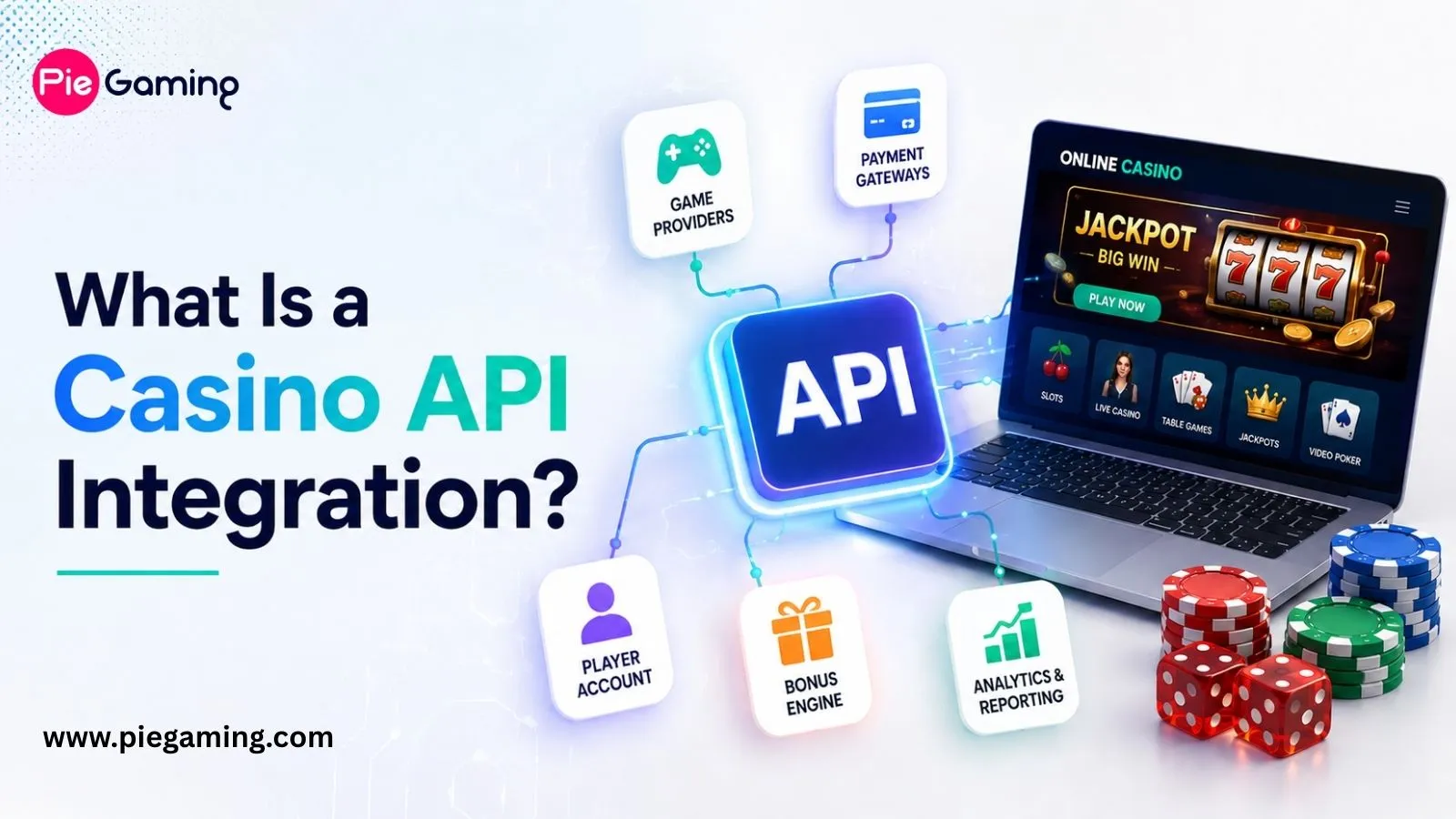
A casino API integration is a software solution that connects your platform with games, payment gateways, wallets, KYC tools and other third-party solutions. It allows data to be exchanged between systems in real-time. This way you can launch quicker, automate tasks, and provide a smooth playable experience.
House Edge is the mathematical advantage built into online casino games and all other forms of gambling. It shapes the odds, influences your winnings and losses, and constitutes the cornerstone of any online casino or sportsbook operator’s overall financial strategy.
The Hi-Lo casino game is a simple card game where players predict whether the next card will be higher, lower, or equal to the current card. This guide explains how Hi-Lo works, its rules, betting options, payouts, gameplay, and strategies players can use when making predictions.


See you in your inbox soon!

Stay ahead of the game. Subscribe for exclusive content, updates, and insiders!