
Best online casino payment methods in 2026 include credit and debit cards, e-wallets, open banking, cryptocurrencies, prepaid vouchers, and mobile money. Cards are the most widely supported but face issuer restrictions on gambling transactions. E-wallets like PayPal, Skrill, and Neteller offer faster withdrawals.
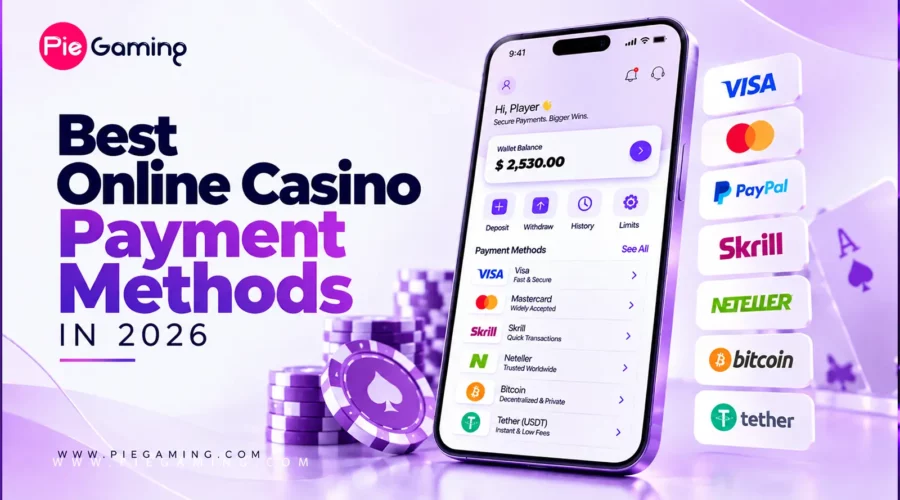
Online casino players don’t all pay the same way. One player wants an instant card deposit. Another needs a local e-wallet that supports their currency. A third is looking for a withdrawal method that doesn’t take three business days. When operators support only a handful of payment options, they create friction for a chunk of their audience before a single bet is placed.
In 2026, a competitive online casino software needs flexible payment infrastructure: local method coverage, reliable deposit, and transparent fees. This guide compares the best online casino payment methods by speed, cost, regional reach, and what actually drives player choice.
How Do Casino Payment Systems Work?
What may appear at first glance to be immediate casino payments are actually the result of the interaction of multiple systems, ensuring the safe transfer of funds within regulatory guidelines.
Deposit flow: Player selects a method of payment and sets a value. A payment gateway route that requests the relevant bank, card network, or e-wallet. The provider confirms or denies it; the fraud and AML checks are done concurrently, and the player’s balance is updated when confirmed. Final settlement may be slightly delayed based on settlement methods.
Withdrawal flow: The operator checks the player’s AML or safer gambling flags, wagering conditions, method of ownership, and KYC status before approving a wager. If approved, the money goes to an eligible method, typically the deposit method. The time required will vary based on the operator’s approval process and the amount of payment for rail utilization.
Five core components keep this infrastructure running:
- Casino Platform and Wallet Ledger — records deposits, withdrawals, bonuses, wagering activity, and available balance; applies the operator’s payment rules and limits.
- Payment Gateway — securely captures and routes payment data between the casino cashier and banks, acquirers, e-wallets, or alternative payment providers.
- Payment Processor or PSP — manages transaction processing, authorization flows, reconciliation, and in some cases acquiring and payout services.
- Security and Risk Management Controls — encryption, tokenization, transaction monitoring, fraud screening, and AML controls that protect player data and flag suspicious activity.
- Verification and Compliance Systems — confirm identity, age, address, and payment ownership while supporting the operator’s KYC, AML, responsible gambling, and jurisdiction-specific obligations.
Together, these systems determine whether a deposit clears quickly; a payout can be automated, a local method is supported, and the operator stays within its legal and risk obligations.
Types of Online Casino Payment Methods
Online Casino Payment Methods
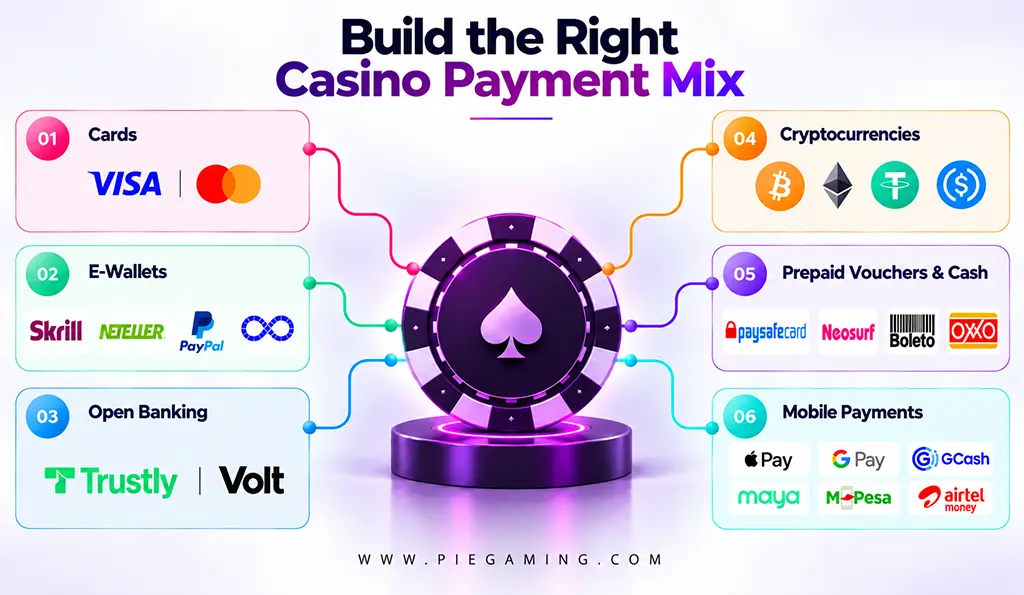
Variety of casino payment options range from cards and e-wallets to crypto and mobile money, and each is different in terms of speed, availability, fees, and region. Here is what operators need to know about each one.
1. Credit and Debit Cards (Visa, Mastercard)
Visa and Mastercard are widely supported at licensed online casinos, though acceptance depends on the jurisdiction, operator, and local gambling payment rules. In some regulated markets, credit card gambling is limited or even banned. Gambling transactions are not allowed at the network level, and the eligible debit card might still be rejected.
Card deposits are usually credited within seconds when approved. Withdrawals typically take 3 to 7 business days, depending on the issuer, card scheme, and the operator’s processing queue. Decline rates are a key operational challenge. Issuer-level gambling restrictions and the gambling MCC can affect authorization rates even on valid cards with sufficient funds.
2. E-Wallets
E-wallets sit between the player’s bank and the casino. Players load funds from a bank account or card and deposit without sharing banking credentials directly with the casino. Deposits are fast, and withdrawals are often quicker than card payouts. Fees and availability vary by provider, market, and operator. Skrill, Neteller, PayPal, and MiFinity are the most widely used options in iGaming.
3. Open Banking and Instant Bank Transfers
Open banking lets players approve a deposit through their own banking app without entering card details in the casino cashier. The player selects their bank, authenticates, and approves the payment. Speed depends on the provider, bank, and local payment rail.
Because it bypasses card networks, an issuer gambling into MCC block is not a factor. However, bank risk policies and payment limits can still cause delays. Key providers include Trustly, which covers 30+ countries, including the Nordics, the UK, and North America, and Volt, which has broad European coverage and availability in Brazil and Australia.
4. Cryptocurrencies
Crypto payments rely on on-chain wallet transfers, made through Bitcoin, Ethereum or stable coins such as USDT and USDC. Payment Processor are usually crypto-friendly and blockchain monitoring solutions are used by operators for compliance, payment processing, and payouts. Different networks and confirmation policies have different settlement speeds.
USDT and USDC will follow the US dollar, and both cause less price fluctuation than USD, but the fee charged on the network and the policy of the casino exchange rate can cause a small difference. Conventional card chargeback risk is removed on-chain with confirmed transfers; however, there are controls to be implemented for fraud, sanctions exposure, and AML compliance.
5. Prepaid Vouchers and Cash-Based Methods
Paysafecard and Neosurf let players deposit using a retail-purchased code with no banking details required. Boleto and OXXO are cash-based local methods used in Brazil and Mexico, respectively. Voucher deposits are instant but typically deposit-only, meaning players need a separate withdrawal method such as a bank transfer or e-wallet to receive winnings.
6. Mobile Payments
GCash and Maya are key rails in the Philippines. M-Pesa is widely used in Kenya and Tanzania. Airtel Money operates across Tanzania, Rwanda, and Zambia. Operators should prioritize local methods based on their licensed market rather than treating entire regions as a single payment market.
Payment Method Comparison: Speed, Fees, and Risk
Note: Costs and speeds are indicative. Actual fees vary by PSP contract, volume, jurisdiction, and operator risk profile. Operators should confirm permitted methods with local counsel and licensed payment partners.
How Operators Evaluate Casino Payment Methods?
Operators do not choose payment methods because players recognise them. They choose them because they convert, comply, and settle predictably. Here is what that evaluation actually looks like.
Authorization Rate and Decline Optimization
The authorization rate measures the percentage of attempted transactions that are completed successfully. It is a core iGaming payment metric that directly affects deposit conversion and revenue.
Card authorization is more challenging in iGaming than standard e-commerce. Issuers may apply enhanced controls to gambling MCC codes and decline payments due to gambling restrictions, fraud rules, 3D Secure failures, or internal bank policy.
Operators use two approaches to recover legitimate declines:
- Payment cascading retries an eligible soft decline through a secondary approved PSP. It should not be used to override hard declines, fraud blocks, or prohibited transaction responses.
- Smart routing directs each transaction to the most suitable PSP based on geography, card BIN, transaction value, and historical authorization performance.
Payment orchestration platforms automate both and can improve approval rates where multiple compliant processing routes are available.
Regulatory Compliance by Market
Payment method availability is a legal decision in regulated markets, not just a commercial one.
Settlement Currency and FX Risk
FX risk arises when players transact in local currency while the operator settles in USD. Exposure depends on PSP agreements, conversion timing, and settlement cycle. USDT and USDC settlement can reduce local currency volatility exposure in permitted markets, but conversion spreads, network fees, and compliance costs still apply.
Common Payment Challenges in Online Casino Transactions
Casino payments fail more often than most operators expect. Some of them are fixable. Some of them are structural. Here is what operators are up against and how to handle it.
KYC Verification Delays
KYC is typically triggered at withdrawal, not at registration or deposit. Players can fund their account, play for weeks, and only discover they need to submit documents when they try to cash out.
Larger withdrawals add another layer: enhanced source-of-funds checks on top of standard KYC, requiring players to explain where their money comes from. This is a regulatory requirement, not an optional step. Prompting players to complete verification before their first withdrawal eliminates the delay before it becomes a friction point.
Slow Withdrawal Processing Times
Withdrawal speed varies by method: e-wallets payment process within hours, open banking can be instant to same-day, cards take 3 to 5 business days, and wire transfers take longer across borders or over weekends. Most casinos also apply an internal pending period on top of the method’s own processing time.
This exists as a responsible gambling control and fraud prevention measure, not a technical delay. Players expecting a same-day e-wallet withdrawal may wait 24 to 48 hours before funds actually move. Setting clear expectations at the point of withdrawal request reduces complaints significantly.
Bonus Wagering Restrictions
Wagering requirements must be fully met before any bonus winnings become withdrawable. Attempting to withdraw during an active bonus typically results in cancellation or forfeiture of the bonus. The terms are disclosed in bonus system conditions but are rarely visible at the point of opt-in, which is where most disputes originate.
Payment Method Limitations
Prepaid vouchers are deposit-only with no withdrawal path back through the voucher itself. Some casinos require withdrawals back to the original deposit method, which creates friction when that method does not support outgoing payments. Switching to a different withdrawal method triggers an additional KYC review before the payment can be processed.
Withdrawal Limits and Restrictions
Most platforms apply daily, weekly, or monthly withdrawal caps. Players with large wins may receive funds in instalments rather than a single payment. These limits are typically buried in the banking section of the terms rather than surfaced during the deposit or bonus journey. Some casinos offer higher limits for VIP or verified high-roller accounts, but the process for accessing them is not always clearly communicated.
Regional Payment Preferences — What Works Where
Regional Payment Preferences
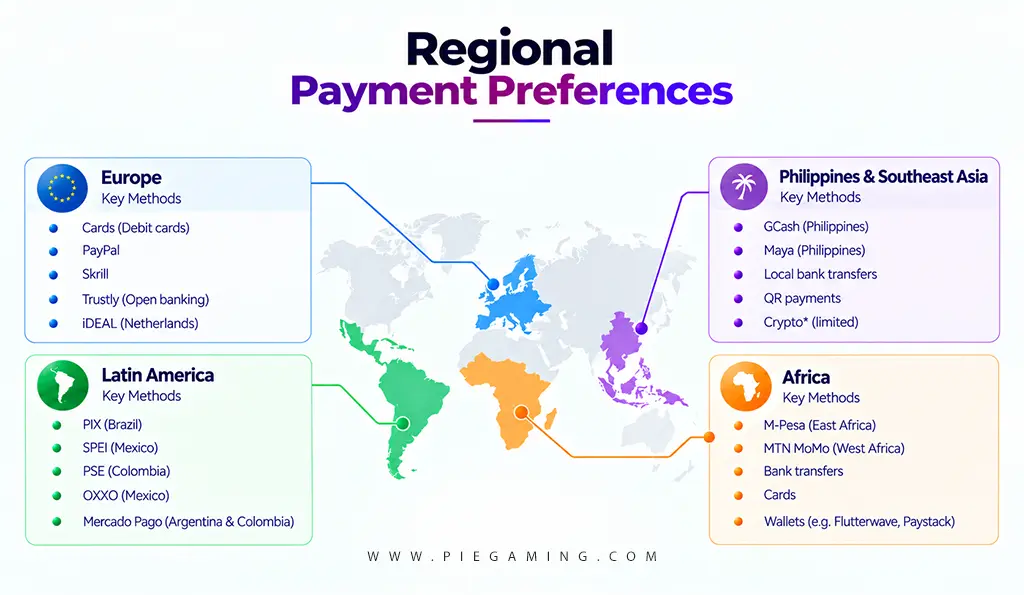
Payment preferences vary sharply by country. A payment stack that does not support familiar local methods, and compliant KYC flows can materially reduce deposit conversion even when the product and acquisition strategy are strong.
Europe
Debit cards are widely used, but local account-to-account methods matter significantly in some markets. In Great Britain, licensed operators cannot accept credit cards for gambling. The ban covers online betting, casino, and bingo, with narrow lottery exceptions.
PayPal, Skrill, and Neteller are recognised e-wallet options, though relevance varies by market. Open banking is increasingly important across the region. Trustly covers 30+ countries. iDEAL handles around 70% of Dutch online payments and is the standard method in the Netherlands.
Germany adds a key compliance layer. The €1,000 monthly deposit limit applies per player across all German-licensed providers via LUGAS, not per platform. Higher limits are available only under strict regulatory conditions.
Philippines and Southeast Asia
GCash online casino leads in the Philippines with 94 million users. Maya is another major wallet and digital banking platform in the same market. Payment behaviour across Southeast Asia is highly fragmented. Local wallets, domestic bank transfers, and QR payment systems are often more relevant than international card schemes depending on the country. Crypto may appear in some offshore ecosystems but should not be assumed legally available in regulated markets.
Latin America
Brazil operates a restricted payment framework. PIX supports near-instant 24/7 transfers and is a core permitted method, but not the only one. TED transfers, debit and prepaid cards, and certain same-institution transfers are also permitted. Credit cards, crypto, cash, and boleto vouchers are prohibited for regulated betting.
In Mexico, SPEI is the standard interbank transfer rail and OXXO serves unbanked players through cash payments. In Colombia, PSE is the widely used bank transfer method, offered alongside cards and cash options like Efecty and Baloto. Mercado Pago is a significant wallet across Argentina and Colombia, though its role varies by country.
Africa
Mobile money is critical across East Africa and parts of West Africa, while cards, bank transfers, and instant EFT remain important elsewhere. M-Pesa leads in Kenya and Tanzania. MTN MoMo is important in Ghana and several other MTN markets. Nigeria has a fragmented mix of bank transfers, cards, USSD, and wallets, with Flutterwave and Paystack supporting local payment channels. In South Africa, cards, Ozow for instant EFT, and bank-linked methods are the standard options.
Regional Overview
PieGaming Comes with Your Payment Stack Already Integrated
PieGaming’s white label casino software comes with payment integration already in place. Operators launch with a compliant, multi-market payment stack without the cost or delay of building it from scratch.
What’s included out of the box:
- Local payment methods: UPI, PIX, GCash, M-Pesa, and more, covering key markets across Asia, Latin America, and Africa.
- Global card and e-wallet support: Visa, Mastercard, PayPal, Skrill, Neteller, and other widely used methods.
- Crypto and stablecoin support: Bitcoin, Ethereum, USDT, and USDC for operators targeting crypto-friendly markets.
Wrapping Up…
Players want fast deposits, smooth withdrawals, and a method they trust. Operators need local coverage, strong authorization rates, and a compliant payout flow.
Choosing the best online casino payment methods for your target markets and building a stack that delivers on both sides of that equation, is what separates platforms that retain players from ones that lose them at checkout.

Contact Us
FAQs
-
Do casino platforms support multiple online casino payment methods?
Yes. Most modern casino platforms integrate multiple methods through APIs or payment service providers, covering cards, e-wallets, bank transfers, local rails, mobile money, and in some cases compliant crypto options.
-
Which casino payment methods have the lowest chargeback exposure for operators?
Bank transfers, open-banking payments, instant account-to-account methods, and verified e-wallets generally carry lower chargeback exposure than card payments. Fraud monitoring, KYC controls, and transaction review remain essential regardless of method.
-
How many payment methods should an online casino offer at launch?
Enough to cover local demand. That typically means cards, one or two widely used wallets, a bank transfer option, and the dominant local rail in each target market. Prioritize reliability, withdrawal support, and regulatory compliance over volume.
-
How do payment method preferences vary across regulated iGaming markets?
They differ by banking access, local infrastructure, regulation, and player habits. UK players lean on debit cards and e-wallets. Dutch players use iDEAL. Brazilian players transact primarily via PIX. Kenyan players rely on M-Pesa. No single stack works everywhere.
-
What role do local payment methods play in online casino market expansion?
Local methods reduce deposit friction, improve conversion, support local currencies, and reach players who do not have access to international cards or e-wallets. They also help operators meet country-specific compliance and player protection requirements, which matter more as markets become increasingly regulated.

Palak Madan has been writing about the iGaming industry since 2024. She focuses on helping operators and founders understand their options when launching an online casino, from choosing the right software provider to figuring out costs and compliance requirements across different markets. At PieGaming, she covers topics like white label casino solutions, platform selection, and market entry, turning complex industry information into practical guidance for people building iGaming businesses. She also keeps a close eye on licensing and regulatory changes; particularly how new rules shape the way operators enter and grow in different jurisdictions.

Casino influencer marketing involves the collaboration between licensed casino websites and influencers on platforms like YouTube, Kick, Twitch, TikTok, and Telegram who share casino games via tracked links and promo codes. Creators are paid by flat fee, CPA, revenue share or hybrid and paid based on results by FTD, NGR and retention. Campaigns must comply with local advertising, disclosure, and 18+ rules.
This blog explores ways and platforms to find and partner with top sports betting affiliates to grow the iGaming business.
This blog explains how iGaming affiliate marketing software helps operators boost revenue through smart tracking, automation, fraud prevention, and better campaign control.
Affiliate software is instrumental in managing partnerships and keeping track of performance in iGaming. This guide provides an overview of many iGaming affiliate software providers and features that operators can utilize for running an efficient affiliate marketing program.
This write-up talks about the best online casinos supporting GCash in the Philippines—also, the gaming variety, bonuses, and customer support they provide.
Top providers of payment applications for iGaming payment solutions are well-equipped with high transactional volume, robust compliance frameworks, and quick payouts for players using them. Selecting the right provider is your key to high authorization rates, fraud prevention, and seamless integration for your Internet betting platform.
A casino affiliate program is a performance-based marketing model where affiliates promote casino brands and earn commissions for acquiring qualified players. This guide explains how casino affiliate programs work, explores commission models, highlights key performance metrics, and covers strategies to build and scale a profitable acquisition channel.






See you in your inbox soon!

Stay ahead of the game. Subscribe for exclusive content, updates, and insiders!