
A casino affiliate program is a performance-based marketing model where affiliates promote casino brands and earn commissions for acquiring qualified players. This guide explains how casino affiliate programs work, explores commission models, highlights key performance metrics, and covers strategies to build and scale a profitable acquisition channel.

An online casino affiliate program is a partnership model between casinos and third-party marketers. Affiliates promote casino brands to their audiences and earn commissions when referred players complete specific actions. This performance-based approach allows operators to pay only for measurable results.
Affiliates come in different shapes. Content creators and bloggers review games, software, and platforms. Comparison and review sites rank operators side by side. Streamers and influencers showcase gameplay to loyal followers. Each one taps a different audience segment, and together they cover a huge chunk of the player’s acquisition funnel.
Casinos use affiliate programs because they remove the guesswork from marketing spend. There’s no upfront ad budget burned on impressions that might not convert. You pay for actual players, not clicks or views. That makes the ROI clean and the risk low.
Affiliates join for the same reason from the other side. They already have an audience. Affiliates can monetize their audience through commission models such as Revenue Share, CPA, or Hybrid deals. This allows them to generate income without developing their own casino products.
That’s the model in a nutshell.
Understanding how to build, manage, and scale an affiliate program helps operators create a cost-effective channel for acquiring qualified players.
And this is exactly what we are going to talk about in this blog.
Understanding Casino Affiliate Program
A casino affiliate program is a partnership framework for online casinos. It lets them collaborate with third-party marketers, publishers, influencers, and niche websites to acquire new players.
Rather than relying solely on in-house advertising, casinos use casino affiliate marketing to expand their reach across multiple traffic channels while building long-term relationships with trusted affiliate partners.
This strategy covers multiple traffic channels and player segments.
At its core, a casino affiliate program involves several key participants working together:
- Casino Operators: Brands that create and manage the affiliate program infrastructure.
- Affiliates: Individuals or businesses that promote casino offerings to their audience.
- Affiliate Managers: Professionals responsible for recruiting, supporting, and retaining affiliate partners.
- Tracking & Analytics Platforms: Technologies that monitor performance and attribute results accurately.
For casino operators, affiliate programs go way beyond just another marketing channel. They function as a scalable player acquisition strategy that lets brands enter new markets. Operators can target specific player communities and diversify traffic sources. This approach reduces the financial risk of traditional advertising campaigns.
As competition in iGaming intensifies, well-structured affiliate programs become critical growth assets. They help casinos build long-term promotional partnerships and improve marketing efficiency. These programs create a predictable framework for sustainable customer acquisition and consistent revenue generation.
Who Can Become a Casino Affiliate?
Casino affiliate programs are open to anyone who can reach players through a trusted channel. Businesses and individuals both qualify. Here’s who you’ll typically see applying to your program.
Casino review websites
These sites carry the most weight. Players land here while researching bonuses, game providers, payment methods, and licensing before they ever register. That’s high purchase intent. Expect strong FTD numbers and solid conversion rates from this group.
Bloggers and SEO publishers
These affiliates rank for casino games, betting strategy, regulations, and payment methods. Their content pulls organic traffic from players who are already searching for a platform to join. Low cost, high relevance.
Influencers and streamers
YouTube, Twitch, Kick, Instagram, TikTok. These creators promote through live gameplay, bonus demos, and reviews. Their communities are engaged and loyal, which makes for qualified referrals rather than cold traffic.
Sports betting tipster sites
Prediction platforms and tipster communities promote sportsbooks and casinos alongside with match analysis and betting picks. Their audience is already active in online betting, so conversions tend to come fast.
Media companies and gambling portal
High-traffic publishers covering casino news, game releases, and industry trends. Their editorial authority and reach help you break into new markets and pull players across multiple channels at once.
Existing players
Existing players can also become valuable affiliate partners when they actively recommend the platform. Existing players can provide authentic recommendations based on their experience. Players who promote the platform through websites, content channels, or streams can also earn commissions if they meet affiliate requirements.
How Do Online casino affiliate program Work?
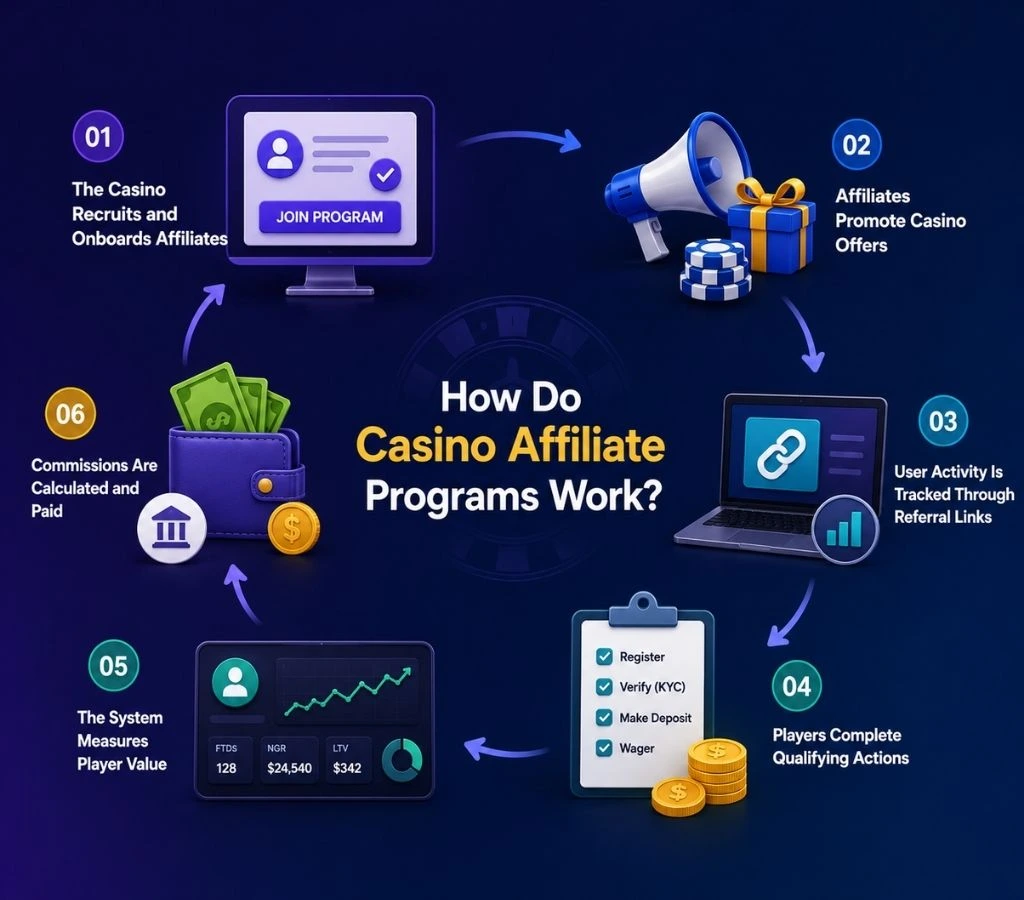
Explore how do casino affiliate programs work
Understanding how a Online casino affiliate program actually operates is essential for building a profitable acquisition channel. Every stage, from traffic generation to commission payouts, directly impacts your acquisition costs and player quality. While the exact setup varies between operators, most programs follow a similar process.
Step 1: The Casino Recruits and Onboards Affiliates
The process kicks off when a casino partners with affiliates who have access to relevant audiences. These might include casino review sites, sports betting portals, gambling comparison of platforms, streamers, and content publishers.
Once approved, affiliates get access to a dedicated dashboard. This includes promotional materials, campaign links, performance reports, and commission details.
Step 2: Affiliates Promote Casino Offers
Affiliates create targeted campaigns designed to attract potential players. A casino review website might publish detailed game reviews. An influencer might showcase welcome bonuses or exclusive promotions. The real goal is driving high-intent traffic, not just generating clicks.
Step 3: User Activity Is Tracked Through Referral Links
Each affiliate receives unique referral links generated by the affiliate tracking platform. These links use cookies and attribution technology to accurately record where traffic originates and how players convert. When users click on these links, the affiliate platform captures important data:
- Affiliate ID.
- Campaign source.
- Device information.
- Geographic location.
- Timestamp.
Step 4: Players Complete Qualifying Actions
Not every visitor generates revenue for the affiliate. Casinos define specific qualification criteria that players must meet:
- Account registration
- Identity verification (KYC)
- First-time deposit (FTD)
- Minimum deposit threshold
- Initial wagering activity
Only players meeting these requirements count as valid referrals.
Step 5: The System Measures Player Value
Once a player becomes active, the iGaming affiliate platform tracks key performance indicators (KPIs), including First-Time Depositors (FTDs), Net Gaming Revenue (NGR), Player Lifetime Value (LTV), retention, and conversion rates. Key performance metrics include first-time deposits (FTDs), deposit amounts, net gaming revenue (NGR), player retention rates, and lifetime value (LTV). These metrics help you evaluate traffic quality and identify top-performing affiliates.
Step 6: Commissions Are Calculated and Paid
Based on your agreed compensation model, the platform automatically calculates affiliate earnings.
Revenue share models reward affiliates with a percentage of player-generated revenue. CPA models pay a fixed amount for each qualified player. Hybrid agreements combine both structures to balance short-term and long-term incentives.
Optimizing each stage of the affiliate process helps operators build a predictable acquisition channel and achieve scalable revenue growth.
Types of Casino Affiliate Commission Model
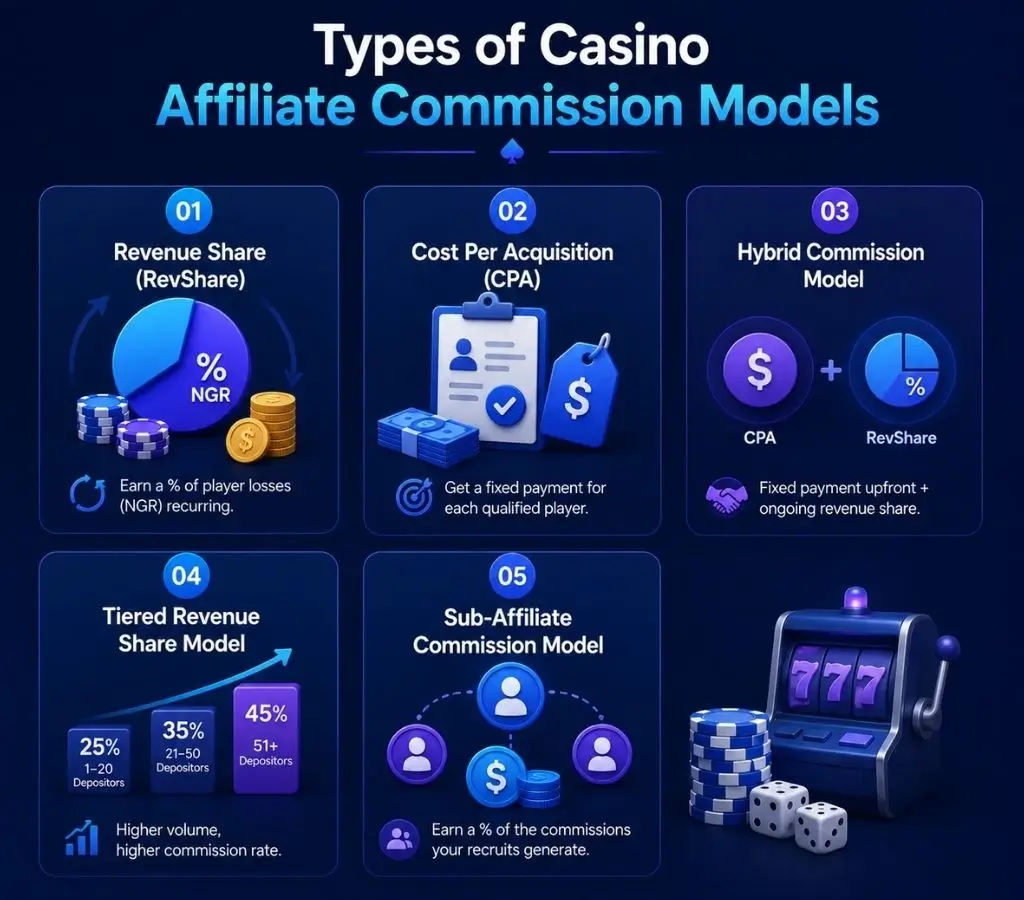
Casino affiliate commission models explained
Your commission structure is the engine that drives your affiliate program. Different models reward different behaviors. Some create long-term partnerships. Others fuel quick wins. Here’s what actually works.
1. Revenue Share (RevShare)
Revenue Share allows affiliates to earn a percentage of the Net Gaming Revenue (NGR) generated by referred players. The beauty here is that it is recurring. Your affiliate keeps earning as long as those players keep playing.
For example, if a referred player generates $1,000 in NGR, a 35% Revenue Share agreement provides the affiliate with a $350 commission. The affiliate can continue earning from future player activity. This model works best when:
- Your affiliates run content sites (casino reviews, strategy guides).
- You’re targeting SEO-driven discovery.
- You want to attract players who stick around and spend more.
The operators benefit from this in a way that they only pay based on actual revenue. Affiliates are motivated to attract engaged players because their earnings depend on player quality and retention.
2. Cost Per Acquisition (CPA)
With the Cost Per Acquisition (CPA) model, operators pay affiliates a fixed commission for every qualified First-Time Depositor (FTD) who meets predefined eligibility requirements. That usually means they’ve registered, passed KYC checks, and made a first deposit.
For example: You pay an affiliate $150 for each new depositor they send. Affiliates have clear visibility into their earnings, while operators can accurately measure player acquisition costs.
This model works best when:
- You’re running paid media campaigns
- You need predictable customer acquisition costs
- You work with high-volume traffic partners
Operators define acquisition costs upfront through fixed CPA agreements. You can budget acquisitions like a traditional business.
3. Hybrid Commission Model
Hybrid combines both: a flat CPA payment upfront, plus a smaller revenue share on ongoing deposits.
Example: An affiliate receives a $75 CPA payment when a player meets qualification criteria. The affiliate then earns 20% of the player’s future NGR.
This model works best when:
- You’re partnering with established affiliates long-term
- You want to reward both new acquisition and player retention
- You’re running multiple marketing channels
Operators can balance immediate costs with lifetime value. Affiliates stay motivated because they earn on day one and keep earning if the player sticks.
4. Tiered Revenue Share Model
Instead of one flat rate, you increase payouts as affiliates hit volume milestones. Affiliates can negotiate higher commission rates by consistently delivering quality player traffic.
Here’s how it typically scales:
- 1-20 new depositors: 25% revenue share.
- 21-50 new depositors: 35% revenue share.
- 51+ new depositors: 45% revenue share.
This model works best when:
- You have high-performing affiliates.
- You run large affiliate networks.
- You want to incentivize growth without increasing base rates.
Why operators love it: You reward loyalty and scale without overpaying smaller partners.
5. Sub-Affiliate Commission Model
This one is different. You pay an affiliate a percentage of what they recruit other affiliates to earn. It’s a commission on commissions.
Say an affiliate recruits another marketer into your program. The recruiting affiliate earns 5% of the new affiliate’s monthly payouts; no questions asked. The recruited affiliate still gets 100% of their commission.
This model works best when:
- You’re tapping affiliate communities and networks.
- You want to scale your partner base without direct recruitment.
- You have influencers who can bring other marketers to the table.
Operators’ existing affiliates become their recruitment team. Your network grows without additional overhead.
| Commission Model | How It Works | Best For | Operator Benefit |
| Revenue Share | Affiliates earn a percentage of Net Gaming Revenue (NGR). | Long-term affiliate partnerships | Lower acquisition risk and higher player lifetime value. |
| Cost Per Acquisition (CPA) | Affiliates receive a fixed payment for each qualified First-Time Depositor (FTD). | High-volume acquisition campaigns | Predictable customer acquisition costs. |
| Hybrid | Combines CPA with Revenue Share. | Balanced acquisition and retention | Aligns short-term growth with long-term profitability. |
| Tiered Revenue Share | Revenue Share percentage increases based on affiliate performance. | High-performing affiliates | Encourages affiliate growth and loyalty. |
| Sub-Affiliate | Affiliates earn commissions by referring other affiliates. | Expanding affiliate networks | Scales partner recruitment efficiently. |
Step-by-Step Guide to Online casino affiliate program
Launching a Online casino affiliate program isn’t just about handing out referral links and paying commissions. You need a framework that attracts quality affiliates, keeps regulators happy, and actually drives profitable player acquisition. Here’s how to build one that works.
Step 1: Define Your Player Acquisition Targets
Before you recruit a single affiliate, know exactly what you’re buying.
Are you chasing high-frequency slot players? VIP whales? Mobile-first casual gamblers? A sportsbook and a casino need completely different affiliate strategies. Get specific about your ideal player.
Establish these benchmarks:
- Monthly First-Time Depositors (FTDs) you want to acquire
- Target Cost Per Acquisition (CPA)
- Average Deposit Value for new players
- Player Lifetime Value (LTV) over 90 days
- Retention rates at 30, 60, and 90 days
These metrics guide everything that follows: commission rates, affiliate selection, performance targets.
Step 2: Configure Tracking Around Casino KPIs
Most affiliate tracking platforms count registrations and clicks, but successful casino operators monitor the entire conversion funnel, from referral clicks to FTDs, NGR, retention, and affiliate payouts. This approach provides limited value for casino operators. You need visibility into metrics that actually impact your profit.
Track:
- FTDs and deposit count.
- Net Gaming Revenue (NGR) each player generates
- Deposit frequency and repeat purchase behavior
- Bonus costs per player (bonuses eat into margins)
- Chargebacks and fraud
- 30, 60, and 90-day retention
This ensures affiliates earn money for sending profitable players, not low-quality tire-kickers.
Step 3: Build Commission Plans Around Player Value
Avoid applying identical commission rates to all affiliates. Segment commissions based on the quality of traffic each affiliate type delivers.
For example:
- SEO casino review sites: 35% Revenue Share (they send sticky players)
- PPC affiliates: Fixed CPA per qualified FTD (predictable costs)
- Streamers and influencers: Hybrid model (upfront + ongoing share)
Align affiliate incentives with what actually makes you money.
Step 4: Establish FTD Qualification Requirements
This is where many operators face challenges. They pay commissions on registrations that never deposit, or players who abuse bonuses and vanish.
Define what qualifies as a valid referral before you go live:
- KYC verification must be complete
- Minimum deposit amount (not just $1)
- No duplicate accounts or linked emails
- Initial wagering activity to prove intent
- Compliance with responsible gambling checks
Clear qualification rules kill fraud and improve your actual cost per profitable player.
Step 5: Create Market-Specific Promotional Assets
A German player and a Brazilian player don’t want the same bonus. Give affiliates tools that actually convert their audience.
Instead of generic banners, provide:
- Country-specific landing pages with local payment methods
- Region-based welcome bonuses that comply with local rules
- Currency-appropriate promotions
- Language-specific creatives and messaging
Affiliates convert better when marketing materials match what their players actually want.
Step 6: Recruit From High-Intent Traffic Sources
Chase affiliates that already reach active gambling audiences, not random publishers.
Target:
- Casino review portals and comparison sites
- Sports betting communities and tipster groups
- Twitch and YouTube casino streamers with engaged audiences
- Telegram betting channels and Discord communities
These sources generate higher conversion rates and stronger player retention. Generic traffic sources waste your acquisition budget.
Step 7: Monitor Traffic Quality, Not Just Volume
An affiliate sending 50 FTDs with strong 90-day retention is worth more than one sending 200 players who never play again.
Watch:
- FTD-to-registration ratio (what % actually deposit?)
- Average deposit size
- NGR per player acquired
- Bonus abuse rates (are these players gaming at your promos?
- 90-day retention (do they come back?)
Use this data to identify which affiliates deserve scaling investment.
Step 8: Scale Top Affiliates with Custom Deals
Once you have performance data, create exclusive arrangements for your highest-performing partners.
Examples:
- Increased Revenue Share percentages for top performers
- Exclusive bonus codes that drive higher deposits
- Custom landing pages optimized for their audience
- Geo-specific campaigns in their best markets
- Dedicated affiliate manager support
This strengthens relationships and makes your casino the priority, not just one of the ten programs they promote.
Read more – How to Find Sports Betting Affiliates
Common Online casino affiliate program Challenges
Casino affiliate programs can be your best player acquisition channel. Poorly managed affiliate programs can result in unnecessary costs and reduced profitability. Here are the obstacles every operator faces, and why they matter.
Attracting High-Quality Affiliates
High traffic volume does not always indicate high-quality player acquisition. You can have an affiliate sending 500 clicks a month and zero deposits. Another affiliate may generate 100 clicks but deliver 15 FTDs, making them the stronger acquisition partner.
The problem: Most affiliates look identical on the surface. Affiliate performance becomes clear only after analyzing traffic quality and player value over time.
What matters:
- High-volume doesn’t equal high converting
- Some affiliates deliver FTDs who never play again
- Others send players who stick around and generate real NGR
- Vetting takes time you don’t have
Without proper due diligence, you waste the budget on low-performing partnerships.
Tracking and Attribution Disputes
Affiliates trust based on one thing: accurate tracking. if affiliates suspect inaccurate commission tracking, they may lose trust in the partnership.
Problems happen constantly:
- Players click an affiliate link, clear their cookies, deposit later (affiliate gets no credit)
- Cross-device journeys get split across multiple partners
- Ad blockers prevent pixel firing
- Misconfigurations in your tracking setup
- Duplicate attribution when multiple affiliates claim the same player
Even a 2% tracking error compounds over months and destroys affiliate confidence.
Managing Fraudulent Traffic
Some affiliates will cheat. They’ll create fake accounts, abuse your bonuses, self-refer themselves, or use incentivized traffic that violates your terms.
Common fraud patterns:
- Fake registrations that cost you money
- Coordinated bonus abuse schemes
- Self-referrals disguised as independent players
- Linked duplicate accounts from the same household
- Traffic that breaks your program policies
Without fraud detection, these schemes directly affect your margin.
Balancing CPA Costs and Player Profitability
High CPA payouts attract affiliates. They also kill profitability if players don’t spend.
The trap: You pay an affiliate $200 CPA for a player who deposits $20 and never plays again. That’s a $180 loss on day one.
You need constant visibility into:
- What you’re paying per affiliate
- Average first deposit value
- NGR generated per acquired player
- 30, 60, and 90-day retention
- Whether the math actually works
A CPA that sounds cheap becomes expensive fast if players don’t stick around.
Compliance and Regulatory Risks
Casino affiliates operate in heavily regulated markets. One misleading bonus claim or unapproved promotion can expose your license to scrutiny.
Compliance failures include:
- Bonus terms that misrepresent wagering requirements
- Marketing claims that violate local advertising rules
- Targeting restricted jurisdictions (UK has different rules than Malta)
- Missing responsible gambling messaging in promotional materials
Regulators hold casino operators accountable for affiliate marketing compliance, responsible gambling messaging, and advertising practices across every licensed jurisdiction. Your license is still on the line.
Retaining Top-Performing Affiliates
Your best affiliate works with 10 other casinos. Affiliates may move to competitors that provide better commission rates, faster payments, or exclusive promotional opportunities.
Retention requires:
- Commission rates that compete with other programs
- Payouts that happen exactly when promised
- Exclusive bonus codes and campaigns they can’t get elsewhere
- An actual person managing their account, not a dashboard
Losing top affiliates is more expensive than recruiting new ones.
Scaling Without Sacrificing Quality
Growth metrics may appear positive, but increasing affiliate numbers does not always guarantee sustainable acquisition. It can also halve your player’s quality if you’re not selective.
The tension:
- You want more affiliates
- But more affiliates mean lower quality control
- Low-quality traffic drives up acquisition costs
- Poor retention kills your ROI
- Regulatory risk increases with careless partners
Fast growth built on weak foundations collapses fast.
Key Metrics Every Casino Operator Should Track
Launching an affiliate program is easy. Running one profitably is harder. You need to watch the right numbers, or you’ll keep paying affiliates for garbage traffic while thinking your program is working. Here’s what actually matters.
First-Time Depositors (FTDs)
This is your baseline. How many referred players actually make a first deposit? It’s the primary measure of whether an affiliate’s traffic is real.
If an affiliate sends 100 visitors and zero FTDs, you have a problem. If they send 100 visitors and 10 FTDs, they will be working. Track this daily so you spot underperformers fast.
FTD-to-Registration Conversion Rate
Not all signups become depositing players. Some hit your onboarding, see your terms, and bounce. Others start playing and realize they hate your game selection.
Your conversion rate shows what percentage of registered users actually deposit. If it’s below 5%, your onboarding is broken or your traffic quality is poor. If it’s above 15%, you’re doing something right.
Compare this across affiliates. The ones converting 20% of registrations to FTDs are sending better players than ones converting 2%.
Net Gaming Revenue (NGR)
This is the money that actually stays in your casino after you pay out winnings, bonuses, chargebacks, and taxes. It’s what Revenue Share commissions are built on.
A player deposits $100, plays for hours, loses $60 after bonuses and winnings pay out. That $60 is NGR. That’s the number that matters to your bottom line, not the $100 deposit.
Track NGR per affiliate, so you know who’s sending players that actually generate revenue, not just sign-ups.
Player Lifetime Value (LTV)
LTV is total revenue a player generates over their entire relationship with you. Some affiliates send players who play for two weeks and vanish. Others send players who play for six months.
A player with $500 LTV is worth more than a player with $50 LTV, even if both made the same first deposit. Affiliates delivering high-LTV players deserve better commission rates because they’re doing harder work.
Average Deposit Value
How much does the typical referred player deposit on day one? If most affiliate-referred players deposit $50 on average, but one affiliate generates players with $150 deposits, that partner is likely attracting a higher-value audience.
High deposit values often correlate with higher retention and better long-term value.
Cost Per Acquisition (CPA)
This is simple math: total affiliate payouts divided by FTDs acquired. If you pay $5,000 to an affiliate and they send 50 FTDs, your CPA is $100 per player.
The trap: A $100 CPA looks good if players generate $500 LTV. It looks terrible if players generate $50 LTV and churn after two weeks.
Always measure CPA against player value. Cheap CPA on garbage players is expensive.
Best Practices for Scaling a Online casino affiliate program
Scaling isn’t about recruiting more affiliates. It’s about growing profitable player volume while maintaining quality and keeping costs down.
Prioritize High-Value Affiliates
One partner generating 100 monthly FTDs with strong retention can provide more value than several partners delivering lower-quality traffic. Focus resources on top-performing affiliates by offering improved commissions, exclusive deals, and dedicated support. Remove partnerships that consistently generate poor results.
Create Tiered Incentives
Affiliates sending 200 FTDs shouldn’t earn the same commission as those sending 20. Tier payouts so top performers keep earning more:
- 1-50 FTDs: 30% Revenue Share
- 51-150 FTDs: 35% Revenue Share
- 151+ FTDs: 40% Revenue Share
Affiliates scale their efforts because the reward is tangible.
Expand Into New Markets
Once you’ve optimized your home market, recruit affiliates with audiences in licensed jurisdictions where you operate. Localize everything: landing pages, payment methods, welcome bonuses, creatives. A German player and Spanish player respond to different offers.
Segment Affiliates by Performance
Your 150-FTD partner needs different support than your 20-FTD partner. Group them by tier and allocate resources accordingly. Elite affiliates get strategic guidance. Emerging ones get onboarding help.
Optimize Conversion
Traffic growth means nothing if conversion stays flat. Test registration flows, bonuses, and payment options relentlessly. A 2% conversion improvement across all affiliate traffic adds 10-20% to annual revenue without recruiting new partners.
Use Data to Decide
Scale based on NGR, retention rates, and CPA metrics, not gut feel. Invest confidently where data says you’ll make money. Avoid markets where numbers don’t work.
Focus on quality over quantity, and your affiliate program becomes a sustainable revenue machine.
Building a Scalable Online casino affiliate program with PieGaming
PieGaming simplifies affiliate management through a single platform. It provides real-time tracking for FTDs and NGR, supports CPA, Revenue Share, and Hybrid models, detects fraud automatically, and improves transparency through detailed reporting. Operators can scale acquisition while reducing operational complexity.
Wrapping Up…
A successful online casino affiliate program is more than a traffic channel. It is a scalable affiliate marketing ecosystem that helps operators acquire qualified players, strengthen affiliate partnerships, and achieve sustainable long-term growth. It’s your path to scalable player acquisition when you build it right. Attract quality affiliates who deliver real players. Track performance accurately so you know what’s working.
Reward partners who generate profitable players and strong retention. Get the fundamentals down, and your affiliate channel becomes a sustainable revenue machine. Ignore them, and it bleeds money fast.

FAQs
-
How does a casino affiliate program work?
Operators partner with affiliates who promote the casino through their own channels. Referred players get tracked via a unique link or code. When that player signs up and deposits, the affiliate earns a commission based on the agreed model.
-
What are the different types of casino affiliate commission models?
Three commission models dominate casino affiliate programs. Revenue Share pays affiliates a percentage of NGR generated over the player's lifetime. CPA provides a fixed payment for qualified players, while Hybrid combines upfront CPA payments with ongoing Revenue Share.
-
Which casino affiliate commission model is best for operators?
CPA suits operators chasing fast volume with predictable, capped costs. Rev share favors long-term value since payouts scale with player activity. Hybrid strikes a balance, and most mature programs eventually land here.
-
How are casino affiliate commissions tracked and paid?
Affiliate software or PAM-integrated tracking logs clicks, sign-ups, and deposits against a unique affiliate ID. Affiliate payouts are usually processed monthly based on tracked FTDs or NGR. Operators can issue payments through bank transfers, e-wallets, or cryptocurrency options.
-
How do casino operators track affiliate performance?
Tracking platforms measure clicks, conversion rates, FTDs, NGR, retention, and LTV per affiliate, feeding it all into a dashboard. Operators compare affiliates side by side to identify quality traffic and decide who's worth scaling.
-
How can casino operators prevent affiliate fraud?
Use fraud detection tools to flag duplicate accounts and bonus abuse. Set clear eligibility rules, including geo-restrictions and self-referral bans. Monitor post-signup player behavior and pair automated monitoring with manual audits on high-volume affiliates.


Palak Madan has been writing about the iGaming industry since 2024. She focuses on helping operators and founders understand their options when launching an online casino, from choosing the right software provider to figuring out costs and compliance requirements across different markets. At PieGaming, she covers topics like white label casino solutions, platform selection, and market entry, turning complex industry information into practical guidance for people building iGaming businesses. She also keeps a close eye on licensing and regulatory changes; particularly how new rules shape the way operators enter and grow in different jurisdictions.

Casino influencer marketing involves the collaboration between licensed casino websites and influencers on platforms like YouTube, Kick, Twitch, TikTok, and Telegram who share casino games via tracked links and promo codes. Creators are paid by flat fee, CPA, revenue share or hybrid and paid based on results by FTD, NGR and retention. Campaigns must comply with local advertising, disclosure, and 18+ rules.
Best online casino payment methods in 2026 include credit and debit cards, e-wallets, open banking, cryptocurrencies, prepaid vouchers, and mobile money. Cards are the most widely supported but face issuer restrictions on gambling transactions. E-wallets like PayPal, Skrill, and Neteller offer faster withdrawals.
This blog explores ways and platforms to find and partner with top sports betting affiliates to grow the iGaming business.
This blog explains how iGaming affiliate marketing software helps operators boost revenue through smart tracking, automation, fraud prevention, and better campaign control.
Affiliate software is instrumental in managing partnerships and keeping track of performance in iGaming. This guide provides an overview of many iGaming affiliate software providers and features that operators can utilize for running an efficient affiliate marketing program.
This write-up talks about the best online casinos supporting GCash in the Philippines—also, the gaming variety, bonuses, and customer support they provide.
Top providers of payment applications for iGaming payment solutions are well-equipped with high transactional volume, robust compliance frameworks, and quick payouts for players using them. Selecting the right provider is your key to high authorization rates, fraud prevention, and seamless integration for your Internet betting platform.







See you in your inbox soon!

Stay ahead of the game. Subscribe for exclusive content, updates, and insiders!