
A slot tournament is a tournament where all the players are given the same number of credits, play a certain game for a period of time, and receive a point for each win. Understanding how slot tournaments work is simple: It isn’t the amount of money you win during the tournament that matters; it’s where you are on the leaderboard when the tournament ends.

Most people play slots and hope the reels go their way. Slot tournaments work differently. Everyone gets the same credits, plays the same game, and has the same amount of time.
The goal is simple: finish with more points than everyone else and win a share of the prize pool. You’re not playing against the house anymore. You’re playing against real people. This guide explains how tournaments work, what types exist, how to join, and how to actually win.
What Is an Online Slot Tournament?
Most people think slot tournaments are just regular slots with a fancier interface. They’re not.
In a tournament, you’re not playing against the house. You’re playing against everyone else in the room, or in this case, everyone else on the leaderboard. Your job isn’t to land a big payout. It’s to outscore the person above you before time runs out.
The setup is straightforward. Everyone gets the same starting credits or the same number of spins. You play. You accumulate points. When the round ends, the players at the top of the leaderboard split the prize pool. Simple enough, but the details matter.
Some tournaments run on a timer. Others end when your credits run dry. Some let you play at your own pace over a longer window. The format changes, but the objective doesn’t: finish higher than everyone else.
One thing that doesn’t change regardless of format is the RNG. Every spin is random. Your final score depends on a combination of how you play and how the reels land, and the tournament’s own scoring rules determine how those wins translate into leaderboard points.
Prize structures vary. Some operators guarantee a fixed pool. Others offer bonus funds, free spins, or cash split across the top finishers. The eligible games, entry conditions, and scoring systems all depend on the specific event, so checking the terms before you register is non-negotiable.
Tournament Credits vs. Real Money – What’s the Difference?
Here’s where most first-time players get confused.
Real money is what sits in your casino account. You deposit it, you play with it, you withdraw it when you win. In most tournaments, credits are separate from your real money. The casino issues them at the start of the event, they exist purely to keep score, and when the tournament ends, they disappear.
You can’t cash them out. You can’t carry them over. Their only job is to determine where you rank.
So, when the tournament closes and you’ve stacked up 45,000 credits in third place, you don’t receive 45,000 anything. You receive whatever the third-place prize is from the pool. Could be $50. Could be $500. Depends entirely on the event terms. The credit total is just the scoreboard, not the payout.
How Do Slot Tournaments Work?
From registration to prize distribution, slot tournaments follow a defined process. Here’s how each stage works and what to expect at every step.
STEP 1: Register and Pay Your Buy-In (or Join Free)
You must have a verified account at the casino in order to participate and must satisfy all the requirements set in the tournament rules. There are a number of ways you can enter. The freerolls are open to eligible players and free to join.
Buy-in tournaments are based on a set fee that is used to help fund the prize pool, although it will vary depending on the tournament operator’s structure. The entry fees are usually between $5 and $500 or more, depending on the size of the event and the casino.
It is important to note the events that are generally unlocked for VIPs, and invite-only events are not usually based on a published tier, but on loyalty programmes, qualifying activity, or specific promotions.
There are some tournaments with limited places and a registration date. Other businesses remain open during the promotional period. Make sure to read the event rules to see your eligibility and deadlines before you register.
STEP 2: Receive Your Tournament Credits
After they enter, most classic tournament rounds assign each player the same amount of tournament credits or spins. The number of credits usually starts from 1,000 up to 5,000, varying by platform.
These are not real money credits but only available for the event’s duration and are not available for withdrawal. This equal starting point is what levels the field. Tournaments differ from normal play in the sense that everyone starts off playing with the same bankroll.
Not all tournaments are like this, however. On some of the longer leaderboard events, the winnings or real-money wagering is added across specific games instead of providing a credit balance.
STEP 3: Spin Within the Time Limit
Game time varies depending on the game format. Typically, timed rounds are 5-20 minutes. The events on the leaderboard can be longer than events, lasting a day, a week or even a month, which you can play in at your own speed within the duration. Some formats feature a time limit, as well as a credit limit or a spin limit.
Once you lose your credits or spins or the timer reaches zero, your session will be over. The event rules will tell you which one applies.
If available, use spin assist tools to maximize spins during timed rounds. However, availability is subject to the rules of the game, the operator, and local regulations, so don’t depend on it without checking what it allows.
STEP 4: Score Points Based on Wins
Each tournament is scored differently, and this will determine where you will move up the leader board. In many formats, the number of spins or the amount of money you win in your tournament is converted to points or added to your running total.
Other events offer qualifying bets, win multipliers, or activity of specific games. Where win-value scoring applies, bigger wins push your score higher. Position can be further enhanced by bonus features and multipliers (if applicable) depending on how the event is calculated.
Rankings on the leader board can be updated in real time, close to real time or periodically. The event terms will also explain how ties are broken if two players finish on the same score.
STEP 5: Prize Pool Is Distributed to Top Finishers
When the event closes, prizes go to the top finishers based on the published payout structure. Depending on the tournament, rewards can include cash, bonus funds, free spins, loyalty points, or tournament tickets.
The payouts vary between operators. Some tournaments have a guaranteed minimum pool. There are also rewards that are established in advance and rewards by participation. The number of paid positions and what each rank receives is set out in the event terms.
Here’s an example of a situation (which may not be true but looks similar). 200 players pay a $25 buy-in, which gives 5,000 in entry fees. The operator keeps 10% (500), leaving a $4,500 prize pool. The top 8 places are paid:
| Place | Share | Prize |
|---|---|---|
| 1st | 30% | $1,350 |
| 2nd | 20% | $900 |
| 3rd | 10% | $450 |
| 4th–8th | 8% each | $360 each |
Note: Always check the event’s own payout table.
Types of Online Slot Tournaments
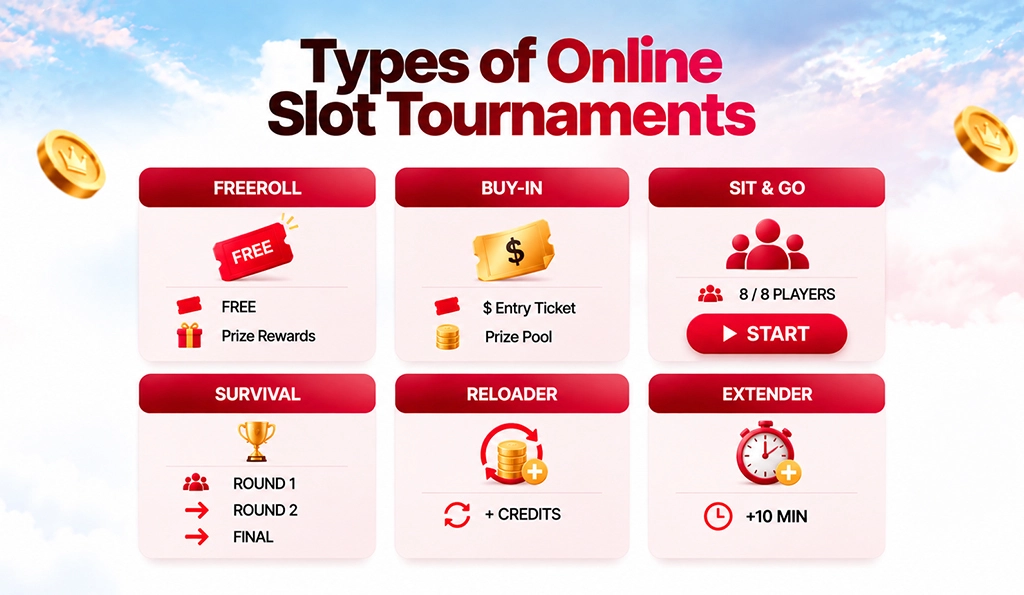
Types of Online Slot Tournaments
Not all slot tournaments run the same way. The format determines the entry requirements, start time, scoring rules, prize structure, and whether players can rebuy or extend play.
Freeroll Tournaments
No entry fee, no financial commitment. The casino puts up the rewards as part of a promotion, which can be anything from cash and bonus funds to free spins or loyalty points. Some freerolls are open to any eligible account holder. Others require you to sign up or comply with certain requirements before you join.
Freeroll is likely the best choice for new players who have not participated in a slot tournament before. You can experience how the credits work, how the leaderboard changes, how the time pressure impacts your decisions, and without risking any cash. However, be sure to read the promotion terms before you get involved. Requirements and guidelines differ, and what appears to be a simple prize can have a catch.
Buy-In Tournaments
These tournaments cost money to enter, and that’s the first thing worth being honest about. The entry fee might go toward the prize pool, sit in a guaranteed fund, or simply buy you a seat in an event with a fixed payout schedule. It depends on how the operator has structured things, and operators don’t all do it the same way.
Before you commit, actually read what you’re paying for. What’s the buy-in? Which games can you play? How does scoring work? How long does the tournament run? How many players finish in a paid position? These aren’t minor details. They’re the difference between an event that makes sense to enter and one that doesn’t.
Sit & Go Tournaments
Sit & Go tournaments don’t run on a fixed schedule. They begin when a certain number of players have registered. When the field fills, the event launches and play begins under the stated time, credit, and scoring rules. It’s great for those who’re not willing to attend a set event, but there might be a time frame where it’s not available, and the prize structures differ from one operator to another.
Multi-Day Leaderboard Races
Several events continue for a day, a week, or a month. It’s played at your own speed, and results are added to a leaderboard. You can earn points for winning, betting, or playing specific games. Review event terms for end date and eligible games.
Survival Tournaments
Survival tournaments run across multiple elimination rounds. Players who meet the required leaderboard position at the end of each round advance. Those who don’t are eliminated.
Reloader and Extender Add-Ons
Some tournaments let you pay for extra play once you’ve started. These are add-ons to a tournament, not formats of their own.
Reloader: Players may be able to pay additional credits or another round of play. The cost, number of rebuys permitted, and effect on your existing score are all set by the operator.
Extender: More time may be available for players to buy before the session ends. Check out the remaining time, cost, current position, and prize structure before paying. More time won’t help you get a better result, as slot results are random.
Note: Play within your budget. Use deposit and time limits and never spend more to catch up on the leaderboard.
Online vs. Land-Based Slot Tournaments
Slot tournaments run in both formats, but access, scheduling, and the playing environment are meaningfully different.
Online tournaments allow eligible players to participate remotely without traveling. Events can be held on a predetermined schedule or be a sit & go once enough players register. The frequency of updates to the leaderboard depends on the operator, and can be live, near real time, or at regular intervals.
Land based tournaments are conducted in the same room, on real machines, with a common countdown. That face-to-face environment and ambiance just doesn’t exist online. Larger venue events may include qualifying rounds which lead to a final.
Read more: Online vs. Land-Based Casinos
How to Find and Enter Online Slot Tournaments
The most direct place to look is the online casino’s bonuses and promotions, Tournaments, or Rewards section. There are many operators that post their events and upcoming events there, requirements to enter, what games can be played, information about the prizes, and rules for the leaderboard. Be sure to read all of the terms before signing up.
Before entering, confirm what actually matters:
- Whether your account and location are eligible.
- Whether opt-in is required before the event starts.
- Start and end time, including time zone.
- Which games count toward the leaderboard.
- How is the score calculated.
- Prize type and conditions, including wagering requirements and cashout limits.
- Whether rebuys or extensions are available and what they cost.
A leader board finish does not always mean the prize is immediately available. Check the terms of the prize before playing. Casino notifications can alert you of upcoming events but do not guarantee access or availability.
If you turn on alerts, make sure they’re only for events that are within your time and budget. If you don’t know about freeroll, it’s a good way to get started because it doesn’t have any entry fees. Utilize it to learn scoring, credit, and timing.
For mobile, ensure that the game loads properly and that you have a solid connection before a timed event begins. Any technical problems that occur during the session are a lost opportunity.
How to Tell If a Slot Tournament Is Fair and Trustworthy

A reliable tournament is built on more than gameplay
Not every tournament is structured to the same standard. Here’s what to look for before entering.
Reliable scoring and leaderboards
It is important that scores are recorded accurately during the event. Some tournaments update rankings in real time, others at intervals, others only after the event closes. The rules should tell you which applies and when final standings are confirmed.
There may be a delay in the visible leaderboard without the loss of a score, but you should be able to distinguish between provisional and final rankings.
Licensed operator and tested games
The casino should have a license in your jurisdiction, and the games are supposed to be tested according to requirements of your jurisdiction. RNG systems and game software are independently assessed by a number of assessment organizations, such as GLI, eCOGRA, and iTech Labs.
Look for information about the casino licence, the game provider, and any published RNG or fairness documentation. Certification covers the game’s random outcomes, but the tournament’s scoring and prize rules are governed separately by the event terms.
Transparent prize structure
Prior to entering, it is important to be able to see the prize pool or prize schedule, number of paid positions, prize type, and any conditions attached to winnings. All prizes must be paid either as cash or bonus funds; there must be no wagering requirements and no cashout limits that must be broken before cashing out.
Clear event rules
All entry requirements, eligible games, scoring method, start and end times, tie-break rules and rebuy or extension rules should be made public before the games begin. If material rules aren’t available before you enter, that’s a problem with the event setup.
Technical failure policy
Disconnections happen. A well-structured tournament publishes what happens when they do, whether a session can resume, whether a recorded score stands, or whether an incomplete round doesn’t count. Read this before a timed event, not during one.
Player protection tools
Responsible gambling features, like time limits, spending limits, and deposit limits, should be available. In case of any issues during the event, a clear dispute process and customer support should be provided.
Wrapping Up…
Whether you start with a freeroll or jump into a buy-in event, the fundamentals covered here apply across every format you’ll encounter.
After understanding the basics of how online slot tournaments operate, the next step is to refine your online casino slot game strategy; knowing how many credits to spend, what type of tournament to play and how quickly to spin can have an impact on where you stand on the leaderboard.

Contact Us
FAQ's
-
How do I join a slot tournament at an online casino?
Look for Promotions or Tournaments in the casino platform, verify the requirements, and sign up before it reaches capacity. Some require opt-in; others require a buy-in or qualifying deposit.
-
How does a slot tournament leaderboard work?
Your score earned from spins that were eligible is kept and compared to rivals. The rankings are updated on the fly, periodically, or when the event is closed, depending upon the operator's configuration.
-
Which is better for beginners: cash slots or tournament slots?
There is no right or wrong answer. Slots are also available at tournaments, and they have a specific number of credits along with a leaderboard. Cash slots are easier to play. You can do both by playing a freeroll tournament, which is a low-risk option.
-
How to choose the right slot game pool for a beginner-friendly tournament?
Look for tournaments with clearly listed eligible games, simple scoring rules, no mandatory buy-in, and a published prize structure. Freerolls with a single designated game are the most straightforward starting point.
-
What's the average prize pool in an online slot tournament?
It varies widely. Freerolls usually offer small prizes like bonus money or free spins, whereas buy-in events can provide large prizes. Refer to the published prize table for each event.
-
Can I get scammed by fake online slot tournaments?
Yes. Play at licensed operators, check the casino's license information, and thoroughly read the tournament conditions before playing. The highest risk for fraudulent prize structures is on unlicensed platforms.


Palak Madan has been writing about the iGaming industry since 2024. She focuses on helping operators and founders understand their options when launching an online casino, from choosing the right software provider to figuring out costs and compliance requirements across different markets. At PieGaming, she covers topics like white label casino solutions, platform selection, and market entry, turning complex industry information into practical guidance for people building iGaming businesses. She also keeps a close eye on licensing and regulatory changes; particularly how new rules shape the way operators enter and grow in different jurisdictions.

Self-exclusion tools in iGaming help operators improve responsible gambling practices. It lets operators protect players from harmful gambling behavior and strengthen regulatory compliance.
To obtain a gambling license in Romania, operators should register a local company and submit financial documents and fulfill ONJN requirements. Obtaining a Romanian iGaming license gives operators a significant opportunity to legally offer gambling services to other European countries as well.
Poker game development is one of the biggest revenue engines for online casino businesses in the modern era. It helps companies increase player engagement, retention, and revenue. The evolution of poker services through multiplayer poker and real-time tournaments, white label and turnkey poker solutions, make for faster penetration into and scalable operations within the marketplace.
Provably fair technology enables players around the world to personally confirm that online game outcomes are fair and transparent.



See you in your inbox soon!

Stay ahead of the game. Subscribe for exclusive content, updates, and insiders!