
A GCGRA Gaming License is required to operate commercial gaming in the UAE, including online casinos and sportsbooks. Foreign operators can apply, but must meet GCGRA’s suitability, financial, compliance, and operational requirements before they can launch.
The UAE is becoming a market operators cannot ignore. But entering it is not as simple as launching a casino or sportsbook and going live. Any operator offering online gaming, sports wagering, or land-based commercial gaming must first obtain a GCGRA Gaming License UAE.
The regulatory landscape also saw an important change in June 2026. Amendments to the Civil Code removed legacy gambling provisions, giving licensed operators greater legal clarity under the GCGRA-led framework. However, the reform did not legalise unregulated gambling. Operators still need a valid GCGRA license to offer commercial gaming legally in the UAE.
For businesses planning to enter this market, getting the licensing requirements right is the first step. This guide explains what operators need to know about eligibility, the GCGRA licensing process, costs, and ongoing compliance before applying.
What is the GCGRA Gaming License UAE?
The General Commercial Gaming Regulatory Authority (GCGRA) is the UAE’s federal regulator for commercial gaming. It was established in 2023 to regulate, license, and supervise commercial gaming activities across the country. The GCGRA is the UAE’s sole federal authority responsible for commercial gaming regulation.
A GCGRA Gaming License UAE gives an approved operator the legal right to conduct the specific commercial gaming activity covered by its license. The GCGRA regulates several types of gaming, including:
- Online Casino: Covers casino games offered through online platforms, such a slots, roulette, blackjack, baccarat, and other casino-style games.
- Sports Betting: Covers wagering on sports events, including bets placed before an event and during live events, where permitted under the relevant license.
- Internet Gaming: Covers other forms of gaming offered through digital platforms that fall within the GCGRA’s commercial gaming framework.
- Lottery: Covers licensed lottery activities, including the operation and management of lottery games and related products.
- Land-Based Gaming: Covers commercial gaming offered at physical venues, such as casinos and other approved gaming facilities.
Types of GCGRA Licenses
The GCGRA has five main license categories . These cover the businesses that run gaming operations, the companies that support them, and the people involved in key decision-making roles. Depending on the business structure, an applicant may need more than one license.
Entity Licenses
1. Gaming Operators
This license is for businesses that operate commercial gaming activities. It covers online gaming platforms, sports wagering, land-based gaming facilities, lotteries, and lottery retailers.
2. Gaming-Related Vendors
This category covers businesses that supply gaming equipment, technology, products, or other services to licensed gaming operators.
3. Key Persons – Corporates
This applies to companies or other entities that have significant decision-making roles within a gaming business. This can include controllers, affiliates, and management service providers.
Individual Licenses
4. Key Persons – Individuals
This license applies to individuals with important decision-making responsibilities within a gaming business. Directors, senior executives, and controllers may fall under this category.
5. Gaming Employees
This category covers individuals who work for or are otherwise connected to a licensed gaming business and whose role falls within the GCGRA’s licensing requirements.
For an online casino or sportsbook operator, the Gaming Operator license is the key category to understand. However, the business may also need additional licenses for certain vendors, corporate key persons, or employees, depending on its structure and activities.
If you need legal guidance on the UAE gaming licensing process, Intelium law’s UAE Gaming License lawyers can assist with licensing, company setup, documentation, and ongoing regulatory support.
GCGRA License Types: Who Needs Them and What They Cover
| License Category | Who Should Apply | Business Activities / Role | Typical Time to Get License | Typical Licensees |
| Gaming Operator | Businesses that want to run commercial gaming activities | Online casino, sports wagering, lottery, lottery retail, or land-based gaming | Varies by application | Online casino operators, sportsbooks, lottery operators, casino operators |
| Gaming-Related Vendor | Companies supplying gaming-related products or services | Gaming equipment, technology, and other gaming-related goods or services | Varies by application | Software providers, gaming technology suppliers, equipment providers |
| Key Person – Corporate | Companies with a key role in a gaming operator or vendor | Ownership, control, affiliate, or management services functions | Varies by application | Controllers, affiliates, management service providers |
| Key Person – Individual | Individuals in senior decision-making roles | Executive and governance responsibilities within an operator or vendor | Varies by application | Directors, executive officers, other designated key persons |
| Gaming Employee | Employees whose roles fall under GCGRA licensing requirements | Supervisory or other roles directly or indirectly involved in commercial gaming | Varies by application | Supervisors and other licensed gaming employees |
GCGRA Licensing Process (Step-by-Step)
GCGRA licensing process
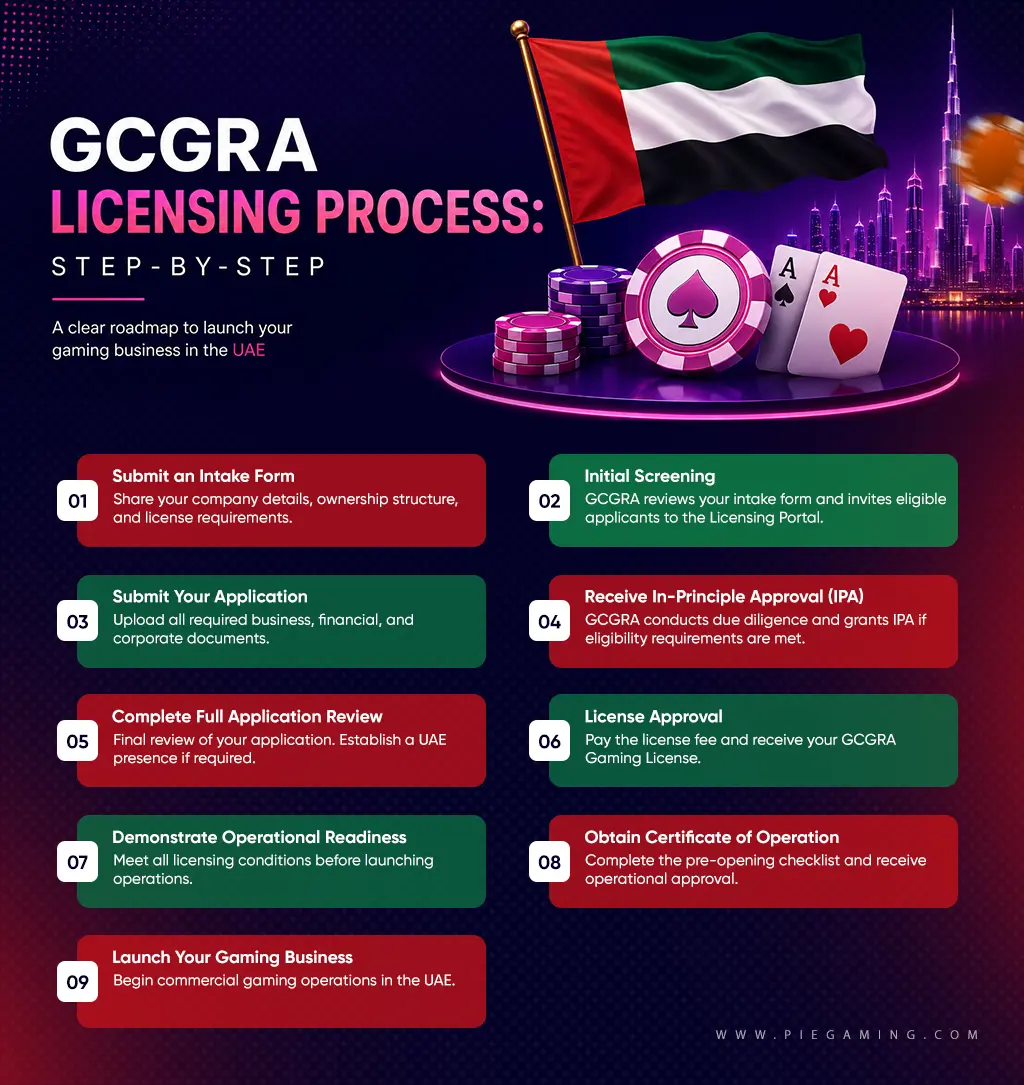
Getting a GCGRA gaming license is a structured process. It starts with a basic intake form and ends with a Certificate of Operation. For operators, the key is to prepare early. The GCGRA reviews the applicant, its owners, finances, business model, and ability to meet regulatory requirements.
Here is what the process looks like:
Step 1: Submit an Intake Form
The first step is to notify the GCGRA of your intention to apply. You then complete an intake form with basic details about your business.
This includes your company name, organisation structure, key people, type of license required, and the emirate where you plan to operate. The GCGRA uses this information for its initial screening.
Step 2: Initial Screening and Invitation to Apply
The GCGRA reviews the information submitted through the intake form. If you are considered eligible to apply, the regulator provides secure access to its Licensing Portal.
The portal is where you submit the full application and supporting documents. The application fee must also be paid as part of this stage.
Step 3: Submit the Full License Application
Once you receive portal access, you can submit the complete application.
Operators should be ready with key documents covering:
- Business and corporate information
- Ownership and organisation structure
- Financial information
- Directors and key persons
- Legal and regulatory history
- Third-party advisers
- Responsible gaming plans
The exact documents can vary based on the license required.
Step 4: Eligibility Review and In-Principle Approval
The GCGRA then carries out a detailed suitability assessment. It reviews the applicant’s ownership, financial position, regulatory history, key people, and overall ability to operate a compliant gaming business.
If the applicant meets the requirements, the GCGRA grants In-Principle Approval (IPA) after the applicable fee is paid.
This approval allows the applicant to move ahead with important setup activities. These may include incorporating the required UAE entity, opening bank accounts, and obtaining relevant permits or visas.
Step 5: Complete the Full Application Review
After the required business setup is completed, the GCGRA conducts its full review of the application.
The regulator may also require the applicant to establish a presence in the UAE, depending on the business and license category. Operators should therefore have their corporate and operational structure ready before moving toward launch.
Step 6: Receive the License Decision
Once the review is complete, the GCGRA confirms whether the applicant is suitable for a license.
If approved, the applicant pays the applicable license fee. The GCGRA then issues the license, which may include specific conditions. The license term starts once the license is granted.
Step 7: Demonstrate Operational Readiness
Getting the license does not mean you can launch immediately. The operator must first show that it is ready to conduct commercial gaming.
This means meeting all applicable licensing conditions and demonstrating that the required operational, technical, security, compliance, and responsible gaming controls are in place.
Step 8: Complete the Pre-Opening Checklist
Where applicable, the GCGRA provides a pre-opening checklist. The operator must complete the required items before commercial operations can start.
Once the requirements are met, the GCGRA grants a Certificate of Operation.
Step 9: Start Commercial Operations
With the Certificate of Operation in place, the operator can commence its approved commercial gaming activities.
However, licensing does not end at launch. Operators must continue to meet GCGRA requirements, including responsible gaming, financial crime prevention, reporting, and other ongoing regulatory obligations. The GCGRA uses a risk-based approach to supervise licensees after they are licensed.
How Long Does the GCGRA Licensing Process Take?
The GCGRA does not set one standard timeline that applies to every applicant. The process can vary based on the license category, complexity of the business, completeness of the application, and the level of due diligence required.
For operators, the best way to avoid unnecessary delays is to prepare the required corporate, financial, ownership, compliance, and operational information before starting the application.
Eligibility Requirements for a GCGRA Gaming License
Getting a GCGRA license is not only about having the funds to launch a gaming business. The regulator also looks at who is behind the business, how it will operate, and whether it can meet UAE gaming regulations.
Before applying, operators should be prepared to demonstrate:
- A registered business: The applicant must have a suitable legal structure and, where required, establish a UAE entity.
- Transparent ownership: The GCGRA needs clear information about shareholders, directors, and Ultimate Beneficial Owners (UBOs).
- Strong financial capacity: Operators must show that they have enough financial resources to support the proposed business.
- Compliance readiness: Applicants should have AML, KYC, and responsible gaming policies in place.
- Technical capability: The operator must be able to run a secure and reliable gaming platform that meets regulatory standards.
- Clean regulatory record: The GCGRA considers the applicant’s licensing and compliance history in other jurisdictions.
Can Foreign Companies Apply?
Yes. Foreign companies can apply for a GCGRA gaming license. However, they must establish a legal entity in the UAE before receiving the license.
The GCGRA may also review the company’s history in other markets. This can include previous gaming licenses, regulatory actions, sanctions, and overall compliance records. International operators should therefore be ready to provide clear information about their existing businesses and licenses.
Fit-and-Proper Assessment
The GCGRA also assesses the people responsible for running and controlling the business. This can include directors, major shareholders, UBOs, and key management personnel.
The assessment looks at:
- Criminal and legal background: Past convictions, legal proceedings, and other relevant issues.
- Financial integrity: Bankruptcy, insolvency, and other financial concerns.
- Industry experience: Relevant gaming, business, or professional experience.
- Professional reputation: The person’s conduct, reputation, and business associations.
For operators, this means the application is assessed at both the company and individual level. Having a strong business plan is important, but so is demonstrating that the people behind the business are suitable to operate in the UAE’s regulated gaming market.
GCGRA Gaming License Costs
The GCGRA does not publicly list one fixed cost for every gaming license. Fees depend on the license category and the type and scope of the gaming business. Operators should also remember that the license fee is only one part of the overall cost of entering the UAE market.
Here are the main GCGRA fees operators should plan for:
- Application Fee: This must be paid before the applicant gets access to the GCGRA Licensing Portal. The amount follows the GCGRA’s approved fee schedule and is non-refundable.
- In-Principle Approval (IPA) Fee: Applicants who pass the initial assessment must pay an IPA fee before receiving In-Principle Approval. This is equal to 10% of the total license fee.
- License Fee: The remaining license fee is payable before the GCGRA issues the final license.
- Yearly License Maintenance Fee: Licensees must pay an annual maintenance fee. The amount depends on the type of license held.
- License Renewal: GCGRA licenses can be renewed when they expire. However, serious non-compliance can affect an operator’s ability to renew its license.
Operators should also budget for costs beyond the regulator’s fees. These can include UAE company setup, legal support, platform certification, compliance systems, audits, payment infrastructure, and other operational expenses.
Note: All fees paid to the GCGRA are non-refundable. Failure to meet compliance requirements may impact license renewal.
GCGRA Compliance Requirements
Getting a GCGRA gaming license is only the first step. Operators must continue to meet the regulator’s requirements after they go live. Strong AML/CFT controls, responsible gaming measures, and regular reporting are essential to keep the license in good standing.
AML & CFT Compliance
Gaming operators must have systems in place to prevent money laundering and terrorist financing. Key requirements include:
- Customer Due Diligence (CDD): Verify customer identity and collect the required information before or during the business relationship.
- Enhanced Due Diligence (EDD): Apply additional checks to high-risk customers, politically exposed persons (PEPs), and higher-risk transactions.
- Transaction Monitoring: Monitor customer activity to identify unusual transactions and potential financial crime.
- Suspicious Transaction Reporting (STR): Report suspected money laundering or terrorist financing to the UAE Financial Intelligence Unit (FIU).
Internal Compliance Requirements
Operators also need a clear internal framework to manage their AML/CFT responsibilities. This includes:
- Appointing a Money Laundering Reporting Officer (MLRO).
- Maintaining written AML/CFT policies and procedures.
- Providing regular compliance training to employees.
- Conducting independent audits of the AML programme.
- Keeping customer, transaction, and due diligence records for at least five years.
Ongoing Regulatory Obligations
Compliance does not stop once the license is granted. Operators must:
- Follow GCGRA regulations on an ongoing basis.
- Submit required reports and cooperate with regulatory inspections.
- Keep customer and transaction records accurate and up to date.
- Inform the GCGRA about significant changes to ownership, management, or other relevant business circumstances.
Penalties for Non-Compliance
Failure to meet these requirements can have serious consequences. Depending on the nature and severity of the breach, operators may face:
- Financial penalties
- License suspension or revocation
- Criminal action for serious AML/CFT violations
For operators, compliance should therefore be built into the business from the start, rather than treated as a requirement to address after obtaining the license.
What Changed After the June 2026 Civil Code Update?
The UAE’s gaming laws saw an important change on 1 June 2026. The new Civil Transactions Law, introduced under Federal Decree-Law No. 25 of 2025, replaced the previous Civil Code. It removed the former provisions that specifically dealt with gambling and betting. Under the old law, Articles 1012 to 1021 covered areas such as the validity of gambling and betting agreements, recovery of losses, and related claims. These provisions were not carried into the new law.
For gaming operators, this change brings more clarity to the legal framework. Commercial gaming is now governed through the dedicated regulatory structure led by the GCGRA, rather than relying on gambling provisions in the general Civil Code. The GCGRA is responsible for licensing and regulating internet gaming, sports wagering, lottery, and land-based gaming in the UAE.
However, the reform did not legalise unlicensed gambling. Operators still need a valid GCGRA license to conduct commercial gaming in the UAE. The GCGRA states that conducting or facilitating commercial gaming without a license is illegal and can lead to severe penalties.
UAE Gaming Regulation: Before vs. After June 2026
| Before June 2026 | After June 2026 |
| Gambling and betting were specifically addressed in the old Civil Code. | The new Civil Transactions Law no longer carries those gambling provisions. |
| General civil law contained rules on gambling and betting agreements. | Commercial gaming is regulated through the dedicated GCGRA framework. |
| Operators faced a less specialised legal framework. | Licensed operators have a clearer sector-specific regulatory path. |
| Commercial gaming still required regulatory approval. | A valid GCGRA license remains mandatory for legal commercial gaming. |
For operators, the key takeaway is simple: the June 2026 reform provides greater legal clarity, but it does not replace the GCGRA Gaming License UAE requirement. Businesses must still obtain the appropriate license and meet the regulator’s requirements before launching.

Contact Us
FAQs
-
What is GCGRA?
The General Commercial Gaming Regulatory Authority (GCGRA) is the UAE’s federal authority responsible for regulating, licensing, and supervising commercial gaming.
-
Who needs a GCGRA gaming license?
Any business conducting commercial gaming in the UAE needs the appropriate GCGRA license. This includes online gaming operators, sportsbooks, lottery operators, land-based gaming businesses, and certain gaming-related vendors.
-
How much does a UAE gaming license cost?
There is no single cost for all GCGRA licenses. Fees vary by license category and business scope. Operators should also budget for application, licensing, maintenance, and business setup costs.
-
How long does approval take?
The GCGRA does not publish one fixed approval timeline for every applicant. The time can vary based on the license type, application complexity, due diligence, and completeness of the submitted information.
-
Can foreign companies apply?
Yes. Foreign companies can apply, but they must meet the GCGRA’s eligibility requirements and establish the required UAE presence before licensing.
-
Does GCGRA regulate online casinos?
Yes. Online casinos fall under Interactive Gaming, which the GCGRA regulates. This includes online slots, roulette, blackjack, baccarat, poker, and other eligible games.
-
Does GCGRA regulate sportsbooks?
Yes. Sports betting falls under Sports Wagering, which covers betting on sports events and athlete or team performance through licensed sportsbooks or bookmakers.
-
Can software vendors obtain a GCGRA license?
Yes. Gaming-related vendors can apply for a GCGRA license if they provide gaming equipment, technology, products, or related services to the commercial gaming industry.
-
Is crypto gambling allowed in the UAE?
Operators should not assume that crypto gambling is permitted simply because they hold a GCGRA license. Any use of virtual assets must comply with applicable UAE laws and GCGRA requirements. Operators should obtain specific regulatory advice before offering crypto payments or crypto-based gaming.
-
What documents are required for a GCGRA application?
Applicants may need corporate documents, ownership and organisational details, financial information, key-person details, legal and regulatory history, third-party details, and a responsible gaming plan. Additional documents may be required depending on the license type.


Jaya Swaroop has been covering iGaming and betting technology since 2019, with a specialization in online casino platforms, sportsbook solutions, and licensing frameworks. Her work involves analyzing platform capabilities and evaluating cost structures, compliance requirements, payment integrations, market strategies, and regulatory updates that impact operators entering or scaling in the iGaming space. With a background in B2B marketing and content strategy, she has contributed to SEO-led growth and demand generation initiatives for global businesses. Jaya holds a Bachelor’s degree in Science (Chemistry & Mathematics) and is certified in content writing, email marketing (HubSpot), project management, and Google Analytics.

Online casino gaming is not allowed in Australia under Interactive Gambling Act 2001. But operators can still apply for an internet gaming license via specific jurisdictions like the Northern Territory, which allows them to offer gambling services legally- generally outside Australia.
Bulgaria’s iGaming license enables operators to legally provide services in the areas of online casino, betting, poker, and bingo in accordance with the regulations of the EU. Typically, a licensing process can take 60 to 90 days, and it will need to be approved by the NRA, technical certification, AML compliance, and data storage in the local area. Minimum capital requirements range from BGN 50,000 for betting operators to BGN 1.5 million for online casino operators.
To obtain the Anjouan Gaming License, applicants must collect and submit all the important documents. Learn the process of obtaining Anjouan iGaming license.
Algeria has no online casino or sports betting regulation to speak of — instead, the country enforces a near-total gambling ban rooted in civil law and Islamic principles. Yet despite the prohibition, offshore platforms continue to pull in millions of users every month, driven by high demand and a near-total absence of legal local alternatives.
A Kahnawake iGaming license is a credible and cost-effective licensing solution for online casinos and sportsbook operators. The process to obtain this license includes multiple steps, key benefits, and licensing costs.
Malta pays attention to the credibility of the regulatory framework and to access regulated markets, which is more conducive to long-term growth and industry reputation. However, Curaçao places a strong emphasis on speed and affordability, making it a good choice for startups and businesses focused on cryptocurrencies that are keen to establish a presence rapidly and at a lower cost. If you are constructing a major operation, select Malta. Pick Curaçao when you are just getting started and have to get your product to market quickly.
The best jurisdiction depends on your target market. Malta suits operators who want a credible European base with strong banking. The UKGC is required for Great Britain. The Isle of Man suits B2B and platform-led operators. Curaçao is the usual low-cost route for global launches. Anjouan is typically quoted as the cheapest and fastest, but with limited banking and lower recognition.


See you in your inbox soon!

Stay ahead of the game. Subscribe for exclusive content, updates, and insiders!