
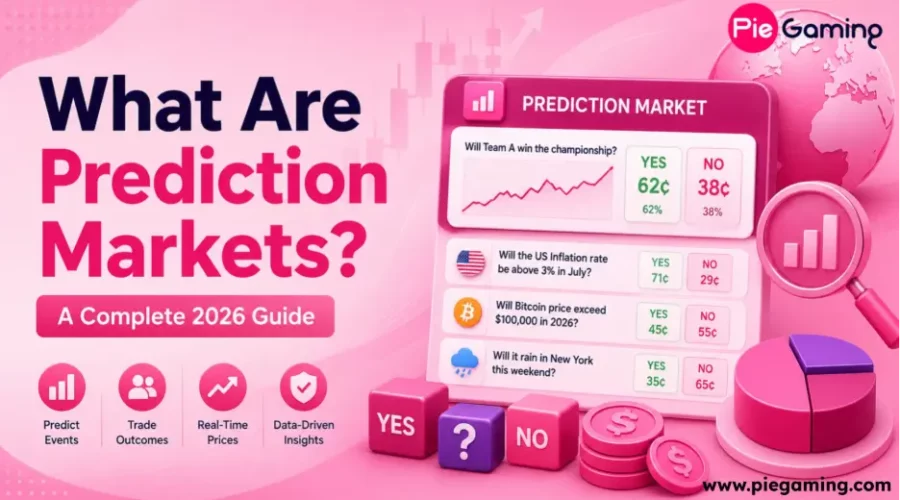
What are prediction markets, and why is everyone in iGaming suddenly talking about them? The answer may be just one number: $44.8 billion. That’s the combined trading volume of Kalshi and Polymarket in June 2026 alone, a 75% increase from the previous month when the FIFA World Cup catalyzed unprecedented activity.
What was once a niche notion is now drawing traders, bettors, operators, and regulators alike. To understand the hype, the key is figuring out how prediction markets function. Prediction markets allow users to trade contracts based on the likelihood of future events. Every contract’s price reflects what the market believes is likely to happen, and those prices can rise or fall with new information.
This guide is designed to give a very simple and clear analysis of prediction markets: the basics of prediction markets, how they work, how they compare to sports betting, how these platforms generate revenue, and why they could reshape the future of iGaming.
What Is a Prediction Market?
A prediction market is a marketplace where people put money into their predictions of what will happen in the future. Most events are presented as straightforward yes-or-no questions. Participants can also purchase a position that pays out if they are correct in that position. The price of that position depends on how much money people are willing to shell out for one outcome or the other. So it can be an uncomplicated means of demonstrating what the crowd thinks is likely to happen.
This concept is older than most people know. Traders bet on papal elections in 16th-century Europe. Wall Street betting pools on US presidential races were commonplace enough by the early 1900s that the New York Times printed their odds.
Prediction markets re-emerged in the 21st century, courtesy of the internet and academic interest in crowd forecasting. Now they are popular because of their capacity to pool information and to rival conventional polls. As of 2026, both are US-based, and they run under two names in the discussion.
- Polymarket, established in 2020, and is built on blockchain technology.
- Kalshi, which has been up and running since 2021.
There are other peer-to-peer platforms apart from these two. For example, PredictIt and Manifold are both based on smaller platforms. Even if they’re much smaller in scope, they mostly focus on a particular topic that also allows them to build their audiences slowly.
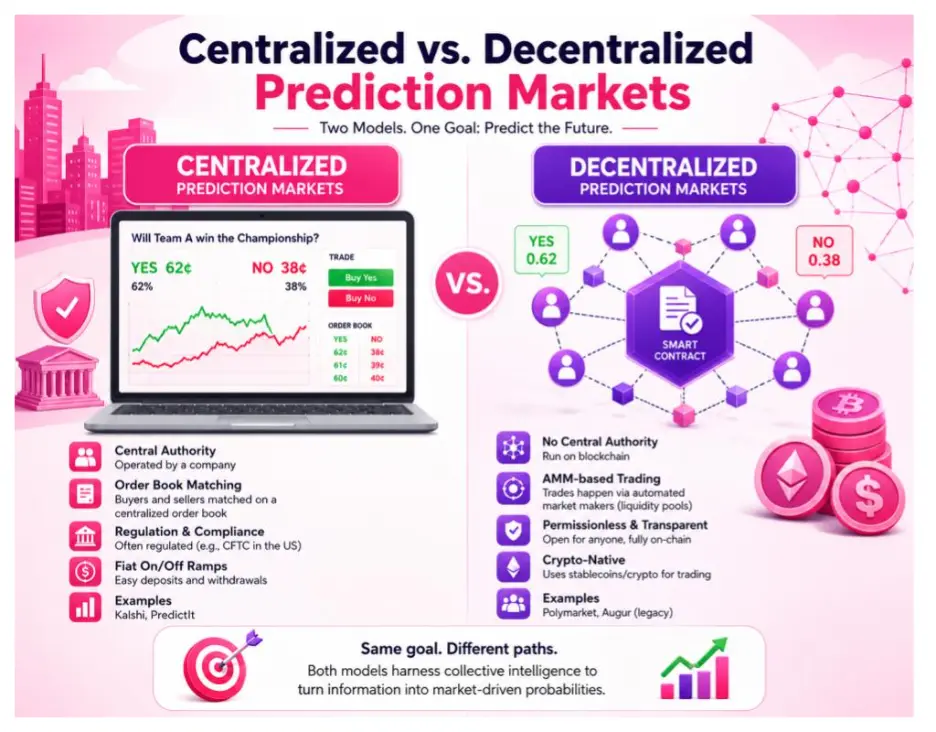
Prediction markets generally fall into two categories – centralized and decentralized. Centralized platforms, such as Kalshi, are operated by a company that manages user accounts, holds funds, and settles outcomes. Decentralized marketplaces use smart contracts to trade and disperse information without a central intermediary.
How Do Prediction Markets Work?
Every prediction market consists of a simple question that has two possible answers at its core. This is called a Yes/No contract or an event contract. It might say something like this:
- Will England win the FIFA World Cup 2026?
- Will the U.S. Federal Reserve cut interest rates this month?
- Will Bitcoin cross $150,000 before the end of the year?
Instead of placing a traditional bet, users purchase contracts based on which outcome they believe will occur. Each contract is priced between $0.00 and $1.00. The price is a market’s current estimate of the event’s likelihood. For instance, we say that a Yes contract is priced at $0.62. So, in the eyes of the market, there is a 62% probability of whether the event happens. Similarly, the no contract would fetch around $0.38, translating to a 38% probability.
How Prices Change in Prediction Markets
Prices move on the basis of supply and demand. When more people buy Yes contracts, it will increase the price, indicating increasing faith that the event will take place. If traders instead begin purchasing No contracts, the Yes price declines. In reality, prices should be liquid when changes take place. Traders respond on the spot as new news, injuries, economic statistics, or public announcements happen. The price of the stock is adjusted in real-time to incorporate this information.
Centralized vs. Decentralized Prediction Markets
Centralized vs. Decentralized Prediction Markets
The model of prediction markets generally has one of two versions:
Centralized platforms like Kalshi use an order book, where the parties buy and sell the products directly. The platform handles pricing, settlements, and regulatory compliance.
Decentralized platforms like Polymarket operate on blockchain technology. Many markets use such technology through an automated market maker (AMM) in place of an order book, for liquidity and the ability to allow trading free from central intermediation.
Despite such differences, both models are ultimately for the same reason: Both systems allow participants to trade based on the probability of future events but update prices dynamically (always) based on the consensus view of the market. Studies have shown that if we run prediction markets right, they can produce remarkably accurate results. Brier scores of around 0.09 were reported by one paper. This suggests that market prices can provide a reliable indicator for probability estimates around future events if a lot of individuals contribute their views.
Who Creates the Markets & How Do Platforms Make Money?
Every prediction market begins with a clear question. On most platforms, the platform team creates these questions or approves them after a review process. Before a market is live, the platform specifies the precise event, settlement date, and resolution criteria. This eliminates any doubt on the ultimate result.
Some decentralized platforms are also open to the possibility of new markets being suggested, but they must be vetted before publication to ensure fairness and accuracy.
Unlike sportsbooks, prediction market platforms rarely monetize when users lose. They do, however, receive revenues when they enable trades between participants. The predominant source of income is the transaction fee imposed on users when they enter or exit contracts. Others may also charge fees on winning payouts or for creating specialized markets.
Take, for instance, Kalshi, which is based on a high-frequency trading model, making money from lots of transactions. In contrast, Polymarket generally has fewer but larger-value contracts because it is driven by blockchain-based markets with relatively fewer trades on the blockchain.
That is something completely different from traditional sportsbooks, which make their money through the vig or house margin baked into betting odds. Rather than taking the opposite side of a user position, prediction market platforms succeed by increasing trading activity.
Prediction Markets vs. Sports Betting: What’s the Difference?
Prediction markets and sports betting may appear similar on the surface. In each case, users make decisions about what they think is likely to happen. But their functioning is very different. The main difference is that sports betting is based on the odds a bookmaker puts on a team, whereas prediction markets allow players to swap contracts with one another. Prices change according to market activity, not the odds in a sportsbook.
Flexibility is another important distinction. In the case of prediction markets, you don’t have to wait until an event is complete. Once the value of your contract goes up, you can sell it to another participant and lock in the profits early. Traditional sportsbooks offer cash out on some bets, but the amount is determined by an operator rather than the open market. However, the two formats are pulling together many of the same users.
Prediction Markets vs. Sports Betting: Feature Comparison
| Feature | Prediction Markets | Sports Betting |
| How Prices Are Set | Contract prices are determined by market demand and represent the collective probability of an event. | Odds are set by the sportsbook and adjusted to balance betting activity and manage risk. |
| Trading & Exit | Users can buy or sell contracts before the event ends, allowing them to lock in profits or limit losses early. | Bets are generally fixed after placement. Some sportsbooks offer cash-out, but the payout is determined by the operator. |
| Events Covered | Covers a wide range of events, including sports, elections, financial markets, cryptocurrencies, weather, entertainment, and more. | Primarily focuses on sports, esports, and a limited number of novelty or special-event markets. |
| Revenue Model | Platforms earn through transaction, trading, or settlement fees rather than taking the opposite side of a trade. | Sportsbooks generate revenue from the built-in house margin (vig) included in betting odds. |
| Risk Model | Participants trade against each other, while the platform acts as a facilitator. | The sportsbook accepts bets, manages risk, and pays out winning wagers. |
Popular Prediction Market Platforms
A handful of platforms dominate the space, each with a distinct model and focus.
Kalshi is a US-based, CFTC-regulated exchange that operates as a centralized order book. Its output has grown as it became a sports-heavy platform, with a big share of its volume from high-frequency, event-driven contracts around games and tournaments.
Polymarket is the world’s biggest prediction market by trading volume and uses blockchain infrastructure rather than a traditional order book. It leans heavily on political, economic, and cultural events, though sports output has swelled alongside major tournaments. In 2025, Polymarket processed $21.5 billion in trading volume versus Kalshi’s $17.1 billion, making them clearly category leaders, though the gap has been closing fast as Kalshi’s sports-led volume picks up.
Other smaller platforms, such as PredictIt and Manifold, cater to more niche or community-driven use cases with lower stakes or non-monetary formats.
Prediction Market Regulations
Are Prediction Markets Legal?
The short answer is “it depends”.
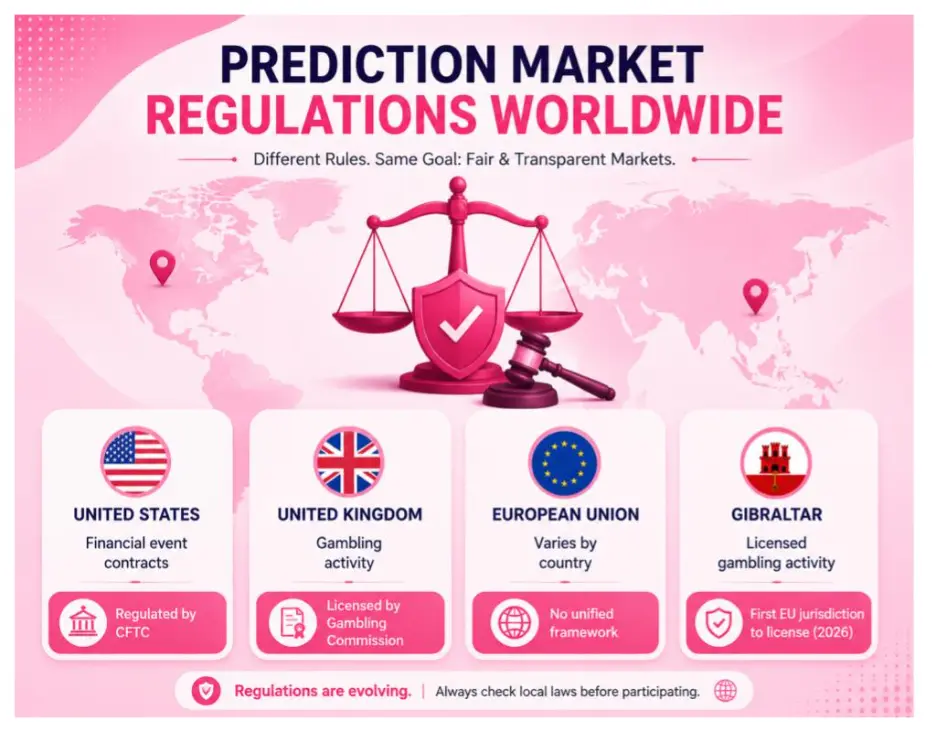
No law governs prediction markets globally. Rather, each country will determine how these platforms are classified and regulated. They may be treated as financial products in some jurisdictions. In others, they may fall under gambling laws or face restrictions altogether. As the rise of prediction markets expands, regulators worldwide are trying to pin down where they fall into present legal frameworks. Here’s a snapshot of the current prediction markets regulation landscape.
Prediction Market Regulations Around the World
| Region | Classification | Current Status |
| United States | Financial event contracts | Kalshi operates under the oversight of the Commodity Futures Trading Commission (CFTC). However, prediction markets remain the subject of ongoing legal and political debate, with proposed legislation such as the Prediction Markets Are Gambling Act seeking stricter rules for certain event contracts. |
| United Kingdom | Gambling activity | Operators offering prediction markets to UK consumers generally require a licence from the UK Gambling Commission and must comply with the country’s gambling regulations. |
| European Union | Varies by country | There is no single EU-wide framework for prediction markets. Regulations differ across member states, with some allowing them under gambling or financial laws, while others impose restrictions or outright bans. |
| Gibraltar | Licensed gambling activity | In 2026, Gibraltar became the first European jurisdiction to introduce a dedicated licensing framework for prediction market operators, setting a precedent for regulated growth in the sector. |
Disclaimer: A platform that’s perfectly compliant in one jurisdiction may not be permitted to offer the same markets in another.
As the industry develops, more countries are likely to introduce clearer regulations. Until this happens, operators and users should learn local laws before participating in or offering prediction market services.
Why Prediction Markets Matter for iGaming Operators?
Prediction markets are not just an emerging trend; they are now part of the broader prediction markets iGaming ecosystem. Users exchange their guesses at the outcome of future events, prices change based on demand, and markets are active until the final result. The largest opportunity is the volume of events to offer.
Unlike ordinary sportsbooks, prediction markets are not confined solely to sporting events. Operators can build markets around elections, entertainment, financial indicators, cryptocurrencies, weather, technology, and other real-world events. This turns prediction markets into an always-on engagement channel that keeps users coming back even when major sports aren’t in season.
The industry is already moving in this direction. Prediction market companies received $1.85 billion of crypto venture funds in the first half of 2026. More than 26% of all crypto VC investment in the same time frame.
Major consumer brands alike are dipping a toe into the ground, with companies like FanDuel and DraftKings said to be looking at prediction market opportunities alongside what they currently offer in the sportsbook category. The transition for operators is more than simply creating a new feature. It is about creating a system that can respond to shifting player tastes and market trends.
Technology innovators with expertise in sportsbook infrastructure, risk management, wallet systems, and engagement with players can be well-positioned to support the development of predictive systems intended to help operators adapt to emerging prediction market platforms. PieGaming, which is known for developing scalable iGaming technologies, is fully aware of these ongoing platform changes and the technology requirements to enable the future of betting with scalability.
Conclusion
Prediction markets combine the three elements of trading, forecasting, and wagering into one experience. By letting users buy and sell contracts on futures, they offer a more dynamic form of investment than traditional betting. There is also a broad expansion of these markets into other areas of activity, such as politics, finance, entertainment, and many others beyond just gambling.
With regulations becoming clearer and implementation steadily on the rise, prediction markets are predicted to have a much greater role in the future of iGaming. Getting a sense of how these platforms work today is step one for the operators in discovering new opportunities tomorrow.

Contact Us
FAQs
-
What are prediction markets?
Prediction markets are platforms where people buy and sell contracts tied to the outcome of a real-world event, like an election, a sports result, or a Fed rate decision. Contract prices move between $0.00 and $1.00 and reflect the crowd's collective estimate of how likely that outcome is. When the event resolves, correct contracts pay out $1.00 and incorrect ones pay out $0.00.
-
How do prediction markets work?
Traders buy "Yes" or "No" shares on a specific outcome, and the price of each share reflects the market's implied probability. A “Yes” share trading at $0.62 implies a 62% chance of that outcome. As new information emerges, prices shift in real time based on buying and selling activity, and traders can sell their position before the event resolves rather than waiting it out.
-
Are prediction markets legal?
It depends on the platform and jurisdiction. In the US, Kalshi operates under CFTC oversight as a regulated derivatives exchange, though the category faces legal challenges in several states and a proposed federal bill; the UK treats them as gambling products requiring a Gambling Commission licence; and EU countries are split, with some restricting or banning them outright, while Gibraltar recently became the first EU jurisdiction to license an operator.
-
What's the difference between prediction markets and sports betting?
In sports betting, the operator sets the odds and carries the risk. In a prediction market, prices are set by supply and demand between traders, and the operator (in a true peer-to-peer model) is largely a neutral matchmaker. Prediction markets also cover far more than sports; politics, economics, crypto, and culture. And let traders exit a position early at the market price rather than a fixed cash-out rate.
-
How do prediction market platforms make money?
Most platforms charge a transaction fee on trades, and some charge a fee on winnings or on creating new markets. This differs from a sportsbook's margin model, where the operator builds a profit margin into the odds themselves.
-
Who decides what events prediction markets cover?
Platform teams typically design the question and resolution criteria for each market, and many also let users propose new markets, which are then vetted for manipulation risk, ambiguity, and reliable data sources before going live.


Jaya Swaroop has been covering iGaming and betting technology since 2019, with a specialization in online casino platforms, sportsbook solutions, and licensing frameworks. Her work involves analyzing platform capabilities and evaluating cost structures, compliance requirements, payment integrations, market strategies, and regulatory updates that impact operators entering or scaling in the iGaming space. With a background in B2B marketing and content strategy, she has contributed to SEO-led growth and demand generation initiatives for global businesses. Jaya holds a Bachelor’s degree in Science (Chemistry & Mathematics) and is certified in content writing, email marketing (HubSpot), project management, and Google Analytics.

Policies, tools, and practices that address gambling harm by keeping betting safe, controlled, and strictly for entertainment are called responsible gambling. Stakeholders such as regulators, operators, and players collectively set the financial boundaries, provide self-exclusion options, and verify the right age for gambling.

This blog walks you through the top eSports games, most played and watched by the audience. Stay tuned to find out about the best eSports betting games available worldwide.
This blog covers everything from success keys to case studies of successful Asian iGaming operators to help start your dream business.
Choosing between a land-based vs. online casino business model is the primary decision that any operator must make. Both options possess unique characteristics in terms of costs, profit, market reach, and other factors.
This blog is a comprehensive guide on key success strategies for European iGaming Operators. Read on to build your iGaming empire in the European market.
Explore top iGaming events 2025 in this blog. Learn why you need to be part of gambling conferences and what you can learn from them.
Find out why SiGMA Asia 2025 is a must-visit event for iGaming operators, startups, and investors. See what’s happening, who’s coming, and how it can help grow your iGaming business in Manila.



See you in your inbox soon!

Stay ahead of the game. Subscribe for exclusive content, updates, and insiders!